
Chemical Reactions What Are Chemical Reactions occur when
- Slides: 24
Chemical Reactions
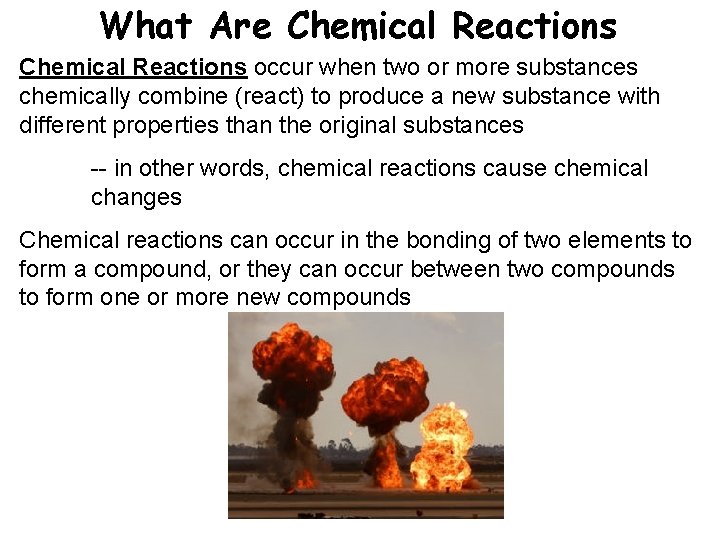
What Are Chemical Reactions occur when two or more substances chemically combine (react) to produce a new substance with different properties than the original substances -- in other words, chemical reactions cause chemical changes Chemical reactions can occur in the bonding of two elements to form a compound, or they can occur between two compounds to form one or more new compounds
Evidence for Chemical Reactions There are many pieces of evidence that you can look for in order to see if a chemical reaction has occurred when two substances are mixed: -- formation of gas bubbles -- color change -- formation of a precipitate -- production of new materials with different properties -- changes in energy/temperature
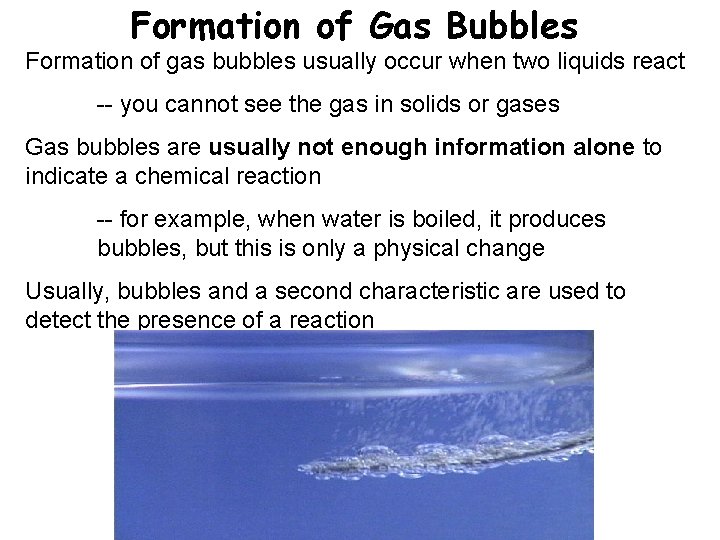
Formation of Gas Bubbles Formation of gas bubbles usually occur when two liquids react -- you cannot see the gas in solids or gases Gas bubbles are usually not enough information alone to indicate a chemical reaction -- for example, when water is boiled, it produces bubbles, but this is only a physical change Usually, bubbles and a second characteristic are used to detect the presence of a reaction
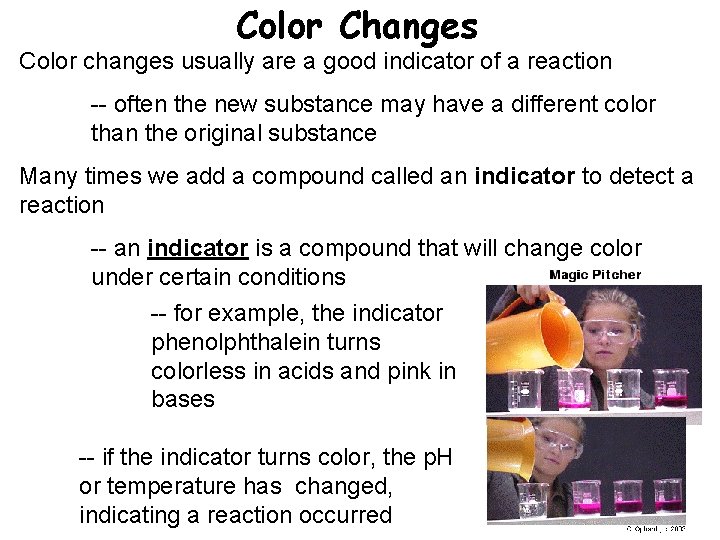
Color Changes Color changes usually are a good indicator of a reaction -- often the new substance may have a different color than the original substance Many times we add a compound called an indicator to detect a reaction -- an indicator is a compound that will change color under certain conditions -- for example, the indicator phenolphthalein turns colorless in acids and pink in bases -- if the indicator turns color, the p. H or temperature has changed, indicating a reaction occurred
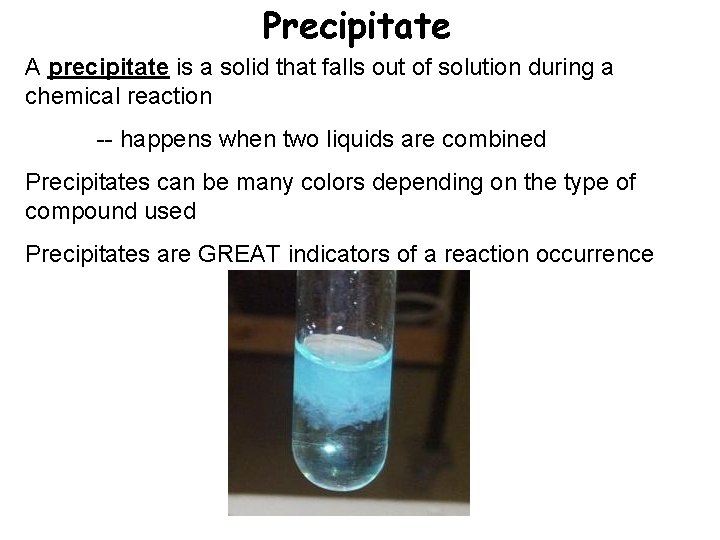
Precipitate A precipitate is a solid that falls out of solution during a chemical reaction -- happens when two liquids are combined Precipitates can be many colors depending on the type of compound used Precipitates are GREAT indicators of a reaction occurrence
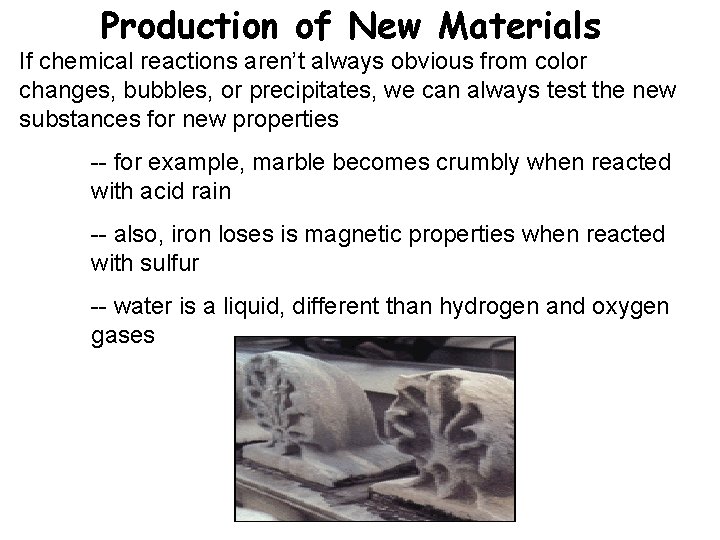
Production of New Materials If chemical reactions aren’t always obvious from color changes, bubbles, or precipitates, we can always test the new substances for new properties -- for example, marble becomes crumbly when reacted with acid rain -- also, iron loses is magnetic properties when reacted with sulfur -- water is a liquid, different than hydrogen and oxygen gases
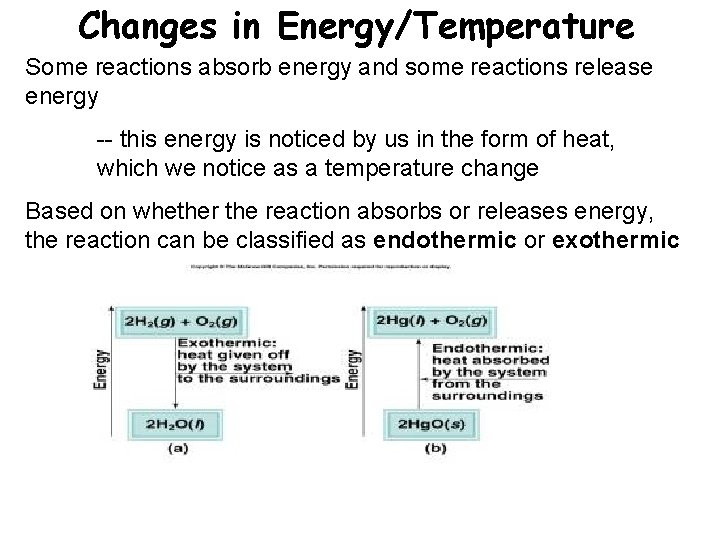
Changes in Energy/Temperature Some reactions absorb energy and some reactions release energy -- this energy is noticed by us in the form of heat, which we notice as a temperature change Based on whether the reaction absorbs or releases energy, the reaction can be classified as endothermic or exothermic
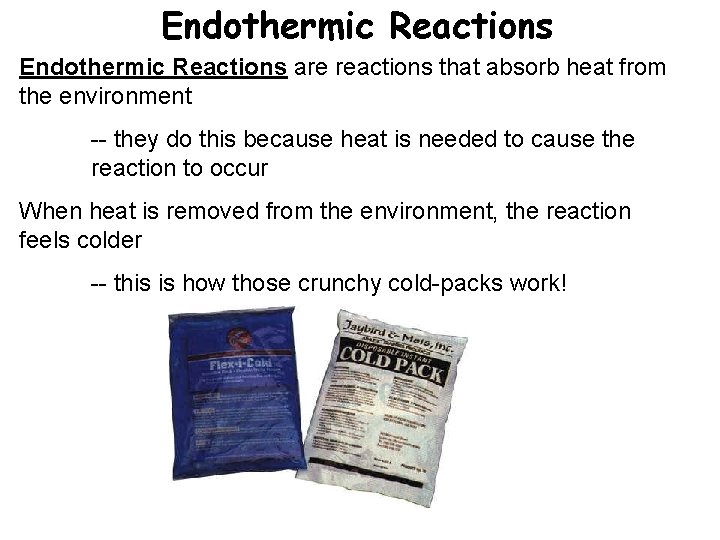
Endothermic Reactions are reactions that absorb heat from the environment -- they do this because heat is needed to cause the reaction to occur When heat is removed from the environment, the reaction feels colder -- this is how those crunchy cold-packs work!
Exothermic Reactions are reactions that release heat to their environment -- this reaction is so reactive that it gives off heat readily We feel the results of exothermic reactions as heat Many reactions we are familiar with are exothermic: -- burning of fossil fuels -- disposable heat packs
Bonds and Chemical Reactions In order to make new substances from original substances, you have to break bonds and make bonds -- breaking bonds of old substance releases energy -- making bonds of new substances requires energy For a reaction to be complete, all atoms of one substance must come in contact will all of the atoms of the other substance The stronger the chemical bonds in a substance, the less likely a substance is to react chemically
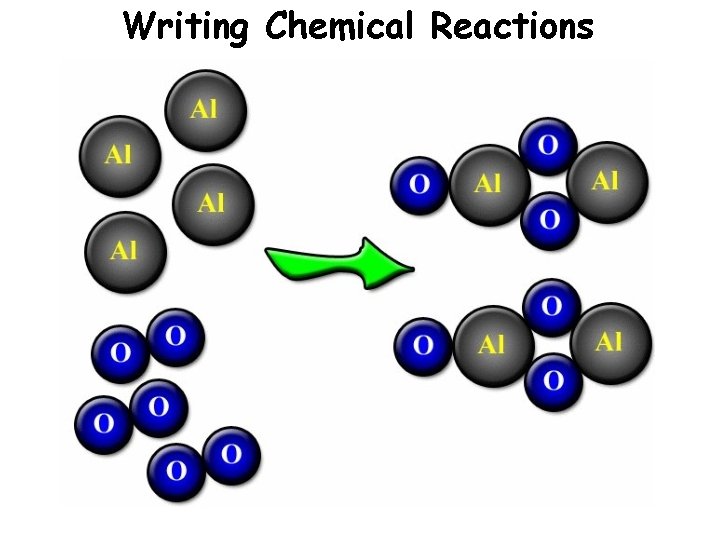
Writing Chemical Reactions
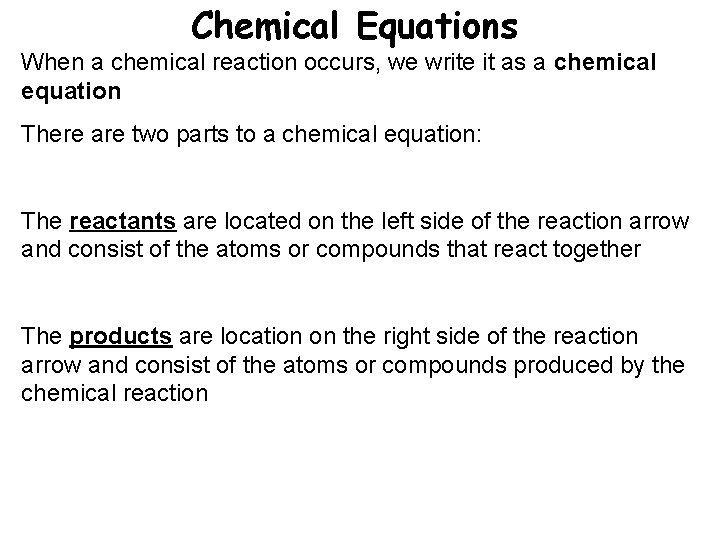
Chemical Equations When a chemical reaction occurs, we write it as a chemical equation There are two parts to a chemical equation: The reactants are located on the left side of the reaction arrow and consist of the atoms or compounds that react together The products are location on the right side of the reaction arrow and consist of the atoms or compounds produced by the chemical reaction
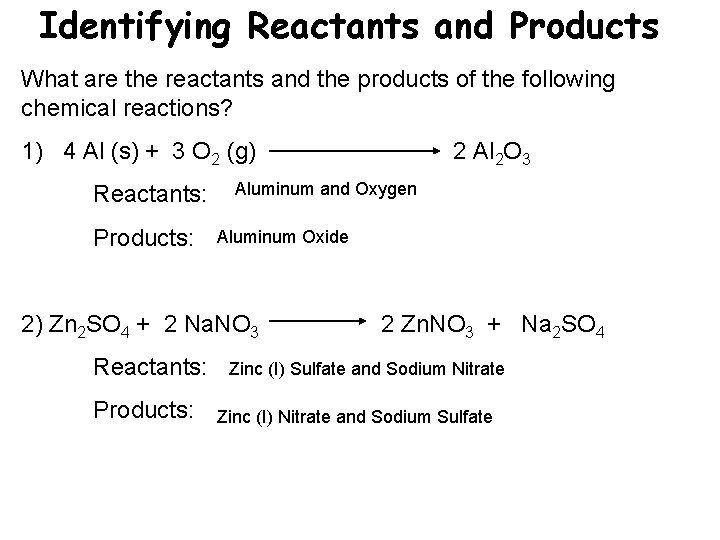
Identifying Reactants and Products What are the reactants and the products of the following chemical reactions? 1) 4 Al (s) + 3 O 2 (g) Reactants: Products: Aluminum and Oxygen Aluminum Oxide 2) Zn 2 SO 4 + 2 Na. NO 3 Reactants: Products: 2 Al 2 O 3 2 Zn. NO 3 + Na 2 SO 4 Zinc (I) Sulfate and Sodium Nitrate Zinc (I) Nitrate and Sodium Sulfate
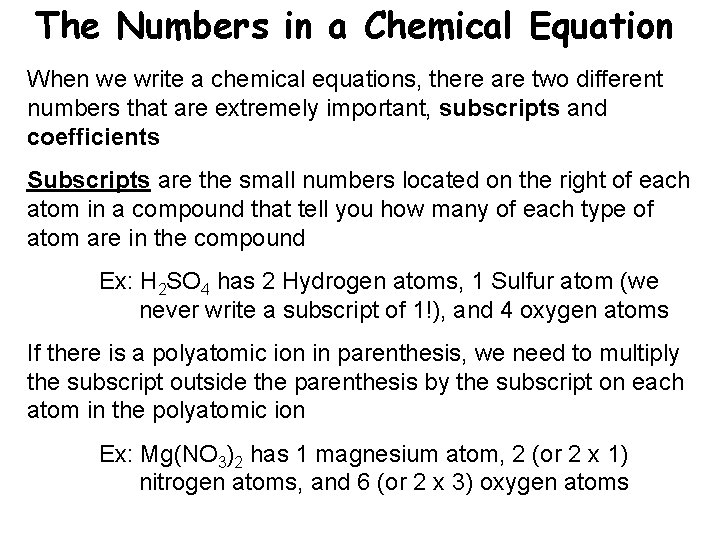
The Numbers in a Chemical Equation When we write a chemical equations, there are two different numbers that are extremely important, subscripts and coefficients Subscripts are the small numbers located on the right of each atom in a compound that tell you how many of each type of atom are in the compound Ex: H 2 SO 4 has 2 Hydrogen atoms, 1 Sulfur atom (we never write a subscript of 1!), and 4 oxygen atoms If there is a polyatomic ion in parenthesis, we need to multiply the subscript outside the parenthesis by the subscript on each atom in the polyatomic ion Ex: Mg(NO 3)2 has 1 magnesium atom, 2 (or 2 x 1) nitrogen atoms, and 6 (or 2 x 3) oxygen atoms
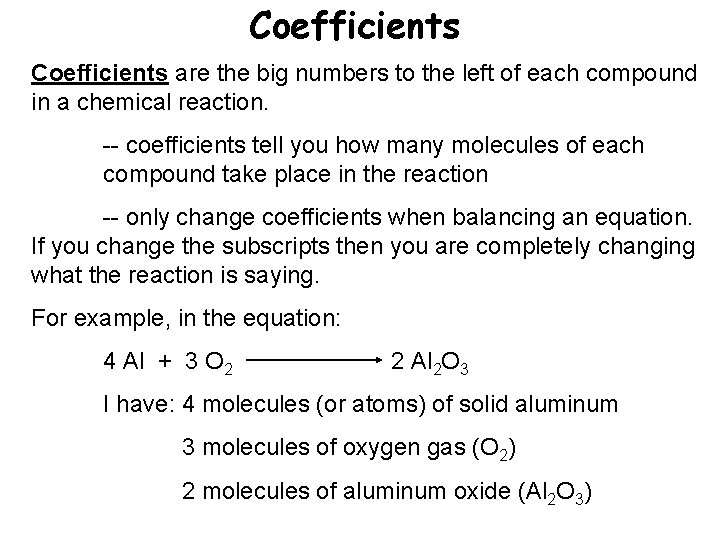
Coefficients are the big numbers to the left of each compound in a chemical reaction. -- coefficients tell you how many molecules of each compound take place in the reaction -- only change coefficients when balancing an equation. If you change the subscripts then you are completely changing what the reaction is saying. For example, in the equation: 4 Al + 3 O 2 2 Al 2 O 3 I have: 4 molecules (or atoms) of solid aluminum 3 molecules of oxygen gas (O 2) 2 molecules of aluminum oxide (Al 2 O 3)
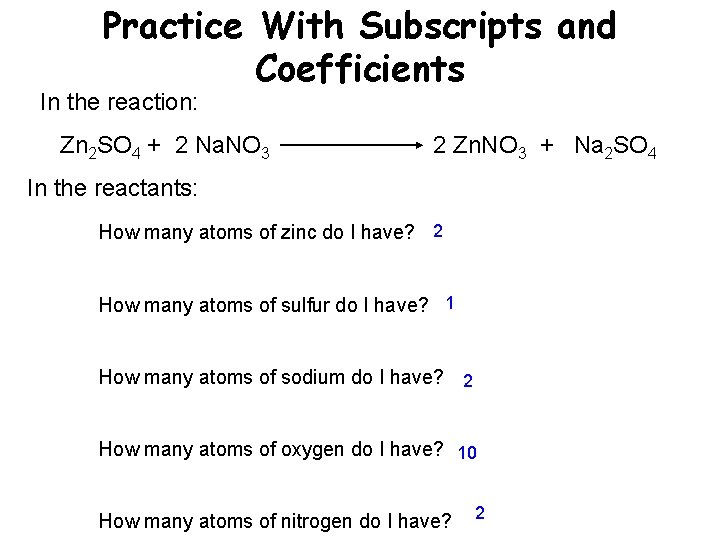
Practice With Subscripts and Coefficients In the reaction: Zn 2 SO 4 + 2 Na. NO 3 2 Zn. NO 3 + Na 2 SO 4 In the reactants: How many atoms of zinc do I have? 2 How many atoms of sulfur do I have? 1 How many atoms of sodium do I have? 2 How many atoms of oxygen do I have? 10 How many atoms of nitrogen do I have? 2
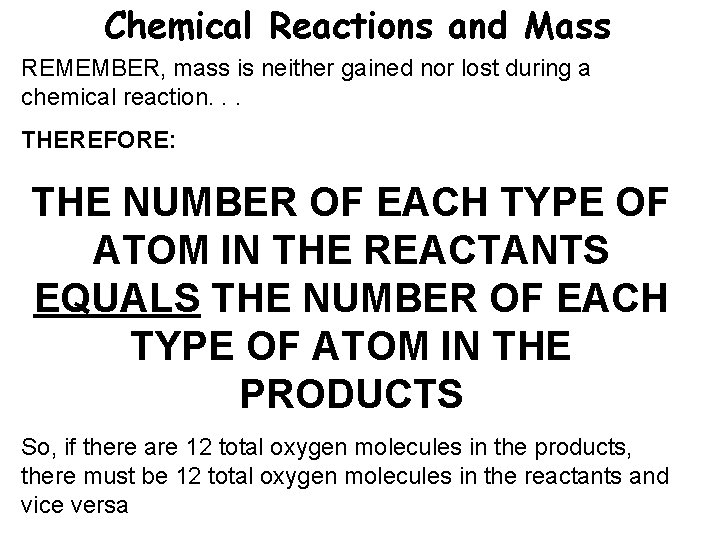
Chemical Reactions and Mass REMEMBER, mass is neither gained nor lost during a chemical reaction. . . THEREFORE: THE NUMBER OF EACH TYPE OF ATOM IN THE REACTANTS EQUALS THE NUMBER OF EACH TYPE OF ATOM IN THE PRODUCTS So, if there are 12 total oxygen molecules in the products, there must be 12 total oxygen molecules in the reactants and vice versa
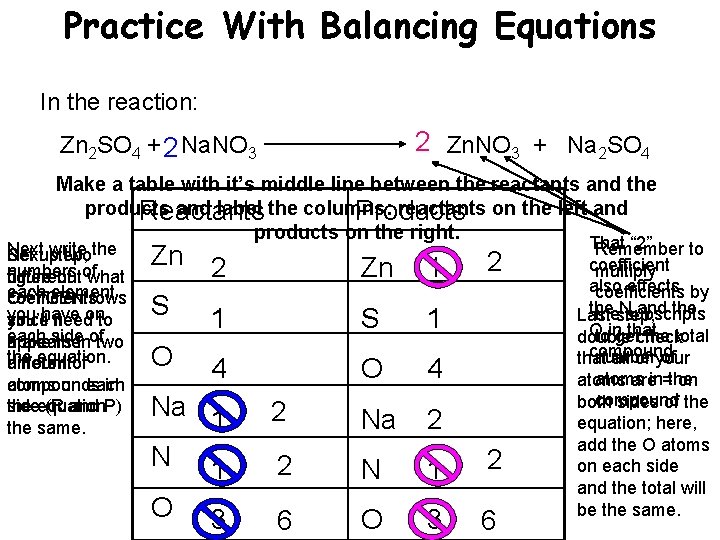
Practice With Balancing Equations In the reaction: 2 Zn. NO 3 + Na 2 SO 4 Zn 2 SO 4 + 2 Na. NO 3 Make a table with it’s middle line between the reactants and the products and label the columns: reactants on the left and Reactants Products products on the right. Next write Set up Next step, twothe numbers different figure outof what each element OXYGEN coefficients rows you have on since need you’ll it to each side appears make theinoftwo the equation. different amount of atoms on each compounds in the equation side (R and P) the same. Zn 2 S 1 Zn 1 S 1 O O 4 4 2 Na 1 N 1 2 Na 2 2 N 1 2 O 6 O 3 6 3 That “ 2” Remember to coefficient multiply also effects by coefficients the Nsubscripts and thestep, Last Otoinget that the total double check compound number of that all of your atoms arein=the on compound both sides of the equation; here, add the O atoms on each side and the total will be the same.
Types of Chemical Reactions • For our class, there are only three types of chemical reactions that we need to worry about.
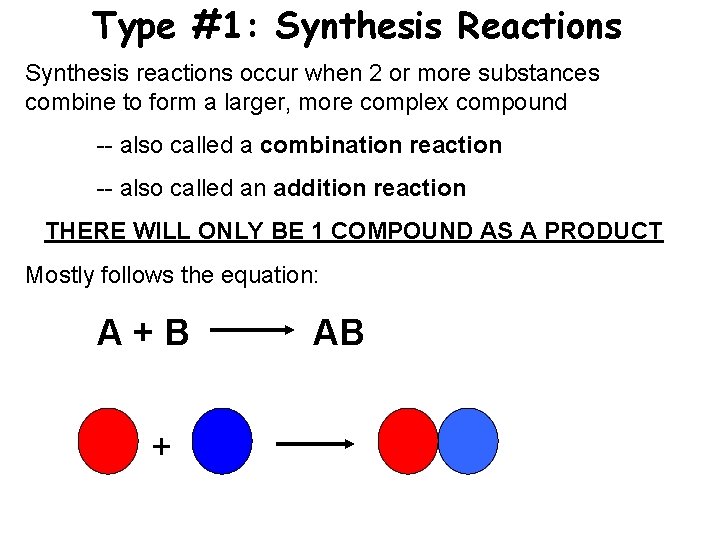
Type #1: Synthesis Reactions Synthesis reactions occur when 2 or more substances combine to form a larger, more complex compound -- also called a combination reaction -- also called an addition reaction THERE WILL ONLY BE 1 COMPOUND AS A PRODUCT Mostly follows the equation: A+B + AB
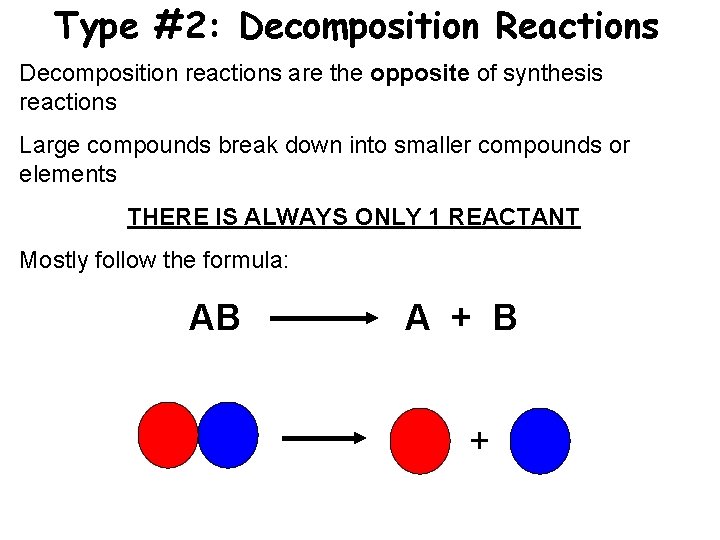
Type #2: Decomposition Reactions Decomposition reactions are the opposite of synthesis reactions Large compounds break down into smaller compounds or elements THERE IS ALWAYS ONLY 1 REACTANT Mostly follow the formula: AB A + B +
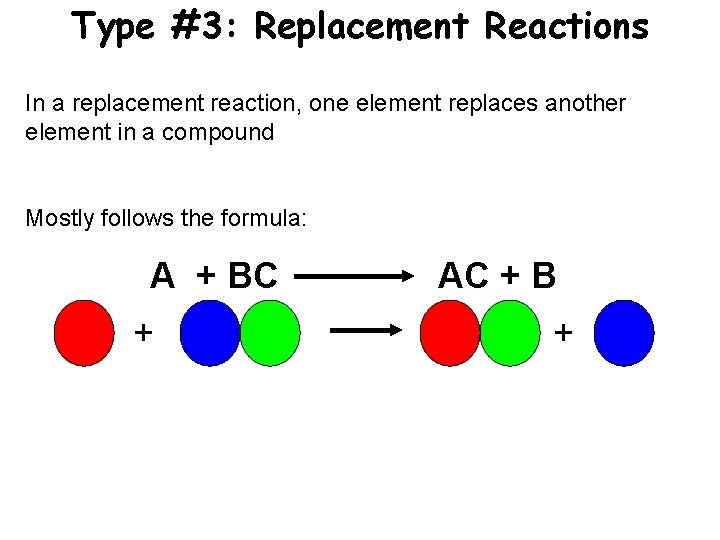
Type #3: Replacement Reactions In a replacement reaction, one element replaces another element in a compound Mostly follows the formula: A + BC + AC + B +
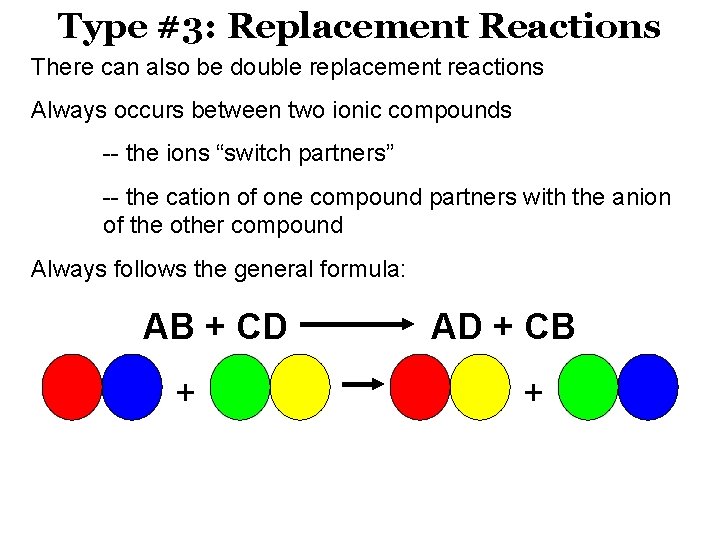
Type #3: Replacement Reactions There can also be double replacement reactions Always occurs between two ionic compounds -- the ions “switch partners” -- the cation of one compound partners with the anion of the other compound Always follows the general formula: AB + CD + AD + CB +