
CHEMICAL REACTIONS This is when one chemical reacts
![Question 3 1. Synthesis (Building up) and Decomposition (Breaking down) [2] 2. Magnesium +](https://slidetodoc.com/presentation_image_h2/ae572212f87e9c96a3fd3c6046c417f9/image-5.jpg "Question 3 1. Synthesis (Building up) and Decomposition (Breaking down) [2] 2. Magnesium +")
![Question 4 1. Maize (Mealies), Malt, Yeast, Water. 2. Carbon Dioxide, Alcohol. [2] 3.](https://slidetodoc.com/presentation_image_h2/ae572212f87e9c96a3fd3c6046c417f9/image-6.jpg "Question 4 1. Maize (Mealies), Malt, Yeast, Water. 2. Carbon Dioxide, Alcohol. [2] 3.")
![Question 6 [8] MIXTURES Not chemically joined. Each item keeps its own properties. Can](https://slidetodoc.com/presentation_image_h2/ae572212f87e9c96a3fd3c6046c417f9/image-7.jpg "Question 6 [8] MIXTURES Not chemically joined. Each item keeps its own properties. Can")
- Slides: 7
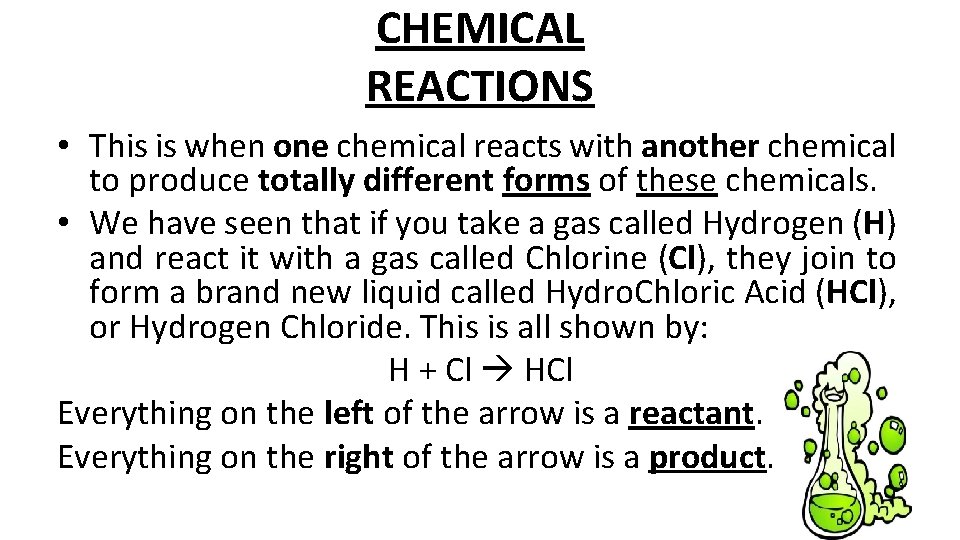
CHEMICAL REACTIONS • This is when one chemical reacts with another chemical to produce totally different forms of these chemicals. • We have seen that if you take a gas called Hydrogen (H) and react it with a gas called Chlorine (Cl), they join to form a brand new liquid called Hydro. Chloric Acid (HCl), or Hydrogen Chloride. This is all shown by: H + Cl HCl Everything on the left of the arrow is a reactant. Everything on the right of the arrow is a product.
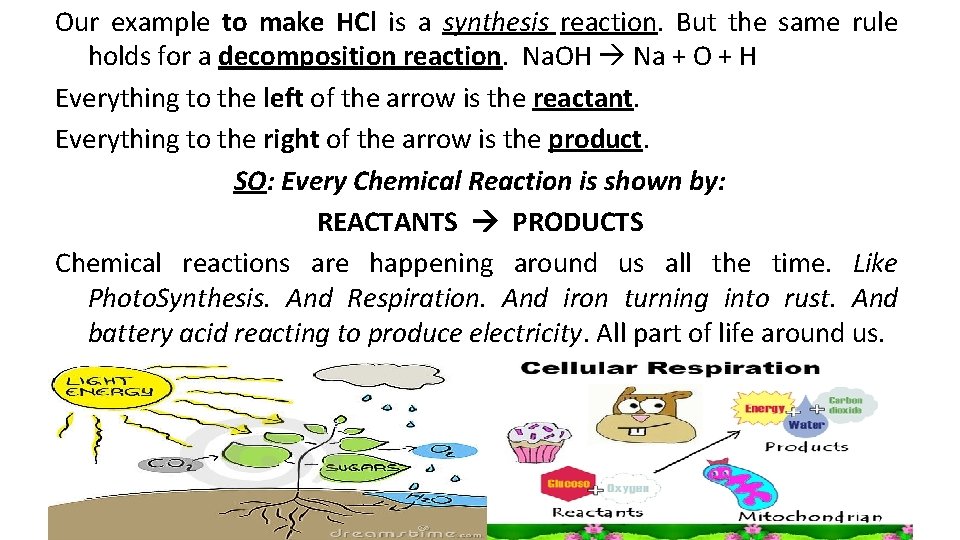
Our example to make HCl is a synthesis reaction. But the same rule holds for a decomposition reaction. Na. OH Na + O + H Everything to the left of the arrow is the reactant. Everything to the right of the arrow is the product. SO: Every Chemical Reaction is shown by: REACTANTS PRODUCTS Chemical reactions are happening around us all the time. Like Photo. Synthesis. And Respiration. And iron turning into rust. And battery acid reacting to produce electricity. All part of life around us.
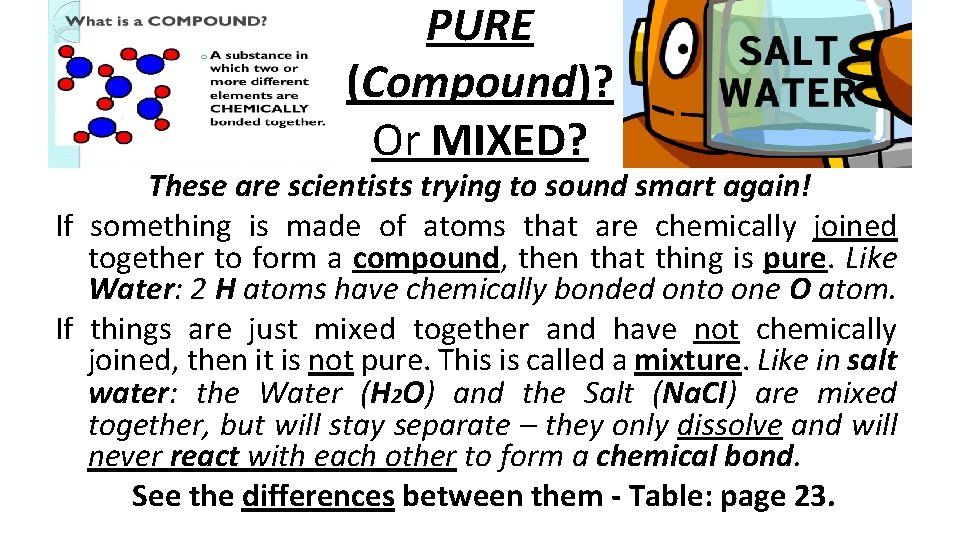
PURE (Compound)? Or MIXED? These are scientists trying to sound smart again! If something is made of atoms that are chemically joined together to form a compound, then that thing is pure. Like Water: 2 H atoms have chemically bonded onto one O atom. If things are just mixed together and have not chemically joined, then it is not pure. This is called a mixture. Like in salt water: the Water (H 2 O) and the Salt (Na. Cl) are mixed together, but will stay separate – they only dissolve and will never react with each other to form a chemical bond. See the differences between them - Table: page 23.
QUESTIONS Pages 81 -82 Question 1 1. Two chemicals react together to produce a new product. [2] 2. Respiration. Photosynthesis. Iron rusting. Making beer, etc. [3] Question 2 1. A and B [2] 2. C and D [2]
Question 3 1. Synthesis (Building up) and Decomposition (Breaking down) [2] 2. Magnesium + Oxygen → Magnesium Oxide Sodium + Chlorine → Sodium Chloride REACTANTS 3. → PRODUCTS Water → Hydrogen + Oxygen Mercury Oxide → Mercury + Oxygen Etcetera [12]
Question 4 1. Maize (Mealies), Malt, Yeast, Water. 2. Carbon Dioxide, Alcohol. [2] 3. Vitamin B. [1] 4. Less than 3%. [1] [4] Question 5 1. Two substances are chemically joined together. [2] 2. Any compounds: Oxygen, Sugar, Iron, Water. [3] 3. Two substances not chemically joined together. [2] 4. (a) Iron filings and Sulfur [2] (b) Iron filings and Water [2] (c) Sugar and Salt [2]
Question 6 [8] MIXTURES Not chemically joined. Each item keeps its own properties. Can be physically separated. Any mixture is possible. COMPOUNDS Are chemically joined. New compound has new properties. Can. NOT be physically separated. Proportions of atoms are specific.