
Chemical Reactions Steps to Writing Reactions Some steps


- Slides: 15
Chemical Reactions
Steps to Writing Reactions • Some steps for doing reactions 1. 2. 3. Identify the type of reaction Predict the product(s) using the type of reaction as a model Balance it – number and kind of atoms must be the same on both sides of the equation Don’t forget about the diatomic elements! (For example, Oxygen is O 2 as an molecule. In a compound, it can’t be a diatomic element because it’s not an element anymore, it’s a compound!
Types of Reactions • There are five types of chemical reactions we will talk about: 1. 2. 3. 4. 5. • • Synthesis reactions Decomposition reactions Single displacement reactions Double replacement reactions Combustion reactions You need to be able to identify the type of reaction and predict the product(s) Note: most of these are skeleton equations
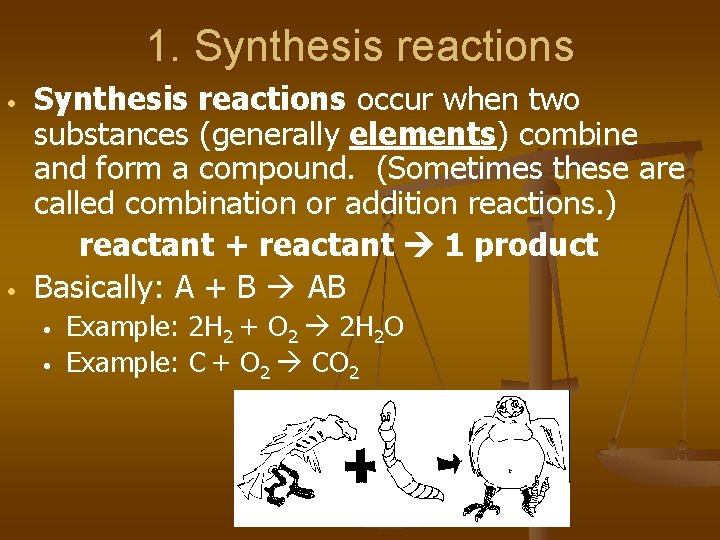
1. Synthesis reactions • • Synthesis reactions occur when two substances (generally elements) combine and form a compound. (Sometimes these are called combination or addition reactions. ) reactant + reactant 1 product Basically: A + B AB • • Example: 2 H 2 + O 2 2 H 2 O Example: C + O 2 CO 2
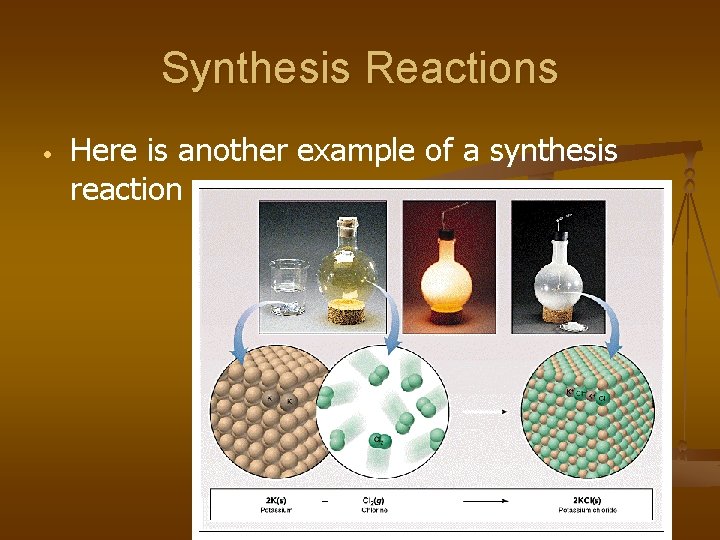
Synthesis Reactions • Here is another example of a synthesis reaction
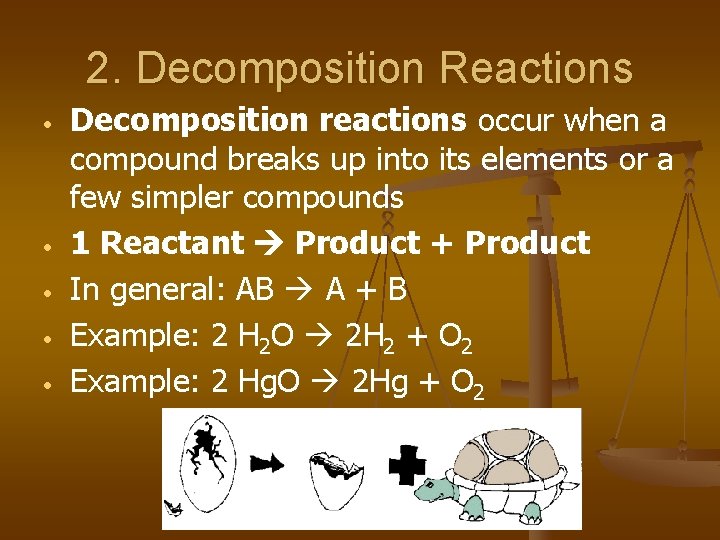
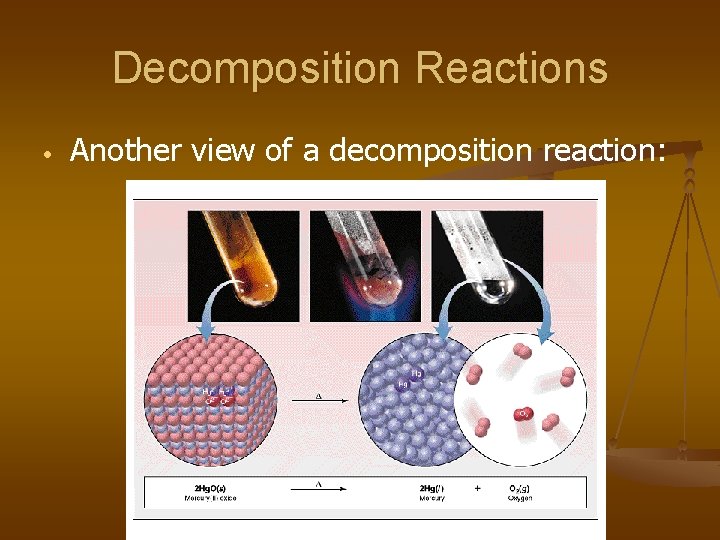
2. Decomposition Reactions • • • Decomposition reactions occur when a compound breaks up into its elements or a few simpler compounds 1 Reactant Product + Product In general: AB A + B Example: 2 H 2 O 2 H 2 + O 2 Example: 2 Hg. O 2 Hg + O 2
Decomposition Reactions • Another view of a decomposition reaction:
Decomposition Reactions n There are six different types that we will discuss in more detail later!
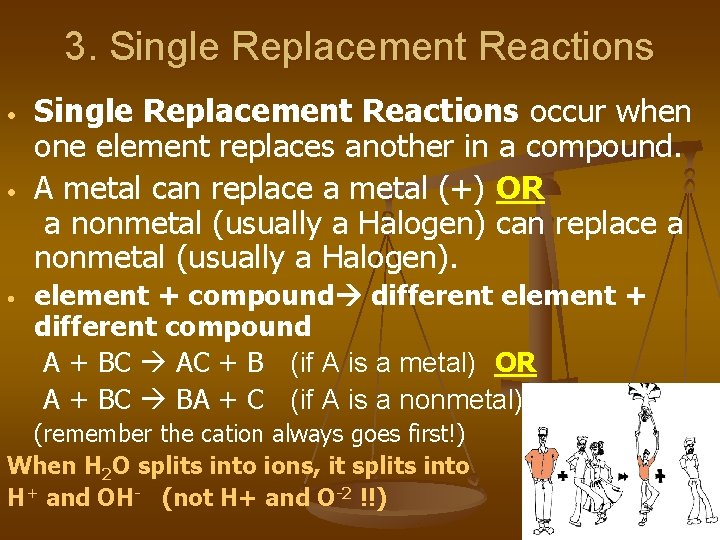
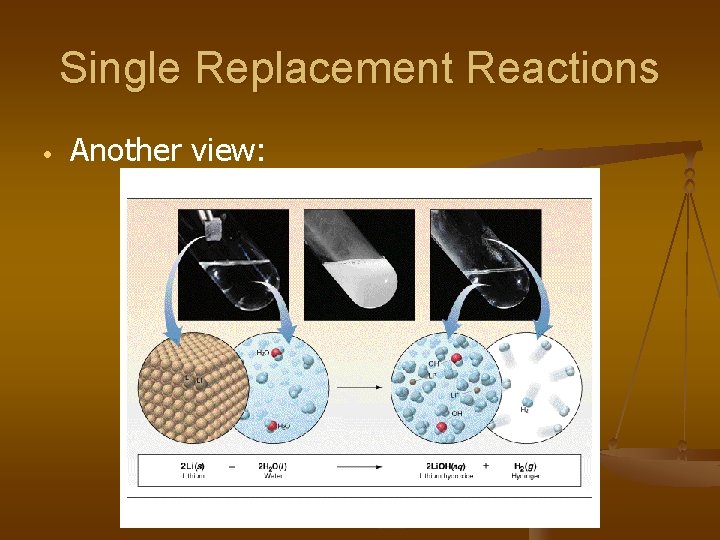
3. Single Replacement Reactions • • • Single Replacement Reactions occur when one element replaces another in a compound. A metal can replace a metal (+) OR a nonmetal (usually a Halogen) can replace a nonmetal (usually a Halogen). element + compound different element + different compound A + BC AC + B (if A is a metal) OR A + BC BA + C (if A is a nonmetal) (remember the cation always goes first!) When H 2 O splits into ions, it splits into H+ and OH- (not H+ and O-2 !!)
Single Replacement Reactions • Another view:
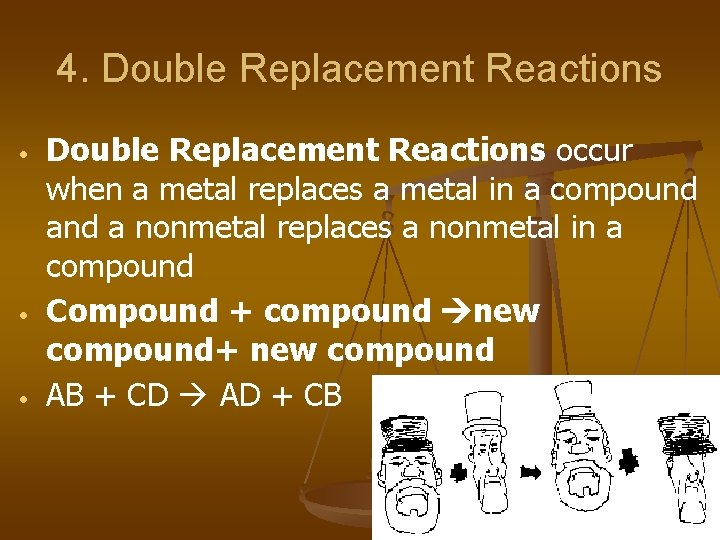
4. Double Replacement Reactions • • • Double Replacement Reactions occur when a metal replaces a metal in a compound a nonmetal replaces a nonmetal in a compound Compound + compound new compound+ new compound AB + CD AD + CB
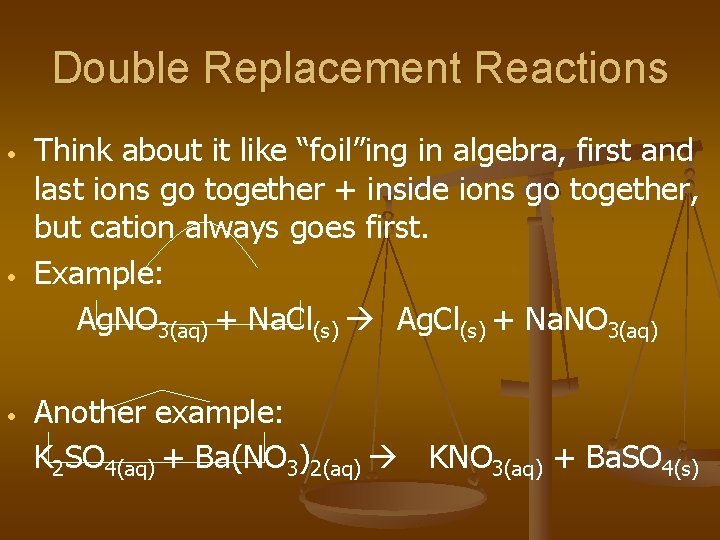
Double Replacement Reactions • • • Think about it like “foil”ing in algebra, first and last ions go together + inside ions go together, but cation always goes first. Example: Ag. NO 3(aq) + Na. Cl(s) Ag. Cl(s) + Na. NO 3(aq) Another example: K 2 SO 4(aq) + Ba(NO 3)2(aq) KNO 3(aq) + Ba. SO 4(s)
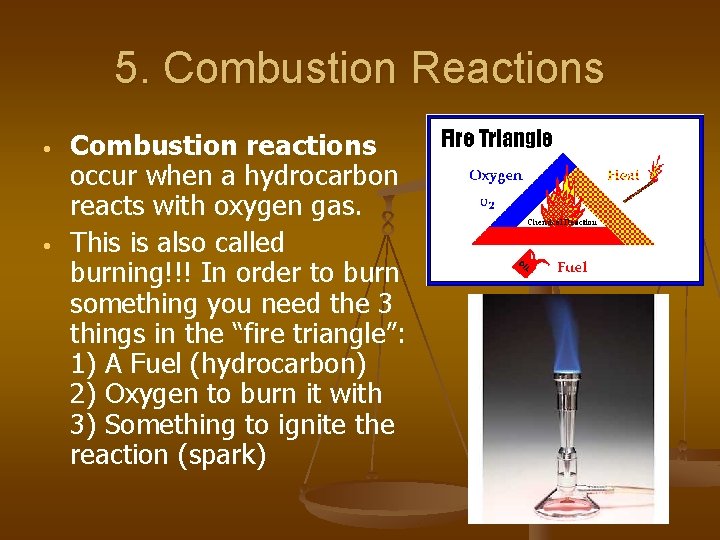
5. Combustion Reactions • • Combustion reactions occur when a hydrocarbon reacts with oxygen gas. This is also called burning!!! In order to burn something you need the 3 things in the “fire triangle”: 1) A Fuel (hydrocarbon) 2) Oxygen to burn it with 3) Something to ignite the reaction (spark)
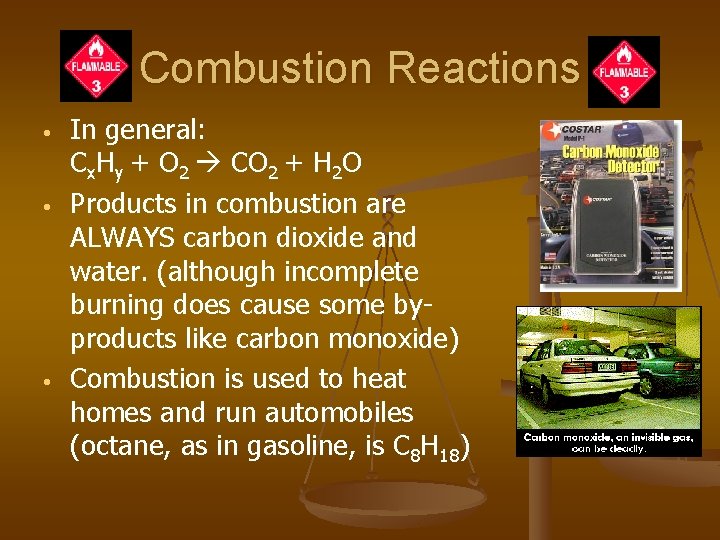
Combustion Reactions • • • In general: Cx. Hy + O 2 CO 2 + H 2 O Products in combustion are ALWAYS carbon dioxide and water. (although incomplete burning does cause some byproducts like carbon monoxide) Combustion is used to heat homes and run automobiles (octane, as in gasoline, is C 8 H 18)
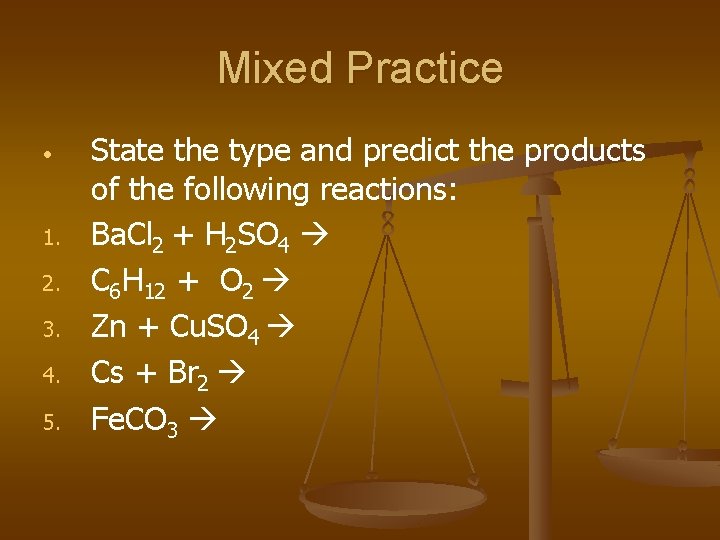
Mixed Practice • 1. 2. 3. 4. 5. State the type and predict the products of the following reactions: Ba. Cl 2 + H 2 SO 4 C 6 H 12 + O 2 Zn + Cu. SO 4 Cs + Br 2 Fe. CO 3