
Chemical Reactions Section 3 1 In which reaction
- Slides: 17
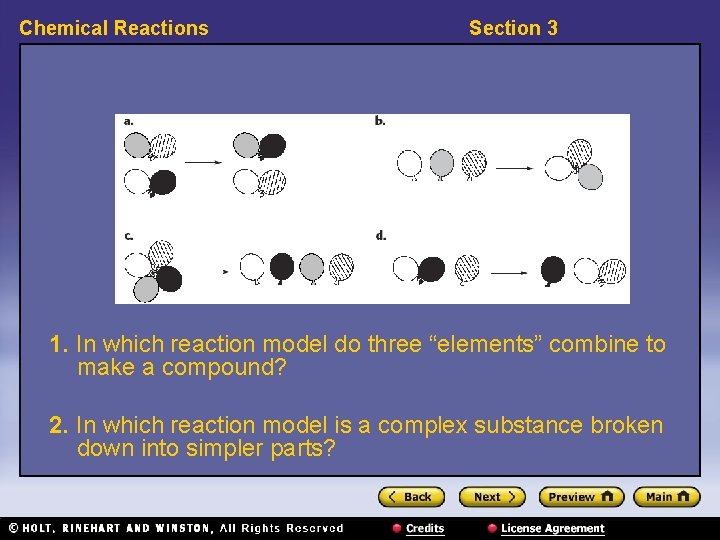
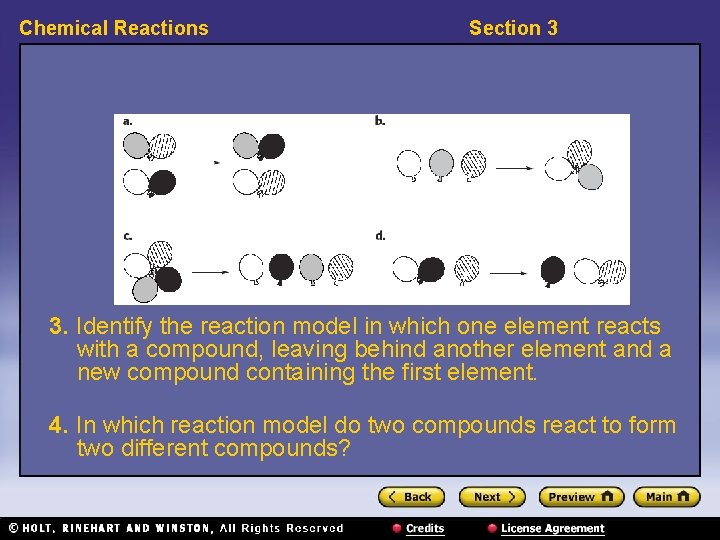
Chemical Reactions Section 3 1. In which reaction model do three “elements” combine to make a compound? 2. In which reaction model is a complex substance broken down into simpler parts?
Chemical Reactions Section 3 3. Identify the reaction model in which one element reacts with a compound, leaving behind another element and a new compound containing the first element. 4. In which reaction model do two compounds react to form two different compounds?
Chemical Reactions Section 3 Classifying Reactions 〉 How does learning about reaction types help in understanding chemical reactions? 〉 You can use patterns to identify kinds of chemical reactions and to predict the products of the chemical reactions.
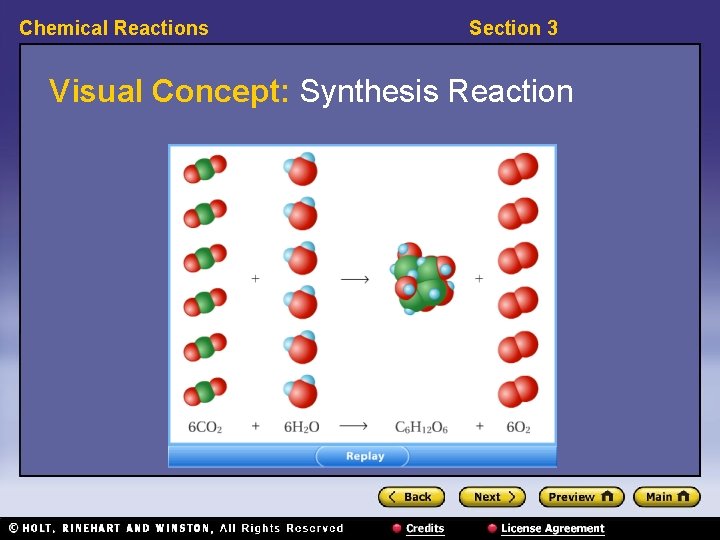
Chemical Reactions Section 3 Classifying Reactions, continued • Synthesis reactions combine substances. – synthesis reaction: a reaction in which two or more substances combine to form a new compound • The general form of a synthesis reaction is: A + B → AB • Example: 2 Na + Cl 2 → 2 Na. Cl
Chemical Reactions Section 3 Visual Concept: Synthesis Reaction
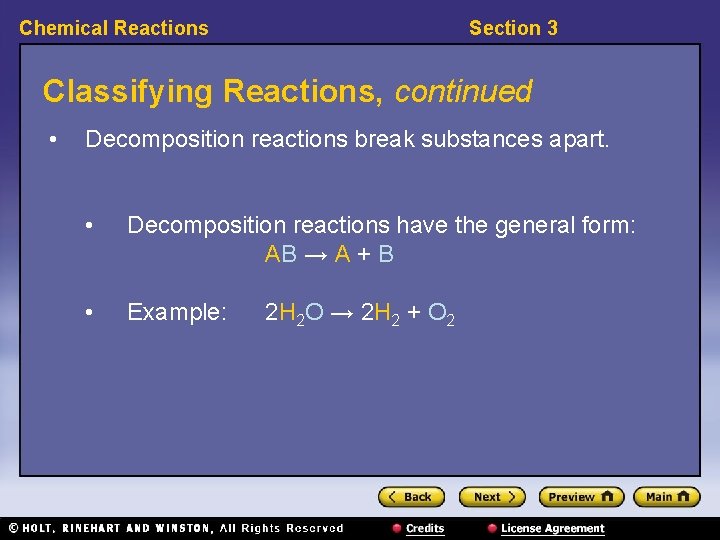
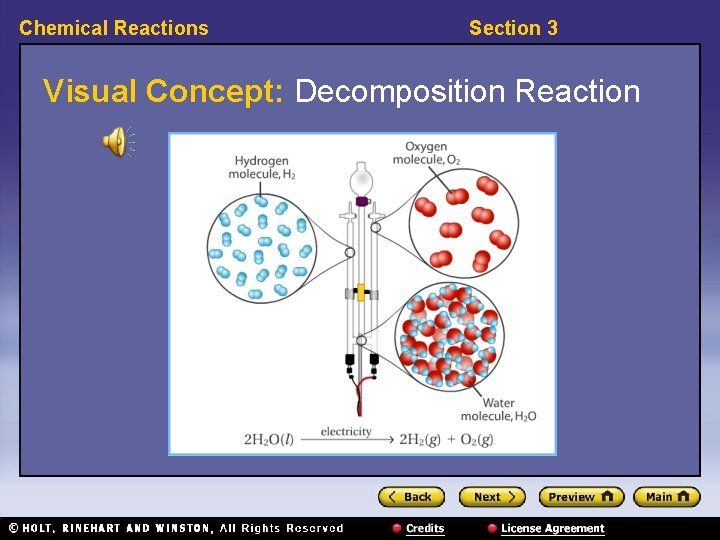
Chemical Reactions Section 3 Classifying Reactions, continued • Decomposition reactions break substances apart. • Decomposition reactions have the general form: AB → A + B • Example: 2 H 2 O → 2 H 2 + O 2
Chemical Reactions Section 3 Visual Concept: Decomposition Reaction
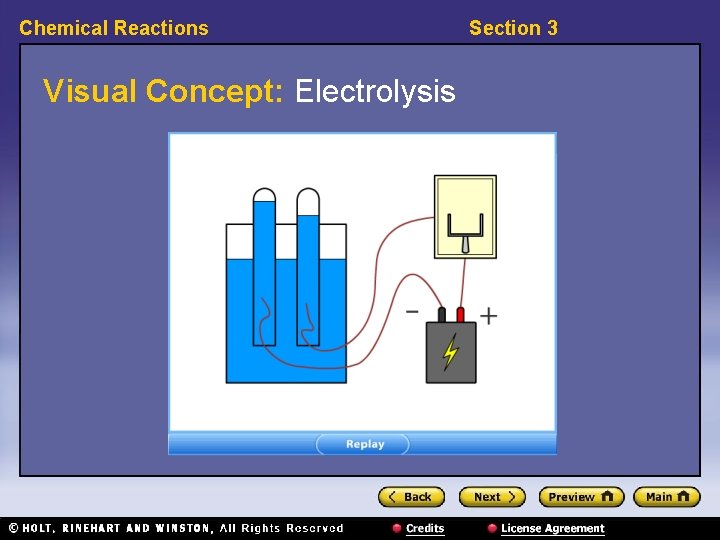
Chemical Reactions Visual Concept: Electrolysis Section 3
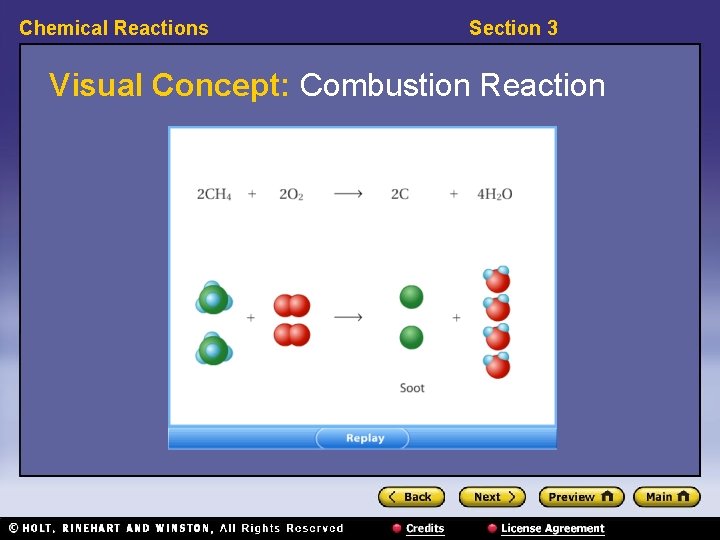
Chemical Reactions Section 3 Classifying Reactions, continued • Combustion reactions use oxygen as a reactant. • In combustion reactions, the products depend on the amount of oxygen available for the reaction.
Chemical Reactions Section 3 Visual Concept: Combustion Reaction
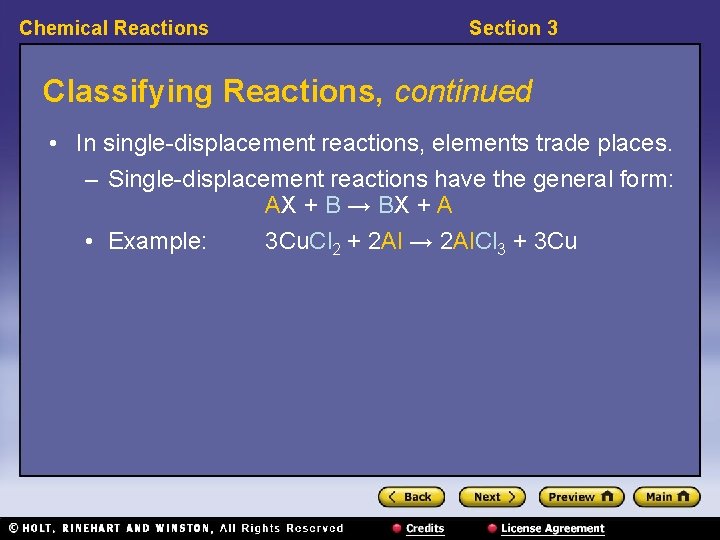
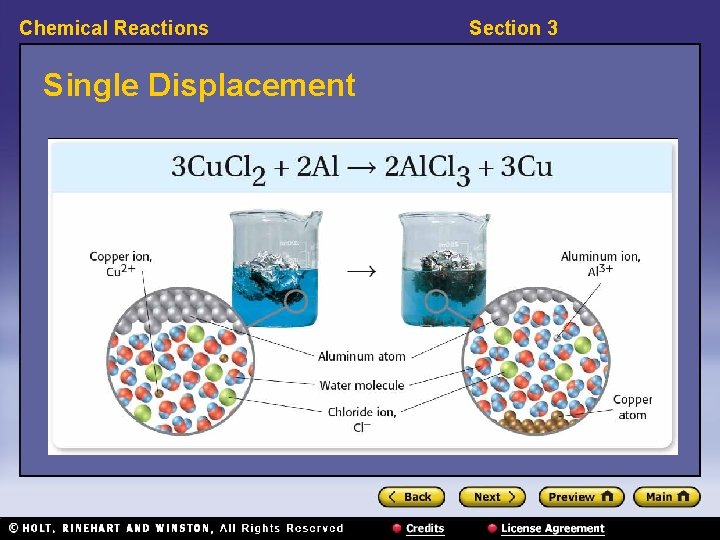
Chemical Reactions Section 3 Classifying Reactions, continued • In single-displacement reactions, elements trade places. – Single-displacement reactions have the general form: AX + B → BX + A • Example: 3 Cu. Cl 2 + 2 Al → 2 Al. Cl 3 + 3 Cu
Chemical Reactions Single Displacement Section 3
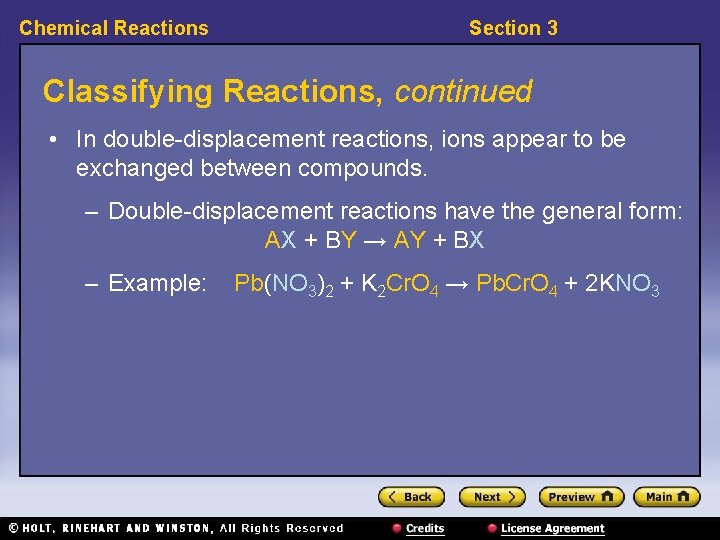
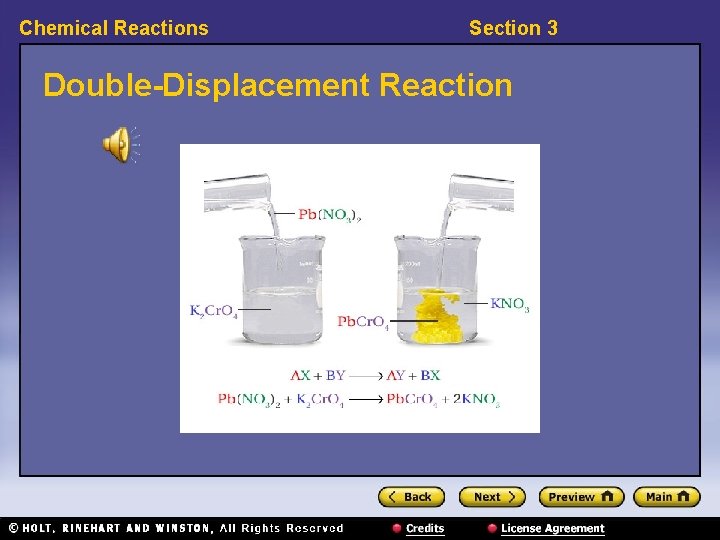
Chemical Reactions Section 3 Classifying Reactions, continued • In double-displacement reactions, ions appear to be exchanged between compounds. – Double-displacement reactions have the general form: AX + BY → AY + BX – Example: Pb(NO 3)2 + K 2 Cr. O 4 → Pb. Cr. O 4 + 2 KNO 3
Chemical Reactions Section 3 Double-Displacement Reaction
Chemical Reactions Section 3 Electrons and Chemical Reactions 〉 In which kinds of chemical reactions do the numbers of electrons in atoms change? 〉 Free-radical reactions and redox reactions can be understood as changes in the numbers of electrons that atoms have.
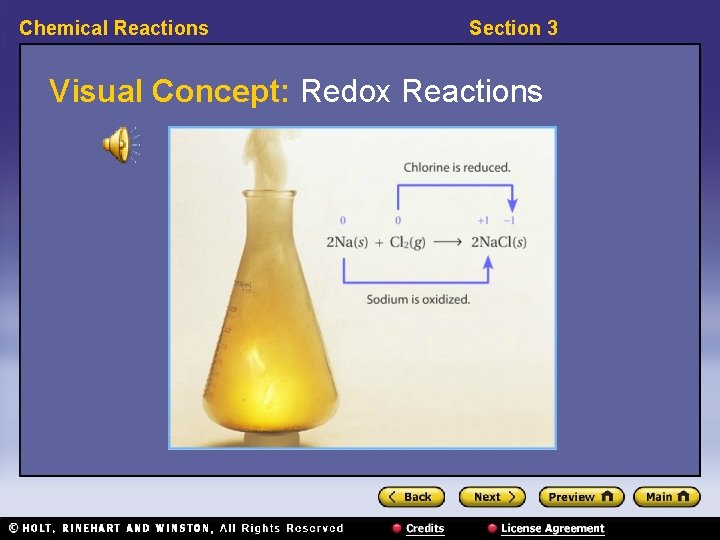
Chemical Reactions Section 3 Electrons and Chemical Reactions, continued • Substances that accept electrons are said to be reduced. • Substances that give up electrons are said to be oxidized. • Some redox reactions do not involve ions. • Free radicals have electrons available for bonding.
Chemical Reactions Section 3 Visual Concept: Redox Reactions