
Chemical Reactions Freshman Chemistry Objectives Know what happens
Chemical Reactions Freshman Chemistry
Objectives Know what happens to matter and energy in a reaction. 2. Know what these terms mean: products, reactants, exothermic reaction and endothermic reaction 1.
Chemical Reactions A chemical reaction is when atoms rearrange to form new substances. The important thing to remember is that something different is made in a chemical reaction.

Example Eggs + flour + energy Cake
Chemical Reactions (cont) Chemical Reactions rearrange atoms.
Reactants A substance or molecule that participates in a chemical reaction Found on the left side of the equation Examples H 2 + O 2 H 2 O CH 4 + O 2 CO 2 + H 2 O
Products A substance that forms in a chemical reaction. Found on the right side of the equation. Examples: H 2 + O 2 H 2 O CH 4 + O 2 CO 2 + H 2 O
Energy in Reactions Chemical reactions always involve changes in energy. Energy must be added to break bonds. Different forms of energy can be used to break bonds. Examples: Electricity, heat, light
Energy in Reactions Forming bonds usually releases energy When new bonds are formed, energy is usually released. Energy is conserved in chemical reactions. Remember: Energy can NOT be created or destroyed
Energy classifications Exothermic Reactions – Reactions that release energy when new bonds form. The surrounding area warms up. Endothermic Reactions- Energy is absorbed Surrounding area cools down.
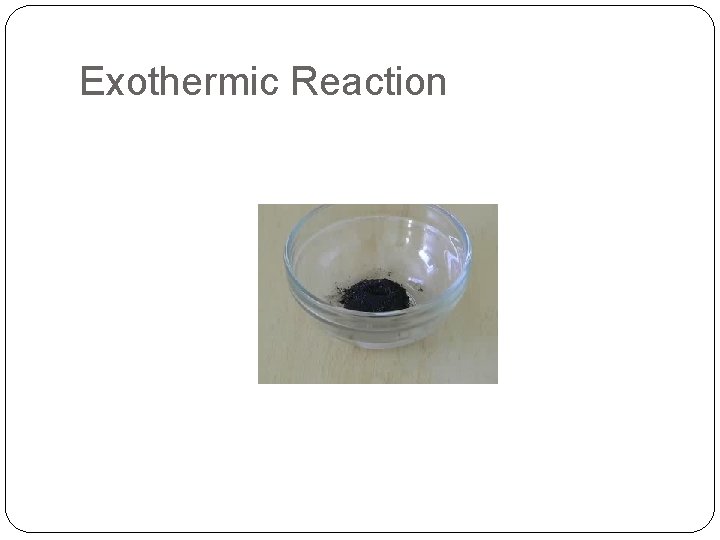
Exothermic Reaction
Endothermic Reaction
- Slides: 12