
Chemical Protective Clothing Paul Bryce Technical Director Microgard
Chemical Protective Clothing Paul Bryce, Technical Director Microgard Ltd
Topics • European Directive 89/686/EEC - “The PPE Directive” • Certification of PPE • European Chemical Protective Clothing “Types” • Selection of Chemical Protective Clothing • Correct Wearing of Chemical Protective Clothing
European Directive 89/686/EEC – “The PPE Directive” The PPE Directive applies to Personal Protective Equipment (PPE) intended for use in domestic, leisure and sports activities, as well as for professional use. The objectives of the PPE Directive are: 1. to provide the Basic Health & Safety Requirements which the PPE must satisfy to preserve the health and ensure the safety of intended users; 2. to ensure free movement of PPE within the Community The PPE Directive does not cover; 1. The Use of PPE – Directive 89/656/EEC applies 2. Health & Safety at Work – Directive 89/391/EEC applies The PPE Directive is a “New Approach” Directive laying down Basic Health and Safety Requirements (BHSRS) and leaving it to standards, primarily European harmonised standards, to give technical expression of the relevant requirements contained in the directive.
What is PPE? -Basic Health & Safety Requirements (BHSRs) • PPE must provide adequate protection against all risks encountered • Principles of design – Ergonomics – Highest level of protection possible – Classes of protection appropriate to different levels of risk • Innocuousness of PPE – Designed and manufactured as to preclude risks and other nuisance factors under foreseeable conditions of use – PPE materials and parts must not adversely affect user hygiene or health – Must be free of roughness, sharp edges etc. – Maximum permissible user impediment • Comfort and efficiency – Adaptation of PPE to the user morphology – Lightness and design strength – Compatibility of different classes or types of PPE • Information supplied by the manufacturers
What is PPE? - Additional Requirements for Chemical Protective Clothing Article 3. 10 Protection against dangerous substances and infective agents; Article 3. 10. 2 Protection against cutaneous and ocular contact “PPE intended to prevent the surface contact of all or part of the body with dangerous substances and infective agents must be capable of preventing the penetration or diffusion of such substances through the protective integument under the foreseeable conditions of use for which the PPE is placed on the market”
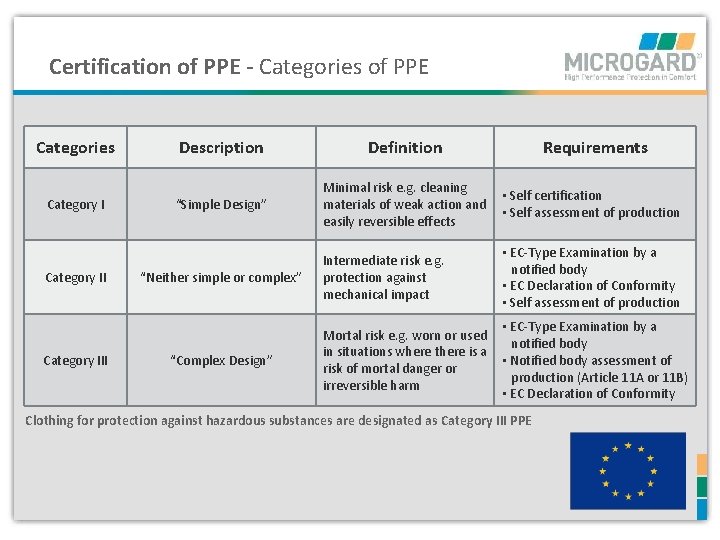
Certification of PPE - Categories of PPE Categories Category III Description Definition Requirements “Simple Design” Minimal risk e. g. cleaning materials of weak action and easily reversible effects • Self certification • Self assessment of production Intermediate risk e. g. protection against mechanical impact • EC-Type Examination by a notified body • EC Declaration of Conformity • Self assessment of production Mortal risk e. g. worn or used in situations where there is a risk of mortal danger or irreversible harm • EC-Type Examination by a notified body • Notified body assessment of production (Article 11 A or 11 B) • EC Declaration of Conformity “Neither simple or complex” “Complex Design” Clothing for protection against hazardous substances are designated as Category III PPE
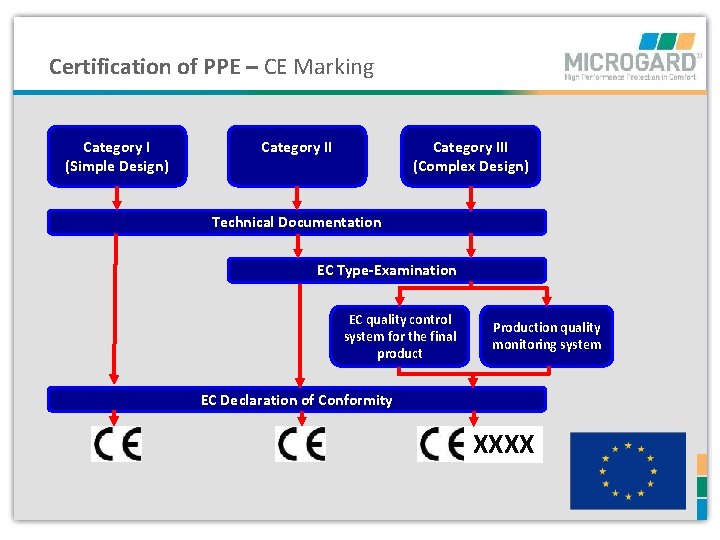
Certification of PPE – CE Marking Category I (Simple Design) Category III (Complex Design) Technical Documentation EC Type-Examination EC quality control system for the final product Production quality monitoring system EC Declaration of Conformity XXXX
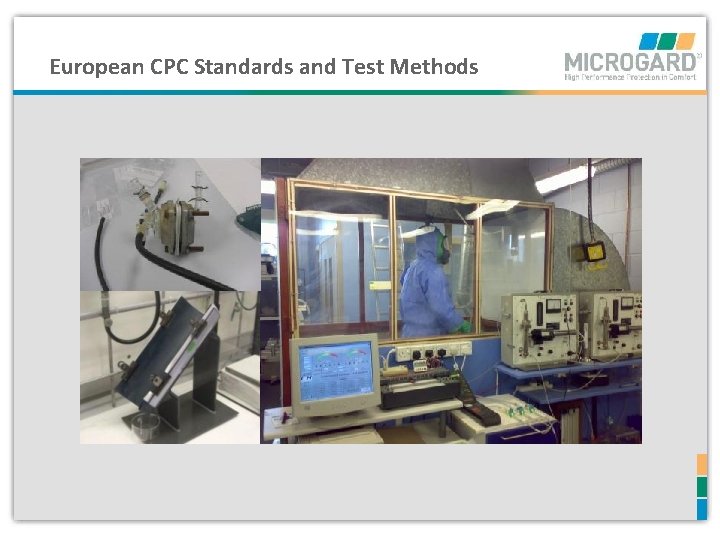
European CPC Standards and Test Methods
European PPE Testing - What is covered? • Innocuousness. To ensure that no harmful, forbidden or restricted substance is used in product construction, as well as checking for sharp edges or injurious surfaces. • Ergonomics. Design, comfort, fit. Can the wearer carry out the required activity comfortably? • Protective coverage. Adequate coverage to provide sufficient protection • Protective qualities. Impact, abrasion, cut, chemical and thermal resistance • Marking and instructions –Manufacturers name and address –Storage/ cleaning/ maintenance –Protective performance level –Suitable accessories/spare parts –Relevant warnings –Type approval Notified Body details The European standard which covers the “general requirements” for protective clothing is EN 340: 2003
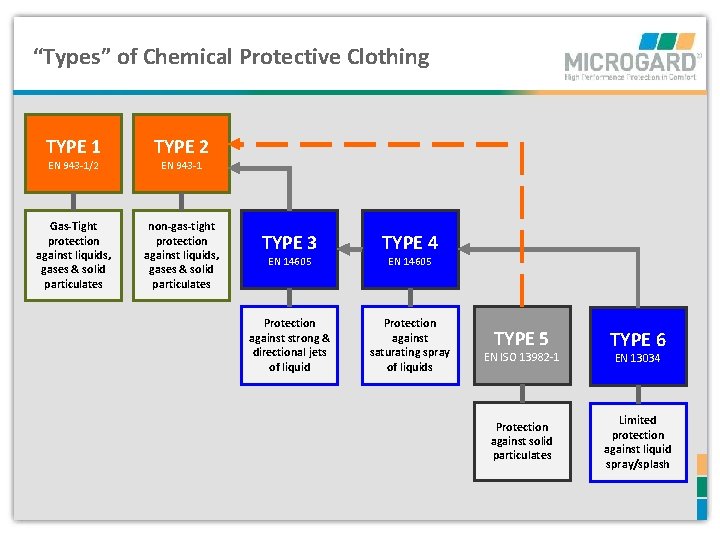
“Types” of Chemical Protective Clothing TYPE 1 TYPE 2 Gas-Tight protection against liquids, gases & solid particulates non-gas-tight protection against liquids, gases & solid particulates EN 943 -1/2 EN 943 -1 TYPE 3 TYPE 4 Protection against strong & directional jets of liquid Protection against saturating spray of liquids EN 14605 TYPE 5 EN ISO 13982 -1 Protection against solid particulates © Microgard Ltd 2011 TYPE 6 EN 13034 Limited protection against liquid spray/splash
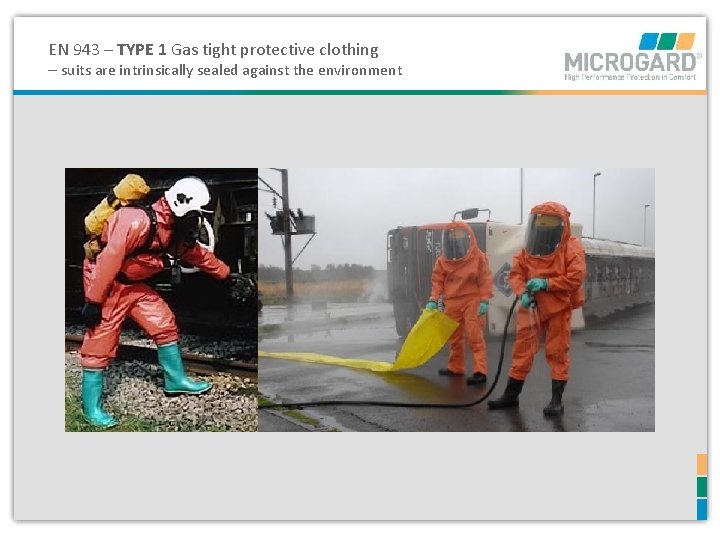
EN 943 – TYPE 1 Gas tight protective clothing – suits are intrinsically sealed against the environment
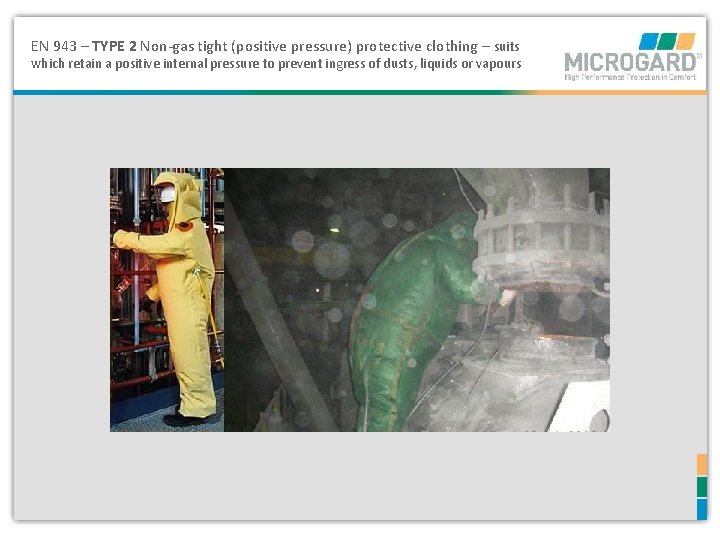
EN 943 – TYPE 2 Non-gas tight (positive pressure) protective clothing – suits which retain a positive internal pressure to prevent ingress of dusts, liquids or vapours
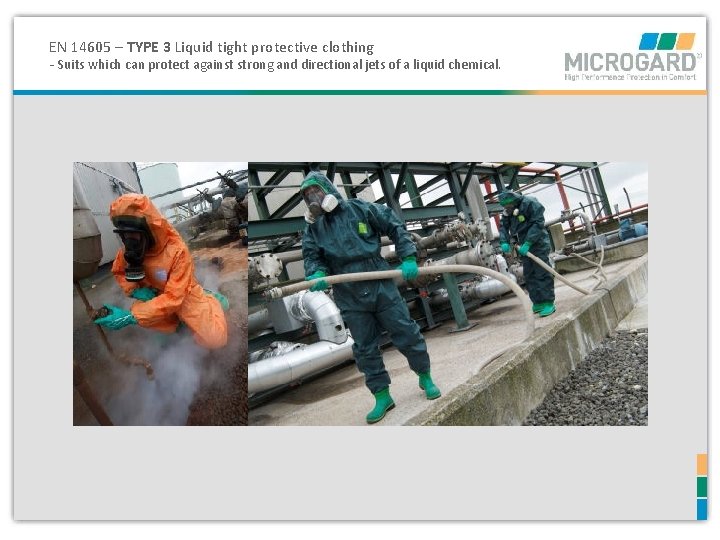
EN 14605 – TYPE 3 Liquid tight protective clothing - Suits which can protect against strong and directional jets of a liquid chemical.
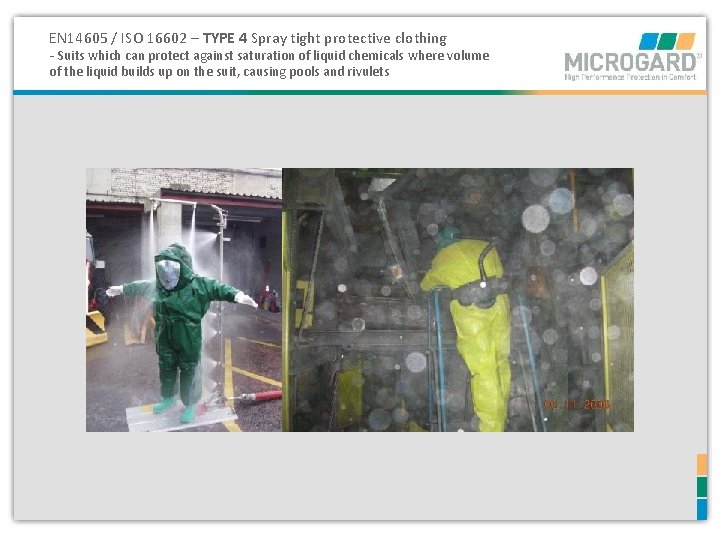
EN 14605 / ISO 16602 – TYPE 4 Spray tight protective clothing - Suits which can protect against saturation of liquid chemicals where volume of the liquid builds up on the suit, causing pools and rivulets
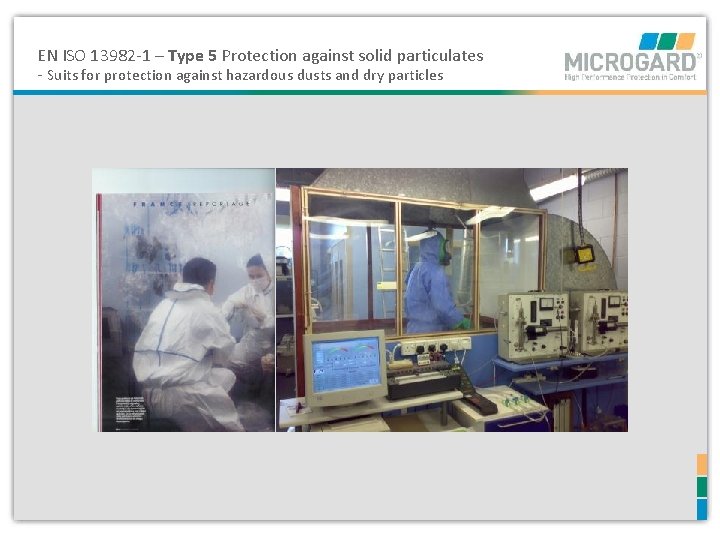
EN ISO 13982 -1 – Type 5 Protection against solid particulates - Suits for protection against hazardous dusts and dry particles
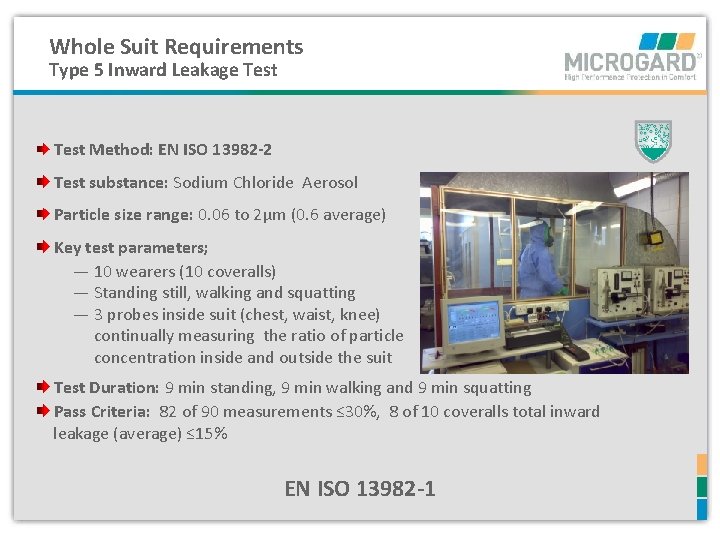
Whole Suit Requirements Type 5 Inward Leakage Test Method: EN ISO 13982 -2 Test substance: Sodium Chloride Aerosol Particle size range: 0. 06 to 2µm (0. 6 average) Key test parameters; — 10 wearers (10 coveralls) — Standing still, walking and squatting — 3 probes inside suit (chest, waist, knee) continually measuring the ratio of particle concentration inside and outside the suit Test Duration: 9 min standing, 9 min walking and 9 min squatting Pass Criteria: 82 of 90 measurements ≤ 30%, 8 of 10 coveralls total inward leakage (average) ≤ 15% EN ISO 13982 -1
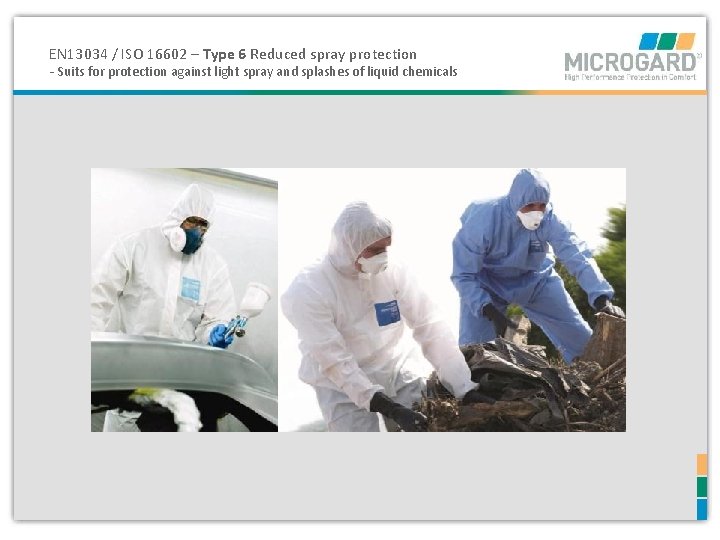
EN 13034 / ISO 16602 – Type 6 Reduced spray protection - Suits for protection against light spray and splashes of liquid chemicals
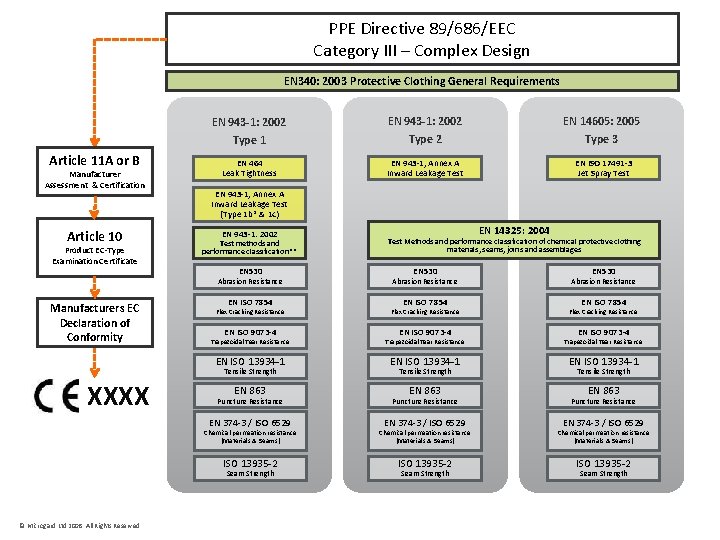
PPE Directive 89/686/EEC Category III – Complex Design EN 340: 2003 Protective Clothing General Requirements Article 11 A or B Manufacturer Assessment & Certification Article 10 Product EC-Type Examination Certificate EN 943 -1: 2002 Type 1 EN 943 -1: 2002 Type 2 EN 14605: 2005 Type 3 EN 464 Leak Tightness EN 943 -1, Annex A Inward Leakage Test EN ISO 17491 -3 Jet Spray Test EN 943 -1, Annex A Inward Leakage Test (Type 1 b* & 1 c) EN 943 -1: 2002 Test methods and performance classification** EN 530 Abrasion Resistance Manufacturers EC Declaration of Conformity EN ISO 7854 Flex Cracking Resistance EN ISO 9073 -4 EN 530 Abrasion Resistance EN ISO 7854 Flex Cracking Resistance EN ISO 9073 -4 Trapezoidal Tear Resistance EN ISO 13934 -1 EN 863 Puncture Resistance EN 374 -3 / ISO 6529 Tensile Strength EN 863 Puncture Resistance EN 374 -3 / ISO 6529 Chemical permeation resistance (Materials & Seams) ISO 13935 -2 Seam Strength © Microgard Ltd 2008. All Rights Reserved EN 530 Abrasion Resistance Trapezoidal Tear Resistance Tensile Strength XXXX EN 14325: 2004 Test Methods and performance classification of chemical protective clothing materials, seams, joins and assemblages Seam Strength
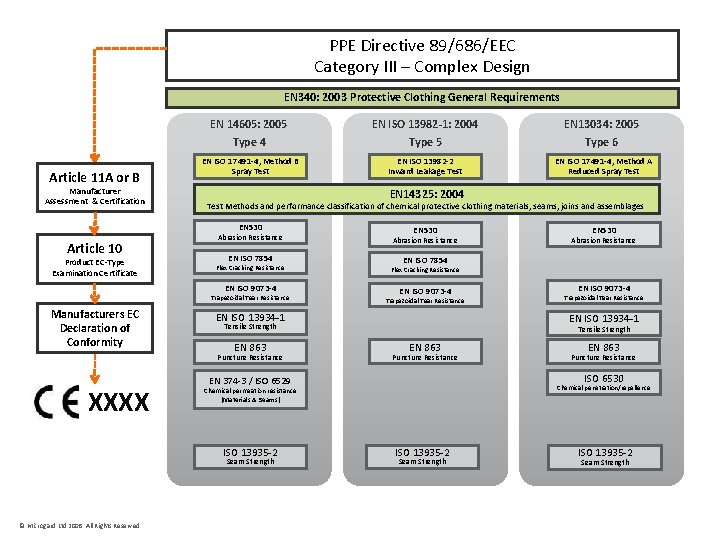
PPE Directive 89/686/EEC Category III – Complex Design EN 340: 2003 Protective Clothing General Requirements Article 11 A or B Manufacturer Assessment & Certification EN 14605: 2005 Type 4 EN ISO 13982 -1: 2004 Type 5 EN 13034: 2005 Type 6 EN ISO 17491 -4, Method B Spray Test EN ISO 13982 -2 Inward Leakage Test EN ISO 17491 -4, Method A Reduced Spray Test EN 14325: 2004 Test Methods and performance classification of chemical protective clothing materials, seams, joins and assemblages EN 530 Article 10 Product EC-Type Examination Certificate Abrasion Resistance EN ISO 7854 Flex Cracking Resistance EN ISO 9073 -4 Trapezoidal Tear Resistance Manufacturers EC Declaration of Conformity EN ISO 9073 -4 Trapezoidal Tear Resistance Tensile Strength EN 863 Puncture Resistance ISO 6530 EN 374 -3 / ISO 6529 Seam Strength EN ISO 9073 -4 Trapezoidal Tear Resistance EN ISO 13934 -1 Chemical penetration/repellence Chemical permeation resistance (Materials & Seams) ISO 13935 -2 © Microgard Ltd 2008. All Rights Reserved EN ISO 7854 Tensile Strength EN 863 EN 530 Abrasion Resistance Flex Cracking Resistance EN ISO 13934 -1 Puncture Resistance XXXX EN 530 Abrasion Resistance ISO 13935 -2 Seam Strength

So what product should I choose…. . ? ? ?
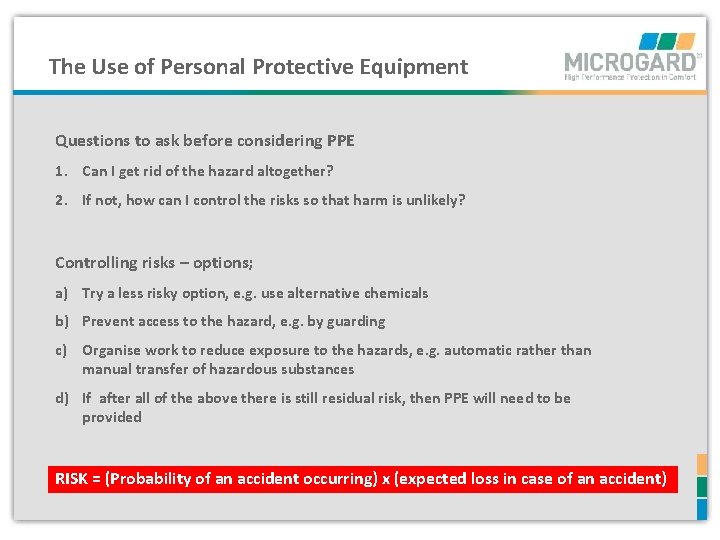
The Use of Personal Protective Equipment Questions to ask before considering PPE 1. Can I get rid of the hazard altogether? 2. If not, how can I control the risks so that harm is unlikely? Controlling risks – options; a) Try a less risky option, e. g. use alternative chemicals b) Prevent access to the hazard, e. g. by guarding c) Organise work to reduce exposure to the hazards, e. g. automatic rather than manual transfer of hazardous substances d) If after all of the above there is still residual risk, then PPE will need to be provided RISK = (Probability of an accident occurring) x (expected loss in case of an accident)
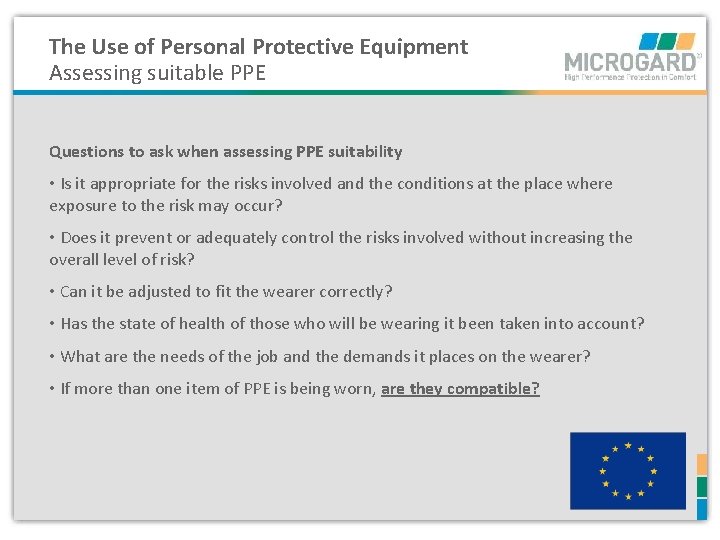
The Use of Personal Protective Equipment Assessing suitable PPE Questions to ask when assessing PPE suitability • Is it appropriate for the risks involved and the conditions at the place where exposure to the risk may occur? • Does it prevent or adequately control the risks involved without increasing the overall level of risk? • Can it be adjusted to fit the wearer correctly? • Has the state of health of those who will be wearing it been taken into account? • What are the needs of the job and the demands it places on the wearer? • If more than one item of PPE is being worn, are they compatible?
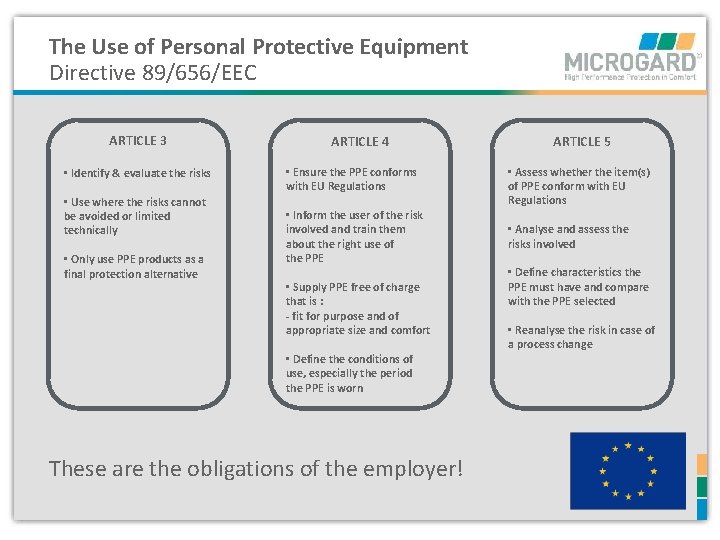
The Use of Personal Protective Equipment Directive 89/656/EEC ARTICLE 3 • Identify & evaluate the risks • Use where the risks cannot be avoided or limited technically • Only use PPE products as a final protection alternative ARTICLE 4 • Ensure the PPE conforms with EU Regulations • Inform the user of the risk involved and train them about the right use of the PPE • Supply PPE free of charge that is : - fit for purpose and of appropriate size and comfort • Define the conditions of use, especially the period the PPE is worn These are the obligations of the employer! ARTICLE 5 • Assess whether the item(s) of PPE conform with EU Regulations • Analyse and assess the risks involved • Define characteristics the PPE must have and compare with the PPE selected • Reanalyse the risk in case of a process change
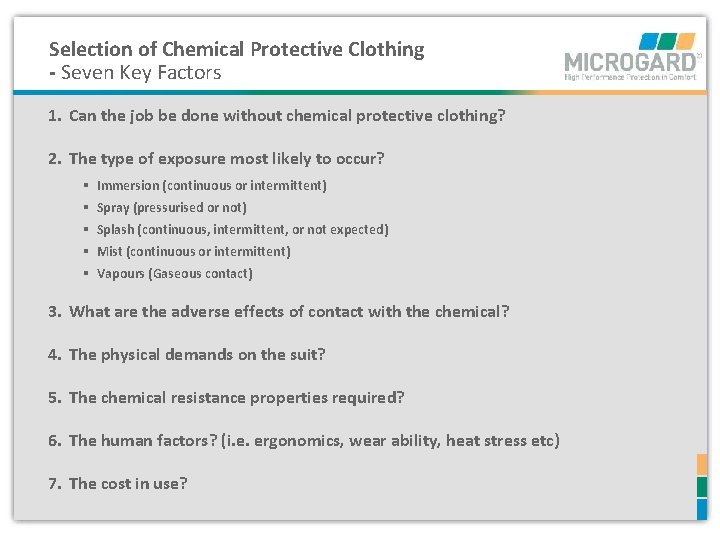
Selection of Chemical Protective Clothing - Seven Key Factors 1. Can the job be done without chemical protective clothing? 2. The type of exposure most likely to occur? § Immersion (continuous or intermittent) § Spray (pressurised or not) § Splash (continuous, intermittent, or not expected) § Mist (continuous or intermittent) § Vapours (Gaseous contact) 3. What are the adverse effects of contact with the chemical? 4. The physical demands on the suit? 5. The chemical resistance properties required? 6. The human factors? (i. e. ergonomics, wear ability, heat stress etc) 7. The cost in use?
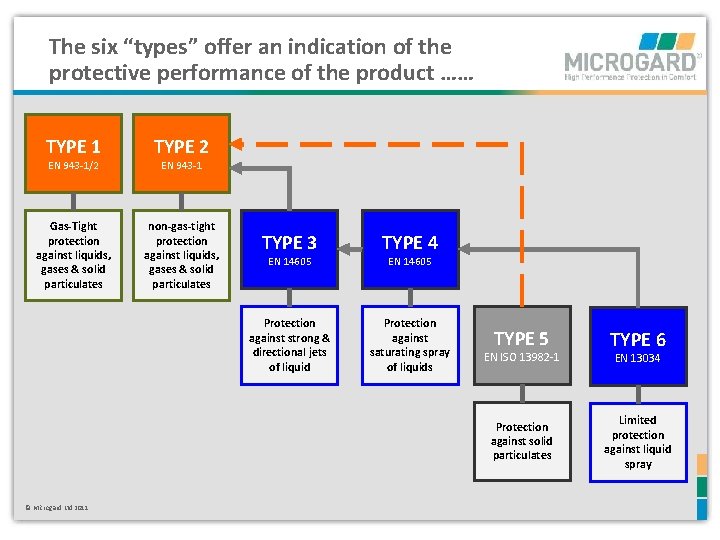
The six “types” offer an indication of the protective performance of the product …… TYPE 1 TYPE 2 Gas-Tight protection against liquids, gases & solid particulates non-gas-tight protection against liquids, gases & solid particulates EN 943 -1/2 EN 943 -1 TYPE 3 TYPE 4 Protection against strong & directional jets of liquid Protection against saturating spray of liquids EN 14605 TYPE 5 EN ISO 13982 -1 Protection against solid particulates © Microgard Ltd 2011 TYPE 6 EN 13034 Limited protection against liquid spray
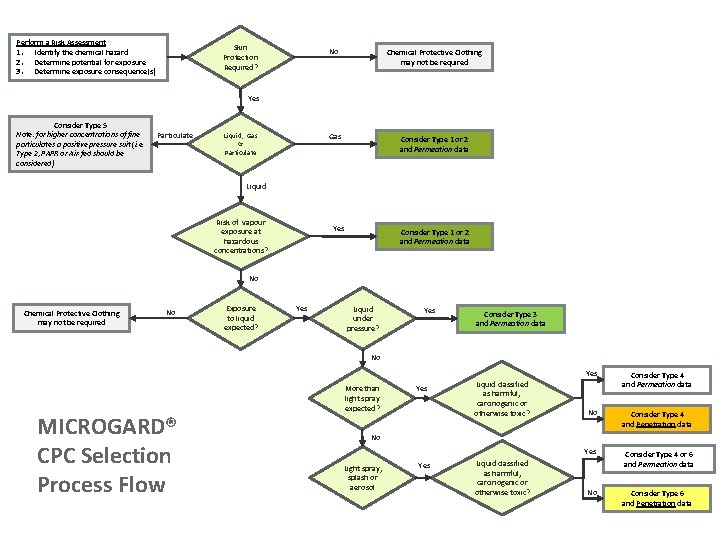
Perform a Risk Assessment 1. Identify the chemical hazard 2. Determine potential for exposure 3. Determine exposure consequence(s) Skin Protection Required? No Chemical Protective Clothing may not be required Gas Consider Type 1 or 2 and Permeation data Yes Consider Type 5 Note: for higher concentrations of fine particulates a positive pressure suit (i. e. Type 2, PAPR or Air-fed should be considered) Particulate Liquid, Gas or Particulate Liquid Risk of vapour exposure at hazardous concentrations? Yes Consider Type 1 or 2 and Permeation data No Chemical Protective Clothing may not be required No Exposure to liquid expected? Yes Liquid under pressure? Yes Consider Type 3 and Permeation data No MICROGARD® CPC Selection Process Flow More than light spray expected? Yes Liquid classified as harmful, carcinogenic or otherwise toxic? Yes Consider Type 4 and Permeation data No Consider Type 4 and Penetration data Yes Consider Type 4 or 6 and Permeation data No Consider Type 6 and Penetration data No Light spray, splash or aerosol Yes Liquid classified as harmful, 26 or carcinogenic otherwise toxic?
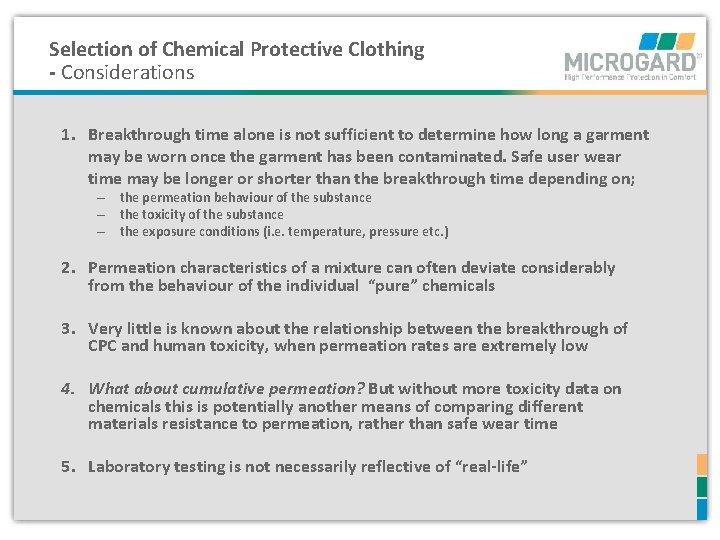
Selection of Chemical Protective Clothing - Considerations 1. Breakthrough time alone is not sufficient to determine how long a garment may be worn once the garment has been contaminated. Safe user wear time may be longer or shorter than the breakthrough time depending on; – the permeation behaviour of the substance – the toxicity of the substance – the exposure conditions (i. e. temperature, pressure etc. ) 2. Permeation characteristics of a mixture can often deviate considerably from the behaviour of the individual “pure” chemicals 3. Very little is known about the relationship between the breakthrough of CPC and human toxicity, when permeation rates are extremely low 4. What about cumulative permeation? But without more toxicity data on chemicals this is potentially another means of comparing different materials resistance to permeation, rather than safe wear time 5. Laboratory testing is not necessarily reflective of “real-life”
Correct wearing of chemical protective clothing
Correct wearing of Chemical Protective Clothing
Correct wearing of Chemical Protective Clothing
Correct wearing of Chemical Protective Clothing
Correct wearing of Chemical Protective Clothing
Correct wearing of Chemical Protective Clothing
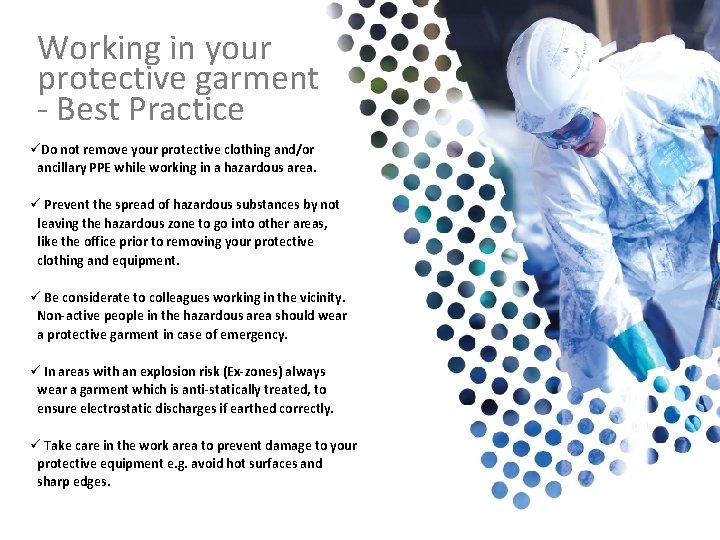
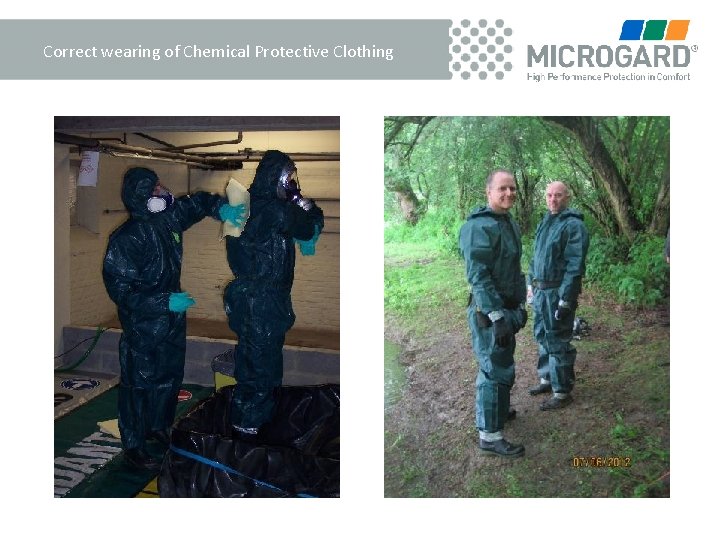
Working in your protective garment - Best Practice üDo not remove your protective clothing and/or ancillary PPE while working in a hazardous area. ü Prevent the spread of hazardous substances by not leaving the hazardous zone to go into other areas, like the office prior to removing your protective clothing and equipment. ü Be considerate to colleagues working in the vicinity. Non-active people in the hazardous area should wear a protective garment in case of emergency. ü In areas with an explosion risk (Ex-zones) always wear a garment which is anti-statically treated, to ensure electrostatic discharges if earthed correctly. ü Take care in the work area to prevent damage to your protective equipment e. g. avoid hot surfaces and sharp edges.
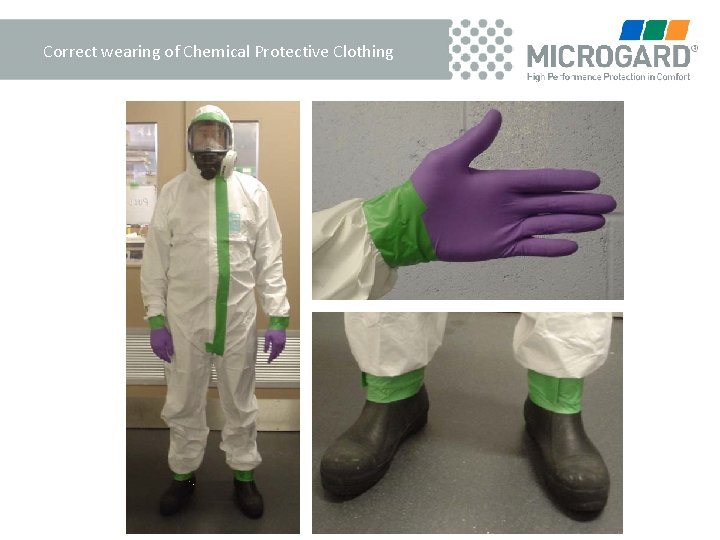
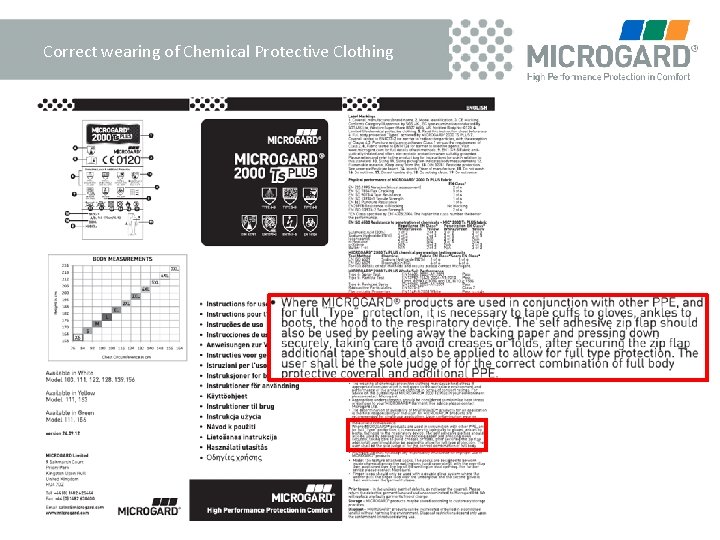
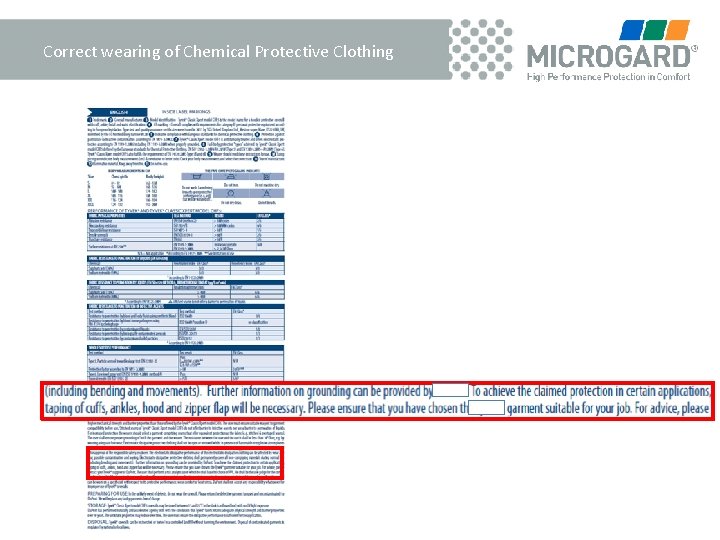
Correct wearing of Chemical Protective Clothing Remember. . • You have your limitations, and so does protective clothing • Always check the label • Take of your shoes/boots • Don’t rush! • Use your buddy • You are responsible for your own safety and well-being!
Correct wearing of Chemical Protective Clothing

Thank you Any Questions? www. microgard. com
- Slides: 37