
Chemical Properties of Secondary Phyllosilicates Isomorphous substitution replacement
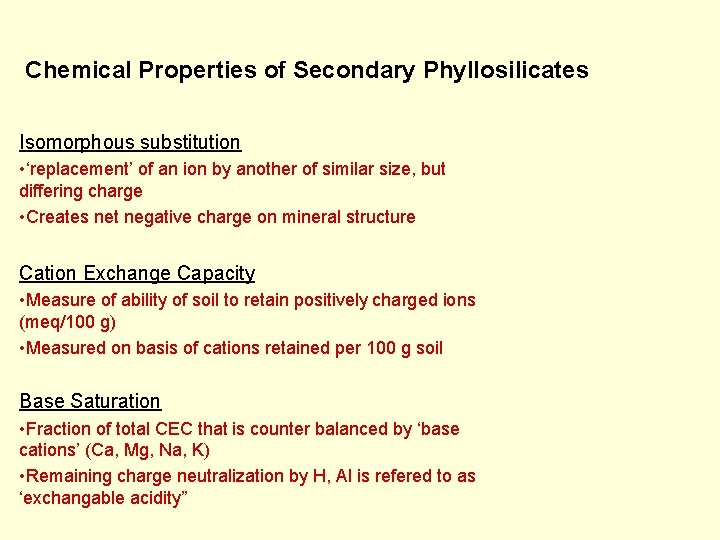
Chemical Properties of Secondary Phyllosilicates Isomorphous substitution • ‘replacement’ of an ion by another of similar size, but differing charge • Creates net negative charge on mineral structure Cation Exchange Capacity • Measure of ability of soil to retain positively charged ions (meq/100 g) • Measured on basis of cations retained per 100 g soil Base Saturation • Fraction of total CEC that is counter balanced by ‘base cations’ (Ca, Mg, Na, K) • Remaining charge neutralization by H, Al is refered to as ‘exchangable acidity”
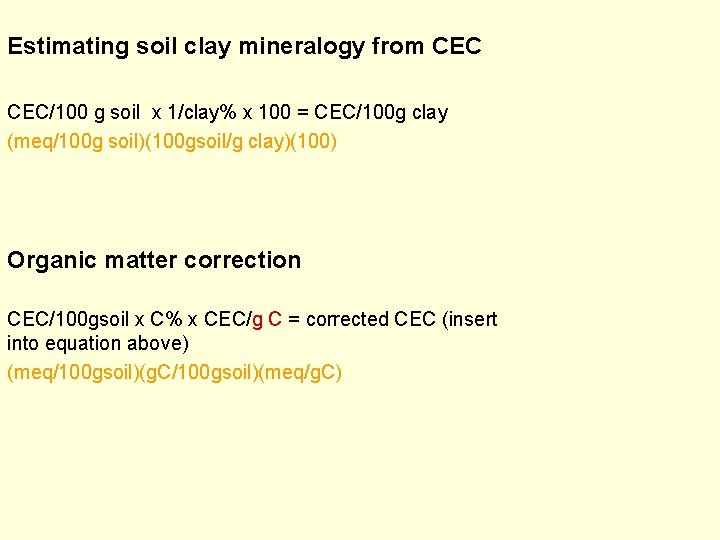
Estimating soil clay mineralogy from CEC/100 g soil x 1/clay% x 100 = CEC/100 g clay (meq/100 g soil)(100 gsoil/g clay)(100) Organic matter correction CEC/100 gsoil x C% x CEC/g C = corrected CEC (insert into equation above) (meq/100 gsoil)(g. C/100 gsoil)(meq/g. C)
Example from Brazil
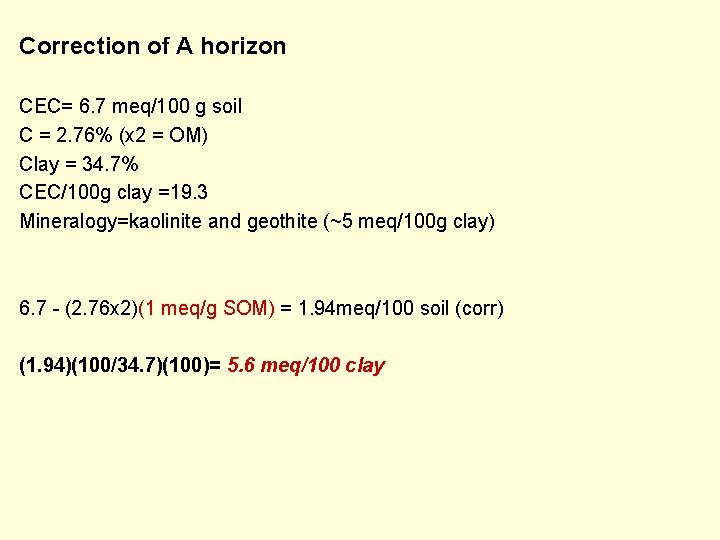
Correction of A horizon CEC= 6. 7 meq/100 g soil C = 2. 76% (x 2 = OM) Clay = 34. 7% CEC/100 g clay =19. 3 Mineralogy=kaolinite and geothite (~5 meq/100 g clay) 6. 7 - (2. 76 x 2)(1 meq/g SOM) = 1. 94 meq/100 soil (corr) (1. 94)(100/34. 7)(100)= 5. 6 meq/100 clay
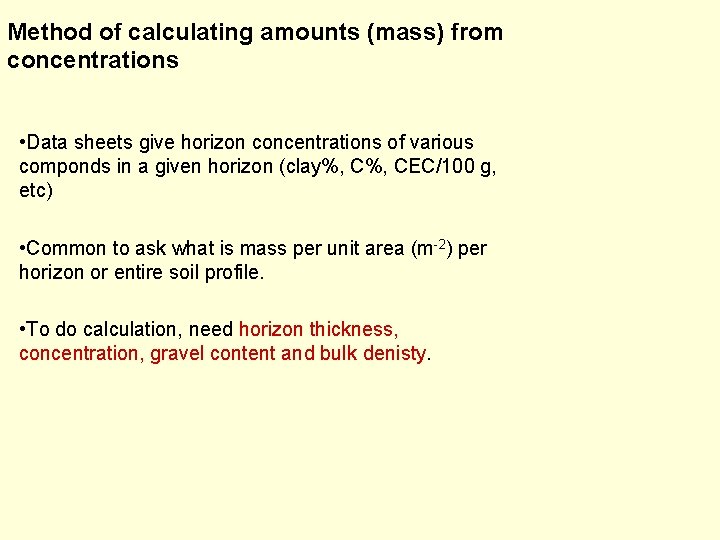
Method of calculating amounts (mass) from concentrations • Data sheets give horizon concentrations of various componds in a given horizon (clay%, CEC/100 g, etc) • Common to ask what is mass per unit area (m-2) per horizon or entire soil profile. • To do calculation, need horizon thickness, concentration, gravel content and bulk denisty.
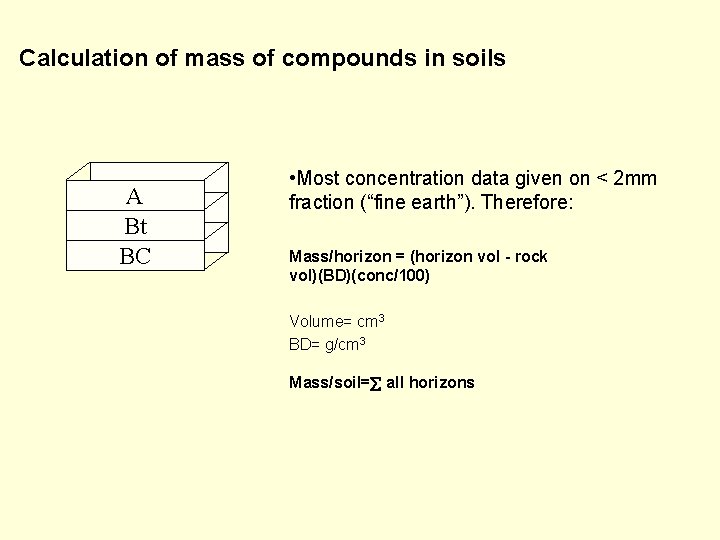
Calculation of mass of compounds in soils A Bt BC • Most concentration data given on < 2 mm fraction (“fine earth”). Therefore: Mass/horizon = (horizon vol - rock vol)(BD)(conc/100) Volume= cm 3 BD= g/cm 3 Mass/soil= all horizons
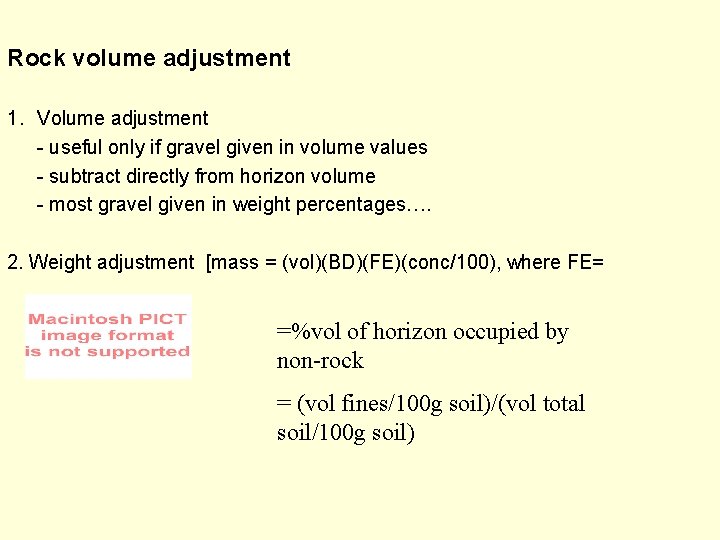
Rock volume adjustment 1. Volume adjustment - useful only if gravel given in volume values - subtract directly from horizon volume - most gravel given in weight percentages…. 2. Weight adjustment [mass = (vol)(BD)(FE)(conc/100), where FE= =%vol of horizon occupied by non-rock = (vol fines/100 g soil)/(vol total soil/100 g soil)
Clay Dispersion and Flocculation: mechanisms and soil impacts • Clay formation can occur througout soil, though clay is usually concentrated below surface –Implies some sort of transport • The suspension of clays in downward moving water is related to their electrical properties and the chemistry of the surrounding waters
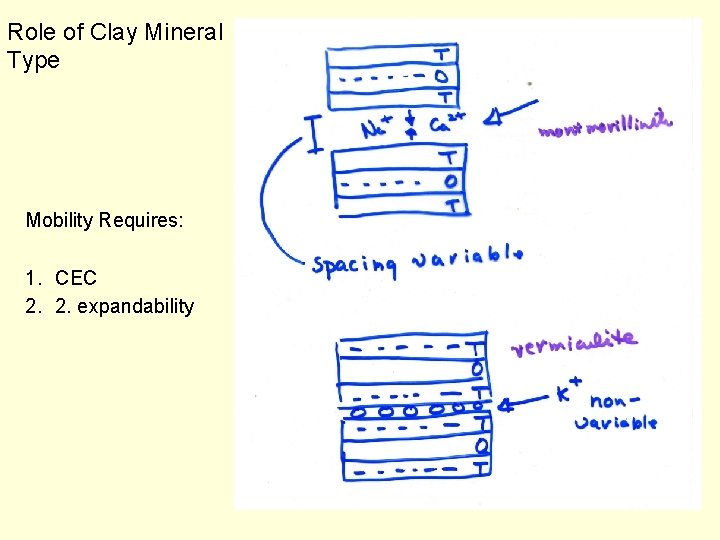
Role of Clay Mineral Type Mobility Requires: 1. CEC 2. 2. expandability
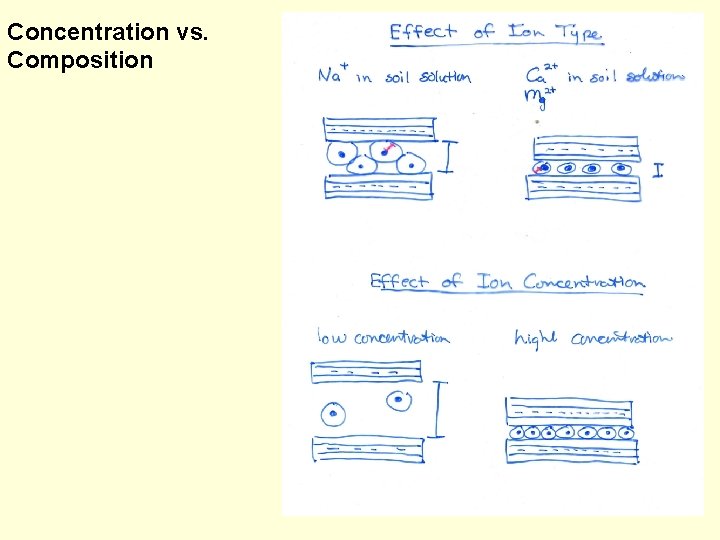
Concentration vs. Composition
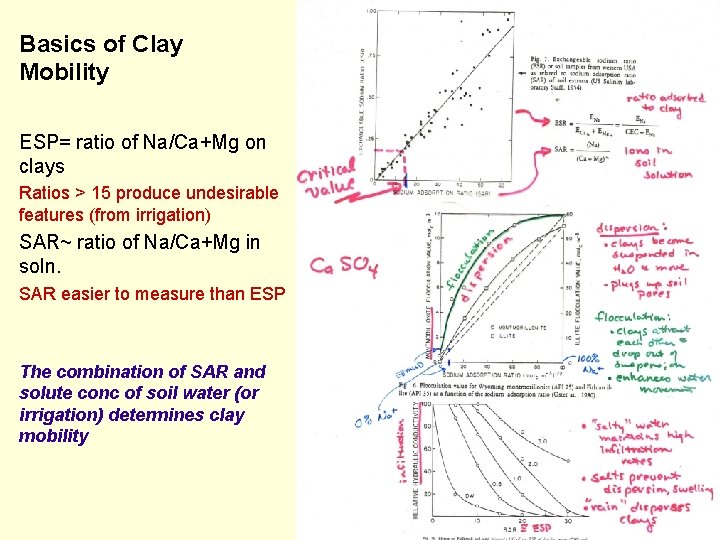
Basics of Clay Mobility ESP= ratio of Na/Ca+Mg on clays Ratios > 15 produce undesirable features (from irrigation) SAR~ ratio of Na/Ca+Mg in soln. SAR easier to measure than ESP The combination of SAR and solute conc of soil water (or irrigation) determines clay mobility
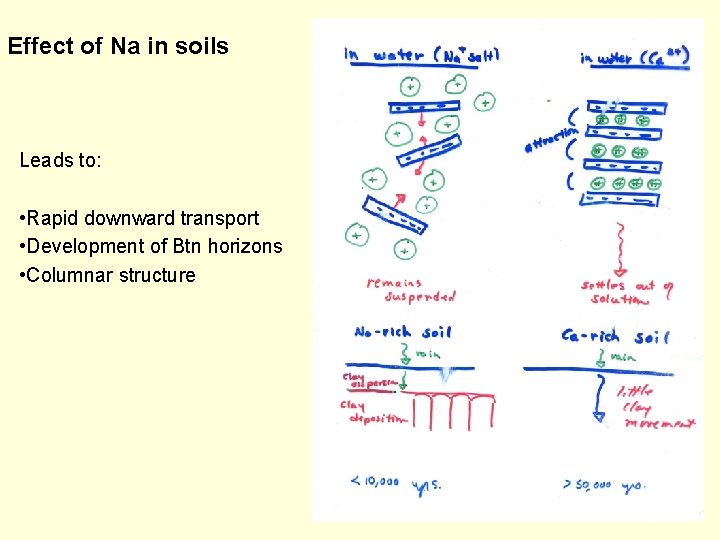
Effect of Na in soils Leads to: • Rapid downward transport • Development of Btn horizons • Columnar structure
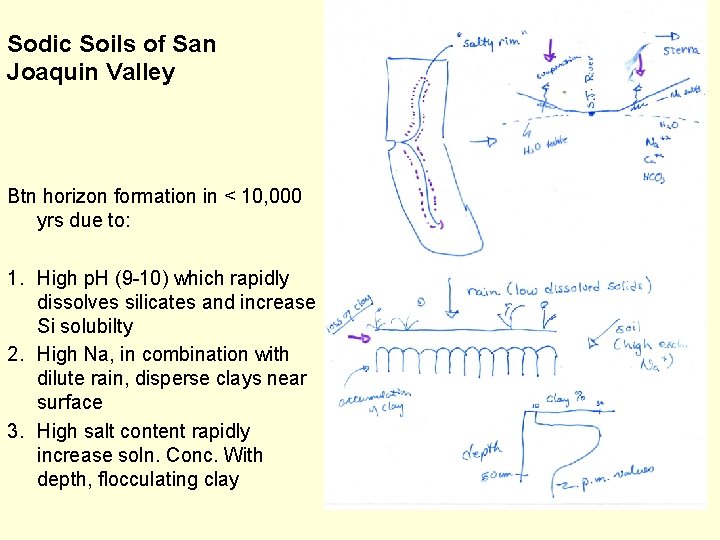
Sodic Soils of San Joaquin Valley Btn horizon formation in < 10, 000 yrs due to: 1. High p. H (9 -10) which rapidly dissolves silicates and increase Si solubilty 2. High Na, in combination with dilute rain, disperse clays near surface 3. High salt content rapidly increase soln. Conc. With depth, flocculating clay
ransect of east
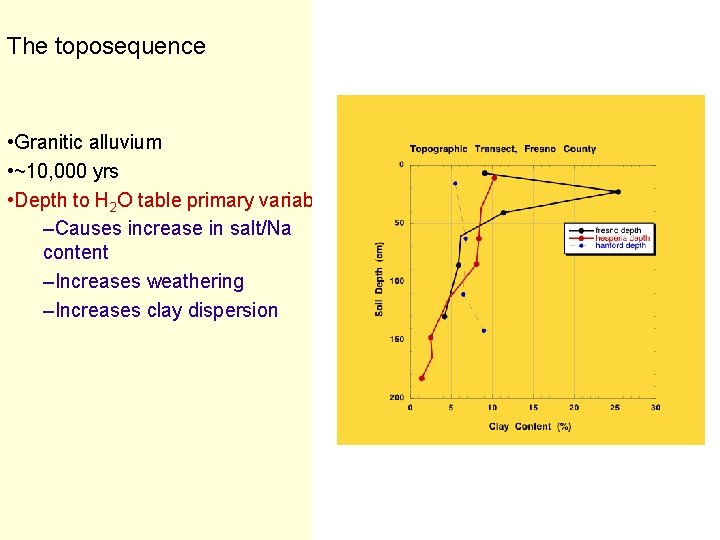
The toposequence • Granitic alluvium • ~10, 000 yrs • Depth to H 2 O table primary variable –Causes increase in salt/Na content –Increases weathering –Increases clay dispersion
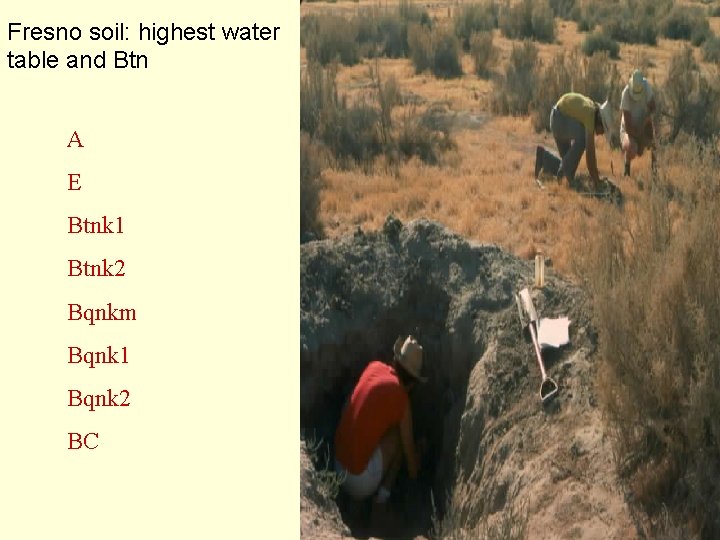
Fresno soil: highest water table and Btn A E Btnk 1 Btnk 2 Bqnkm Bqnk 1 Bqnk 2 BC
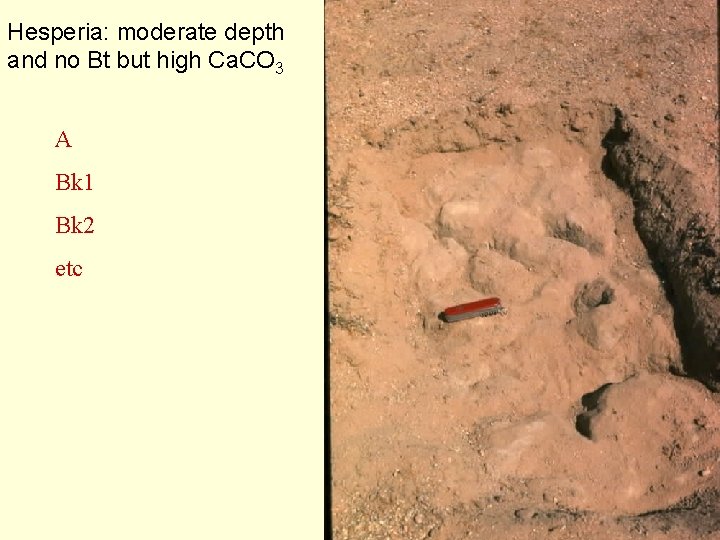
Hesperia: moderate depth and no Bt but high Ca. CO 3 A Bk 1 Bk 2 etc
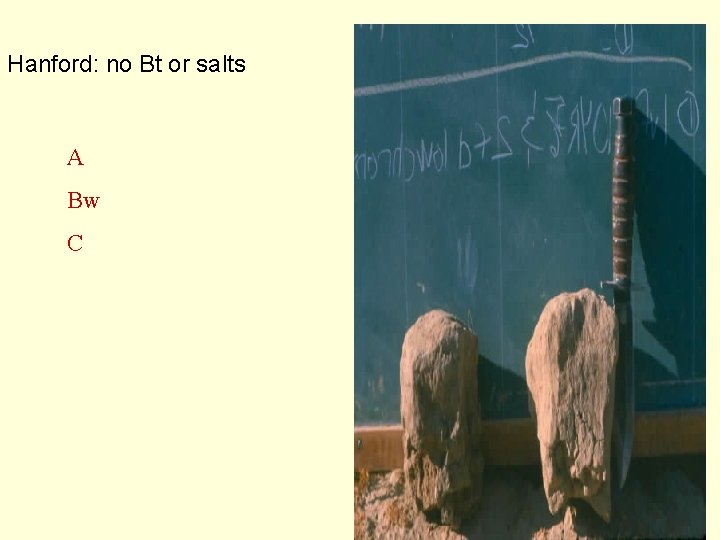
Hanford: no Bt or salts A Bw C
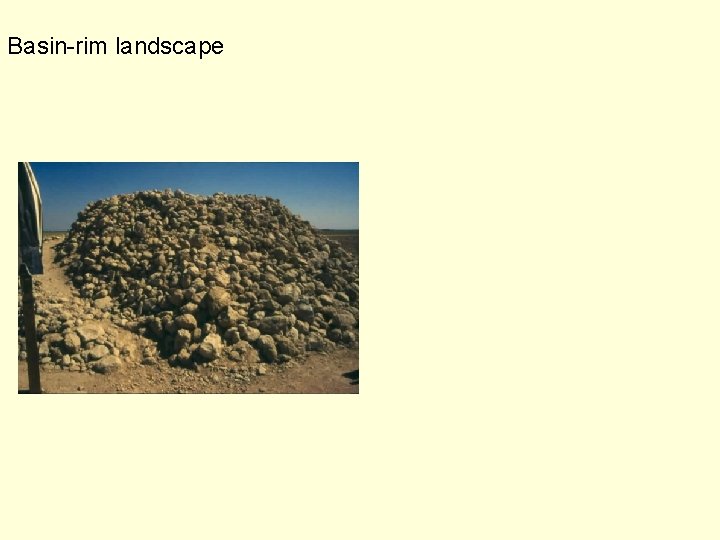
Basin-rim landscape

- Slides: 20