
Chemical Properties of Gases Daily Uses of Gases
- Slides: 8
Chemical Properties of Gases
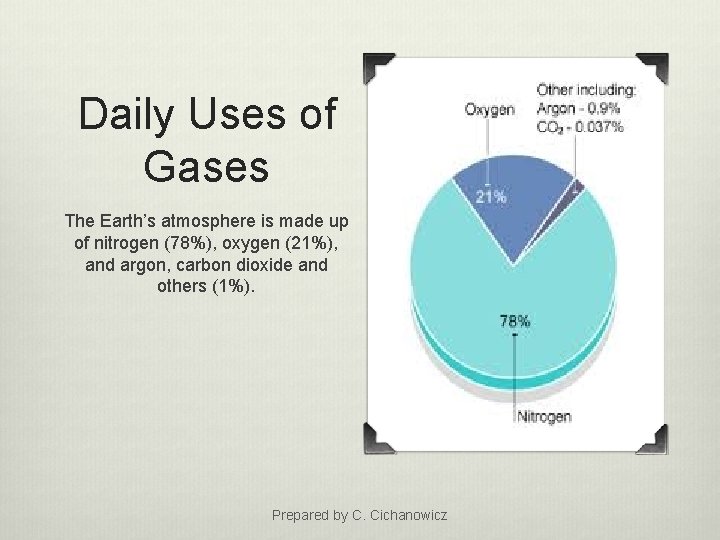
Daily Uses of Gases The Earth’s atmosphere is made up of nitrogen (78%), oxygen (21%), and argon, carbon dioxide and others (1%). Prepared by C. Cichanowicz
Daily Uses of Gases v Nitrogen is the most abundant gas in the atmosphere and the most essential to plants; however, plants cannot absorb it until it has been transformed into nitrogen compounds by bacteria found in soil. v Oxygen is the second most abundant gas in the atmosphere and it is essential for respiration. It is mainly produced by photosynthesis. v Carbon dioxide (a product of cellular respiration) and methane (results from the fermentation of organic matter, mammals digestion, and trapped in permafrost) are greenhouse gases. v Gases have an undefined shape and volume. Prepared by C. Cichanowicz
Chemical Reactivity of Gases v The chemical reactivity of gases is determined by the physical and chemical properties of substances. The chemical reactivity of a substance is the capacity and ease with which it reacts in given physical conditions or in the presence of other chemical substances. The reactivity of a gas is usually specific to it or a group of gases. v The following element are gaseous at ambient temperature: H 2, N 2, O 2, F 2, Cl 2, He, Ne, Ar, Kr, Xe, Rn (the last 6 are monatomic and are the noble gases). Prepared by C. Cichanowicz
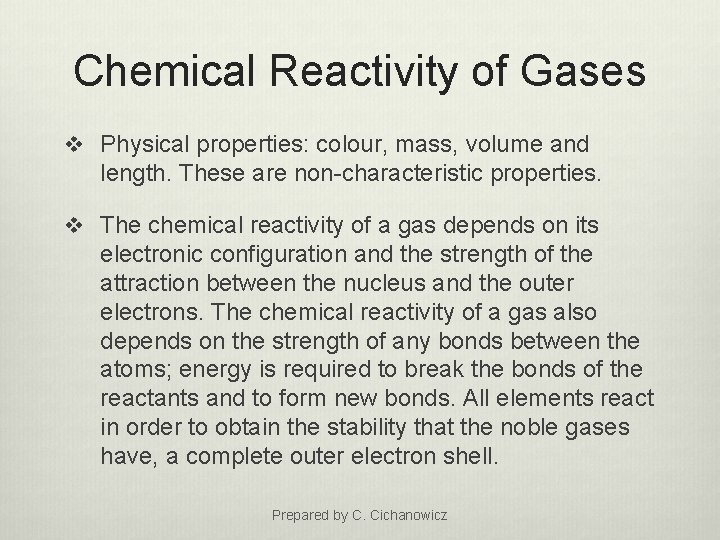
Chemical Reactivity of Gases v Physical properties: colour, mass, volume and length. These are non-characteristic properties. v The chemical reactivity of a gas depends on its electronic configuration and the strength of the attraction between the nucleus and the outer electrons. The chemical reactivity of a gas also depends on the strength of any bonds between the atoms; energy is required to break the bonds of the reactants and to form new bonds. All elements react in order to obtain the stability that the noble gases have, a complete outer electron shell. Prepared by C. Cichanowicz
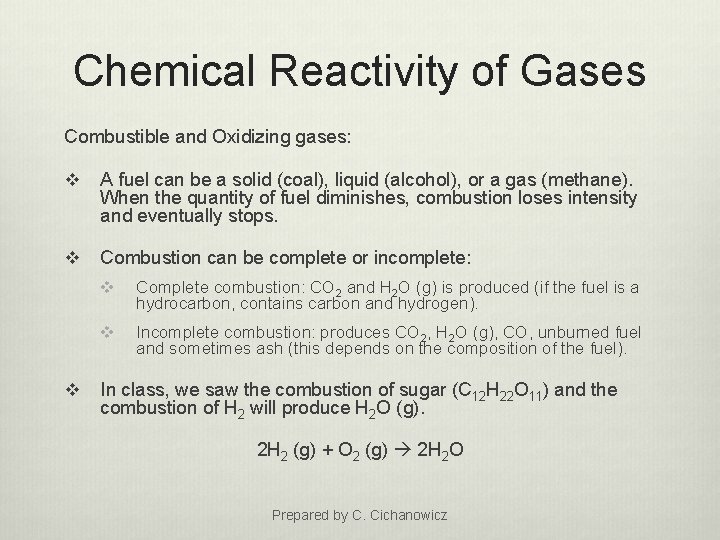
Chemical Reactivity of Gases Combustible and Oxidizing gases: v A fuel can be a solid (coal), liquid (alcohol), or a gas (methane). When the quantity of fuel diminishes, combustion loses intensity and eventually stops. v Combustion can be complete or incomplete: v v Complete combustion: CO 2 and H 2 O (g) is produced (if the fuel is a hydrocarbon, contains carbon and hydrogen). v Incomplete combustion: produces CO 2, H 2 O (g), CO, unburned fuel and sometimes ash (this depends on the composition of the fuel). In class, we saw the combustion of sugar (C 12 H 22 O 11) and the combustion of H 2 will produce H 2 O (g). 2 H 2 (g) + O 2 (g) 2 H 2 O Prepared by C. Cichanowicz
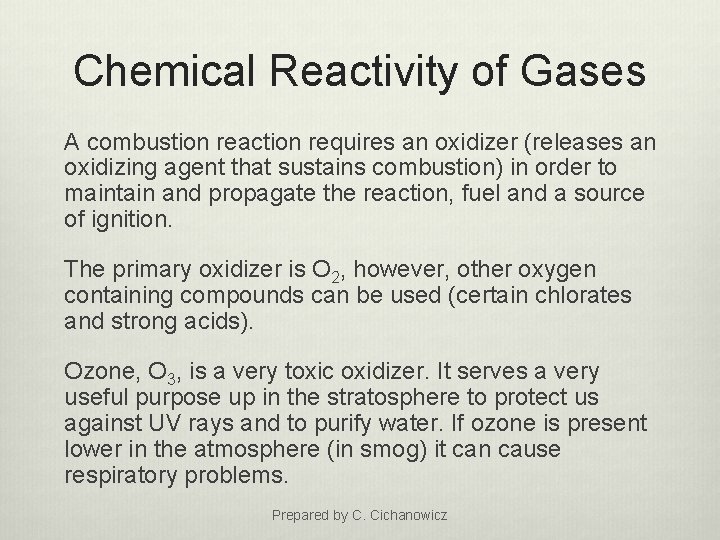
Chemical Reactivity of Gases A combustion reaction requires an oxidizer (releases an oxidizing agent that sustains combustion) in order to maintain and propagate the reaction, fuel and a source of ignition. The primary oxidizer is O 2, however, other oxygen containing compounds can be used (certain chlorates and strong acids). Ozone, O 3, is a very toxic oxidizer. It serves a very useful purpose up in the stratosphere to protect us against UV rays and to purify water. If ozone is present lower in the atmosphere (in smog) it can cause respiratory problems. Prepared by C. Cichanowicz
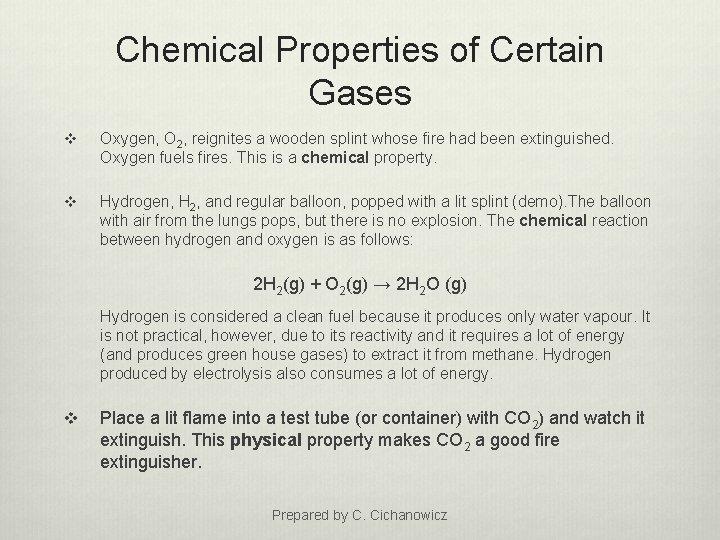
Chemical Properties of Certain Gases v Oxygen, O 2, reignites a wooden splint whose fire had been extinguished. Oxygen fuels fires. This is a chemical property. v Hydrogen, H 2, and regular balloon, popped with a lit splint (demo). The balloon with air from the lungs pops, but there is no explosion. The chemical reaction between hydrogen and oxygen is as follows: 2 H 2(g) + O 2(g) → 2 H 2 O (g) Hydrogen is considered a clean fuel because it produces only water vapour. It is not practical, however, due to its reactivity and it requires a lot of energy (and produces green house gases) to extract it from methane. Hydrogen produced by electrolysis also consumes a lot of energy. v Place a lit flame into a test tube (or container) with CO 2) and watch it extinguish. This physical property makes CO 2 a good fire extinguisher. Prepared by C. Cichanowicz