
CHEMICAL PROPERTIES Chapter 3 3 IDENTIFYING CHEMICAL PROPERTIES
- Slides: 9
CHEMICAL PROPERTIES Chapter 3 - 3
IDENTIFYING CHEMICAL PROPERTIES • Chemical properties are the ability of substances to change into entirely new substances. • The new substances have a different set of properties from the original substances.
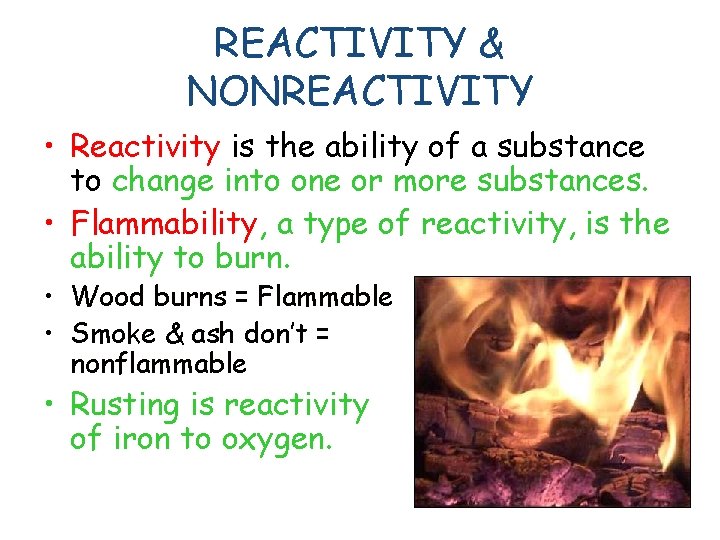
REACTIVITY & NONREACTIVITY • Reactivity is the ability of a substance to change into one or more substances. • Flammability, a type of reactivity, is the ability to burn. • Wood burns = Flammable • Smoke & ash don’t = nonflammable • Rusting is reactivity of iron to oxygen.
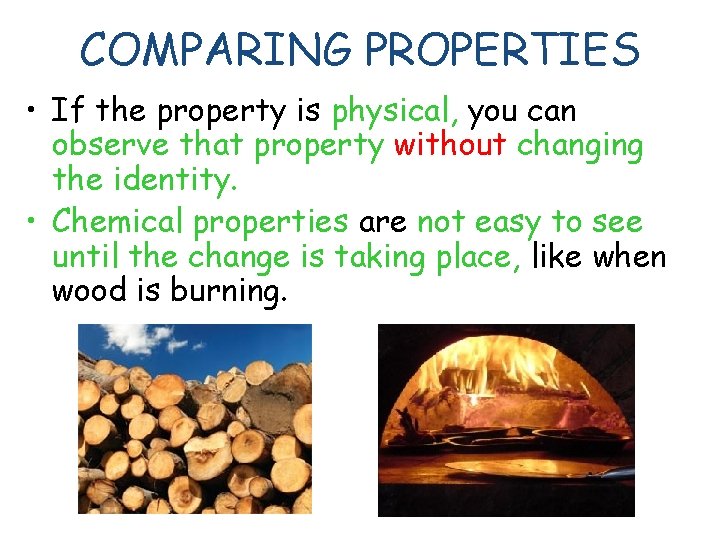
COMPARING PROPERTIES • If the property is physical, you can observe that property without changing the identity. • Chemical properties are not easy to see until the change is taking place, like when wood is burning.
CHARACTERISTIC PROPERTIES • Characteristics that are the most useful in identifying substances are called characteristic properties. • Density and reactivity are two of these properties. • Scientists rely on these to identify and classify substances.
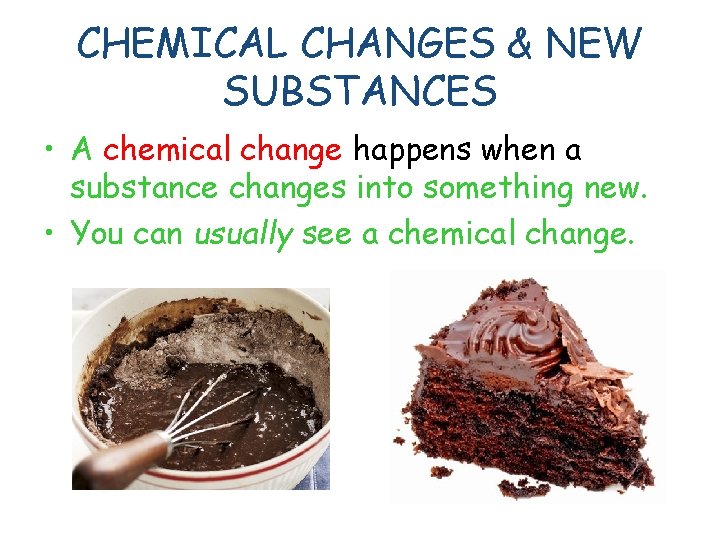
CHEMICAL CHANGES & NEW SUBSTANCES • A chemical change happens when a substance changes into something new. • You can usually see a chemical change.
SIGNS OF CHEMICAL CHANGES: • Chemical changes often cause color changes, fizzing or foaming, a temperature change, production of sound, light, or odor. • Chemical changes cannot be “undone” because the substance’s identity changes.
EXAMPLES OF CHEMICAL CHANGES: • Soured milk smells bad because bacteria have formed new substances in the milk. • Statue of Liberty turned green because the copper reacts to the moist air. • Effervescent tablets bubble because the ingredients react with water. • Hot gases from a rocket form because hydrogen and oxygen join to make water.
THE END • CHAPTER 3 - 3