
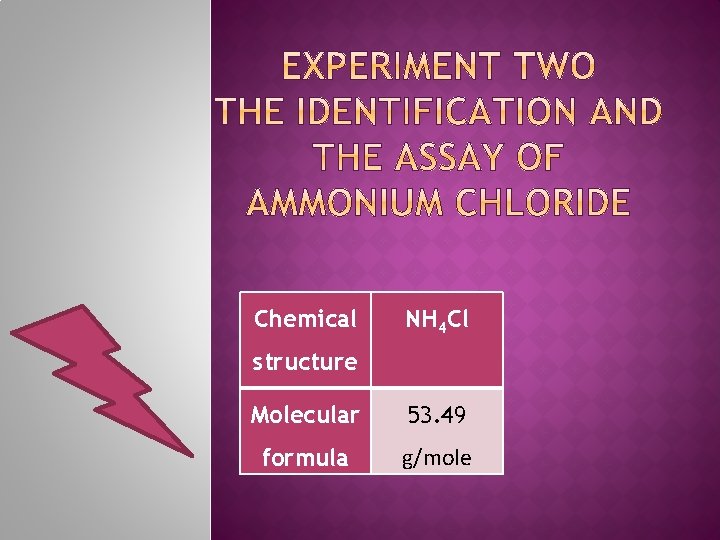
Chemical NH 4 Cl structure Molecular 53 49
- Slides: 16
Chemical NH 4 Cl structure Molecular 53. 49 formula g/mole
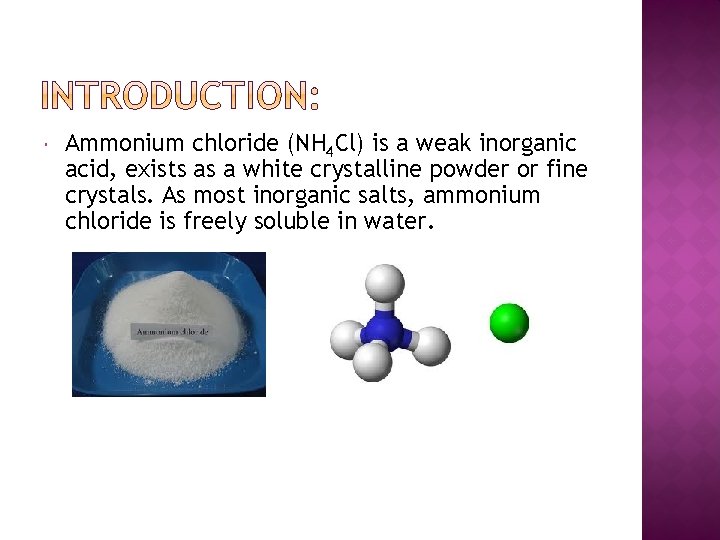
Ammonium chloride (NH 4 Cl) is a weak inorganic acid, exists as a white crystalline powder or fine crystals. As most inorganic salts, ammonium chloride is freely soluble in water.
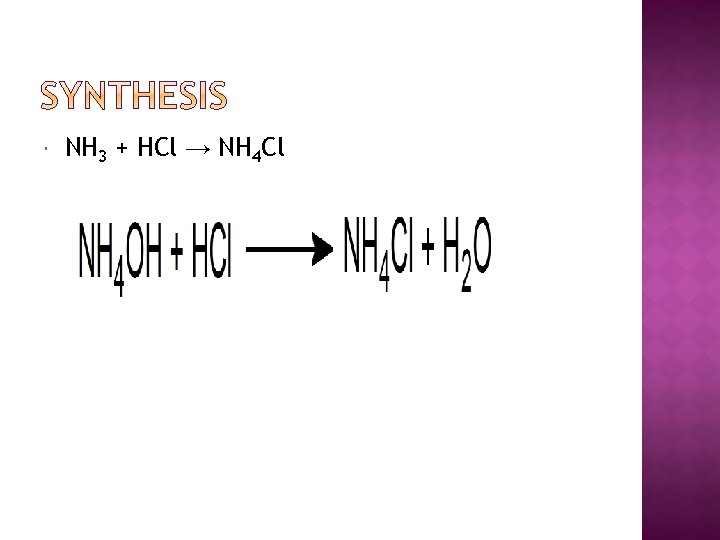
NH 3 + HCl → NH 4 Cl
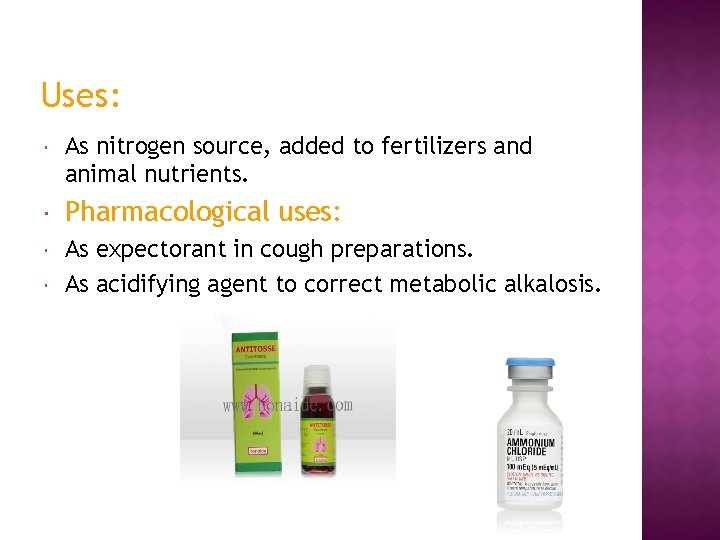
Uses: As nitrogen source, added to fertilizers and animal nutrients. Pharmacological uses: As expectorant in cough preparations. As acidifying agent to correct metabolic alkalosis.
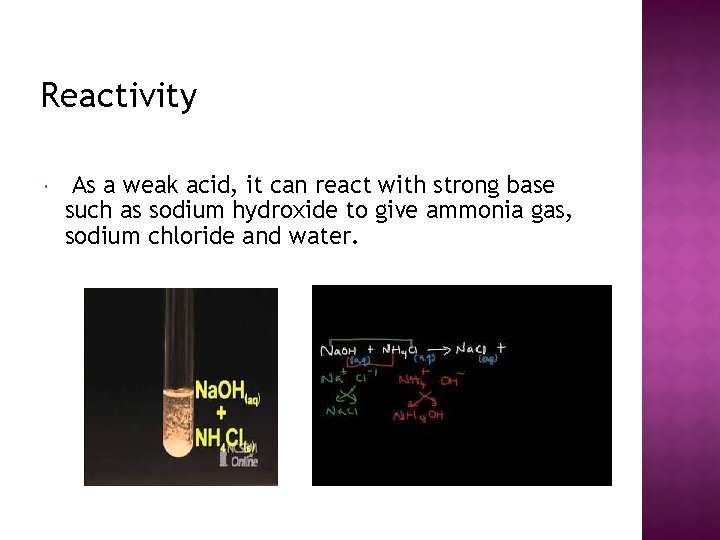
Reactivity As a weak acid, it can react with strong base such as sodium hydroxide to give ammonia gas, sodium chloride and water.
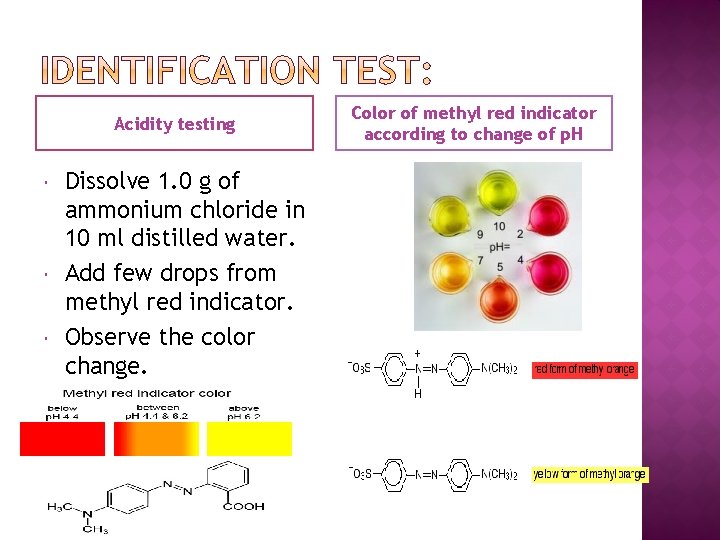
Acidity testing Dissolve 1. 0 g of ammonium chloride in 10 ml distilled water. Add few drops from methyl red indicator. Observe the color change. Color of methyl red indicator according to change of p. H
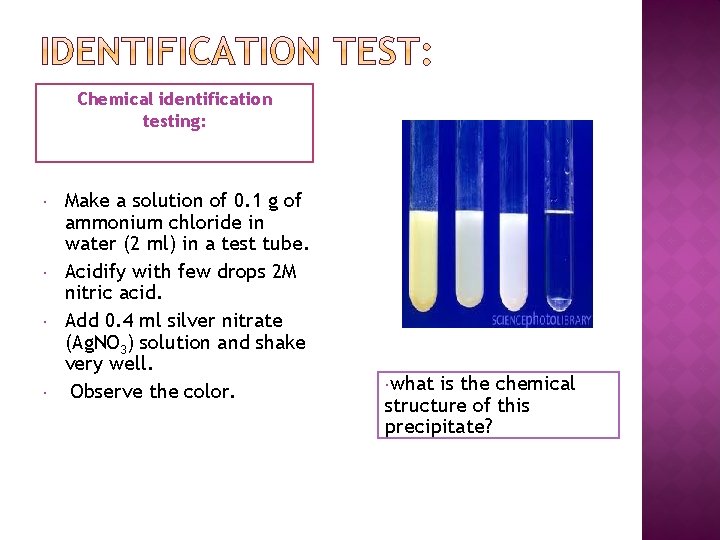
Chemical identification testing: Make a solution of 0. 1 g of ammonium chloride in water (2 ml) in a test tube. Acidify with few drops 2 M nitric acid. Add 0. 4 ml silver nitrate (Ag. NO 3) solution and shake very well. Observe the color. what is the chemical structure of this precipitate?
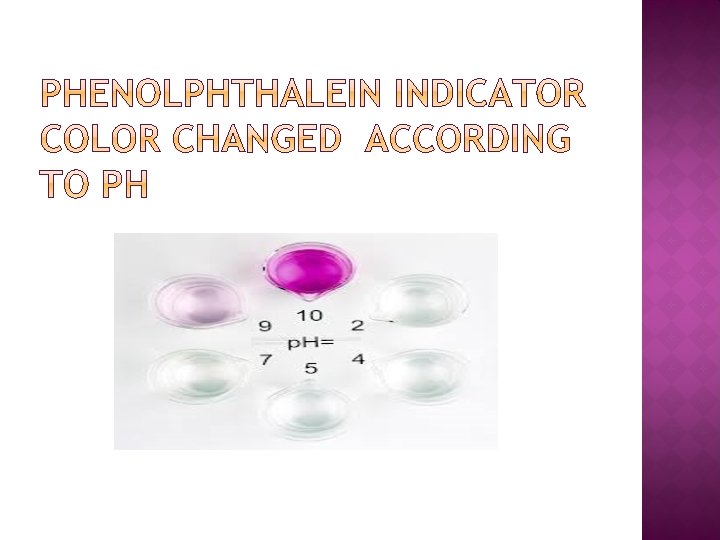
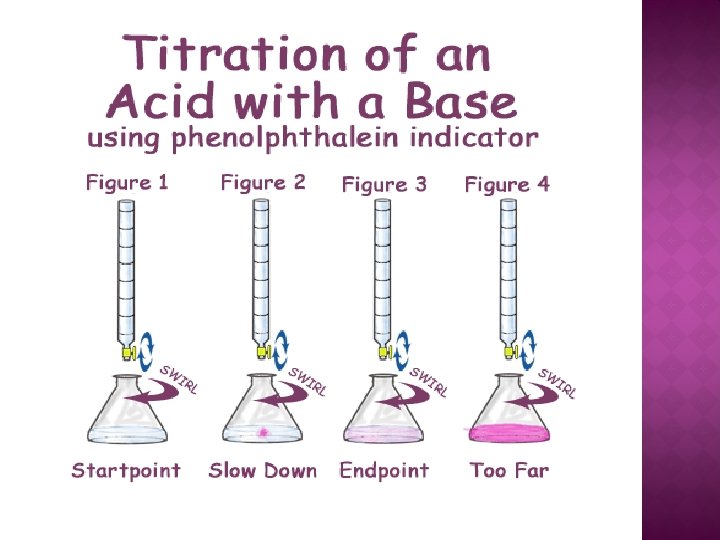
Informations about today titration Titrant : 1 M Na. OH Titrand: ammonium chloride Indicator: phenolphthalein Type : acid base titration Note to have good titration: Ø The rate of reaction is rapid , the reaction is complete & can be expressed by chemical equation in addition to using a standard solution which is sufficiently stable & react rapidly & completely with analyte &undergo a selective reaction with the analyte that can be described by a balanced equation.
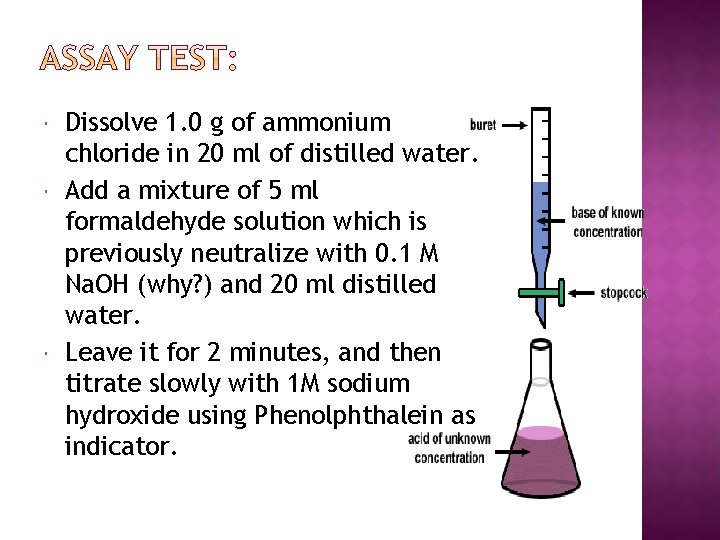
Dissolve 1. 0 g of ammonium chloride in 20 ml of distilled water. Add a mixture of 5 ml formaldehyde solution which is previously neutralize with 0. 1 M Na. OH (why? ) and 20 ml distilled water. Leave it for 2 minutes, and then titrate slowly with 1 M sodium hydroxide using Phenolphthalein as indicator.
Formaldehyde was added. Why? Suggest one reason. Neutralization of formaldehyde is done Why? Suggest one reason. How ?
Note: each 1 ml of 1 M sodium hydroxide is equivalent to 53. 49 mg of NH 4 Cl. Note: according to British Pharmacopeia, ammonium chloride sample should contain not less than 99% and not more than 100. 5% of pure, dry NH 4 Cl (compare your result with this accepted range)
Using dirty glass. Rinsing burette or pipette with wrong solution. Not filling burette properly. Not transferring all solid /liquid. Transferring excess volume of liquid. Using wrong reagent. Leaking titrant from burette. Note : Na. OH may adsorb atmospheric CO 2 thiosulfate may decompose slowly
What is the difference between qualitative test & quantitative test? Which point is happened first the end point or equivalence test?
Any questions?