
Chemical Names of Ionic Compounds Lesson 7 What

- Slides: 13
Chemical Names of Ionic Compounds Lesson 7
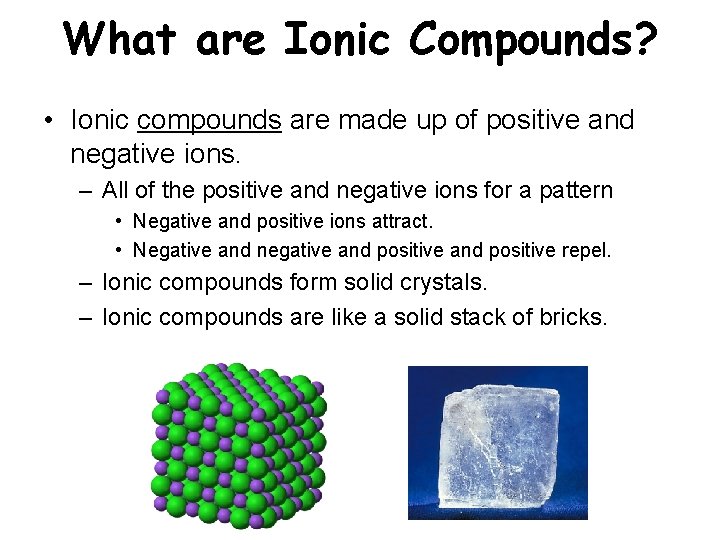
What are Ionic Compounds? • Ionic compounds are made up of positive and negative ions. – All of the positive and negative ions for a pattern • Negative and positive ions attract. • Negative and negative and positive repel. – Ionic compounds form solid crystals. – Ionic compounds are like a solid stack of bricks.
Where does our salt come from?
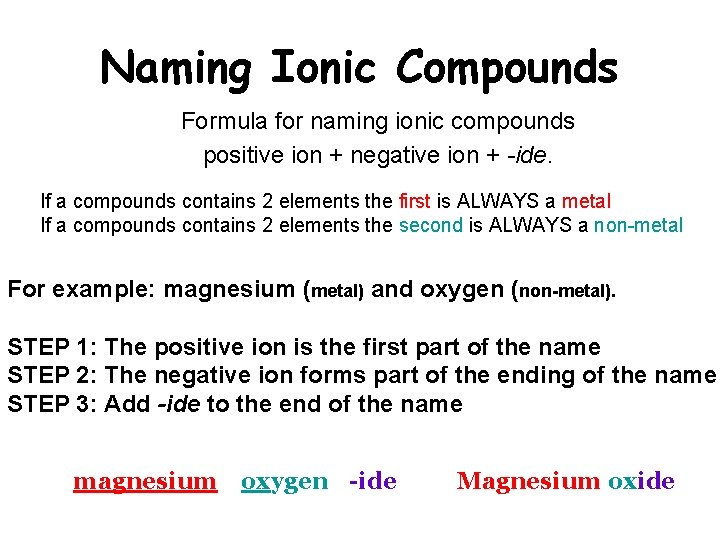
Naming Ionic Compounds Formula for naming ionic compounds positive ion + negative ion + -ide. If a compounds contains 2 elements the first is ALWAYS a metal If a compounds contains 2 elements the second is ALWAYS a non-metal For example: magnesium (metal) and oxygen (non-metal). STEP 1: The positive ion is the first part of the name STEP 2: The negative ion forms part of the ending of the name STEP 3: Add -ide to the end of the name magnesium oxygen -ide Magnesium oxide
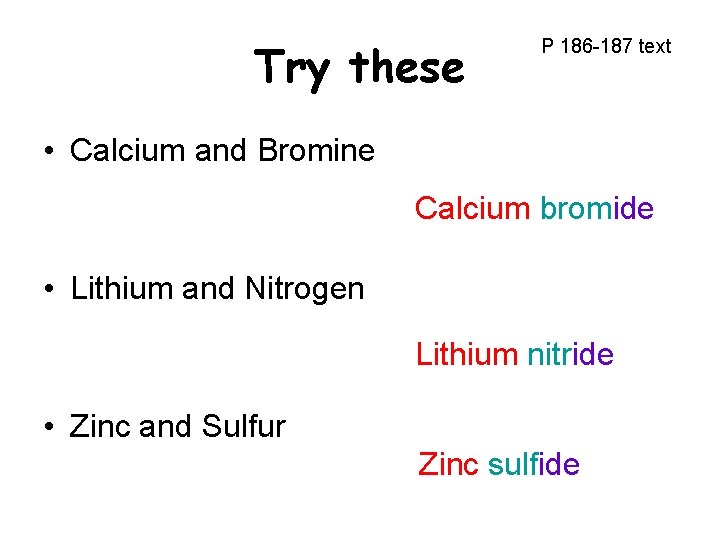
Try these P 186 -187 text • Calcium and Bromine Calcium bromide • Lithium and Nitrogen Lithium nitride • Zinc and Sulfur Zinc sulfide
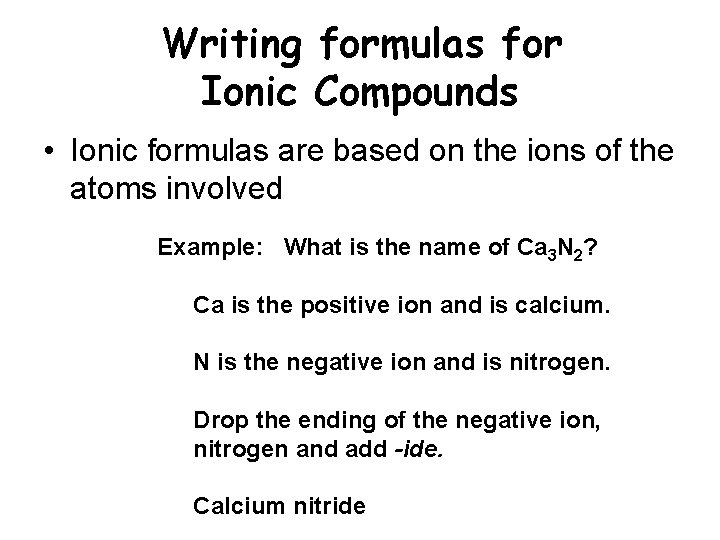
Writing formulas for Ionic Compounds • Ionic formulas are based on the ions of the atoms involved Example: What is the name of Ca 3 N 2? Ca is the positive ion and is calcium. N is the negative ion and is nitrogen. Drop the ending of the negative ion, nitrogen and add -ide. Calcium nitride
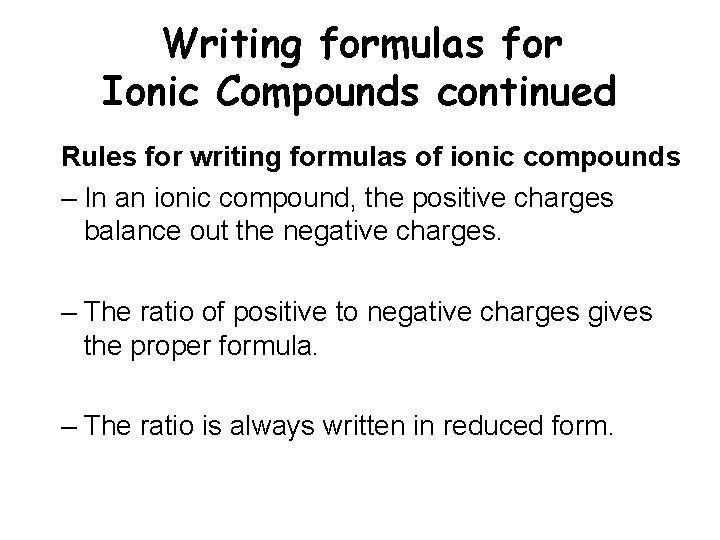
Writing formulas for Ionic Compounds continued Rules for writing formulas of ionic compounds – In an ionic compound, the positive charges balance out the negative charges. – The ratio of positive to negative charges gives the proper formula. – The ratio is always written in reduced form.
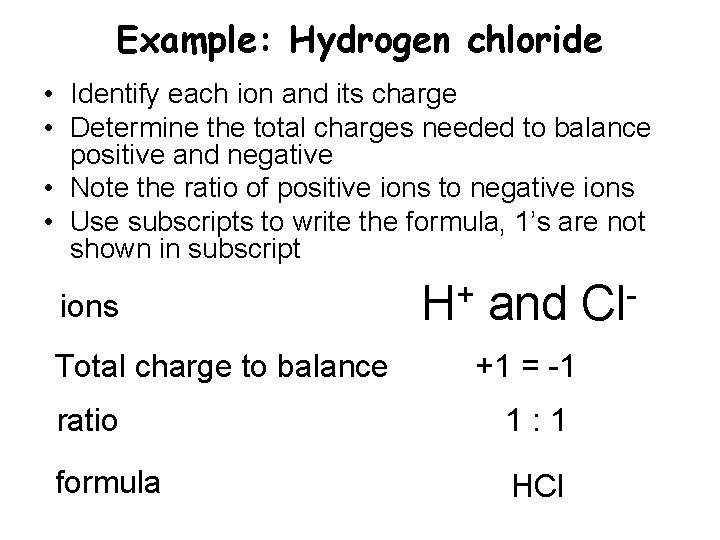
Example: Hydrogen chloride • Identify each ion and its charge • Determine the total charges needed to balance positive and negative • Note the ratio of positive ions to negative ions • Use subscripts to write the formula, 1’s are not shown in subscript ions Total charge to balance + H and +1 = -1 ratio 1: 1 formula HCl Cl
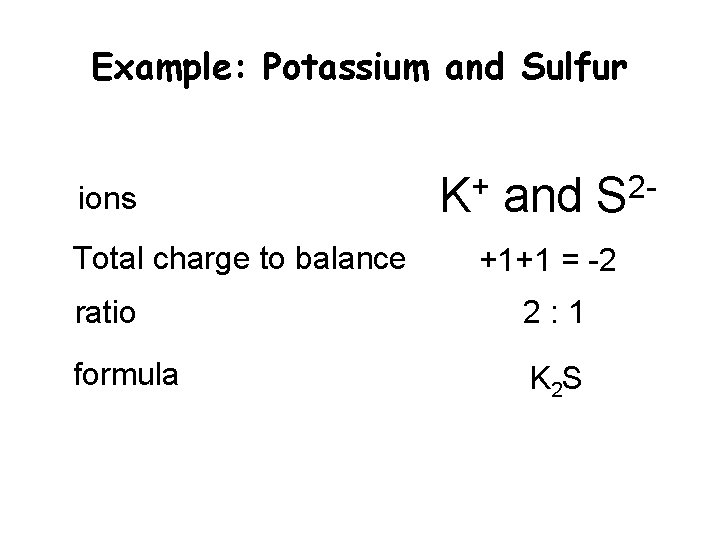
Example: Potassium and Sulfur ions Total charge to balance + K and 2 S +1+1 = -2 ratio 2: 1 formula K 2 S
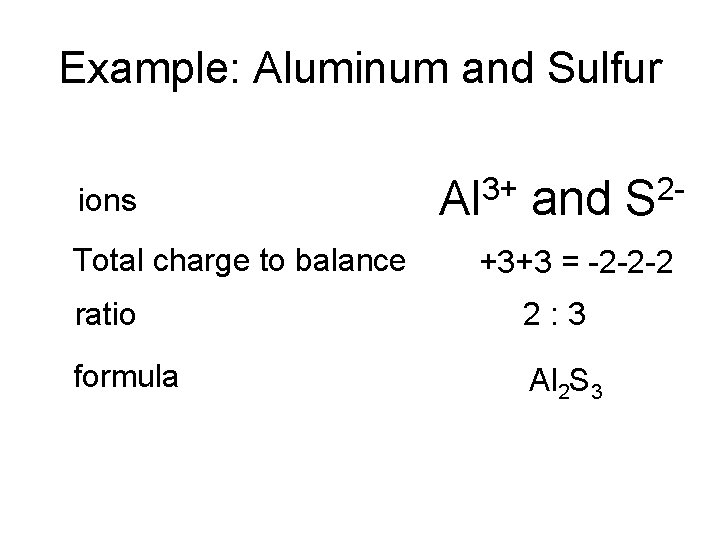
Example: Aluminum and Sulfur ions Total charge to balance Al 3+ and S 2+3+3 = -2 -2 -2 ratio 2: 3 formula Al 2 S 3
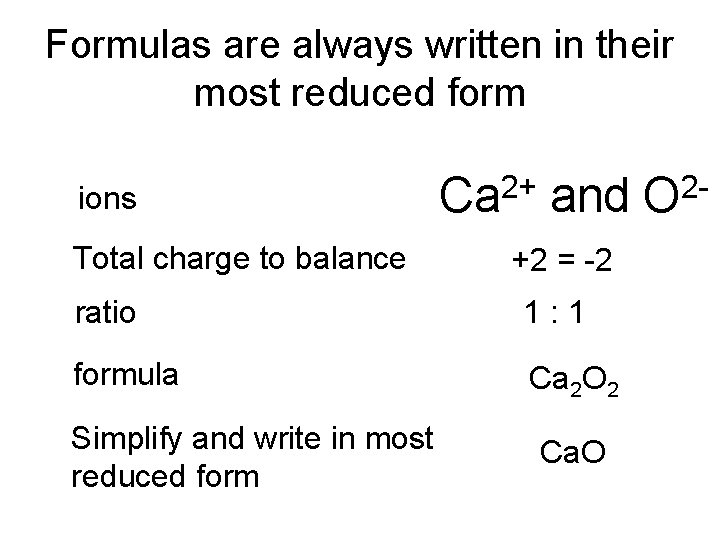
Formulas are always written in their most reduced form ions Total charge to balance 2+ Ca and +2 = -2 ratio 1: 1 formula Ca 2 O 2 Simplify and write in most reduced form Ca. O 2 O
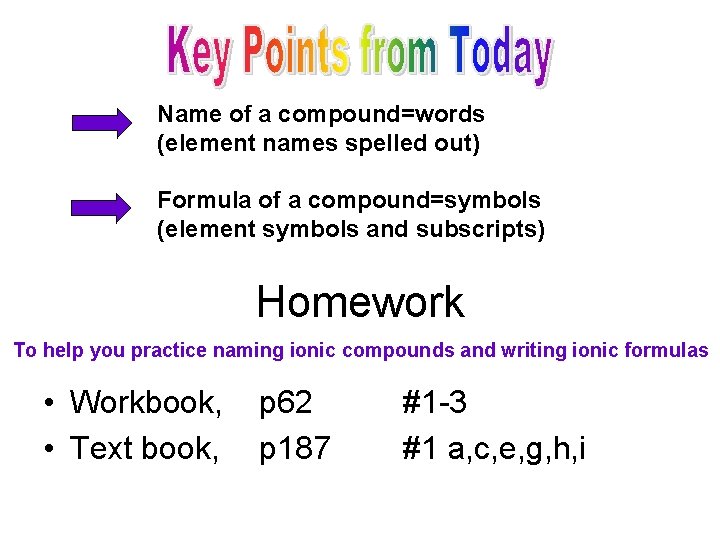
Name of a compound=words (element names spelled out) Formula of a compound=symbols (element symbols and subscripts) Homework To help you practice naming ionic compounds and writing ionic formulas • Workbook, • Text book, p 62 p 187 #1 -3 #1 a, c, e, g, h, i