
Chemical Names and Formulas 9 1 Naming Ions
- Slides: 17
Chemical Names and Formulas 9. 1 Naming Ions
Ionic Compounds • Ionic compounds consist of a positive metal ion and a negative nonmetal ion combined in a proportion such that their charges add up to a net charge of zero.
Monatomic Ions • Single atom with a positive or negative charge resulting from the loss or gain of one or more (valence) electrons. • Mono=1
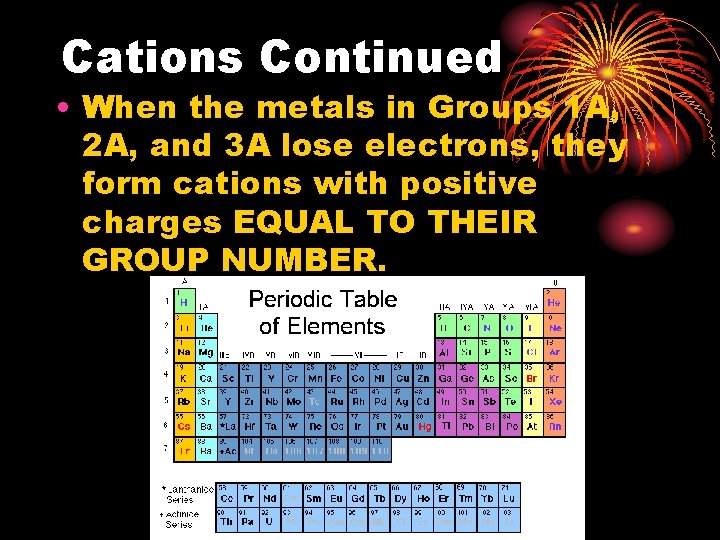
Cations • Metallic atoms like to lose electrons (charge of ion is positive). • Group 1 A likes to lose ONE e • Group 2 A likes to lose TWO e-
Cations Continued • When the metals in Groups 1 A, 2 A, and 3 A lose electrons, they form cations with positive charges EQUAL TO THEIR GROUP NUMBER.
Naming Cations • Written as the element then “ion” or “cation”. • Example: Li+ is called the “Lithium ion (or cation)”.
Anions • Nonmetals like to gain electrons (charge of ion is negative). • Charge determined by subtracting 8 from the group number.
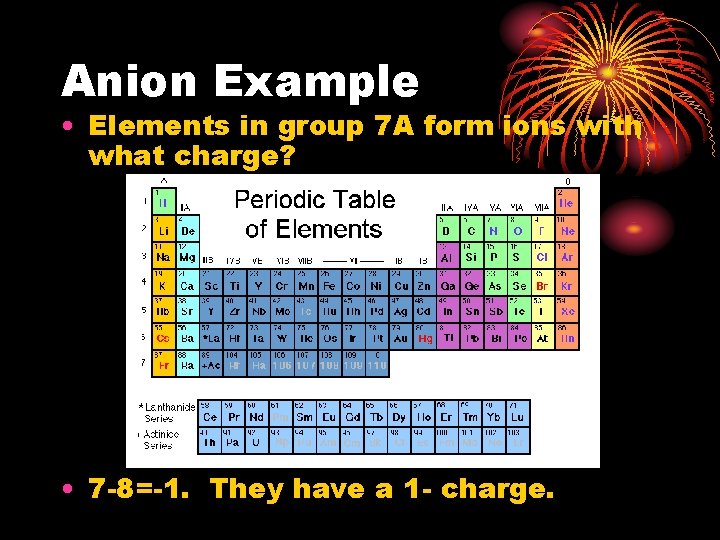
Anion Example • Elements in group 7 A form ions with what charge? • 7 -8=-1. They have a 1 - charge.
Naming Anions • Start with the stem of that ion and end in –ide. • Example: oxygen forms the anion oxide (O 2 -). • What about chlorine?
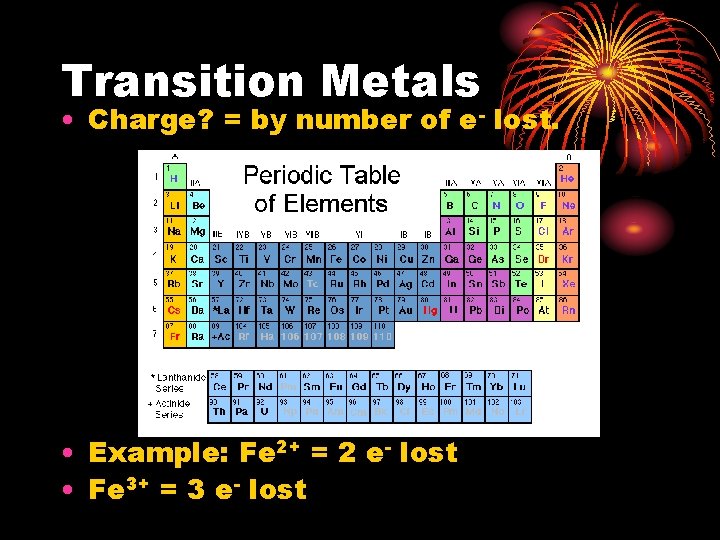
Transition Metals • Charge? = by number of e- lost. • Example: Fe 2+ = 2 e- lost • Fe 3+ = 3 e- lost
Naming Transition Metal Ions • Use “Stock System” • Roman numeral in parentheses after element name with charge value. • Example: Fe 3+ = Iron (III) ion • You try: Fe 2+ = ?
Classical Naming System • Uses Latin root • “Ferrum” = Latin for Iron • Root = “Ferr-” • Ending Based on charge • -ous ending is lower of 2 charges • -ic ending is higher of 2 charges • EX: Copper Cu+ is cupr. OUS ion Cu 2+ is cupr. IC ion
Transition Metals Cont… • Few transition metals have only one ionic charge. These don’t need a Roman numeral (see pg. 255 for these exceptions).
Polyatomic Ions • Ions composed of more than one atom. • Behave as a unit and carry a charge. • Example: sulfate anion = SO 42 -
Naming Polyatomic Ions • Most end in –ite or –ate. • See chart on page 257 for list to memorize. • HINT: -ite ending has one less oxygen than the –ate ending
NOTE: • If a formula for a polyatomic ion begins in H (hydrogen), you call it hydrogen ____. • Example: HPO 43 - = hydrogen phosphate
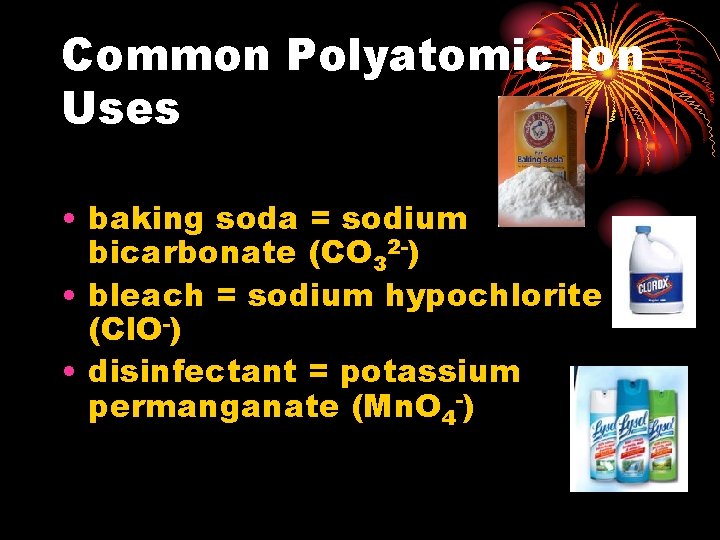
Common Polyatomic Ion Uses • baking soda = sodium bicarbonate (CO 32 -) • bleach = sodium hypochlorite (Cl. O-) • disinfectant = potassium permanganate (Mn. O 4 -)