
Chemical Kinetics Texts Atkins 8 th edtn chaps
![Rate Law How does the rate depend upon [ ]s? l Find out by](https://slidetodoc.com/presentation_image_h/eb7e12e023a99b8e27076d5b2d58635f/image-4.jpg "Rate Law How does the rate depend upon [ ]s? l Find out by")
![Experimental rate laws? l Rate = k [CO][Cl 2]1/2 CO + Cl 2 ®](https://slidetodoc.com/presentation_image_h/eb7e12e023a99b8e27076d5b2d58635f/image-5.jpg "Experimental rate laws? l Rate = k [CO][Cl 2]1/2 CO + Cl 2 ®")
![First-order reaction A plot of ln[A] versus t gives a straight line of slope](https://slidetodoc.com/presentation_image_h/eb7e12e023a99b8e27076d5b2d58635f/image-9.jpg "First-order reaction A plot of ln[A] versus t gives a straight line of slope")
![A ® P assume that -(d[A]/dt) = k [A]1 11](https://slidetodoc.com/presentation_image_h/eb7e12e023a99b8e27076d5b2d58635f/image-11.jpg "A ® P assume that -(d[A]/dt) = k [A]1 11")
![Integrated rate equation ln [A] = -k t + ln [A]0 12](https://slidetodoc.com/presentation_image_h/eb7e12e023a99b8e27076d5b2d58635f/image-12.jpg "Integrated rate equation ln [A] = -k t + ln [A]0 12")
![Half life: first-order reaction l 13 The time taken for [A] to drop to](https://slidetodoc.com/presentation_image_h/eb7e12e023a99b8e27076d5b2d58635f/image-13.jpg "Half life: first-order reaction l 13 The time taken for [A] to drop to")
![When is a reaction over? l [A] = [A]0 exp{-kt} Technically [A]=0 only after](https://slidetodoc.com/presentation_image_h/eb7e12e023a99b8e27076d5b2d58635f/image-15.jpg "When is a reaction over? l [A] = [A]0 exp{-kt} Technically [A]=0 only after")
![Second-order reaction A plot of 1/[A] versus t gives a straight line of slope](https://slidetodoc.com/presentation_image_h/eb7e12e023a99b8e27076d5b2d58635f/image-17.jpg "Second-order reaction A plot of 1/[A] versus t gives a straight line of slope")
![Molecularity of elementary reactions? 21 l l Unimolecular (decay) A ® P - (d[A]/dt)](https://slidetodoc.com/presentation_image_h/eb7e12e023a99b8e27076d5b2d58635f/image-21.jpg "Molecularity of elementary reactions? 21 l l Unimolecular (decay) A ® P - (d[A]/dt)")
![CO + Cl 2 l Exptal rate law: 22 COCl 2 - (d[CO]/dt) =](https://slidetodoc.com/presentation_image_h/eb7e12e023a99b8e27076d5b2d58635f/image-22.jpg "CO + Cl 2 l Exptal rate law: 22 COCl 2 - (d[CO]/dt) =")
![- (d[CO]/dt) = k 2 [Cl] [CO] 23 If steps 2 & 3 are](https://slidetodoc.com/presentation_image_h/eb7e12e023a99b8e27076d5b2d58635f/image-23.jpg "- (d[CO]/dt) = k 2 [Cl] [CO] 23 If steps 2 & 3 are")
![H 2 + I 2 2 HI 24 l Predict: + (1/2) (d[HI]/dt) =](https://slidetodoc.com/presentation_image_h/eb7e12e023a99b8e27076d5b2d58635f/image-24.jpg "H 2 + I 2 2 HI 24 l Predict: + (1/2) (d[HI]/dt) =")
![Flash photolysis l on] Fast burst of laser light – 10 ns, 1 ps](https://slidetodoc.com/presentation_image_h/eb7e12e023a99b8e27076d5b2d58635f/image-43.jpg "Flash photolysis l on] Fast burst of laser light – 10 ns, 1 ps")
![Example [RK, Pilling & Seakins, p 48] CH + O 2 ® products Excess](https://slidetodoc.com/presentation_image_h/eb7e12e023a99b8e27076d5b2d58635f/image-45.jpg "Example [RK, Pilling & Seakins, p 48] CH + O 2 ® products Excess")
![Photodissociation [RK, p. 288] Beam Splitter l Same laser dissociates ICN at 306 nm](https://slidetodoc.com/presentation_image_h/eb7e12e023a99b8e27076d5b2d58635f/image-47.jpg "Photodissociation [RK, p. 288] Beam Splitter l Same laser dissociates ICN at 306 nm")
![Problem [RK, Pilling & Seakins, p 36] 51 HO 2· + C 2 H](https://slidetodoc.com/presentation_image_h/eb7e12e023a99b8e27076d5b2d58635f/image-51.jpg "Problem [RK, Pilling & Seakins, p 36] 51 HO 2· + C 2 H")
- Slides: 59
Chemical Kinetics Texts: Atkins, 8 th edtn. , chaps. 22, 23 & 24 Specialist: “Reaction Kinetics” Pilling & Seakins (1995) Revision l Photochemical Kinetics l Photolytic activation, flash photolysis l Fast reactions l Theories of reaction rates l – Simple collision theory – Transition state theory 1
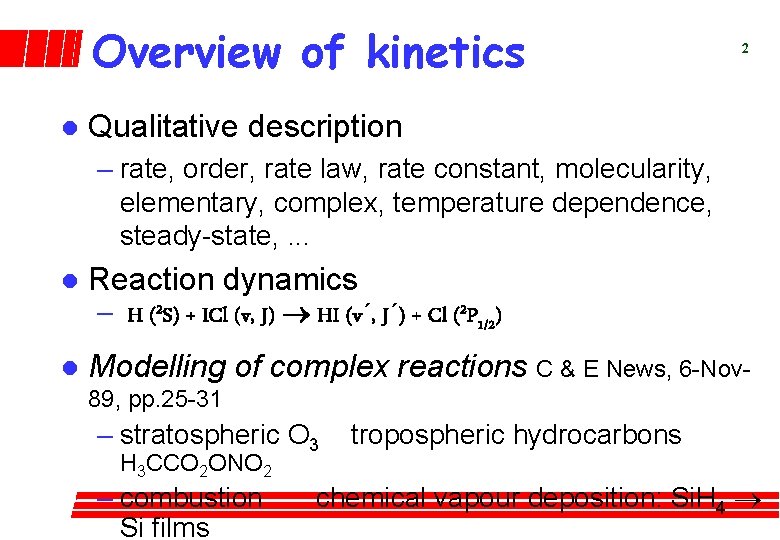
Overview of kinetics l 2 Qualitative description – rate, order, rate law, rate constant, molecularity, elementary, complex, temperature dependence, steady-state, . . . l Reaction dynamics l Modelling of complex reactions C & E News, 6 -Nov- – H (2 S) + ICl (v, J) HI (v´, J´) + Cl (2 P 1/2) 89, pp. 25 -31 – stratospheric O 3 H 3 CCO 2 ONO 2 – combustion Si films tropospheric hydrocarbons chemical vapour deposition: Si. H 4 ®
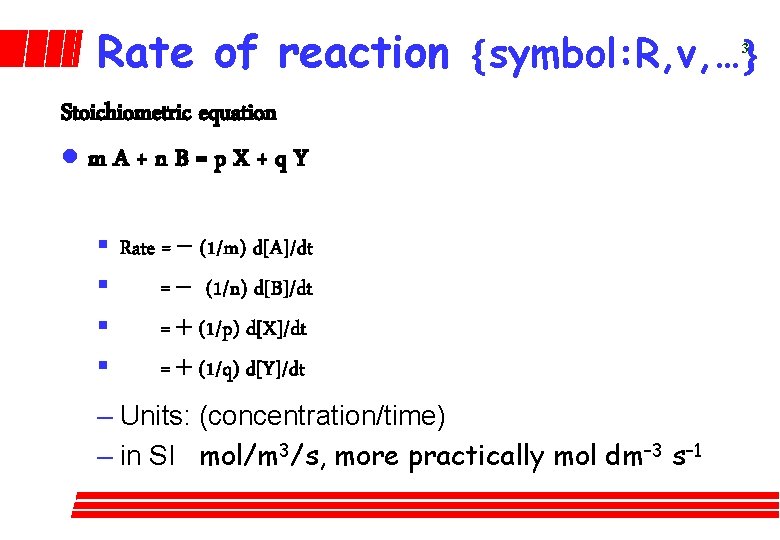
Rate of reaction {symbol: R, v, …} 3 Stoichiometric equation lm. A+n. B=p. X+q. Y § Rate = - (1/m) d[A]/dt § = - (1/n) d[B]/dt § = + (1/p) d[X]/dt § = + (1/q) d[Y]/dt – Units: (concentration/time) – in SI mol/m 3/s, more practically mol dm– 3 s– 1
Rate Law How does the rate depend upon [ ]s? l Find out by experiment l The Rate Law equation l R = kn [A]a [B]b … (for many reactions) – order, n = a + b + … (dimensionless) – rate constant, kn (units depend on n) – Rate = kn when each [conc] = unity 4
Experimental rate laws? l Rate = k [CO][Cl 2]1/2 CO + Cl 2 ® COCl 2 – Order = 1. 5 or one-and-a-half order l Rate = k [H 2][I 2] H 2 + I 2 ® 2 HI – Order = 2 or second order l H 2 + Br 2 ® 2 HBr Rate = k [H 2][Br 2] / (1 + k’ {[HBr]/[Br 2]} ) – Order = undefined or none 5
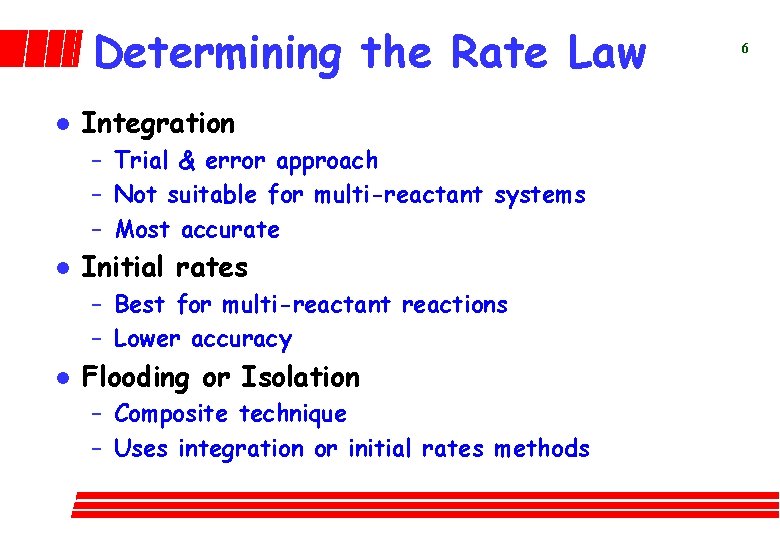
Determining the Rate Law l Integration – Trial & error approach – Not suitable for multi-reactant systems – Most accurate l Initial rates – Best for multi-reactant reactions – Lower accuracy l Flooding or Isolation – Composite technique – Uses integration or initial rates methods 6
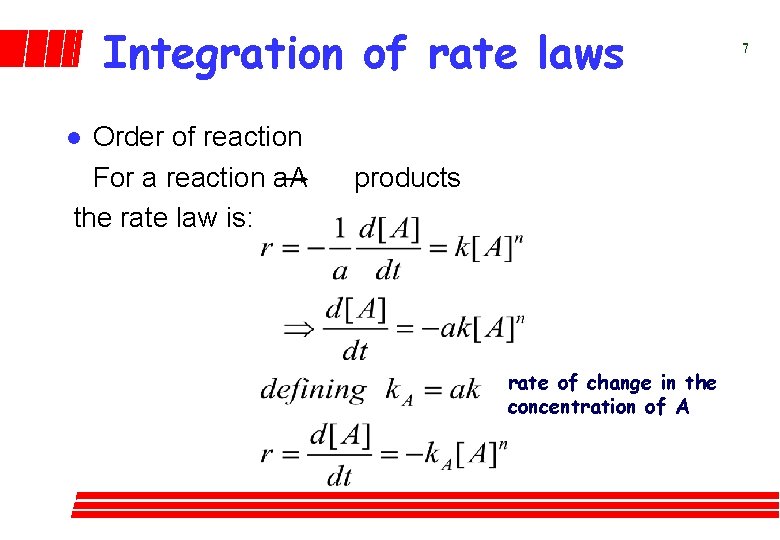
Integration of rate laws Order of reaction For a reaction a. A the rate law is: l products rate of change in the concentration of A 7
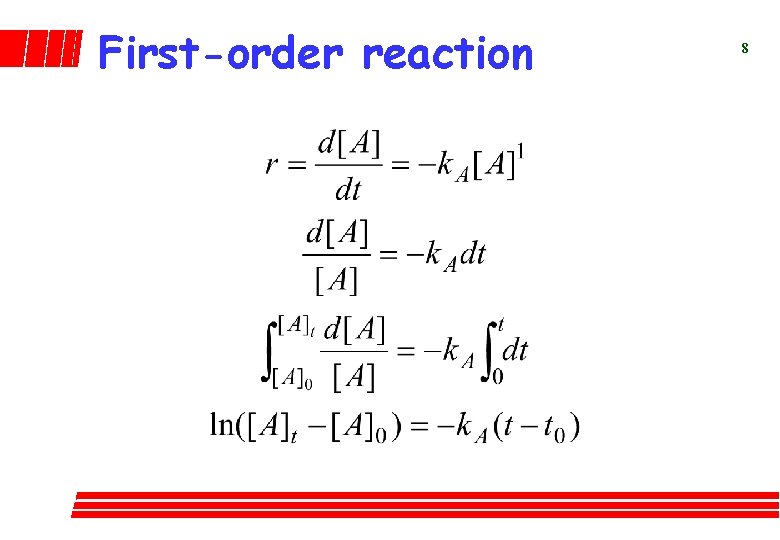
First-order reaction 8
First-order reaction A plot of ln[A] versus t gives a straight line of slope -k. A if r = k. A[A]1 9
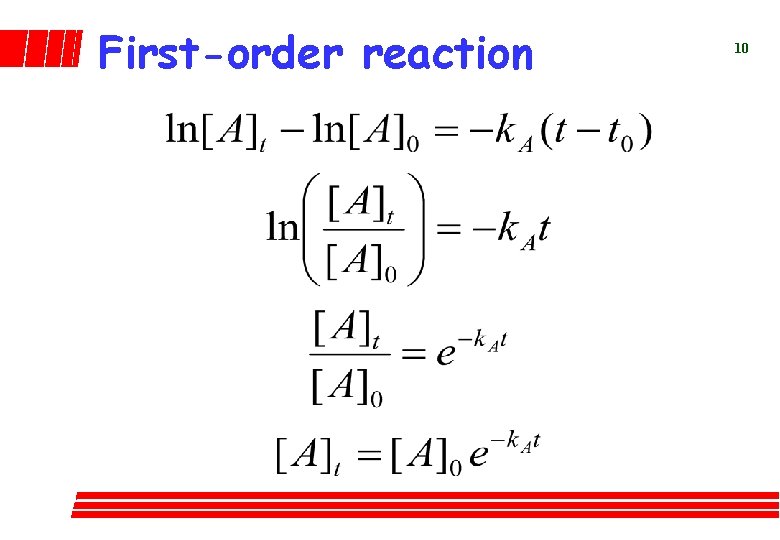
First-order reaction 10
A ® P assume that -(d[A]/dt) = k [A]1 11
Integrated rate equation ln [A] = -k t + ln [A]0 12
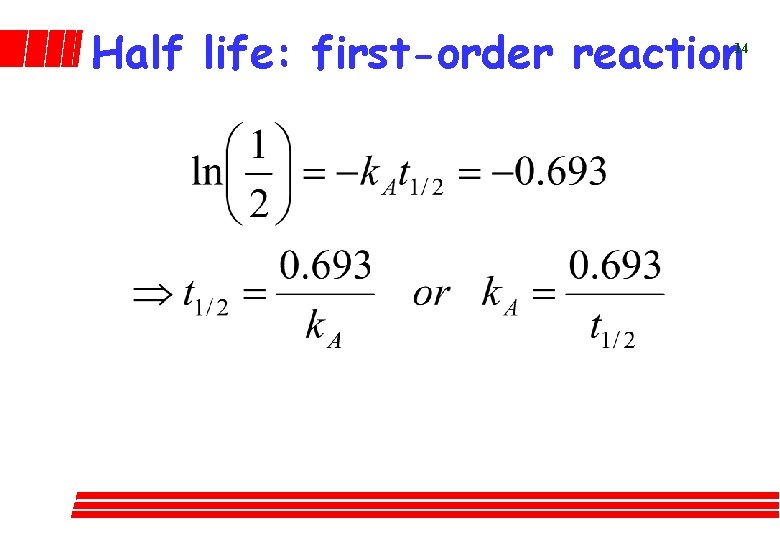
Half life: first-order reaction l 13 The time taken for [A] to drop to half its original value is called the reaction’s half-life, t 1/2. Setting [A] = ½[A]0 and t = t 1/2 in:
Half life: first-order reaction 14
When is a reaction over? l [A] = [A]0 exp{-kt} Technically [A]=0 only after infinite time 15
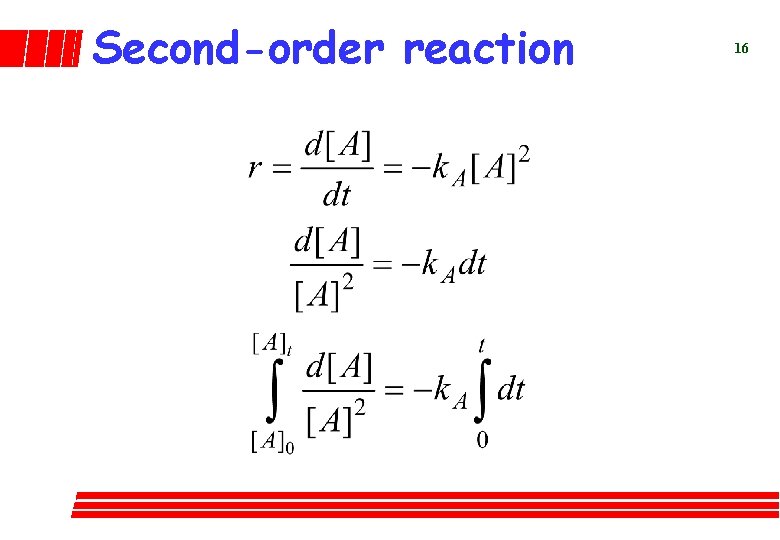
Second-order reaction 16
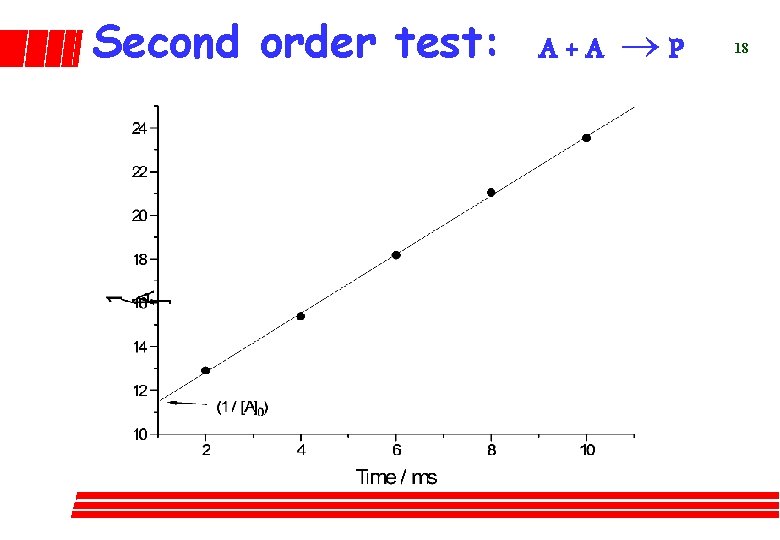
Second-order reaction A plot of 1/[A] versus t gives a straight line of slope k. A if r = k. A[A]2 17
Second order test: A + A ® P 18
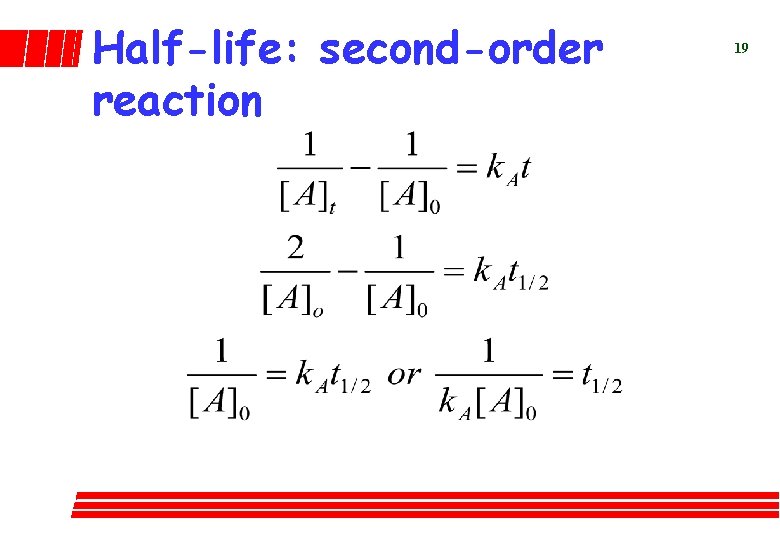
Half-life: second-order reaction 19
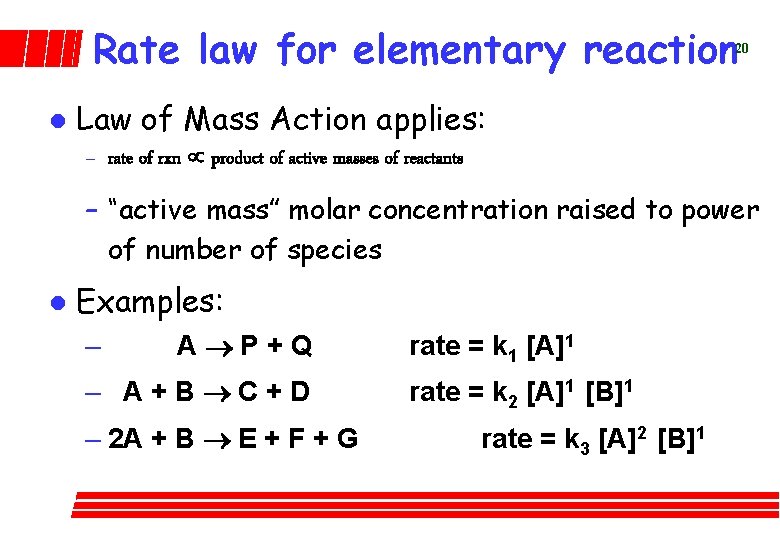
Rate law for elementary reaction 20 l Law of Mass Action applies: – rate of rxn µ product of active masses of reactants – “active mass” molar concentration raised to power of number of species l Examples: – A P+Q – A+B C+D – 2 A + B E + F + G rate = k 1 [A]1 rate = k 2 [A]1 [B]1 rate = k 3 [A]2 [B]1
Molecularity of elementary reactions? 21 l l Unimolecular (decay) A ® P - (d[A]/dt) = k 1 [A] Bimolecular (collision) A + B ® P - (d[A]/dt) = k 2 [A] [B] Termolecular (collision) A + B + C ® P - (d[A]/dt) = k 3 [A] [B] [C] No other are feasible! Statistically highly unlikely.
CO + Cl 2 l Exptal rate law: 22 COCl 2 - (d[CO]/dt) = k [CO] [Cl 2]1/2 – Conclusion? : reaction does not proceed as written – “Elementary” reactions; rxns. that proceed as written at the molecular level. l l Cl 2 Cl + Cl Cl + CO COCl + Cl 2 COCl 2 + Cl Cl + Cl 2 (1) (3) (4) ● Decay (2) ● Collisional – Steps 1 thru 4 comprise the “mechanism” of the reaction.
- (d[CO]/dt) = k 2 [Cl] [CO] 23 If steps 2 & 3 are slow in comparison to 1 & 4 then, Cl 2 ⇌ 2 Cl or K = [Cl]2 / [Cl 2] So [Cl] = ÖK × [Cl 2]1/2 Hence: l - (d[CO] / dt) = k 2 × ÖK × [CO][Cl 2]1/2 Predict that: observed k = k 2 × ÖK l Therefore mechanism confirmed (? )
H 2 + I 2 2 HI 24 l Predict: + (1/2) (d[HI]/dt) = k [H 2] [I 2] l But if via: – I 2 2 I – I + H 2 2 HI – I + I I 2 rate = k 2 [I]2 [H 2] Assume, as before, that 1 & 3 are fast cf. to 2 Then: I 2 ⇌ 2 I or K = [I]2 / [I 2] l Rate = k 2 [I]2 [H 2] = k 2 K [I 2] [H 2] (identical) Check? I 2 + hn ® 2 I (light of 578 nm)
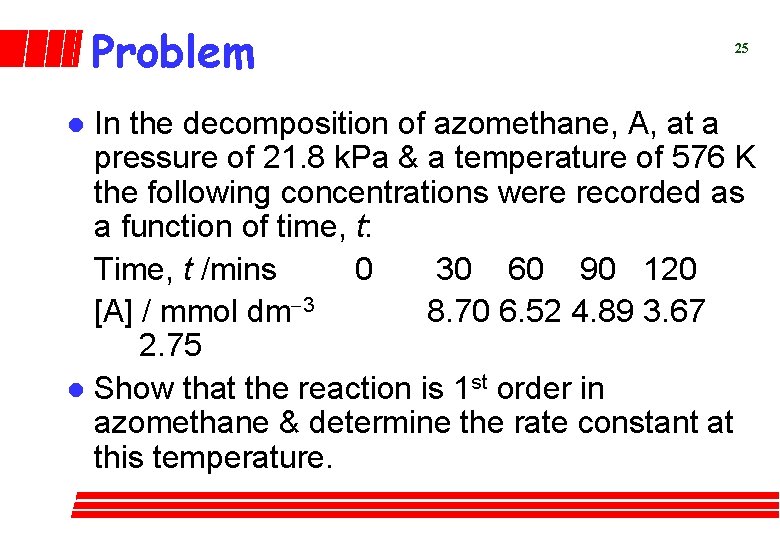
Problem 25 In the decomposition of azomethane, A, at a pressure of 21. 8 k. Pa & a temperature of 576 K the following concentrations were recorded as a function of time, t: Time, t /mins 0 30 60 90 120 [A] / mmol dm-3 8. 70 6. 52 4. 89 3. 67 2. 75 l Show that the reaction is 1 st order in azomethane & determine the rate constant at this temperature. l
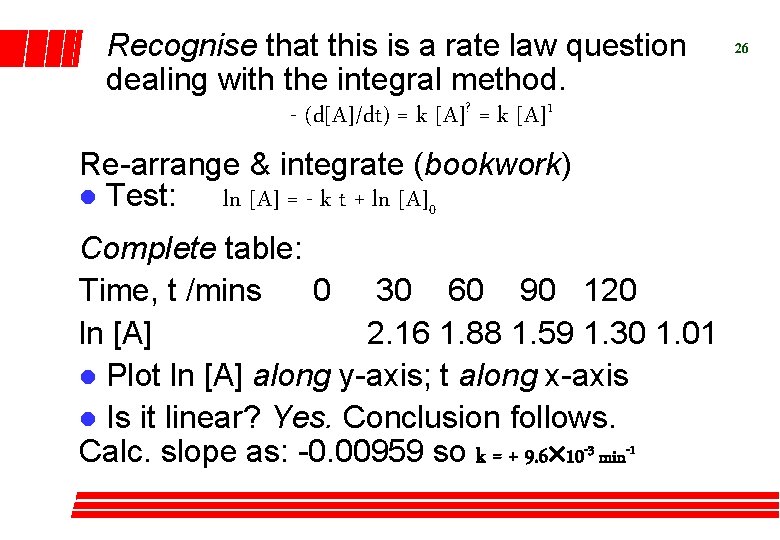
Recognise that this is a rate law question dealing with the integral method. - (d[A]/dt) = k [A]? = k [A]1 Re-arrange & integrate (bookwork) l Test: ln [A] = - k t + ln [A]0 Complete table: Time, t /mins 0 30 60 90 120 ln [A] 2. 16 1. 88 1. 59 1. 30 1. 01 l Plot ln [A] along y-axis; t along x-axis l Is it linear? Yes. Conclusion follows. Calc. slope as: -0. 00959 so k = + 9. 6´ 10 -3 min-1 26
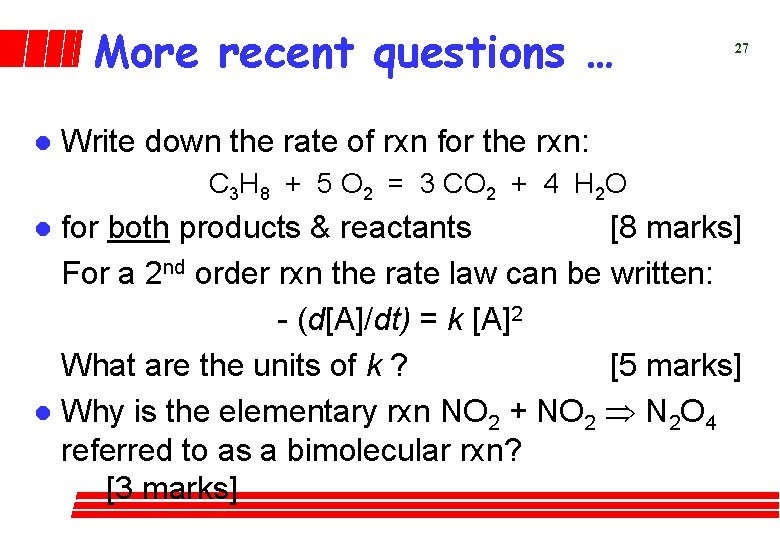
More recent questions … l 27 Write down the rate of rxn for the rxn: C 3 H 8 + 5 O 2 = 3 CO 2 + 4 H 2 O for both products & reactants [8 marks] For a 2 nd order rxn the rate law can be written: - (d[A]/dt) = k [A]2 What are the units of k ? [5 marks] l Why is the elementary rxn NO 2 + NO 2 N 2 O 4 referred to as a bimolecular rxn? [3 marks] l
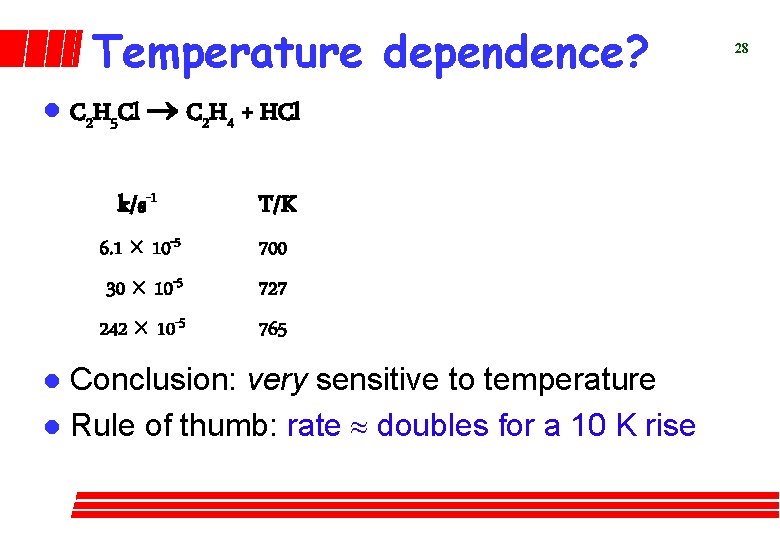
Temperature dependence? l C 2 H 5 Cl C 2 H 4 + HCl k/s-1 6. 1 ´ 10 -5 30 ´ 10 -5 242 ´ 10 -5 T/K 700 727 765 Conclusion: very sensitive to temperature l Rule of thumb: rate » doubles for a 10 K rise l 28
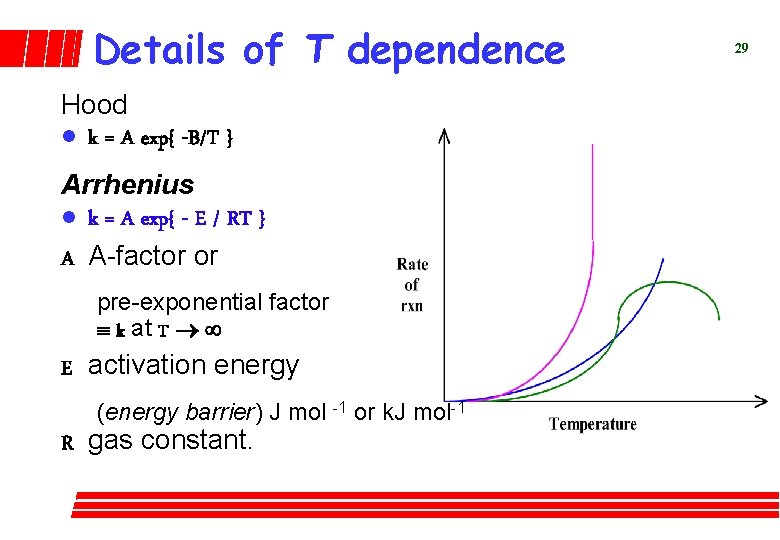
Details of T dependence Hood l k = A exp{ -B/T } Arrhenius l k = A exp{ - E / RT } A A-factor or pre-exponential factor º k at T ¥ E activation energy (energy barrier) J mol -1 or k. J mol-1 R gas constant. 29
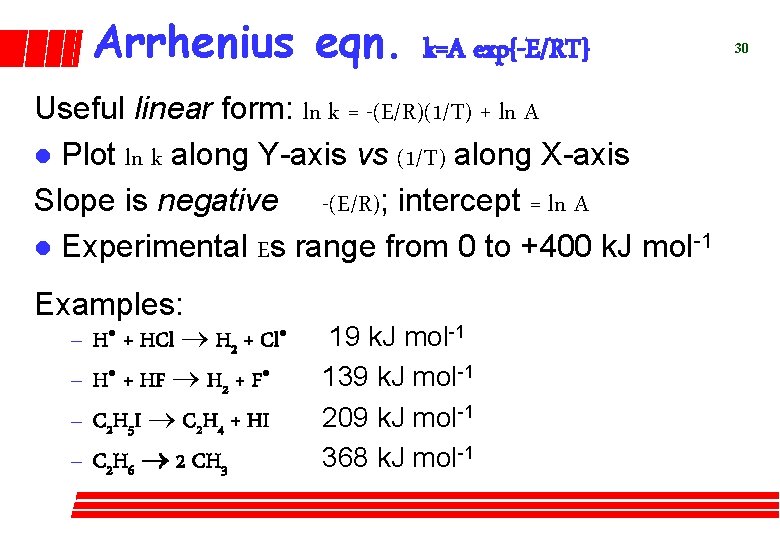
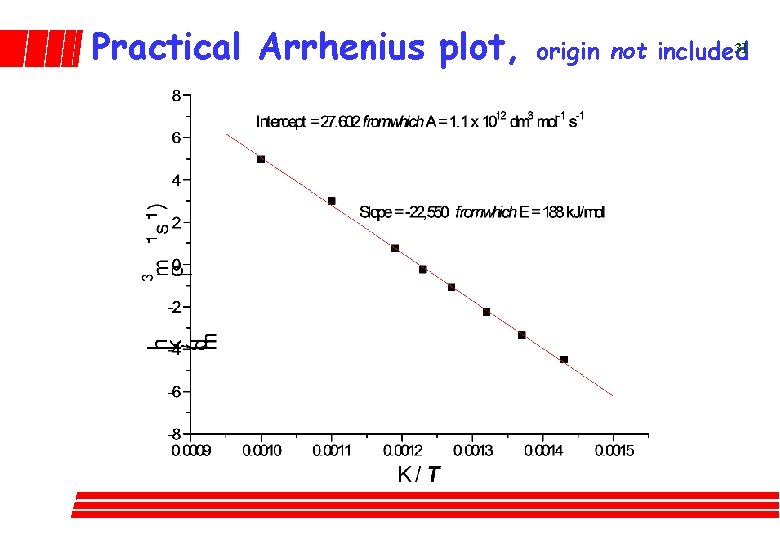
Arrhenius eqn. k=A exp{-E/RT} Useful linear form: ln k = -(E/R)(1/T) + ln A l Plot ln k along Y-axis vs (1/T) along X-axis Slope is negative -(E/R); intercept = ln A l Experimental Es range from 0 to +400 k. J mol-1 Examples: – – H· + HCl ® H 2 + Cl· H· + HF ® H 2 + F· C 2 H 5 I ® C 2 H 4 + HI C 2 H 6 2 CH 3 19 k. J mol-1 139 k. J mol-1 209 k. J mol-1 368 k. J mol-1 30
Practical Arrhenius plot, 31 origin not included
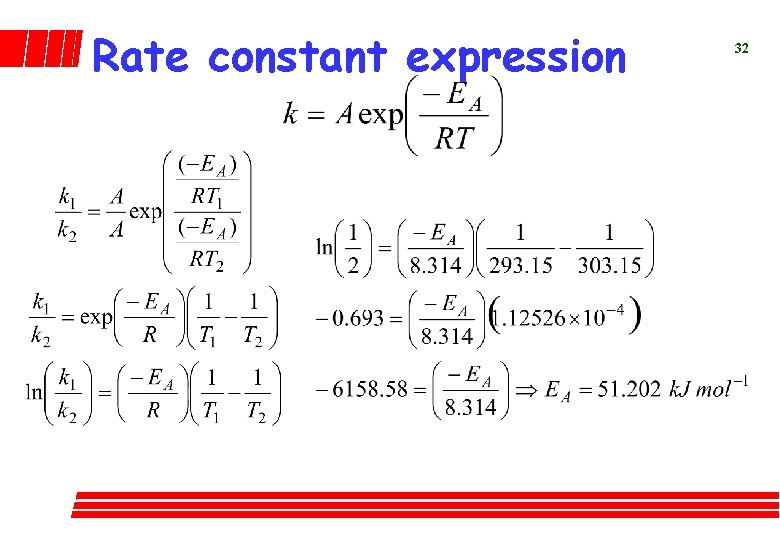
Rate constant expression 32
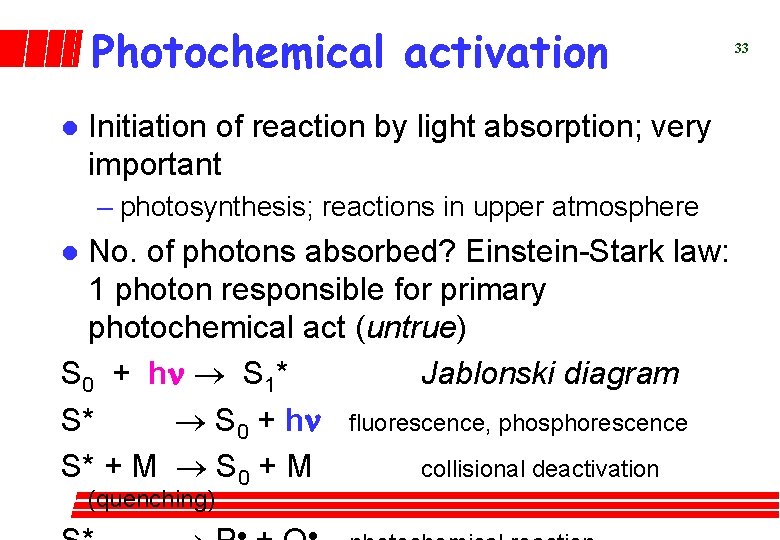
Photochemical activation l Initiation of reaction by light absorption; very important – photosynthesis; reactions in upper atmosphere No. of photons absorbed? Einstein-Stark law: 1 photon responsible for primary photochemical act (untrue) S 0 + hn ® S 1* Jablonski diagram S* ® S 0 + hn fluorescence, phosphorescence S* + M ® S 0 + M collisional deactivation l (quenching) 33
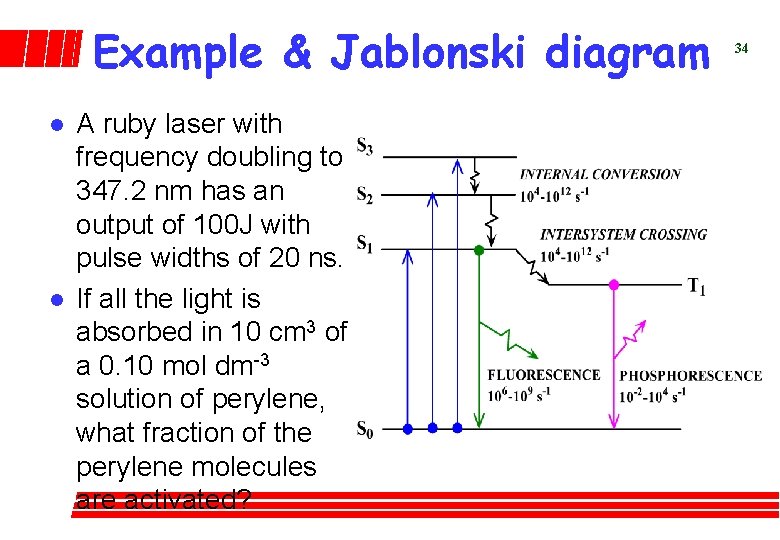
Example & Jablonski diagram l l A ruby laser with frequency doubling to 347. 2 nm has an output of 100 J with pulse widths of 20 ns. If all the light is absorbed in 10 cm 3 of a 0. 10 mol dm-3 solution of perylene, what fraction of the perylene molecules are activated? 34
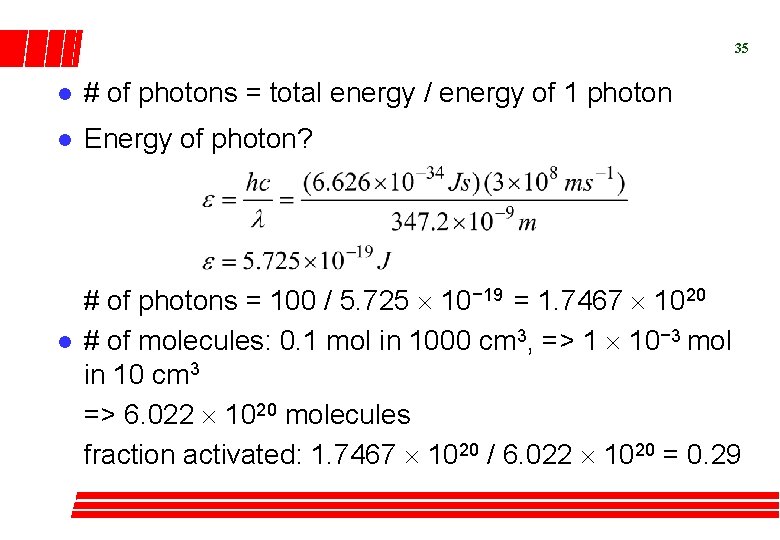
35 l # of photons = total energy / energy of 1 photon l Energy of photon? l # of photons = 100 / 5. 725 10− 19 = 1. 7467 1020 # of molecules: 0. 1 mol in 1000 cm 3, => 1 10− 3 mol in 10 cm 3 => 6. 022 1020 molecules fraction activated: 1. 7467 1020 / 6. 022 1020 = 0. 29
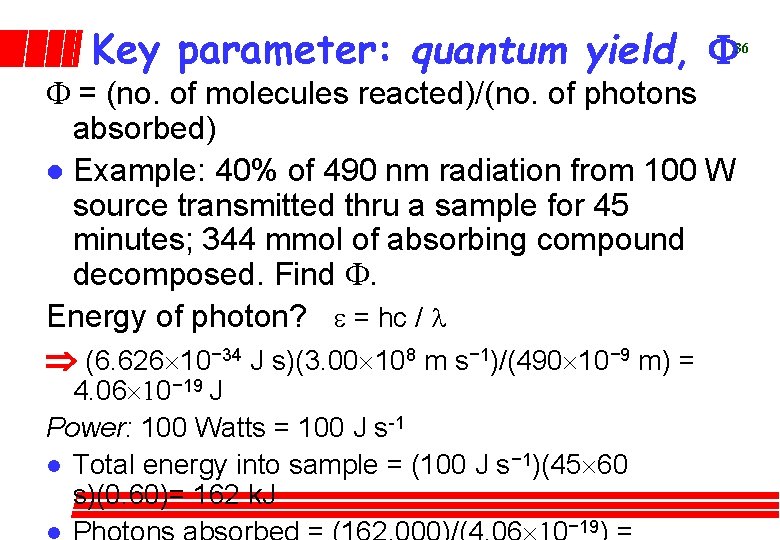
Key parameter: quantum yield, F 36 F = (no. of molecules reacted)/(no. of photons absorbed) l Example: 40% of 490 nm radiation from 100 W source transmitted thru a sample for 45 minutes; 344 mmol of absorbing compound decomposed. Find F. Energy of photon? e = hc / l Þ (6. 626 10− 34 J s)(3. 00 108 m s− 1)/(490 10− 9 m) = 4. 06 10− 19 J Power: 100 Watts = 100 J s-1 l Total energy into sample = (100 J s− 1)(45 60 s)(0. 60)= 162 k. J − 19
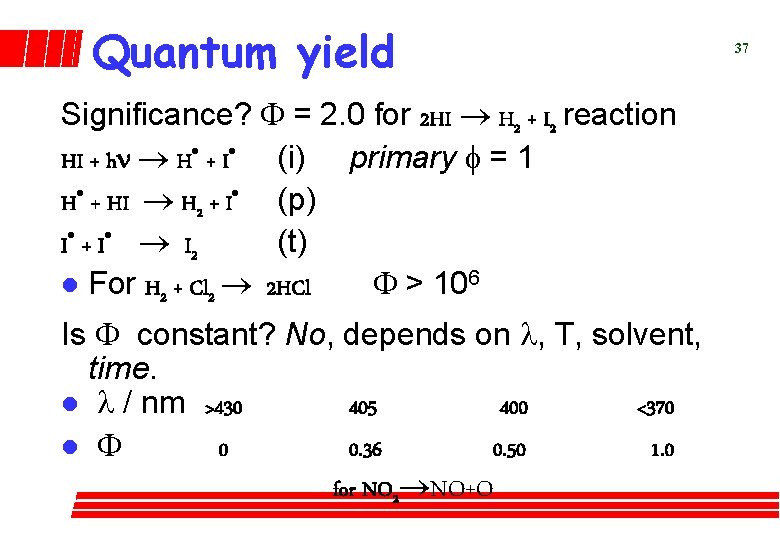
Quantum yield Significance? F = 2. 0 for 2 HI ® H 2 + I 2 reaction HI + hn ® H • + I • (i) primary f = 1 H • + HI ® H 2 + I • (p) I • + I • ® I 2 (t) l For H 2 + Cl 2 ® 2 HCl F > 106 Is F constant? No, depends on l, T, solvent, time. l l / nm >430 405 400 <370 l F 0 0. 36 0. 50 1. 0 for NO 2®NO+O 37
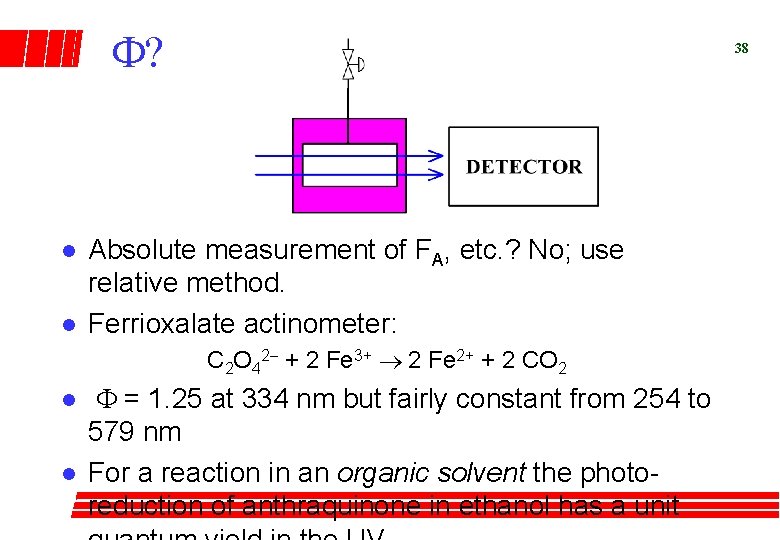
F? l l 38 Absolute measurement of FA, etc. ? No; use relative method. Ferrioxalate actinometer: C 2 O 42 - + 2 Fe 3+ ® 2 Fe 2+ + 2 CO 2 l l F = 1. 25 at 334 nm but fairly constant from 254 to 579 nm For a reaction in an organic solvent the photoreduction of anthraquinone in ethanol has a unit
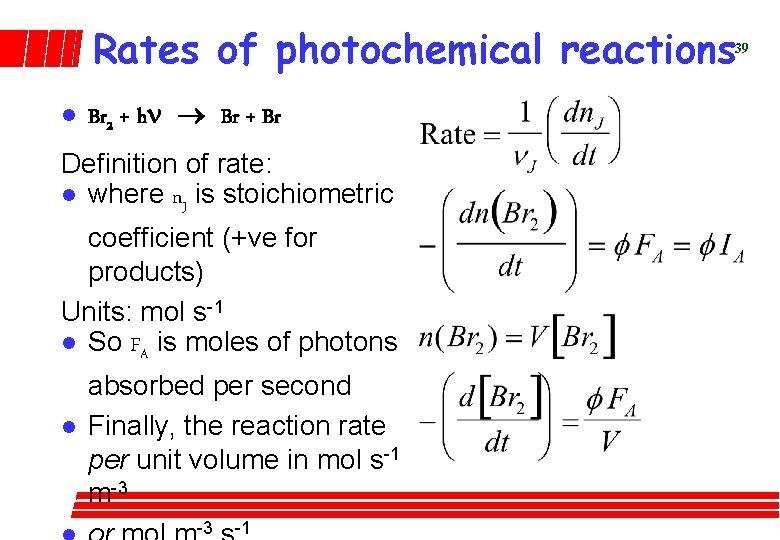
Rates of photochemical reactions 39 l Br 2 + hn Br + Br Definition of rate: l where n. J is stoichiometric coefficient (+ve for products) Units: mol s-1 l So FA is moles of photons l absorbed per second Finally, the reaction rate per unit volume in mol s-1 m-3 -3 -1
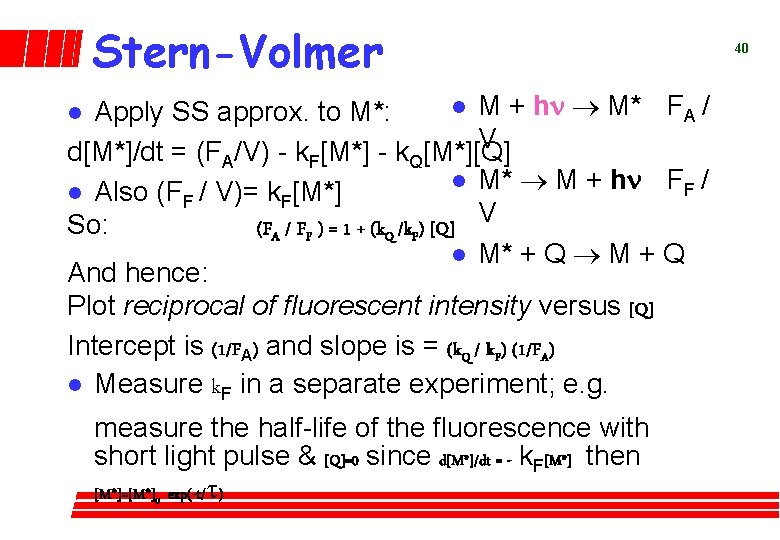
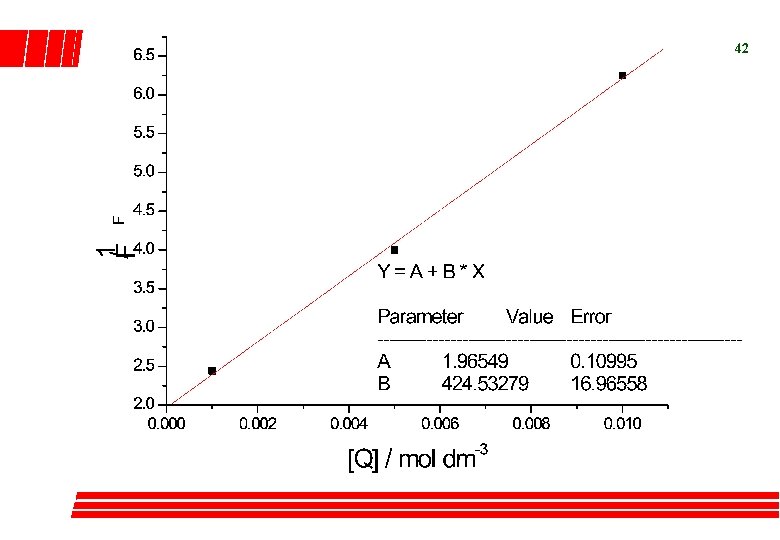
Stern-Volmer l M + hn ® M* FA / Apply SS approx. to M*: V d[M*]/dt = (FA/V) - k. F[M*] - k. Q[M*][Q] l M* ® M + hn FF / l Also (FF / V)= k. F[M*] So: (FA / FF ) = 1 + (k. Q /k. F) [Q] V l M* + Q ® M + Q And hence: Plot reciprocal of fluorescent intensity versus [Q] Intercept is (1/FA) and slope is = (k. Q / k. F) (1/FA) l Measure k. F in a separate experiment; e. g. l measure the half-life of the fluorescence with short light pulse & [Q]=0 since d[M*]/dt = - k. F[M*] then [M*]=[M*]0 exp(-t/t) 40
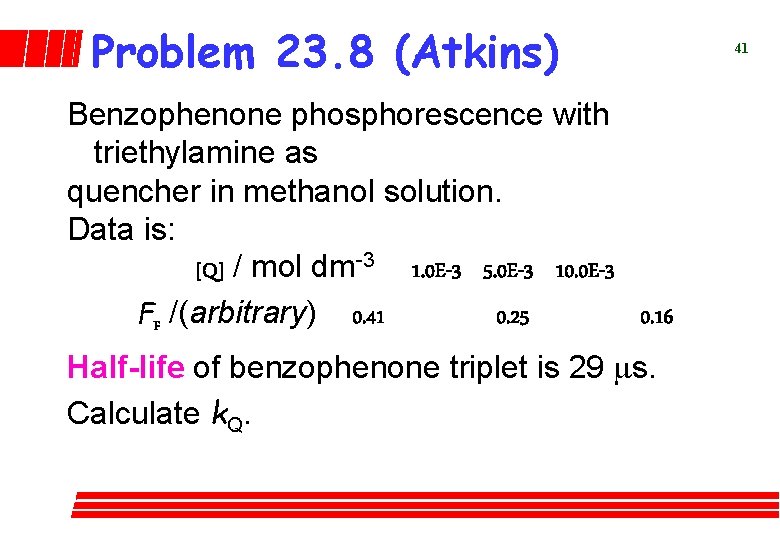
Problem 23. 8 (Atkins) Benzophenone phosphorescence with triethylamine as quencher in methanol solution. Data is: [Q] / mol dm-3 1. 0 E-3 5. 0 E-3 10. 0 E-3 FF /(arbitrary) 0. 41 0. 25 0. 16 Half-life of benzophenone triplet is 29 ms. Calculate k. Q. 41
42
Flash photolysis l on] Fast burst of laser light – 10 ns, 1 ps down to femtosecond l l l High concentrations of reactive species instantaneously Study their fate Transition state spectroscopy J. Phys. Chem. a 4 -698 43 [RK, Pilling & Seakins, p 39
Flash photolysis l Adiabatic – Light absorbed => heat => T rise – Low heat capacity of gas => 2, 000 K – Pyrolytic not photolytic – Study RH + O 2 spectra of OH • , C 2, CH, etc l Isothermal – Reactant ca. 100 Pa, inert gas 100 k. Pa – T rise ca. 10 K; quantitative study possible – precursor + hn ® CH subsequent CH + O 2 ® 44
Example [RK, Pilling & Seakins, p 48] CH + O 2 ® products Excess O 2 present [O 2]0 = 8. 8 1014 molecules cm-3 1 st order kinetics Follow [CH] by LIF t / ms 20 30 40 60 IF 0. 230 0. 144 0. 088 0. 033 Calculate k 1 and k 2 45
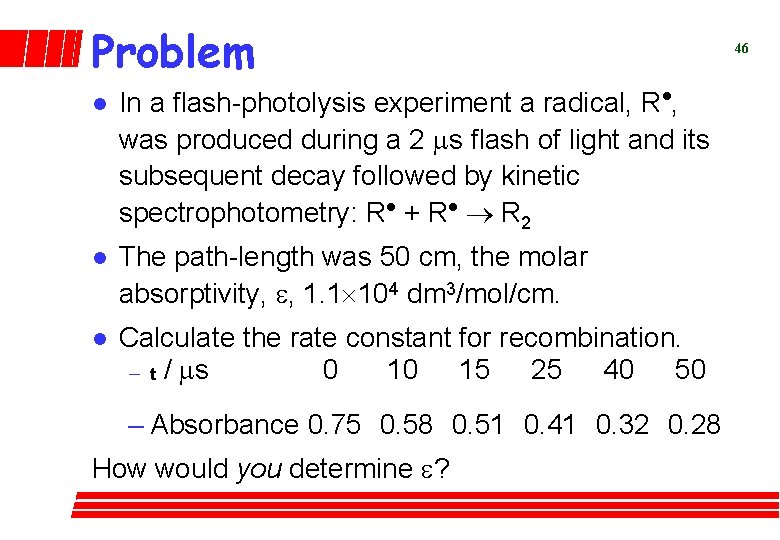
Problem l In a flash-photolysis experiment a radical, R·, was produced during a 2 ms flash of light and its subsequent decay followed by kinetic spectrophotometry: R· + R· ® R 2 l The path-length was 50 cm, the molar absorptivity, e, 1. 1 104 dm 3/mol/cm. l Calculate the rate constant for recombination. – t / ms 0 10 15 25 40 50 – Absorbance 0. 75 0. 58 0. 51 0. 41 0. 32 0. 28 How would you determine e? 46
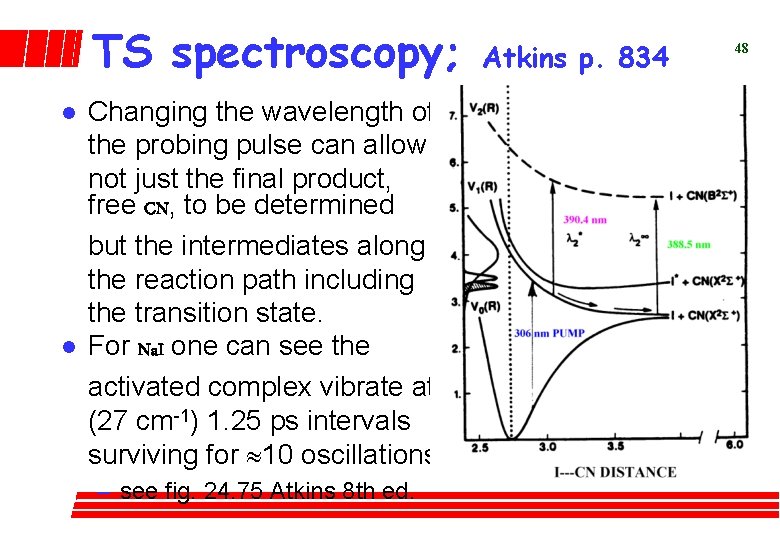
Photodissociation [RK, p. 288] Beam Splitter l Same laser dissociates ICN at 306 nm & is used to measure [CN] by LIF at 388. 5 nm Aim: measure time delay between photolysis pulse and appearance of CN by changing the timing of the two pulses. Experimentally: t » 205± 30 fs; separation » 600 pm [C & l E News 7 -Nov-88] 47
TS spectroscopy; l l Changing the wavelength of the probing pulse can allow not just the final product, free CN, to be determined but the intermediates along the reaction path including the transition state. For Na. I one can see the activated complex vibrate at (27 cm-1) 1. 25 ps intervals surviving for » 10 oscillations – see fig. 24. 75 Atkins 8 th ed. Atkins p. 834 48
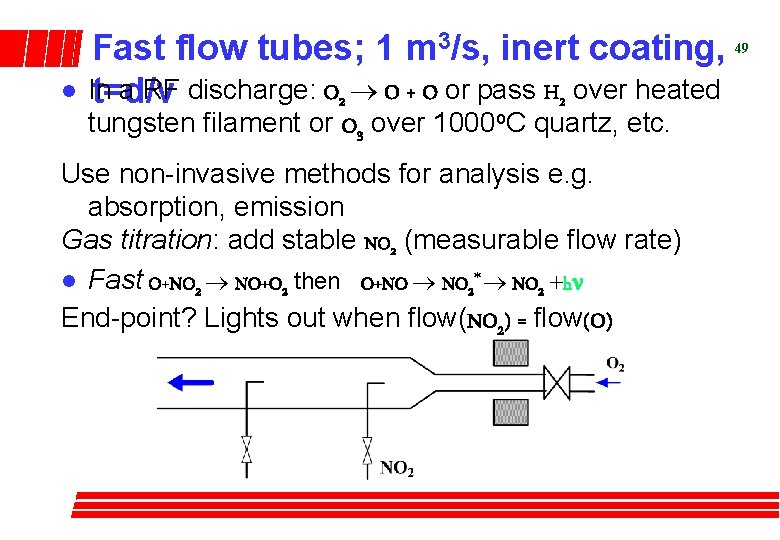
l Fast flow tubes; 1 m 3/s, inert coating, In a RF discharge: O 2 ® O + O or pass H 2 over heated t=d/v tungsten filament or O 3 over 1000 o. C quartz, etc. Use non-invasive methods for analysis e. g. absorption, emission Gas titration: add stable NO 2 (measurable flow rate) l Fast O+NO 2 ® NO+O 2 then O+NO ® NO 2*® NO 2 +hn End-point? Lights out when flow(NO 2) = flow(O) 49
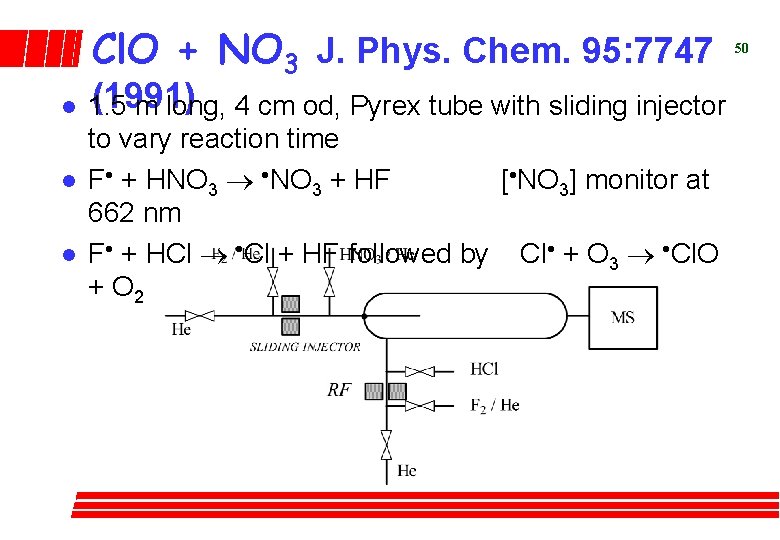
Cl. O + NO 3 J. Phys. Chem. 95: 7747 l l l (1991) 1. 5 m long, 4 cm od, Pyrex tube with sliding injector to vary reaction time F· + HNO 3 ® ·NO 3 + HF [·NO 3] monitor at 662 nm F· + HCl ® ·Cl + HF followed by Cl· + O 3 ® ·Cl. O + O 2 50
Problem [RK, Pilling & Seakins, p 36] 51 HO 2· + C 2 H 4 ¬ C 2 H 5· + O 2 ® C 2 H 5 O 2· MS determines LH channel 11%, RH channel 89% C 2 H 5 signal 6. 14 3. 95 2. 53 1. 25 0. 70 0. 40 Injector d / cm 3 5 7 10 12 15 Linear flow velocity was 1, 080 cm s-1 at 295 K & 263 Pa. Calculate 1 st order rate constant; NB ·
Flow tubes; pros & cons Mixing time restricts timescale to millisecond range l Difficult to work at pressures > (atm/100) l Wall reactions can complicate kinetics l – coat with Teflon or halocarbon wax; or vary tube diameter l Cheap to build & operate, sensitive detection available – Resonance fluorescence – Laser induced fluorescence 52
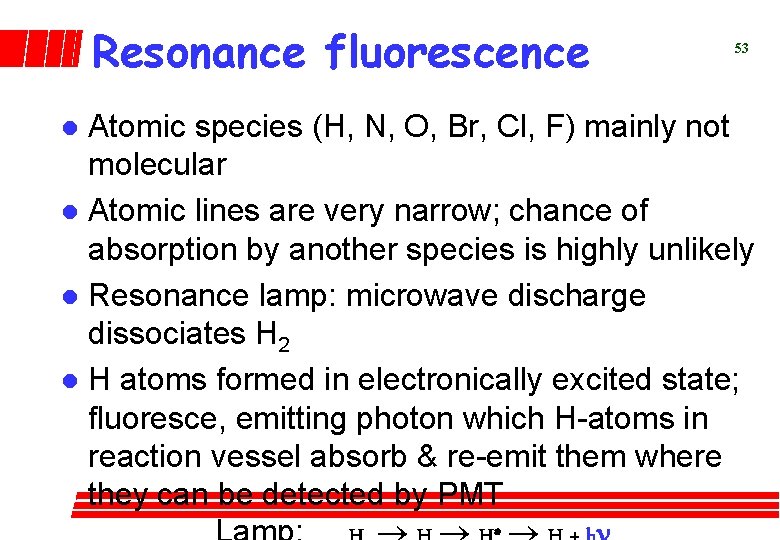
Resonance fluorescence 53 Atomic species (H, N, O, Br, Cl, F) mainly not molecular l Atomic lines are very narrow; chance of absorption by another species is highly unlikely l Resonance lamp: microwave discharge dissociates H 2 l H atoms formed in electronically excited state; fluoresce, emitting photon which H-atoms in reaction vessel absorb & re-emit them where they can be detected by PMT l
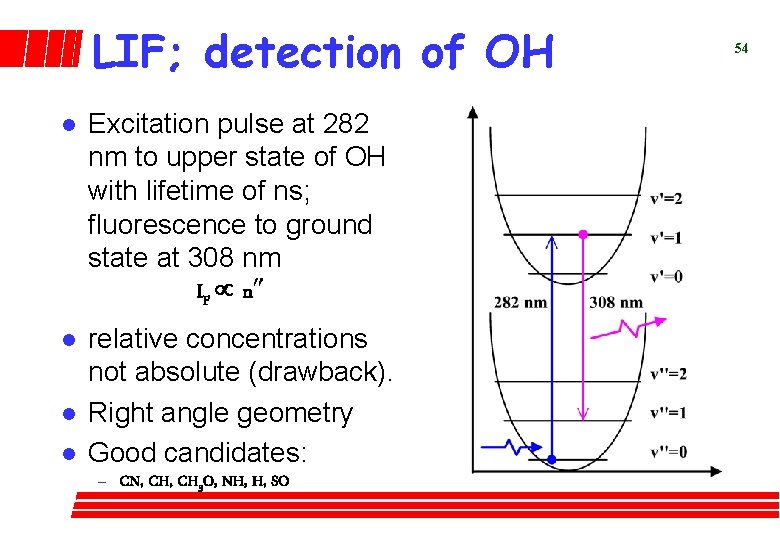
LIF; detection of OH l Excitation pulse at 282 nm to upper state of OH with lifetime of ns; fluorescence to ground state at 308 nm IF µ n² l relative concentrations not absolute (drawback). Right angle geometry Good candidates: l l – CN, CH 3 O, NH, H, SO 54
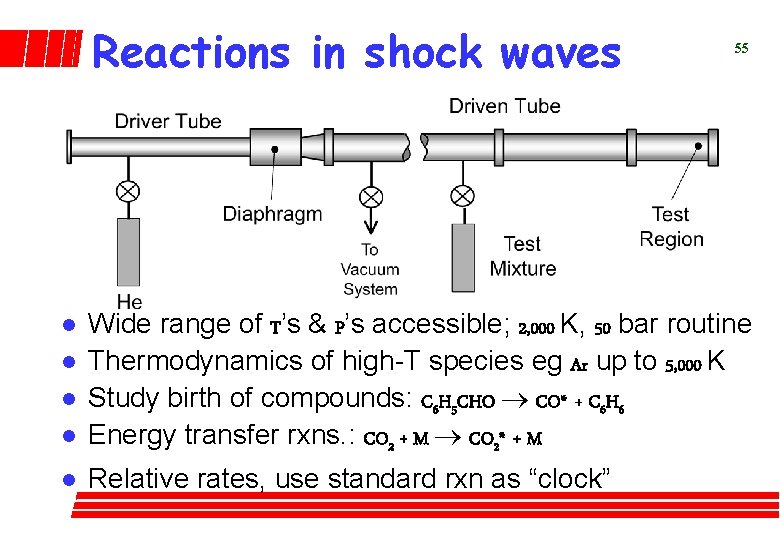
Reactions in shock waves l l l 55 Wide range of T’s & P’s accessible; 2, 000 K, 50 bar routine Thermodynamics of high-T species eg Ar up to 5, 000 K Study birth of compounds: C 6 H 5 CHO ® CO* + C 6 H 6 Energy transfer rxns. : CO 2 + M ® CO 2* + M Relative rates, use standard rxn as “clock”
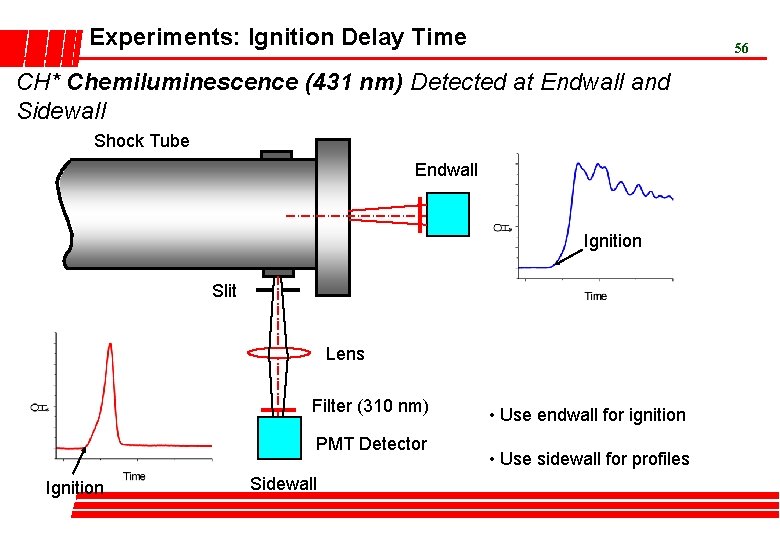
Experiments: Ignition Delay Time 56 CH* Chemiluminescence (431 nm) Detected at Endwall and Sidewall Shock Tube Endwall Ignition Slit Lens Filter (310 nm) PMT Detector Ignition Sidewall • Use endwall for ignition • Use sidewall for profiles
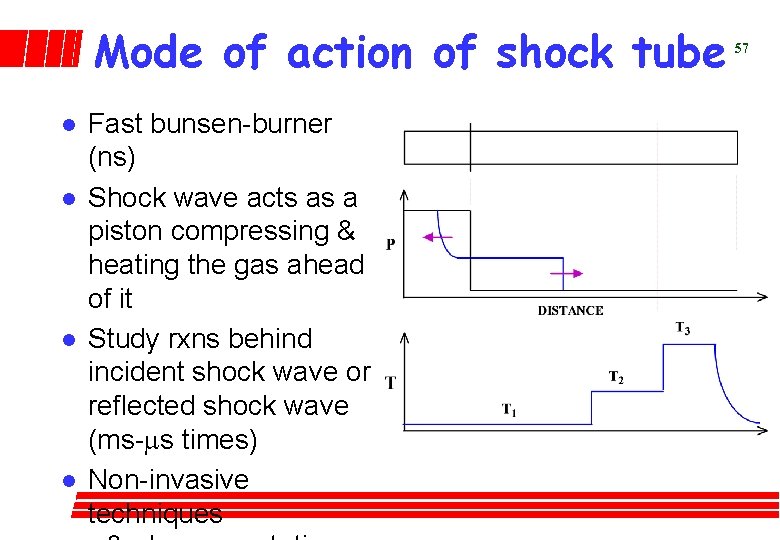
Mode of action of shock tube l l Fast bunsen-burner (ns) Shock wave acts as a piston compressing & heating the gas ahead of it Study rxns behind incident shock wave or reflected shock wave (ms-ms times) Non-invasive techniques 57
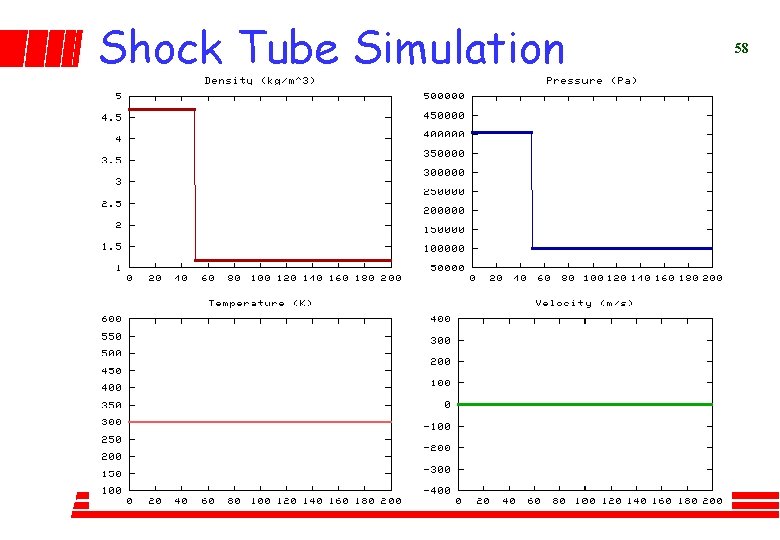
Shock Tube Simulation 58
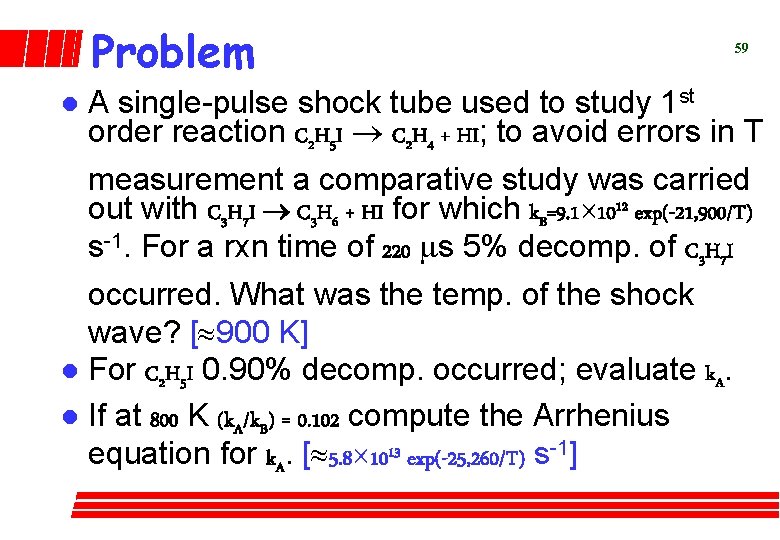
Problem 59 A single-pulse shock tube used to study 1 st order reaction C 2 H 5 I ® C 2 H 4 + HI; to avoid errors in T measurement a comparative study was carried out with C 3 H 7 I C 3 H 6 + HI for which k. B=9. 1 1012 exp(-21, 900/T) s-1. For a rxn time of 220 ms 5% decomp. of C 3 H 7 I occurred. What was the temp. of the shock wave? [» 900 K] l For C 2 H 5 I 0. 90% decomp. occurred; evaluate k. A. l If at 800 K (k. A/k. B) = 0. 102 compute the Arrhenius equation for k. A. [» 5. 8 1013 exp(-25, 260/T) s-1] l