
Chemical Kinetics Study of how rapidly reactions proceed
![NO 2(g) + CO(g) --> NO(g) + CO 2 (g) rate = D[NO] D[CO](https://slidetodoc.com/presentation_image/574d9ab004d315699c71d99f5527cbe4/image-11.jpg "NO 2(g) + CO(g) --> NO(g) + CO 2 (g) rate = D[NO] D[CO")
![Order of a Reaction rate = k [A]m [B]n Order of the reaction =](https://slidetodoc.com/presentation_image/574d9ab004d315699c71d99f5527cbe4/image-16.jpg "Order of a Reaction rate = k [A]m [B]n Order of the reaction =")
![rate = k [HI]n a) rate 1 = k ([HI]1)n rate 2 = k](https://slidetodoc.com/presentation_image/574d9ab004d315699c71d99f5527cbe4/image-19.jpg "rate = k [HI]n a) rate 1 = k ([HI]1)n rate 2 = k")
![rate 3/rate 2 = k [O 2]3 m [NO]3 n / k [O 2]2](https://slidetodoc.com/presentation_image/574d9ab004d315699c71d99f5527cbe4/image-21.jpg "rate 3/rate 2 = k [O 2]3 m [NO]3 n / k [O 2]2")
![N 2 O 5(g) --> N 2 O 4(g) + 1/2 O 2(g) [A]](https://slidetodoc.com/presentation_image/574d9ab004d315699c71d99f5527cbe4/image-23.jpg "N 2 O 5(g) --> N 2 O 4(g) + 1/2 O 2(g) [A]")
![Second order reactions rate = k [A] [B] or rate = k [A]2 Rate](https://slidetodoc.com/presentation_image/574d9ab004d315699c71d99f5527cbe4/image-27.jpg "Second order reactions rate = k [A] [B] or rate = k [A]2 Rate")
![ln [C 2 F 4] 2 C 2 F 4 -> C 4 F](https://slidetodoc.com/presentation_image/574d9ab004d315699c71d99f5527cbe4/image-28.jpg "ln [C 2 F 4] 2 C 2 F 4 -> C 4 F")
![Zero order reactions A --> P If the rate law is - d[A]/ dt](https://slidetodoc.com/presentation_image/574d9ab004d315699c71d99f5527cbe4/image-29.jpg "Zero order reactions A --> P If the rate law is - d[A]/ dt")
![Zero order reaction: [A] = [A]o - kt slope = -k [A] t 1](https://slidetodoc.com/presentation_image/574d9ab004d315699c71d99f5527cbe4/image-30.jpg "Zero order reaction: [A] = [A]o - kt slope = -k [A] t 1")
![Mechanism I rate = k 1[H 2]2 [NO]2 not possible Mechanism II rate =](https://slidetodoc.com/presentation_image/574d9ab004d315699c71d99f5527cbe4/image-38.jpg "Mechanism I rate = k 1[H 2]2 [NO]2 not possible Mechanism II rate =")
![At equilibrium k 1 [NO]2 eq = k-1 [N 2 O 2]eq k 2](https://slidetodoc.com/presentation_image/574d9ab004d315699c71d99f5527cbe4/image-45.jpg "At equilibrium k 1 [NO]2 eq = k-1 [N 2 O 2]eq k 2")
![Autocatalysis Catalysis of a reaction by the products A-> P Rate = k [A][P]](https://slidetodoc.com/presentation_image/574d9ab004d315699c71d99f5527cbe4/image-59.jpg "Autocatalysis Catalysis of a reaction by the products A-> P Rate = k [A][P]")
- Slides: 60
Chemical Kinetics Study of how rapidly reactions proceed - rate of reaction Details of process from reactants to products - mechanism Thermodynamics determines the direction in which reactions proceed spontaneously and equilibrium conditions, but not the rate at which equilibrium is reached. For a complete picture of a chemical reaction need information on both thermodynamics and kinetics of a reaction.
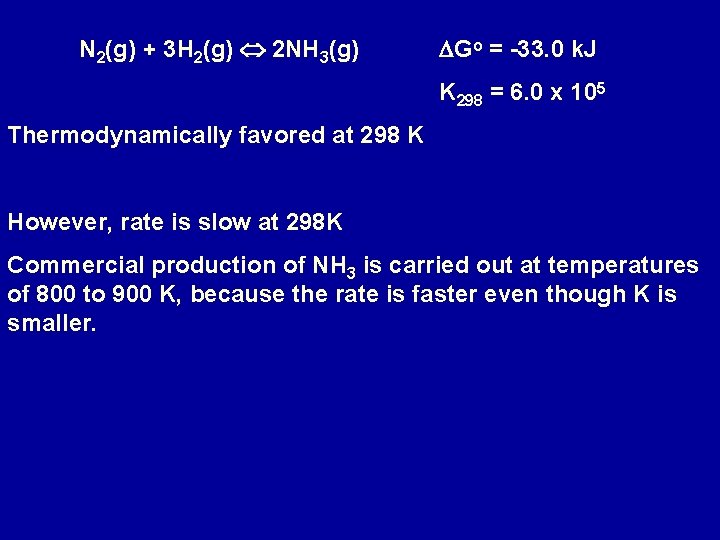
N 2(g) + 3 H 2(g) 2 NH 3(g) DGo = -33. 0 k. J K 298 = 6. 0 x 105 Thermodynamically favored at 298 K However, rate is slow at 298 K Commercial production of NH 3 is carried out at temperatures of 800 to 900 K, because the rate is faster even though K is smaller.
Thermodynamical functions are state functions (DG, DH, DE) Thermodynamics does not depend on the mechanism of the reaction. The rate of the reaction is very dependent on the path of the process or path between reactants and products. Kinetics reveals information on the mechanism of the reaction.
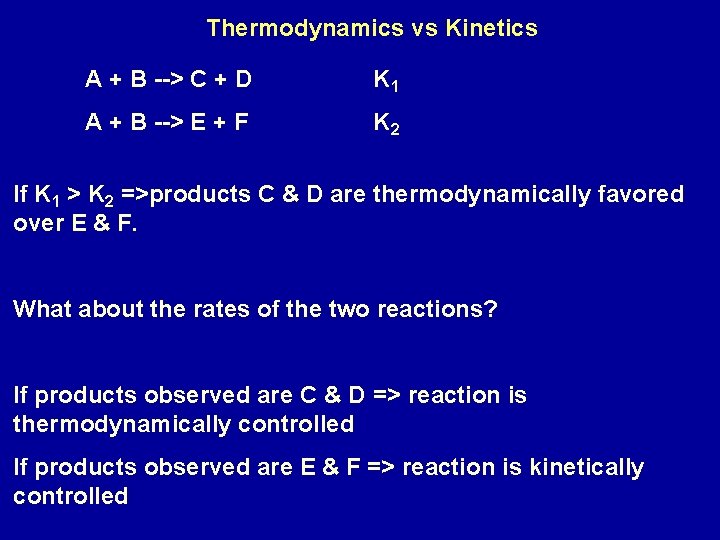
Thermodynamics vs Kinetics A + B --> C + D K 1 A + B --> E + F K 2 If K 1 > K 2 =>products C & D are thermodynamically favored over E & F. What about the rates of the two reactions? If products observed are C & D => reaction is thermodynamically controlled If products observed are E & F => reaction is kinetically controlled
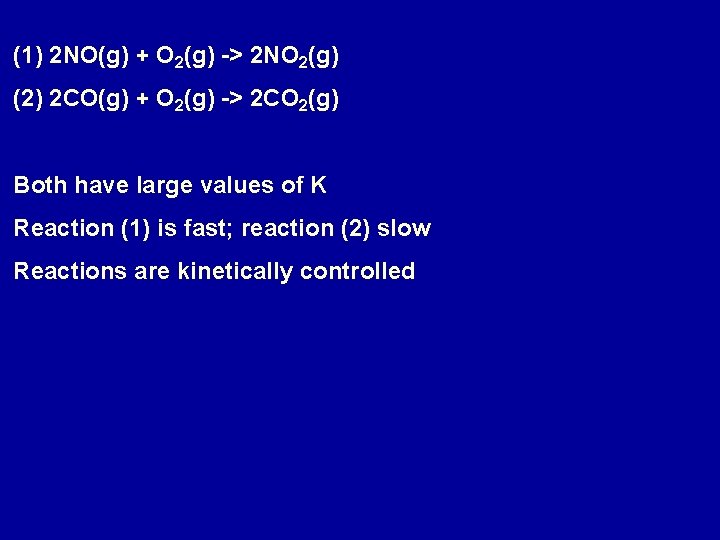
(1) 2 NO(g) + O 2(g) -> 2 NO 2(g) (2) 2 CO(g) + O 2(g) -> 2 CO 2(g) Both have large values of K Reaction (1) is fast; reaction (2) slow Reactions are kinetically controlled
Rates of Reactions A -> P Rate of a reaction: change in concentration per unit time
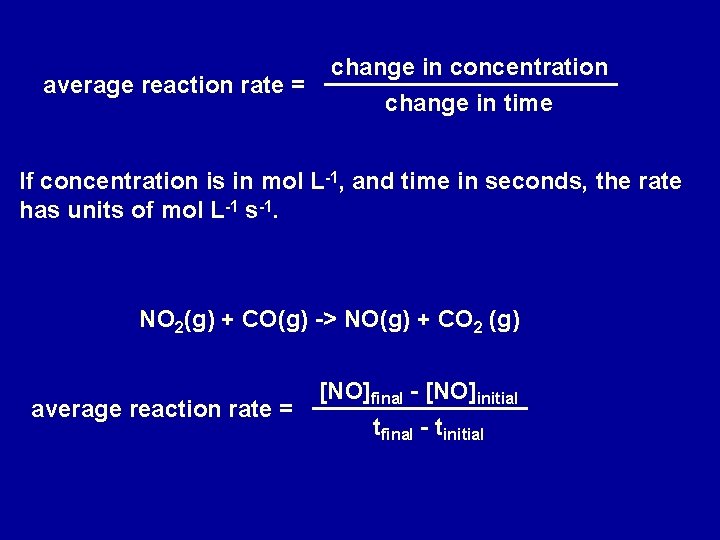
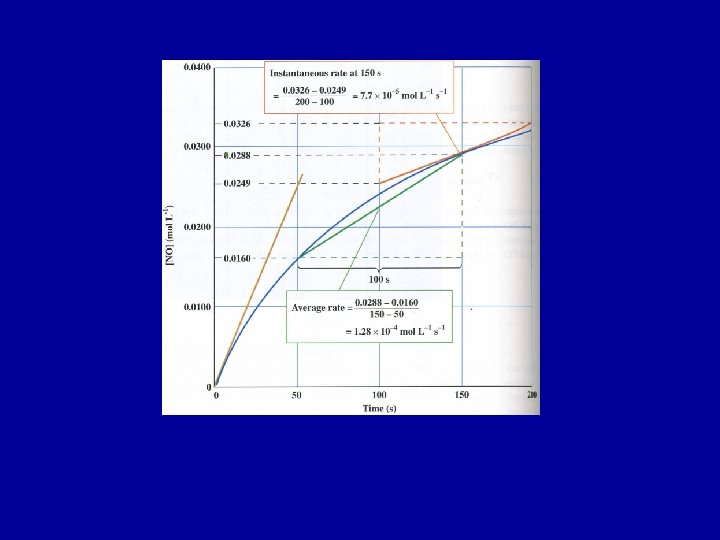
average reaction rate = change in concentration change in time If concentration is in mol L-1, and time in seconds, the rate has units of mol L-1 s-1. NO 2(g) + CO(g) -> NO(g) + CO 2 (g) average reaction rate = [NO]final - [NO]initial tfinal - tinitial
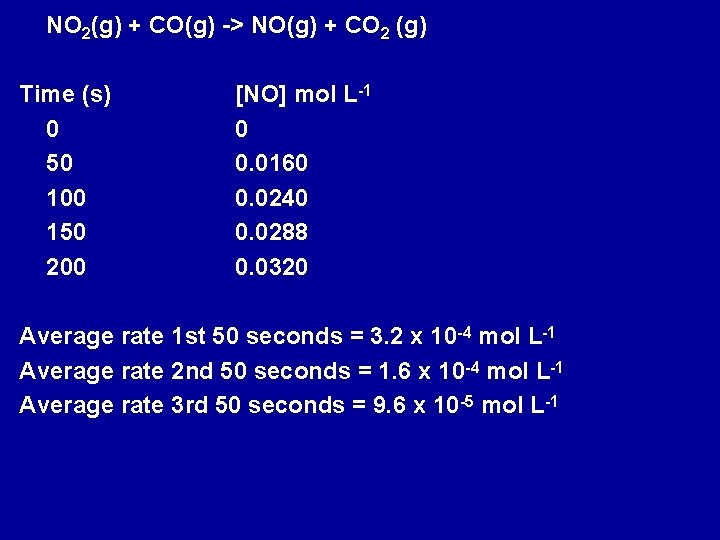
NO 2(g) + CO(g) -> NO(g) + CO 2 (g) Time (s) 0 50 100 150 200 [NO] mol L-1 0 0. 0160 0. 0240 0. 0288 0. 0320 Average rate 1 st 50 seconds = 3. 2 x 10 -4 mol L-1 Average rate 2 nd 50 seconds = 1. 6 x 10 -4 mol L-1 Average rate 3 rd 50 seconds = 9. 6 x 10 -5 mol L-1
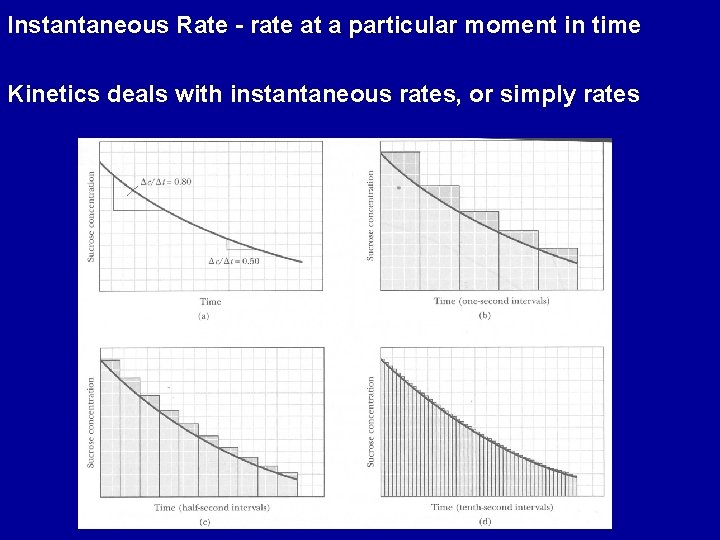
Instantaneous Rate - rate at a particular moment in time Kinetics deals with instantaneous rates, or simply rates
NO 2(g) + CO(g) --> NO(g) + CO 2 (g) rate = D[NO] D[CO 2] - D[NO 2] - D[CO] = = = Dt Dt which, for infinitesimally small changes, d[CO] dt For a general reaction: a. A + b. B --> x. C + y. D 1 d[D] = 1 d[C] rate = = y dt x dt - 1 d[A] = a dt 1 d[B] b dt
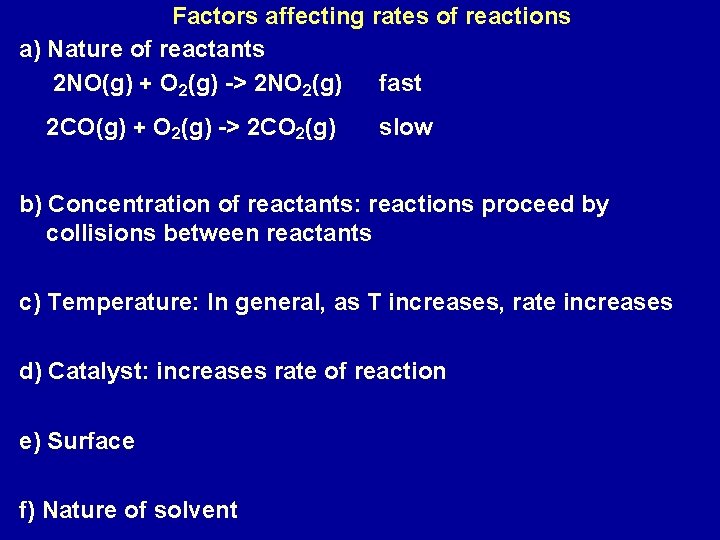
Factors affecting rates of reactions a) Nature of reactants 2 NO(g) + O 2(g) -> 2 NO 2(g) fast 2 CO(g) + O 2(g) -> 2 CO 2(g) slow b) Concentration of reactants: reactions proceed by collisions between reactants c) Temperature: In general, as T increases, rate increases d) Catalyst: increases rate of reaction e) Surface f) Nature of solvent
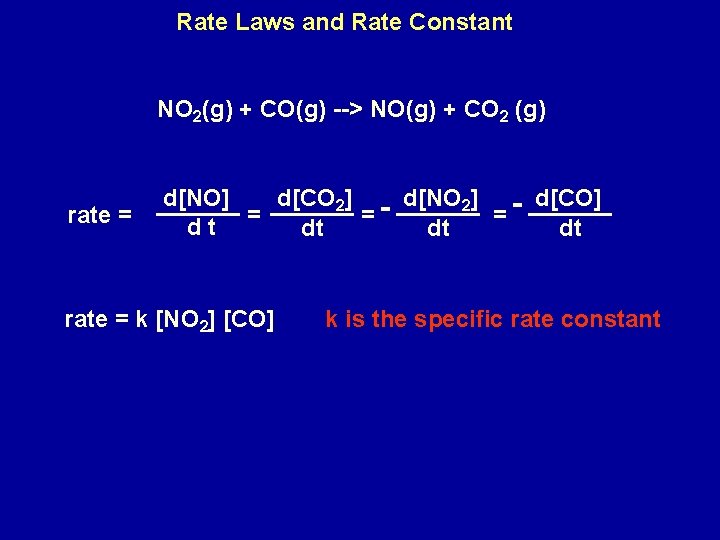
Rate Laws and Rate Constant NO 2(g) + CO(g) --> NO(g) + CO 2 (g) rate = d[NO] d[CO 2] - d[NO 2] - d[CO] = = dt dt dt rate = k [NO 2] [CO] k is the specific rate constant
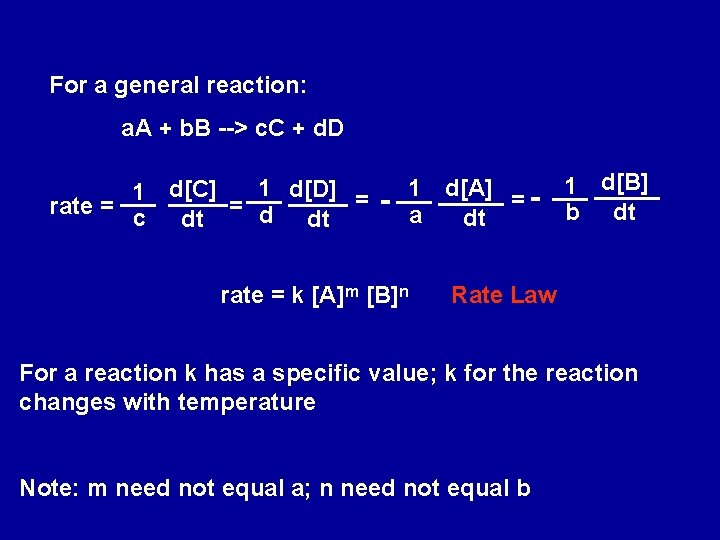
For a general reaction: a. A + b. B --> c. C + d. D 1 d[D] = 1 d[C] rate = = d c dt dt - 1 d[A] = a dt rate = k [A]m [B]n 1 d[B] b dt Rate Law For a reaction k has a specific value; k for the reaction changes with temperature Note: m need not equal a; n need not equal b
Order of a Reaction rate = k [A]m [B]n Order of the reaction = m + n The reaction order is determined by the experimentally determined rate law N 2 O 5(g) --> N 2 O 4(g) + 1/2 O 2(g) Rate = k [N 2 O 5] reaction is a first order reaction For a 1 st order reaction, units of k: time-1
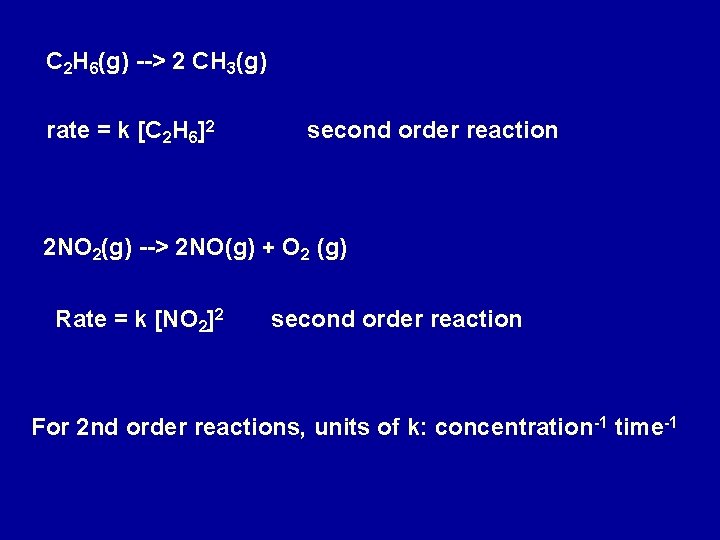
C 2 H 6(g) --> 2 CH 3(g) rate = k [C 2 H 6]2 second order reaction 2 NO 2(g) --> 2 NO(g) + O 2 (g) Rate = k [NO 2]2 second order reaction For 2 nd order reactions, units of k: concentration-1 time-1
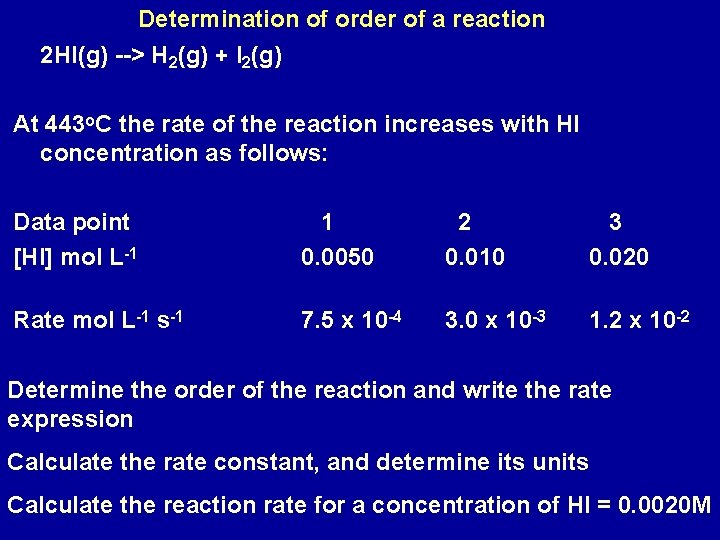
Determination of order of a reaction 2 HI(g) --> H 2(g) + I 2(g) At 443 o. C the rate of the reaction increases with HI concentration as follows: Data point [HI] mol L-1 1 0. 0050 2 0. 010 3 0. 020 Rate mol L-1 s-1 7. 5 x 10 -4 3. 0 x 10 -3 1. 2 x 10 -2 Determine the order of the reaction and write the rate expression Calculate the rate constant, and determine its units Calculate the reaction rate for a concentration of HI = 0. 0020 M
rate = k [HI]n a) rate 1 = k ([HI]1)n rate 2 = k ([HI]2)n rate 2 / rate 1 = ([HI]2)n / ([HI]1)n 3. 0 x 10 -3 / 7. 5 x 10 -4 = (0. 010/0. 0050)n 4 = 2 n n=2 rate = k [HI]2 b) 7. 5 x 10 -4 mol L-1 s-1 = k (0. 0050 mol L-1)2 k = 30 L mol-1 s-1 c) rate = k [HI]2 = 1. 2 x 10 -4 mol L-1 s-1
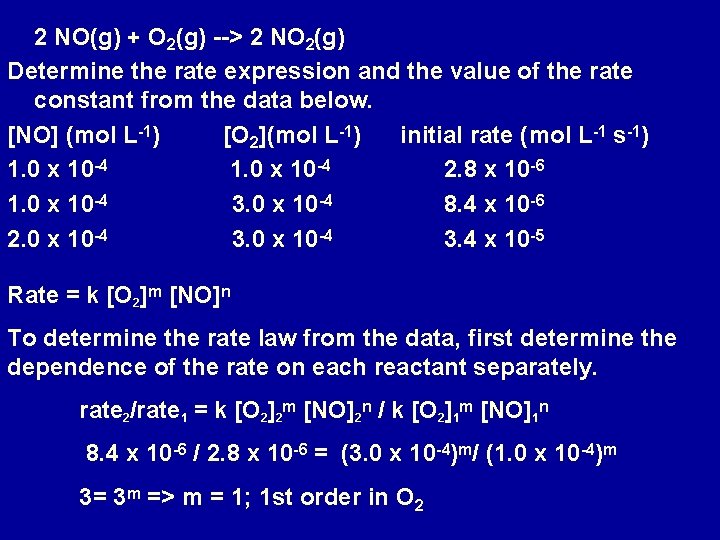
2 NO(g) + O 2(g) --> 2 NO 2(g) Determine the rate expression and the value of the rate constant from the data below. [NO] (mol L-1) [O 2](mol L-1) initial rate (mol L-1 s-1) 1. 0 x 10 -4 2. 8 x 10 -6 1. 0 x 10 -4 3. 0 x 10 -4 8. 4 x 10 -6 2. 0 x 10 -4 3. 4 x 10 -5 Rate = k [O 2]m [NO]n To determine the rate law from the data, first determine the dependence of the rate on each reactant separately. rate 2/rate 1 = k [O 2]2 m [NO]2 n / k [O 2]1 m [NO]1 n 8. 4 x 10 -6 / 2. 8 x 10 -6 = (3. 0 x 10 -4)m/ (1. 0 x 10 -4)m 3= 3 m => m = 1; 1 st order in O 2
rate 3/rate 2 = k [O 2]3 m [NO]3 n / k [O 2]2 m [NO]2 n 3. 4 x 10 -5 / 8. 4 x 10 -6 = (2. 0 x 10 -4)n/ (1. 0 x 10 -4)n 4= 2 n => n = 2; 2 nd order in NO Rate = k [O 2][NO]2 Order of reaction = 3 2. 8 x 10 -6 mol L-1 s-1 = k [1. 0 x 10 -4 mol L-1]2 k = 2. 8 x 10⁶ L 2 mol-2 s-1
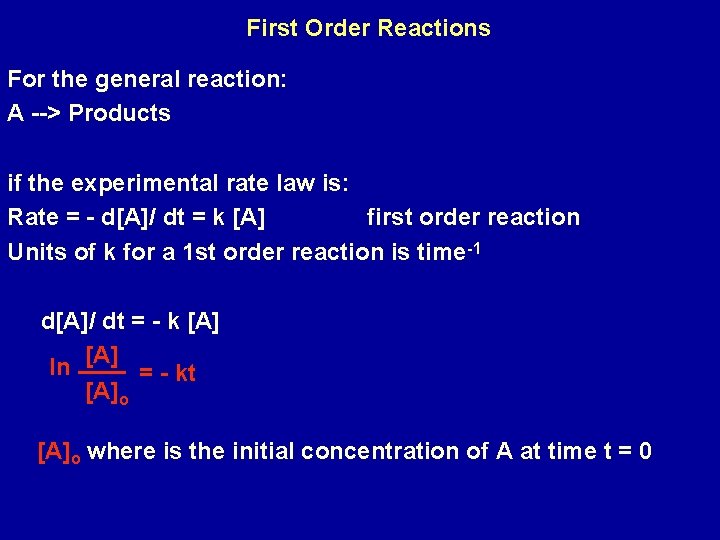
First Order Reactions For the general reaction: A --> Products if the experimental rate law is: Rate = - d[A]/ dt = k [A] first order reaction Units of k for a 1 st order reaction is time-1 d[A]/ dt = - k [A] ln [A] = - kt [A]o where is the initial concentration of A at time t = 0
N 2 O 5(g) --> N 2 O 4(g) + 1/2 O 2(g) [A] = [A]o e-kt rate = k [N 2 O 5] ln[A] = ln [A]o - kt
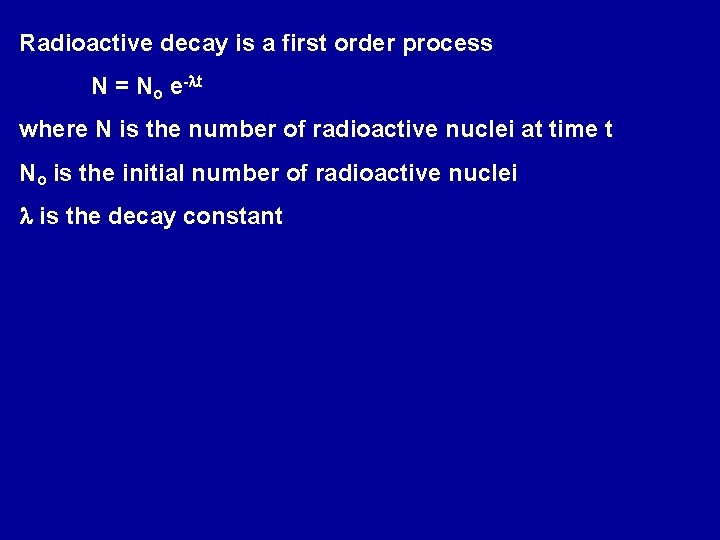
Radioactive decay is a first order process N = No e-lt where N is the number of radioactive nuclei at time t No is the initial number of radioactive nuclei l is the decay constant
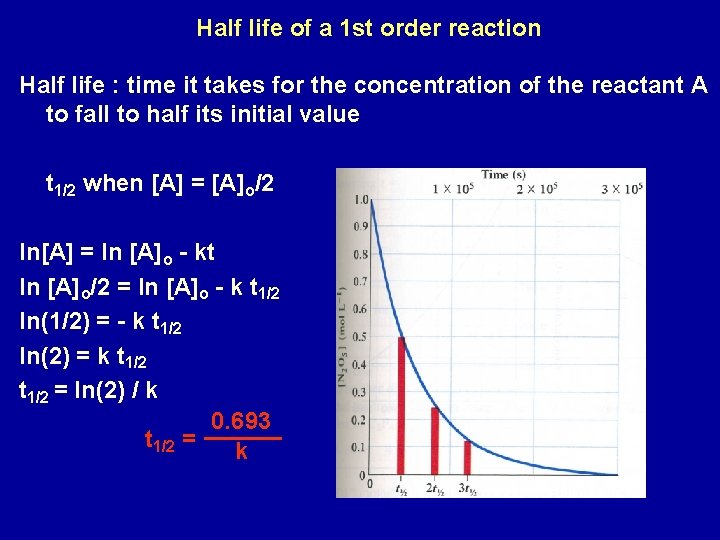
Half life of a 1 st order reaction Half life : time it takes for the concentration of the reactant A to fall to half its initial value t 1/2 when [A] = [A]o/2 ln[A] = ln [A]o - kt ln [A]o/2 = ln [A]o - k t 1/2 ln(1/2) = - k t 1/2 ln(2) = k t 1/2 = ln(2) / k 0. 693 t 1/2 = k
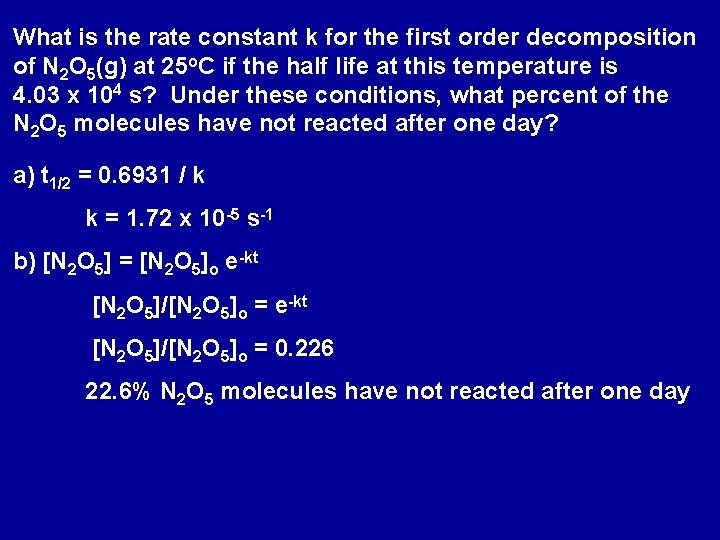
What is the rate constant k for the first order decomposition of N 2 O 5(g) at 25 o. C if the half life at this temperature is 4. 03 x 104 s? Under these conditions, what percent of the N 2 O 5 molecules have not reacted after one day? a) t 1/2 = 0. 6931 / k k = 1. 72 x 10 -5 s-1 b) [N 2 O 5] = [N 2 O 5]o e-kt [N 2 O 5]/[N 2 O 5]o = 0. 226 22. 6% N 2 O 5 molecules have not reacted after one day
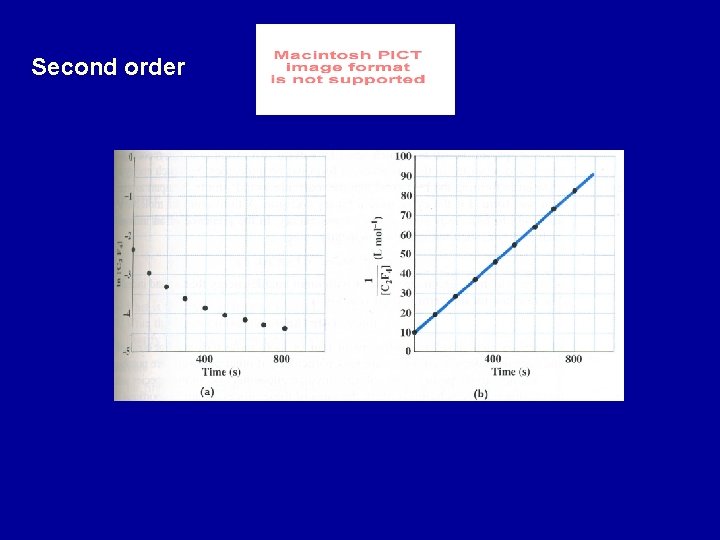
Second order reactions rate = k [A] [B] or rate = k [A]2 Rate = k[A]2 2 nd order reaction for which the rate depends on one reactant - d[A]/ dt = k [A]2 The half-life of a 2 nd order reaction can be determined by setting [A] = [A]o/2 at t = t 1/2
ln [C 2 F 4] 2 C 2 F 4 -> C 4 F 8 ln[C 2 F 4] vs time is not linear rate = k [C 2 F 4]2 slope = k
Zero order reactions A --> P If the rate law is - d[A]/ dt = k zero order reaction For a 0 th order reaction: rate is independent of concentration [A] = [A]o - kt slope = -k [A]
Zero order reaction: [A] = [A]o - kt slope = -k [A] t 1 st order [A] = [A]o e-kt ln[A] = ln [A]o - kt
Second order
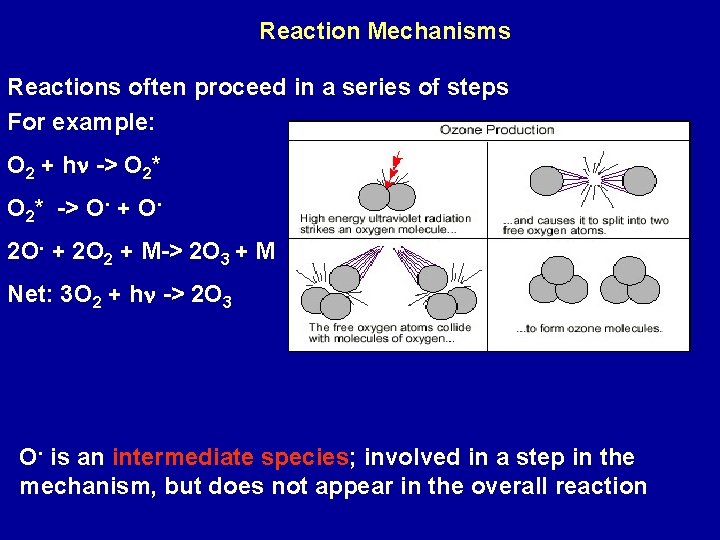
Reaction Mechanisms Reactions often proceed in a series of steps For example: O 2 + hn -> O 2* -> O. + O. 2 O. + 2 O 2 + M-> 2 O 3 + M Net: 3 O 2 + hn -> 2 O 3 O. is an intermediate species; involved in a step in the mechanism, but does not appear in the overall reaction
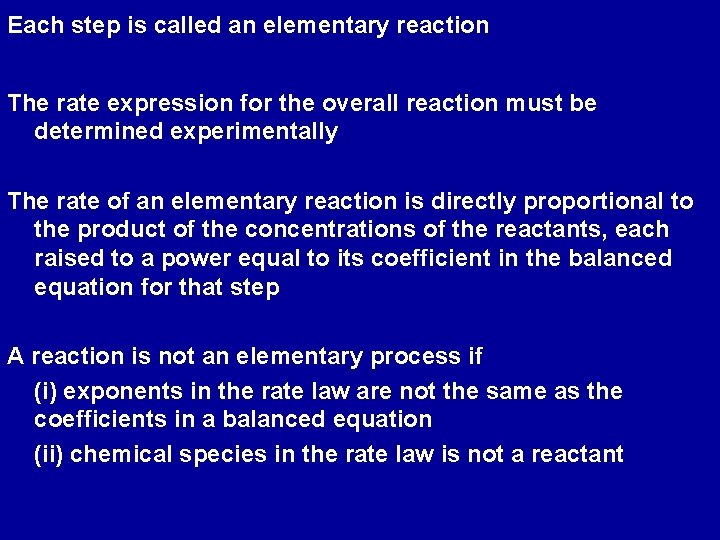
Each step is called an elementary reaction The rate expression for the overall reaction must be determined experimentally The rate of an elementary reaction is directly proportional to the product of the concentrations of the reactants, each raised to a power equal to its coefficient in the balanced equation for that step A reaction is not an elementary process if (i) exponents in the rate law are not the same as the coefficients in a balanced equation (ii) chemical species in the rate law is not a reactant
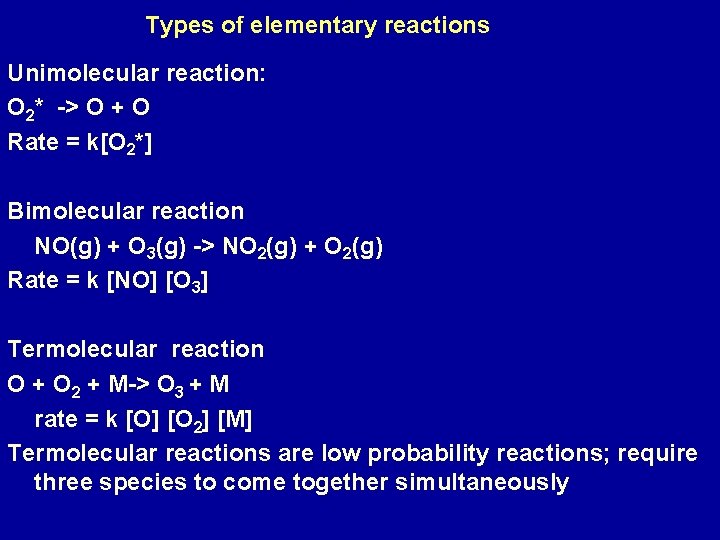
Types of elementary reactions Unimolecular reaction: O 2* -> O + O Rate = k[O 2*] Bimolecular reaction NO(g) + O 3(g) -> NO 2(g) + O 2(g) Rate = k [NO] [O 3] Termolecular reaction O + O 2 + M-> O 3 + M rate = k [O] [O 2] [M] Termolecular reactions are low probability reactions; require three species to come together simultaneously
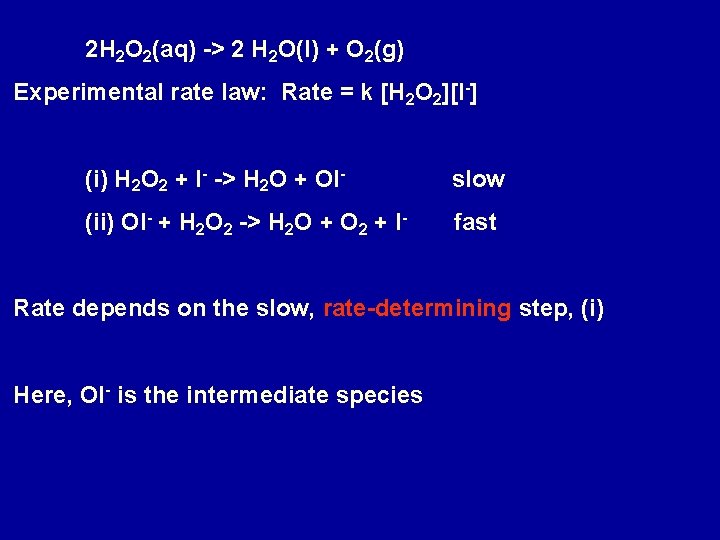
2 H 2 O 2(aq) -> 2 H 2 O(l) + O 2(g) Experimental rate law: Rate = k [H 2 O 2][I-] (i) H 2 O 2 + I- -> H 2 O + OI- slow (ii) OI- + H 2 O 2 -> H 2 O + O 2 + I- fast Rate depends on the slow, rate-determining step, (i) Here, OI- is the intermediate species
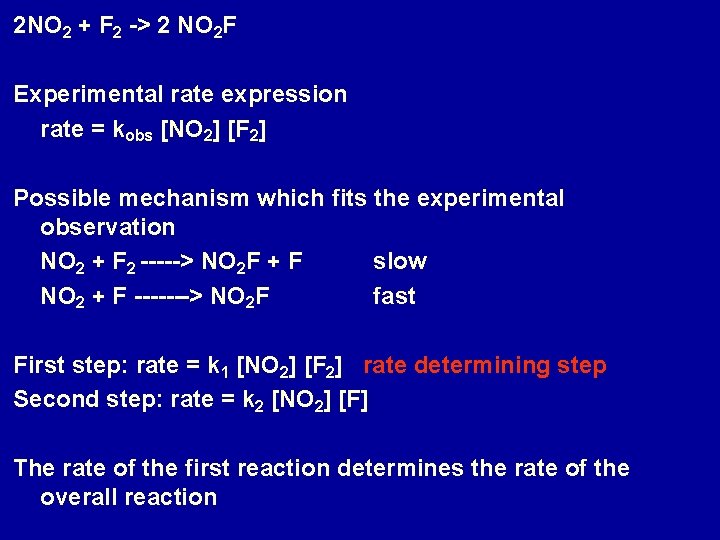
2 NO 2 + F 2 -> 2 NO 2 F Experimental rate expression rate = kobs [NO 2] [F 2] Possible mechanism which fits the experimental observation NO 2 + F 2 -----> NO 2 F + F slow NO 2 + F -------> NO 2 F fast First step: rate = k 1 [NO 2] [F 2] rate determining step Second step: rate = k 2 [NO 2] [F] The rate of the first reaction determines the rate of the overall reaction
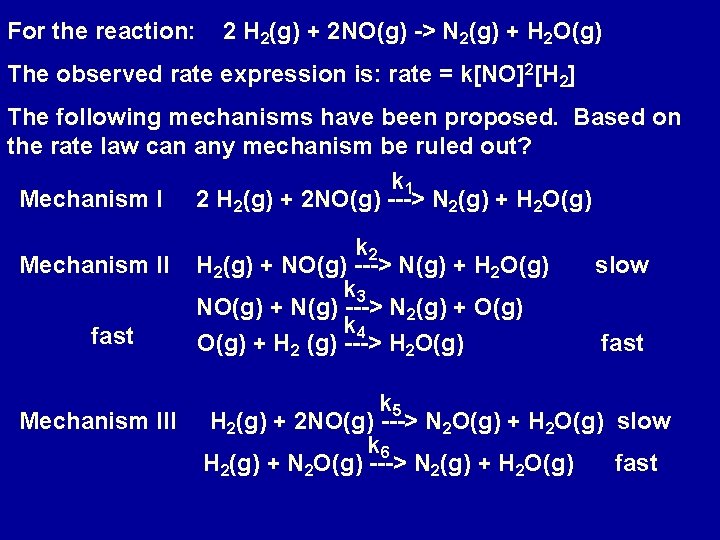
For the reaction: 2 H 2(g) + 2 NO(g) -> N 2(g) + H 2 O(g) The observed rate expression is: rate = k[NO]2[H 2] The following mechanisms have been proposed. Based on the rate law can any mechanism be ruled out? k 1 Mechanism I 2 H 2(g) + 2 NO(g) ---> N 2(g) + H 2 O(g) Mechanism II fast Mechanism III k 2 H 2(g) + NO(g) ---> N(g) + H 2 O(g) k 3 NO(g) + N(g) ---> N 2(g) + O(g) k 4 O(g) + H 2 (g) ---> H 2 O(g) slow fast k 5 H 2(g) + 2 NO(g) ---> N 2 O(g) + H 2 O(g) slow k 6 H 2(g) + N 2 O(g) ---> N 2(g) + H 2 O(g) fast
Mechanism I rate = k 1[H 2]2 [NO]2 not possible Mechanism II rate = k 2[H 2] [NO] not possible Mechanism III rate = k 5[H 2] [NO]2 possible If mechanism III is a possible mechanism, try to detect N 2 O experimentally to confirm mechanism.
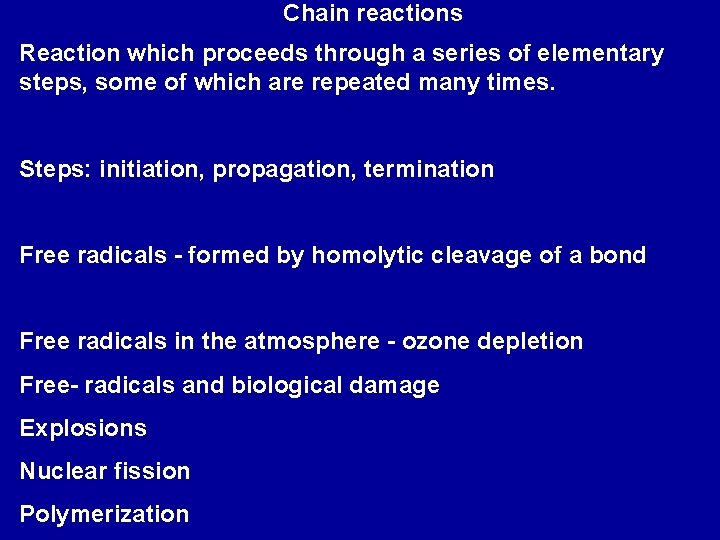
Chain reactions Reaction which proceeds through a series of elementary steps, some of which are repeated many times. Steps: initiation, propagation, termination Free radicals - formed by homolytic cleavage of a bond Free radicals in the atmosphere - ozone depletion Free- radicals and biological damage Explosions Nuclear fission Polymerization
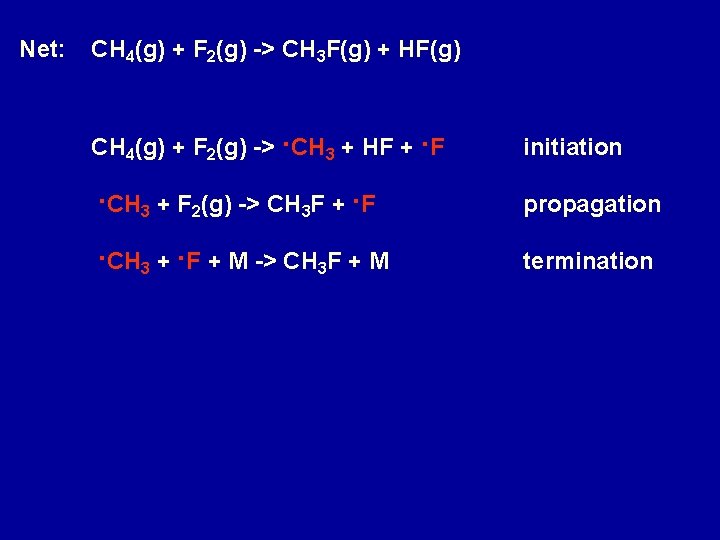
Net: CH 4(g) + F 2(g) -> CH 3 F(g) + HF(g) CH 4(g) + F 2(g) ->. CH 3 + HF +. F initiation . CH 3 + F 2(g) -> CH 3 F +. F propagation . CH 3 +. F + M -> CH 3 F + M termination
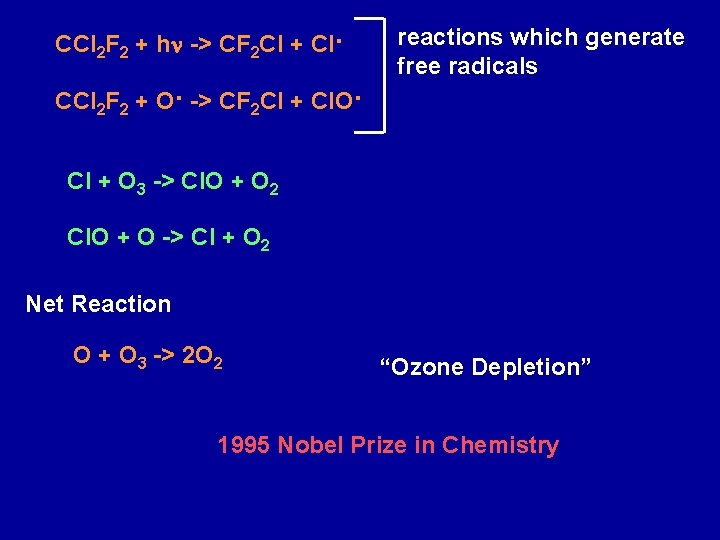
CCl 2 F 2 + hn -> CF 2 Cl + Cl. CCl 2 F 2 + O. -> CF 2 Cl + Cl. O. reactions which generate free radicals Cl + O 3 -> Cl. O + O 2 Cl. O + O -> Cl + O 2 Net Reaction O + O 3 -> 2 O 2 “Ozone Depletion” 1995 Nobel Prize in Chemistry
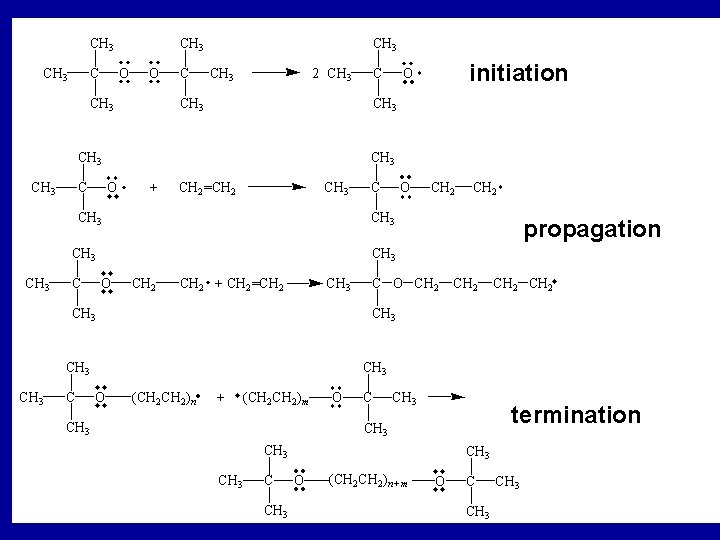
initiation propagation termination
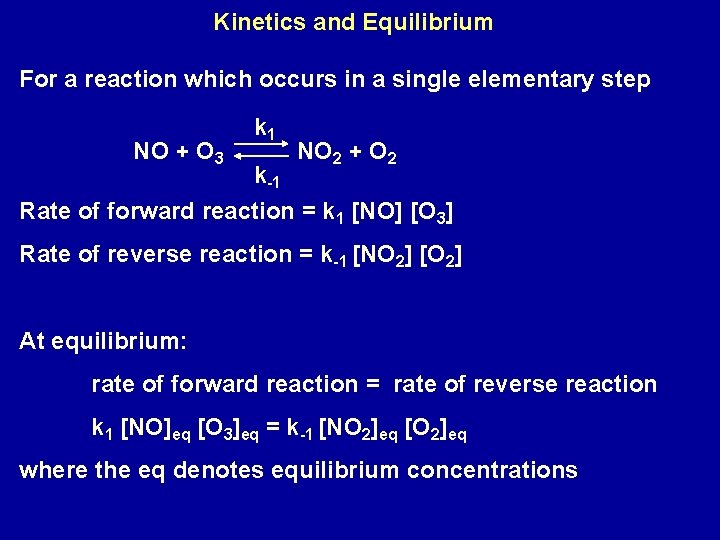
Kinetics and Equilibrium For a reaction which occurs in a single elementary step NO + O 3 k 1 NO 2 + O 2 k-1 Rate of forward reaction = k 1 [NO] [O 3] Rate of reverse reaction = k-1 [NO 2] [O 2] At equilibrium: rate of forward reaction = rate of reverse reaction k 1 [NO]eq [O 3]eq = k-1 [NO 2]eq [O 2]eq where the eq denotes equilibrium concentrations
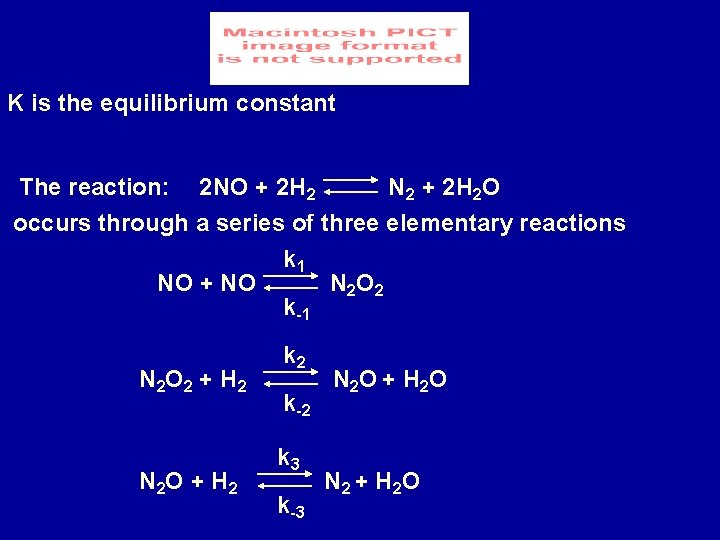
K is the equilibrium constant N 2 + 2 H 2 O The reaction: 2 NO + 2 H 2 occurs through a series of three elementary reactions k 1 NO + NO N 2 O 2 k-1 N 2 O 2 + H 2 N 2 O + H 2 k-2 k 3 k-3 N 2 O + H 2 O N 2 + H 2 O
At equilibrium k 1 [NO]2 eq = k-1 [N 2 O 2]eq k 2 [N 2 O 2]eq [H 2]eq = k-2 [N 2 O]eq [H 2 O]eq k 3 [N 2 O]eq [H 2]eq = k-3 [N 2]eq [H 2 O]eq
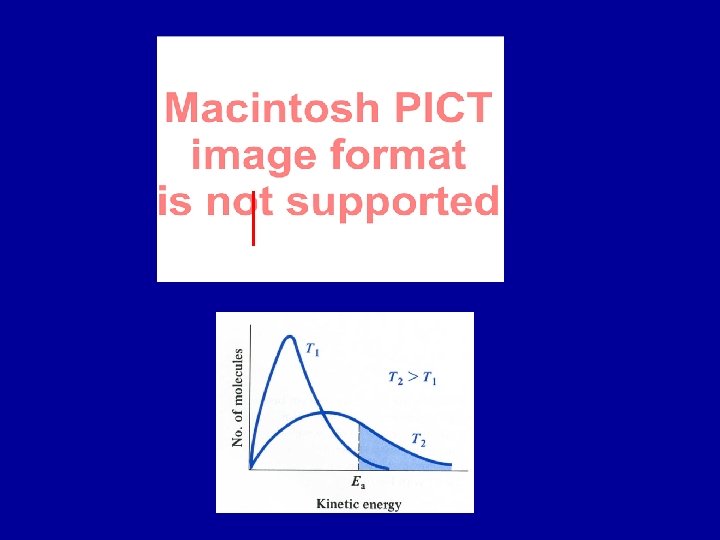
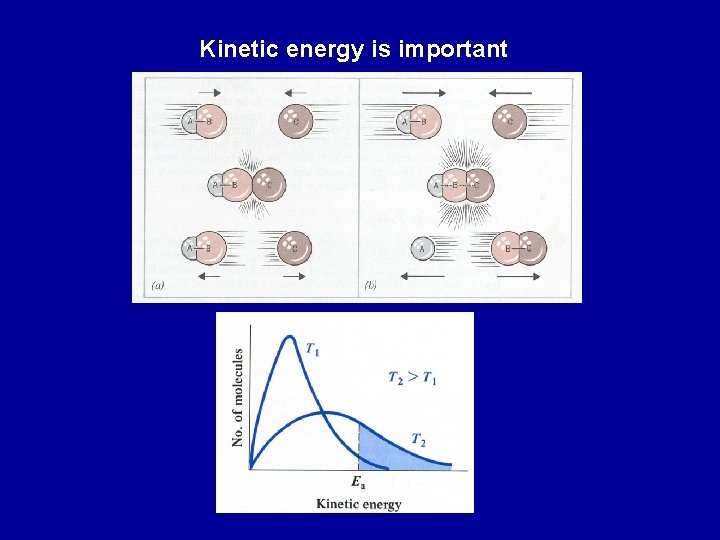
Temperature dependence of reaction rates Collisions between two (or more) atoms/molecules required for a reaction. However, every time two reactants collide they may not react As temperature increases: atoms/molecules collide more frequently kinetic energy of atoms/molecules increases
Kinetic energy is important
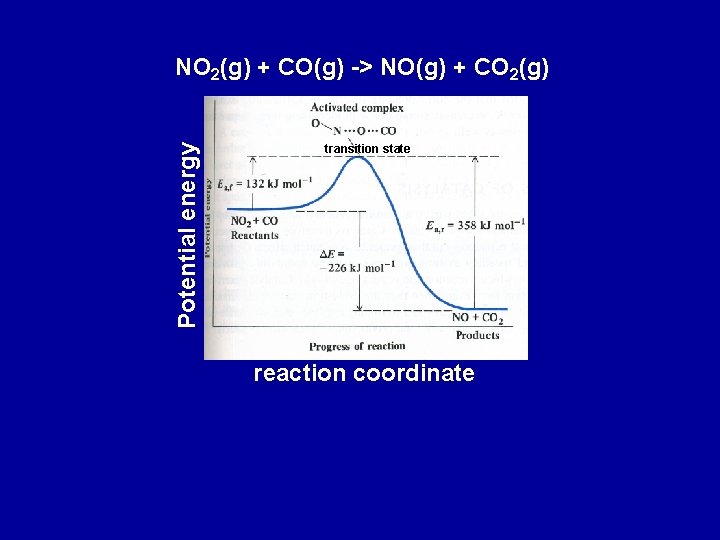
Potential energy NO 2(g) + CO(g) -> NO(g) + CO 2(g) transition state reaction coordinate
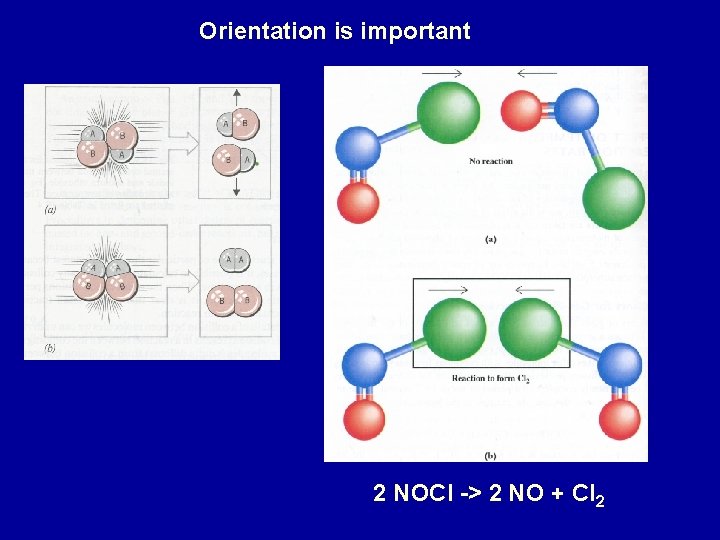
Orientation is important 2 NOCl -> 2 NO + Cl 2
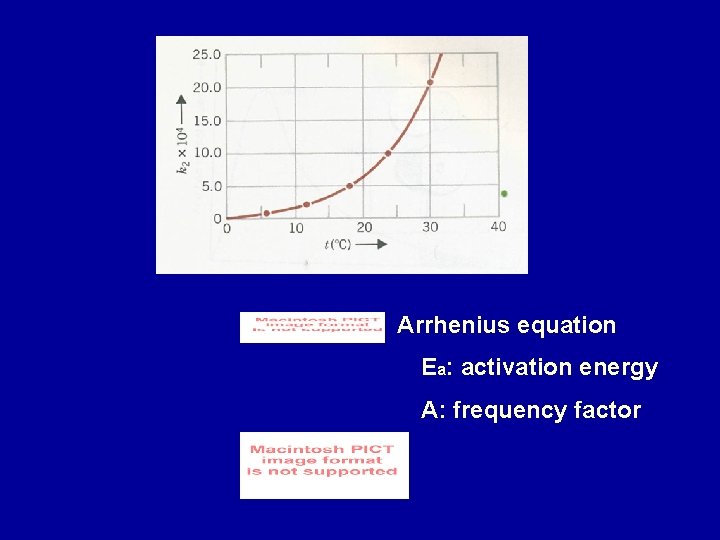
Arrhenius equation Ea: activation energy A: frequency factor
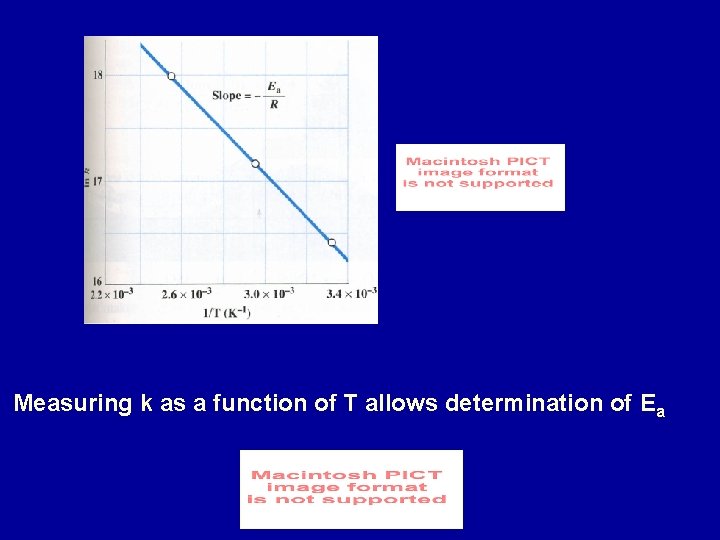
Measuring k as a function of T allows determination of Ea
Catalysis A compound which takes part in a chemical reaction, speeds up the rate, but does not itself undergo a chemical change. Simple mechanism A + catalyst -> intermediates -> B + catalyst Overall: A -> B Concentration of catalyst is included in k; hence k varies with concentration of catalyst
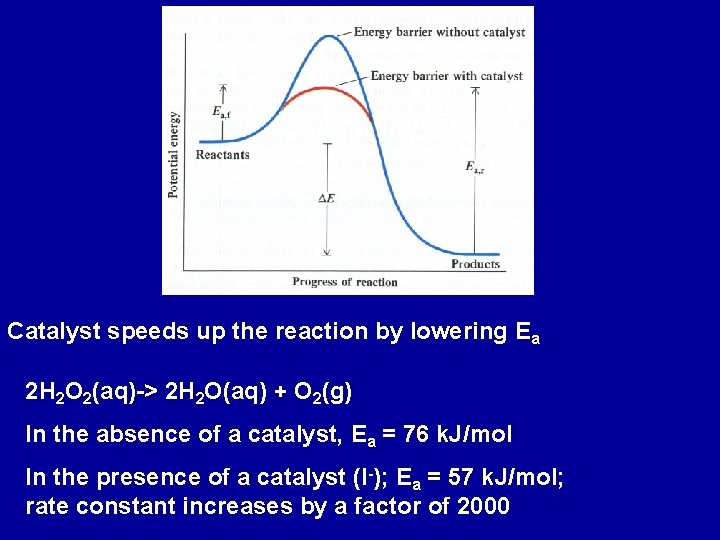
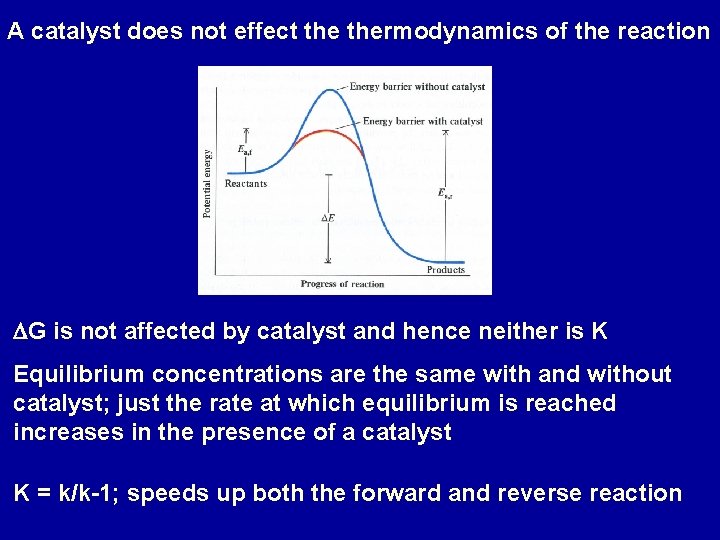
Catalyst speeds up the reaction by lowering Ea 2 H 2 O 2(aq)-> 2 H 2 O(aq) + O 2(g) In the absence of a catalyst, Ea = 76 k. J/mol In the presence of a catalyst (I-); Ea = 57 k. J/mol; rate constant increases by a factor of 2000
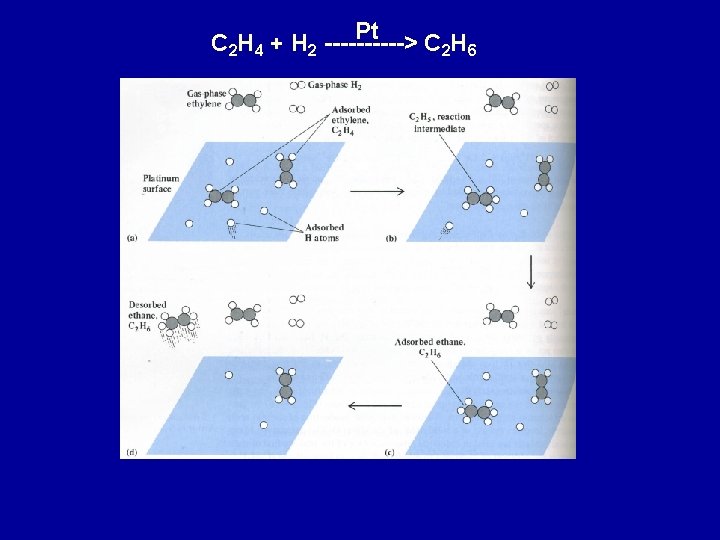
Pt C 2 H 4 + H 2 -----> C 2 H 6
A catalyst does not effect thermodynamics of the reaction DG is not affected by catalyst and hence neither is K Equilibrium concentrations are the same with and without catalyst; just the rate at which equilibrium is reached increases in the presence of a catalyst K = k/k-1; speeds up both the forward and reverse reaction
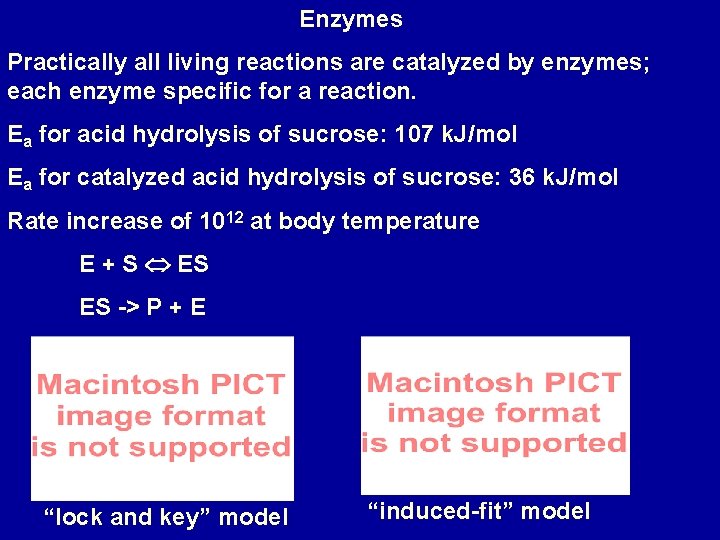
Enzymes Practically all living reactions are catalyzed by enzymes; each enzyme specific for a reaction. Ea for acid hydrolysis of sucrose: 107 k. J/mol Ea for catalyzed acid hydrolysis of sucrose: 36 k. J/mol Rate increase of 1012 at body temperature E + S ES ES -> P + E “lock and key” model “induced-fit” model
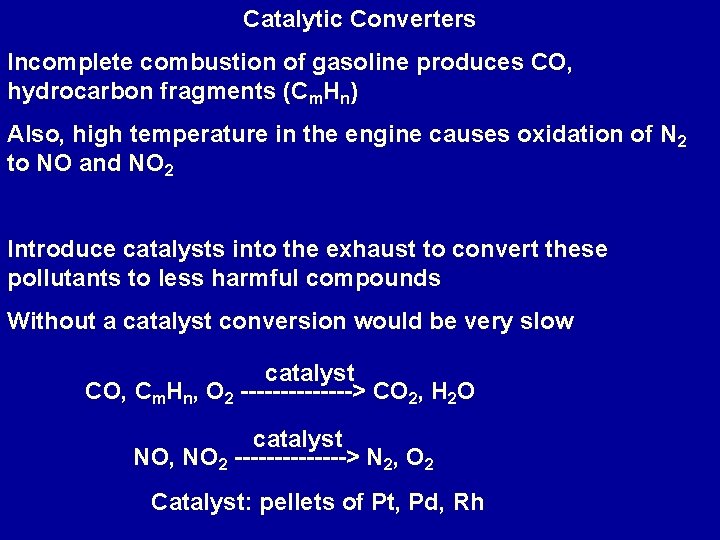
Catalytic Converters Incomplete combustion of gasoline produces CO, hydrocarbon fragments (Cm. Hn) Also, high temperature in the engine causes oxidation of N 2 to NO and NO 2 Introduce catalysts into the exhaust to convert these pollutants to less harmful compounds Without a catalyst conversion would be very slow catalyst CO, Cm. Hn, O 2 -------> CO 2, H 2 O catalyst NO, NO 2 -------> N 2, O 2 Catalyst: pellets of Pt, Pd, Rh
Autocatalysis Catalysis of a reaction by the products A-> P Rate = k [A][P] reaction rate increase as P is formed Br. O 3 - + HBr. O 2 + H 3 O+ -> 2 Br. O 2 + 2 H 2 O 2 Br. O 2 + 2 Ce 3+ 2 H 3 O+ --> 2 HBr. O 2 + 2 Ce 4+ + 2 H 2 O A consequence of autocatalysis is an oscillating reaction Concentration of reactants, products or intermediates vary periodically with time Autocatalysis plays the role of “positive feedback”
Briggs-Rauscher Reaction http: //www. chem. leeds. ac. uk/delights/texts/expt_11. html