
Chemical Kinetics Chapter 14 Reminders Assignment 1 due

- Slides: 26
Chemical Kinetics Chapter 14
Reminders • Assignment 1 due today (end of class) • Assignment 2 up on ACME, due Jan. 29 (in class) • Assignment 3 will be up Mon. , Jan 29 and will be due Mon. , Feb. 05 • Assignment 4 (Ch. 15) will not be due before Midterm 1, but Ch. 15 will be on the midterm
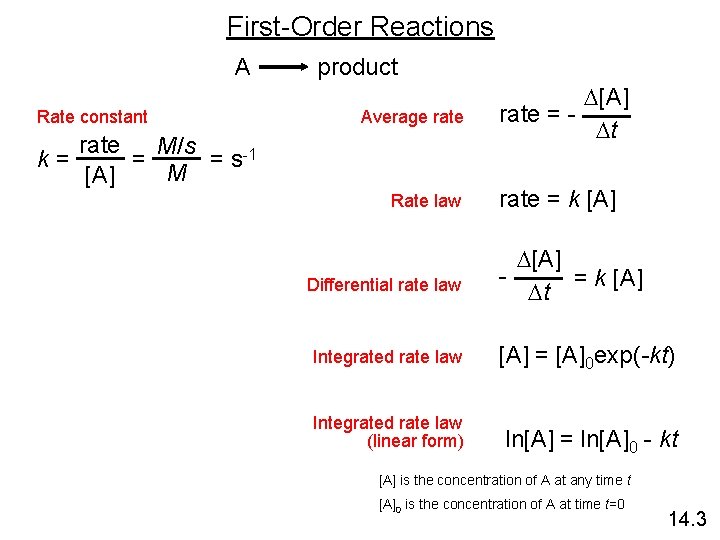
First-Order Reactions A Rate constant k= product Average rate M/s = = s-1 M [A] Rate law Differential rate law D[A] rate = Dt rate = k [A] D[A] = k [A] Dt Integrated rate law [A] = [A]0 exp(-kt) Integrated rate law (linear form) ln[A] = ln[A]0 - kt [A] is the concentration of A at any time t [A]0 is the concentration of A at time t=0 14. 3
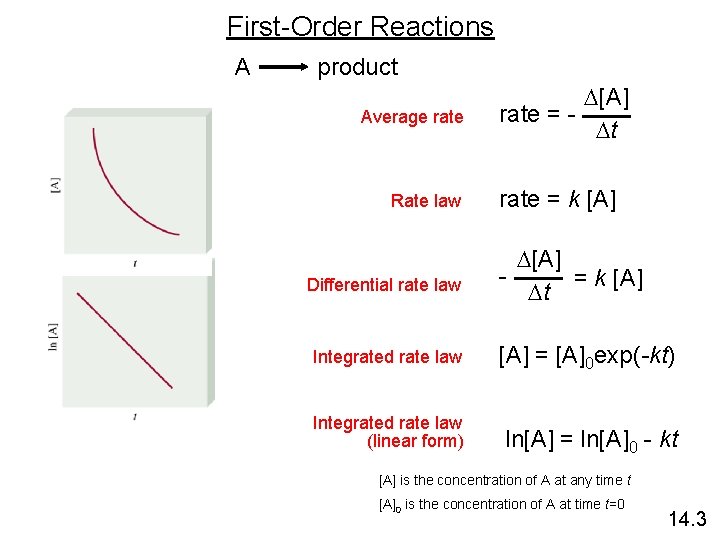
First-Order Reactions A product Average rate Rate law Differential rate law D[A] rate = Dt rate = k [A] D[A] = k [A] Dt Integrated rate law [A] = [A]0 exp(-kt) Integrated rate law (linear form) ln[A] = ln[A]0 - kt [A] is the concentration of A at any time t [A]0 is the concentration of A at time t=0 14. 3
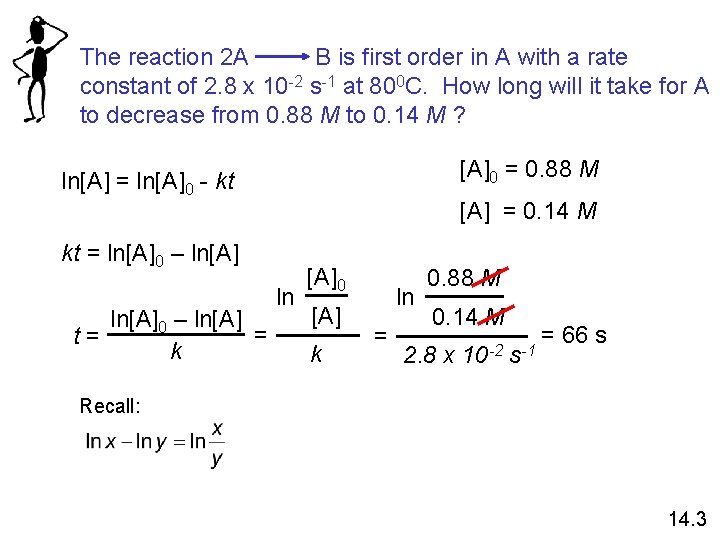
The reaction 2 A B is first order in A with a rate constant of 2. 8 x 10 -2 s-1 at 800 C. How long will it take for A to decrease from 0. 88 M to 0. 14 M ? [A]0 = 0. 88 M ln[A] = ln[A]0 - kt [A] = 0. 14 M kt = ln[A]0 – ln[A] = t= k ln [A]0 [A] k ln = 0. 88 M 0. 14 M 2. 8 x 10 -2 s-1 = 66 s Recall: 14. 3
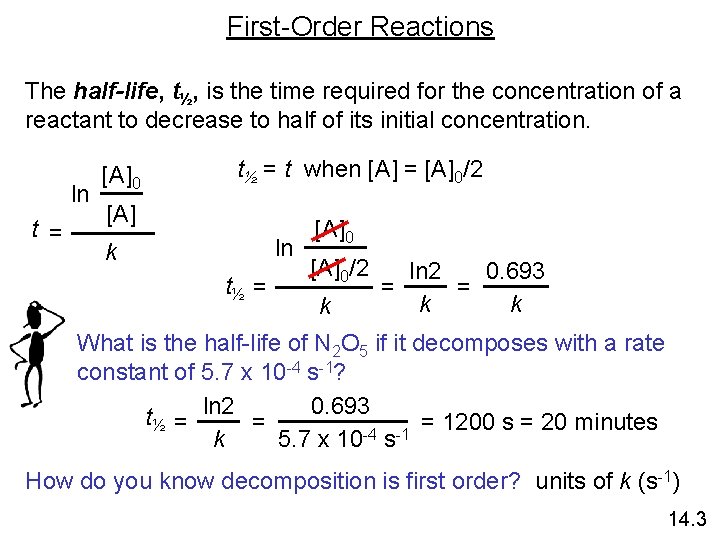
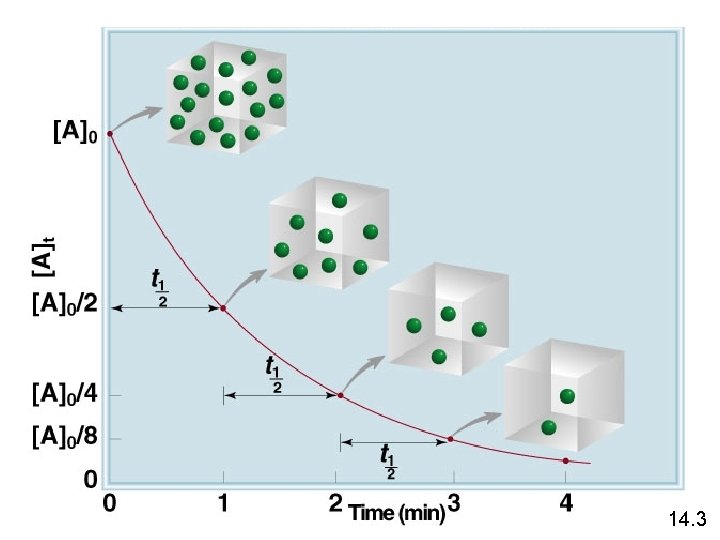
First-Order Reactions The half-life, t½, is the time required for the concentration of a reactant to decrease to half of its initial concentration. ln t = [A]0 t½ = t when [A] = [A]0/2 [A] ln k t½ = [A]0/2 k ln 2 0. 693 = = k k What is the half-life of N 2 O 5 if it decomposes with a rate constant of 5. 7 x 10 -4 s-1? 0. 693 t½ = ln 2 = = 1200 s = 20 minutes -4 -1 k 5. 7 x 10 s How do you know decomposition is first order? units of k (s-1) 14. 3
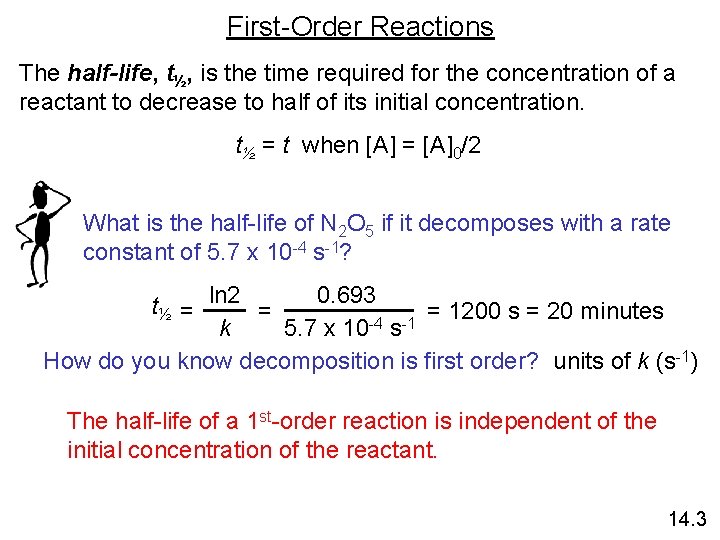
First-Order Reactions The half-life, t½, is the time required for the concentration of a reactant to decrease to half of its initial concentration. t½ = t when [A] = [A]0/2 What is the half-life of N 2 O 5 if it decomposes with a rate constant of 5. 7 x 10 -4 s-1? 0. 693 t½ = ln 2 = = 1200 s = 20 minutes -4 -1 k 5. 7 x 10 s How do you know decomposition is first order? units of k (s-1) The half-life of a 1 st-order reaction is independent of the initial concentration of the reactant. 14. 3
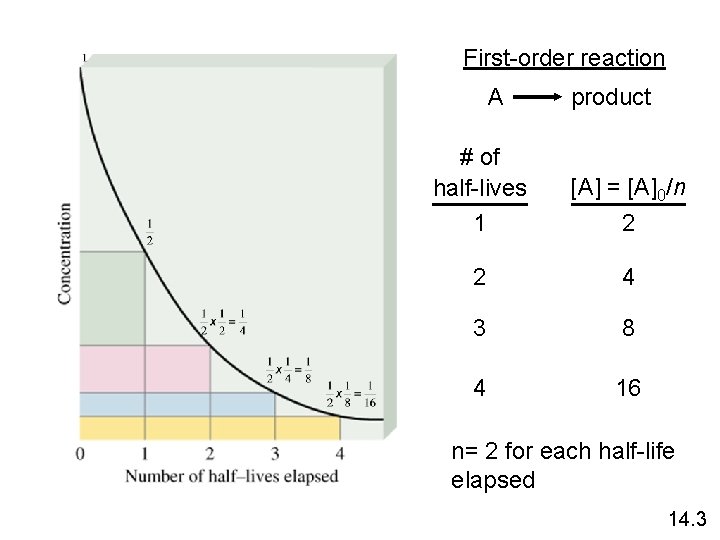
First-order reaction A product # of half-lives 1 [A] = [A]0/n 2 4 3 8 4 16 2 n= 2 for each half-life elapsed 14. 3
14. 3
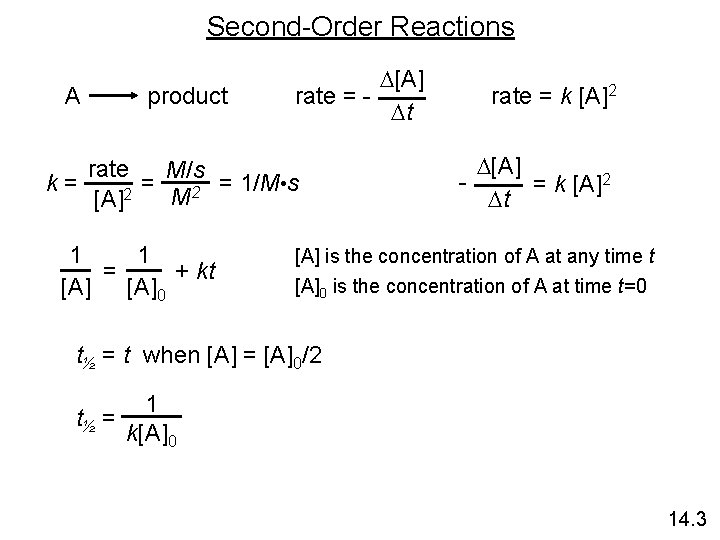
Second-Order Reactions A product D[A] rate = Dt rate M/s = = 1/M • s k= 2 2 M [A] 1 1 = + kt [A]0 rate = k [A]2 D[A] = k [A]2 Dt [A] is the concentration of A at any time t [A]0 is the concentration of A at time t=0 t½ = t when [A] = [A]0/2 1 t½ = k[A]0 14. 3
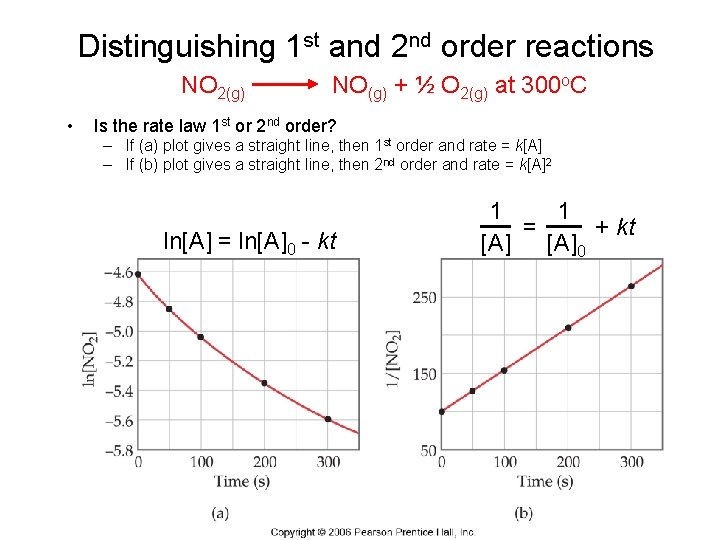
Distinguishing 1 st and 2 nd order reactions NO 2(g) • NO(g) + ½ O 2(g) at 300 o. C Is the rate law 1 st or 2 nd order? – If (a) plot gives a straight line, then 1 st order and rate = k[A] – If (b) plot gives a straight line, then 2 nd order and rate = k[A]2 ln[A] = ln[A]0 - kt 1 1 = + kt [A]0 [A]
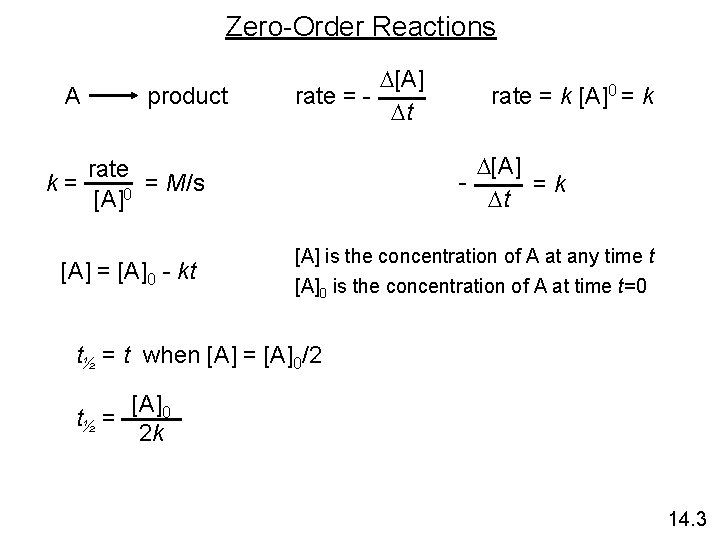
Zero-Order Reactions A product D[A] rate = Dt D[A] =k Dt rate = M/s k= 0 [A] = [A]0 - kt rate = k [A]0 = k [A] is the concentration of A at any time t [A]0 is the concentration of A at time t=0 t½ = t when [A] = [A]0/2 [A]0 t½ = 2 k 14. 3
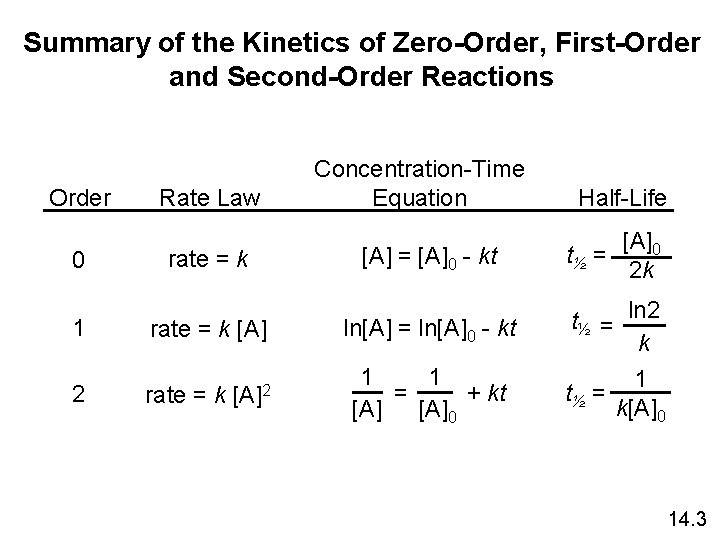
Summary of the Kinetics of Zero-Order, First-Order and Second-Order Reactions Order 0 Rate Law rate = k 1 rate = k [A] 2 [A]2 rate = k Concentration-Time Equation [A] = [A]0 - kt Half-Life t½ = [A]0 2 k ln[A] = ln[A]0 - kt t½ = ln 2 k 1 1 = + kt [A]0 1 t½ = k[A]0 14. 3
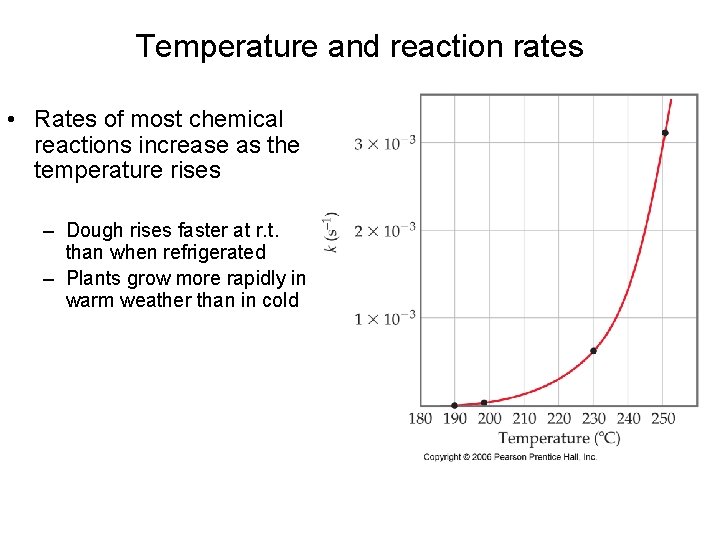
Temperature and reaction rates • Rates of most chemical reactions increase as the temperature rises – Dough rises faster at r. t. than when refrigerated – Plants grow more rapidly in warm weather than in cold
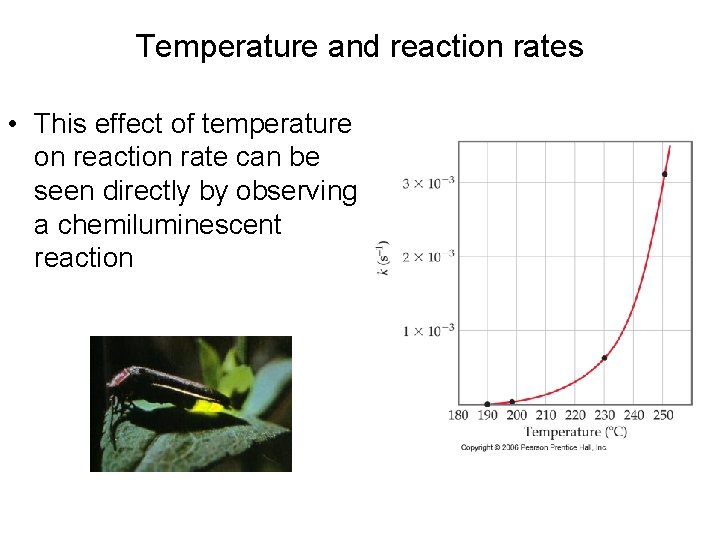
Temperature and reaction rates • This effect of temperature on reaction rate can be seen directly by observing a chemiluminescent reaction
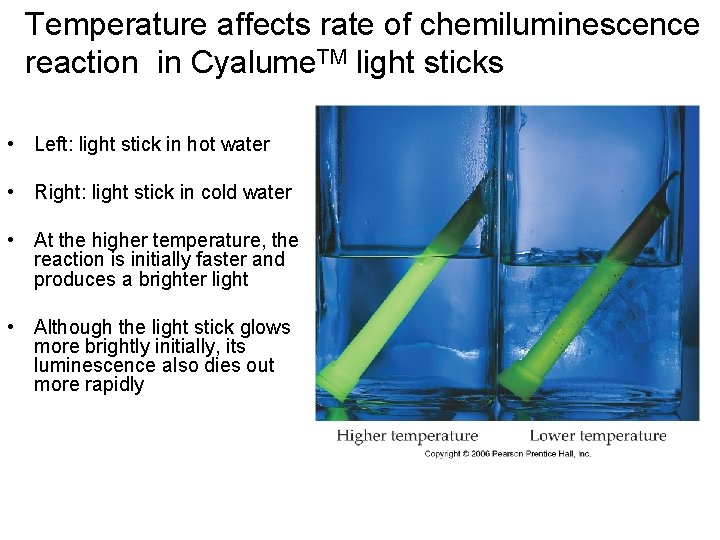
Temperature affects rate of chemiluminescence reaction in Cyalume. TM light sticks • Left: light stick in hot water • Right: light stick in cold water • At the higher temperature, the reaction is initially faster and produces a brighter light • Although the light stick glows more brightly initially, its luminescence also dies out more rapidly
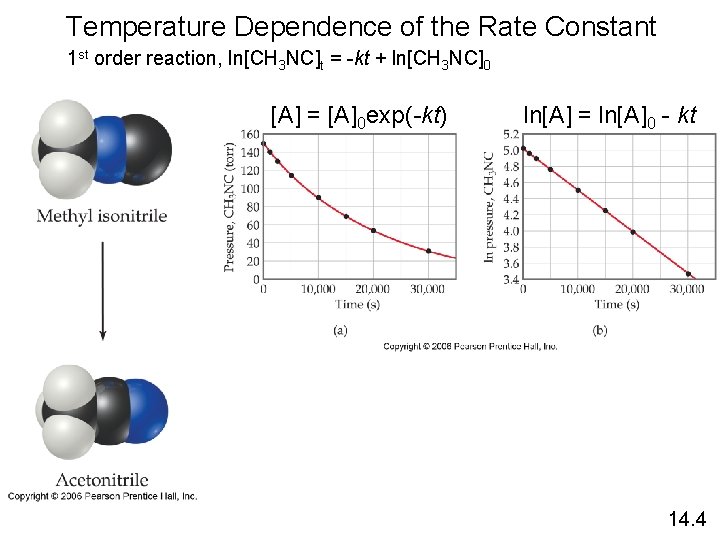
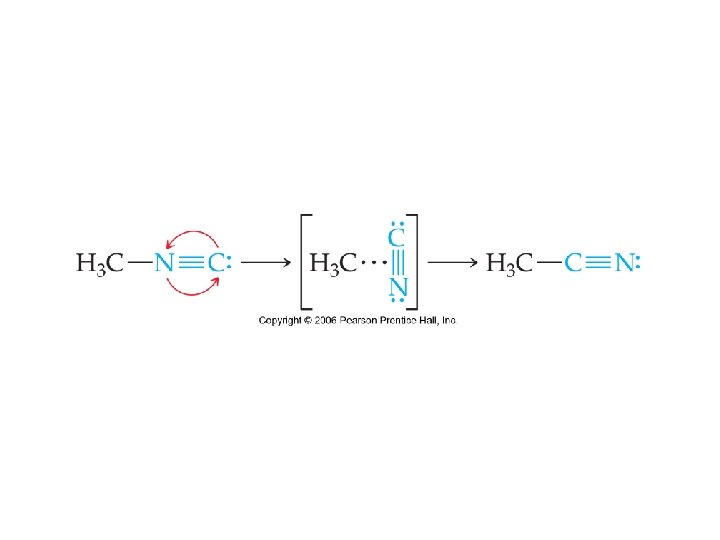
Temperature Dependence of the Rate Constant 1 st order reaction, ln[CH 3 NC]t = -kt + ln[CH 3 NC]0 [A] = [A]0 exp(-kt) ln[A] = ln[A]0 - kt 14. 4
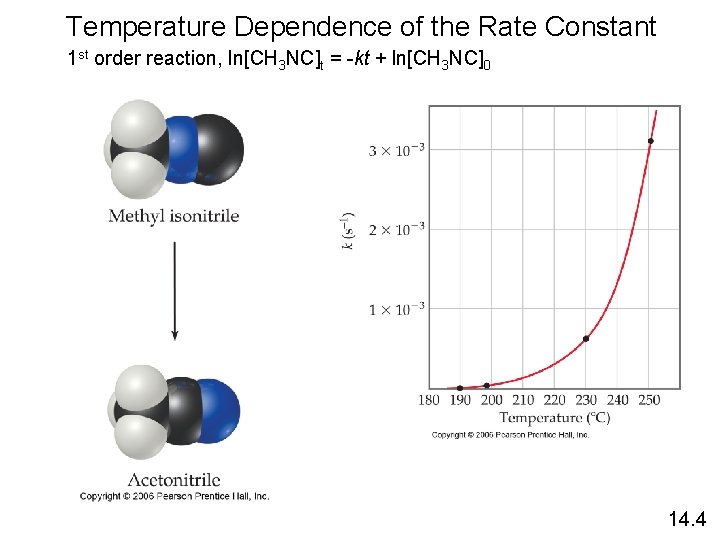
Temperature Dependence of the Rate Constant 1 st order reaction, ln[CH 3 NC]t = -kt + ln[CH 3 NC]0 14. 4
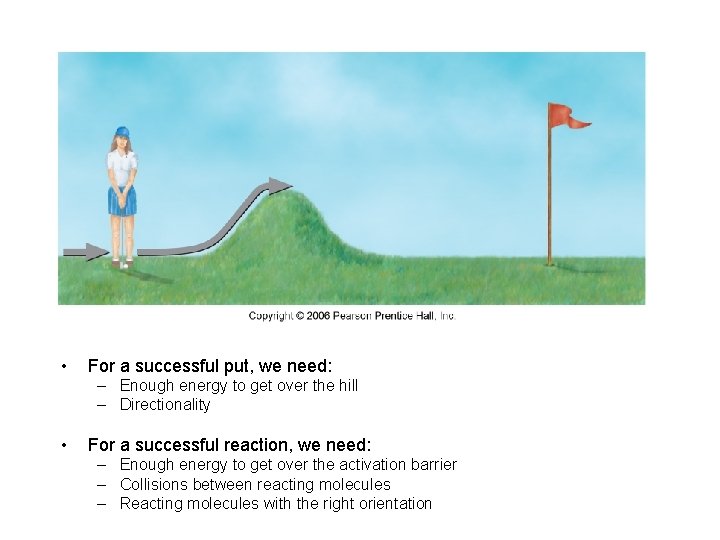
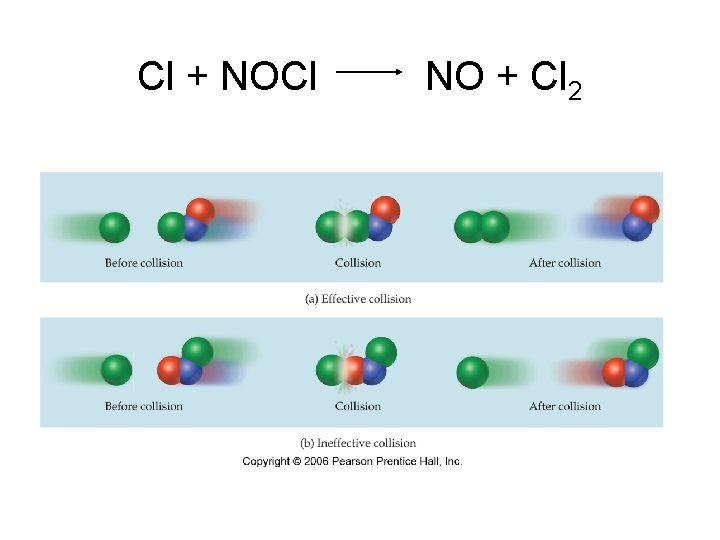
• For a successful put, we need: – Enough energy to get over the hill – Directionality • For a successful reaction, we need: – Enough energy to get over the activation barrier – Collisions between reacting molecules – Reacting molecules with the right orientation
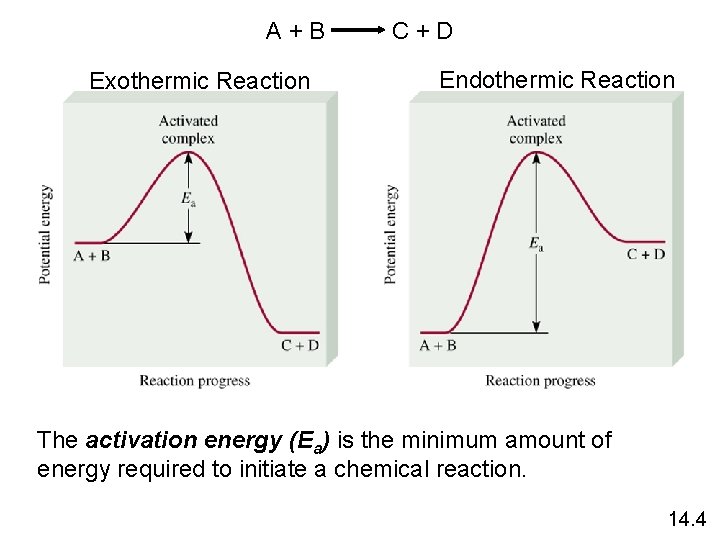
A+B Exothermic Reaction C+D Endothermic Reaction The activation energy (Ea) is the minimum amount of energy required to initiate a chemical reaction. 14. 4
Cl + NOCl NO + Cl 2
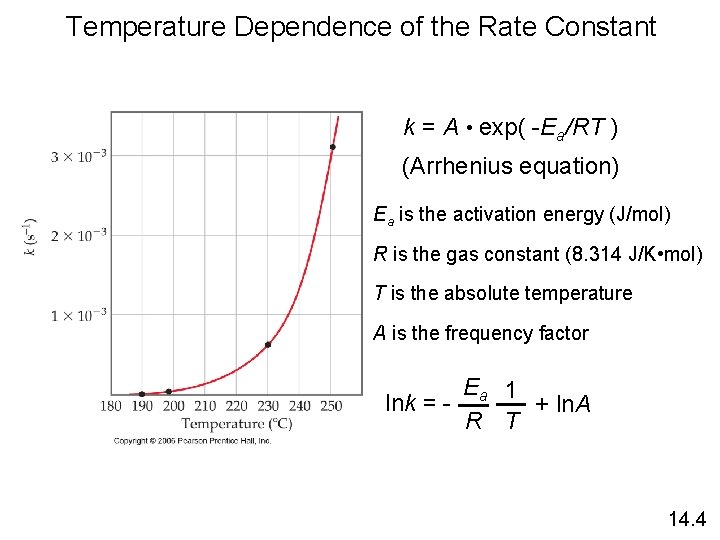
Temperature Dependence of the Rate Constant k = A • exp( -Ea/RT ) (Arrhenius equation) Ea is the activation energy (J/mol) R is the gas constant (8. 314 J/K • mol) T is the absolute temperature A is the frequency factor Ea 1 lnk = + ln. A R T 14. 4
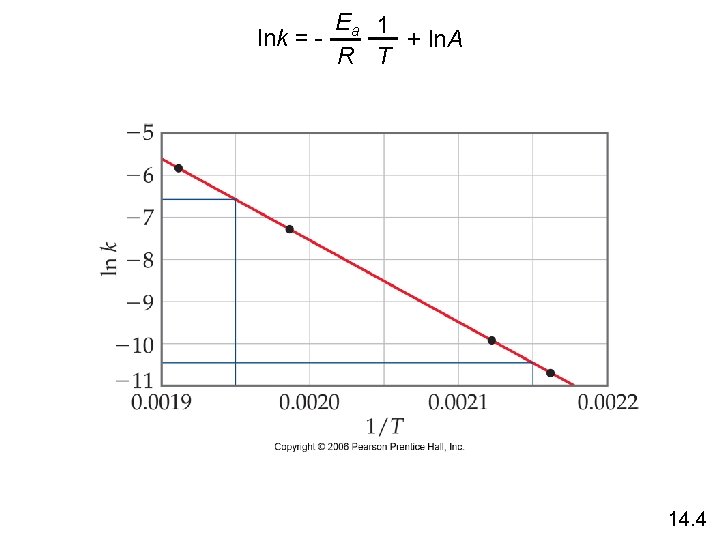
Ea 1 lnk = + ln. A R T 14. 4
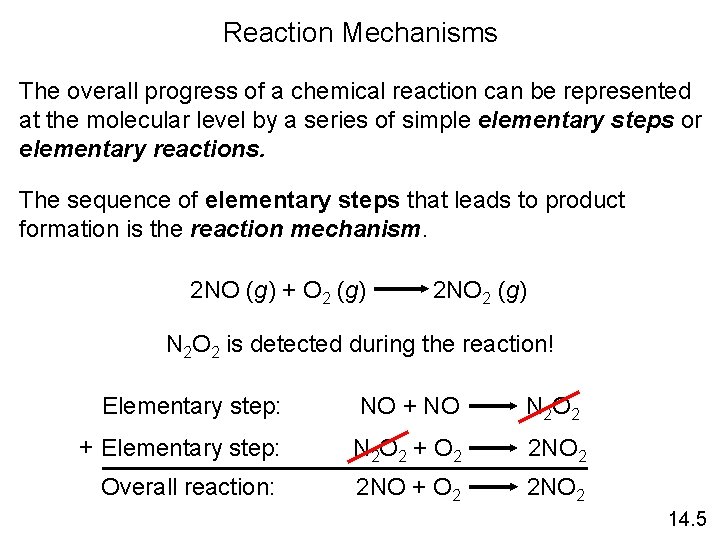
Reaction Mechanisms The overall progress of a chemical reaction can be represented at the molecular level by a series of simple elementary steps or elementary reactions. The sequence of elementary steps that leads to product formation is the reaction mechanism. 2 NO (g) + O 2 (g) 2 NO 2 (g) N 2 O 2 is detected during the reaction! Elementary step: NO + NO N 2 O 2 + Elementary step: N 2 O 2 + O 2 2 NO 2 Overall reaction: 2 NO + O 2 2 NO 2 14. 5