
Chemical Hydrograph Separation 1 STEP 1 MIXING DIAGRAMS

- Slides: 17
Chemical Hydrograph Separation 1
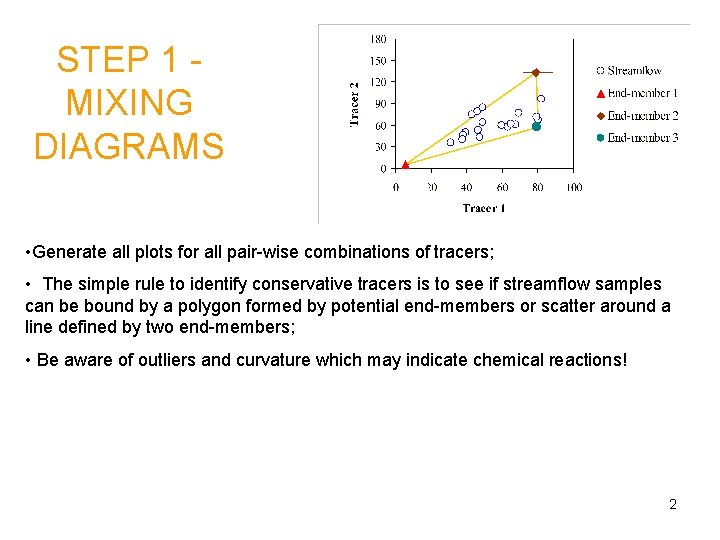
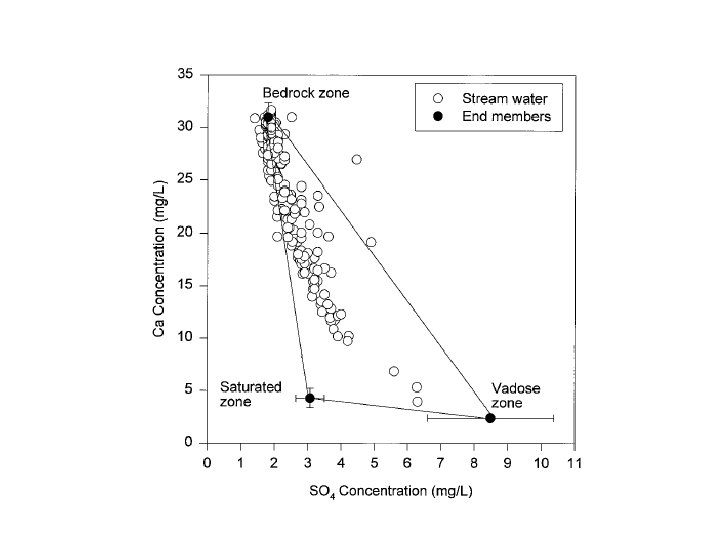
STEP 1 MIXING DIAGRAMS • Generate all plots for all pair-wise combinations of tracers; • The simple rule to identify conservative tracers is to see if streamflow samples can be bound by a polygon formed by potential end-members or scatter around a line defined by two end-members; • Be aware of outliers and curvature which may indicate chemical reactions! 2
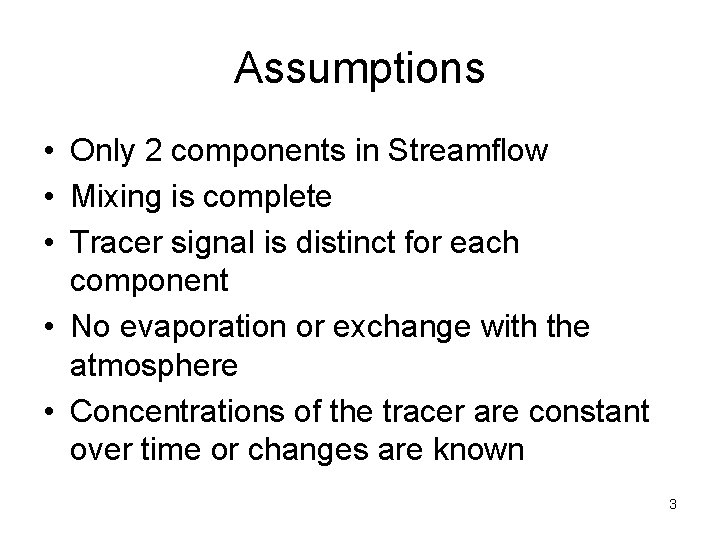
Assumptions • Only 2 components in Streamflow • Mixing is complete • Tracer signal is distinct for each component • No evaporation or exchange with the atmosphere • Concentrations of the tracer are constant over time or changes are known 3
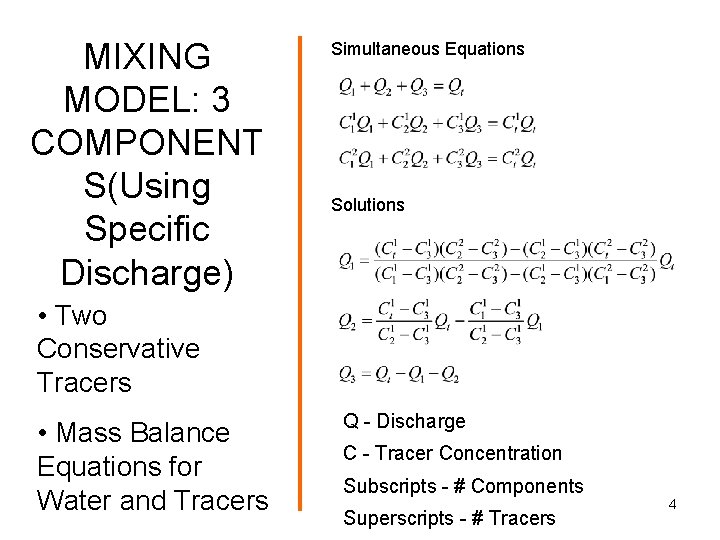
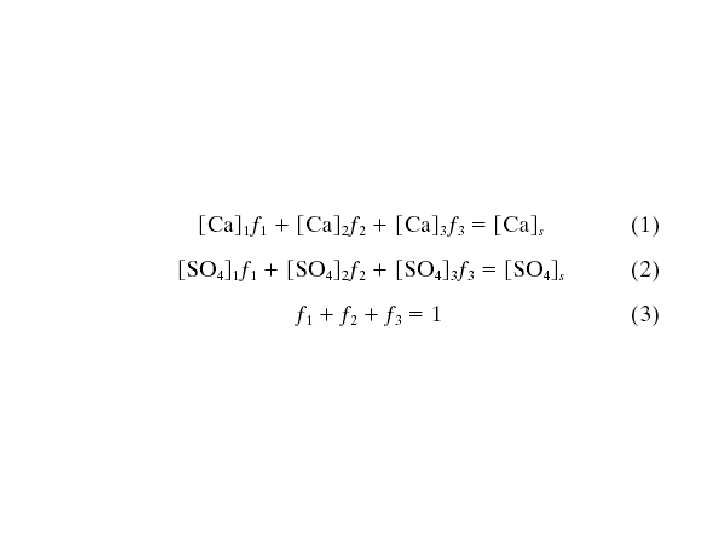
MIXING MODEL: 3 COMPONENT S(Using Specific Discharge) Simultaneous Equations Solutions • Two Conservative Tracers • Mass Balance Equations for Water and Tracers Q - Discharge C - Tracer Concentration Subscripts - # Components Superscripts - # Tracers 4
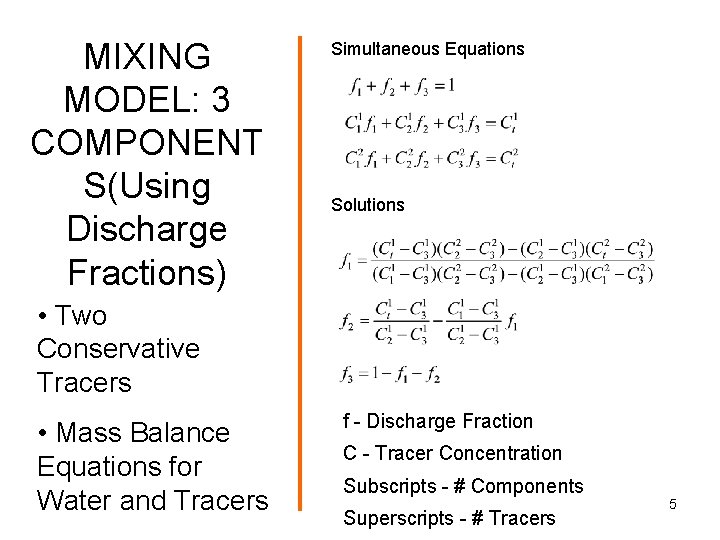
MIXING MODEL: 3 COMPONENT S(Using Discharge Fractions) Simultaneous Equations Solutions • Two Conservative Tracers • Mass Balance Equations for Water and Tracers f - Discharge Fraction C - Tracer Concentration Subscripts - # Components Superscripts - # Tracers 5
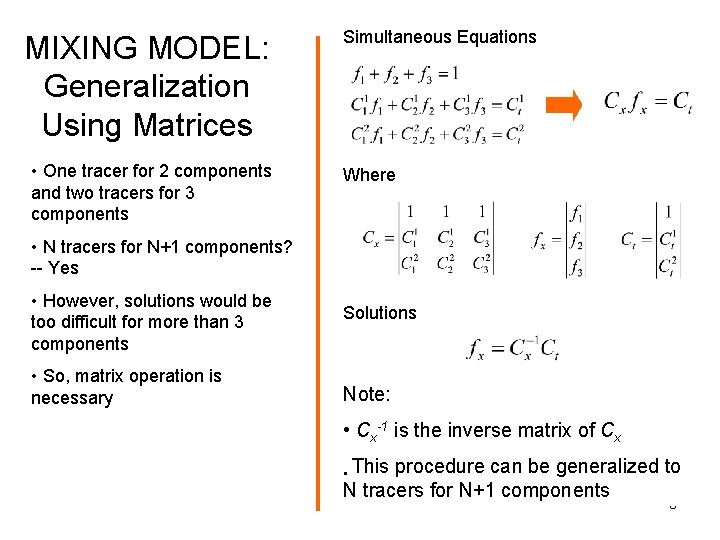
MIXING MODEL: Generalization Using Matrices • One tracer for 2 components and two tracers for 3 components Simultaneous Equations Where • N tracers for N+1 components? -- Yes • However, solutions would be too difficult for more than 3 components • So, matrix operation is necessary Solutions Note: • Cx-1 is the inverse matrix of Cx • This procedure can be generalized to N tracers for N+1 components 6
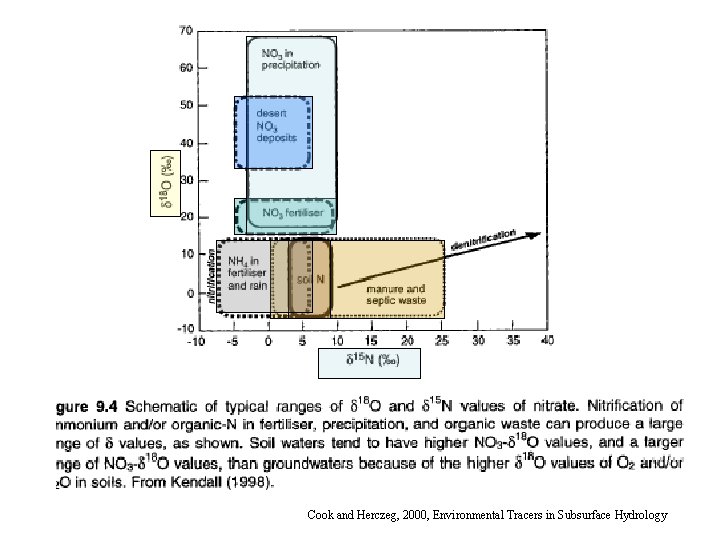
Cook and Herczeg, 2000, Environmental Tracers in Subsurface Hydrology
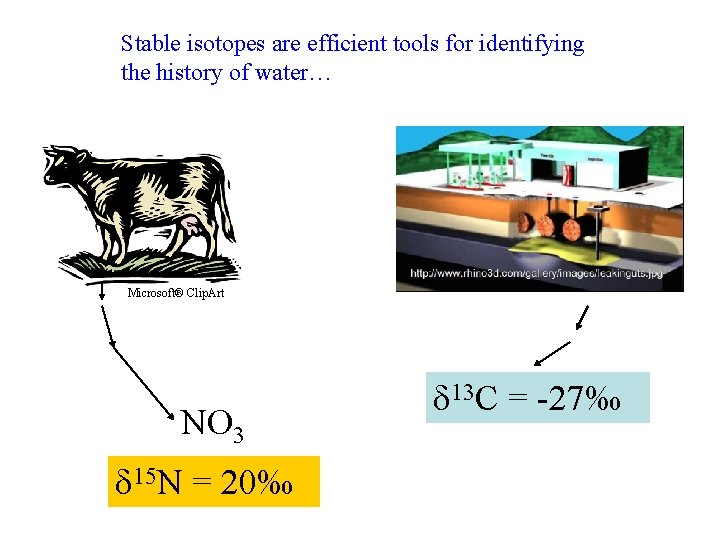
Stable isotopes are efficient tools for identifying the history of water… Microsoft® Clip. Art NO 3 d 15 N = 20‰ d 13 C = -27‰