
Chemical Hazard Communication CONNOSHA Breakfast Roundtable July 16
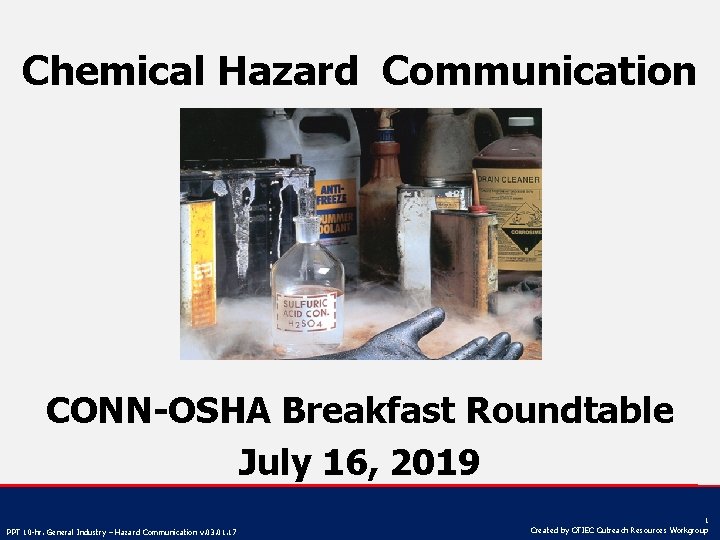
Chemical Hazard Communication CONN-OSHA Breakfast Roundtable July 16, 2019 PPT 10 -hr. General Industry – Hazard Communication v. 03. 01. 17 1 Created by OTIEC Outreach Resources Workgroup
Man dies after accidental worksite poisoning • A metalworker died two days after accidentally ingesting a highly toxic liquid he thought was an energy drink at a work site. • OSHA is investigating the job-site safety practices of Pitkin Iron, the Glenwood Springs company where the employee worked. • The worker was 53. On Friday, Aug. 4, he and a colleague went to a home to work on a metal staircase. • Around noon, the worker walked back to their truck and picked up a Gatorade bottle containing Antique Black. • The bottle still had the drink label on it, and it was not marked as containing the agent, used to age metal. • The substance, which is bright blue, contains selenous acid, which is highly corrosive and for which there is no antidote. PPT 10 -hr. General Industry – Hazard Communication v. 03. 01. 17 2 Created by OTIEC Outreach Resources Workgroup
• The worker apparently swallowed half a mouthful before spitting out the other half. • He immediately knew what had happened and told his co-worker, who drove him to a local hospital. • He was then airlifted to another hospital where he died. • A spokesperson said the worker’s death is considered an accident, and no criminal charges are planned. • The men put the liquid into the smaller bottle for convenience; it is usually stored in five-gallon drums on the grounds of the company. • Selenous acid, which is also common in “gun bluing” agents found in many homes, devastates the human body at the cellular level. • Cells can’t perform normal functions related to energy production and expelling waste, leading to organ failure. PPT 10 -hr. General Industry – Hazard Communication v. 03. 01. 17 3 Created by OTIEC Outreach Resources Workgroup
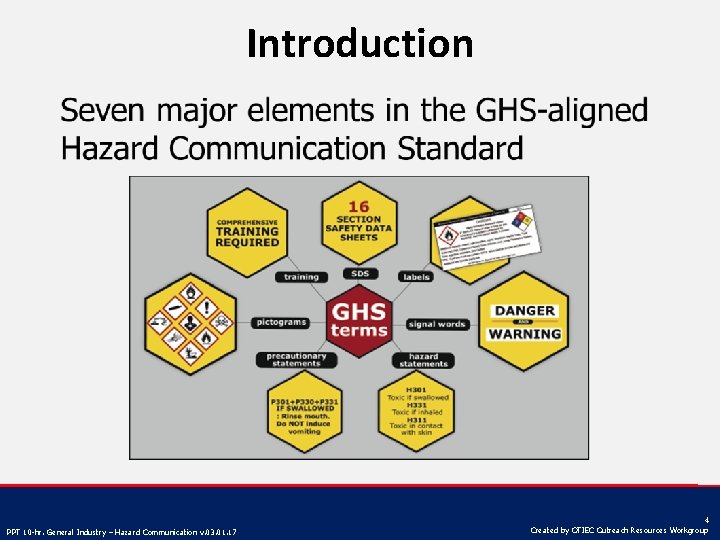
Introduction PPT 10 -hr. General Industry – Hazard Communication v. 03. 01. 17 4 Created by OTIEC Outreach Resources Workgroup
Employer Responsibilities Employer responsibilities under the HCS: • Ensure labels are on incoming labels and not defaced • Maintain SDSs from shipments • Obtain SDSs if not received • Ensure SDSs are readily accessible • Ensure chemicals in workplace are properly labeled, tagged, or marked • Provide information and training to employees • Provide information/access for employees in multi-employer workplaces • Develop, implement, and maintain a written hazard communication program PPT 10 -hr. General Industry – Hazard Communication v. 03. 01. 17 5 Created by OTIEC Outreach Resources Workgroup
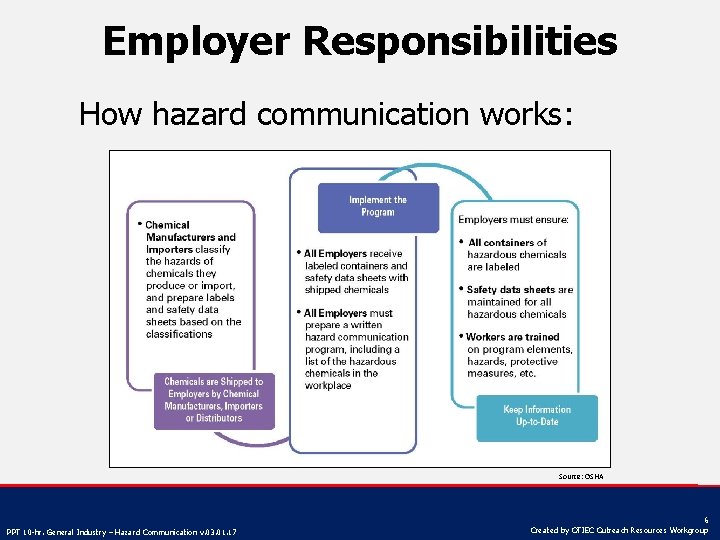
Employer Responsibilities How hazard communication works: Source: OSHA PPT 10 -hr. General Industry – Hazard Communication v. 03. 01. 17 6 Created by OTIEC Outreach Resources Workgroup
Hazard Communication Program Requirements for a written program: • Develop, implement, and maintain a written hazard communication program • Main intent is to ensure compliance with standard in a systematic way that coordinates all elements PPT 10 -hr. General Industry – Hazard Communication v. 03. 01. 17 7 Created by OTIEC Outreach Resources Workgroup
Hazard Communication Program Components of written program: • Lists of hazardous chemicals present at worksite • Availability of SDSs to employees and downstream employers • Labeling of chemical containers • Training programs regarding hazards of chemicals and protective measures PPT 10 -hr. General Industry – Hazard Communication v. 03. 01. 17 8 Created by OTIEC Outreach Resources Workgroup
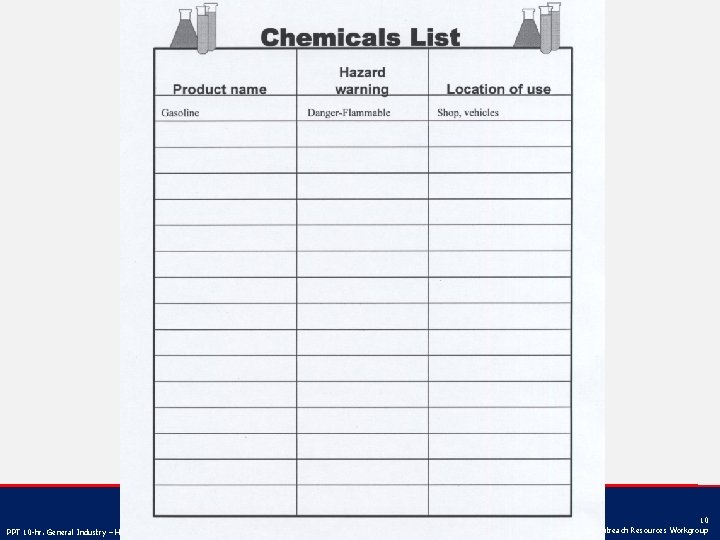
Hazard Communication Program List of hazardous chemicals: • Use product identifier – Product name, common name or chemical name – Same as name used on SDS and label • Inventory of chemicals – employer must have available an SDS for each • Covers all chemicals in all forms, whether contained or not • Include chemicals in containers, pipes, and those generated by work operations PPT 10 -hr. General Industry – Hazard Communication v. 03. 01. 17 9 Created by OTIEC Outreach Resources Workgroup
PPT 10 -hr. General Industry – Hazard Communication v. 03. 01. 17 10 Created by OTIEC Outreach Resources Workgroup
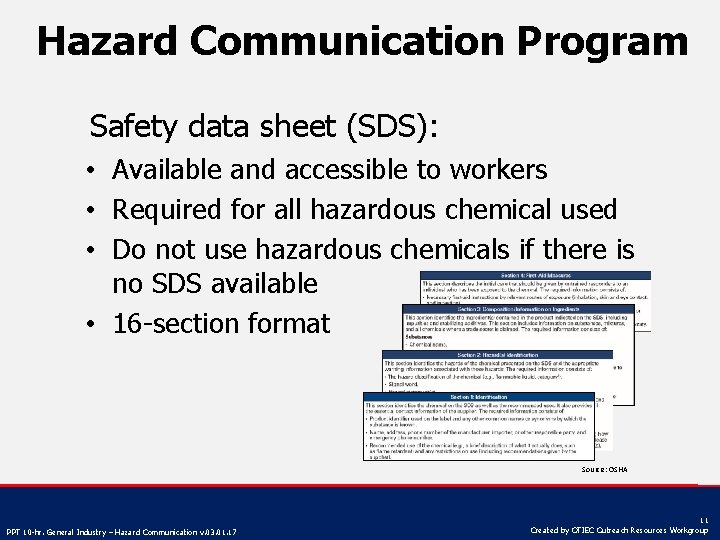
Hazard Communication Program Safety data sheet (SDS): • Available and accessible to workers • Required for all hazardous chemical used • Do not use hazardous chemicals if there is no SDS available • 16 -section format Source: OSHA PPT 10 -hr. General Industry – Hazard Communication v. 03. 01. 17 11 Created by OTIEC Outreach Resources Workgroup
Hazard Communication Program SDS 16 -section format: • • Section Section 1: 2: 3: 4: 5: 6: 7: 8: Identification Hazard(s) identification Composition/information on ingredients First-aid measures Fire-fighting measures Accidental release measures Handling and storage Exposure control/personal protection PPT 10 -hr. General Industry – Hazard Communication v. 03. 01. 17 Source: OSHA 12 Created by OTIEC Outreach Resources Workgroup
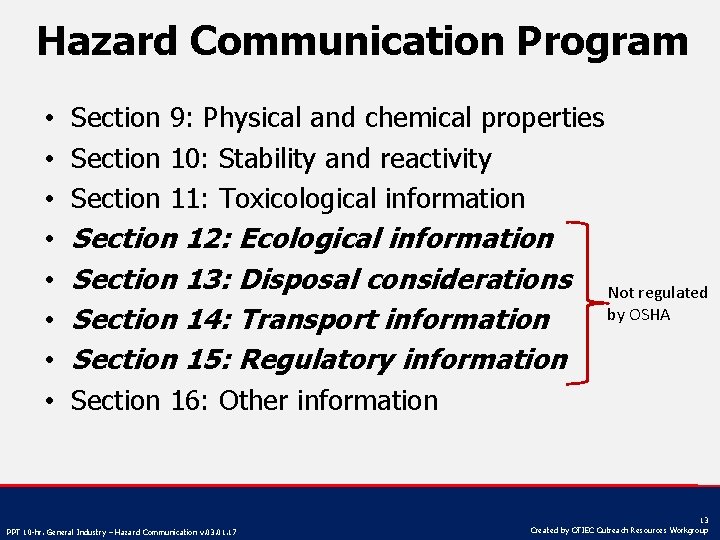
Hazard Communication Program • • Section 9: Physical and chemical properties Section 10: Stability and reactivity Section 11: Toxicological information Section 12: Ecological information Section 13: Disposal considerations Section 14: Transport information Section 15: Regulatory information Not regulated by OSHA Section 16: Other information PPT 10 -hr. General Industry – Hazard Communication v. 03. 01. 17 13 Created by OTIEC Outreach Resources Workgroup
Hazard Communication Program Labeling: • All containers of hazardous materials must be labeled • Immediate warning • Snapshot of hazards and protective information PPT 10 -hr. General Industry – Hazard Communication v. 03. 01. 17 14 Created by OTIEC Outreach Resources Workgroup
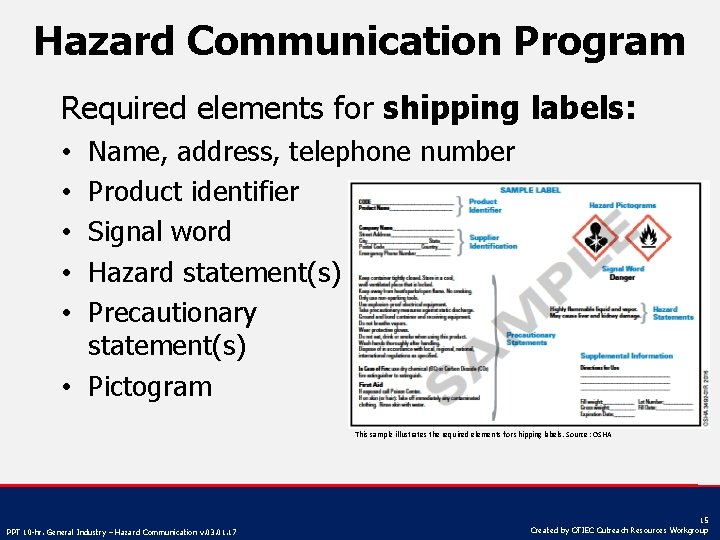
Hazard Communication Program Required elements for shipping labels: Name, address, telephone number Product identifier Signal word Hazard statement(s) Precautionary statement(s) • Pictogram • • • This sample illustrates the required elements for shipping labels. Source: OSHA PPT 10 -hr. General Industry – Hazard Communication v. 03. 01. 17 15 Created by OTIEC Outreach Resources Workgroup
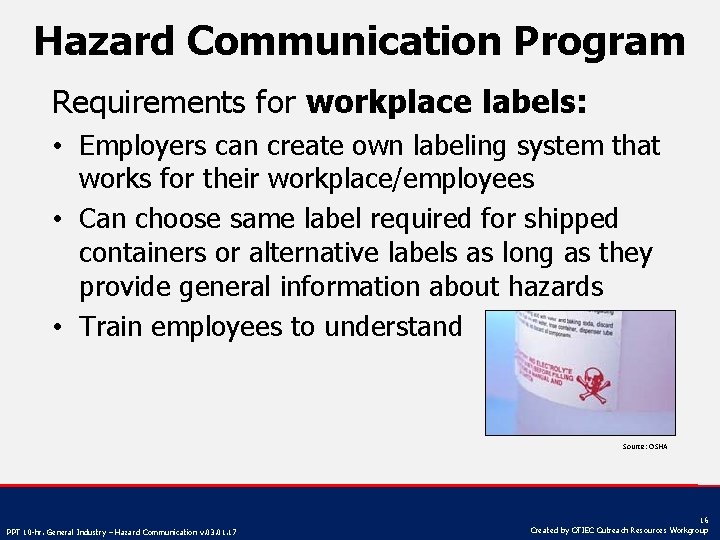
Hazard Communication Program Requirements for workplace labels: • Employers can create own labeling system that works for their workplace/employees • Can choose same label required for shipped containers or alternative labels as long as they provide general information about hazards • Train employees to understand Source: OSHA PPT 10 -hr. General Industry – Hazard Communication v. 03. 01. 17 16 Created by OTIEC Outreach Resources Workgroup
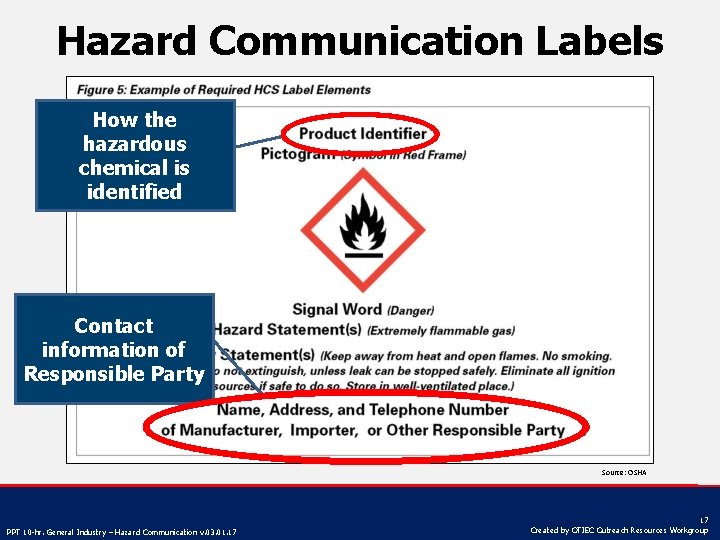
Hazard Communication Labels How the hazardous chemical is identified Contact information of Responsible Party Source: OSHA PPT 10 -hr. General Industry – Hazard Communication v. 03. 01. 17 17 Created by OTIEC Outreach Resources Workgroup
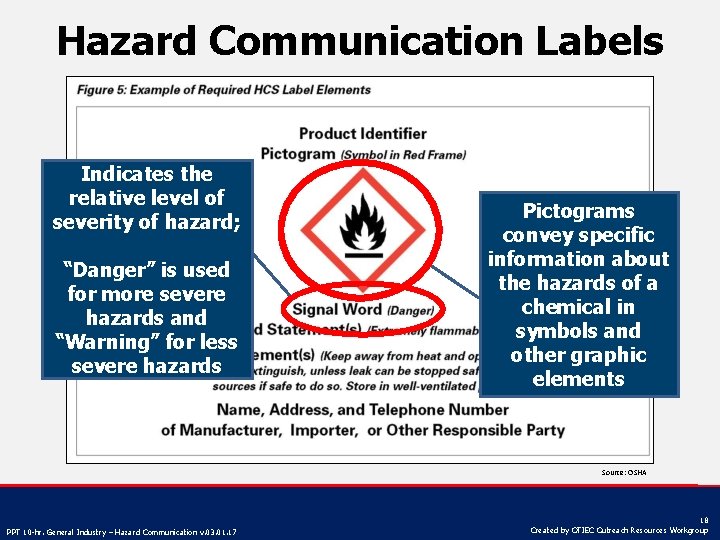
Hazard Communication Labels Indicates the relative level of severity of hazard; “Danger” is used for more severe hazards and “Warning” for less severe hazards Pictograms convey specific information about the hazards of a chemical in symbols and other graphic elements Source: OSHA PPT 10 -hr. General Industry – Hazard Communication v. 03. 01. 17 18 Created by OTIEC Outreach Resources Workgroup
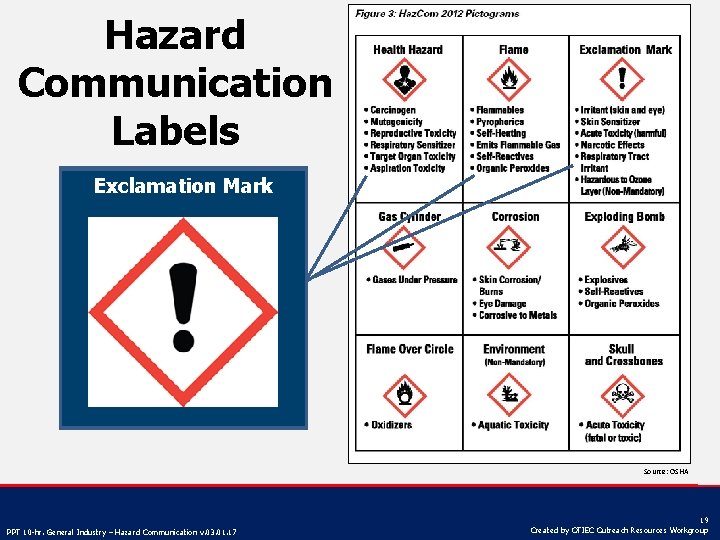
Hazard Communication Labels Health Hazard Exclamation Mark Flame Source: OSHA PPT 10 -hr. General Industry – Hazard Communication v. 03. 01. 17 19 Created by OTIEC Outreach Resources Workgroup
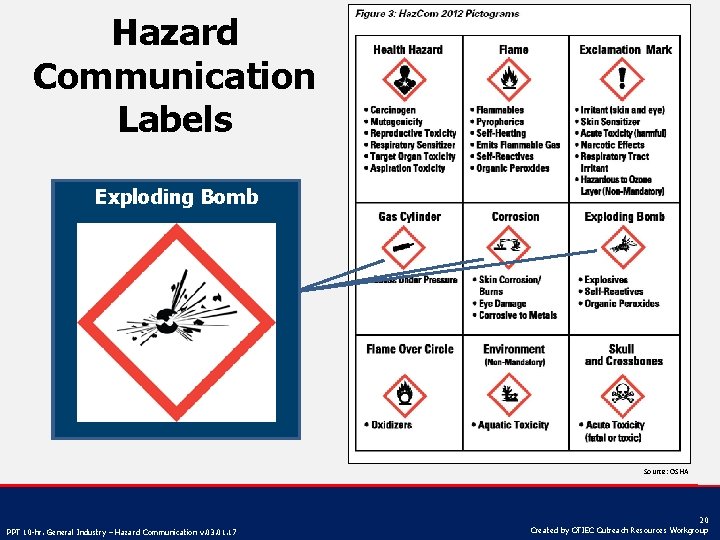
Hazard Communication Labels Gas Cylinder Exploding Corrosion Bomb Source: OSHA PPT 10 -hr. General Industry – Hazard Communication v. 03. 01. 17 20 Created by OTIEC Outreach Resources Workgroup
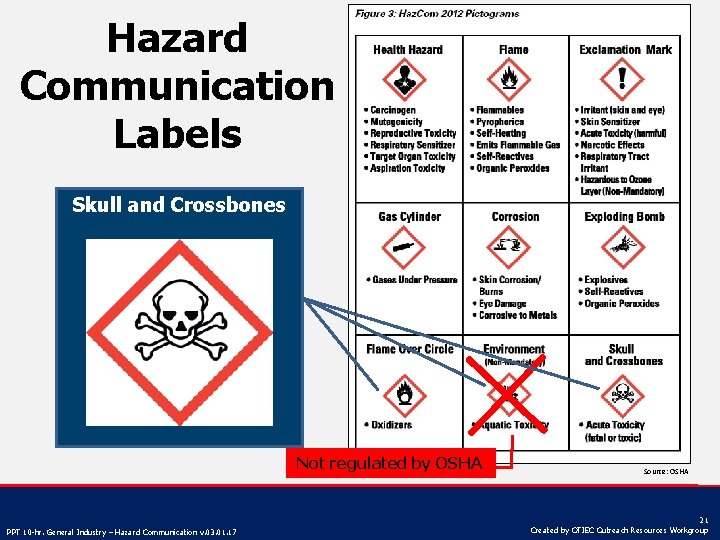
Hazard Communication Labels Environmental Skull Flame and. Over Crossbones Circle (Non-Mandatory) Not regulated by OSHA PPT 10 -hr. General Industry – Hazard Communication v. 03. 01. 17 Source: OSHA 21 Created by OTIEC Outreach Resources Workgroup
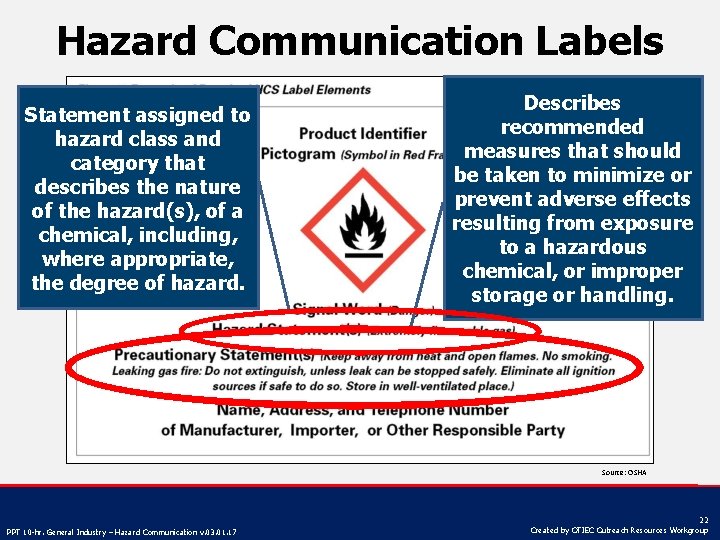
Hazard Communication Labels Statement assigned to hazard class and category that describes the nature of the hazard(s), of a chemical, including, where appropriate, the degree of hazard. Describes recommended measures that should be taken to minimize or prevent adverse effects resulting from exposure to a hazardous chemical, or improper storage or handling. Source: OSHA PPT 10 -hr. General Industry – Hazard Communication v. 03. 01. 17 22 Created by OTIEC Outreach Resources Workgroup
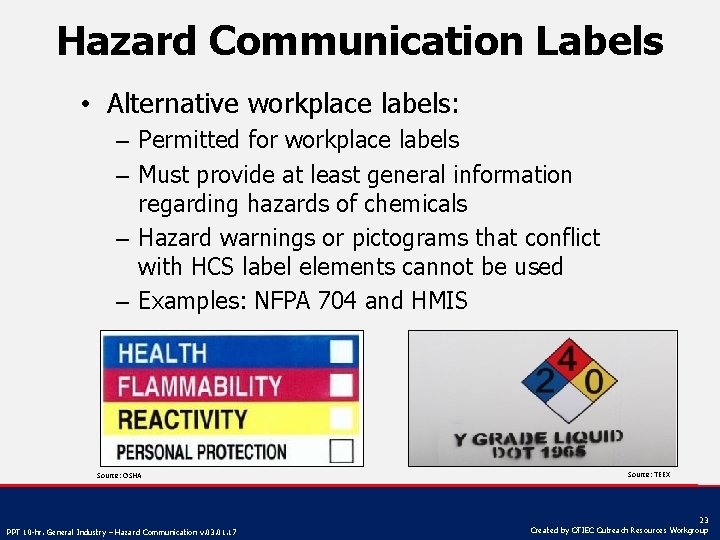
Hazard Communication Labels • Alternative workplace labels: – Permitted for workplace labels – Must provide at least general information regarding hazards of chemicals – Hazard warnings or pictograms that conflict with HCS label elements cannot be used – Examples: NFPA 704 and HMIS Source: OSHA PPT 10 -hr. General Industry – Hazard Communication v. 03. 01. 17 Source: TEEX 23 Created by OTIEC Outreach Resources Workgroup
Hazard Communication Program Training requirements: • Train employees on hazardous chemicals in their work area – Before initial assignment – When new hazards are introduced – Nonroutine tasks Source: OSHA • Include in training – Methods/observations to determine presence/release of chemical in work area – Hazards of chemicals – Appropriate protective measures – Where and how to obtain additional information PPT 10 -hr. General Industry – Hazard Communication v. 03. 01. 17 24 Created by OTIEC Outreach Resources Workgroup
Summary • OSHA’s Hazard Communication Standard is based on a simple concept - that employees have both a need and a right to know the hazards and identities of the chemicals they are exposed to when working • Employees also need to know what protective measures are available to prevent adverse effects from occurring PPT 10 -hr. General Industry – Hazard Communication v. 03. 01. 17 25 Created by OTIEC Outreach Resources Workgroup
- Slides: 25