
Chemical Formulas Main objectives for this chapter Empirical
Chemical Formulas
Main objectives for this chapter: • Empirical and molecular formulas. • Structural formulas. Simple examples • Calculations of empirical formulas, given the percentage composition by mass. • Calculation of empirical formulas, given the masses of reactants and products. HIGHER LEVEL only • Calculation of molecular formulas, given the empirical formulas and the relative molecular masses (examples should include simple biological substances, such as glucose and urea). • Percentage composition by mass. Calculations
Structural formulas, molecular formulas, empirical formulas
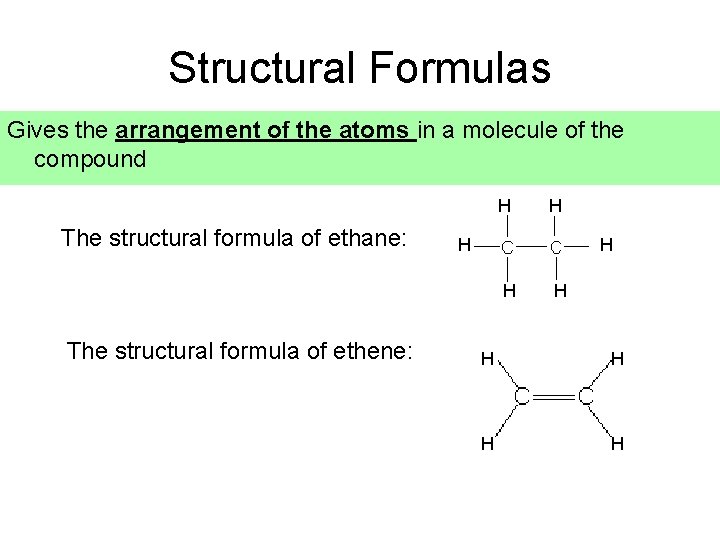
Structural Formulas Gives the arrangement of the atoms in a molecule of the compound H The structural formula of ethane: H H H The structural formula of ethene: H H H
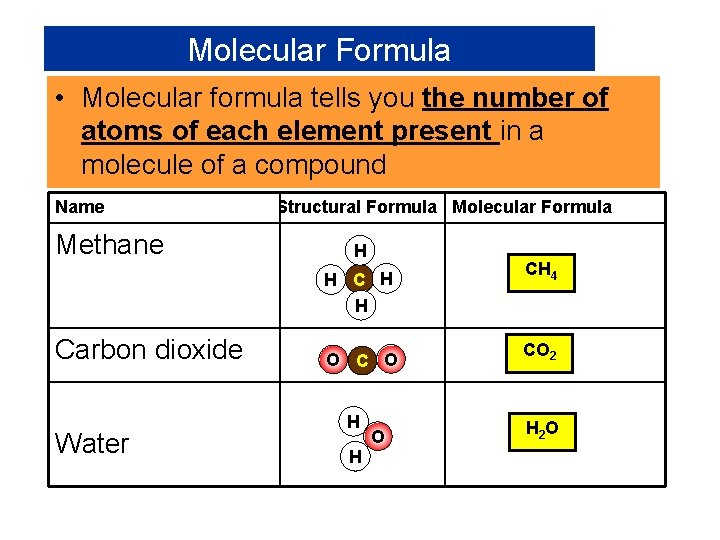
Molecular Formula • Molecular formula tells you the number of atoms of each element present in a molecule of a compound Name Methane Structural Formula Molecular Formula H H Carbon dioxide Water O C O H H O CH 4 CO 2 H 2 O
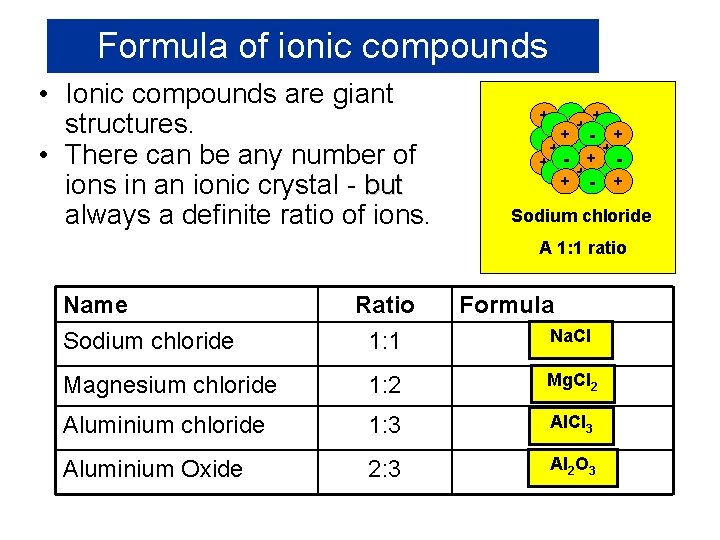
Formula of ionic compounds • Ionic compounds are giant structures. • There can be any number of ions in an ionic crystal - but always a definite ratio of ions. - + -+ - + + -- + -+ + Sodium chloride A 1: 1 ratio Name Sodium chloride Ratio 1: 1 Formula Na. Cl Magnesium chloride 1: 2 Mg. Cl 2 Aluminium chloride 1: 3 Al. Cl 3 Aluminium Oxide 2: 3 Al 2 O 3
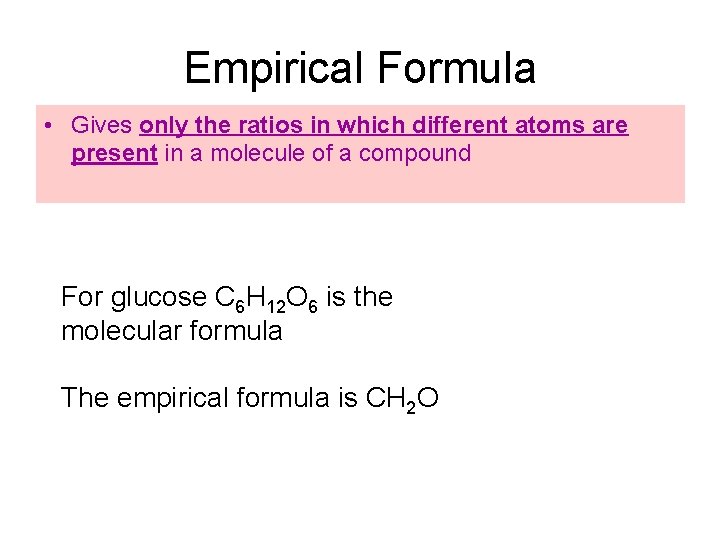
Empirical Formula • Gives only the ratios in which different atoms are present in a molecule of a compound For glucose C 6 H 12 O 6 is the molecular formula The empirical formula is CH 2 O
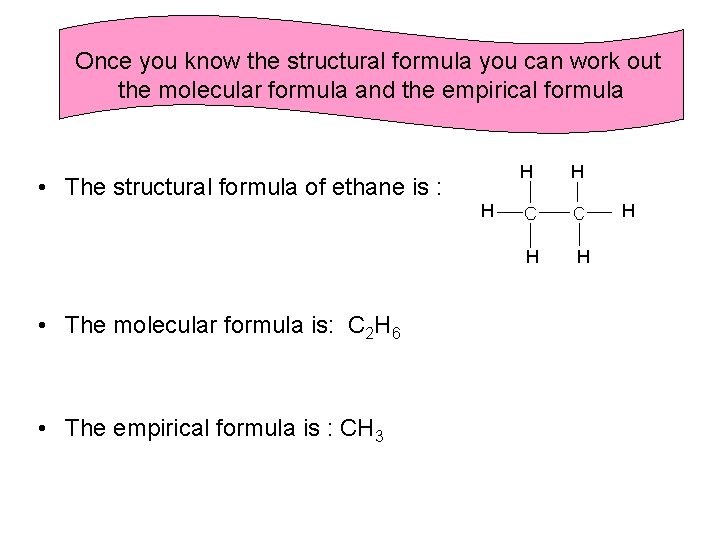
Once you know the structural formula you can work out the molecular formula and the empirical formula H • The structural formula of ethane is : H H • The molecular formula is: C 2 H 6 • The empirical formula is : CH 3 H
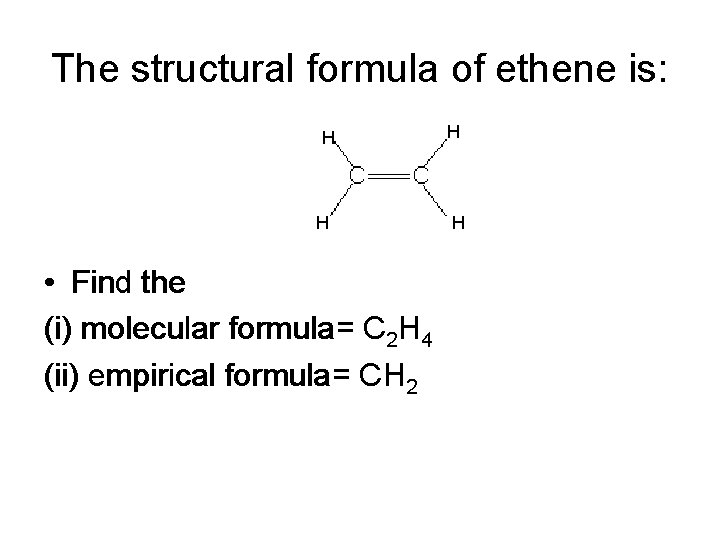
The structural formula of ethene is: H H • Find the (i) molecular formula= C 2 H 4 (ii) empirical formula= CH 2 H H
Check your learning • • Define Structural formula Molecular formula Emperical formula
Objectives for today • Calculations of empirical formulas: (i) Given the % mass of elements present in the compound (ii) given the masses of reactants and products. HIGHER LEVEL (ii) Calculation of molecular formulas
Calculating Empirical Formulas
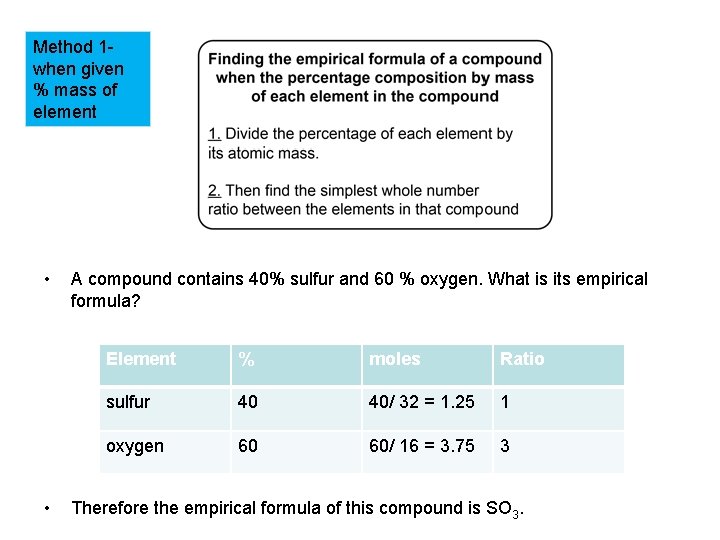
Method 1 when given % mass of element • • A compound contains 40% sulfur and 60 % oxygen. What is its empirical formula? Element % moles Ratio sulfur 40 40/ 32 = 1. 25 1 oxygen 60 60/ 16 = 3. 75 3 Therefore the empirical formula of this compound is SO 3.
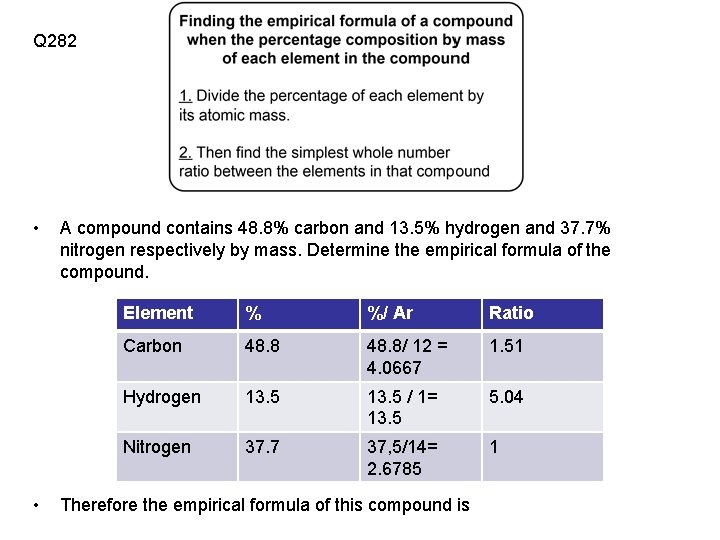
Q 282 • • A compound contains 48. 8% carbon and 13. 5% hydrogen and 37. 7% nitrogen respectively by mass. Determine the empirical formula of the compound. Element % %/ Ar Ratio Carbon 48. 8/ 12 = 4. 0667 1. 51 Hydrogen 13. 5 / 1= 13. 5 5. 04 Nitrogen 37. 7 37, 5/14= 2. 6785 1 Therefore the empirical formula of this compound is
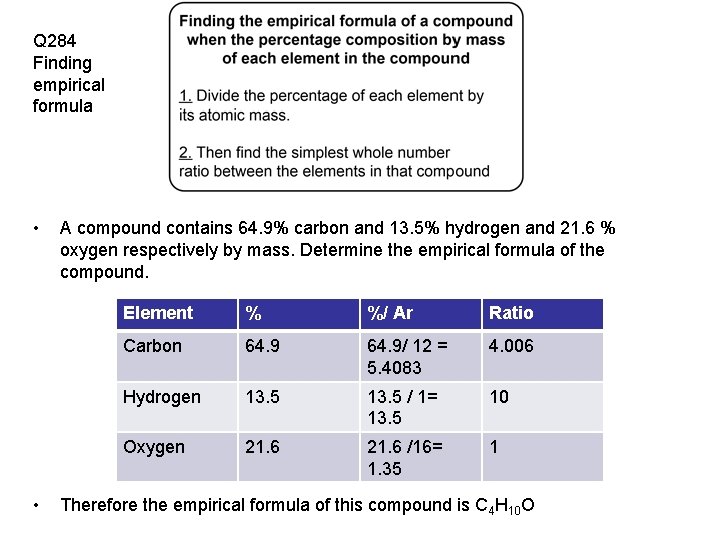
Q 284 Finding empirical formula • • A compound contains 64. 9% carbon and 13. 5% hydrogen and 21. 6 % oxygen respectively by mass. Determine the empirical formula of the compound. Element % %/ Ar Ratio Carbon 64. 9/ 12 = 5. 4083 4. 006 Hydrogen 13. 5 / 1= 13. 5 10 Oxygen 21. 6 /16= 1. 35 1 Therefore the empirical formula of this compound is C 4 H 10 O
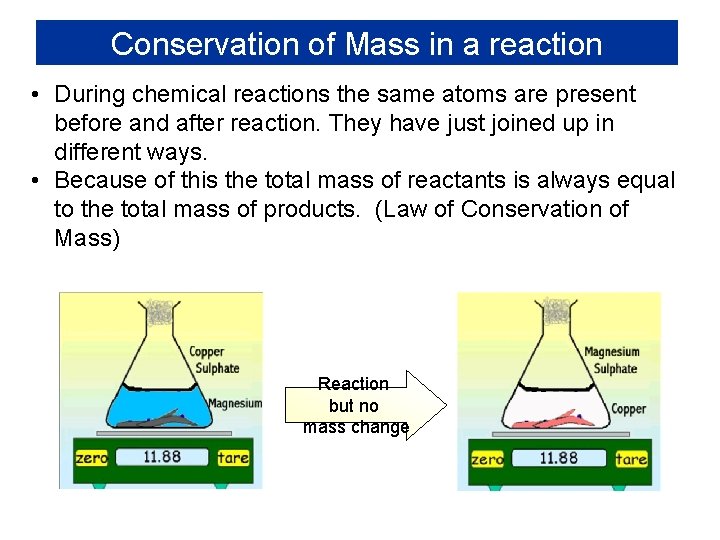
Conservation of Mass in a reaction • During chemical reactions the same atoms are present before and after reaction. They have just joined up in different ways. • Because of this the total mass of reactants is always equal to the total mass of products. (Law of Conservation of Mass) Reaction but no mass change
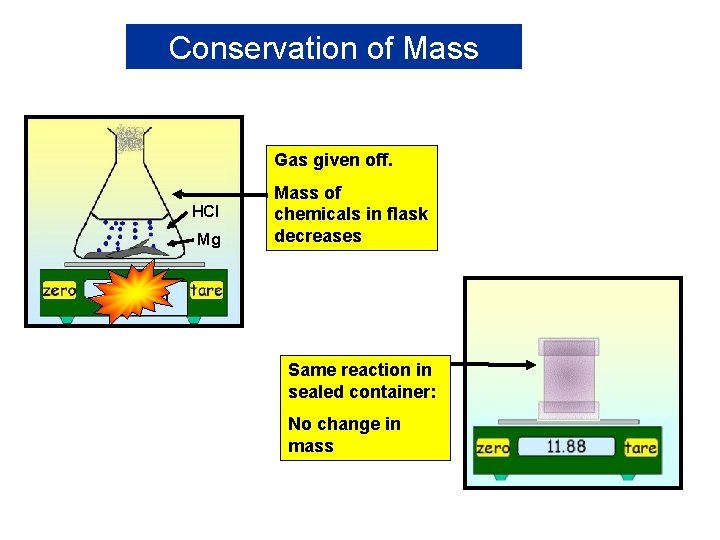
Conservation of Mass Gas given off. HCl Mg Mass of chemicals in flask decreases 11. 71 Same reaction in sealed container: No change in mass
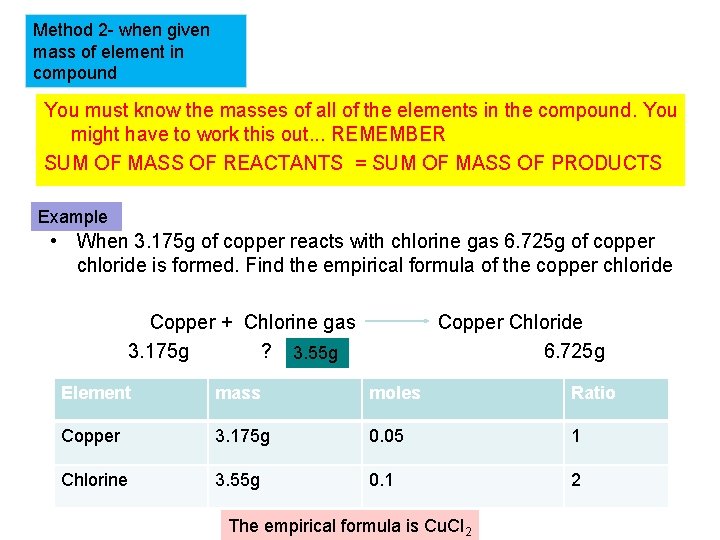
Method 2 - when given mass of element in compound You must know the masses of all of the elements in the compound. You might have to work this out. . . REMEMBER SUM OF MASS OF REACTANTS = SUM OF MASS OF PRODUCTS Example • When 3. 175 g of copper reacts with chlorine gas 6. 725 g of copper chloride is formed. Find the empirical formula of the copper chloride Copper + Chlorine gas 3. 175 g ? 3. 55 g Copper Chloride 6. 725 g Element mass moles Ratio Copper 3. 175 g 0. 05 1 Chlorine 3. 55 g 0. 1 2 The empirical formula is Cu. Cl 2
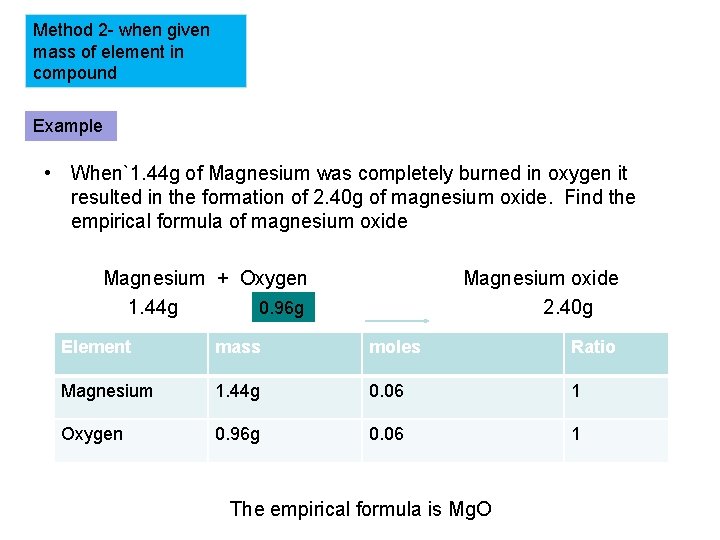
Method 2 - when given mass of element in compound Example • When`1. 44 g of Magnesium was completely burned in oxygen it resulted in the formation of 2. 40 g of magnesium oxide. Find the empirical formula of magnesium oxide Magnesium + Oxygen 0. 96 g 1. 44 g ? Magnesium oxide 2. 40 g Element mass moles Ratio Magnesium 1. 44 g 0. 06 1 Oxygen 0. 96 g 0. 06 1 The empirical formula is Mg. O
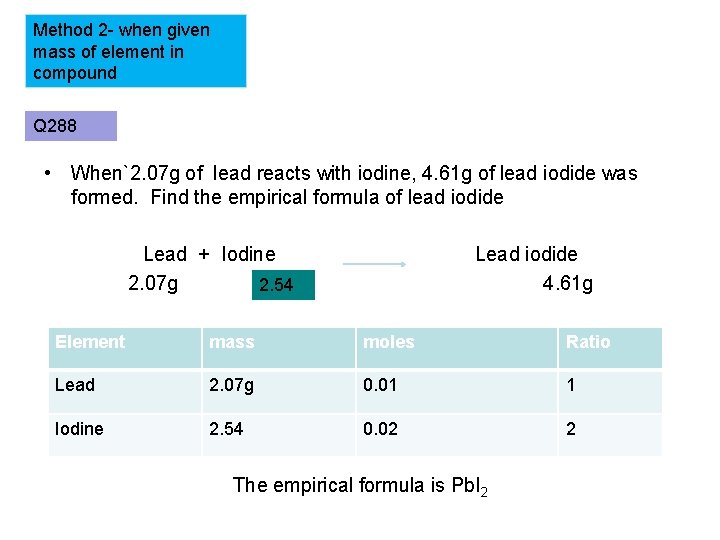
Method 2 - when given mass of element in compound Q 288 • When`2. 07 g of lead reacts with iodine, 4. 61 g of lead iodide was formed. Find the empirical formula of lead iodide Lead + Iodine 2. 07 g ? 2. 54 Lead iodide 4. 61 g Element mass moles Ratio Lead 2. 07 g 0. 01 1 Iodine 2. 54 0. 02 2 The empirical formula is Pb. I 2
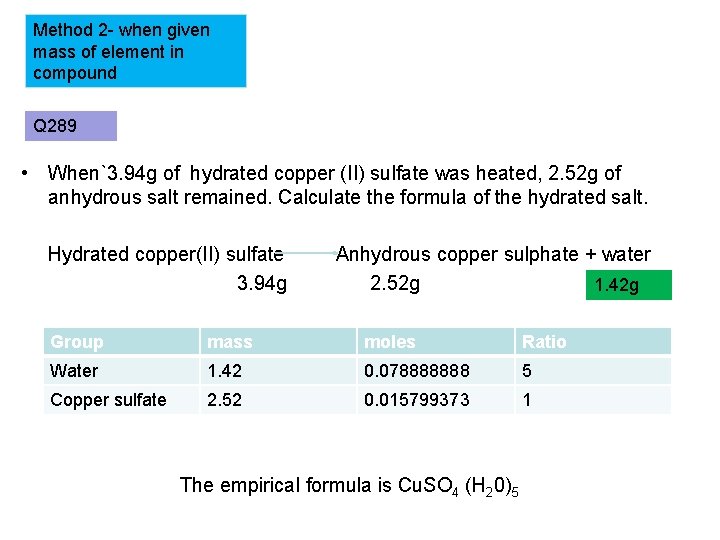
Method 2 - when given mass of element in compound Q 289 • When`3. 94 g of hydrated copper (II) sulfate was heated, 2. 52 g of anhydrous salt remained. Calculate the formula of the hydrated salt. Hydrated copper(II) sulfate 3. 94 g Anhydrous copper sulphate + water 2. 52 g 1. 42 g Group mass moles Ratio Water 1. 42 0. 078888888 5 Copper sulfate 2. 52 0. 015799373 1 The empirical formula is Cu. SO 4 (H 20)5
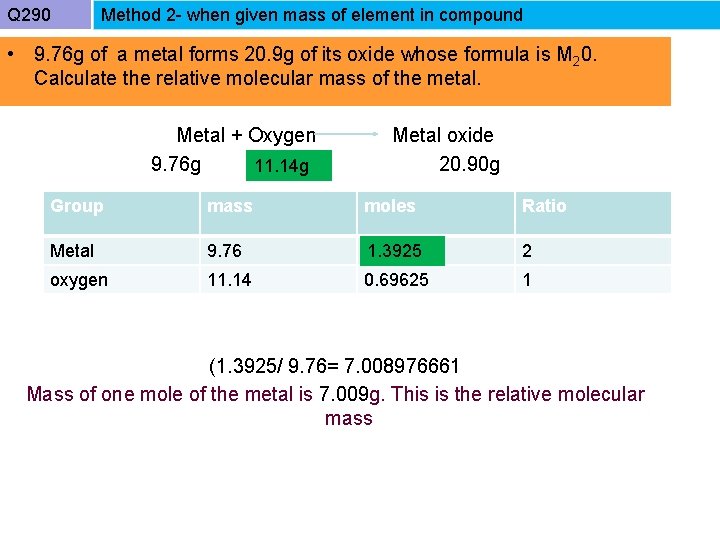
Q 290 Method 2 - when given mass of element in compound • 9. 76 g of a metal forms 20. 9 g of its oxide whose formula is M 20. Calculate the relative molecular mass of the metal. Metal + Oxygen 9. 76 g 11. 14 g Metal oxide 20. 90 g Group mass moles Ratio Metal 9. 76 ? 1. 3925 2 oxygen 11. 14 0. 69625 1 (1. 3925/ 9. 76= 7. 008976661 Mass of one mole of the metal is 7. 009 g. This is the relative molecular mass
Calculating Molecular Formulas
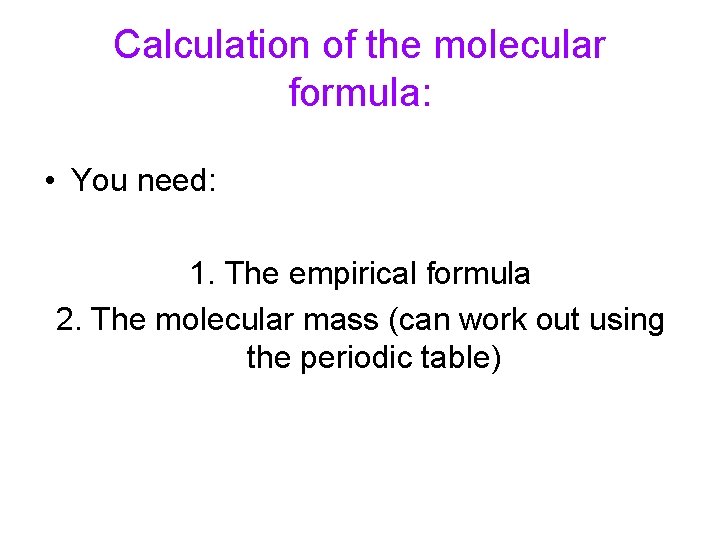
Calculation of the molecular formula: • You need: 1. The empirical formula 2. The molecular mass (can work out using the periodic table)
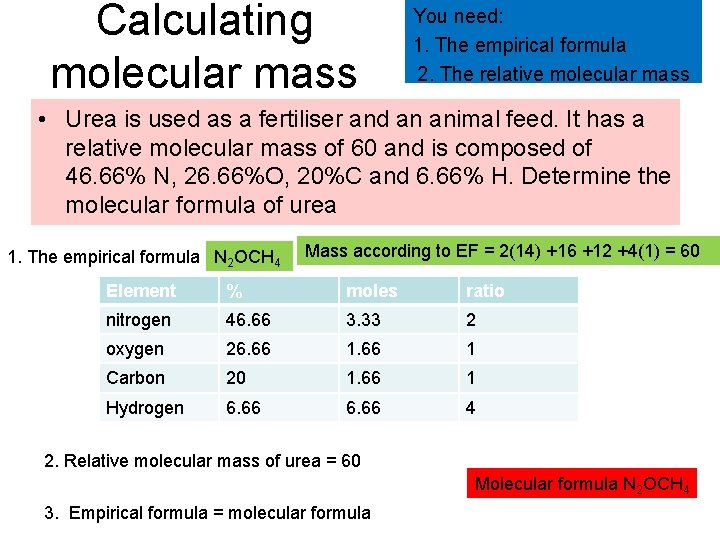
Calculating molecular mass You need: 1. The empirical formula 2. The relative molecular mass • Urea is used as a fertiliser and an animal feed. It has a relative molecular mass of 60 and is composed of 46. 66% N, 26. 66%O, 20%C and 6. 66% H. Determine the molecular formula of urea 1. The empirical formula N 2 OCH 4 Mass according to EF = 2(14) +16 +12 +4(1) = 60 Element % moles ratio nitrogen 46. 66 3. 33 2 oxygen 26. 66 1 Carbon 20 1. 66 1 Hydrogen 6. 66 4 2. Relative molecular mass of urea = 60 Molecular formula N 2 OCH 4 3. Empirical formula = molecular formula
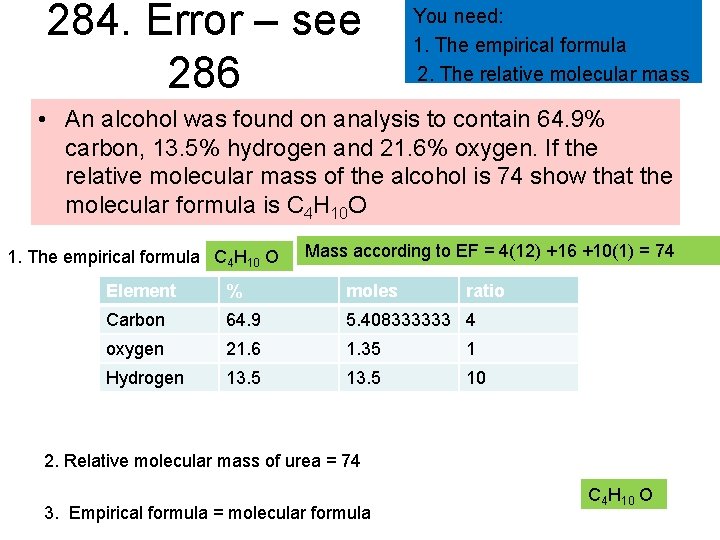
284. Error – see 286 You need: 1. The empirical formula 2. The relative molecular mass • An alcohol was found on analysis to contain 64. 9% carbon, 13. 5% hydrogen and 21. 6% oxygen. If the relative molecular mass of the alcohol is 74 show that the molecular formula is C 4 H 10 O 1. The empirical formula C 4 H 10 O Mass according to EF = 4(12) +16 +10(1) = 74 Element % moles ratio Carbon 64. 9 5. 408333333 4 oxygen 21. 6 1. 35 1 Hydrogen 13. 5 10 2. Relative molecular mass of urea = 74 3. Empirical formula = molecular formula C 4 H 10 O
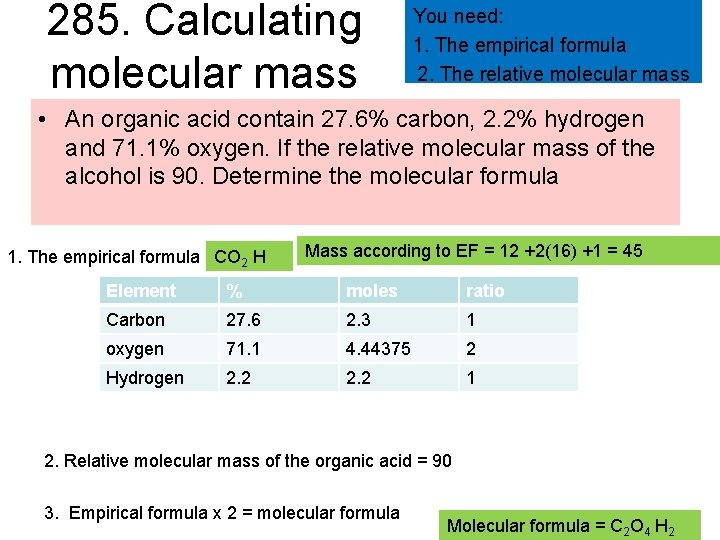
285. Calculating molecular mass You need: 1. The empirical formula 2. The relative molecular mass • An organic acid contain 27. 6% carbon, 2. 2% hydrogen and 71. 1% oxygen. If the relative molecular mass of the alcohol is 90. Determine the molecular formula 1. The empirical formula CO 2 H Mass according to EF = 12 +2(16) +1 = 45 Element % moles ratio Carbon 27. 6 2. 3 1 oxygen 71. 1 4. 44375 2 Hydrogen 2. 2 1 2. Relative molecular mass of the organic acid = 90 3. Empirical formula x 2 = molecular formula Molecular formula = C 2 O 4 H 2
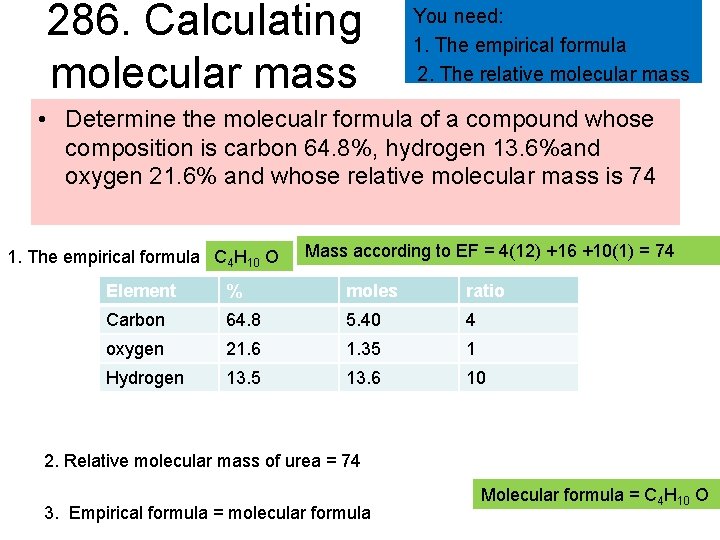
286. Calculating molecular mass You need: 1. The empirical formula 2. The relative molecular mass • Determine the molecualr formula of a compound whose composition is carbon 64. 8%, hydrogen 13. 6%and oxygen 21. 6% and whose relative molecular mass is 74 1. The empirical formula C 4 H 10 O Mass according to EF = 4(12) +16 +10(1) = 74 Element % moles ratio Carbon 64. 8 5. 40 4 oxygen 21. 6 1. 35 1 Hydrogen 13. 5 13. 6 10 2. Relative molecular mass of urea = 74 3. Empirical formula = molecular formula Molecular formula = C 4 H 10 O
Calculating % compositions by mass
By the end of today’s class you should be able to: (iii)Calculate the Percentage composition by mass of an element in a compound
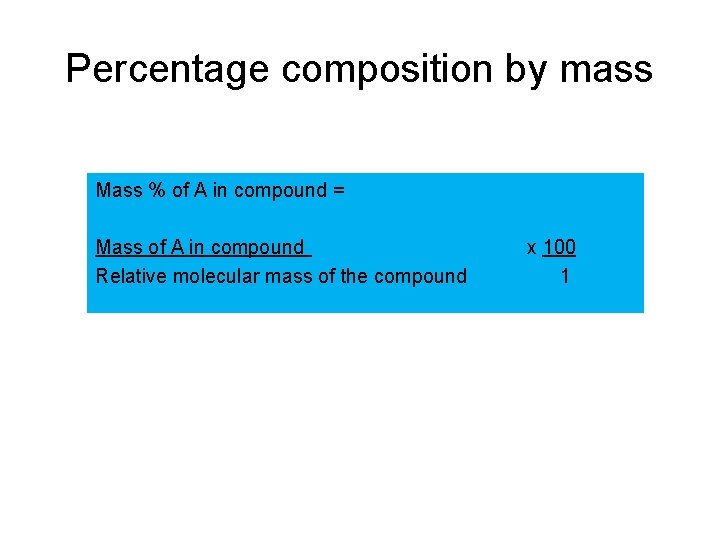
Percentage composition by mass Mass % of A in compound = Mass of A in compound Relative molecular mass of the compound x 100 1
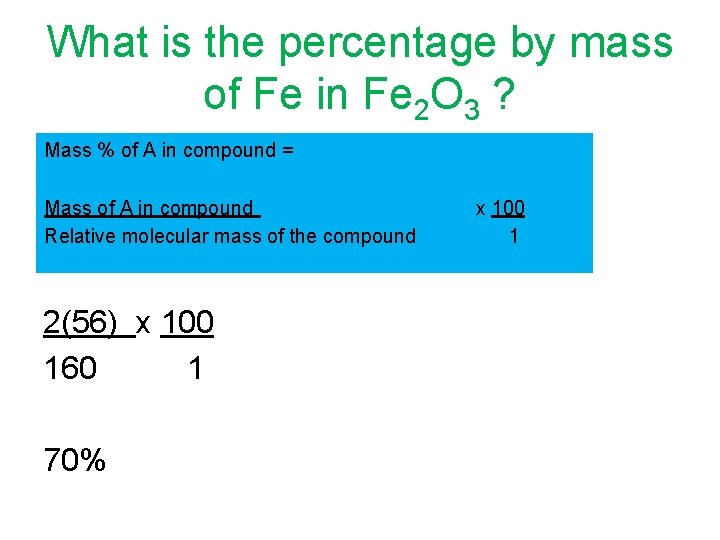
What is the percentage by mass of Fe in Fe 2 O 3 ? Mass % of A in compound = Mass of A in compound Relative molecular mass of the compound 2(56) x 100 160 1 70% x 100 1
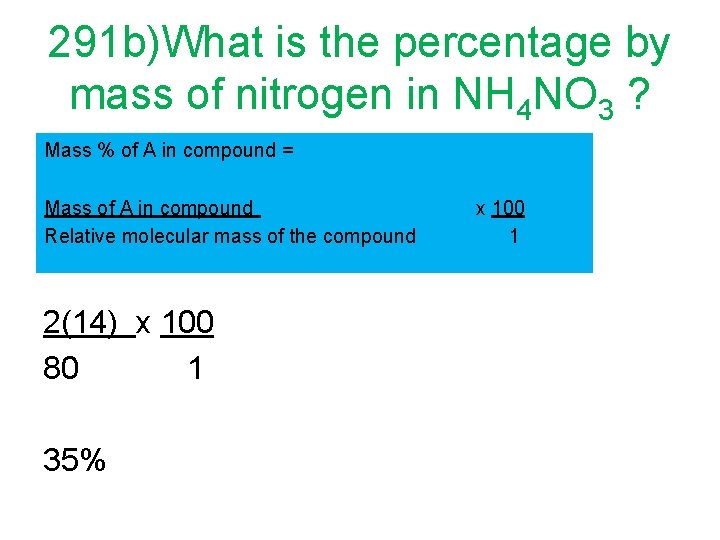
291 b)What is the percentage by mass of nitrogen in NH 4 NO 3 ? Mass % of A in compound = Mass of A in compound Relative molecular mass of the compound 2(14) x 100 80 1 35% x 100 1
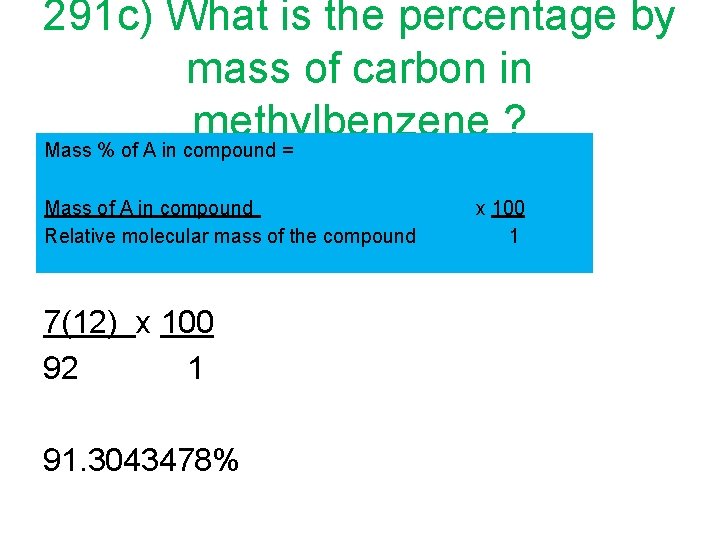
291 c) What is the percentage by mass of carbon in methylbenzene ? Mass % of A in compound = Mass of A in compound Relative molecular mass of the compound 7(12) x 100 92 1 91. 3043478% x 100 1
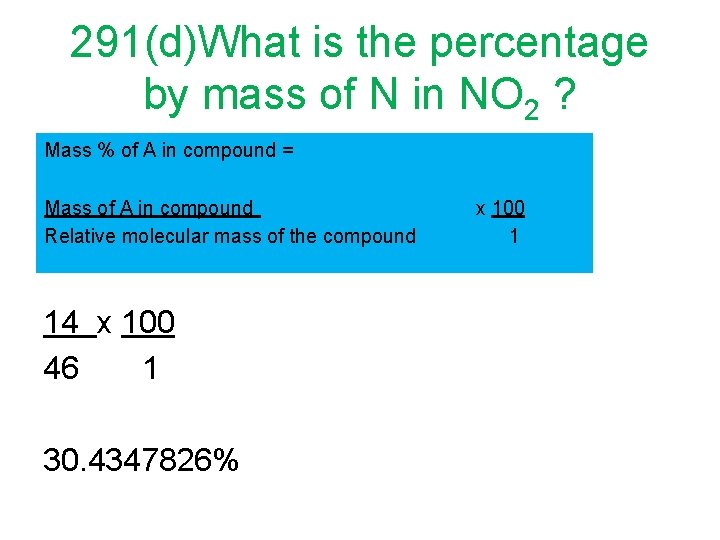
291(d)What is the percentage by mass of N in NO 2 ? Mass % of A in compound = Mass of A in compound Relative molecular mass of the compound 14 x 100 46 1 30. 4347826% x 100 1
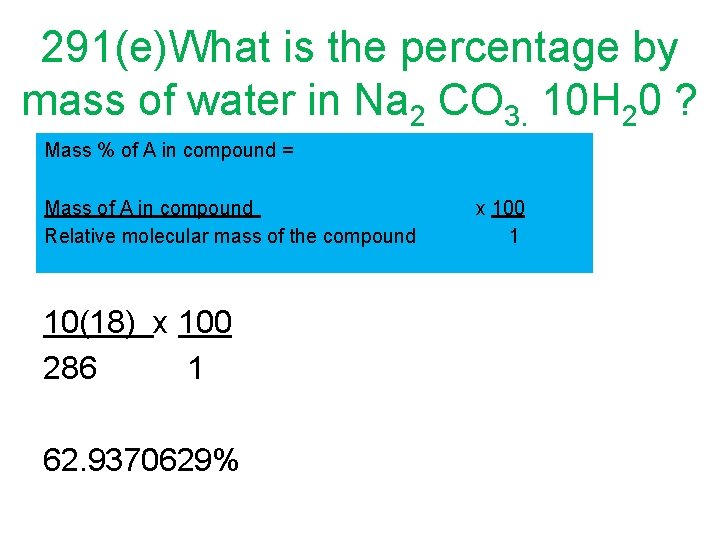
291(e)What is the percentage by mass of water in Na 2 CO 3. 10 H 20 ? Mass % of A in compound = Mass of A in compound Relative molecular mass of the compound 10(18) x 100 286 1 62. 9370629% x 100 1
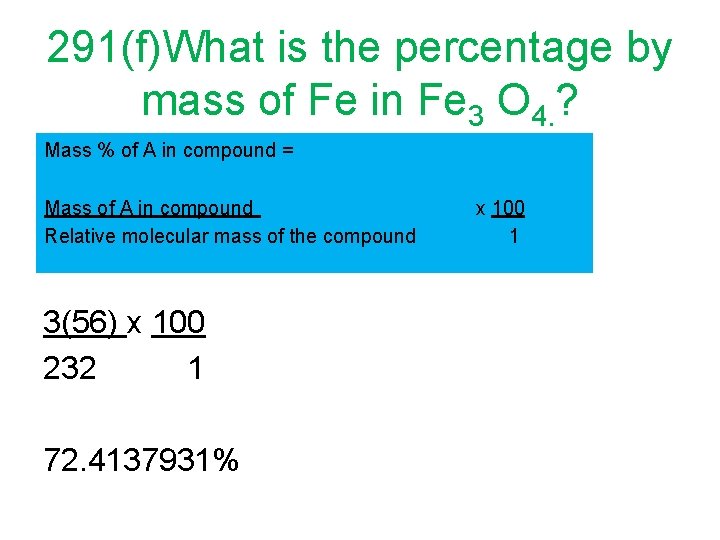
291(f)What is the percentage by mass of Fe in Fe 3 O 4. ? Mass % of A in compound = Mass of A in compound Relative molecular mass of the compound 3(56) x 100 232 1 72. 4137931% x 100 1
Extra questions not on worksheet
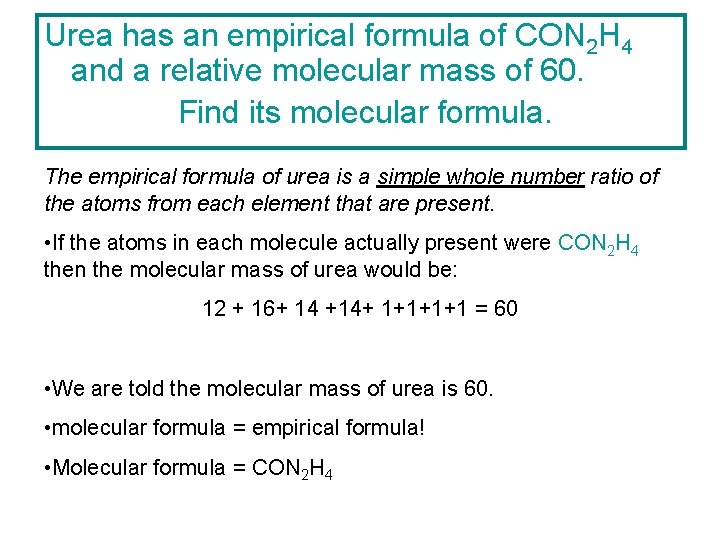
Urea has an empirical formula of CON 2 H 4 and a relative molecular mass of 60. Find its molecular formula. The empirical formula of urea is a simple whole number ratio of the atoms from each element that are present. • If the atoms in each molecule actually present were CON 2 H 4 then the molecular mass of urea would be: 12 + 16+ 14 +14+ 1+1+1+1 = 60 • We are told the molecular mass of urea is 60. • molecular formula = empirical formula! • Molecular formula = CON 2 H 4
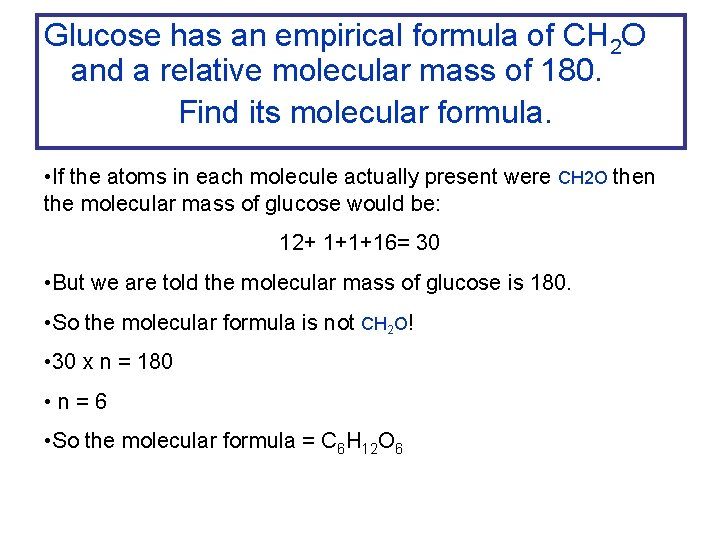
Glucose has an empirical formula of CH 2 O and a relative molecular mass of 180. Find its molecular formula. • If the atoms in each molecule actually present were CH 2 O then the molecular mass of glucose would be: 12+ 1+1+16= 30 • But we are told the molecular mass of glucose is 180. • So the molecular formula is not CH 2 O! • 30 x n = 180 • n=6 • So the molecular formula = C 6 H 12 O 6
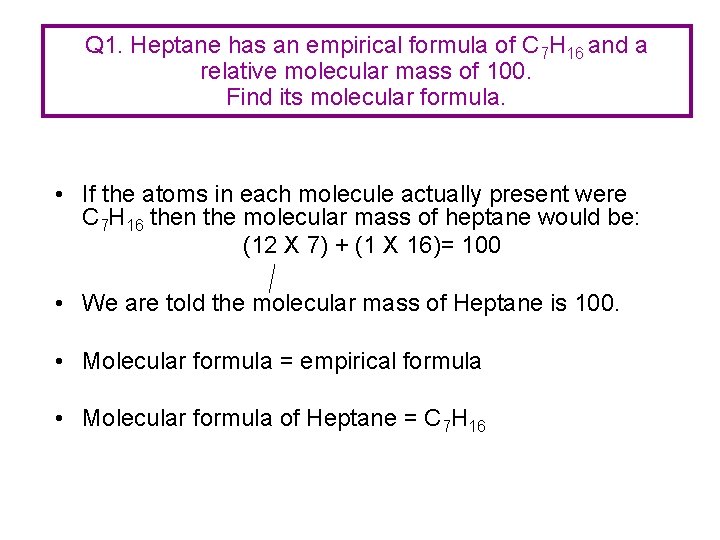
Q 1. Heptane has an empirical formula of C 7 H 16 and a relative molecular mass of 100. Find its molecular formula. • If the atoms in each molecule actually present were C 7 H 16 then the molecular mass of heptane would be: (12 X 7) + (1 X 16)= 100 • We are told the molecular mass of Heptane is 100. • Molecular formula = empirical formula • Molecular formula of Heptane = C 7 H 16
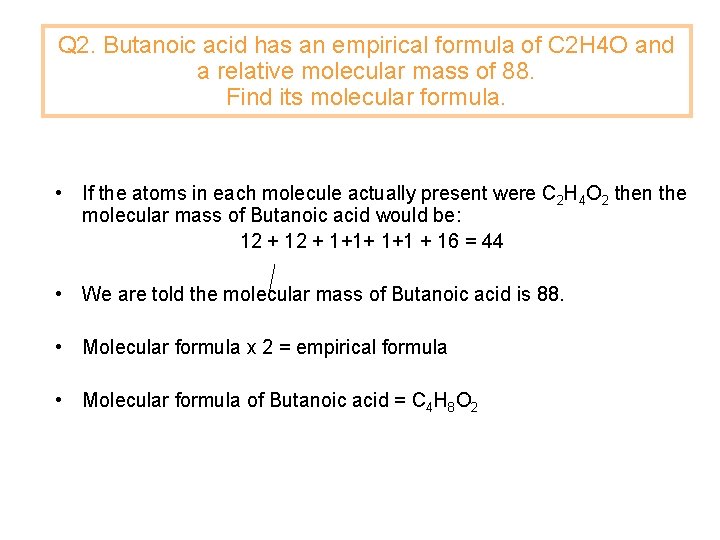
Q 2. Butanoic acid has an empirical formula of C 2 H 4 O and a relative molecular mass of 88. Find its molecular formula. • If the atoms in each molecule actually present were C 2 H 4 O 2 then the molecular mass of Butanoic acid would be: 12 + 1+1+ 1+1 + 16 = 44 • We are told the molecular mass of Butanoic acid is 88. • Molecular formula x 2 = empirical formula • Molecular formula of Butanoic acid = C 4 H 8 O 2
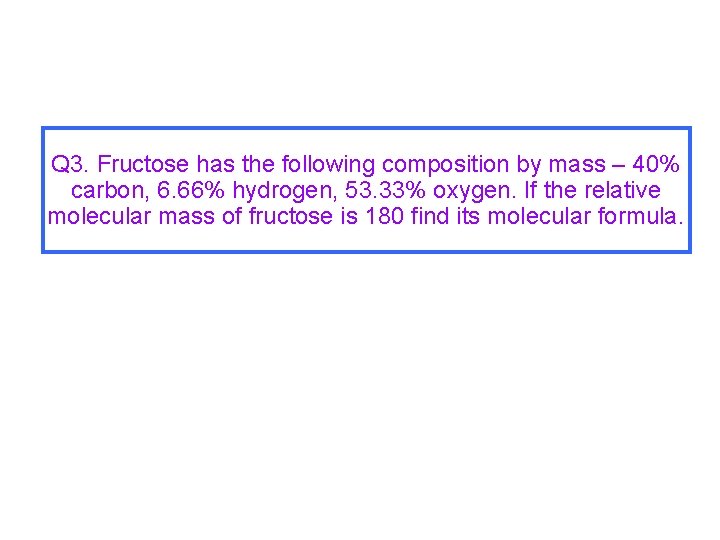
Q 3. Fructose has the following composition by mass – 40% carbon, 6. 66% hydrogen, 53. 33% oxygen. If the relative molecular mass of fructose is 180 find its molecular formula.
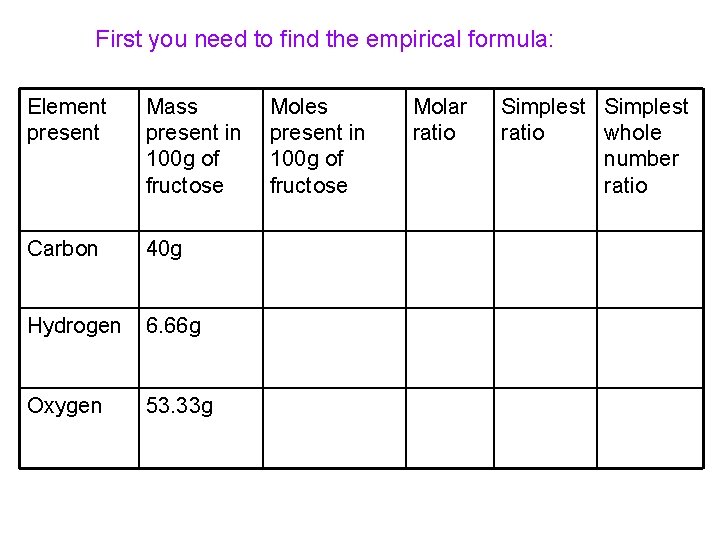
First you need to find the empirical formula: Element present Mass present in 100 g of fructose Carbon 40 g Hydrogen 6. 66 g Oxygen 53. 33 g Moles present in 100 g of fructose Molar ratio Simplest ratio whole number ratio
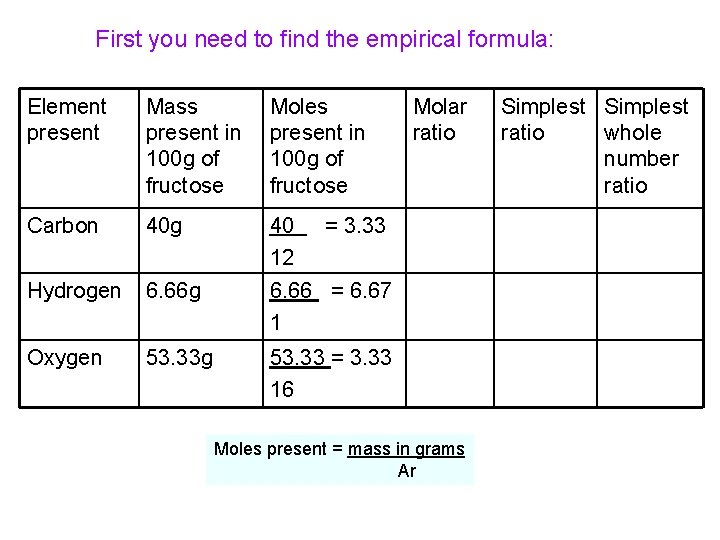
First you need to find the empirical formula: Element present Mass present in 100 g of fructose Moles present in 100 g of fructose Carbon 40 g 40 12 Hydrogen 6. 66 g 6. 66 = 6. 67 1 Oxygen 53. 33 g 53. 33 = 3. 33 16 Molar ratio = 3. 33 Moles present = mass in grams Ar Simplest ratio whole number ratio
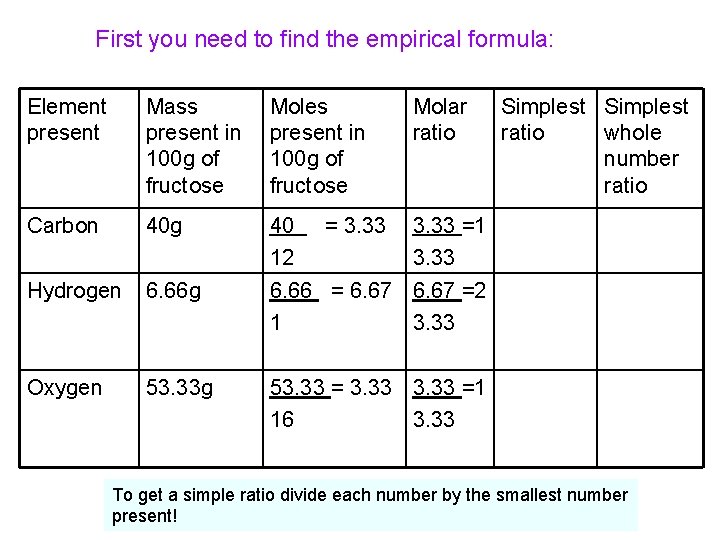
First you need to find the empirical formula: Element present Mass present in 100 g of fructose Moles present in 100 g of fructose Molar ratio Carbon 40 g 40 12 3. 33 =1 3. 33 Hydrogen 6. 66 g 6. 66 = 6. 67 =2 1 3. 33 Oxygen 53. 33 g 53. 33 =1 16 3. 33 = 3. 33 Simplest ratio whole number ratio To get a simple ratio divide each number by the smallest number present!
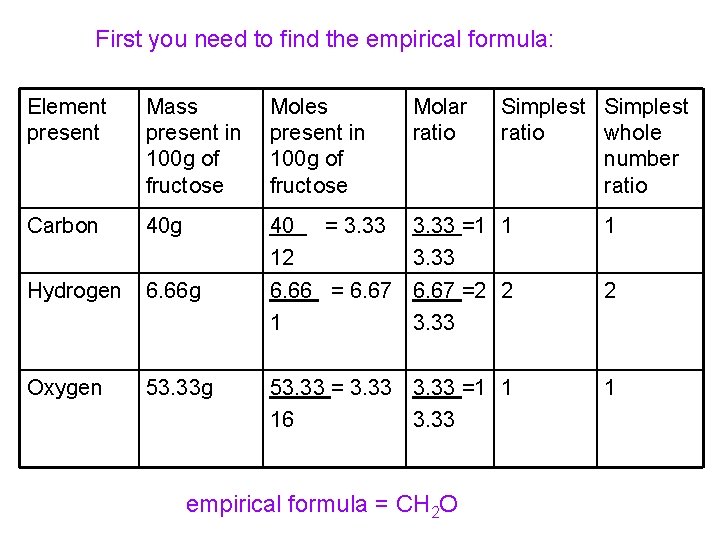
First you need to find the empirical formula: Element present Mass present in 100 g of fructose Moles present in 100 g of fructose Molar ratio Carbon 40 g 40 12 3. 33 =1 1 3. 33 1 Hydrogen 6. 66 g 6. 66 = 6. 67 =2 2 1 3. 33 2 Oxygen 53. 33 g 53. 33 =1 1 16 3. 33 1 = 3. 33 empirical formula = CH 2 O Simplest ratio whole number ratio
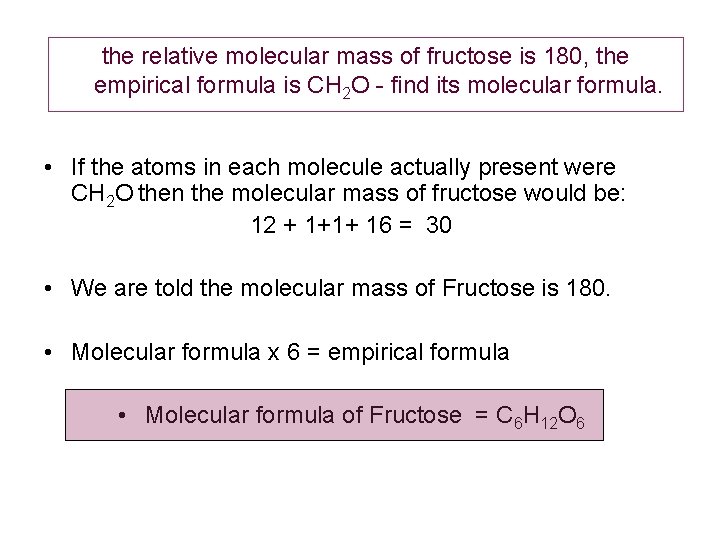
the relative molecular mass of fructose is 180, the empirical formula is CH 2 O - find its molecular formula. • If the atoms in each molecule actually present were CH 2 O then the molecular mass of fructose would be: 12 + 1+1+ 16 = 30 • We are told the molecular mass of Fructose is 180. • Molecular formula x 6 = empirical formula • Molecular formula of Fructose = C 6 H 12 O 6
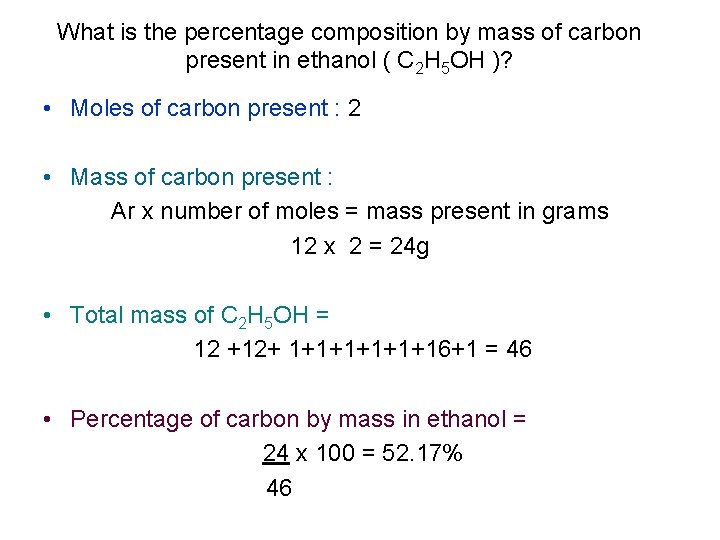
What is the percentage composition by mass of carbon present in ethanol ( C 2 H 5 OH )? • Moles of carbon present : 2 • Mass of carbon present : Ar x number of moles = mass present in grams 12 x 2 = 24 g • Total mass of C 2 H 5 OH = 12 +12+ 1+1+1+16+1 = 46 • Percentage of carbon by mass in ethanol = 24 x 100 = 52. 17% 46
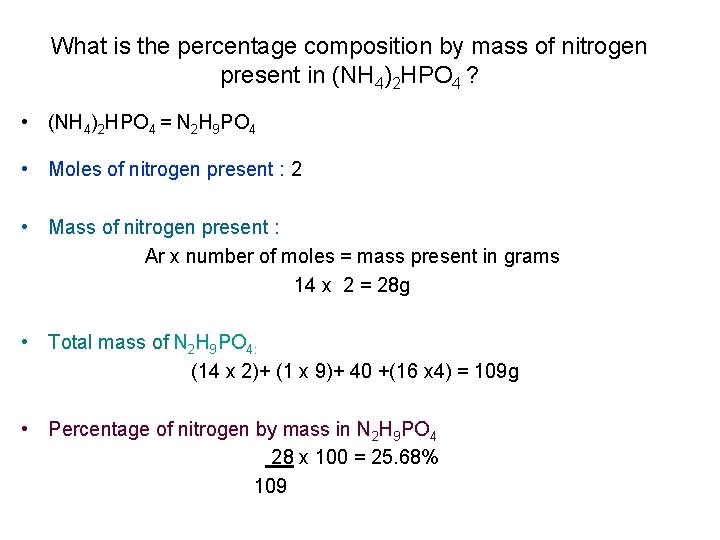
What is the percentage composition by mass of nitrogen present in (NH 4)2 HPO 4 ? • (NH 4)2 HPO 4 = N 2 H 9 PO 4 • Moles of nitrogen present : 2 • Mass of nitrogen present : Ar x number of moles = mass present in grams 14 x 2 = 28 g • Total mass of N 2 H 9 PO 4: (14 x 2)+ (1 x 9)+ 40 +(16 x 4) = 109 g • Percentage of nitrogen by mass in N 2 H 9 PO 4 28 x 100 = 25. 68% 109
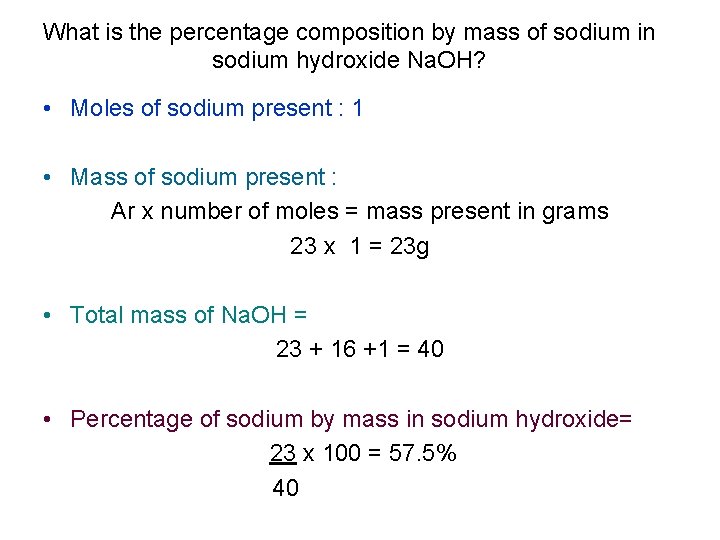
What is the percentage composition by mass of sodium in sodium hydroxide Na. OH? • Moles of sodium present : 1 • Mass of sodium present : Ar x number of moles = mass present in grams 23 x 1 = 23 g • Total mass of Na. OH = 23 + 16 +1 = 40 • Percentage of sodium by mass in sodium hydroxide= 23 x 100 = 57. 5% 40
Chemical equations
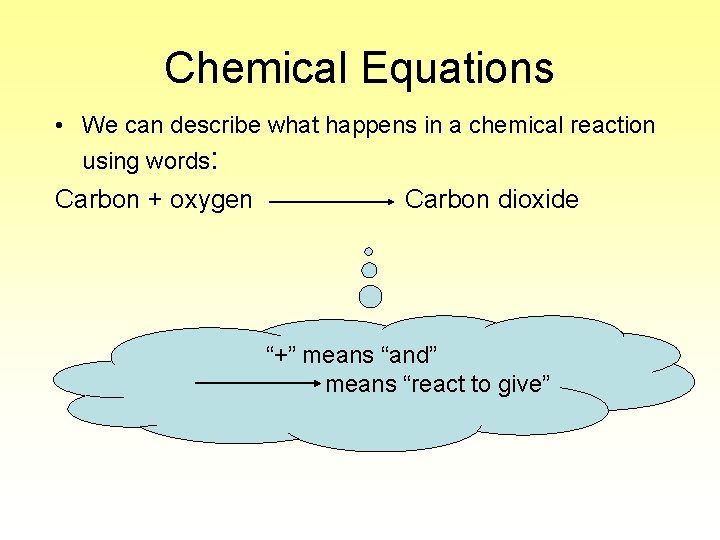
Chemical Equations • We can describe what happens in a chemical reaction using words: Carbon + oxygen Carbon dioxide “+” means “and” means “react to give”
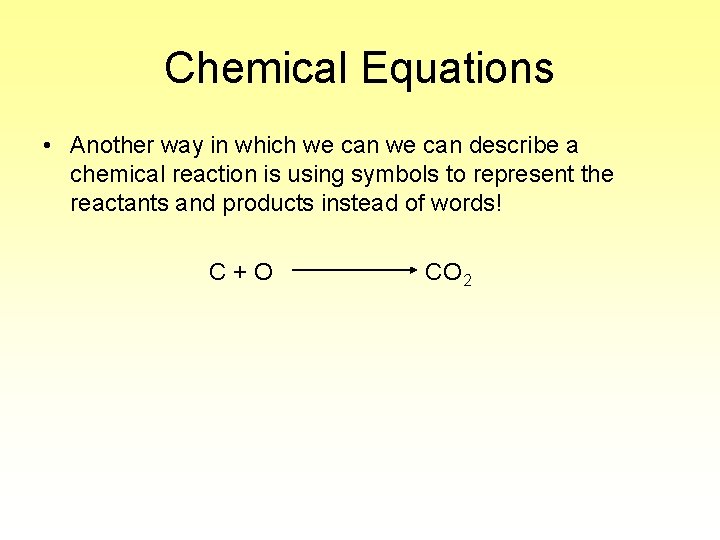
Chemical Equations • Another way in which we can describe a chemical reaction is using symbols to represent the reactants and products instead of words! C+O CO 2
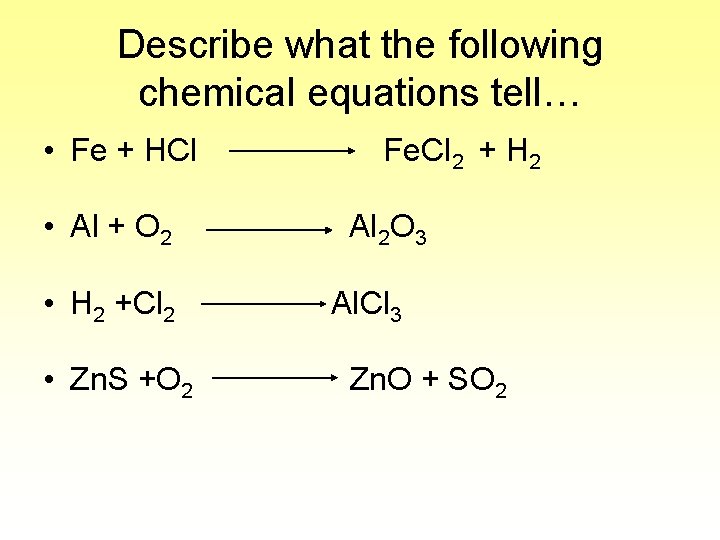
Describe what the following chemical equations tell… • Fe + HCl • Al + O 2 • H 2 +Cl 2 • Zn. S +O 2 Fe. Cl 2 + H 2 Al 2 O 3 Al. Cl 3 Zn. O + SO 2
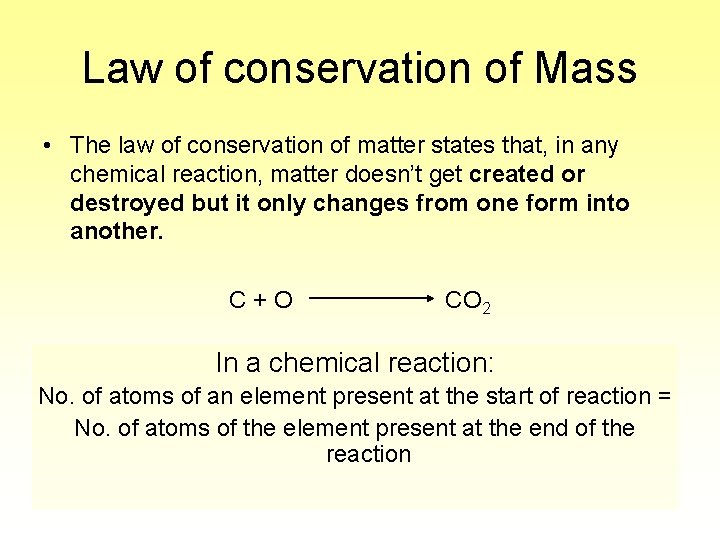
Law of conservation of Mass • The law of conservation of matter states that, in any chemical reaction, matter doesn’t get created or destroyed but it only changes from one form into another. C+O CO 2 In a chemical reaction: No. of atoms of an element present at the start of reaction = No. of atoms of the element present at the end of the reaction
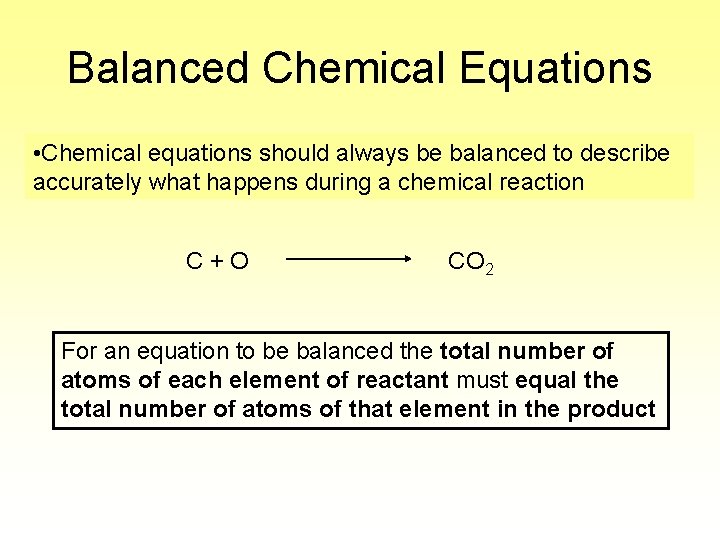
Balanced Chemical Equations • Chemical equations should always be balanced to describe accurately what happens during a chemical reaction C+O CO 2 For an equation to be balanced the total number of atoms of each element of reactant must equal the total number of atoms of that element in the product
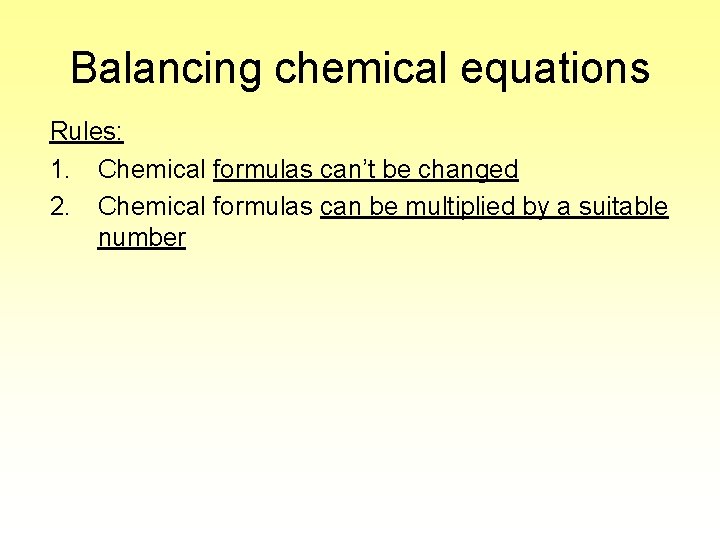
Balancing chemical equations Rules: 1. Chemical formulas can’t be changed 2. Chemical formulas can be multiplied by a suitable number
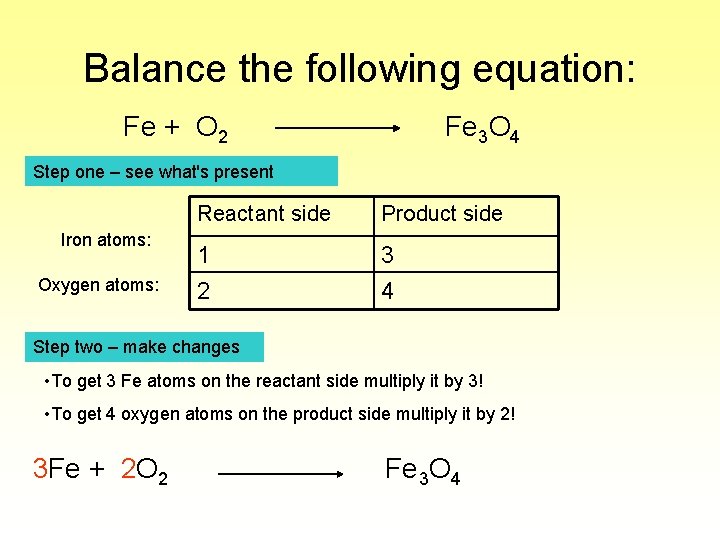
Balance the following equation: Fe + O 2 Fe 3 O 4 Step one – see what's present Iron atoms: Oxygen atoms: Reactant side Product side 1 2 3 4 Step two – make changes • To get 3 Fe atoms on the reactant side multiply it by 3! • To get 4 oxygen atoms on the product side multiply it by 2! 3 Fe + 2 O 2 Fe 3 O 4
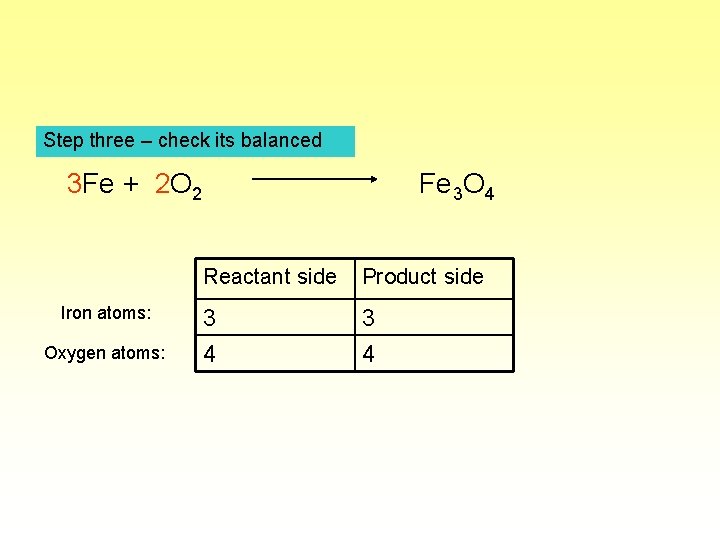
Step three – check its balanced 3 Fe + 2 O 2 Iron atoms: Oxygen atoms: Fe 3 O 4 Reactant side Product side 3 4
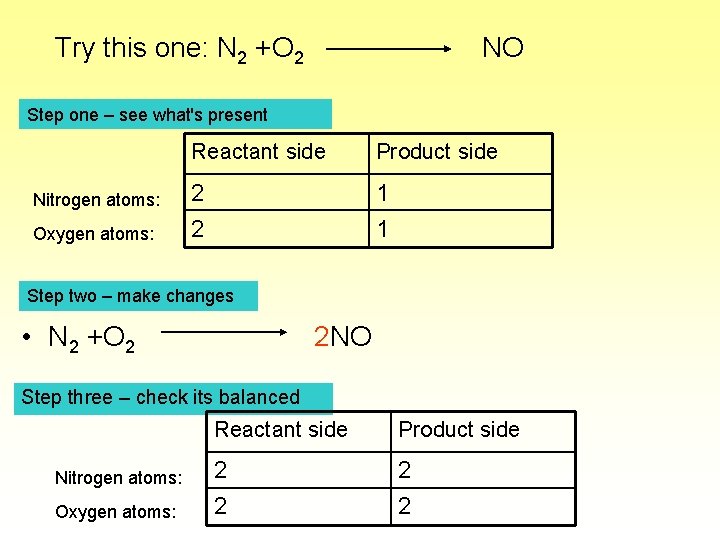
Try this one: N 2 +O 2 NO Step one – see what's present Nitrogen atoms: Oxygen atoms: Reactant side Product side 2 2 1 1 Step two – make changes • N 2 +O 2 2 NO Step three – check its balanced Nitrogen atoms: Oxygen atoms: Reactant side Product side 2 2
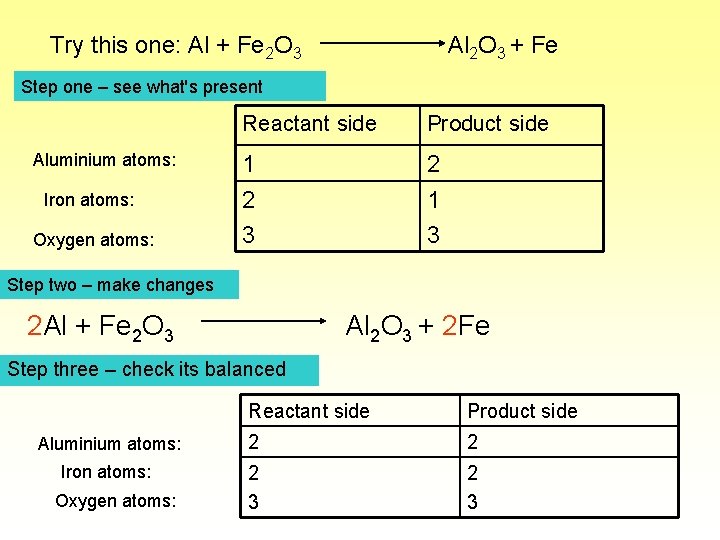
Try this one: Al + Fe 2 O 3 Al 2 O 3 + Fe Step one – see what's present Aluminium atoms: Iron atoms: Oxygen atoms: Reactant side Product side 1 2 3 2 1 3 Step two – make changes 2 Al + Fe 2 O 3 Al 2 O 3 + 2 Fe Step three – check its balanced Reactant side Product side Aluminium atoms: 2 2 Iron atoms: 2 3 Oxygen atoms:

Try now…
Balancing redox equations
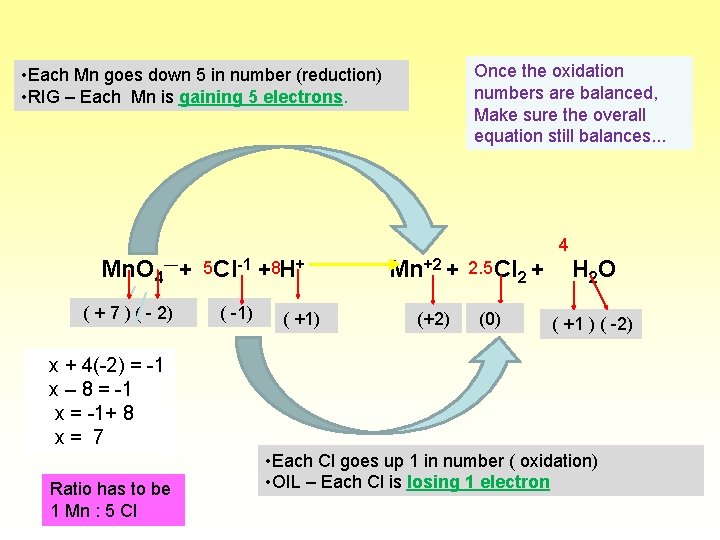
Once the oxidation numbers are balanced, Make sure the overall equation still balances. . . • Each Mn goes down 5 in number (reduction) • RIG – Each Mn is gaining 5 electrons. 4 Mn. O 4―+ 5 Cl-1 +8 H+ ( + 7 ) ( - 2) ( -1) ( +1) Mn+2 + (+2) 2. 5 Cl (0) 2+ H 2 O ( +1 ) ( -2) x + 4(-2) = -1 x – 8 = -1 x = -1+ 8 x= 7 Ratio has to be 1 Mn : 5 Cl • Each Cl goes up 1 in number ( oxidation) • OIL – Each Cl is losing 1 electron
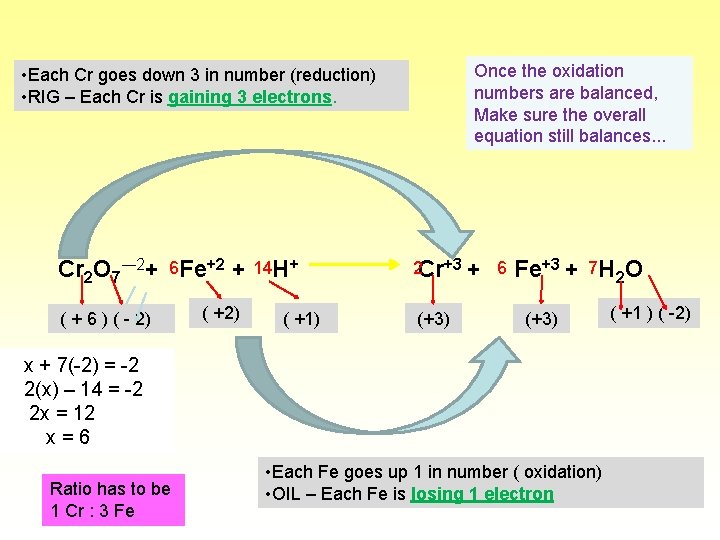
Once the oxidation numbers are balanced, Make sure the overall equation still balances. . . • Each Cr goes down 3 in number (reduction) • RIG – Each Cr is gaining 3 electrons. Cr 2 O 7― 2+ 6 Fe+2 + 14 H+ ( + 6 ) ( - 2) ( +1) 2 Cr+3 + 6 (+3) Fe+3 + 7 H 2 O (+3) x + 7(-2) = -2 2(x) – 14 = -2 2 x = 12 x=6 Ratio has to be 1 Cr : 3 Fe • Each Fe goes up 1 in number ( oxidation) • OIL – Each Fe is losing 1 electron ( +1 ) ( -2)
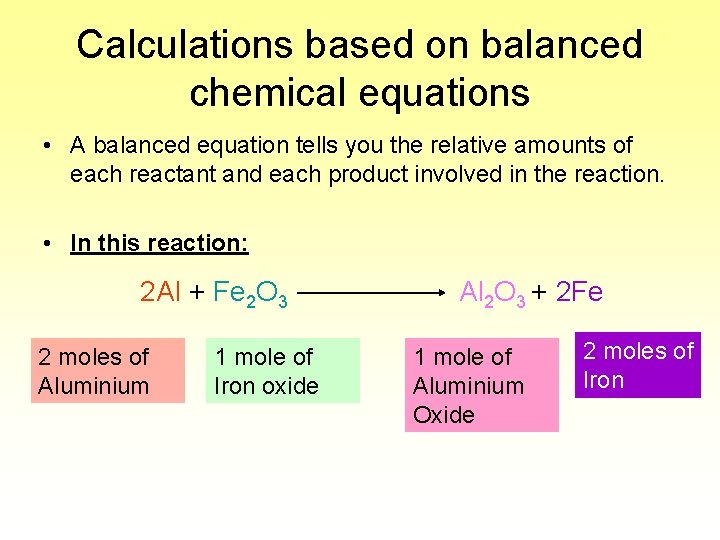
Calculations based on balanced chemical equations • A balanced equation tells you the relative amounts of each reactant and each product involved in the reaction. • In this reaction: 2 Al + Fe 2 O 3 2 moles of Aluminium 1 mole of Iron oxide Al 2 O 3 + 2 Fe 1 mole of Aluminium Oxide 2 moles of Iron
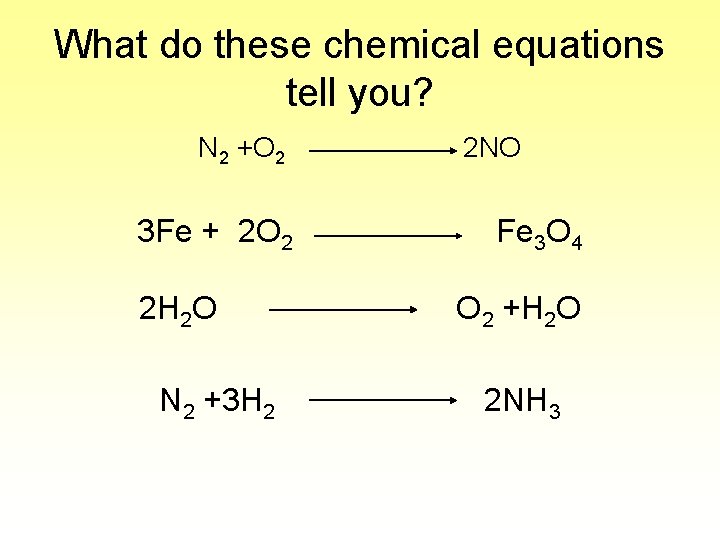
What do these chemical equations tell you? N 2 +O 2 3 Fe + 2 O 2 2 H 2 O N 2 +3 H 2 2 NO Fe 3 O 4 O 2 +H 2 O 2 NH 3
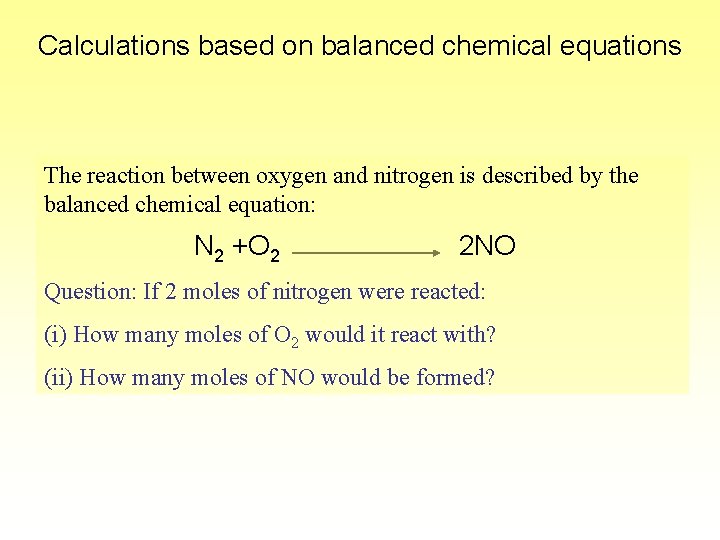
Calculations based on balanced chemical equations The reaction between oxygen and nitrogen is described by the balanced chemical equation: N 2 +O 2 2 NO Question: If 2 moles of nitrogen were reacted: (i) How many moles of O 2 would it react with? (ii) How many moles of NO would be formed?
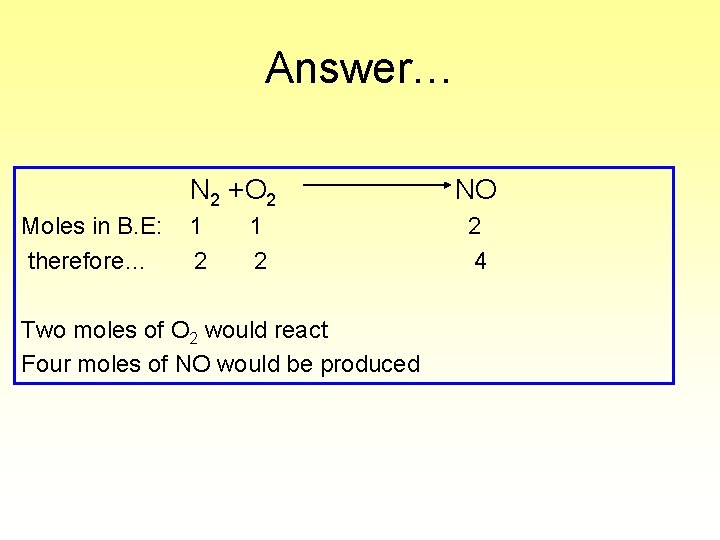
Answer… N 2 +O 2 Moles in B. E: therefore… 1 2 Two moles of O 2 would react Four moles of NO would be produced NO 2 4
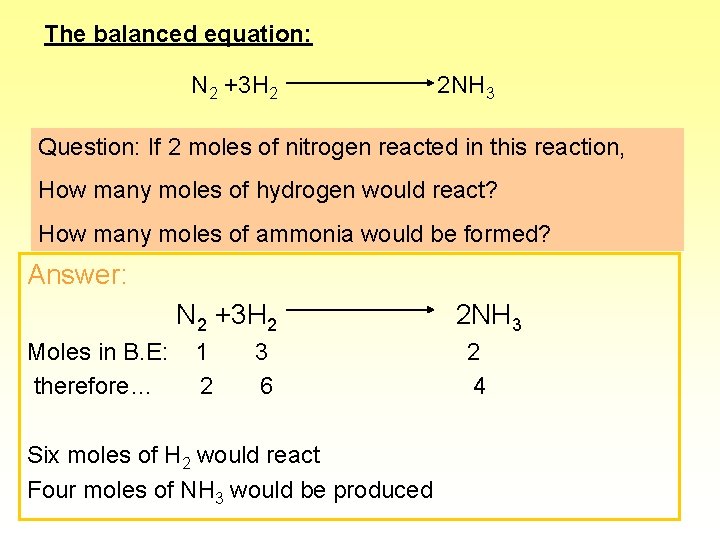
The balanced equation: N 2 +3 H 2 2 NH 3 Question: If 2 moles of nitrogen reacted in this reaction, How many moles of hydrogen would react? How many moles of ammonia would be formed? Answer: N 2 +3 H 2 Moles in B. E: therefore… 1 2 3 6 Six moles of H 2 would react Four moles of NH 3 would be produced 2 NH 3 2 4
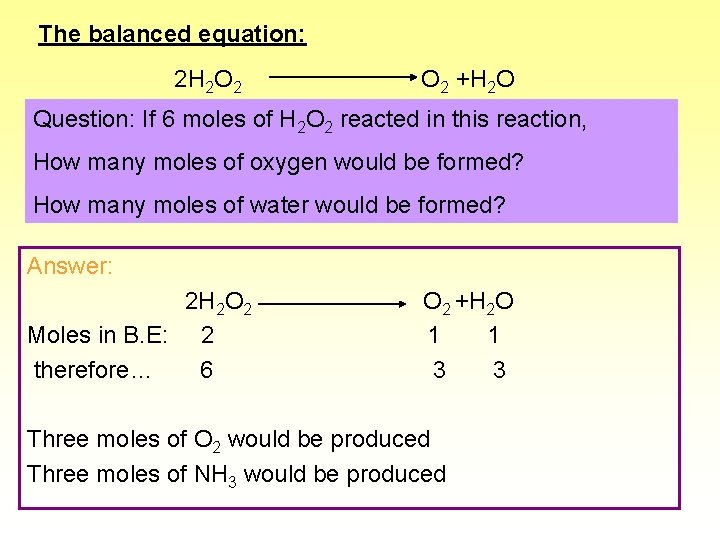
The balanced equation: 2 H 2 O 2 +H 2 O Question: If 6 moles of H 2 O 2 reacted in this reaction, How many moles of oxygen would be formed? How many moles of water would be formed? Answer: 2 H 2 O 2 Moles in B. E: 2 therefore… 6 O 2 +H 2 O 1 1 3 3 Three moles of O 2 would be produced Three moles of NH 3 would be produced
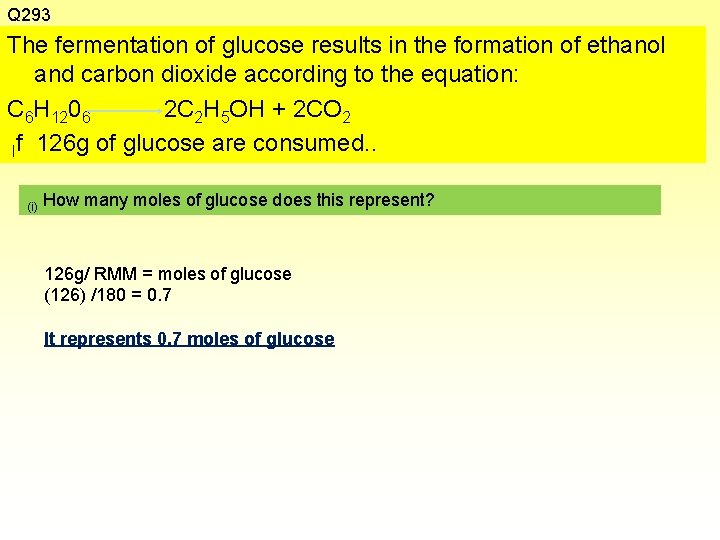
Q 293 The fermentation of glucose results in the formation of ethanol and carbon dioxide according to the equation: C 6 H 1206 2 C 2 H 5 OH + 2 CO 2 If 126 g of glucose are consumed. . (i) How many moles of glucose does this represent? 126 g/ RMM = moles of glucose (126) /180 = 0. 7 It represents 0. 7 moles of glucose
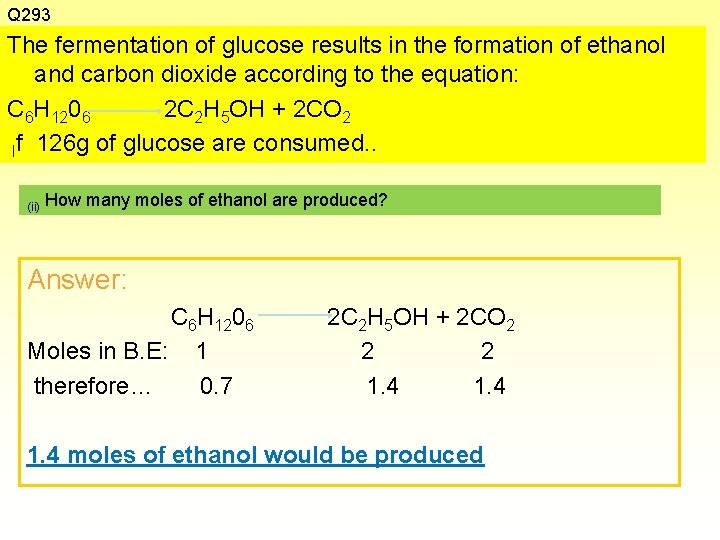
Q 293 The fermentation of glucose results in the formation of ethanol and carbon dioxide according to the equation: C 6 H 1206 2 C 2 H 5 OH + 2 CO 2 If 126 g of glucose are consumed. . (ii) How many moles of ethanol are produced? Answer: C 6 H 1206 Moles in B. E: 1 therefore… 0. 7 2 C 2 H 5 OH + 2 CO 2 2 2 1. 4 moles of ethanol would be produced
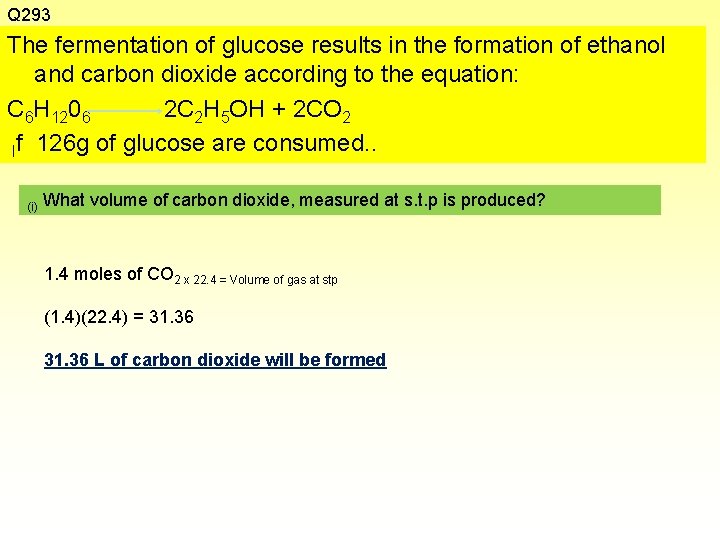
Q 293 The fermentation of glucose results in the formation of ethanol and carbon dioxide according to the equation: C 6 H 1206 2 C 2 H 5 OH + 2 CO 2 If 126 g of glucose are consumed. . (i) What volume of carbon dioxide, measured at s. t. p is produced? 1. 4 moles of CO 2 x 22. 4 = Volume of gas at stp (1. 4)(22. 4) = 31. 36 L of carbon dioxide will be formed
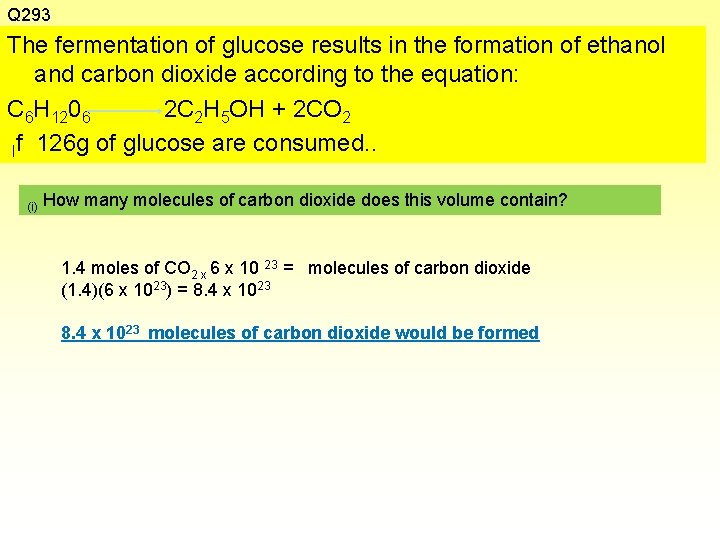
Q 293 The fermentation of glucose results in the formation of ethanol and carbon dioxide according to the equation: C 6 H 1206 2 C 2 H 5 OH + 2 CO 2 If 126 g of glucose are consumed. . (i) How many molecules of carbon dioxide does this volume contain? 1. 4 moles of CO 2 x 6 x 10 23 = molecules of carbon dioxide (1. 4)(6 x 10²³) = 8. 4 x 10²³ molecules of carbon dioxide would be formed
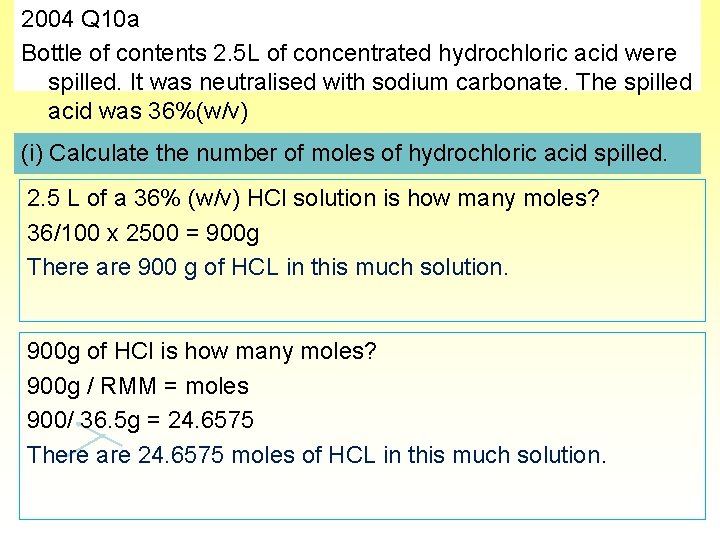
2004 Q 10 a Bottle of contents 2. 5 L of concentrated hydrochloric acid were spilled. It was neutralised with sodium carbonate. The spilled acid was 36%(w/v) . (i) Calculate the number of moles of hydrochloric acid spilled. 2. 5 L of a 36% (w/v) HCl solution is how many moles? 36/100 x 2500 = 900 g There are 900 g of HCL in this much solution. 900 g of HCl is how many moles? 900 g / RMM = moles 900/ 36. 5 g = 24. 6575 There are 24. 6575 moles of HCL in this much solution.
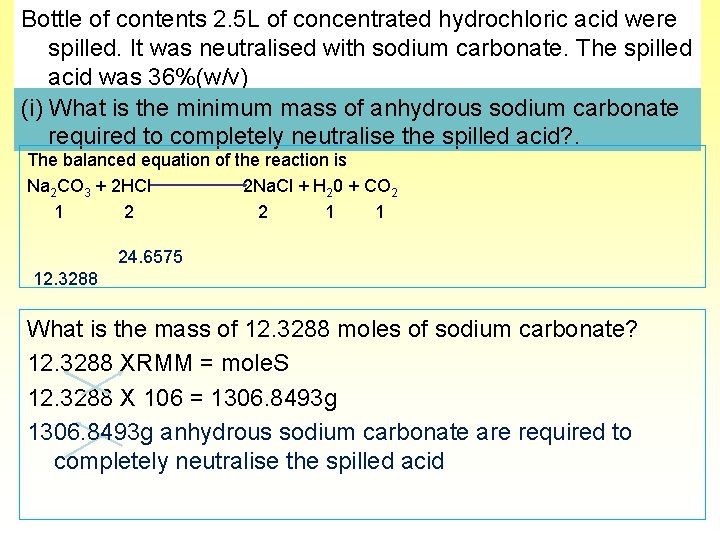
Bottle of contents 2. 5 L of concentrated hydrochloric acid were spilled. It was neutralised with sodium carbonate. The spilled acid was 36%(w/v) (i) What is the minimum mass of anhydrous sodium carbonate required to completely neutralise the spilled acid? . . The balanced equation of the reaction is Na 2 CO 3 + 2 HCl 2 Na. Cl + H 20 + CO 2 1 2 2 1 1 24. 6575 12. 3288 What is the mass of 12. 3288 moles of sodium carbonate? 12. 3288 XRMM = mole. S 12. 3288 X 106 = 1306. 8493 g anhydrous sodium carbonate are required to completely neutralise the spilled acid
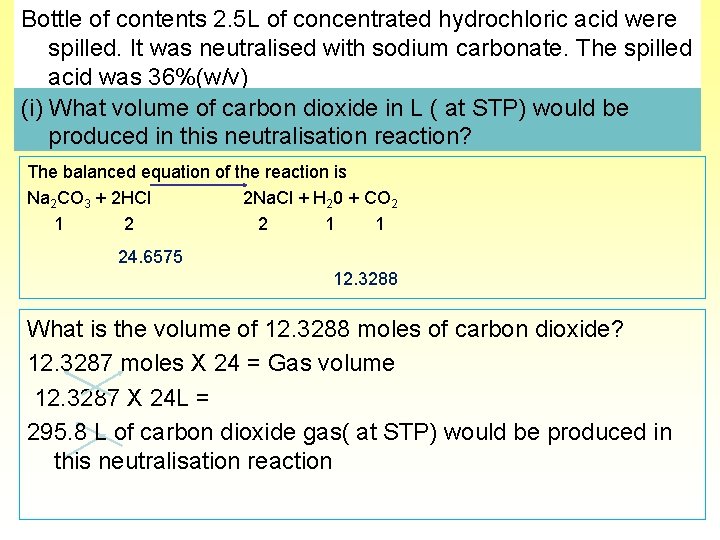
Bottle of contents 2. 5 L of concentrated hydrochloric acid were spilled. It was neutralised with sodium carbonate. The spilled acid was 36%(w/v) (i) What volume of carbon dioxide in L ( at STP) would be produced in this neutralisation reaction? . The balanced equation of the reaction is Na 2 CO 3 + 2 HCl 2 Na. Cl + H 20 + CO 2 1 2 2 1 1 24. 6575 12. 3288 What is the volume of 12. 3288 moles of carbon dioxide? 12. 3287 moles X 24 = Gas volume 12. 3287 X 24 L = 295. 8 L of carbon dioxide gas( at STP) would be produced in this neutralisation reaction
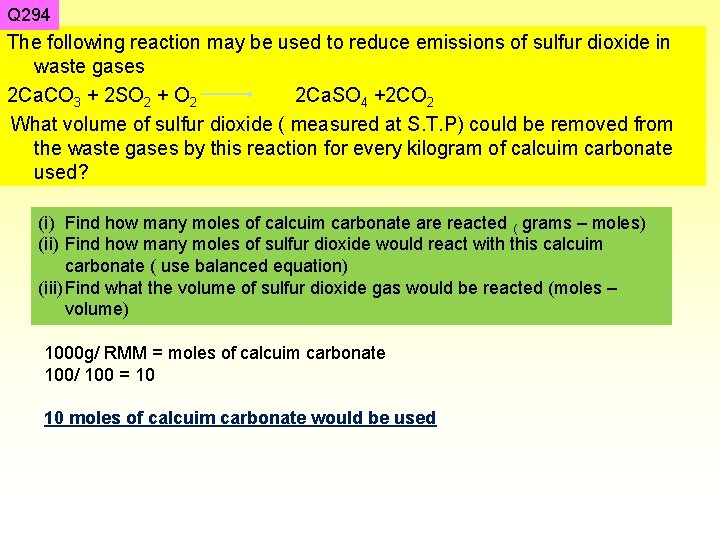
Q 294 The following reaction may be used to reduce emissions of sulfur dioxide in waste gases 2 Ca. CO 3 + 2 SO 2 + O 2 2 Ca. SO 4 +2 CO 2 What volume of sulfur dioxide ( measured at S. T. P) could be removed from the waste gases by this reaction for every kilogram of calcuim carbonate used? (i) Find how many moles of calcuim carbonate are reacted ( grams – moles) (ii) Find how many moles of sulfur dioxide would react with this calcuim carbonate ( use balanced equation) (iii) Find what the volume of sulfur dioxide gas would be reacted (moles – volume) 1000 g/ RMM = moles of calcuim carbonate 100/ 100 = 10 10 moles of calcuim carbonate would be used
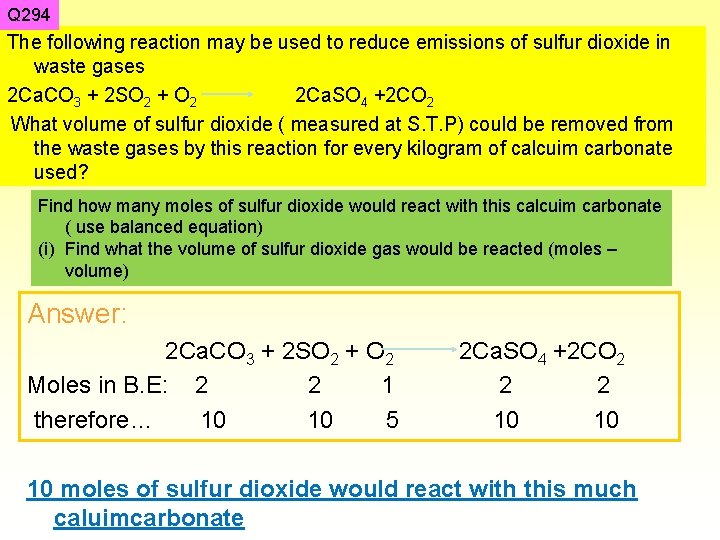
Q 293 Q 294 The reactionofmay be used to reduce emissions of sulfur dioxide in Thefollowing fermentation glucose results in the formation of ethanol waste gases dioxide according to the equation: and carbon 2 Ca. CO 3 + 2 SO 2 + O 2 2 Ca. SO 4 +2 CO 2 What volume of sulfur dioxide ( measured at S. T. P) could be removed from of glucose consumed. . the waste gases by are this reaction for every kilogram of calcuim carbonate If 126 g used? Find how many moles of sulfur dioxide would react with this calcuim carbonate ( use balanced equation) (i) Find what the volume of sulfur dioxide gas would be reacted (moles – volume) Answer: 2 Ca. CO 3 + 2 SO 2 + O 2 Moles in B. E: 2 2 1 therefore… 10 10 5 2 Ca. SO 4 +2 CO 2 2 2 10 10 10 moles of sulfur dioxide would react with this much caluimcarbonate
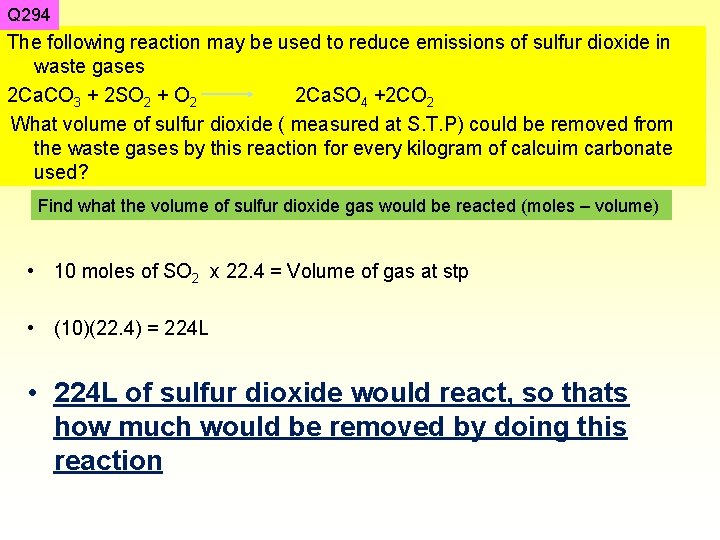
Q 294 The following reaction may be used to reduce emissions of sulfur dioxide in waste gases 2 Ca. CO 3 + 2 SO 2 + O 2 2 Ca. SO 4 +2 CO 2 What volume of sulfur dioxide ( measured at S. T. P) could be removed from the waste gases by this reaction for every kilogram of calcuim carbonate used? Find what the volume of sulfur dioxide gas would be reacted (moles – volume) • 10 moles of SO 2 x 22. 4 = Volume of gas at stp • (10)(22. 4) = 224 L • 224 L of sulfur dioxide would react, so thats how much would be removed by doing this reaction
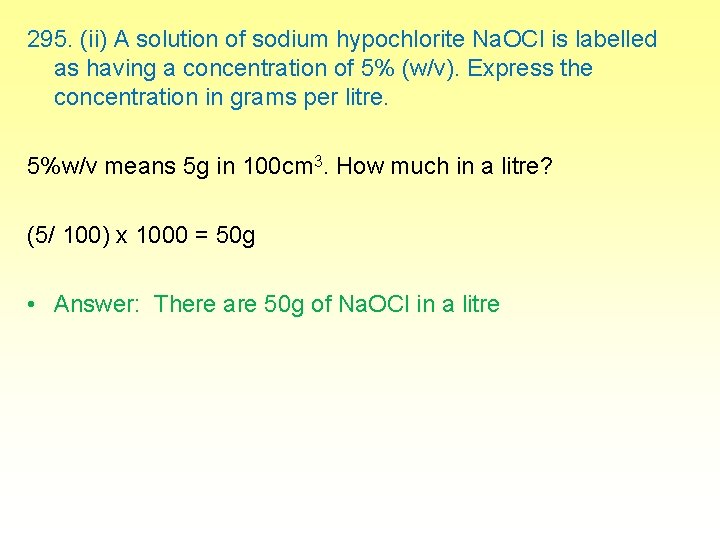
295. (ii) A solution of sodium hypochlorite Na. OCl is labelled as having a concentration of 5% (w/v). Express the concentration in grams per litre. 5%w/v means 5 g in 100 cm 3. How much in a litre? (5/ 100) x 1000 = 50 g • Answer: There are 50 g of Na. OCl in a litre
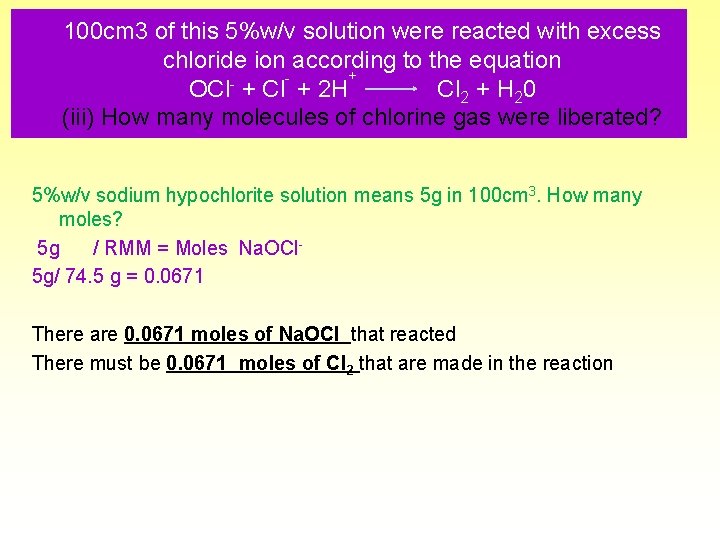
100 cm 3 of this 5%w/v solution were reacted with excess chloride ion according to the equation + OCl + 2 H Cl 2 + H 20 (iii) How many molecules of chlorine gas were liberated? 5%w/v sodium hypochlorite solution means 5 g in 100 cm 3. How many moles? 5 g / RMM = Moles Na. OCl 5 g/ 74. 5 g = 0. 0671 There are 0. 0671 moles of Na. OCl that reacted There must be 0. 0671 moles of Cl 2 that are made in the reaction
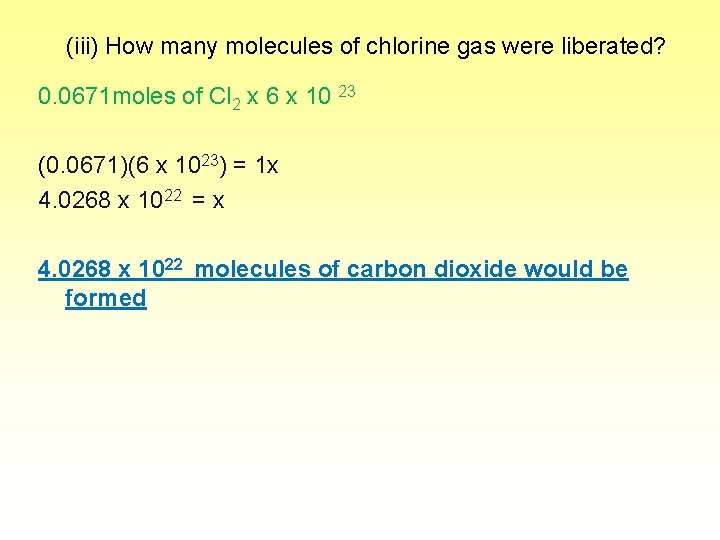
(iii) How many molecules of chlorine gas were liberated? 0. 0671 moles of Cl 2 x 6 x 10 23 (0. 0671)(6 x 10²³) = 1 x 4. 0268 x 1022 = x 4. 0268 x 1022 molecules of carbon dioxide would be formed
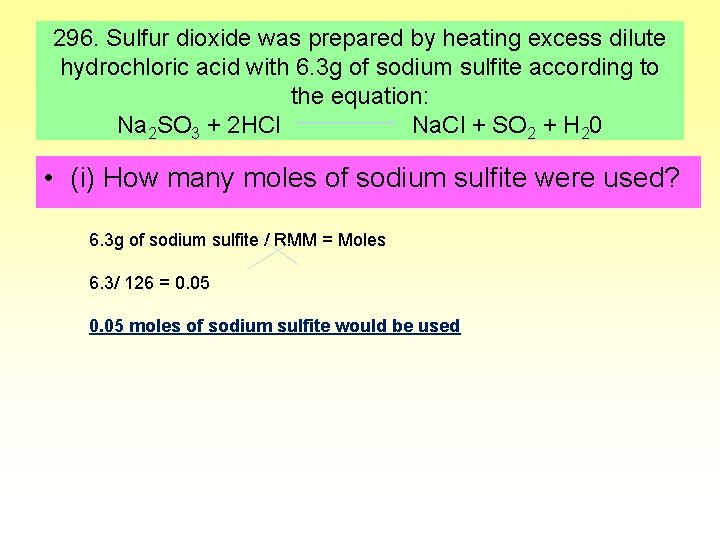
296. Sulfur dioxide was prepared by heating excess dilute hydrochloric acid with 6. 3 g of sodium sulfite according to the equation: Na 2 SO 3 + 2 HCl Na. Cl + SO 2 + H 20 • (i) How many moles of sodium sulfite were used? 6. 3 g of sodium sulfite / RMM = Moles 6. 3/ 126 = 0. 05 moles of sodium sulfite would be used
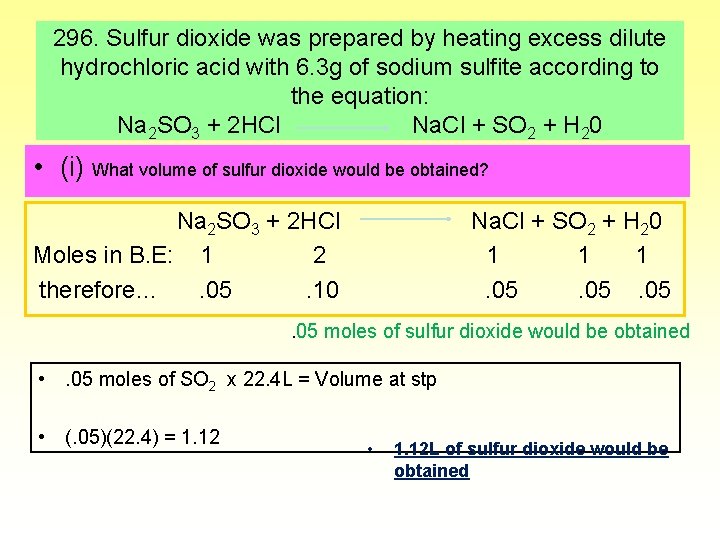
296. Sulfur dioxide was prepared by heating excess dilute hydrochloric acid with 6. 3 g of sodium sulfite according to the equation: Na 2 SO 3 + 2 HCl Na. Cl + SO 2 + H 20 • (i) What volume of sulfur dioxide would be obtained? Na 2 SO 3 + 2 HCl Moles in B. E: 1 2 therefore…. 05. 10 Na. Cl + SO 2 + H 20 1 1 1. 05. 05 moles of sulfur dioxide would be obtained • . 05 moles of SO 2 x 22. 4 L = Volume at stp • (. 05)(22. 4) = 1. 12 • 1. 12 L of sulfur dioxide would be obtained
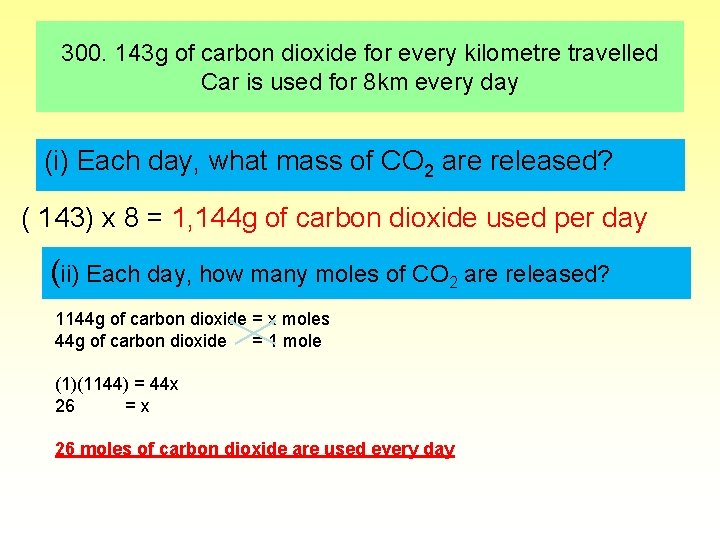
300. 143 g of carbon dioxide for every kilometre travelled Car is used for 8 km every day (i) Each day, what mass of CO 2 are released? ( 143) x 8 = 1, 144 g of carbon dioxide used per day (ii) Each day, how many moles of CO 2 are released? 1144 g of carbon dioxide = x moles 44 g of carbon dioxide = 1 mole (1)(1144) = 44 x 26 =x 26 moles of carbon dioxide are used every day
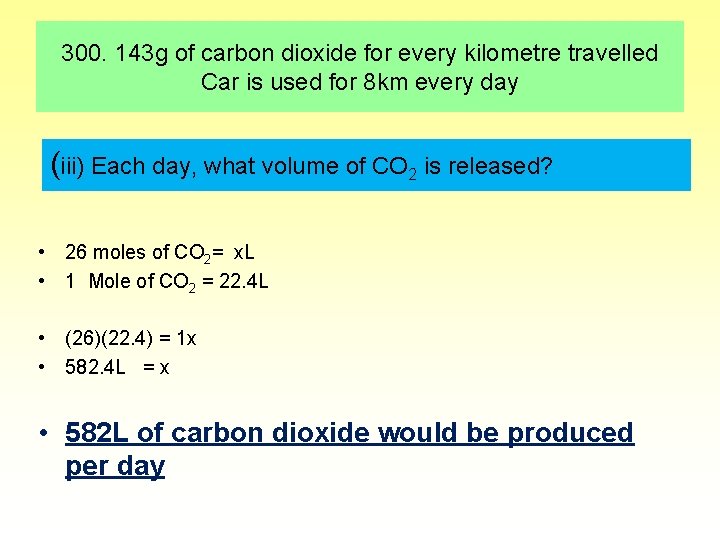
300. 143 g of carbon dioxide for every kilometre travelled Car is used for 8 km every day (iii) Each day, what volume of CO 2 is released? • 26 moles of CO 2= x. L • 1 Mole of CO 2 = 22. 4 L • (26)(22. 4) = 1 x • 582. 4 L = x • 582 L of carbon dioxide would be produced per day
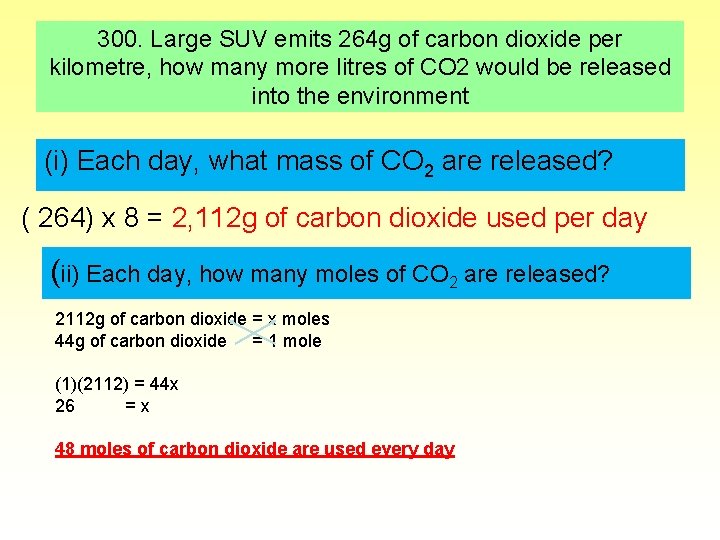
300. Large SUV emits 264 g of carbon dioxide per kilometre, how many more litres of CO 2 would be released into the environment (i) Each day, what mass of CO 2 are released? ( 264) x 8 = 2, 112 g of carbon dioxide used per day (ii) Each day, how many moles of CO 2 are released? 2112 g of carbon dioxide = x moles 44 g of carbon dioxide = 1 mole (1)(2112) = 44 x 26 =x 48 moles of carbon dioxide are used every day
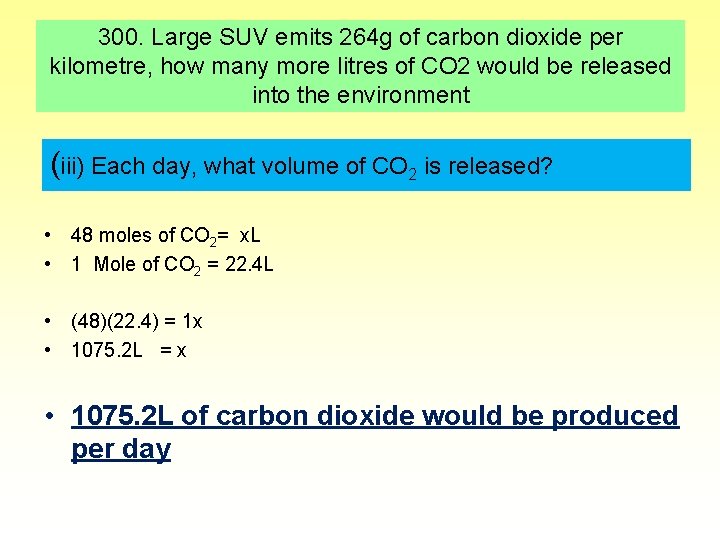
300. Large SUV emits 264 g of carbon dioxide per 300. 143 g of carbon dioxide for every kilometre travelled kilometre, how many more litres of CO 2 would be released Car is used for 8 km every day into the environment (iii) Each day, what volume of CO 2 is released? • 48 moles of CO 2= x. L • 1 Mole of CO 2 = 22. 4 L • (48)(22. 4) = 1 x • 1075. 2 L = x • 1075. 2 L of carbon dioxide would be produced per day
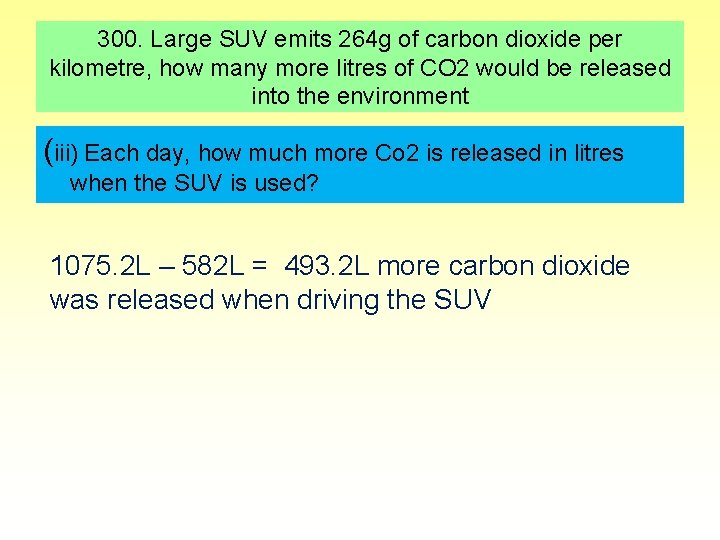
300. Large SUV emits 264 g of carbon dioxide per kilometre, how many more litres of CO 2 would be released into the environment (iii) Each day, how much more Co 2 is released in litres when the SUV is used? 1075. 2 L – 582 L = 493. 2 L more carbon dioxide was released when driving the SUV
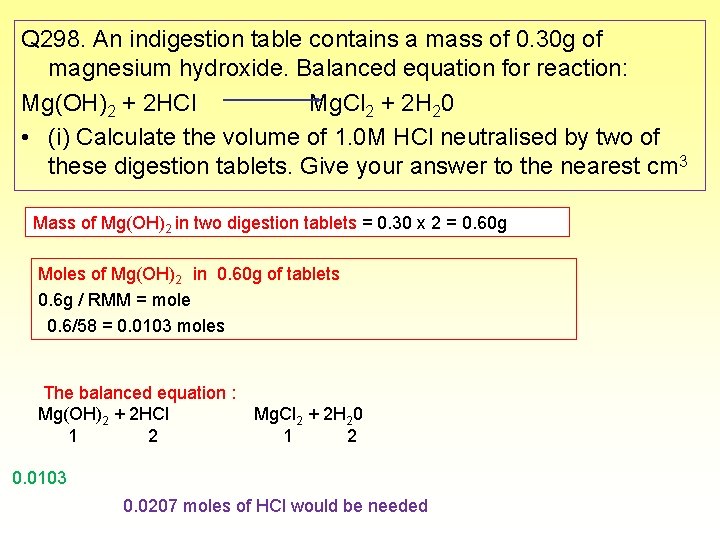
Q 298. An indigestion table contains a mass of 0. 30 g of magnesium hydroxide. Balanced equation for reaction: Mg(OH)2 + 2 HCl Mg. Cl 2 + 2 H 20 • (i) Calculate the volume of 1. 0 M HCl neutralised by two of these digestion tablets. Give your answer to the nearest cm 3 Mass of Mg(OH)2 in two digestion tablets = 0. 30 x 2 = 0. 60 g Moles of Mg(OH)2 in 0. 60 g of tablets 0. 6 g / RMM = mole 0. 6/58 = 0. 0103 moles The balanced equation : Mg(OH)2 + 2 HCl Mg. Cl 2 + 2 H 20 1 2 0. 0103 0. 0207 moles of HCl would be needed
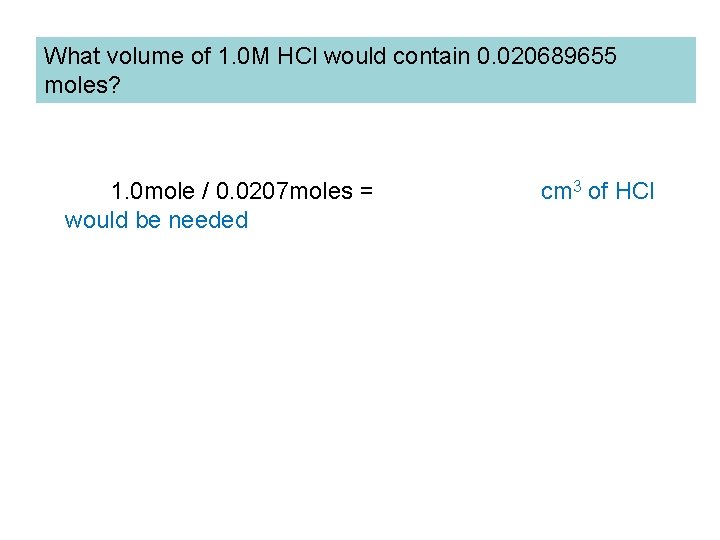
What volume of 1. 0 M HCl would contain 0. 020689655 moles? 1. 0 mole / 0. 0207 moles = would be needed cm 3 of HCl
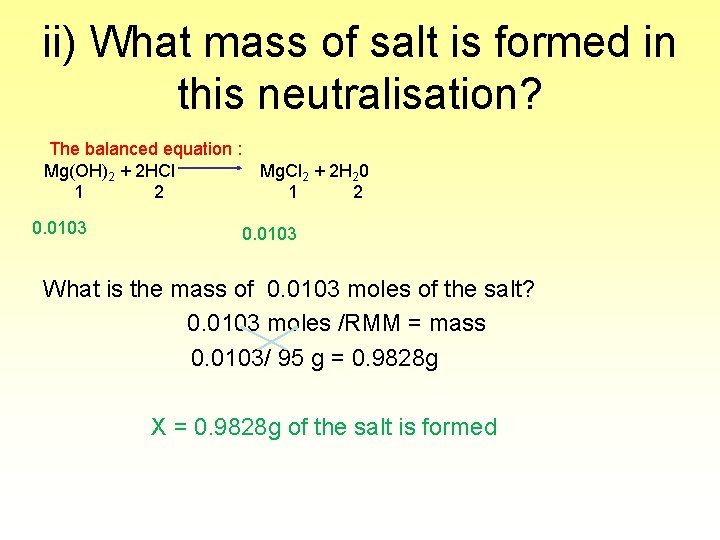
ii) What mass of salt is formed in this neutralisation? The balanced equation : Mg(OH)2 + 2 HCl Mg. Cl 2 + 2 H 20 1 2 0. 0103 What is the mass of 0. 0103 moles of the salt? 0. 0103 moles /RMM = mass 0. 0103/ 95 g = 0. 9828 g X = 0. 9828 g of the salt is formed
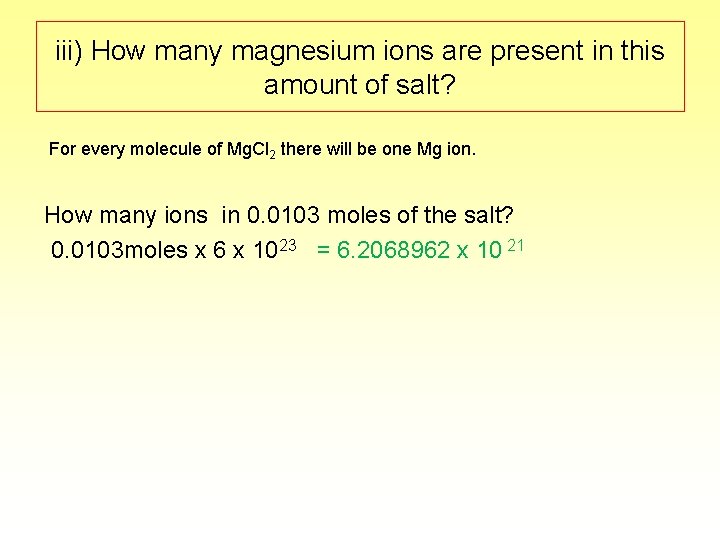
iii) How many magnesium ions are present in this amount of salt? For every molecule of Mg. Cl 2 there will be one Mg ion. How many ions in 0. 0103 moles of the salt? 0. 0103 moles x 6 x 1023 = 6. 2068962 x 10 21
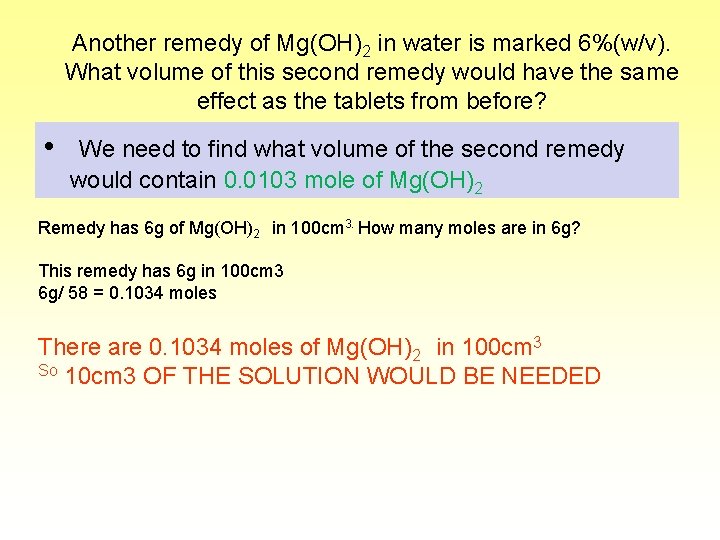
Another remedy of Mg(OH)2 in water is marked 6%(w/v). What volume of this second remedy would have the same effect as the tablets from before? • We need to find what volume of the second remedy would contain 0. 0103 mole of Mg(OH)2 Remedy has 6 g of Mg(OH)2 in 100 cm 3. How many moles are in 6 g? This remedy has 6 g in 100 cm 3 6 g/ 58 = 0. 1034 moles There are 0. 1034 moles of Mg(OH)2 in 100 cm 3 So 10 cm 3 OF THE SOLUTION WOULD BE NEEDED
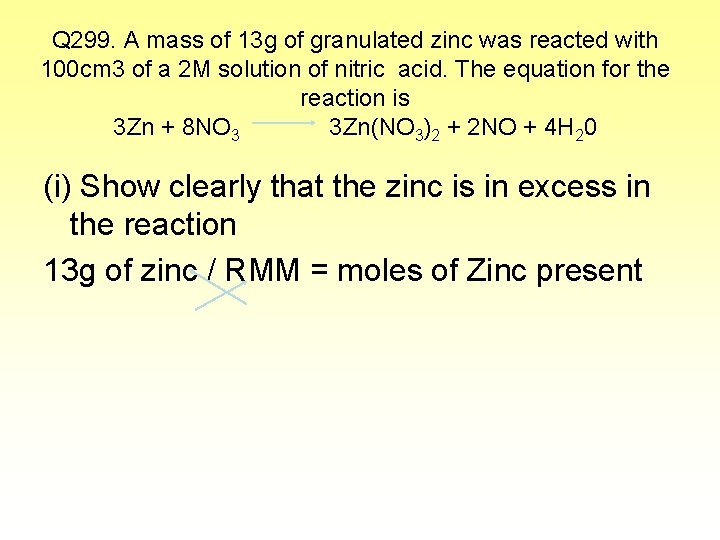
Q 299. A mass of 13 g of granulated zinc was reacted with 100 cm 3 of a 2 M solution of nitric acid. The equation for the reaction is 3 Zn + 8 NO 3 3 Zn(NO 3)2 + 2 NO + 4 H 20 (i) Show clearly that the zinc is in excess in the reaction 13 g of zinc / RMM = moles of Zinc present
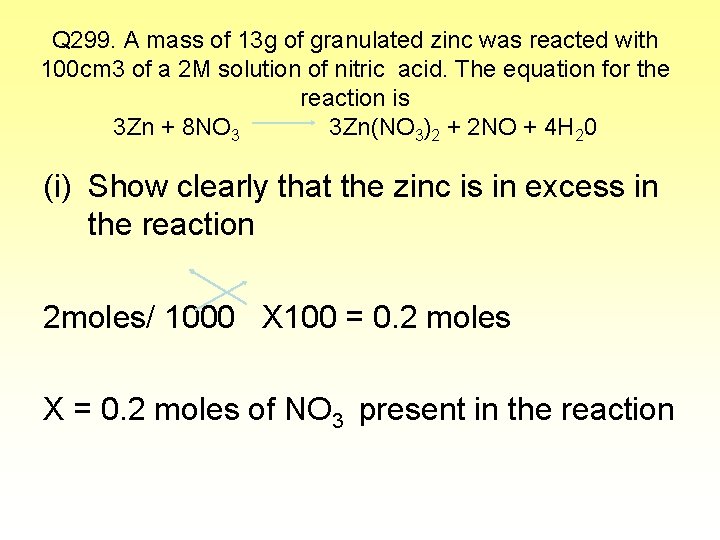
Q 299. A mass of 13 g of granulated zinc was reacted with 100 cm 3 of a 2 M solution of nitric acid. The equation for the reaction is 3 Zn + 8 NO 3 3 Zn(NO 3)2 + 2 NO + 4 H 20 (i) Show clearly that the zinc is in excess in the reaction 2 moles/ 1000 X 100 = 0. 2 moles X = 0. 2 moles of NO 3 present in the reaction
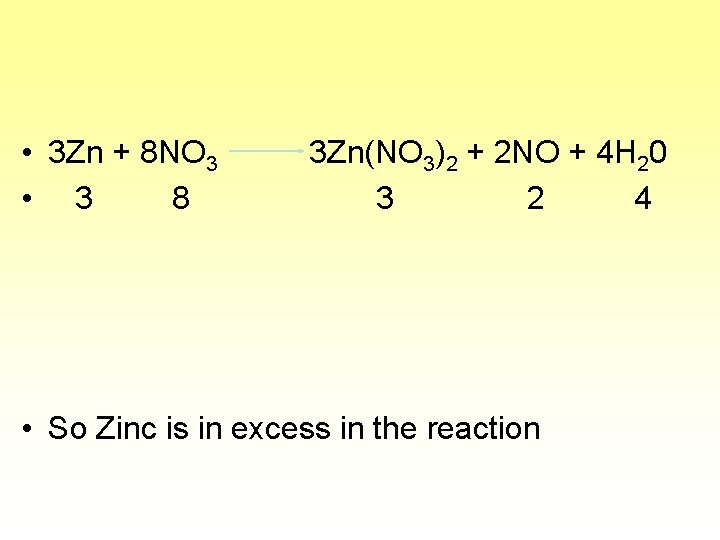
• 3 Zn + 8 NO 3 • 3 8 3 Zn(NO 3)2 + 2 NO + 4 H 20 3 2 4 • So Zinc is in excess in the reaction
What mass of zinc nitrate was formed?
Extra material
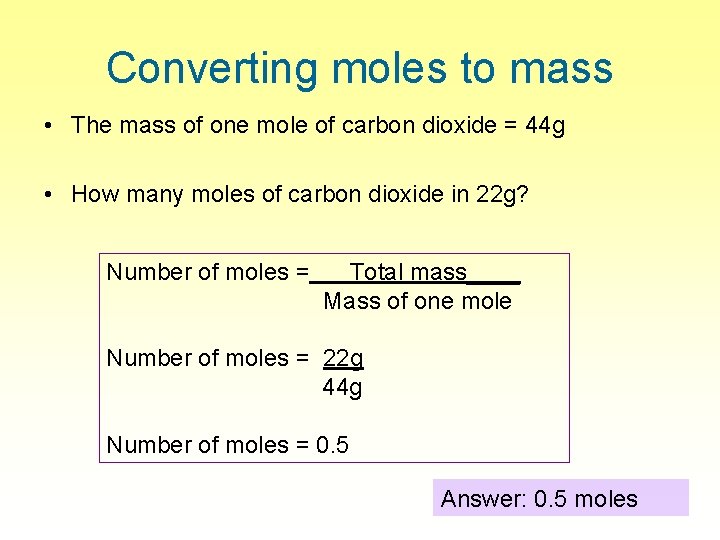
Converting moles to mass • The mass of one mole of carbon dioxide = 44 g • How many moles of carbon dioxide in 22 g? Number of moles = Total mass____ Mass of one mole Number of moles = 22 g 44 g Number of moles = 0. 5 Answer: 0. 5 moles
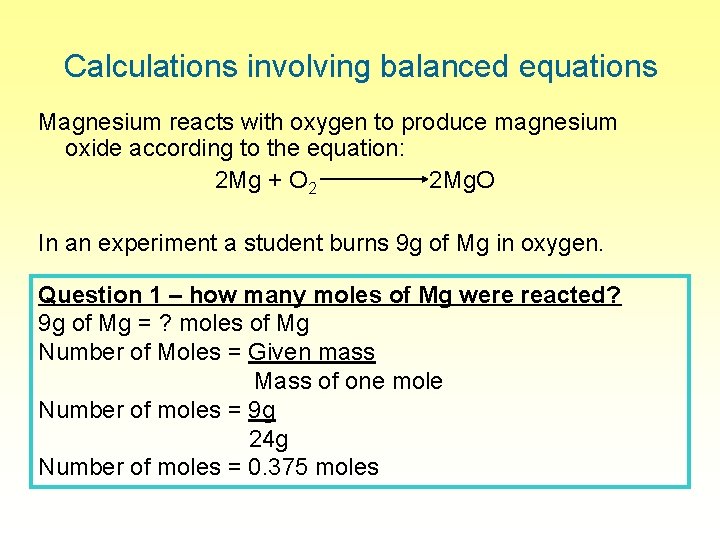
Calculations involving balanced equations Magnesium reacts with oxygen to produce magnesium oxide according to the equation: 2 Mg + O 2 2 Mg. O In an experiment a student burns 9 g of Mg in oxygen. Question 1 – how many moles of Mg were reacted? 9 g of Mg = ? moles of Mg Number of Moles = Given mass Mass of one mole Number of moles = 9 g 24 g Number of moles = 0. 375 moles
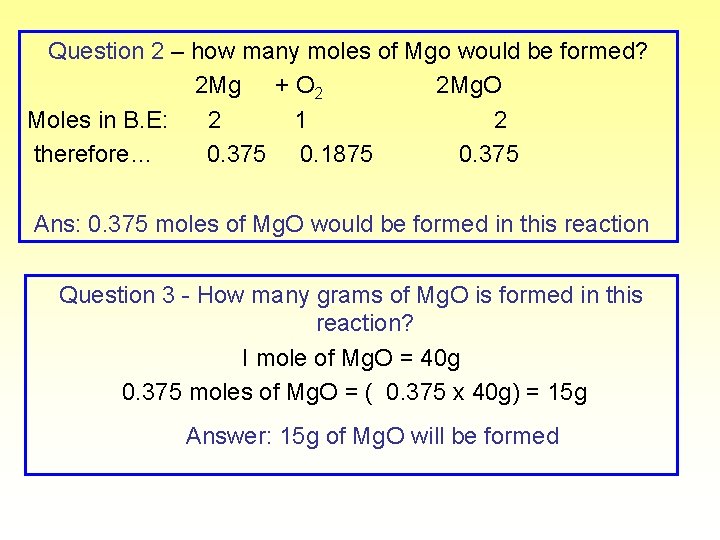
Question 2 – how many moles of Mgo would be formed? 2 Mg + O 2 2 Mg. O Moles in B. E: 2 1 2 therefore… 0. 375 0. 1875 0. 375 Ans: 0. 375 moles of Mg. O would be formed in this reaction Question 3 - How many grams of Mg. O is formed in this reaction? I mole of Mg. O = 40 g 0. 375 moles of Mg. O = ( 0. 375 x 40 g) = 15 g Answer: 15 g of Mg. O will be formed
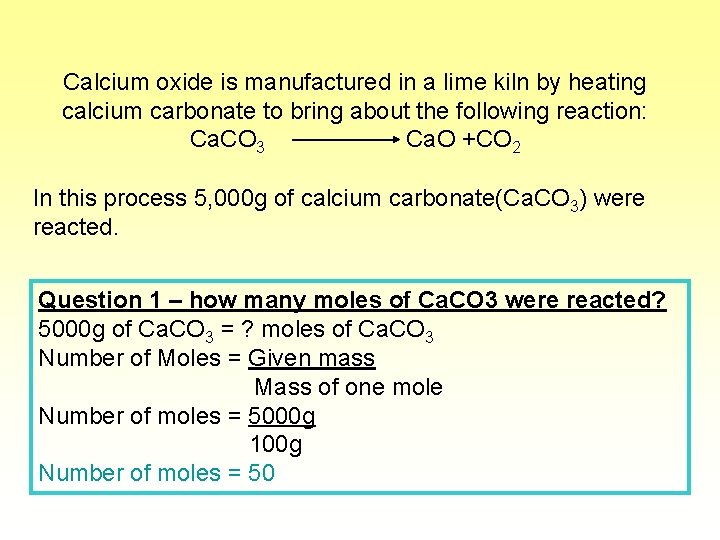
Calcium oxide is manufactured in a lime kiln by heating calcium carbonate to bring about the following reaction: Ca. CO 3 Ca. O +CO 2 In this process 5, 000 g of calcium carbonate(Ca. CO 3) were reacted. Question 1 – how many moles of Ca. CO 3 were reacted? 5000 g of Ca. CO 3 = ? moles of Ca. CO 3 Number of Moles = Given mass Mass of one mole Number of moles = 5000 g 100 g Number of moles = 50
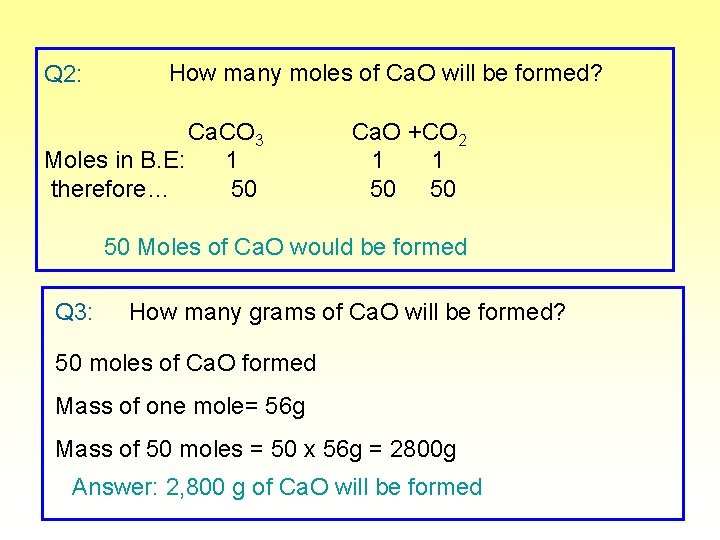
Q 2: How many moles of Ca. O will be formed? Ca. CO 3 Moles in B. E: 1 therefore… 50 Ca. O +CO 2 1 1 50 50 50 Moles of Ca. O would be formed Q 3: How many grams of Ca. O will be formed? 50 moles of Ca. O formed Mass of one mole= 56 g Mass of 50 moles = 50 x 56 g = 2800 g Answer: 2, 800 g of Ca. O will be formed
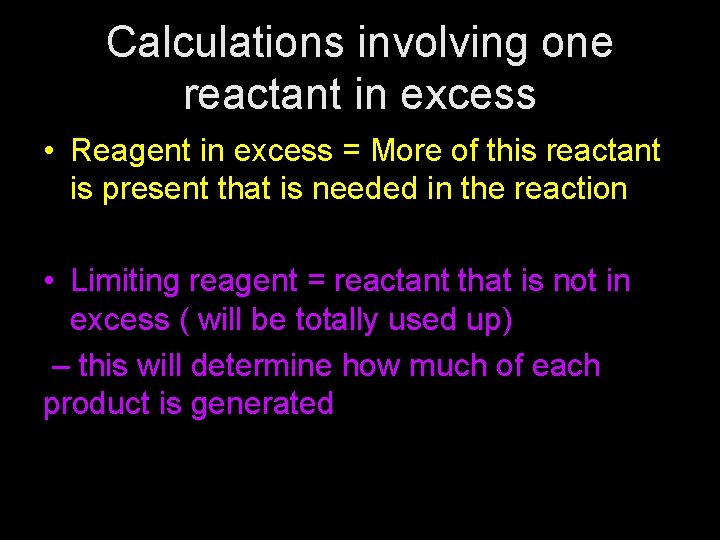
Calculations involving one reactant in excess • Reagent in excess = More of this reactant is present that is needed in the reaction • Limiting reagent = reactant that is not in excess ( will be totally used up) – this will determine how much of each product is generated
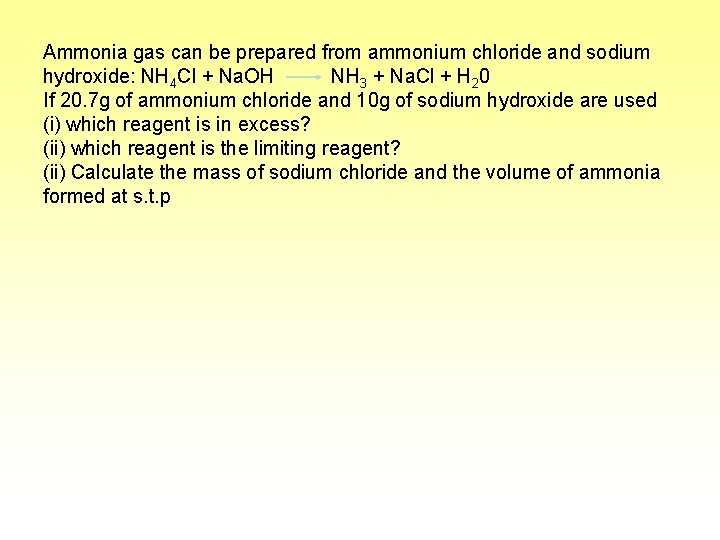
Ammonia gas can be prepared from ammonium chloride and sodium hydroxide: NH 4 Cl + Na. OH NH 3 + Na. Cl + H 20 If 20. 7 g of ammonium chloride and 10 g of sodium hydroxide are used (i) which reagent is in excess? (ii) which reagent is the limiting reagent? (ii) Calculate the mass of sodium chloride and the volume of ammonia formed at s. t. p
Another example. . • Worksheet 24. 5 A, B • Worksheet 24. 7 a
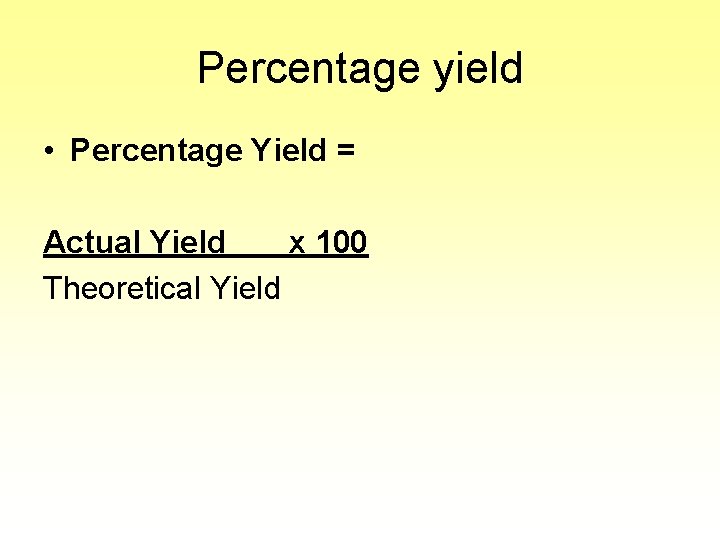
Percentage yield • Percentage Yield = Actual Yield x 100 Theoretical Yield
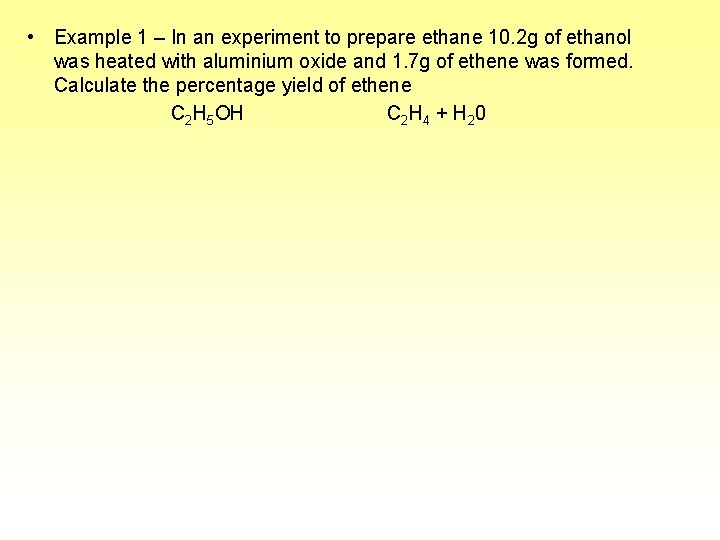
• Example 1 – In an experiment to prepare ethane 10. 2 g of ethanol was heated with aluminium oxide and 1. 7 g of ethene was formed. Calculate the percentage yield of ethene C 2 H 5 OH C 2 H 4 + H 2 0
Try now • 2012 Q 2 (D), (E) • Worksheet 24. 2 • Worksheet 24. 3
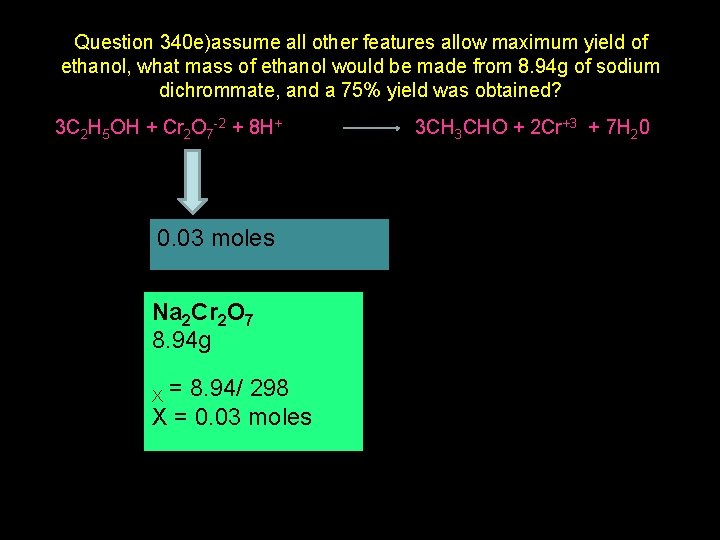
Question 340 e)assume all other features allow maximum yield of ethanol, what mass of ethanol would be made from 8. 94 g of sodium dichrommate, and a 75% yield was obtained? 3 C 2 H 5 OH + Cr 2 O 7 -2 + 8 H+ 0. 03 moles Na 2 Cr 2 O 7 8. 94 g = 8. 94/ 298 X = 0. 03 moles X 3 CHO + 2 Cr+3 + 7 H 20
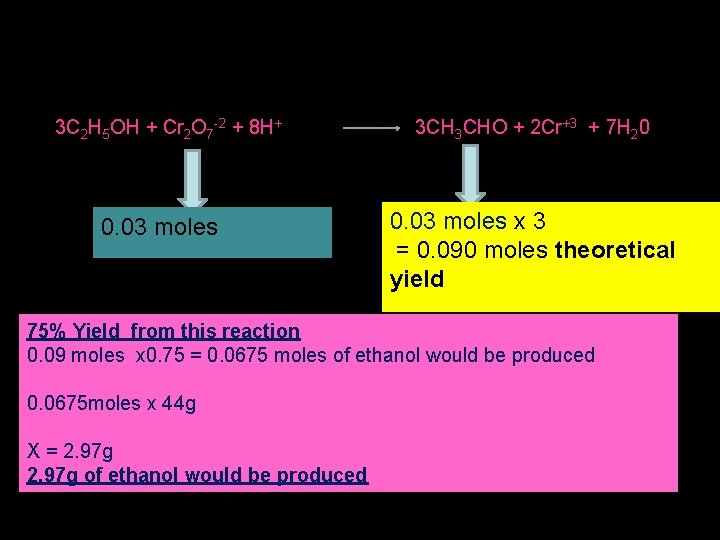
3 C 2 H 5 OH + Cr 2 O 7 -2 + 8 H+ 0. 03 moles 3 CHO + 2 Cr+3 + 7 H 20 0. 03 moles x 3 = 0. 090 moles theoretical yield 75% Yield from this reaction 0. 09 moles x 0. 75 = 0. 0675 moles of ethanol would be produced 0. 0675 moles x 44 g X = 2. 97 g of ethanol would be produced
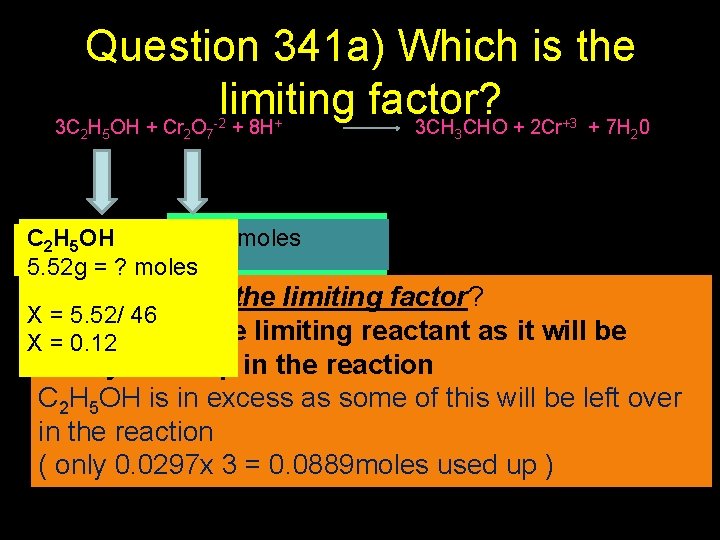
Question 341 a) Which is the limiting factor? 3 C H OH + Cr O + 8 H 3 CH CHO + 2 Cr + 7 H 0 2 5 2 7 -2 + 3 +3 2 Na 2 Crmoles C 2 H 5 moles OH 0. 0297 2 O 7 0. 12 8. 84 g = ? moles 5. 52 g = ? moles a) So which=is 8. 84/ the 298 limiting factor? X = 5. 52/ 46 X limiting reactant as it will be X =the 0. 0297 2 Cr 2 O 7 is XNa = 0. 12 totally used up in the reaction C 2 H 5 OH is in excess as some of this will be left over in the reaction ( only 0. 0297 x 3 = 0. 0889 moles used up )
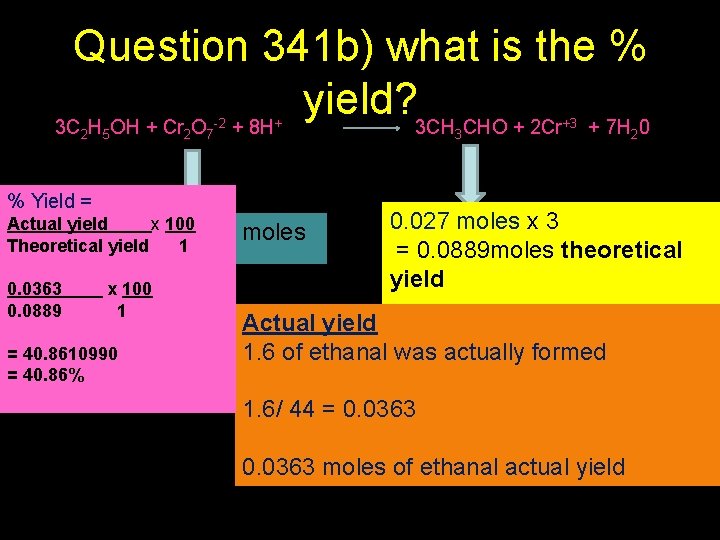
Question 341 b) what is the % yield? 3 C H OH + Cr O + 8 H 3 CH CHO + 2 Cr + 7 H 0 2 5 2 7 -2 + % Yield = Actual yield x 100 0. 029664430 Theoretical yield 1 0. 0363 0. 0889 x 100 1 = 40. 8610990 = 40. 86% moles 3 +3 2 0. 027 moles x 3 = 0. 0889 moles theoretical yield Actual yield 1. 6 of ethanal was actually formed 1. 6/ 44 = 0. 0363 moles of ethanal actual yield
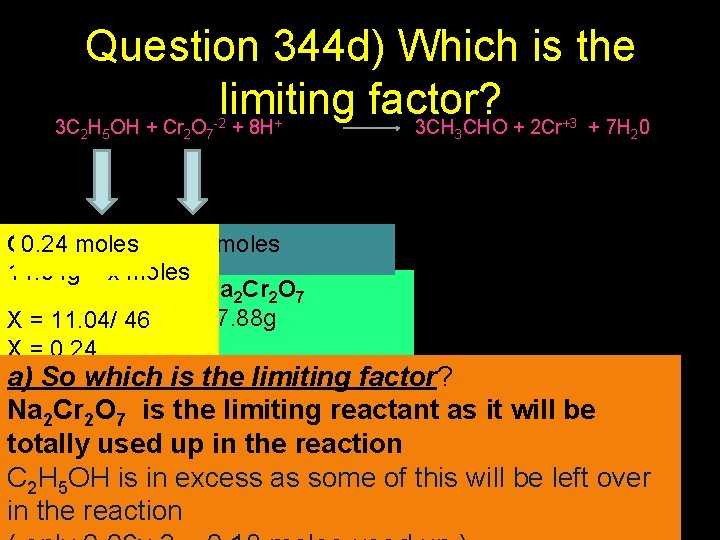
Question 344 d) Which is the limiting factor? 3 C H OH + Cr O + 8 H 3 CH CHO + 2 Cr + 7 H 0 2 5 2 7 -2 + C 0. 24 moles 0. 06 moles 2 H 5 OH 11. 04 g = x moles Na 2 Cr 2 O 7 17. 88 g X = 11. 04/ 46 X = 0. 24 298 X = 17. 88/ a) So which is the limiting factor? X = 0. 06 3 +3 2 Na 2 Cr 2 O 7 is the limiting reactant as it will be totally used up in the reaction C 2 H 5 OH is in excess as some of this will be left over in the reaction
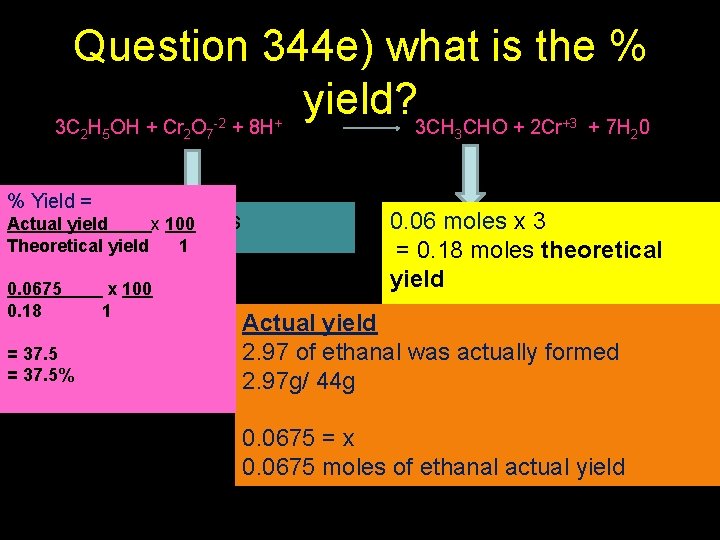
Question 344 e) what is the % yield? 3 C H OH + Cr O + 8 H 3 CH CHO + 2 Cr + 7 H 0 2 5 % Yield = 2 7 -2 moles Actual yield 0. 06 x 100 Theoretical yield 1 0. 0675 0. 18 = 37. 5% x 100 1 + 3 +3 2 0. 06 moles x 3 = 0. 18 moles theoretical yield Actual yield 2. 97 of ethanal was actually formed 2. 97 g/ 44 g 0. 0675 = x 0. 0675 moles of ethanal actual yield
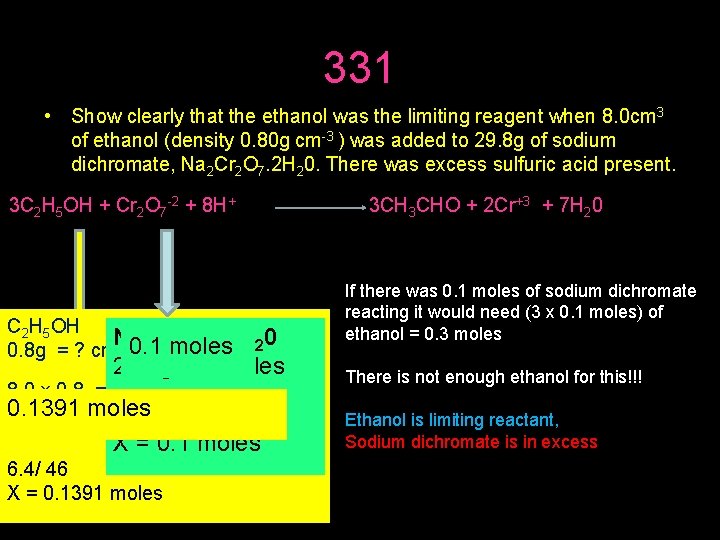
331 • Show clearly that the ethanol was the limiting reagent when 8. 0 cm 3 of ethanol (density 0. 80 g cm-3 ) was added to 29. 8 g of sodium dichromate, Na 2 Cr 2 O 7. 2 H 20. There was excess sulfuric acid present. 3 C 2 H 5 OH + Cr 2 O 7 -2 + 8 H+ C 2 H 5 OH Na 2 Crmoles 2 O 7. 2 H 20 0. 8 g = ? cm 3 0. 1 29. 8 g = ? moles 8. 0 x 0. 8 = 6. 4 g of ethanol 0. 1391 moles X = 29. 8/ 298 6. 4 g = ? moles X = 0. 1 moles 6. 4/ 46 X = 0. 1391 moles 3 CHO + 2 Cr+3 + 7 H 20 If there was 0. 1 moles of sodium dichromate reacting it would need (3 x 0. 1 moles) of ethanol = 0. 3 moles There is not enough ethanol for this!!! Ethanol is limiting reactant, Sodium dichromate is in excess
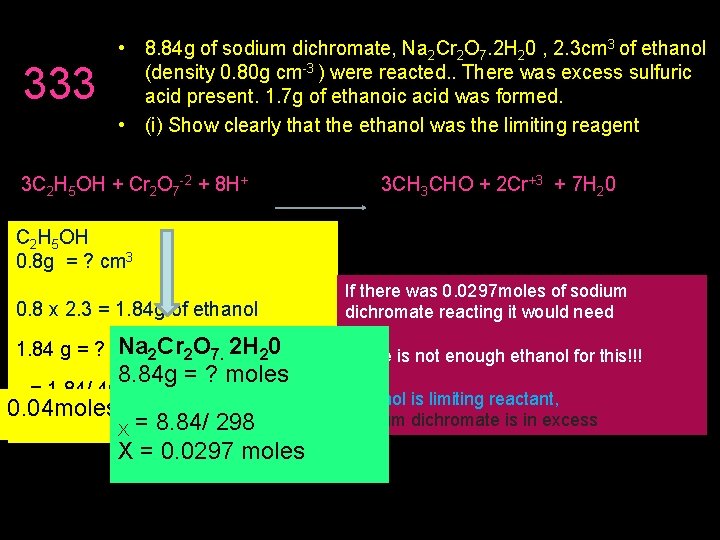
333 • 8. 84 g of sodium dichromate, Na 2 Cr 2 O 7. 2 H 20 , 2. 3 cm 3 of ethanol (density 0. 80 g cm-3 ) were reacted. . There was excess sulfuric acid present. 1. 7 g of ethanoic acid was formed. • (i) Show clearly that the ethanol was the limiting reagent 3 C 2 H 5 OH + Cr 2 O 7 -2 + 8 H+ 3 CHO + 2 Cr+3 + 7 H 20 C 2 H 5 OH 0. 8 g = ? cm 3 0. 8 x 2. 3 = 1. 84 g of ethanol If there was 0. 0297 moles of sodium dichromate reacting it would need Na 0. 029664439 1. 84 g = ? moles 2 Cr 2 O 7. 2 H 20 moles There is not enough ethanol for this!!! 8. 84 g = ? moles X = 1. 84/ 46 0. 04 moles X = 0. 04 moles = 8. 84/ 298 X = 0. 0297 moles X Ethanol is limiting reactant, Sodium dichromate is in excess
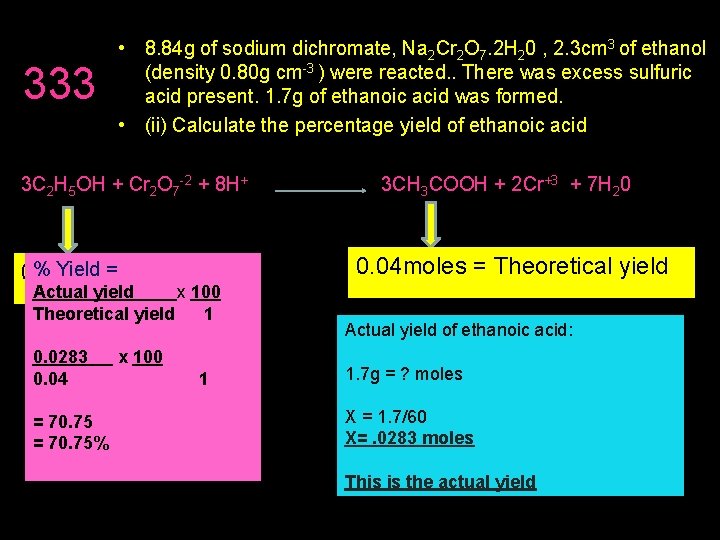
333 • 8. 84 g of sodium dichromate, Na 2 Cr 2 O 7. 2 H 20 , 2. 3 cm 3 of ethanol (density 0. 80 g cm-3 ) were reacted. . There was excess sulfuric acid present. 1. 7 g of ethanoic acid was formed. • (ii) Calculate the percentage yield of ethanoic acid 3 C 2 H 5 OH + Cr 2 O 7 -2 + 8 H+ 0. 04 moles = Theoretical yield % Yield = 0. 04 moles Actual yield x 100 Theoretical yield 1 0. 0283 0. 04 = 70. 75% 3 CH 3 COOH + 2 Cr+3 + 7 H 20 x 100 1 Actual yield of ethanoic acid: 1. 7 g = ? moles X = 1. 7/60 X=. 0283 moles This is the actual yield
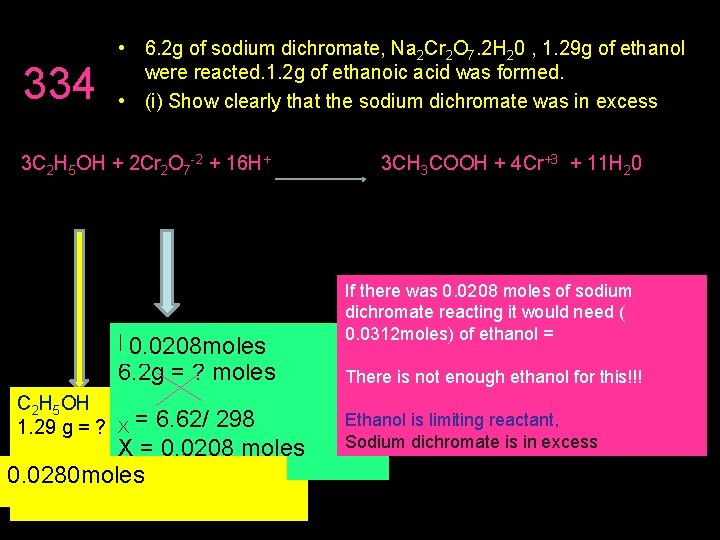
334 • 6. 2 g of sodium dichromate, Na 2 Cr 2 O 7. 2 H 20 , 1. 29 g of ethanol were reacted. 1. 2 g of ethanoic acid was formed. • (i) Show clearly that the sodium dichromate was in excess 3 C 2 H 5 OH + 2 Cr 2 O 7 -2 + 16 H+ Na 0. 0208 moles 2 Cr 2 O 7. 2 H 20 6. 2 g = ? moles C 2 H 5 OH X = 6. 62/ 1. 29 g = ? moles 298 X = 0. 0208 moles X = 1. 84/ 46 0. 0280 moles X = 0. 0280 moles 3 CH 3 COOH + 4 Cr+3 + 11 H 20 If there was 0. 0208 moles of sodium dichromate reacting it would need ( 0. 0312 moles) of ethanol = There is not enough ethanol for this!!! Ethanol is limiting reactant, Sodium dichromate is in excess
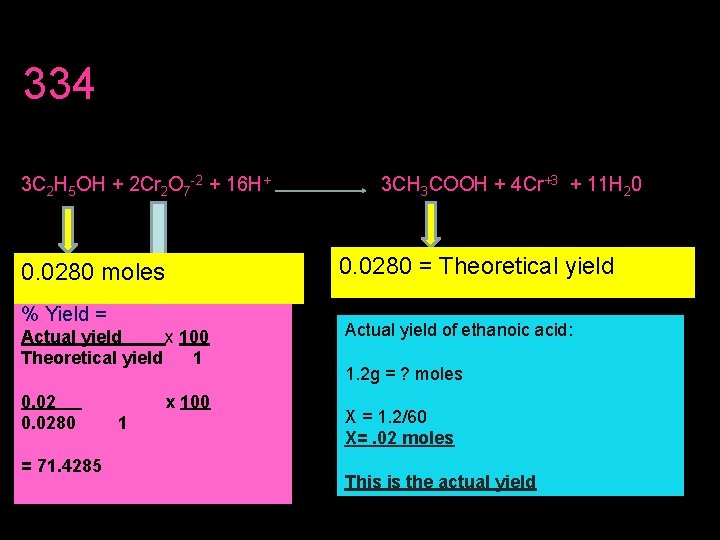
334 3 C 2 H 5 OH + 2 Cr 2 O 7 -2 + 16 H+ 0. 0280 moles % Yield = Actual yield x 100 Theoretical yield 1 0. 0280 = 71. 4285 x 100 1 3 CH 3 COOH + 4 Cr+3 + 11 H 20 0. 0280 = Theoretical yield Actual yield of ethanoic acid: 1. 2 g = ? moles X = 1. 2/60 X=. 02 moles This is the actual yield
- Slides: 124