
Chemical Formula IUPAC Name Common Name Monohydric alcohols


- Slides: 25
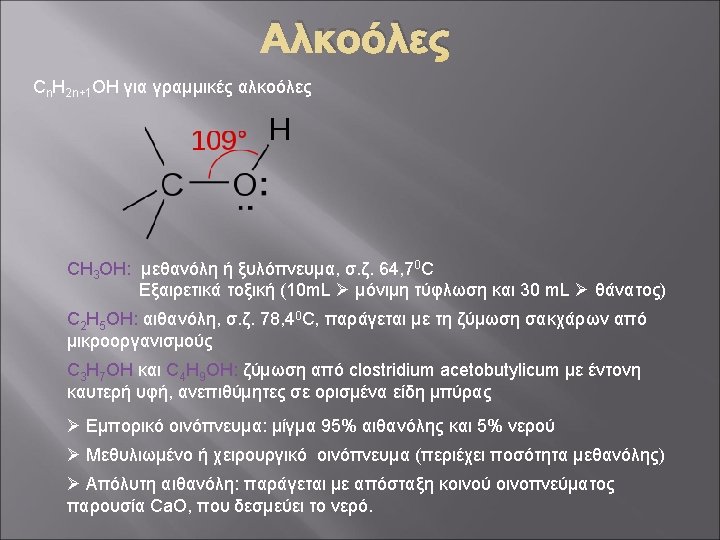
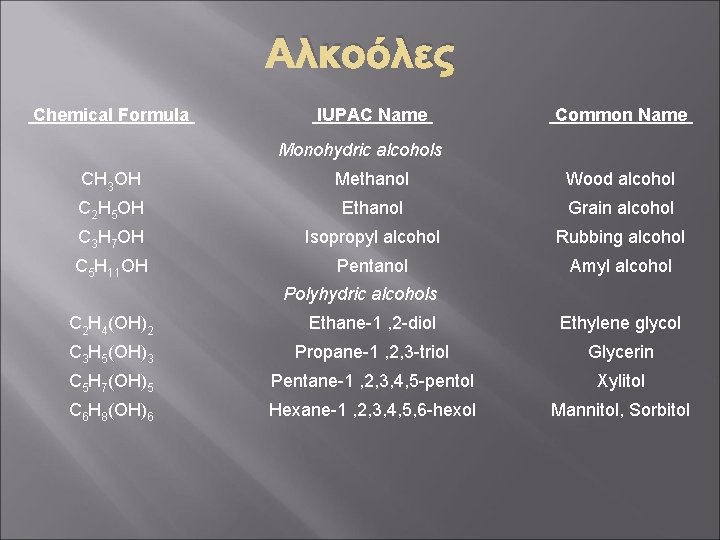
Αλκοόλες Chemical Formula IUPAC Name Common Name Monohydric alcohols CH 3 OH Methanol Wood alcohol C 2 H 5 OH Ethanol Grain alcohol C 3 H 7 OH Isopropyl alcohol Rubbing alcohol C 5 H 11 OH Pentanol Amyl alcohol Polyhydric alcohols C 2 H 4(OH)2 Ethane-1 , 2 -diol Ethylene glycol C 3 H 5(OH)3 Propane-1 , 2, 3 -triol Glycerin C 5 H 7(OH)5 Pentane-1 , 2, 3, 4, 5 -pentol Xylitol C 6 H 8(OH)6 Hexane-1 , 2, 3, 4, 5, 6 -hexol Mannitol, Sorbitol
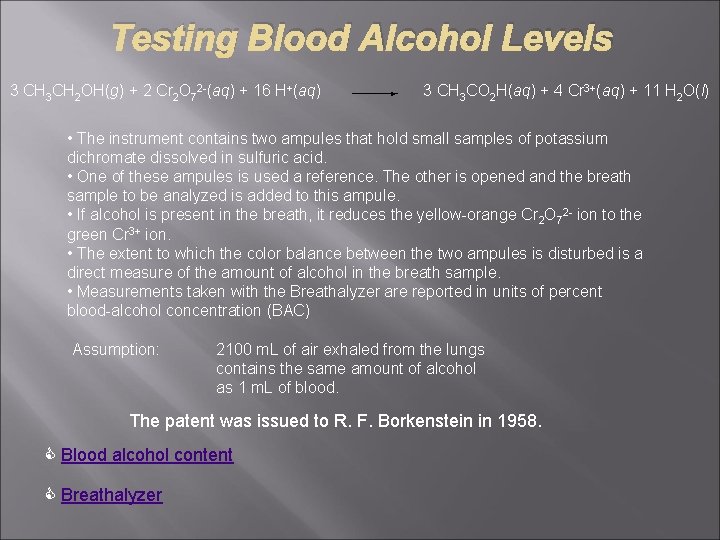
Testing Blood Alcohol Levels 3 CH 3 CH 2 OH(g) + 2 Cr 2 O 72 -(aq) + 16 H+(aq) 3 CH 3 CO 2 H(aq) + 4 Cr 3+(aq) + 11 H 2 O(l) • The instrument contains two ampules that hold small samples of potassium dichromate dissolved in sulfuric acid. • One of these ampules is used a reference. The other is opened and the breath sample to be analyzed is added to this ampule. • If alcohol is present in the breath, it reduces the yellow-orange Cr 2 O 72 - ion to the green Cr 3+ ion. • The extent to which the color balance between the two ampules is disturbed is a direct measure of the amount of alcohol in the breath sample. • Measurements taken with the Breathalyzer are reported in units of percent blood-alcohol concentration (BAC) Assumption: 2100 m. L of air exhaled from the lungs contains the same amount of alcohol as 1 m. L of blood. The patent was issued to R. F. Borkenstein in 1958. Blood alcohol content Breathalyzer
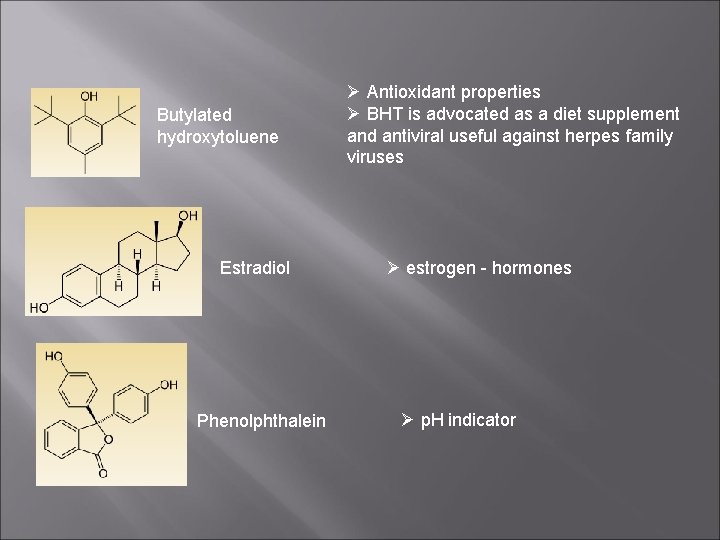
Butylated hydroxytoluene Estradiol Phenolphthalein Antioxidant properties BHT is advocated as a diet supplement and antiviral useful against herpes family viruses estrogen - hormones p. H indicator
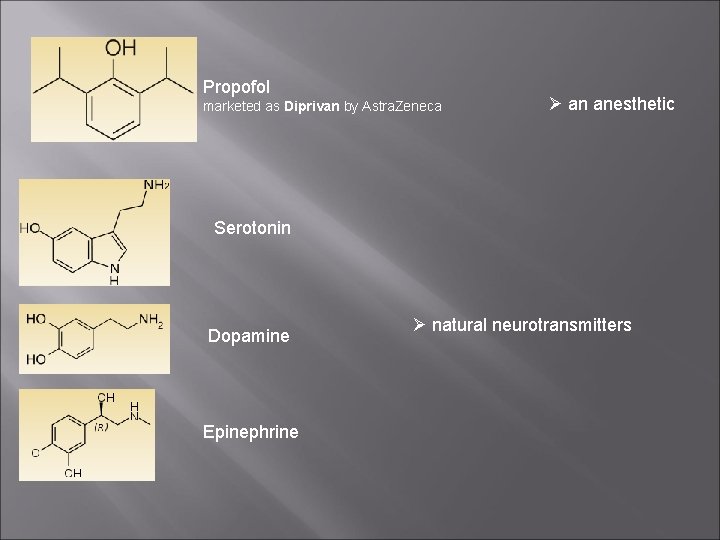
Propofol marketed as Diprivan by Astra. Zeneca an anesthetic Serotonin Dopamine Epinephrine natural neurotransmitters
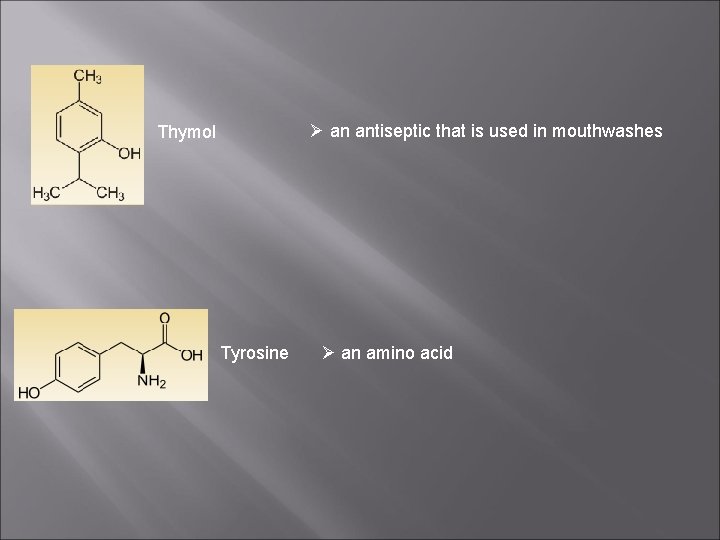
an antiseptic that is used in mouthwashes Thymol Tyrosine an amino acid