
Chemical Equilibrium Reversible Reactions A chemical reaction in
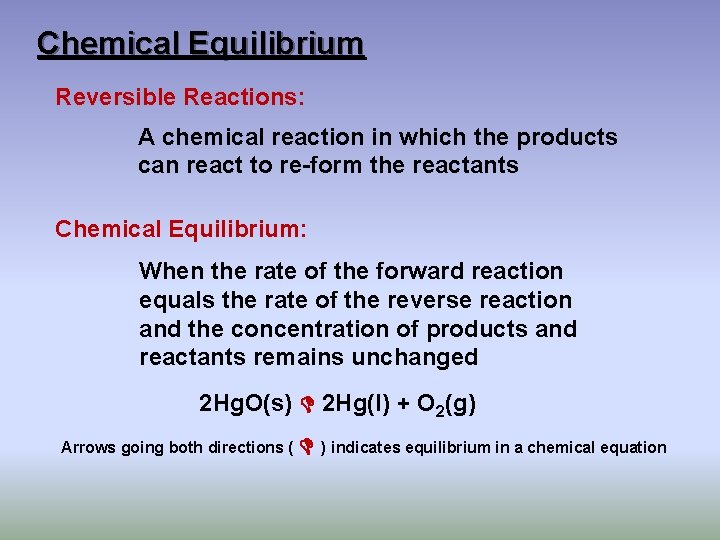
Chemical Equilibrium Reversible Reactions: A chemical reaction in which the products can react to re-form the reactants Chemical Equilibrium: When the rate of the forward reaction equals the rate of the reverse reaction and the concentration of products and reactants remains unchanged 2 Hg. O(s) 2 Hg(l) + O 2(g) Arrows going both directions ( ) indicates equilibrium in a chemical equation
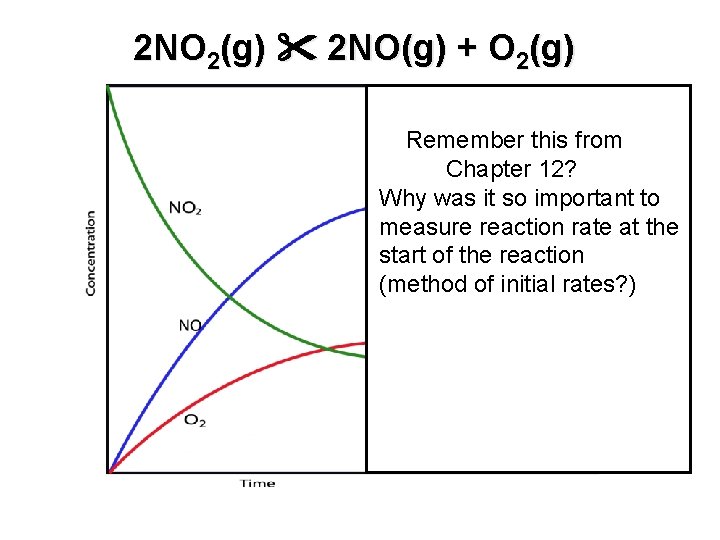
2 NO 2(g) 2 NO(g) + O 2(g) Remember this from Chapter 12? Why was it so important to measure reaction rate at the start of the reaction (method of initial rates? )
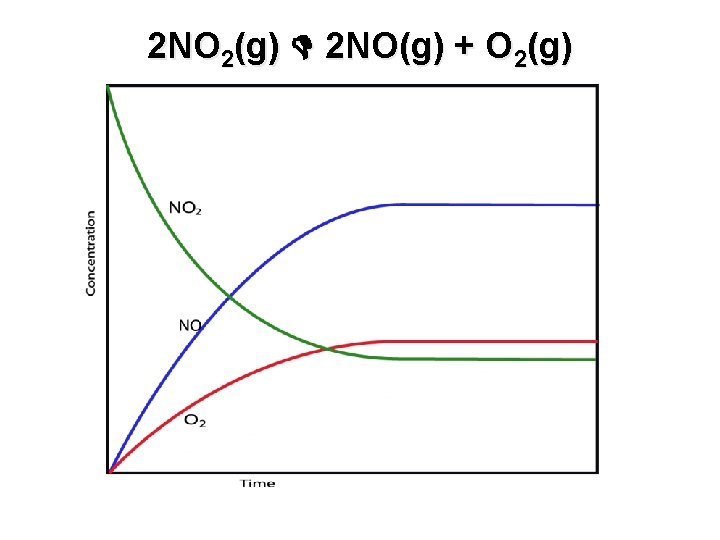
2 NO 2(g) 2 NO(g) + O 2(g)
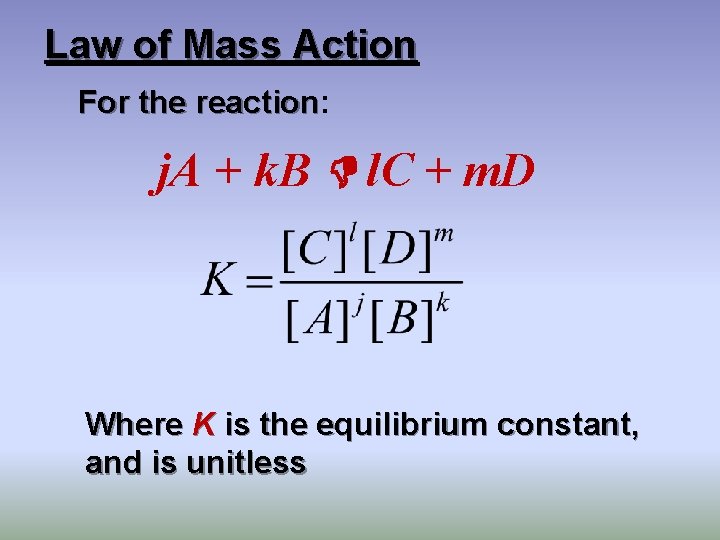
Law of Mass Action For the reaction: reaction j. A + k. B l. C + m. D Where K is the equilibrium constant, and is unitless
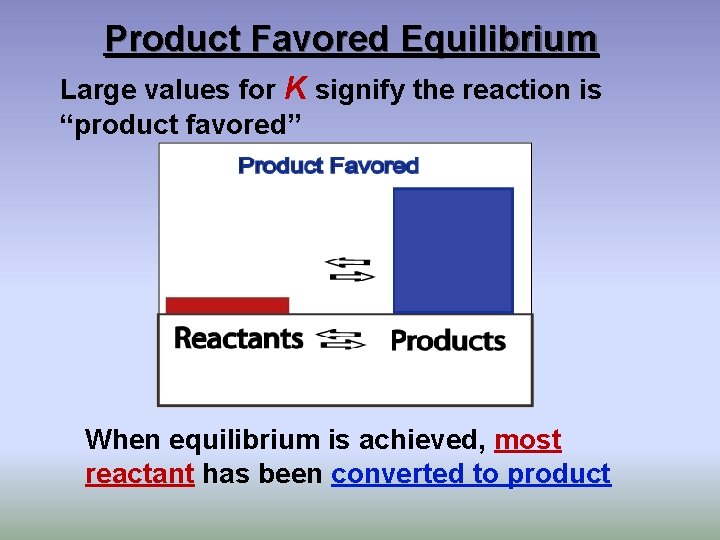
Product Favored Equilibrium Large values for K signify the reaction is “product favored” When equilibrium is achieved, most reactant has been converted to product
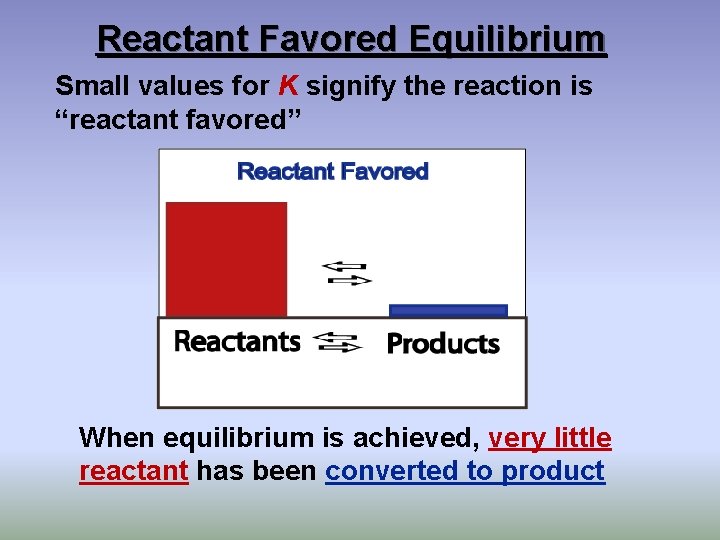
Reactant Favored Equilibrium Small values for K signify the reaction is “reactant favored” When equilibrium is achieved, very little reactant has been converted to product
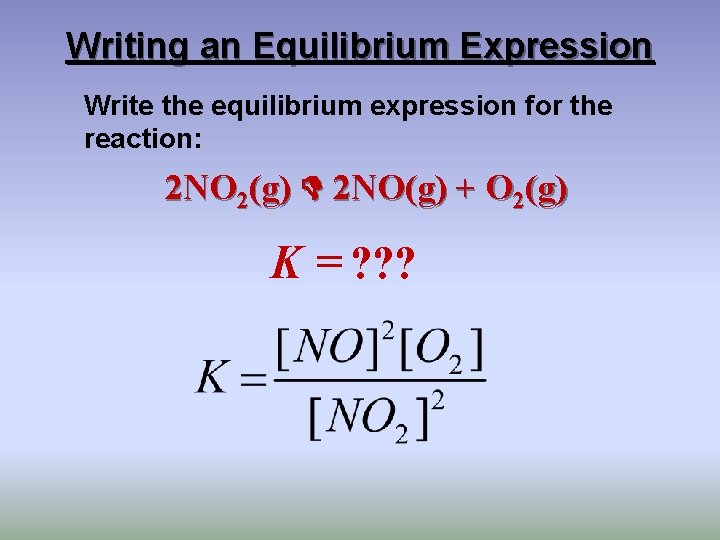
Writing an Equilibrium Expression Write the equilibrium expression for the reaction: 2 NO 2(g) 2 NO(g) + O 2(g) K = ? ? ?
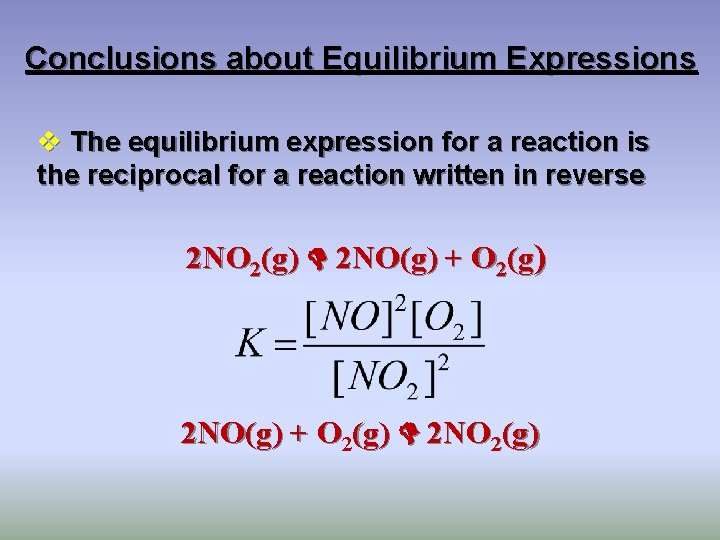
Conclusions about Equilibrium Expressions v The equilibrium expression for a reaction is the reciprocal for a reaction written in reverse 2 NO 2(g) 2 NO(g) + O 2(g) 2 NO 2(g)
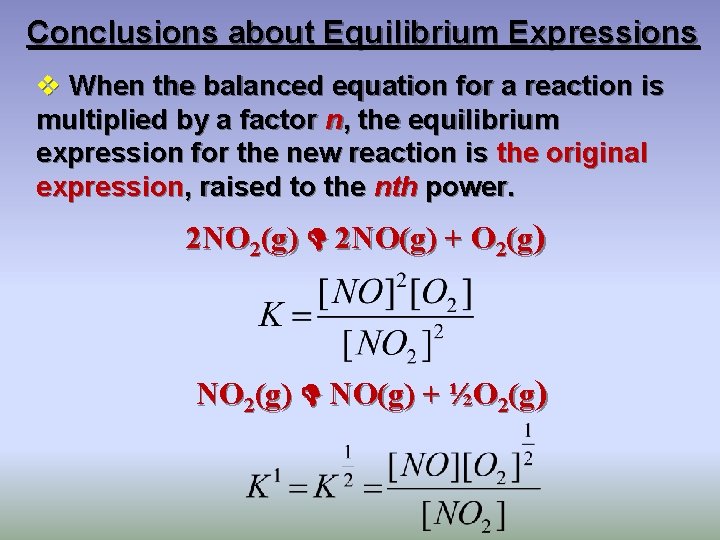
Conclusions about Equilibrium Expressions v When the balanced equation for a reaction is multiplied by a factor n, the equilibrium expression for the new reaction is the original expression, raised to the nth power. 2 NO 2(g) 2 NO(g) + O 2(g) NO 2(g) NO(g) + ½O 2(g)
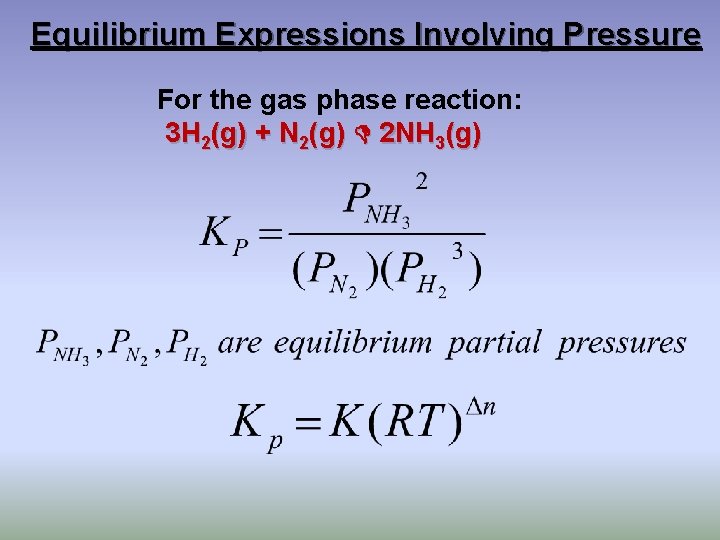
Equilibrium Expressions Involving Pressure For the gas phase reaction: 3 H 2(g) + N 2(g) 2 NH 3(g)
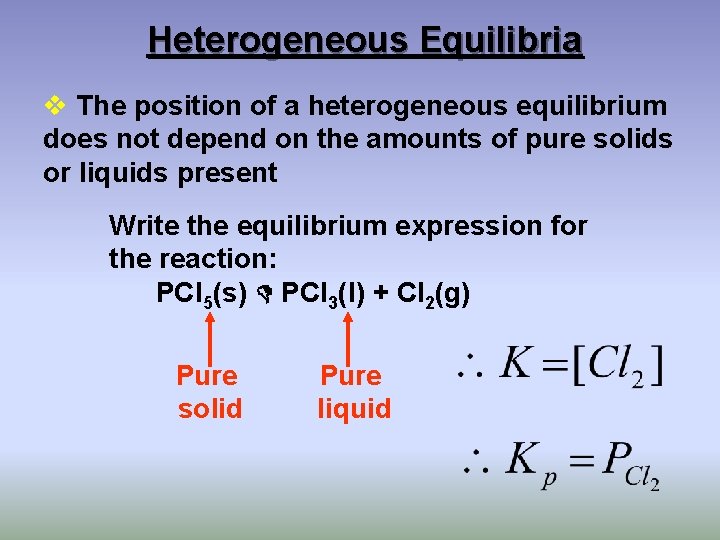
Heterogeneous Equilibria v The position of a heterogeneous equilibrium does not depend on the amounts of pure solids or liquids present Write the equilibrium expression for the reaction: PCl 5(s) PCl 3(l) + Cl 2(g) Pure solid Pure liquid
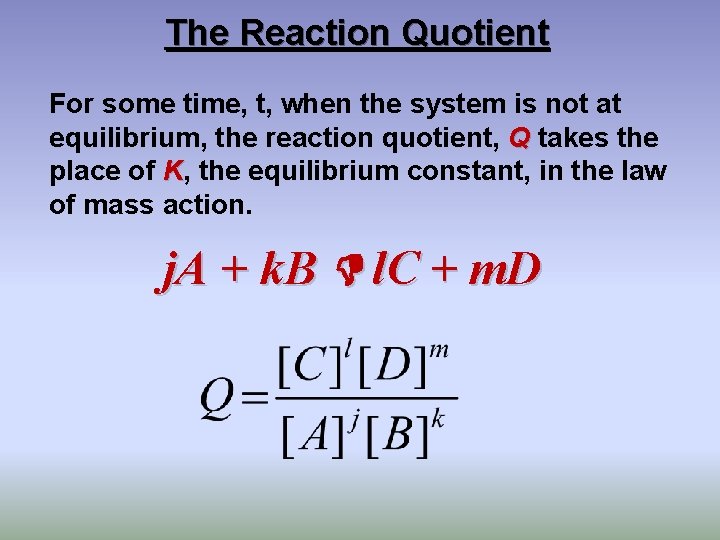
The Reaction Quotient For some time, t, when the system is not at equilibrium, the reaction quotient, Q takes the place of K, the equilibrium constant, in the law of mass action. j. A + k. B l. C + m. D
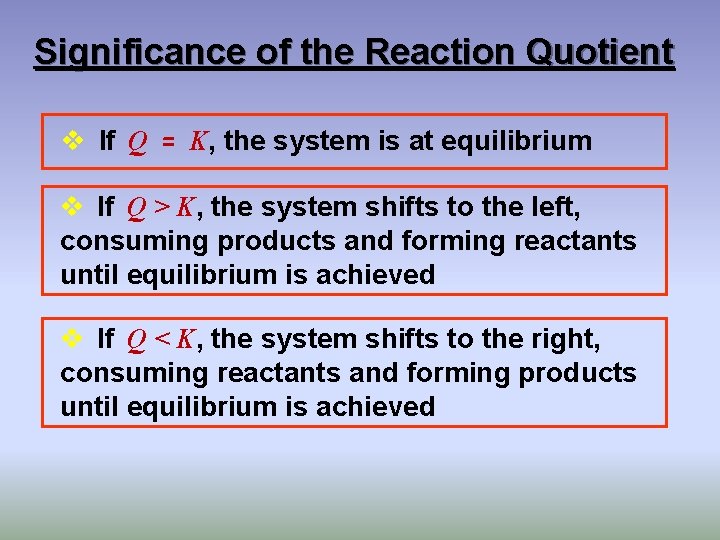
Significance of the Reaction Quotient v If Q = K, the system is at equilibrium v If Q > K, the system shifts to the left, consuming products and forming reactants until equilibrium is achieved v If Q < K, the system shifts to the right, consuming reactants and forming products until equilibrium is achieved
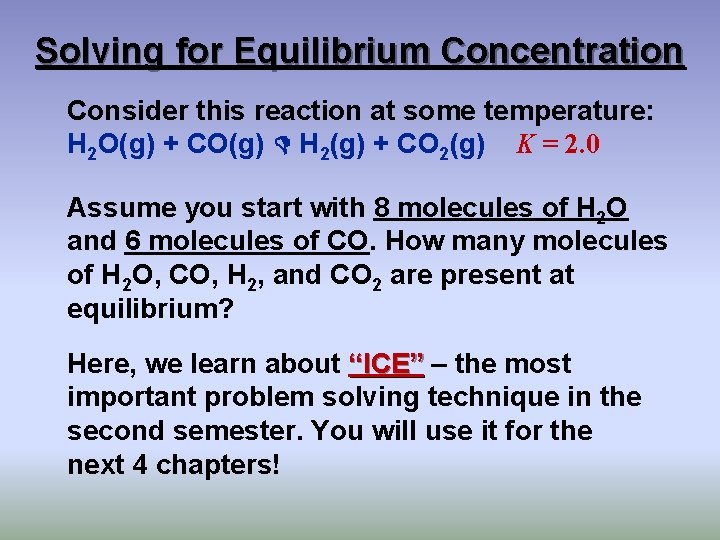
Solving for Equilibrium Concentration Consider this reaction at some temperature: H 2 O(g) + CO(g) H 2(g) + CO 2(g) K = 2. 0 Assume you start with 8 molecules of H 2 O and 6 molecules of CO. How many molecules of H 2 O, CO, H 2, and CO 2 are present at equilibrium? Here, we learn about “ICE” – the most important problem solving technique in the second semester. You will use it for the next 4 chapters!
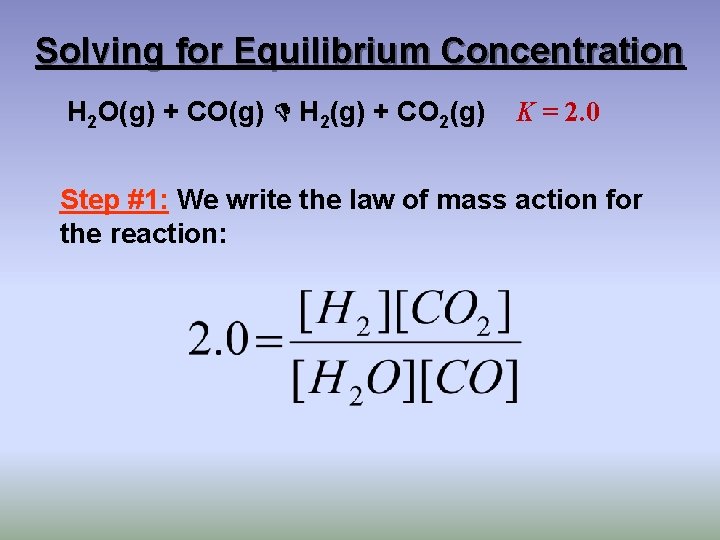
Solving for Equilibrium Concentration H 2 O(g) + CO(g) H 2(g) + CO 2(g) K = 2. 0 Step #1: We write the law of mass action for the reaction:
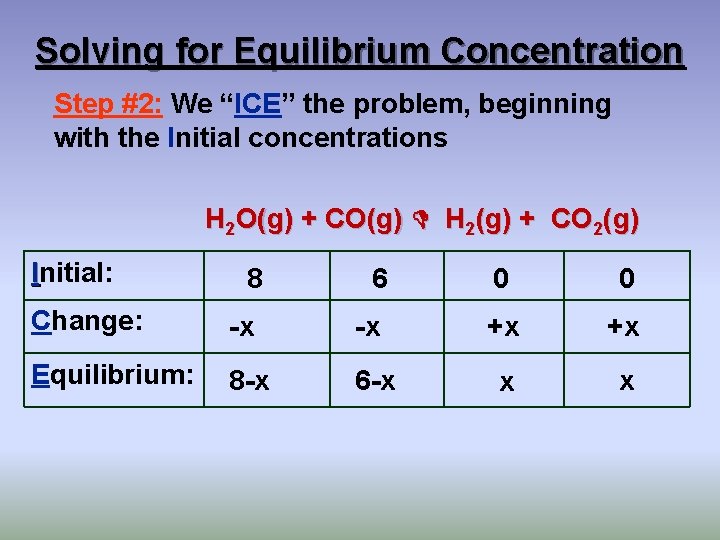
Solving for Equilibrium Concentration Step #2: We “ICE” the problem, beginning with the Initial concentrations H 2 O(g) + CO(g) H 2(g) + CO 2(g) Initial: 8 6 0 0 Change: -x -x +x +x Equilibrium: 8 -x 6 -x x x
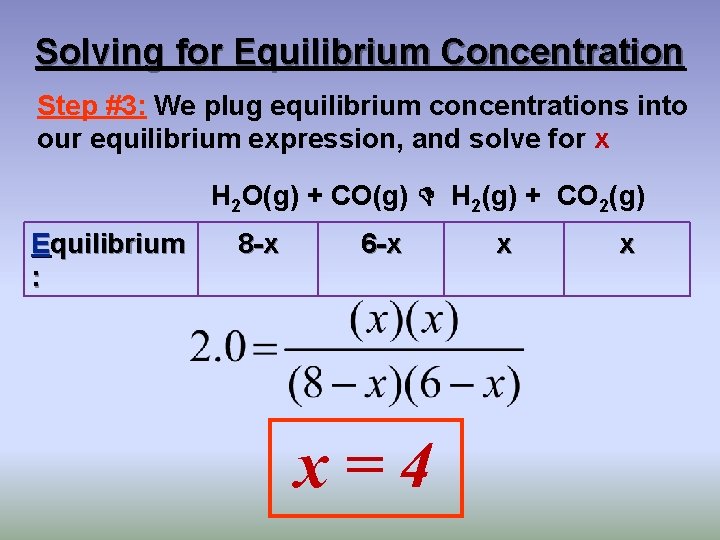
Solving for Equilibrium Concentration Step #3: We plug equilibrium concentrations into our equilibrium expression, and solve for x H 2 O(g) + CO(g) H 2(g) + CO 2(g) Equilibrium : 8 -x 6 -x x=4 x x
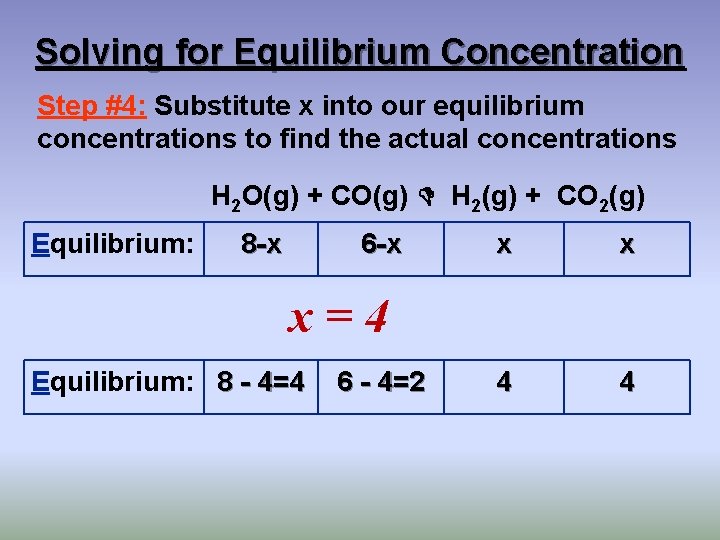
Solving for Equilibrium Concentration Step #4: Substitute x into our equilibrium concentrations to find the actual concentrations H 2 O(g) + CO(g) H 2(g) + CO 2(g) Equilibrium: 8 -x 6 -x x x 4 4 x=4 Equilibrium: 8 - 4=4 6 - 4=2
- Slides: 18