
CHEMICAL EQUILIBRIUM Properties of an Equilibrium systems are
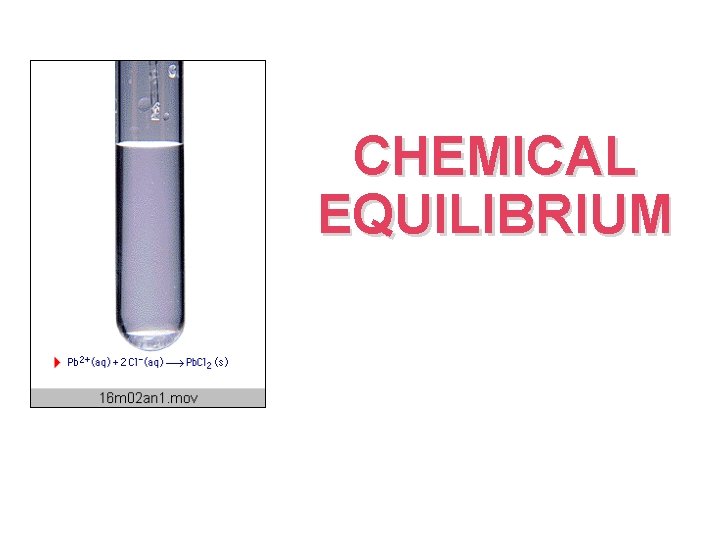
CHEMICAL EQUILIBRIUM
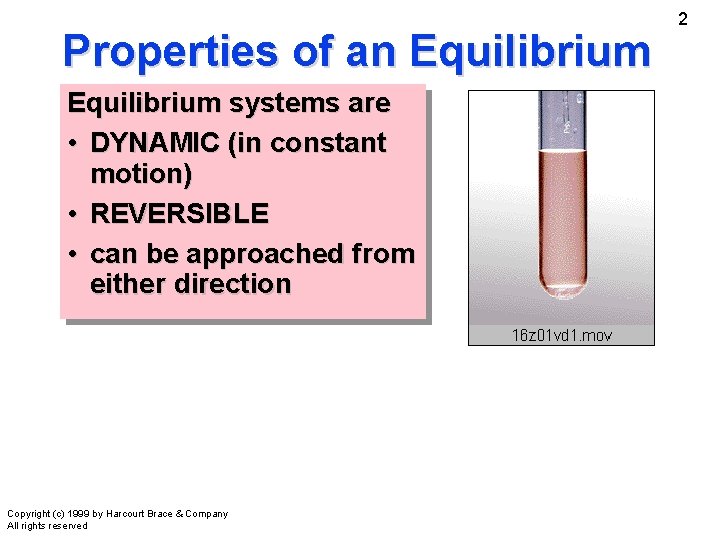
Properties of an Equilibrium systems are • DYNAMIC (in constant motion) • REVERSIBLE • can be approached from either direction Copyright (c) 1999 by Harcourt Brace & Company All rights reserved 2
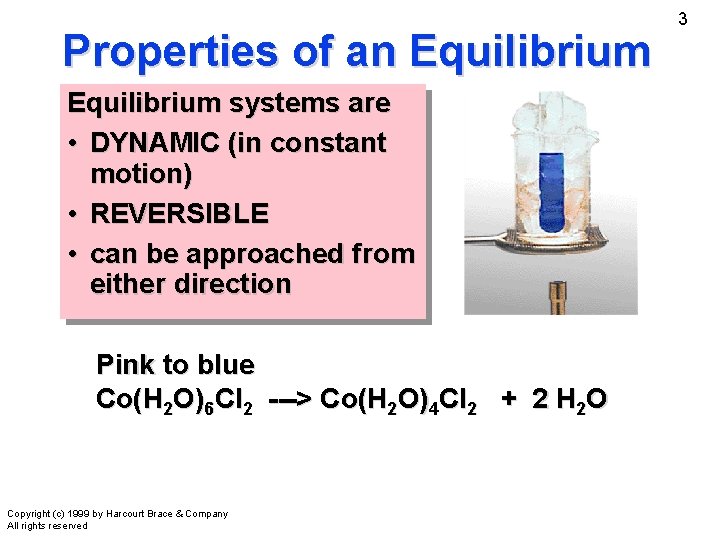
Properties of an Equilibrium systems are • DYNAMIC (in constant motion) • REVERSIBLE • can be approached from either direction Pink to blue Co(H 2 O)6 Cl 2 ---> Co(H 2 O)4 Cl 2 + 2 H 2 O Copyright (c) 1999 by Harcourt Brace & Company All rights reserved 3
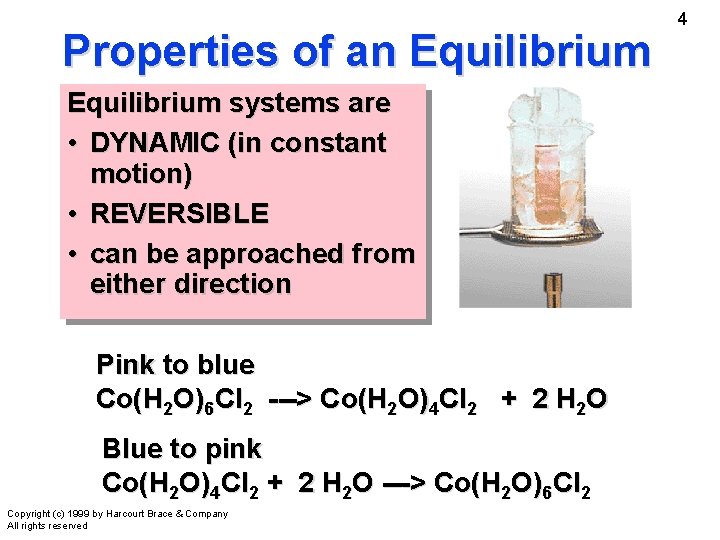
Properties of an Equilibrium systems are • DYNAMIC (in constant motion) • REVERSIBLE • can be approached from either direction Pink to blue Co(H 2 O)6 Cl 2 ---> Co(H 2 O)4 Cl 2 + 2 H 2 O Blue to pink Co(H 2 O)4 Cl 2 + 2 H 2 O ---> Co(H 2 O)6 Cl 2 Copyright (c) 1999 by Harcourt Brace & Company All rights reserved 4
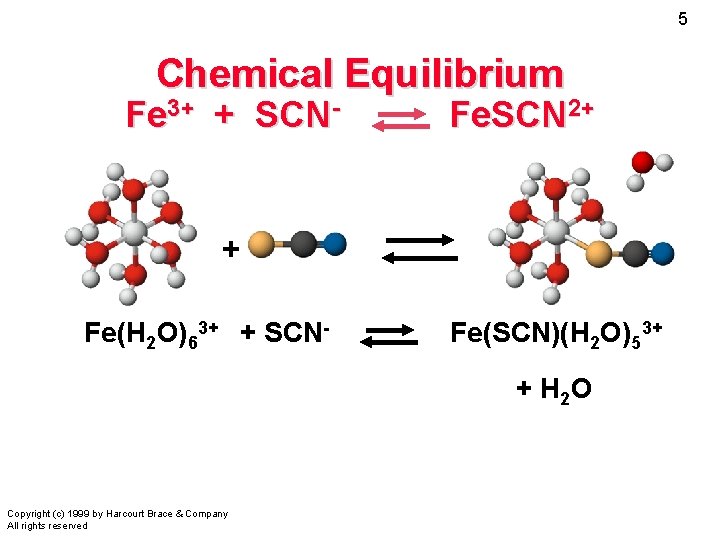
5 Chemical Equilibrium Fe 3+ + SCN- Fe. SCN 2+ + Fe(H 2 O)63+ + SCN- Fe(SCN)(H 2 O)53+ + H 2 O Copyright (c) 1999 by Harcourt Brace & Company All rights reserved
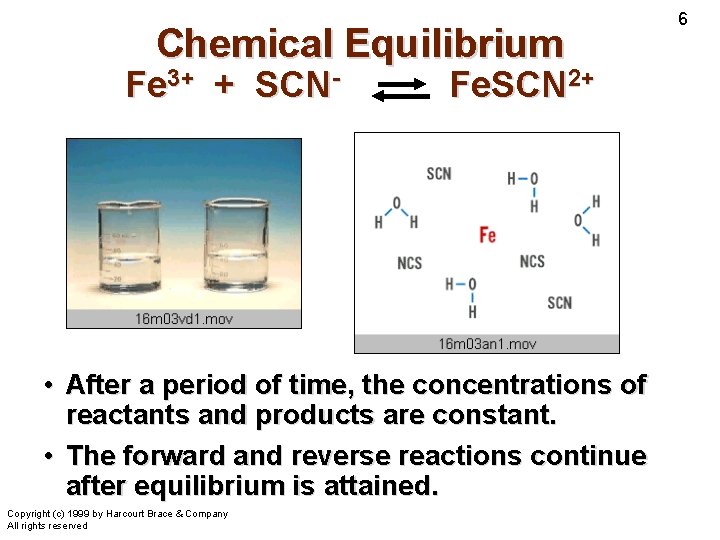
Chemical Equilibrium Fe 3+ + SCN- Fe. SCN 2+ • After a period of time, the concentrations of reactants and products are constant. • The forward and reverse reactions continue after equilibrium is attained. Copyright (c) 1999 by Harcourt Brace & Company All rights reserved 6
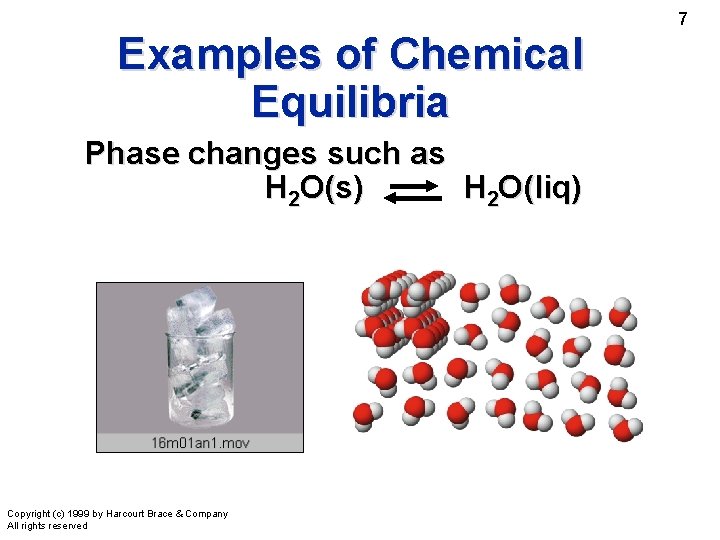
7 Examples of Chemical Equilibria Phase changes such as H 2 O(s) H 2 O(liq) Copyright (c) 1999 by Harcourt Brace & Company All rights reserved
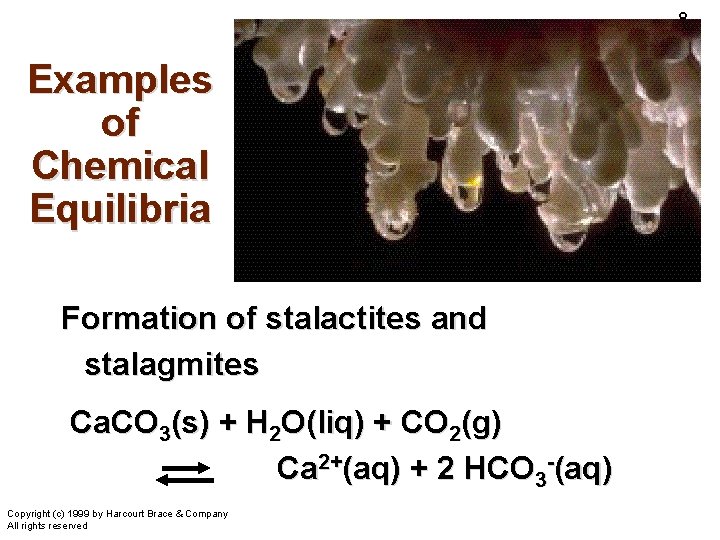
8 Examples of Chemical Equilibria Formation of stalactites and stalagmites Ca. CO 3(s) + H 2 O(liq) + CO 2(g) Ca 2+(aq) + 2 HCO 3 -(aq) Copyright (c) 1999 by Harcourt Brace & Company All rights reserved
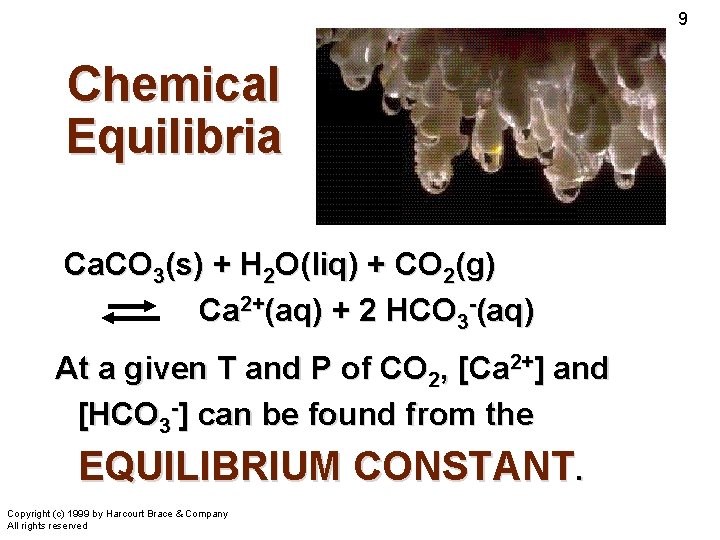
9 Chemical Equilibria Ca. CO 3(s) + H 2 O(liq) + CO 2(g) Ca 2+(aq) + 2 HCO 3 -(aq) At a given T and P of CO 2, [Ca 2+] and [HCO 3 -] can be found from the EQUILIBRIUM CONSTANT. Copyright (c) 1999 by Harcourt Brace & Company All rights reserved
10 THE EQUILIBRIUM CONSTANT For any type of chemical equilibrium of the type a. A + b. B c. C + d. D the following is a CONSTANT (at a given T) Copyright (c) 1999 by Harcourt Brace & Company All rights reserved
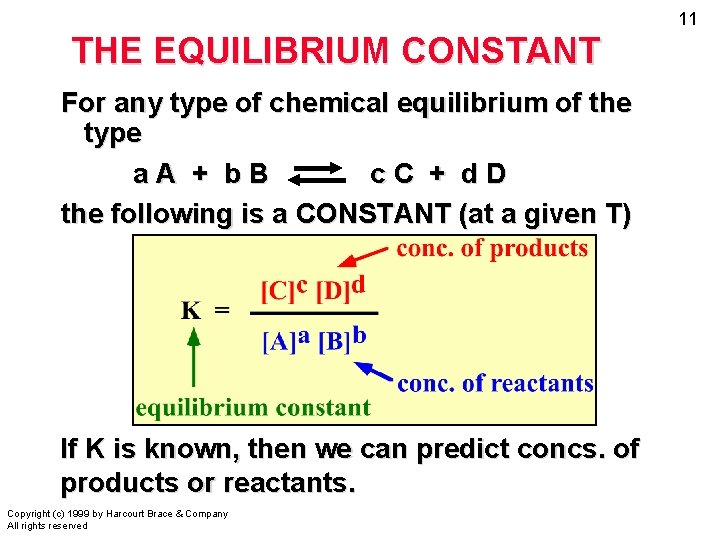
11 THE EQUILIBRIUM CONSTANT For any type of chemical equilibrium of the type a. A + b. B c. C + d. D the following is a CONSTANT (at a given T) If K is known, then we can predict concs. of products or reactants. Copyright (c) 1999 by Harcourt Brace & Company All rights reserved
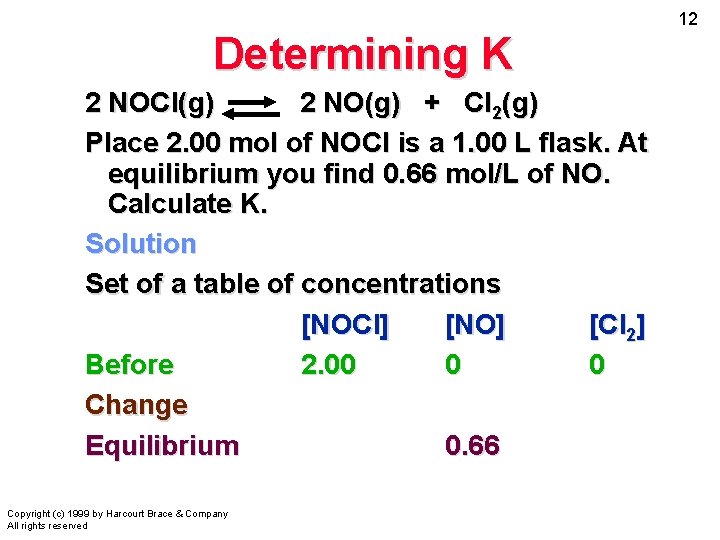
Determining K 2 NOCl(g) 2 NO(g) + Cl 2(g) Place 2. 00 mol of NOCl is a 1. 00 L flask. At equilibrium you find 0. 66 mol/L of NO. Calculate K. Solution Set of a table of concentrations [NOCl] [NO] [Cl 2] Before 2. 00 0 0 Change Equilibrium 0. 66 Copyright (c) 1999 by Harcourt Brace & Company All rights reserved 12
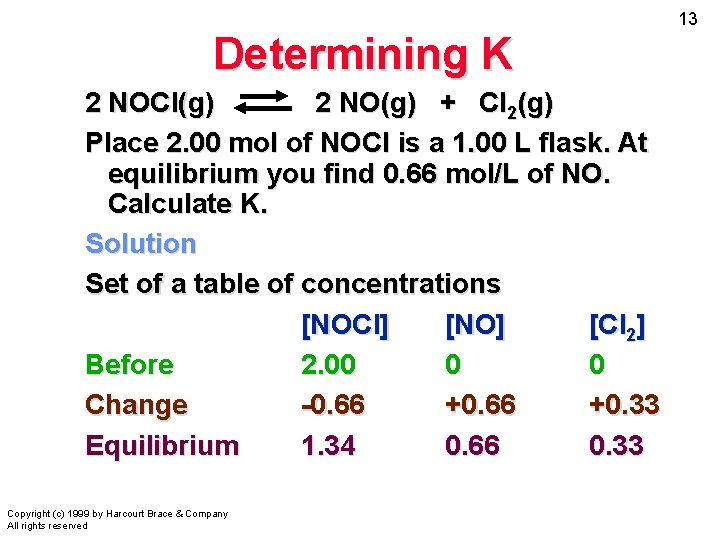
Determining K 2 NOCl(g) 2 NO(g) + Cl 2(g) Place 2. 00 mol of NOCl is a 1. 00 L flask. At equilibrium you find 0. 66 mol/L of NO. Calculate K. Solution Set of a table of concentrations [NOCl] [NO] [Cl 2] Before 2. 00 0 0 Change -0. 66 +0. 33 Equilibrium 1. 34 0. 66 0. 33 Copyright (c) 1999 by Harcourt Brace & Company All rights reserved 13
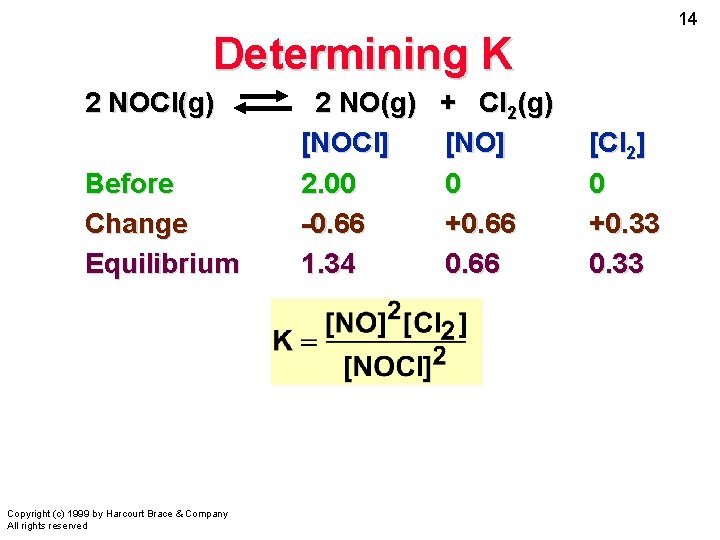
14 Determining K 2 NOCl(g) Before Change Equilibrium Copyright (c) 1999 by Harcourt Brace & Company All rights reserved 2 NO(g) [NOCl] 2. 00 -0. 66 1. 34 + Cl 2(g) [NO] 0 +0. 66 [Cl 2] 0 +0. 33
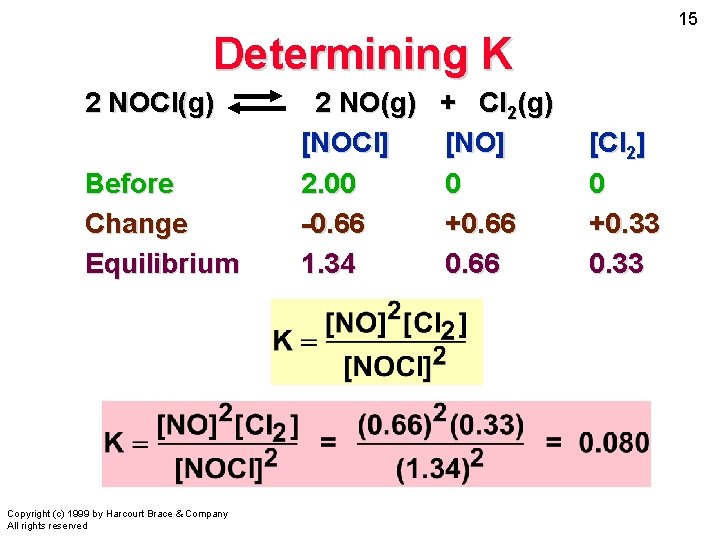
15 Determining K 2 NOCl(g) Before Change Equilibrium Copyright (c) 1999 by Harcourt Brace & Company All rights reserved 2 NO(g) [NOCl] 2. 00 -0. 66 1. 34 + Cl 2(g) [NO] 0 +0. 66 [Cl 2] 0 +0. 33
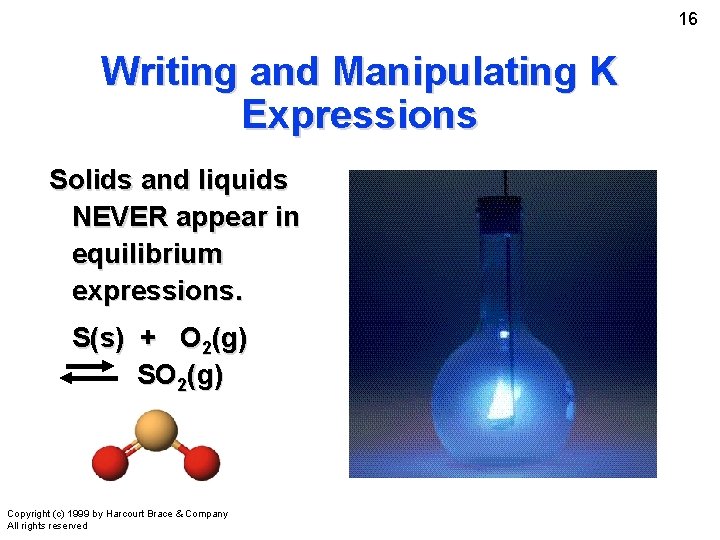
16 Writing and Manipulating K Expressions Solids and liquids NEVER appear in equilibrium expressions. S(s) + O 2(g) SO 2(g) Copyright (c) 1999 by Harcourt Brace & Company All rights reserved
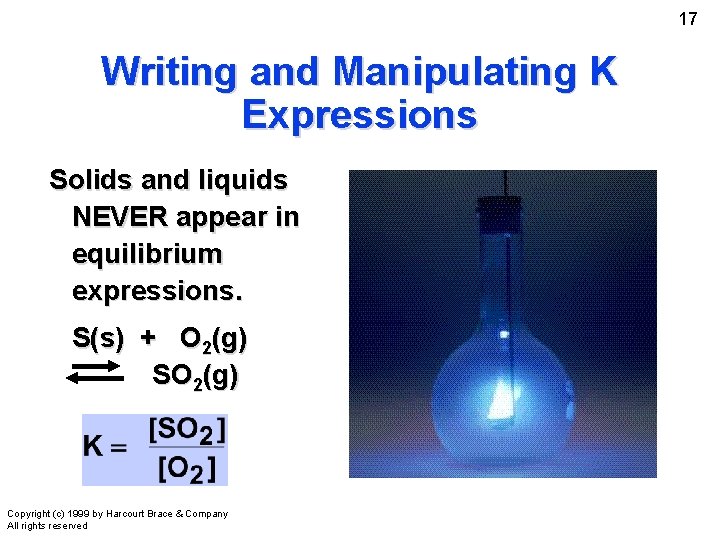
17 Writing and Manipulating K Expressions Solids and liquids NEVER appear in equilibrium expressions. S(s) + O 2(g) SO 2(g) Copyright (c) 1999 by Harcourt Brace & Company All rights reserved
18 Writing and Manipulating K Expressions Solids and liquids NEVER appear in equilibrium expressions. NH 3(aq) + H 2 O(liq) NH 4+(aq) + OH-(aq) Copyright (c) 1999 by Harcourt Brace & Company All rights reserved
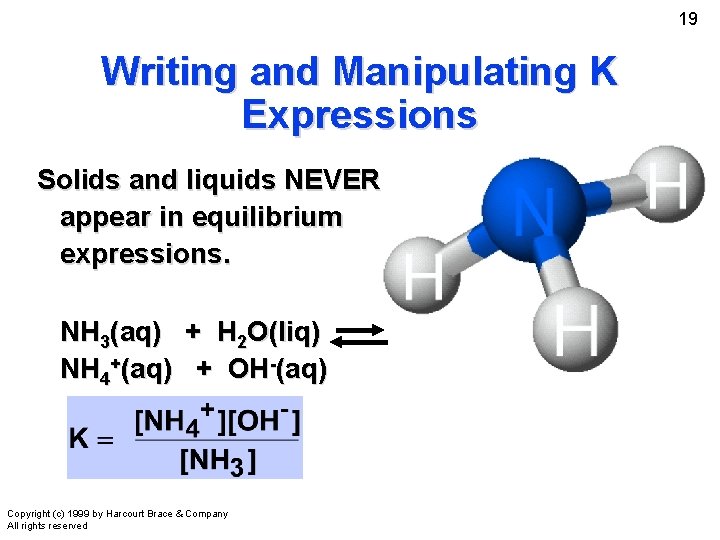
19 Writing and Manipulating K Expressions Solids and liquids NEVER appear in equilibrium expressions. NH 3(aq) + H 2 O(liq) NH 4+(aq) + OH-(aq) Copyright (c) 1999 by Harcourt Brace & Company All rights reserved
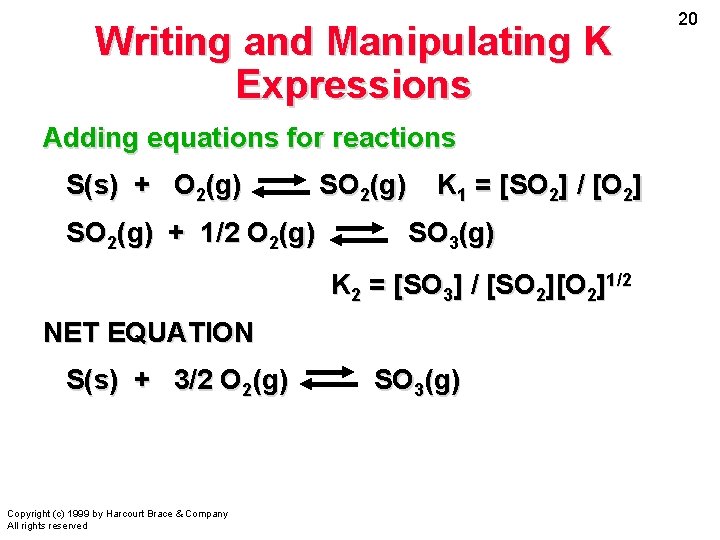
Writing and Manipulating K Expressions Adding equations for reactions S(s) + O 2(g) SO 2(g) + 1/2 O 2(g) SO 2(g) K 1 = [SO 2] / [O 2] SO 3(g) K 2 = [SO 3] / [SO 2][O 2]1/2 NET EQUATION S(s) + 3/2 O 2(g) Copyright (c) 1999 by Harcourt Brace & Company All rights reserved SO 3(g) 20
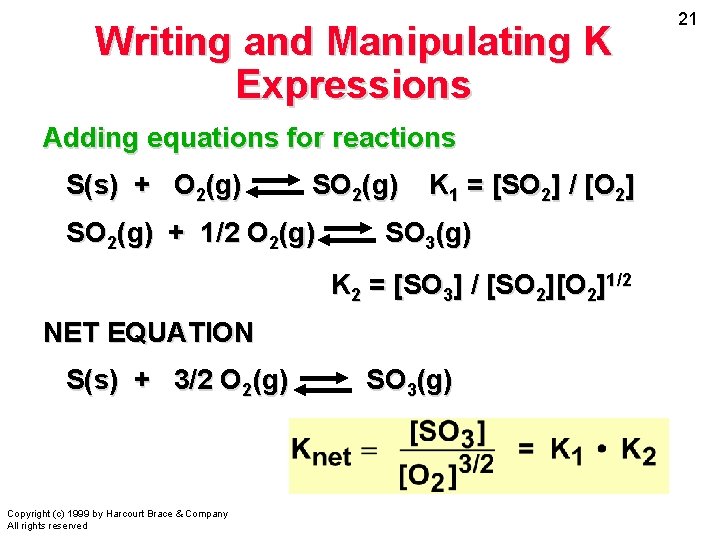
Writing and Manipulating K Expressions Adding equations for reactions S(s) + O 2(g) SO 2(g) + 1/2 O 2(g) K 1 = [SO 2] / [O 2] SO 3(g) K 2 = [SO 3] / [SO 2][O 2]1/2 NET EQUATION S(s) + 3/2 O 2(g) Copyright (c) 1999 by Harcourt Brace & Company All rights reserved SO 3(g) 21
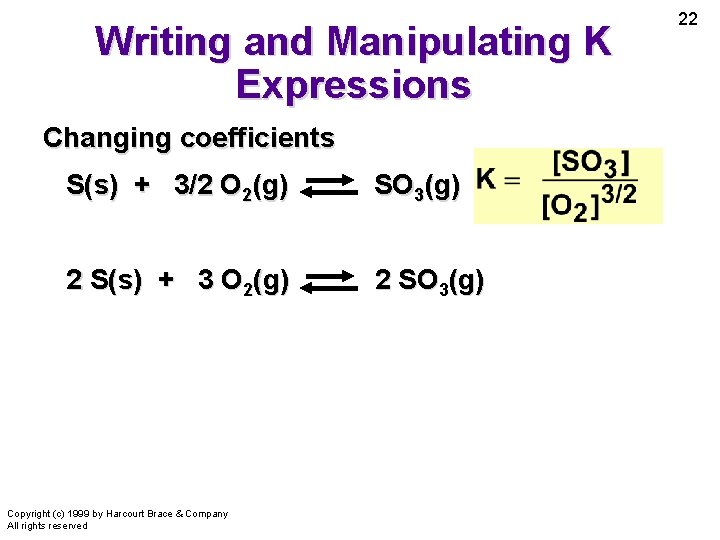
Writing and Manipulating K Expressions Changing coefficients S(s) + 3/2 O 2(g) SO 3(g) 2 S(s) + 3 O 2(g) 2 SO 3(g) Copyright (c) 1999 by Harcourt Brace & Company All rights reserved 22
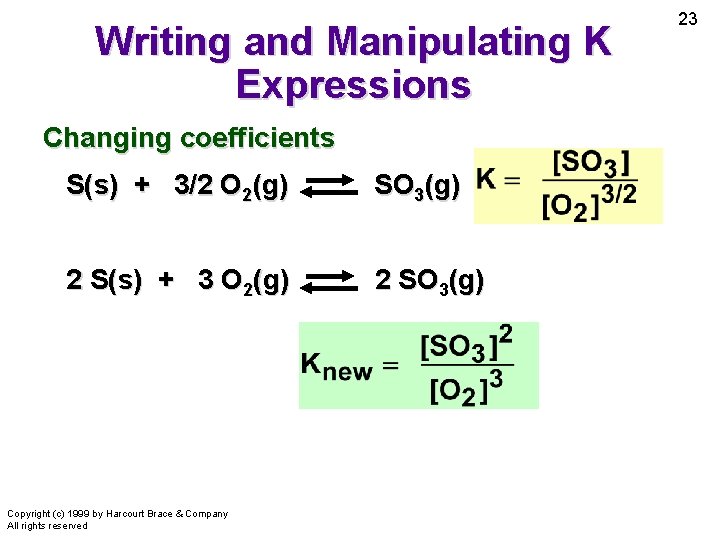
Writing and Manipulating K Expressions Changing coefficients S(s) + 3/2 O 2(g) SO 3(g) 2 S(s) + 3 O 2(g) 2 SO 3(g) Copyright (c) 1999 by Harcourt Brace & Company All rights reserved 23
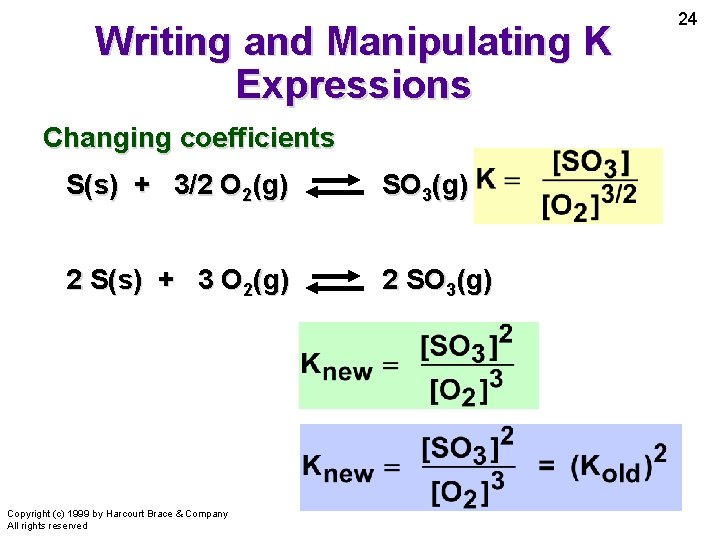
Writing and Manipulating K Expressions Changing coefficients S(s) + 3/2 O 2(g) SO 3(g) 2 S(s) + 3 O 2(g) 2 SO 3(g) Copyright (c) 1999 by Harcourt Brace & Company All rights reserved 24
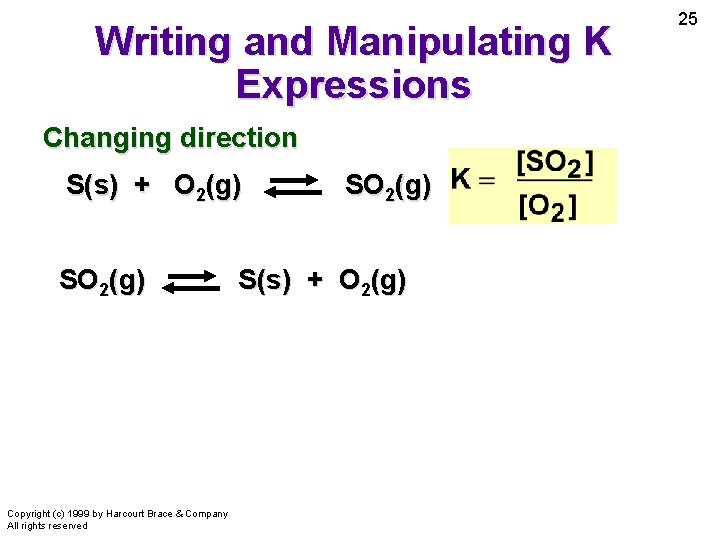
Writing and Manipulating K Expressions Changing direction S(s) + O 2(g) SO 2(g) Copyright (c) 1999 by Harcourt Brace & Company All rights reserved SO 2(g) S(s) + O 2(g) 25
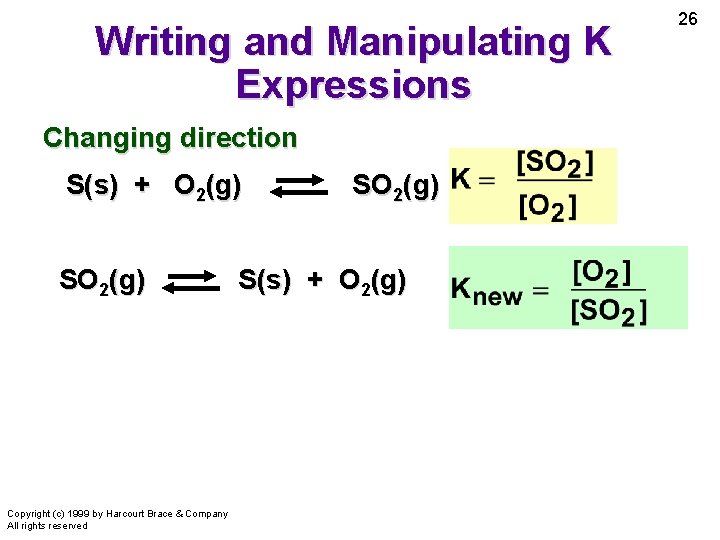
Writing and Manipulating K Expressions Changing direction S(s) + O 2(g) SO 2(g) Copyright (c) 1999 by Harcourt Brace & Company All rights reserved SO 2(g) S(s) + O 2(g) 26
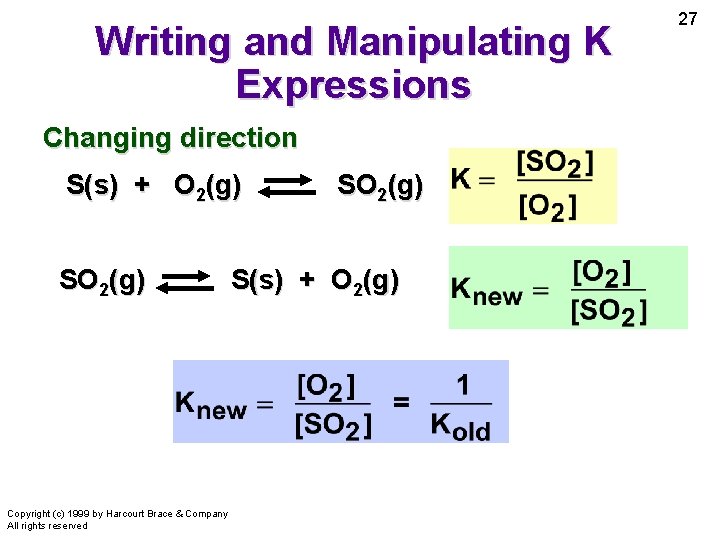
Writing and Manipulating K Expressions Changing direction S(s) + O 2(g) SO 2(g) Copyright (c) 1999 by Harcourt Brace & Company All rights reserved SO 2(g) S(s) + O 2(g) 27
Writing and Manipulating K Expressions Concentration Units We have been writing K in terms of mol/L. These are designated by Kc But with gases, P = (n/V) • RT = conc • RT P is proportional to concentration, so we can write K in terms of P. These are designated by Kp. Kc and Kp may or may not be the same. Copyright (c) 1999 by Harcourt Brace & Company All rights reserved 28
The Meaning of K 1. Can tell if a reaction is productfavored or reactant-favored. For N 2(g) + 3 H 2(g) 2 NH 3(g) Copyright (c) 1999 by Harcourt Brace & Company All rights reserved 29
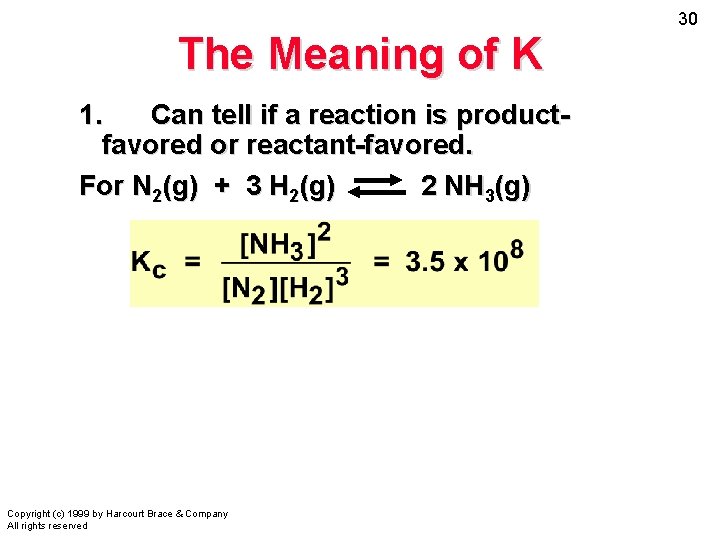
The Meaning of K 1. Can tell if a reaction is productfavored or reactant-favored. For N 2(g) + 3 H 2(g) 2 NH 3(g) Copyright (c) 1999 by Harcourt Brace & Company All rights reserved 30
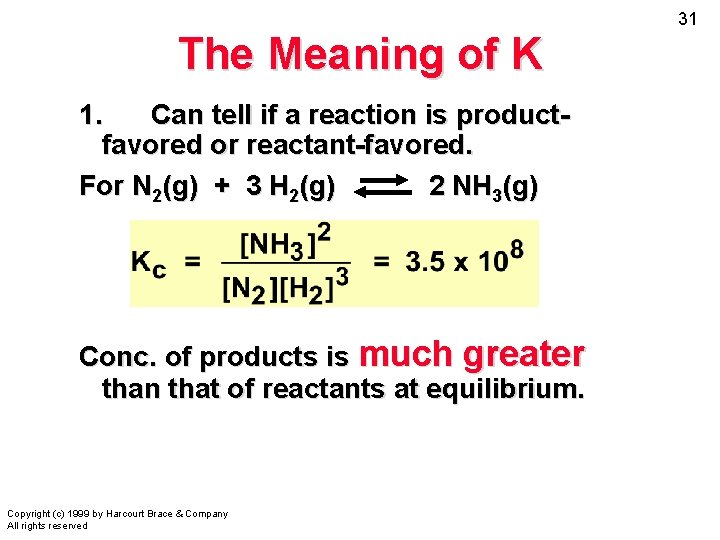
The Meaning of K 1. Can tell if a reaction is productfavored or reactant-favored. For N 2(g) + 3 H 2(g) 2 NH 3(g) Conc. of products is much greater than that of reactants at equilibrium. Copyright (c) 1999 by Harcourt Brace & Company All rights reserved 31
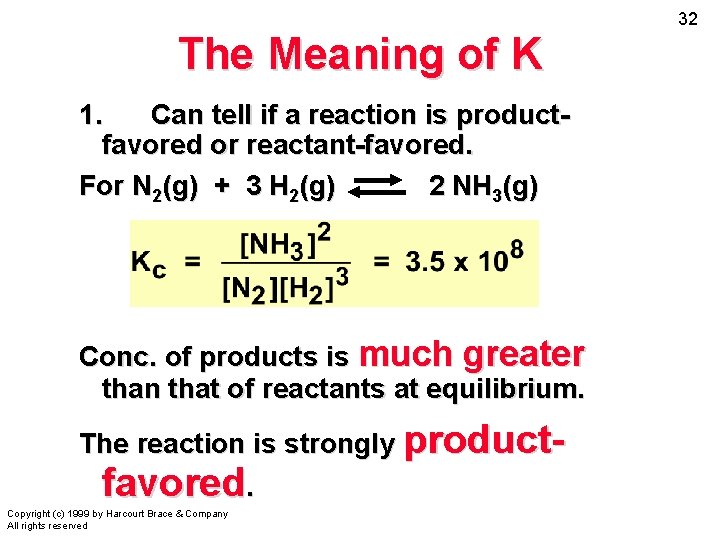
The Meaning of K 1. Can tell if a reaction is productfavored or reactant-favored. For N 2(g) + 3 H 2(g) 2 NH 3(g) Conc. of products is much greater than that of reactants at equilibrium. The reaction is strongly product- favored. Copyright (c) 1999 by Harcourt Brace & Company All rights reserved 32
![The Meaning of K 33 For Ag. Cl(s) Ag+(aq) + Cl-(aq) Kc = [Ag+]](http://slidetodoc.com/presentation_image_h2/3e4bac79b4177e124178d489ddf8f037/image-33.jpg "The Meaning of K 33 For Ag. Cl(s) Ag+(aq) + Cl-(aq) Kc = [Ag+]")
The Meaning of K 33 For Ag. Cl(s) Ag+(aq) + Cl-(aq) Kc = [Ag+] [Cl-] = 1. 8 x 10 -5 Conc. of products is much less than that of reactants at equilibrium. The reaction is strongly Ag+(aq) + Cl-(aq) Ag. Cl(s) reactant-favored. is product-favored. Copyright (c) 1999 by Harcourt Brace & Company All rights reserved
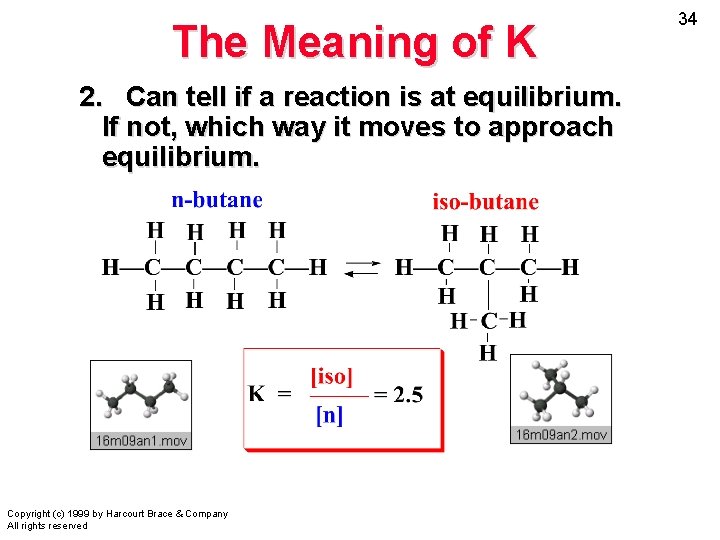
The Meaning of K 2. Can tell if a reaction is at equilibrium. If not, which way it moves to approach equilibrium. Copyright (c) 1999 by Harcourt Brace & Company All rights reserved 34
![The Meaning of K If [iso] = 0. 35 M and [n] = 0.](http://slidetodoc.com/presentation_image_h2/3e4bac79b4177e124178d489ddf8f037/image-35.jpg "The Meaning of K If [iso] = 0. 35 M and [n] = 0.")
The Meaning of K If [iso] = 0. 35 M and [n] = 0. 15 M, are you at equilibrium? Which way does the reaction “shift” to approach equilibrium? See Screen 16. 9. Copyright (c) 1999 by Harcourt Brace & Company All rights reserved 35
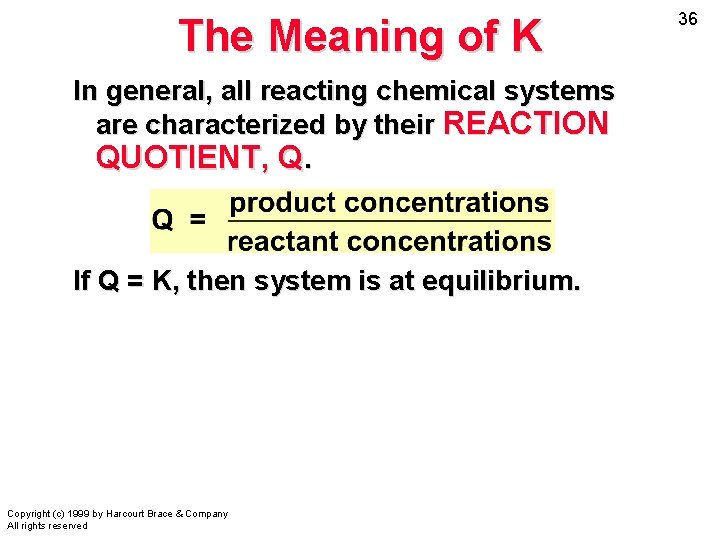
The Meaning of K In general, all reacting chemical systems are characterized by their REACTION QUOTIENT, Q. If Q = K, then system is at equilibrium. Copyright (c) 1999 by Harcourt Brace & Company All rights reserved 36
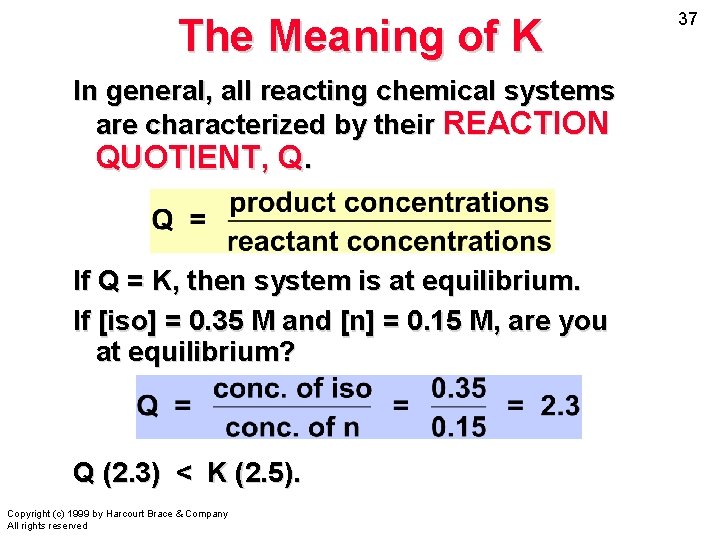
The Meaning of K In general, all reacting chemical systems are characterized by their REACTION QUOTIENT, Q. If Q = K, then system is at equilibrium. If [iso] = 0. 35 M and [n] = 0. 15 M, are you at equilibrium? Q (2. 3) < K (2. 5). Copyright (c) 1999 by Harcourt Brace & Company All rights reserved 37
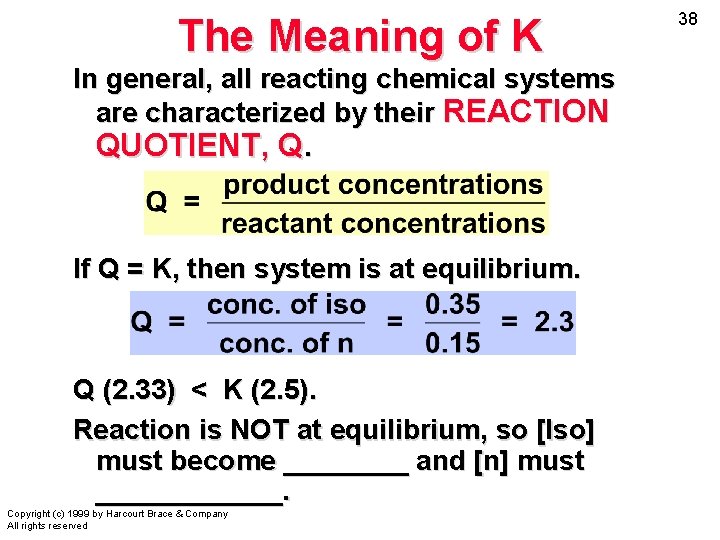
The Meaning of K In general, all reacting chemical systems are characterized by their REACTION QUOTIENT, Q. If Q = K, then system is at equilibrium. Q (2. 33) < K (2. 5). Reaction is NOT at equilibrium, so [Iso] must become ____ and [n] must ______. Copyright (c) 1999 by Harcourt Brace & Company All rights reserved 38
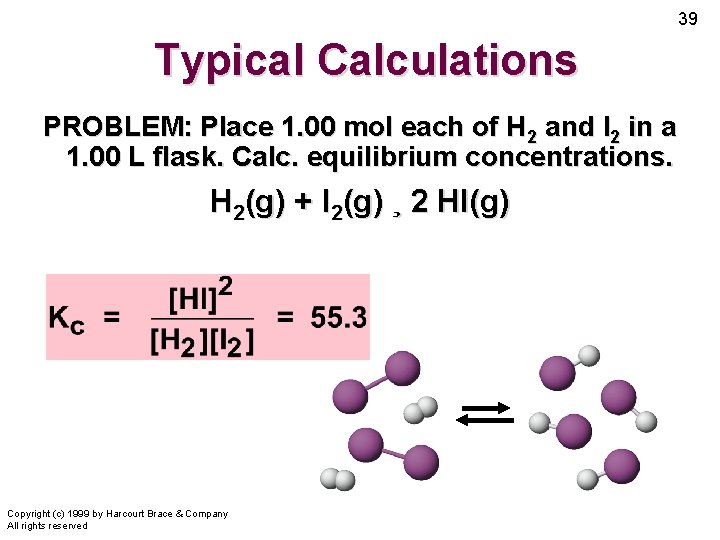
39 Typical Calculations PROBLEM: Place 1. 00 mol each of H 2 and I 2 in a 1. 00 L flask. Calc. equilibrium concentrations. H 2(g) + I 2(g) ¸ 2 HI(g) Copyright (c) 1999 by Harcourt Brace & Company All rights reserved
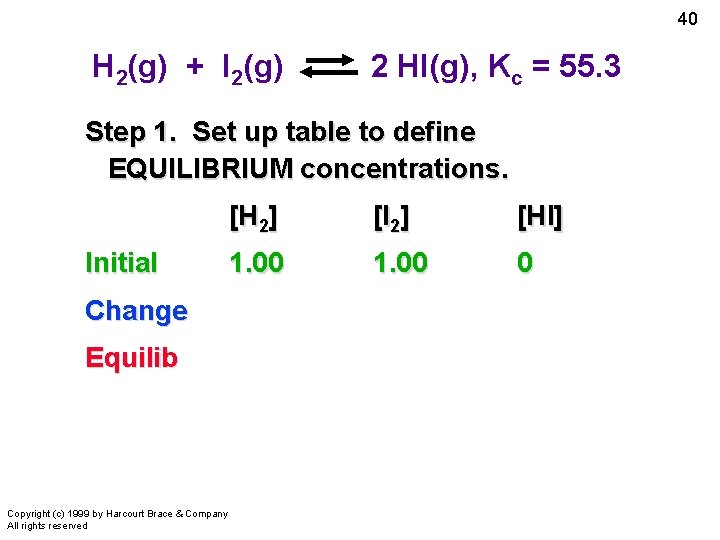
40 H 2(g) + I 2(g) 2 HI(g), Kc = 55. 3 Step 1. Set up table to define EQUILIBRIUM concentrations. Initial Change Equilib Copyright (c) 1999 by Harcourt Brace & Company All rights reserved [H 2] [I 2] [HI] 1. 00 0
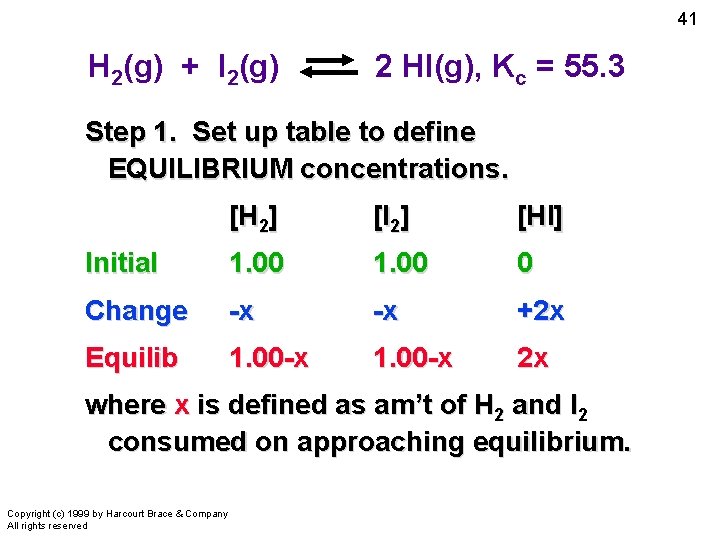
41 H 2(g) + I 2(g) 2 HI(g), Kc = 55. 3 Step 1. Set up table to define EQUILIBRIUM concentrations. [H 2] [I 2] [HI] Initial 1. 00 0 Change -x -x +2 x Equilib 1. 00 -x 2 x where x is defined as am’t of H 2 and I 2 consumed on approaching equilibrium. Copyright (c) 1999 by Harcourt Brace & Company All rights reserved
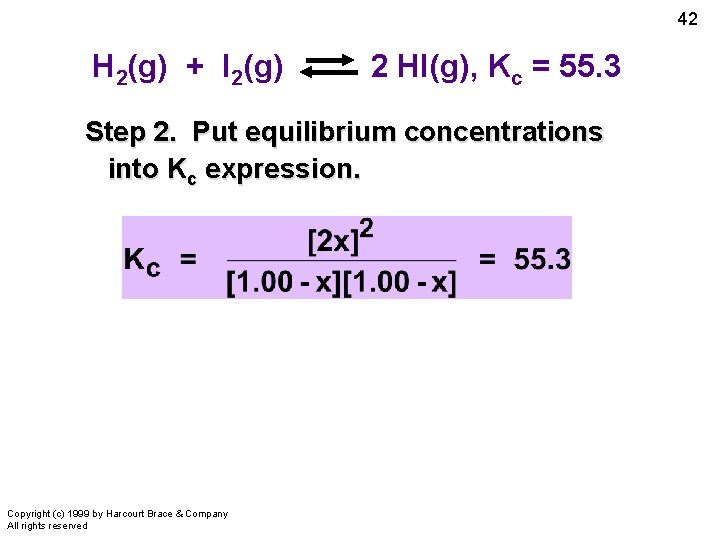
42 H 2(g) + I 2(g) 2 HI(g), Kc = 55. 3 Step 2. Put equilibrium concentrations into Kc expression. Copyright (c) 1999 by Harcourt Brace & Company All rights reserved
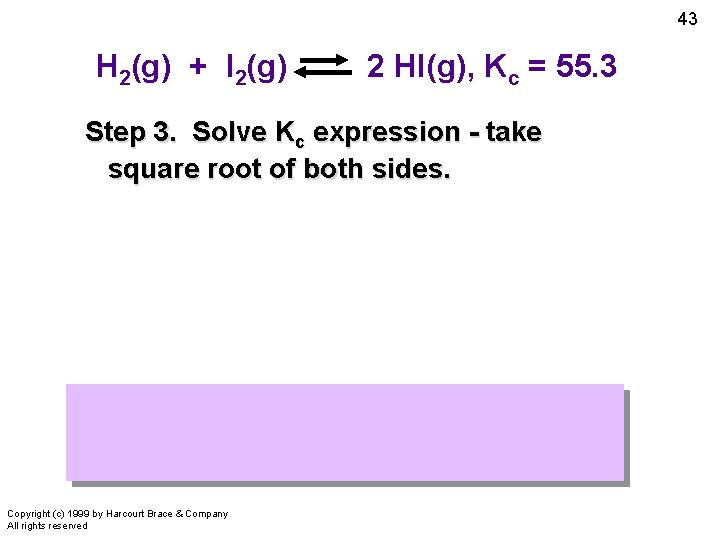
43 H 2(g) + I 2(g) 2 HI(g), Kc = 55. 3 Step 3. Solve Kc expression - take square root of both sides. Copyright (c) 1999 by Harcourt Brace & Company All rights reserved
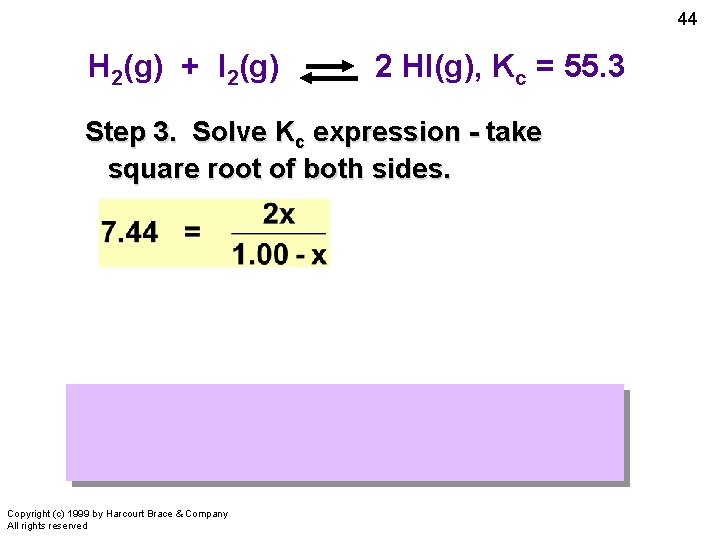
44 H 2(g) + I 2(g) 2 HI(g), Kc = 55. 3 Step 3. Solve Kc expression - take square root of both sides. Copyright (c) 1999 by Harcourt Brace & Company All rights reserved
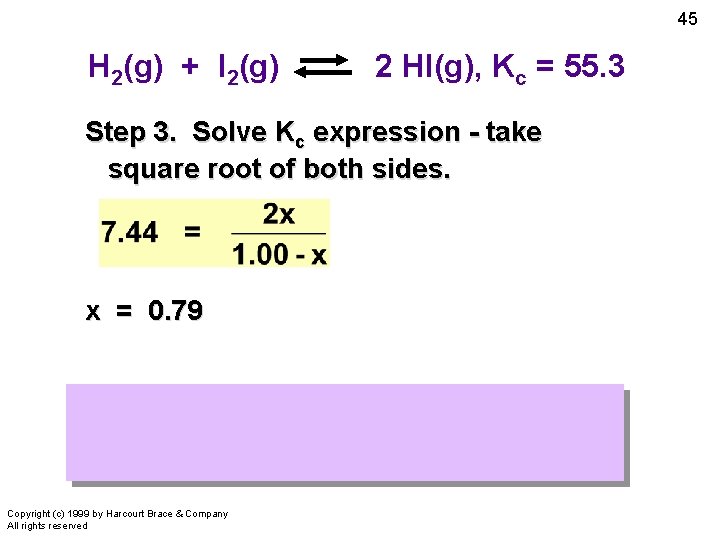
45 H 2(g) + I 2(g) 2 HI(g), Kc = 55. 3 Step 3. Solve Kc expression - take square root of both sides. x = 0. 79 Copyright (c) 1999 by Harcourt Brace & Company All rights reserved
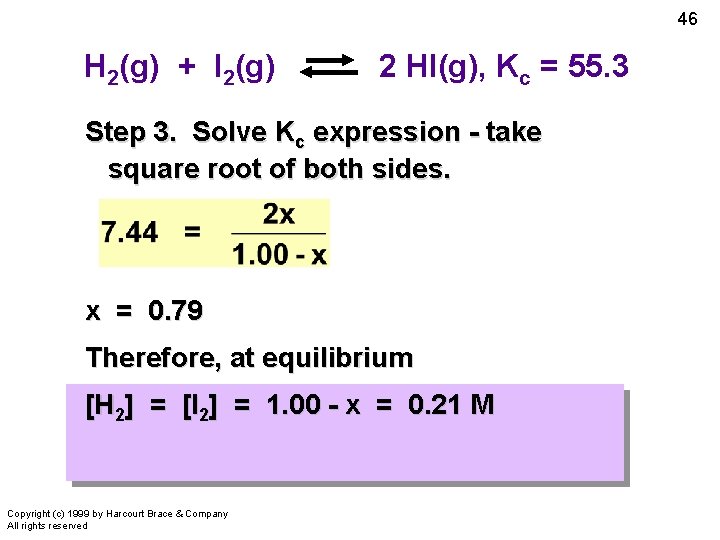
46 H 2(g) + I 2(g) 2 HI(g), Kc = 55. 3 Step 3. Solve Kc expression - take square root of both sides. x = 0. 79 Therefore, at equilibrium [H 2] = [I 2] = 1. 00 - x = 0. 21 M Copyright (c) 1999 by Harcourt Brace & Company All rights reserved
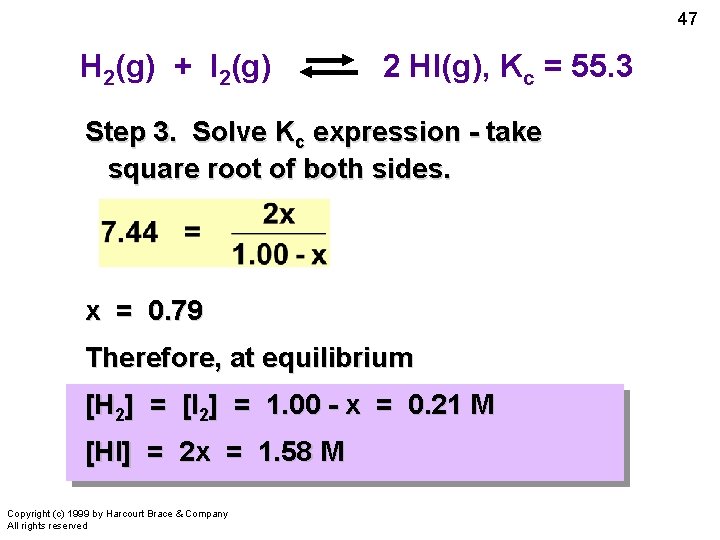
47 H 2(g) + I 2(g) 2 HI(g), Kc = 55. 3 Step 3. Solve Kc expression - take square root of both sides. x = 0. 79 Therefore, at equilibrium [H 2] = [I 2] = 1. 00 - x = 0. 21 M [HI] = 2 x = 1. 58 M Copyright (c) 1999 by Harcourt Brace & Company All rights reserved
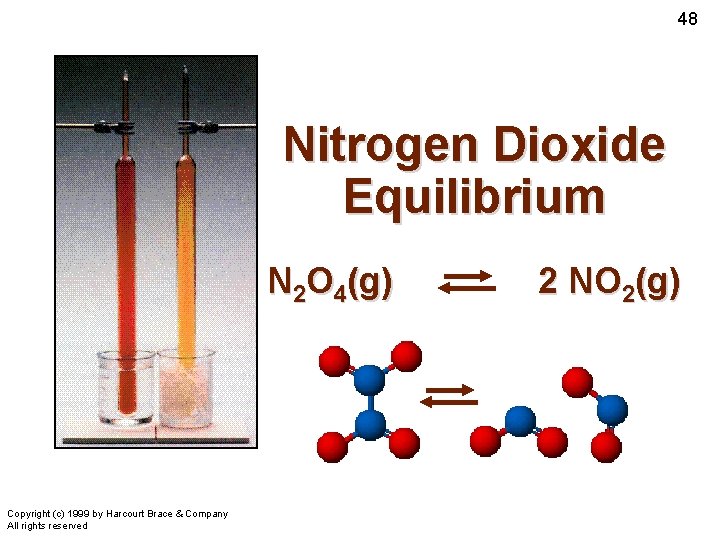
48 Nitrogen Dioxide Equilibrium N 2 O 4(g) Copyright (c) 1999 by Harcourt Brace & Company All rights reserved 2 NO 2(g)
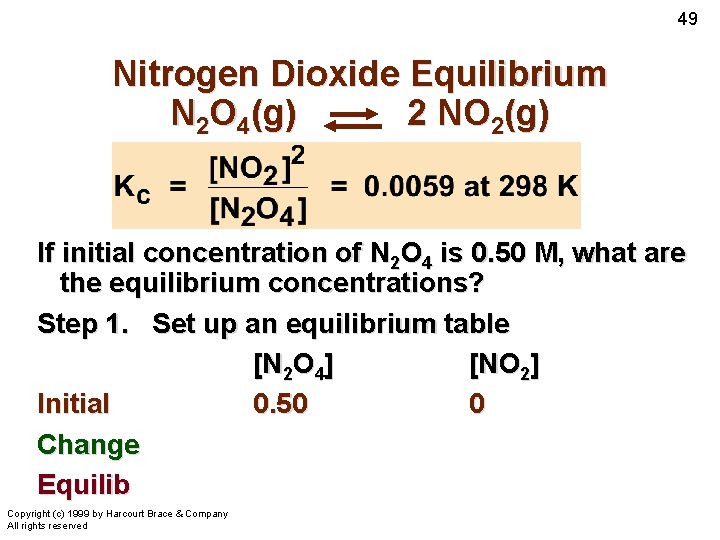
49 Nitrogen Dioxide Equilibrium N 2 O 4(g) 2 NO 2(g) If initial concentration of N 2 O 4 is 0. 50 M, what are the equilibrium concentrations? Step 1. Set up an equilibrium table [N 2 O 4] [NO 2] Initial 0. 50 0 Change Equilib Copyright (c) 1999 by Harcourt Brace & Company All rights reserved
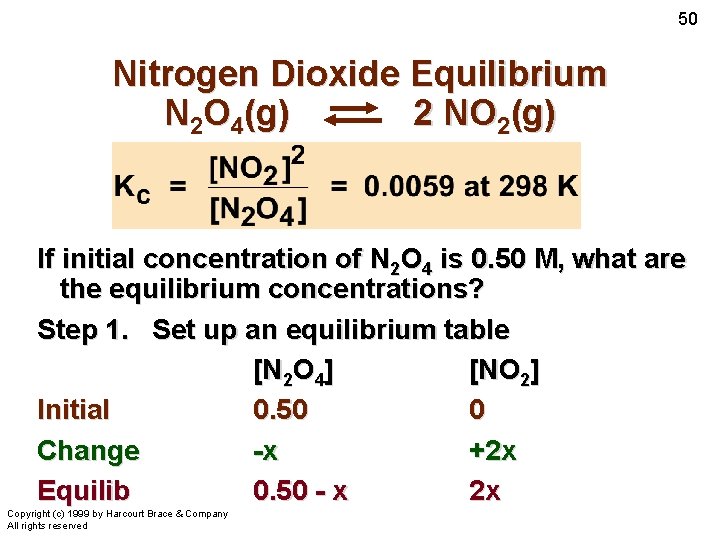
50 Nitrogen Dioxide Equilibrium N 2 O 4(g) 2 NO 2(g) If initial concentration of N 2 O 4 is 0. 50 M, what are the equilibrium concentrations? Step 1. Set up an equilibrium table [N 2 O 4] [NO 2] Initial 0. 50 0 Change -x +2 x Equilib 0. 50 - x 2 x Copyright (c) 1999 by Harcourt Brace & Company All rights reserved
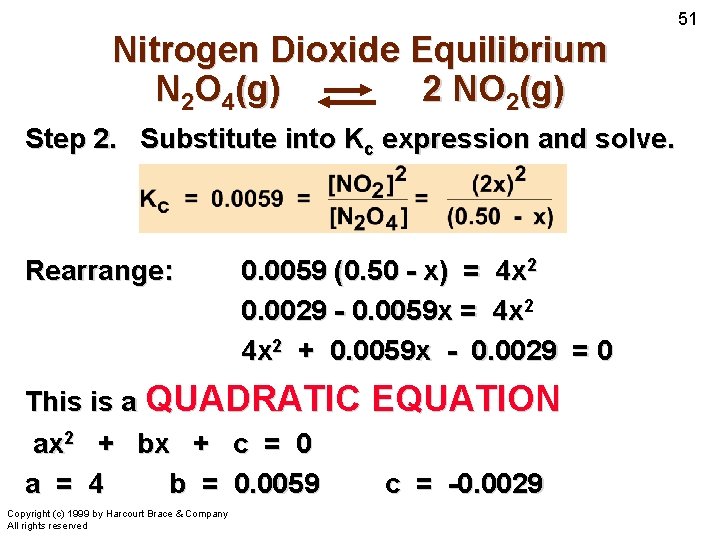
Nitrogen Dioxide Equilibrium N 2 O 4(g) 2 NO 2(g) Step 2. Substitute into Kc expression and solve. Rearrange: 0. 0059 (0. 50 - x) = 4 x 2 0. 0029 - 0. 0059 x = 4 x 2 + 0. 0059 x - 0. 0029 = 0 This is a QUADRATIC EQUATION ax 2 + bx + c = 0 a = 4 b = 0. 0059 c = -0. 0029 Copyright (c) 1999 by Harcourt Brace & Company All rights reserved 51
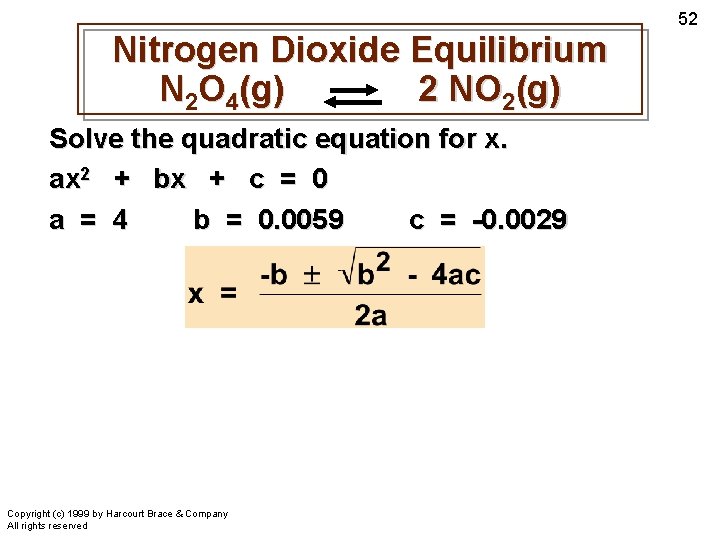
Nitrogen Dioxide Equilibrium N 2 O 4(g) 2 NO 2(g) Solve the quadratic equation for x. ax 2 + bx + c = 0 a = 4 b = 0. 0059 c = -0. 0029 Copyright (c) 1999 by Harcourt Brace & Company All rights reserved 52
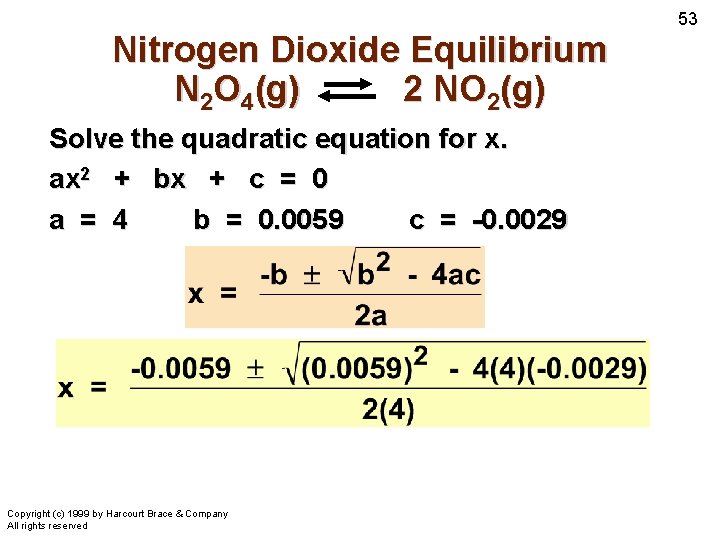
Nitrogen Dioxide Equilibrium N 2 O 4(g) 2 NO 2(g) Solve the quadratic equation for x. ax 2 + bx + c = 0 a = 4 b = 0. 0059 c = -0. 0029 Copyright (c) 1999 by Harcourt Brace & Company All rights reserved 53
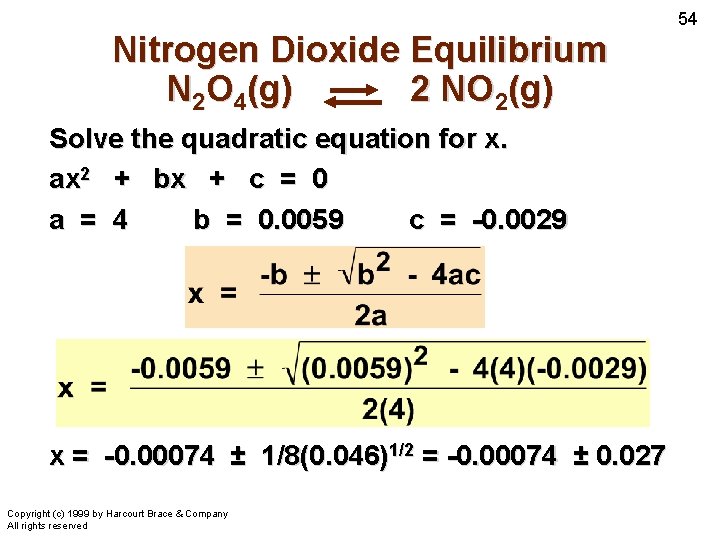
Nitrogen Dioxide Equilibrium N 2 O 4(g) 2 NO 2(g) Solve the quadratic equation for x. ax 2 + bx + c = 0 a = 4 b = 0. 0059 c = -0. 0029 x = -0. 00074 ± 1/8(0. 046)1/2 = -0. 00074 ± 0. 027 Copyright (c) 1999 by Harcourt Brace & Company All rights reserved 54
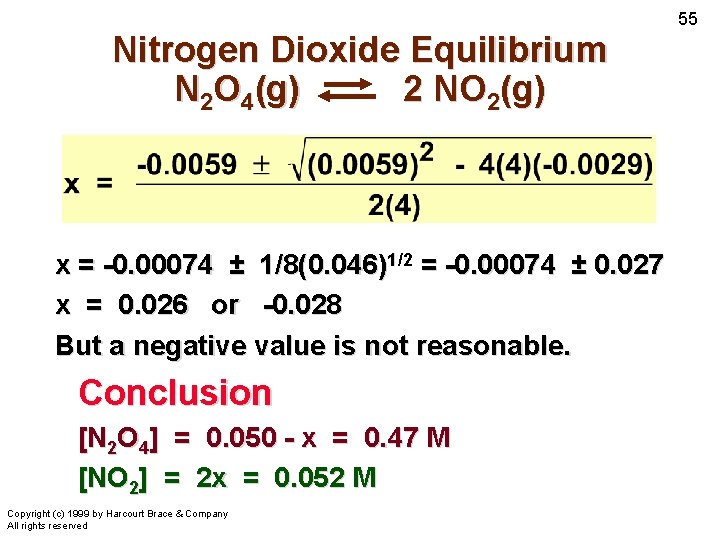
Nitrogen Dioxide Equilibrium N 2 O 4(g) 2 NO 2(g) x = -0. 00074 ± 1/8(0. 046)1/2 = -0. 00074 ± 0. 027 x = 0. 026 or -0. 028 But a negative value is not reasonable. Conclusion [N 2 O 4] = 0. 050 - x = 0. 47 M [NO 2] = 2 x = 0. 052 M Copyright (c) 1999 by Harcourt Brace & Company All rights reserved 55
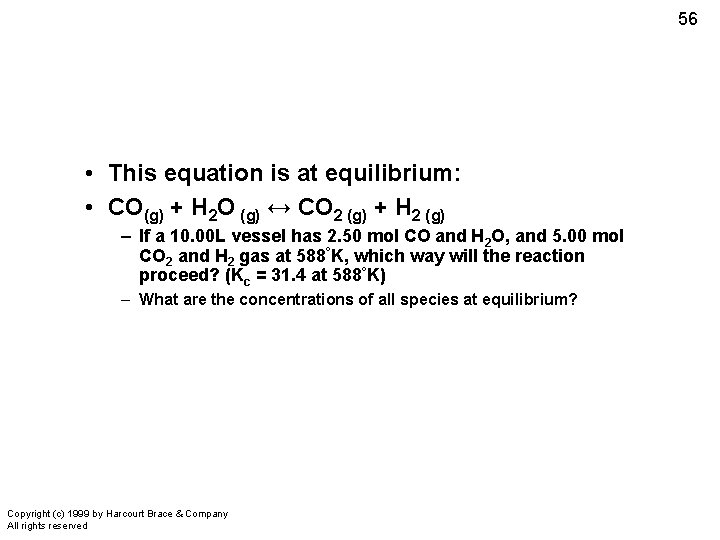
56 • This equation is at equilibrium: • CO(g) + H 2 O (g) ↔ CO 2 (g) + H 2 (g) – If a 10. 00 L vessel has 2. 50 mol CO and H 2 O, and 5. 00 mol CO 2 and H 2 gas at 588°K, which way will the reaction proceed? (Kc = 31. 4 at 588°K) – What are the concentrations of all species at equilibrium? Copyright (c) 1999 by Harcourt Brace & Company All rights reserved
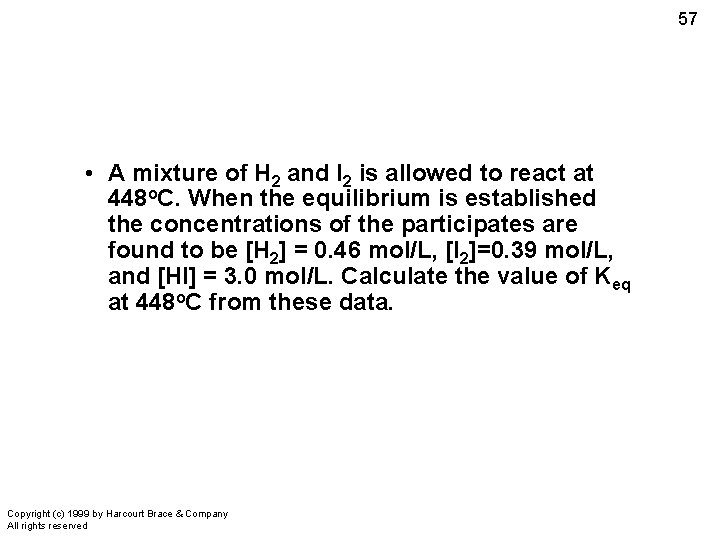
57 • A mixture of H 2 and I 2 is allowed to react at 448 o. C. When the equilibrium is established the concentrations of the participates are found to be [H 2] = 0. 46 mol/L, [I 2]=0. 39 mol/L, and [HI] = 3. 0 mol/L. Calculate the value of Keq at 448 o. C from these data. Copyright (c) 1999 by Harcourt Brace & Company All rights reserved
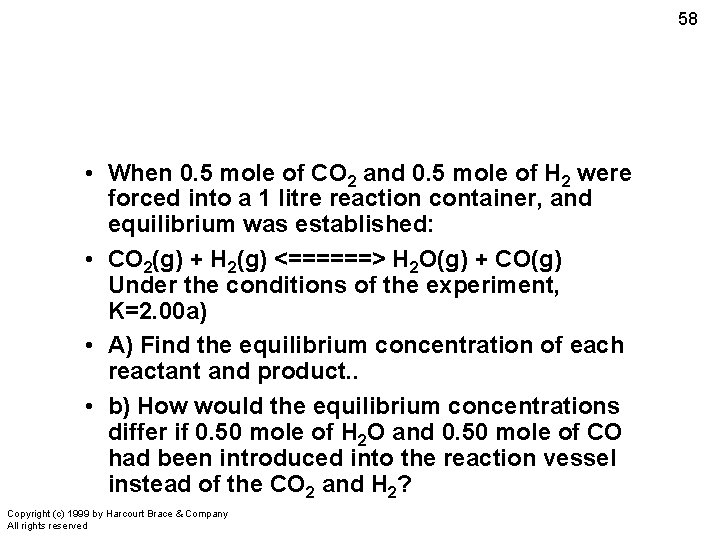
58 • When 0. 5 mole of CO 2 and 0. 5 mole of H 2 were forced into a 1 litre reaction container, and equilibrium was established: • CO 2(g) + H 2(g) <======> H 2 O(g) + CO(g) Under the conditions of the experiment, K=2. 00 a) • A) Find the equilibrium concentration of each reactant and product. . • b) How would the equilibrium concentrations differ if 0. 50 mole of H 2 O and 0. 50 mole of CO had been introduced into the reaction vessel instead of the CO 2 and H 2? Copyright (c) 1999 by Harcourt Brace & Company All rights reserved
- Slides: 58