
Chemical Equilibrium Objectives Define key terms and concepts
Chemical Equilibrium
Objectives �Define key terms and concepts. �Express the equilibrium constant for a reaction. �Calculate the equilibrium constant for a reaction. �Determine how chemical equilibrium is effected by temperature, concentration, pressure, volume, and catalysts. �Predict how the equilibrium of a chemical reaction will shift using Le. Châtelier’s Principle.
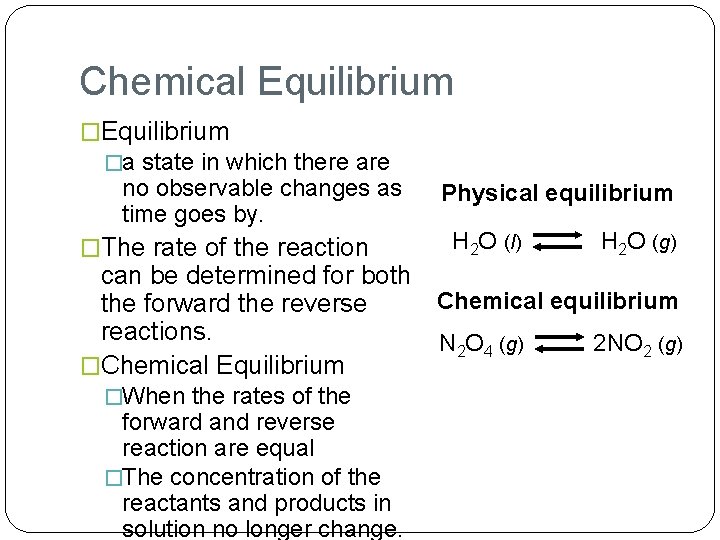
Chemical Equilibrium �a state in which there are no observable changes as time goes by. �The rate of the reaction Physical equilibrium H 2 O (l) H 2 O (g) can be determined for both Chemical equilibrium the forward the reverse reactions. N 2 O 4 (g) 2 NO 2 (g) �Chemical Equilibrium �When the rates of the forward and reverse reaction are equal �The concentration of the reactants and products in solution no longer change.
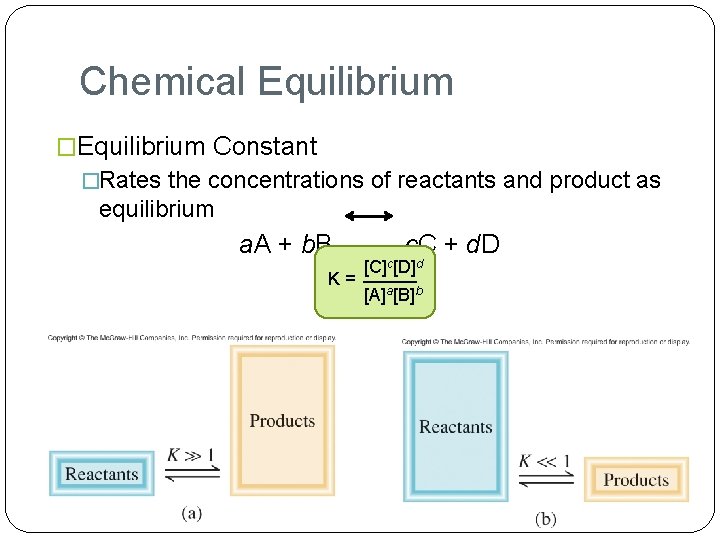
Chemical Equilibrium �Equilibrium Constant �Rates the concentrations of reactants and product as equilibrium a. A + b. B K= c. C + d. D [C]c[D]d [A]a[B]b
Expressing Equilibrium Constants �Homogeneous Equilibrium �Reactants and products are in the same phase �Heterogeneous Equilibrium �Reactants and products are in different phases �Kc is the equilibrium constant expressed in terms of concentration. �If Kc is large, the equilibrium mixture contains mostly products �If Kc is small, the equilibrium mixture contains mostly reactants �If Kc is about 1, the equilibrium contains similar amounts of reactants and products
Rules for Writing Equilibrium Constant Expressions - Kc �The chemicals involved in the reaction can be expressed in moles/L for liquids, or in moles/L or atmospheres for gasses. �The concentrations of pure solids or liquids (in heterogeneous equilibria) and solvents (in homogeneous equilibria) do not appear in the equilibrium constant expressions. �The equilibrium constant is unit less. �In quoting a value for the equilibrium constant, the balanced equation and temperature must be specified.
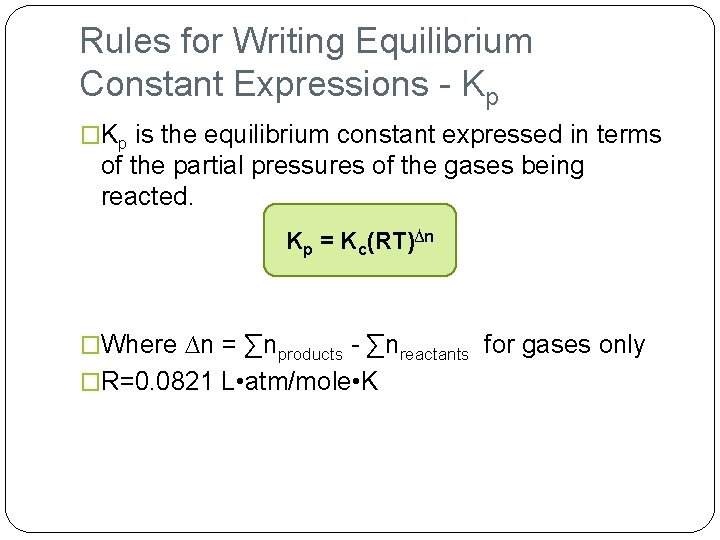
Rules for Writing Equilibrium Constant Expressions - Kp �Kp is the equilibrium constant expressed in terms of the partial pressures of the gases being reacted. Kp = Kc(RT)∆n �Where ∆n = ∑nproducts - ∑nreactants for gases only �R=0. 0821 L • atm/mole • K
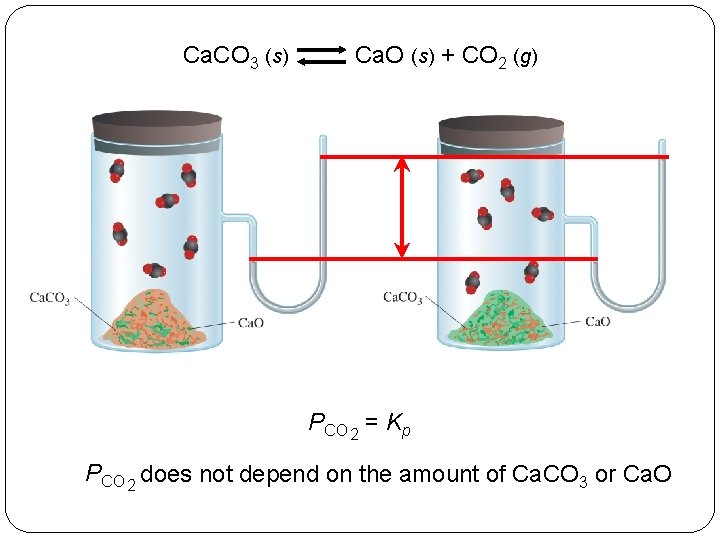
Ca. CO 3 (s) Ca. O (s) + CO 2 (g) PCO 2 = Kp PCO 2 does not depend on the amount of Ca. CO 3 or Ca. O
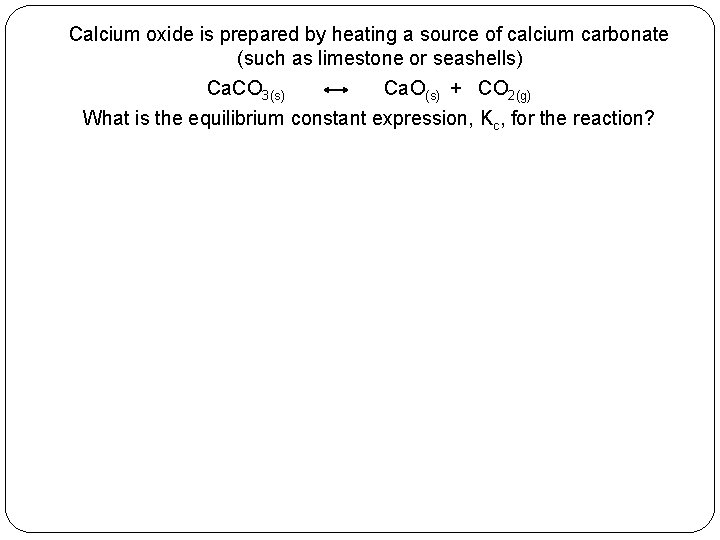
Calcium oxide is prepared by heating a source of calcium carbonate (such as limestone or seashells) Ca. CO 3(s) Ca. O(s) + CO 2(g) What is the equilibrium constant expression, Kc, for the reaction?

The Mond process for purifying nickel involves the formation of nickel tetracarbonyl, Ni(CO)4, from nickel and carbon monoxide Ni(s) + CO(g) Ni(CO)4(g) What is the equilibrium constant expression, Kc, for the reaction?
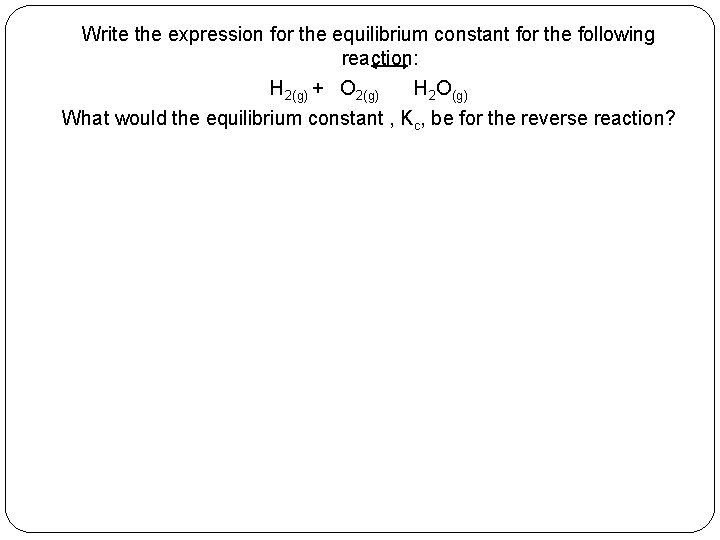
Write the expression for the equilibrium constant for the following reaction: H 2(g) + O 2(g) H 2 O(g) What would the equilibrium constant , Kc, be for the reverse reaction?
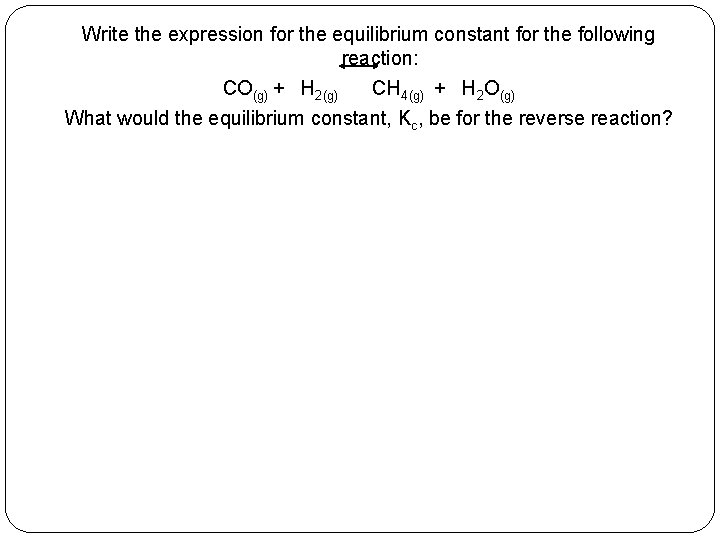
Write the expression for the equilibrium constant for the following reaction: CO(g) + H 2(g) CH 4(g) + H 2 O(g) What would the equilibrium constant, Kc, be for the reverse reaction?
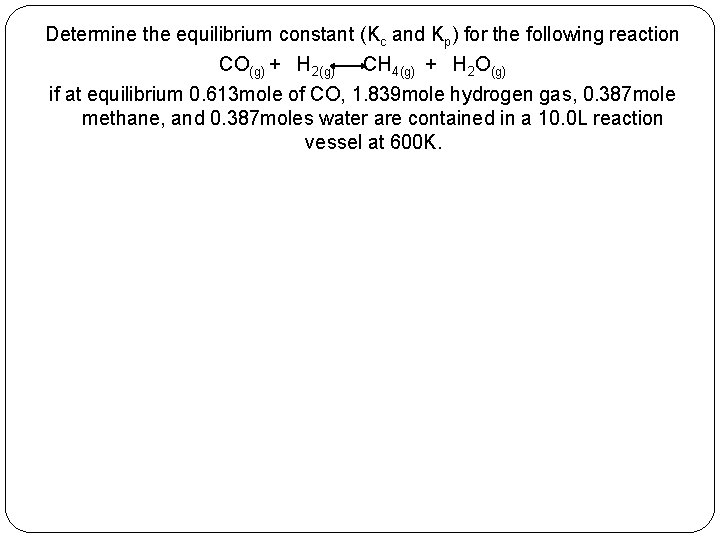
Determine the equilibrium constant (Kc and Kp) for the following reaction CO(g) + H 2(g) CH 4(g) + H 2 O(g) if at equilibrium 0. 613 mole of CO, 1. 839 mole hydrogen gas, 0. 387 mole methane, and 0. 387 moles water are contained in a 10. 0 L reaction vessel at 600 K.
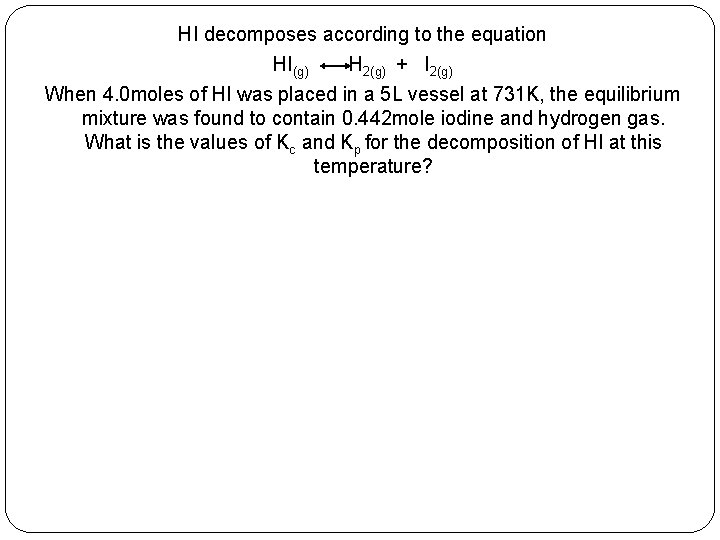
HI decomposes according to the equation HI(g) H 2(g) + I 2(g) When 4. 0 moles of HI was placed in a 5 L vessel at 731 K, the equilibrium mixture was found to contain 0. 442 mole iodine and hydrogen gas. What is the values of Kc and Kp for the decomposition of HI at this temperature?
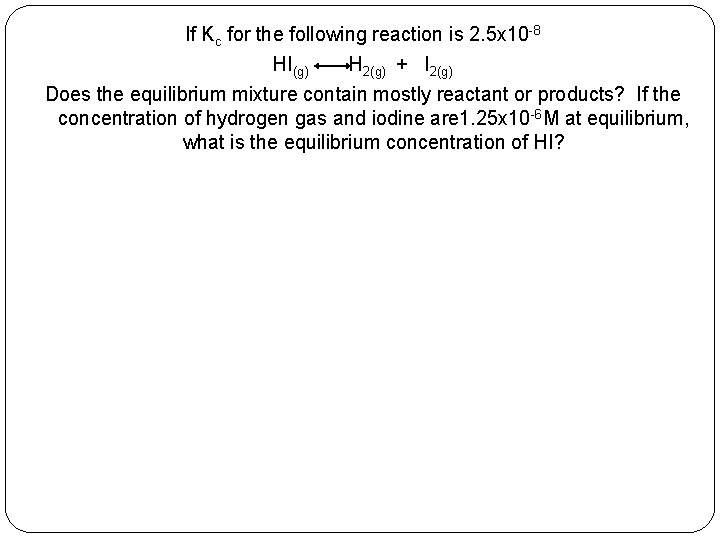
If Kc for the following reaction is 2. 5 x 10 -8 HI(g) H 2(g) + I 2(g) Does the equilibrium mixture contain mostly reactant or products? If the concentration of hydrogen gas and iodine are 1. 25 x 10 -6 M at equilibrium, what is the equilibrium concentration of HI?
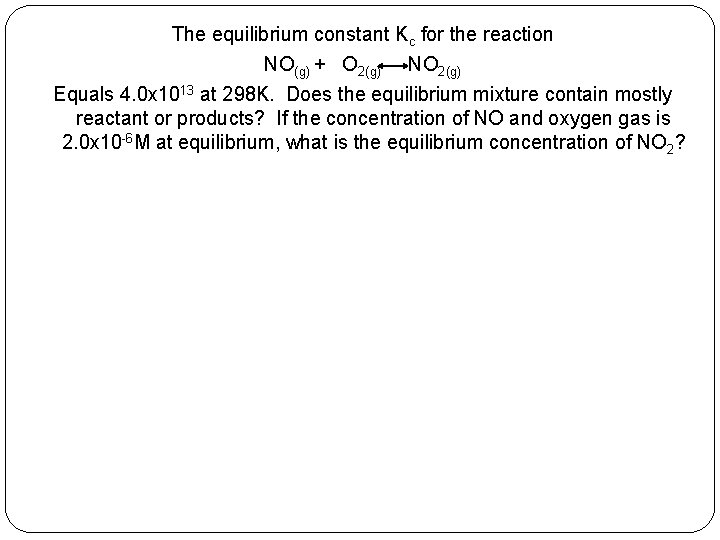
The equilibrium constant Kc for the reaction NO(g) + O 2(g) NO 2(g) Equals 4. 0 x 1013 at 298 K. Does the equilibrium mixture contain mostly reactant or products? If the concentration of NO and oxygen gas is 2. 0 x 10 -6 M at equilibrium, what is the equilibrium concentration of NO 2?
What are Your Questions?
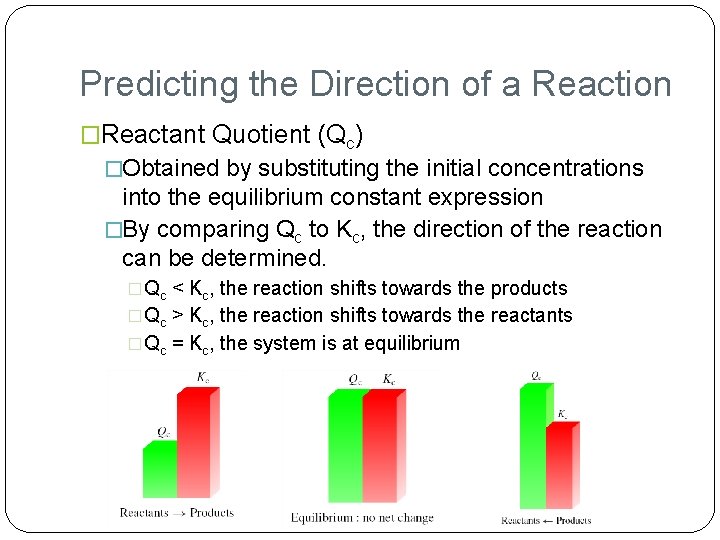
Predicting the Direction of a Reaction �Reactant Quotient (Qc) �Obtained by substituting the initial concentrations into the equilibrium constant expression �By comparing Qc to Kc, the direction of the reaction can be determined. �Qc < Kc, the reaction shifts towards the products �Qc > Kc, the reaction shifts towards the reactants �Qc = Kc, the system is at equilibrium
Hydrogen gas reacts with nitrogen gas to produce ammonia gas. If a 50. 0 L reaction vessel contains 1. 0 mole of nitrogen gas, 3. 0 mole of hydrogen gas, and 0. 50 mole ammonia. Which direction will the reaction go to reach equilibrium at 673 K if Kc for the reaction is 0. 50?
Carbon dioxide gas will react with solid carbon to produce carbon monoxide gas. A 10. 0 L vessel contain 0. 0015 mole of carbon dioxide and 0. 10 mole carbon monoxide. A small amount of carbon is added to the vessel and the temperature raised to 1373 K. What will happen to the reaction? The value of Kc for this reaction is 1. 17 at 1373 K. Assume the volume of the gas is equal to the volume of the container.
Hydrogen gas reacts with oxygen gas to produce water vapor. If a 40. 0 L reaction vessel contains 5. 9 g of hydrogen gas, 8. 1 g of oxygen gas, and 6. 5 g water vapor. Which direction will the reaction go to reach equilibrium at 700 K if Kc for the reaction is 0. 85?
Calculating Equilibrium Concentrations �Express all concentrations in a reaction in terms of the initial concentration and the unknown quantity x, representing the change in concentration. �Write the equilibrium constant expression in terms of the equilibrium concentrations. Solve for x. �Calculate the equilibrium concentration of all species.
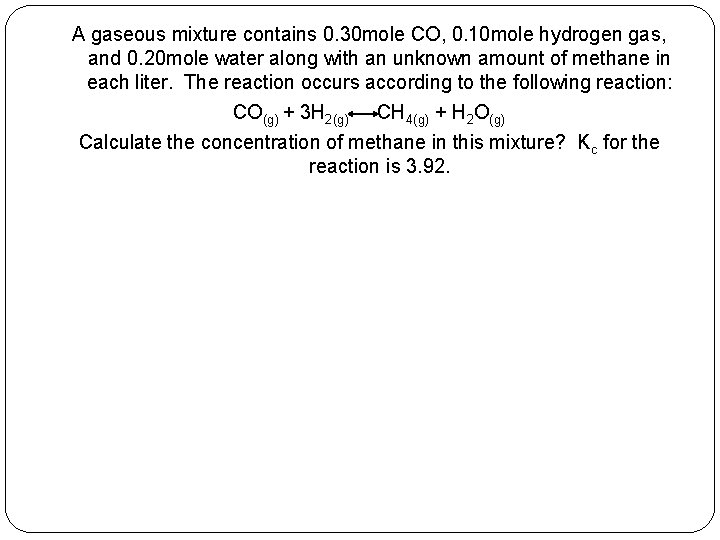
A gaseous mixture contains 0. 30 mole CO, 0. 10 mole hydrogen gas, and 0. 20 mole water along with an unknown amount of methane in each liter. The reaction occurs according to the following reaction: CO(g) + 3 H 2(g) CH 4(g) + H 2 O(g) Calculate the concentration of methane in this mixture? Kc for the reaction is 3. 92.
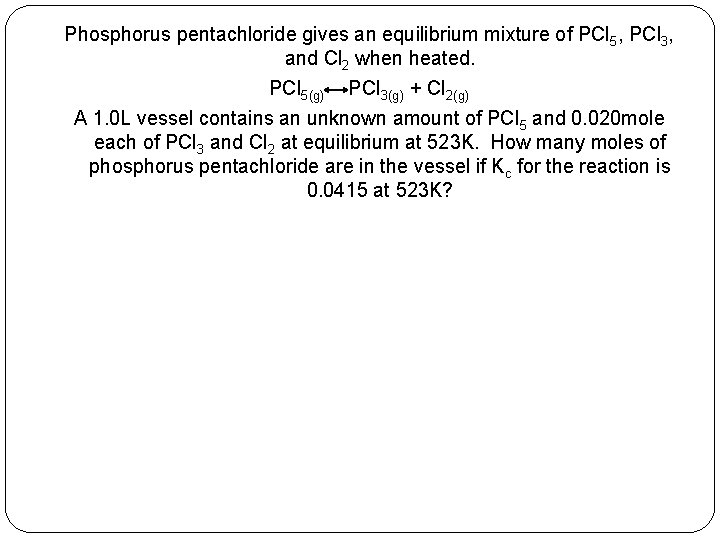
Phosphorus pentachloride gives an equilibrium mixture of PCl 5, PCl 3, and Cl 2 when heated. PCl 5(g) PCl 3(g) + Cl 2(g) A 1. 0 L vessel contains an unknown amount of PCl 5 and 0. 020 mole each of PCl 3 and Cl 2 at equilibrium at 523 K. How many moles of phosphorus pentachloride are in the vessel if Kc for the reaction is 0. 0415 at 523 K?
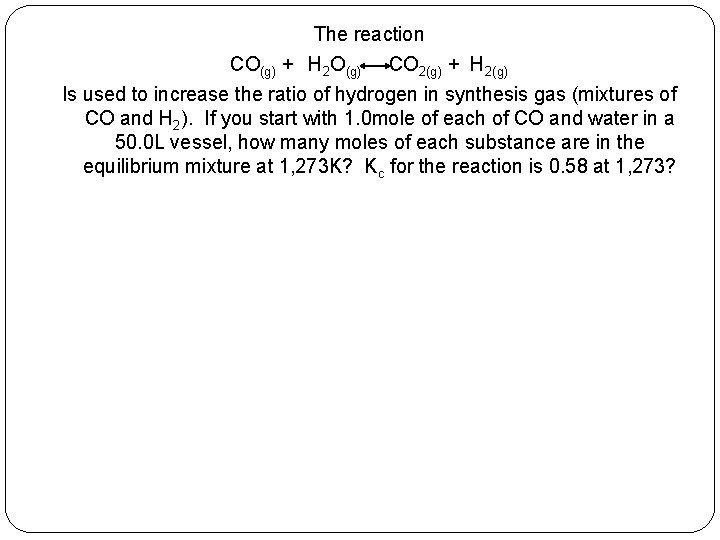
The reaction CO(g) + H 2 O(g) CO 2(g) + H 2(g) Is used to increase the ratio of hydrogen in synthesis gas (mixtures of CO and H 2). If you start with 1. 0 mole of each of CO and water in a 50. 0 L vessel, how many moles of each substance are in the equilibrium mixture at 1, 273 K? Kc for the reaction is 0. 58 at 1, 273?
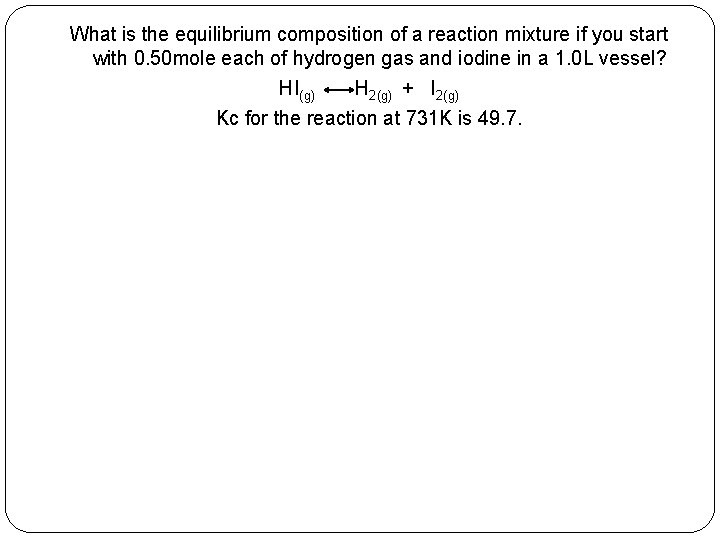
What is the equilibrium composition of a reaction mixture if you start with 0. 50 mole each of hydrogen gas and iodine in a 1. 0 L vessel? HI(g) H 2(g) + I 2(g) Kc for the reaction at 731 K is 49. 7.
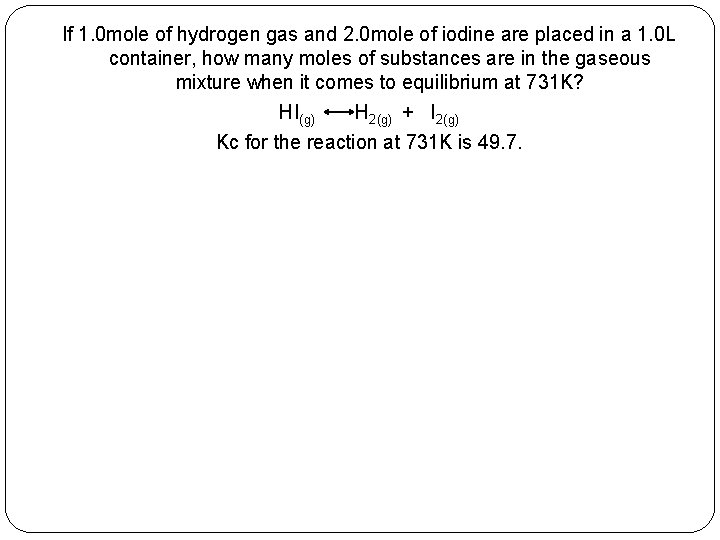
If 1. 0 mole of hydrogen gas and 2. 0 mole of iodine are placed in a 1. 0 L container, how many moles of substances are in the gaseous mixture when it comes to equilibrium at 731 K? HI(g) H 2(g) + I 2(g) Kc for the reaction at 731 K is 49. 7.
What are Your Questions?
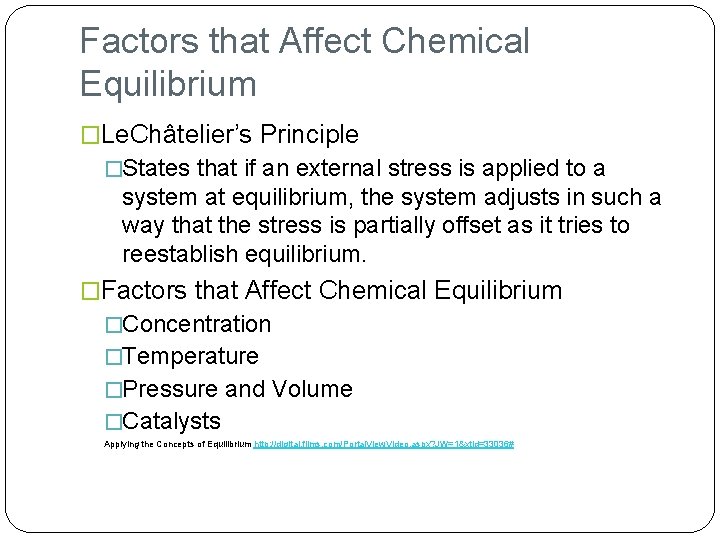
Factors that Affect Chemical Equilibrium �Le. Châtelier’s Principle �States that if an external stress is applied to a system at equilibrium, the system adjusts in such a way that the stress is partially offset as it tries to reestablish equilibrium. �Factors that Affect Chemical Equilibrium �Concentration �Temperature �Pressure and Volume �Catalysts Applying the Concepts of Equilibrium http: //digital. films. com/Portal. View. Video. aspx? JW=1&xtid=33036#
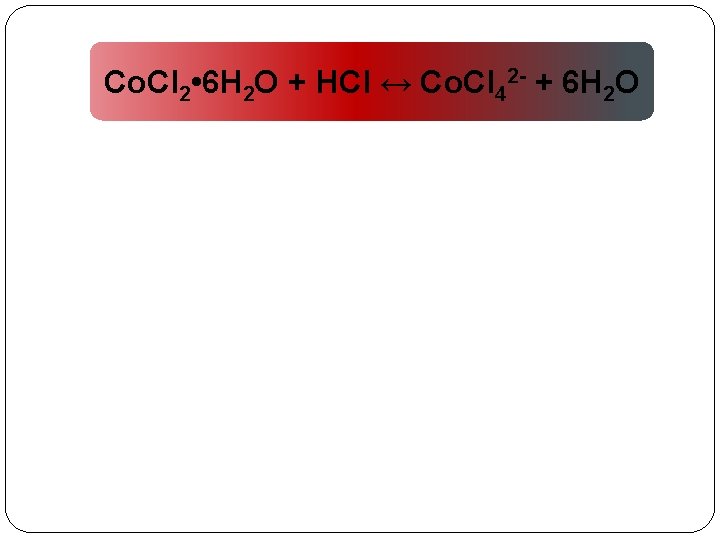
Co. Cl 2 • 6 H 2 O + HCl ↔ Co. Cl 42 - + 6 H 2 O
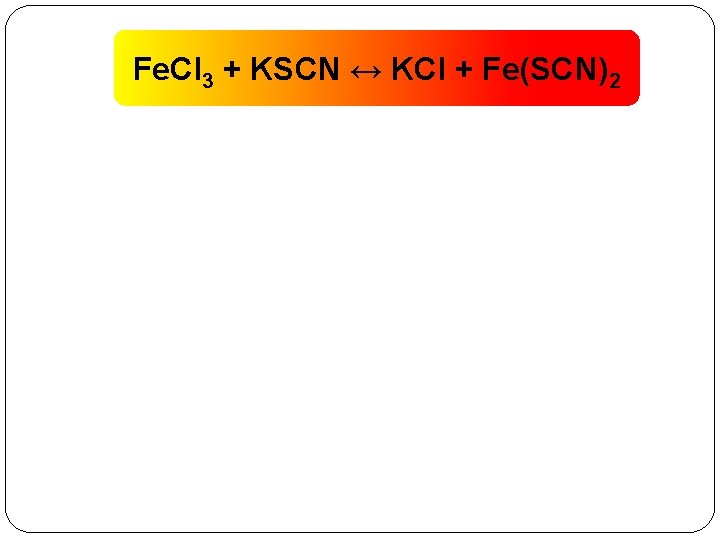
Fe. Cl 3 + KSCN ↔ KCl + Fe(SCN)2
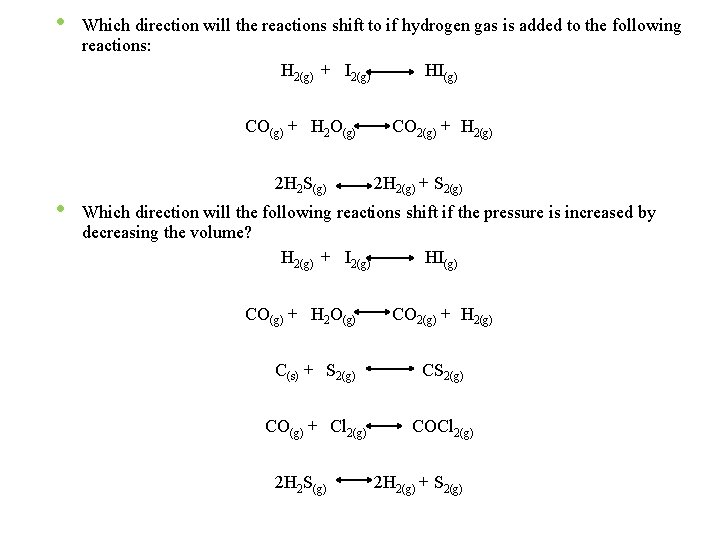
• Which direction will the reactions shift to if hydrogen gas is added to the following reactions: H 2(g) + I 2(g) HI(g) CO(g) + H 2 O(g) • 2 H 2 S(g) CO 2(g) + H 2(g) 2 H 2(g) + S 2(g) Which direction will the following reactions shift if the pressure is increased by decreasing the volume? H 2(g) + I 2(g) HI(g) CO(g) + H 2 O(g) CO 2(g) + H 2(g) C(s) + S 2(g) CO(g) + Cl 2(g) COCl 2(g) 2 H 2 S(g) 2 H 2(g) + S 2(g)
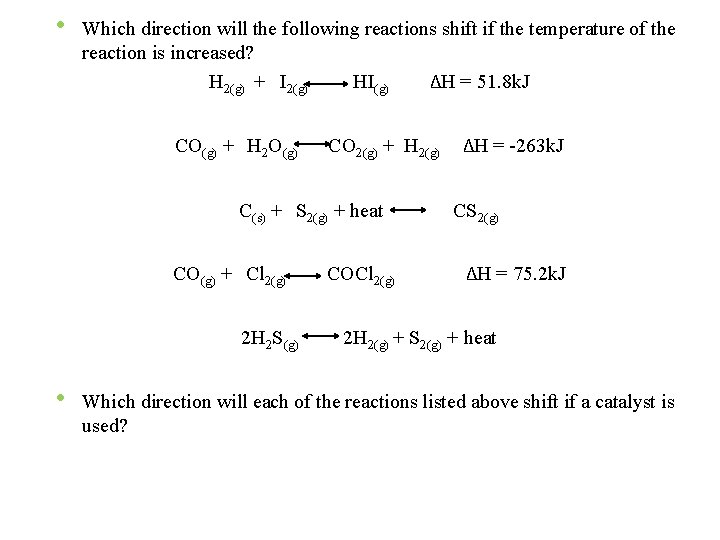
• Which direction will the following reactions shift if the temperature of the reaction is increased? H 2(g) + I 2(g) HI(g) ΔH = 51. 8 k. J CO(g) + H 2 O(g) CO 2(g) + H 2(g) C(s) + S 2(g) + heat CO(g) + Cl 2(g) 2 H 2 S(g) • COCl 2(g) ΔH = -263 k. J CS 2(g) ΔH = 75. 2 k. J 2 H 2(g) + S 2(g) + heat Which direction will each of the reactions listed above shift if a catalyst is used?
What are Your Questions?
- Slides: 34