
CHEMICAL EQUILIBRIUM My faith helps me overcome such
CHEMICAL EQUILIBRIUM My faith helps me overcome such negative emotions and find my equilibrium. - Dalai Lama
Reactions are Reversible A + B C + D (forward) Initially there is only A and B so only the forward reaction is possible As C and D build up, the reverse reaction speeds up while the forward reaction slows down. C + D A + B (reverse) Eventually the rates are equal
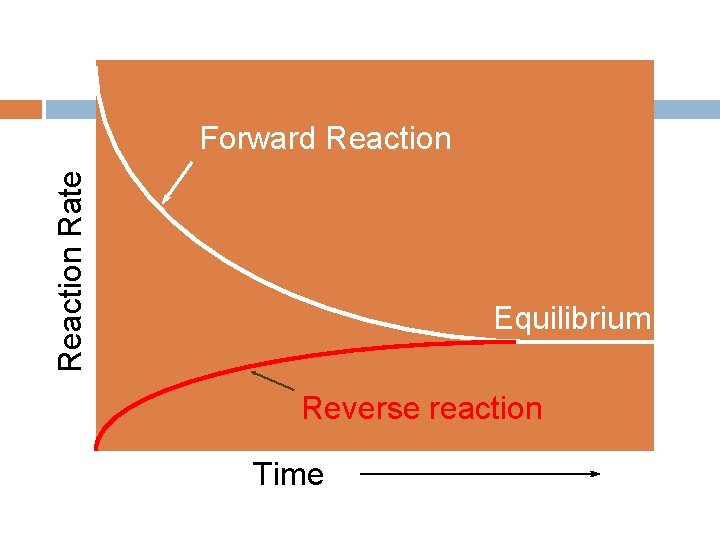
Reaction Rate Forward Reaction Equilibrium Reverse reaction Time
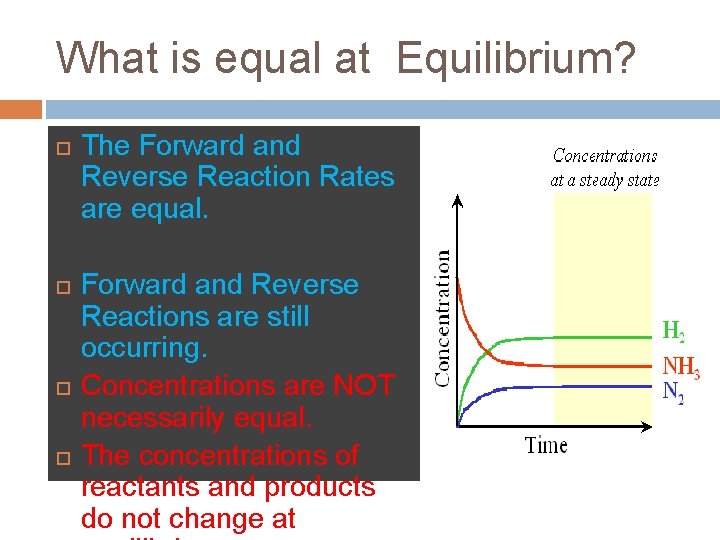
What is equal at Equilibrium? The Forward and Reverse Reaction Rates are equal. Forward and Reverse Reactions are still occurring. Concentrations are NOT necessarily equal. The concentrations of reactants and products do not change at
Ratio of Reactant to Products at EQ At equilibrium, there is a set ratio of product concentrations to reactant concentrations This ratio is given by K, the equilibrium constant K is unique for a particular temperature. Since an increase in temperature usually favors either the forward or reverse reaction (whichever is endothermic), K value changes as the temperature changes.
Law of Mass Action For any reaction j. A + k. B l. C + m. D Keq = [C]l[D]m PRODUCTSpower [A]j[B]k REACTANTSpower Keq is called the equilibrium constant. Keq is commonly written as Kc since concentrations are used to determine the Keq.
Mass Action Expression 2 HCl (g) H 2 (g) + Cl 2 (g) Keq or Kc = N 2 (g) + 3 H 2 (g) Keq or Kc = 2 NH 3 (g)
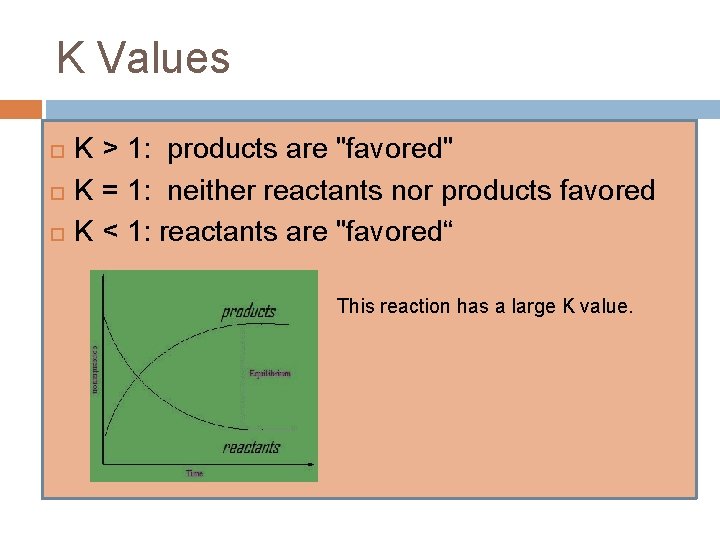
K Values K > 1: products are "favored" K = 1: neither reactants nor products favored K < 1: reactants are "favored“ T This reaction has a large K value.
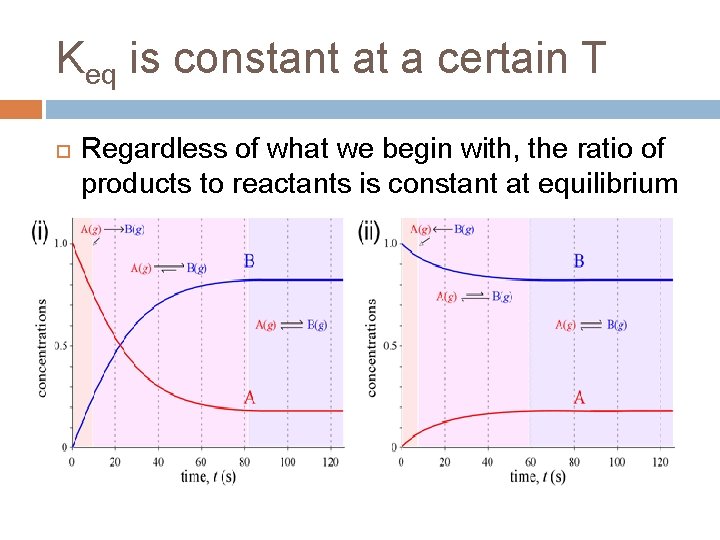
Keq is constant at a certain T Regardless of what we begin with, the ratio of products to reactants is constant at equilibrium
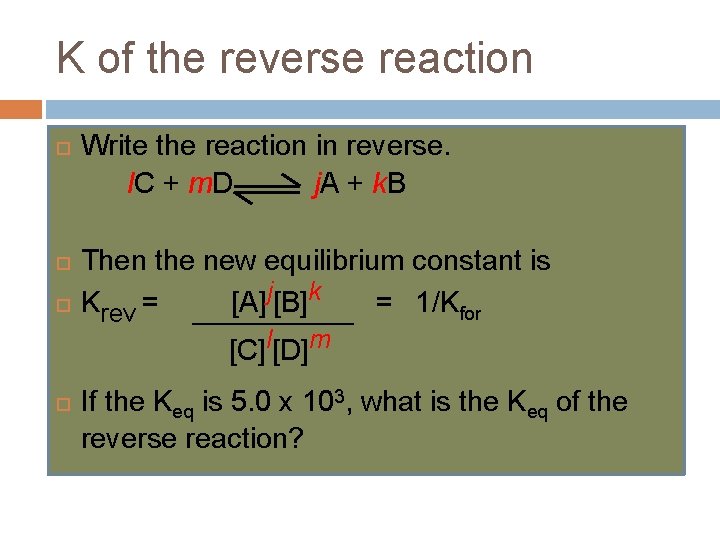
K of the reverse reaction Write the reaction in reverse. l. C + m. D j. A + k. B Then the new equilibrium constant is Krev = [A]j[B]k = 1/Kfor [C]l[D]m If the Keq is 5. 0 x 103, what is the Keq of the reverse reaction?
The units for K There is no set or common unit for K. The units are dependent on the reaction. There may be no units, M, M 2, 1/M, etc. Since units may vary, the standard method is to not include any units.
SOLVING PROBLEMS AT EQUILIBRIUM Using the Mass Action Expression
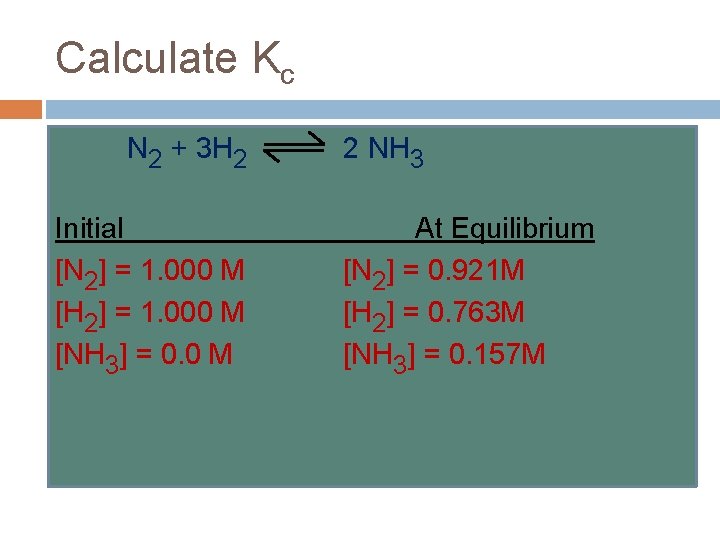
Calculate Kc N 2 + 3 H 2 Initial [N 2] = 1. 000 M [H 2] = 1. 000 M [NH 3] = 0. 0 M 2 NH 3 At Equilibrium [N 2] = 0. 921 M [H 2] = 0. 763 M [NH 3] = 0. 157 M
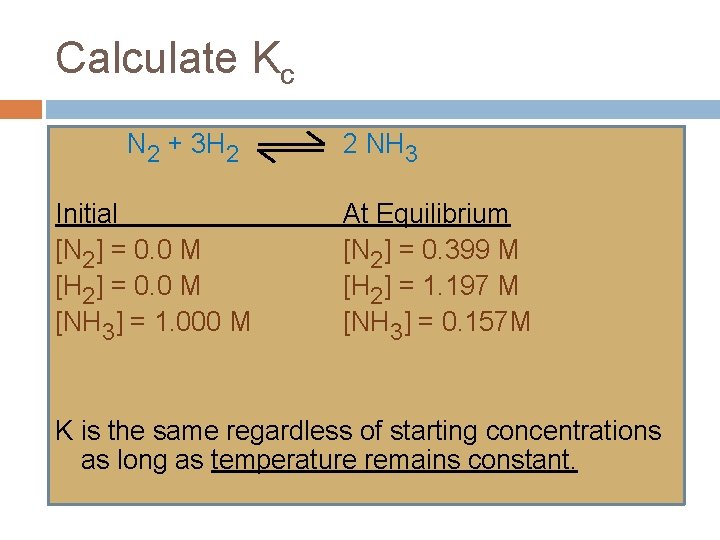
Calculate Kc N 2 + 3 H 2 Initial [N 2] = 0. 0 M [H 2] = 0. 0 M [NH 3] = 1. 000 M 2 NH 3 At Equilibrium [N 2] = 0. 399 M [H 2] = 1. 197 M [NH 3] = 0. 157 M K is the same regardless of starting concentrations as long as temperature remains constant.
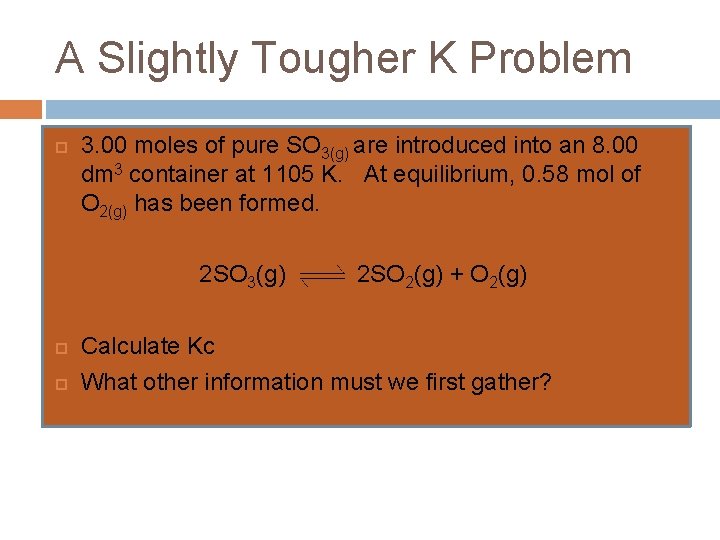
A Slightly Tougher K Problem 3. 00 moles of pure SO 3(g) are introduced into an 8. 00 dm 3 container at 1105 K. At equilibrium, 0. 58 mol of O 2(g) has been formed. 2 SO 3(g) 2 SO 2(g) + O 2(g) Calculate Kc What other information must we first gather?
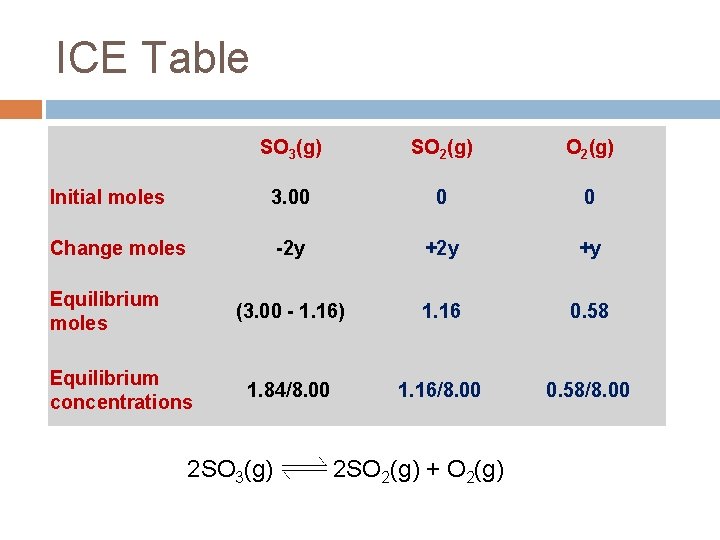
ICE Table SO 3(g) SO 2(g) Initial moles 3. 00 0 0 Change moles -2 y +2 y +y (3. 00 - 1. 16) 1. 16 0. 58 1. 84/8. 00 1. 16/8. 00 0. 58/8. 00 Equilibrium moles Equilibrium concentrations 2 SO 3(g) 2 SO 2(g) + O 2(g)
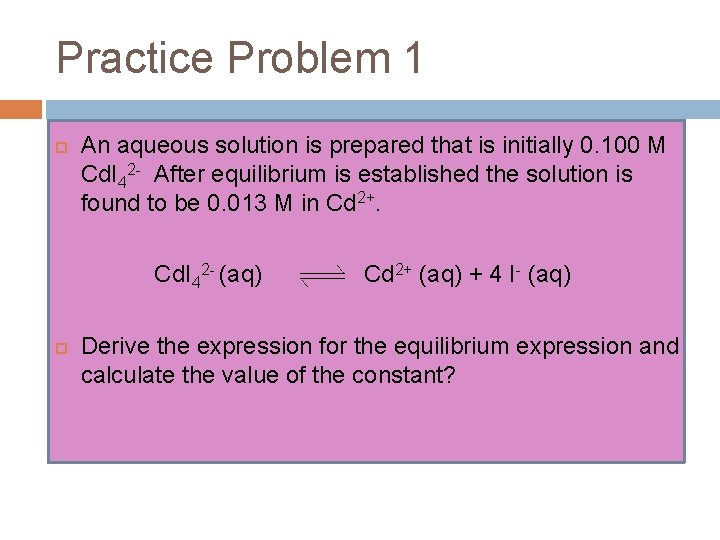
Practice Problem 1 An aqueous solution is prepared that is initially 0. 100 M Cd. I 42 - After equilibrium is established the solution is found to be 0. 013 M in Cd 2+. Cd. I 42 - (aq) Cd 2+ (aq) + 4 I- (aq) Derive the expression for the equilibrium expression and calculate the value of the constant?
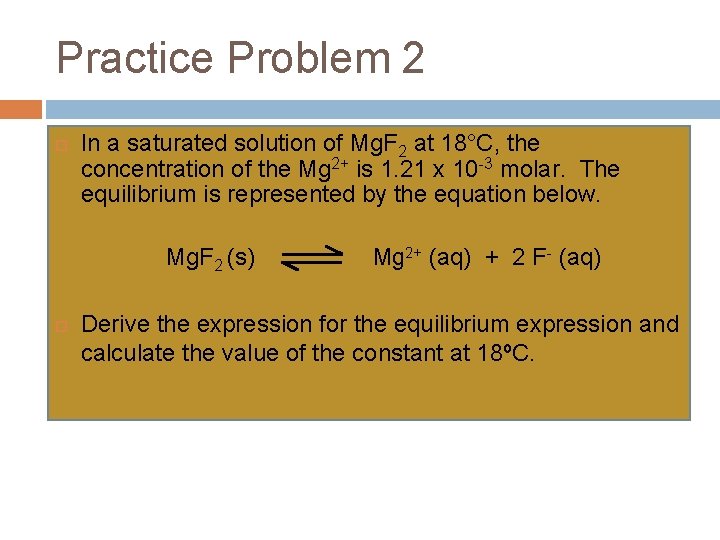
Practice Problem 2 In a saturated solution of Mg. F 2 at 18°C, the concentration of the Mg 2+ is 1. 21 x 10 -3 molar. The equilibrium is represented by the equation below. Mg. F 2 (s) Mg 2+ (aq) + 2 F- (aq) Derive the expression for the equilibrium expression and calculate the value of the constant at 18ºC.
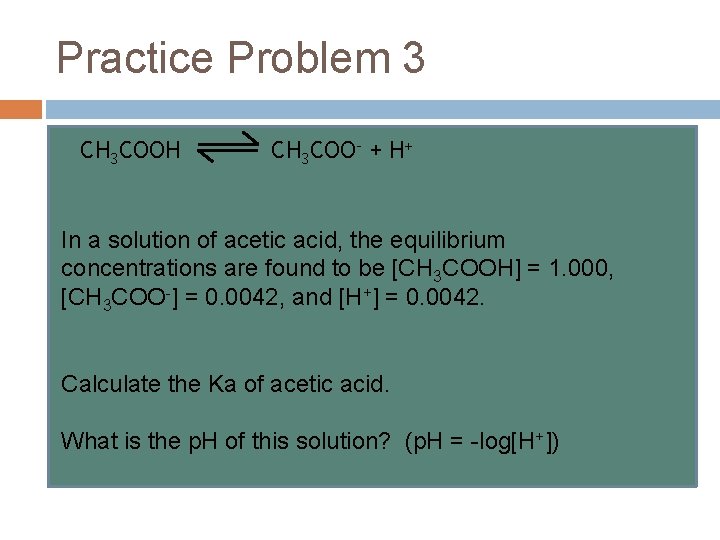
Practice Problem 3 CH 3 COOH CH 3 COO- + H+ In a solution of acetic acid, the equilibrium concentrations are found to be [CH 3 COOH] = 1. 000, [CH 3 COO-] = 0. 0042, and [H+] = 0. 0042. Calculate the Ka of acetic acid. What is the p. H of this solution? (p. H = -log[H+])
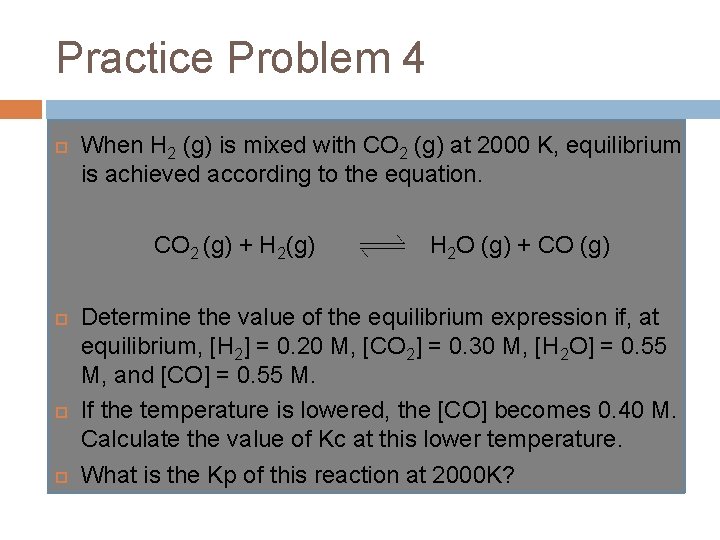
Practice Problem 4 When H 2 (g) is mixed with CO 2 (g) at 2000 K, equilibrium is achieved according to the equation. CO 2 (g) + H 2(g) H 2 O (g) + CO (g) Determine the value of the equilibrium expression if, at equilibrium, [H 2] = 0. 20 M, [CO 2] = 0. 30 M, [H 2 O] = 0. 55 M, and [CO] = 0. 55 M. If the temperature is lowered, the [CO] becomes 0. 40 M. Calculate the value of Kc at this lower temperature. What is the Kp of this reaction at 2000 K?

Converting from Kc to Kp Kp = Kc(RT)Δn Kp = Equilibrium constant based on pressure Kc = Equilibrium constant based on molar conc. R = Gas constant, use 0. 0821 L atm mol-1 K-1 T = Temperature, use Kelvin temp Δn = moles product gas – moles reactant gas
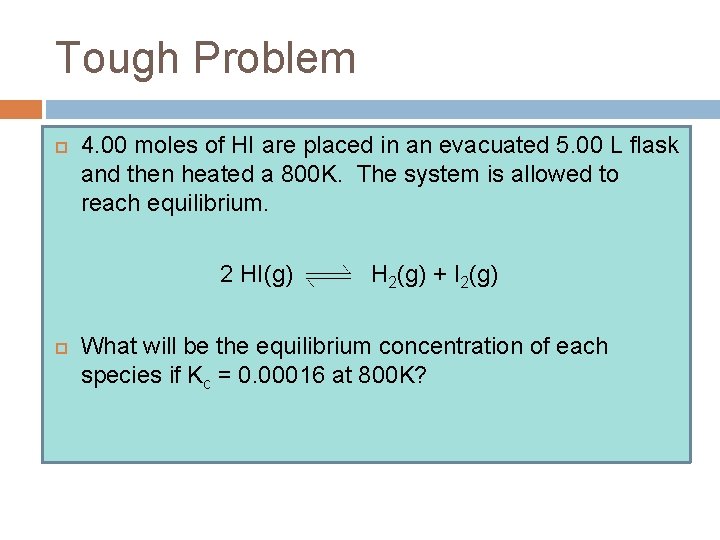
Tough Problem 4. 00 moles of HI are placed in an evacuated 5. 00 L flask and then heated a 800 K. The system is allowed to reach equilibrium. 2 HI(g) H 2(g) + I 2(g) What will be the equilibrium concentration of each species if Kc = 0. 00016 at 800 K?

ICE, baby! 2 HI(g) H 2(g) + I 2(g) HI H 2 Initial . 80 0 0 Change - 2 x + x + x EQ . 80 - 2 x . 00016 = (x) (. 8 - x)2 x = 0. 010 via the quadratic equation
- Slides: 23