
Chemical Equilibrium Lessons 3 4 Objectives Students should
Chemical Equilibrium
Lessons 3 & 4 Objectives Students should be able to: 1. Use the equilibrium constant expressed in terms of partial pressures (Kp) and relate Kp to Kc. 2. Describe heterogeneous equilibria and write their equilibrium constants. 3. Use the relationship between thermodynamics and equilibrium. 4. Estimate equilibrium constants at different temperatures. 5. Relate the variation of Gibbs free energy to pressure for an ideal gas.
6. Relate the variation of Gibbs free energy to temperature for an ideal gas 7. Use the free energy to determine the position of phase equilibria 8. Summarize the Clapeyron and the Clausius-Clapeyron equation for two phase systems 9. Use Raoult’s Law to define ideal solutions.
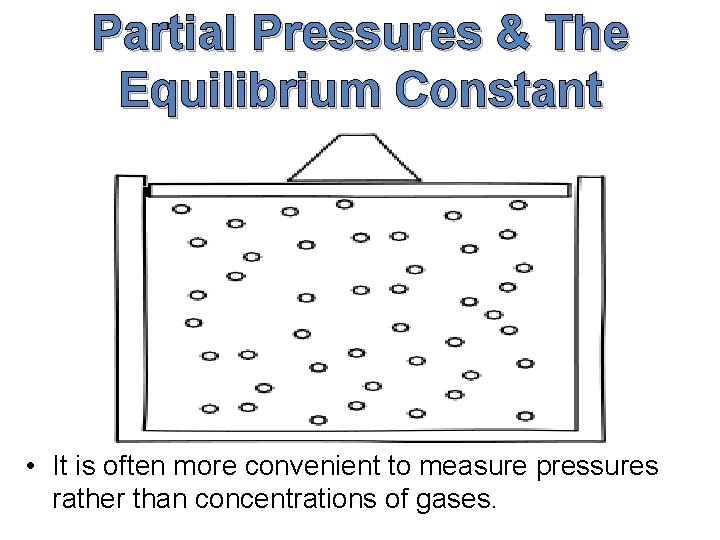
Partial Pressures & The Equilibrium Constant • It is often more convenient to measure pressures rather than concentrations of gases.
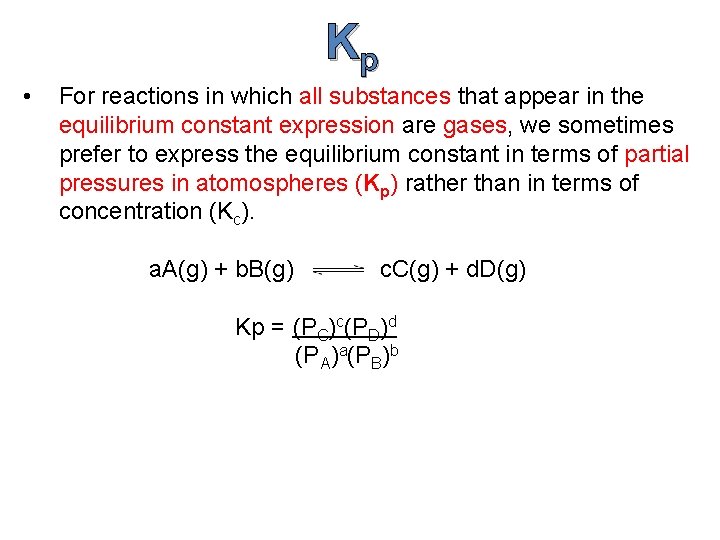
Kp • For reactions in which all substances that appear in the equilibrium constant expression are gases, we sometimes prefer to express the equilibrium constant in terms of partial pressures in atomospheres (Kp) rather than in terms of concentration (Kc). a. A(g) + b. B(g) c. C(g) + d. D(g) Kp = (PC)c(PD)d (P A)a(PB)b
Group Calculations – Calculation of Kp • Review Examples 17 -13 • Work on Exercises 70 & 73
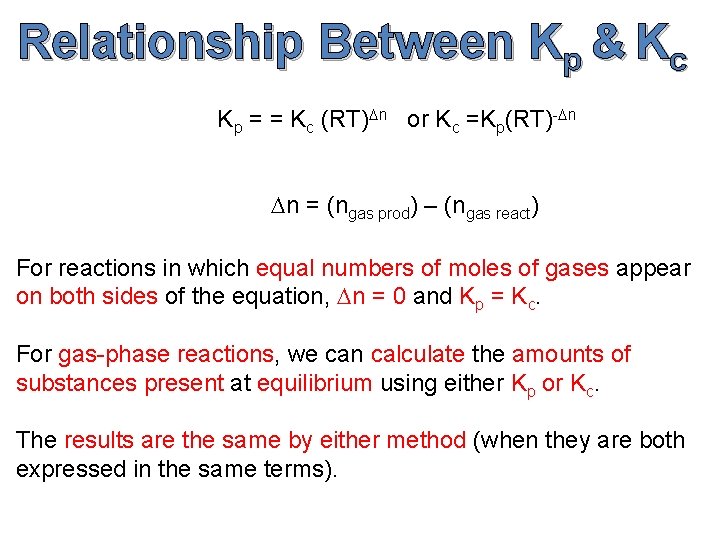
Relationship Between Kp & Kc Kp = = Kc (RT)Dn or Kc =Kp(RT)-Dn Dn = (ngas prod) – (ngas react) For reactions in which equal numbers of moles of gases appear on both sides of the equation, Dn = 0 and Kp = Kc. For gas-phase reactions, we can calculate the amounts of substances present at equilibrium using either Kp or Kc. The results are the same by either method (when they are both expressed in the same terms).
Group Calculations – Calculations with Kc and Kp • Review Examples 17 -14 • Work on Exercises 75 & 78
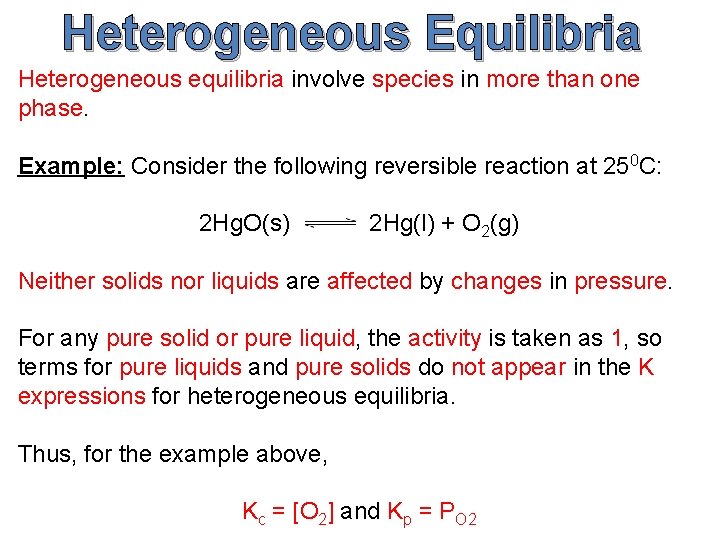
Heterogeneous Equilibria Heterogeneous equilibria involve species in more than one phase. Example: Consider the following reversible reaction at 250 C: 2 Hg. O(s) 2 Hg(l) + O 2(g) Neither solids nor liquids are affected by changes in pressure. For any pure solid or pure liquid, the activity is taken as 1, so terms for pure liquids and pure solids do not appear in the K expressions for heterogeneous equilibria. Thus, for the example above, Kc = [O 2] and Kp = PO 2
Group Calculations – Kc and Kp for Heterogenous Equilibria • Review Examples 17 -15 & 17 -16 • Work on Exercises 80 & 91
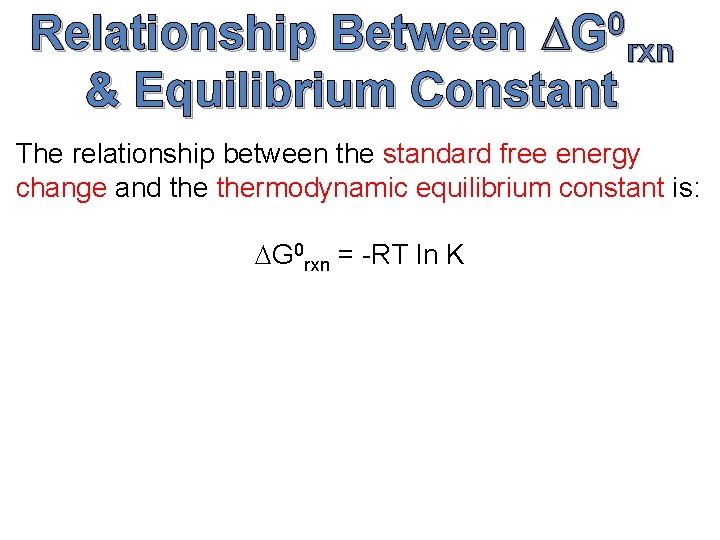
0 DG rxn Relationship Between & Equilibrium Constant The relationship between the standard free energy change and thermodynamic equilibrium constant is: DG 0 rxn = -RT ln K
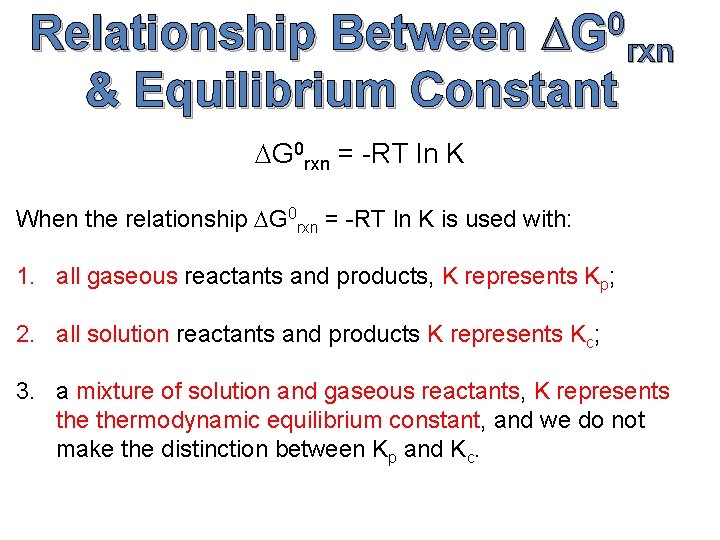
0 DG rxn Relationship Between & Equilibrium Constant DG 0 rxn = -RT ln K When the relationship DG 0 rxn = -RT ln K is used with: 1. all gaseous reactants and products, K represents Kp; 2. all solution reactants and products K represents Kc; 3. a mixture of solution and gaseous reactants, K represents thermodynamic equilibrium constant, and we do not make the distinction between Kp and Kc.
Group Calculations – K Versus DGorxn • Review Examples 17 -17, 17 -18 & 17 -19 • Work on Exercises 84, 86 & 88(a)
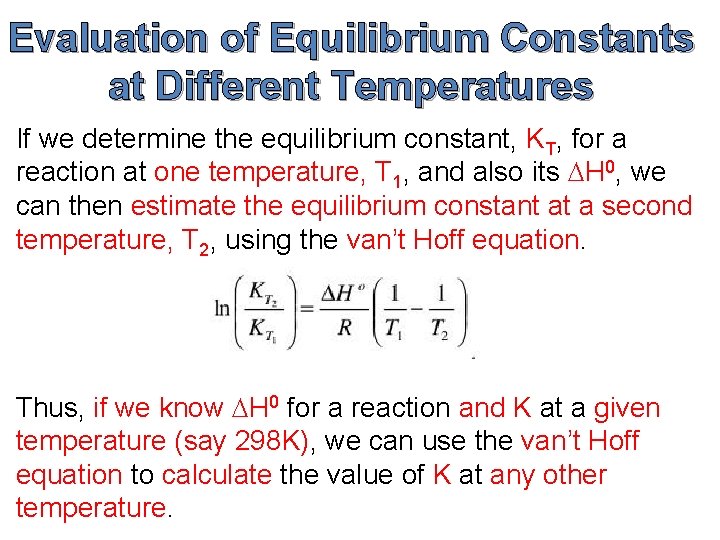
Evaluation of Equilibrium Constants at Different Temperatures If we determine the equilibrium constant, KT, for a reaction at one temperature, T 1, and also its DH 0, we can then estimate the equilibrium constant at a second temperature, T 2, using the van’t Hoff equation. Thus, if we know DH 0 for a reaction and K at a given temperature (say 298 K), we can use the van’t Hoff equation to calculate the value of K at any other temperature.
Group Calculations – K Versus DGorxn • Review Examples 17 -20 • Work on Exercises 88(b-f)
Gibbs Free Energy: Temperature & Pressure Dependance
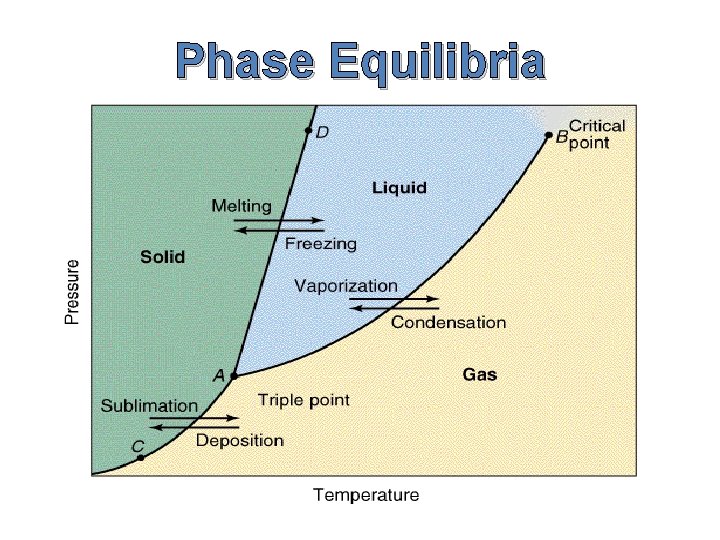
Phase Equilibria
Phase Equilibria WRITE (individually): 1. The derivation of the Clapeyron and the Clausius. Clapeyron equation for two phase systems. 2. An explanation of how Raoult’s Law is used to define ideal solutions
Assignment READ: General Chemistry (9 th Edition) -Chapter 17: Chemical Equilibrium, pages 685 – 702 - Chapter 18: Ionic Equilibria I: Acids and Bases, pages 703 – 742
References 1. General Chemistry (9 th Edition) Kenneth W. Whitten Raymond E. Davis M. Larry Peck George G. Stanley ISBN-13: 978 -0 -495 -39163 -0 ISBN-10: 0 -495 -39163 -8
- Slides: 20