
Chemical Equilibrium For a chemical reaction occurring in
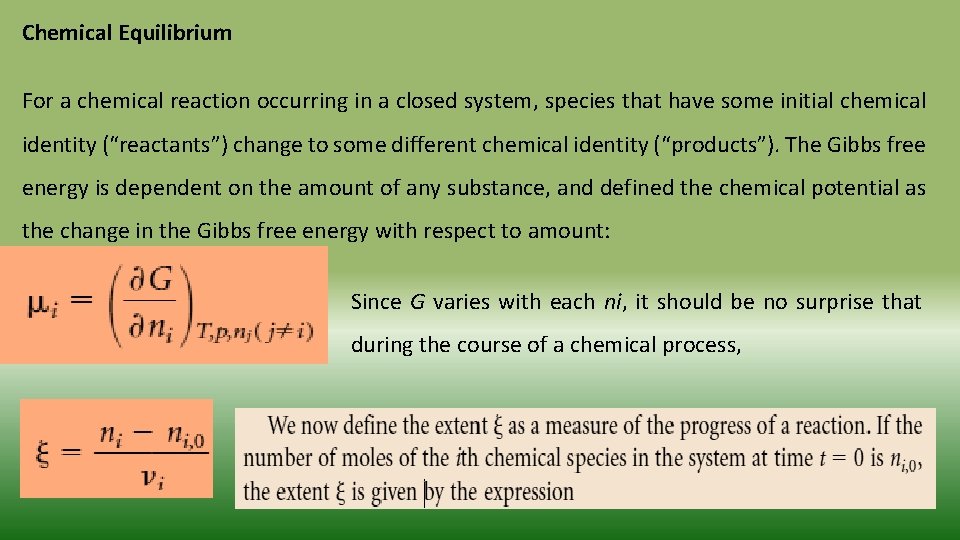
Chemical Equilibrium For a chemical reaction occurring in a closed system, species that have some initial chemical identity (“reactants”) change to some different chemical identity (“products”). The Gibbs free energy is dependent on the amount of any substance, and defined the chemical potential as the change in the Gibbs free energy with respect to amount: Since G varies with each ni, it should be no surprise that during the course of a chemical process,
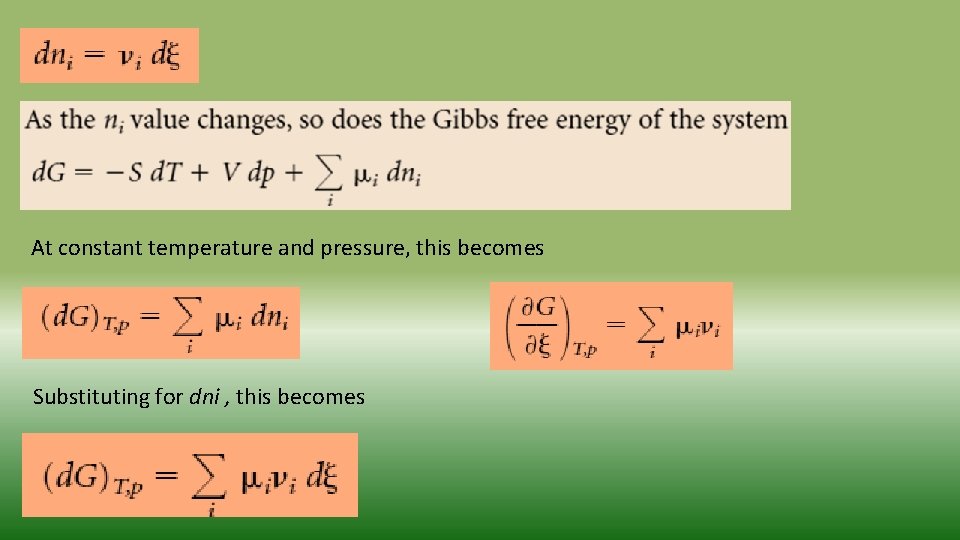
At constant temperature and pressure, this becomes Substituting for dni , this becomes
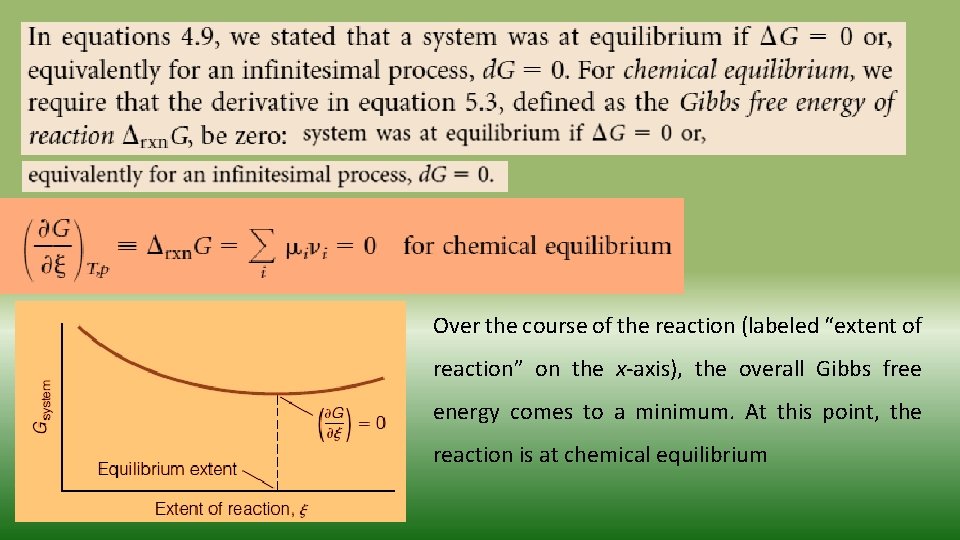
Over the course of the reaction (labeled “extent of reaction” on the x-axis), the overall Gibbs free energy comes to a minimum. At this point, the reaction is at chemical equilibrium
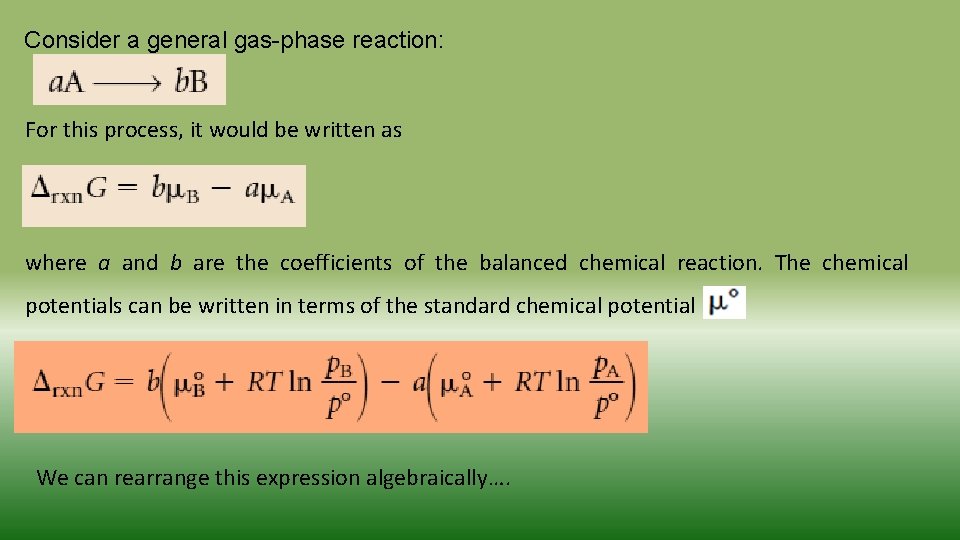
Consider a general gas-phase reaction: For this process, it would be written as where a and b are the coefficients of the balanced chemical reaction. The chemical potentials can be written in terms of the standard chemical potential We can rearrange this expression algebraically…. .
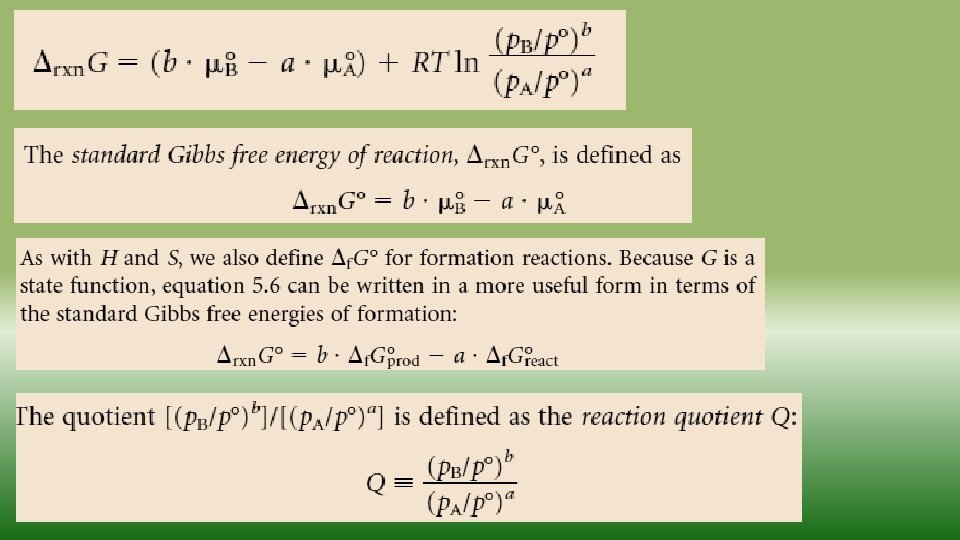
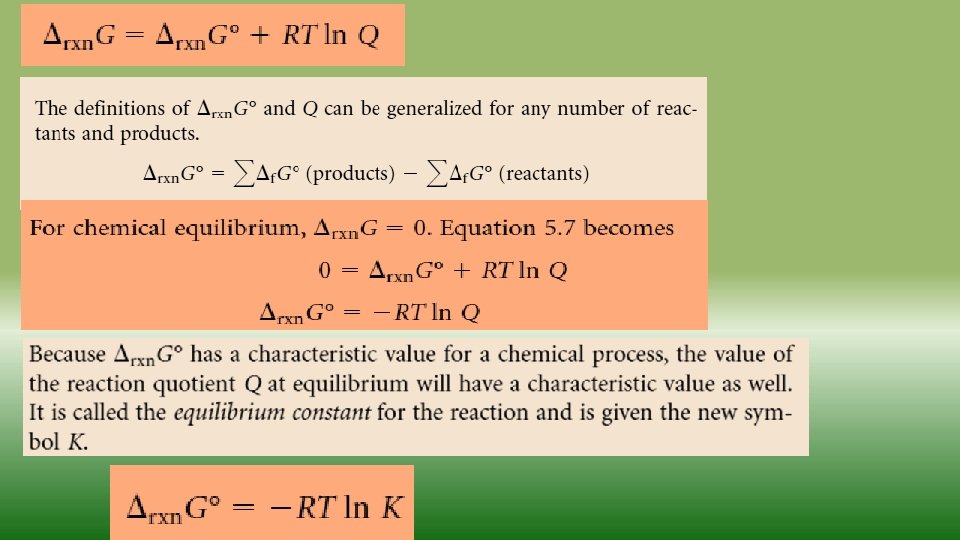
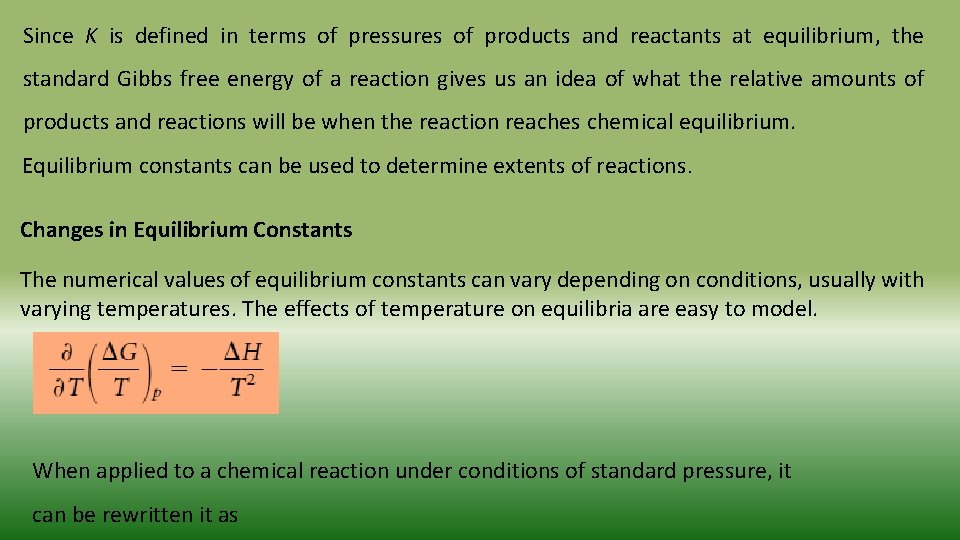
Since K is defined in terms of pressures of products and reactants at equilibrium, the standard Gibbs free energy of a reaction gives us an idea of what the relative amounts of products and reactions will be when the reaction reaches chemical equilibrium. Equilibrium constants can be used to determine extents of reactions. Changes in Equilibrium Constants The numerical values of equilibrium constants can vary depending on conditions, usually with varying temperatures. The effects of temperature on equilibria are easy to model. When applied to a chemical reaction under conditions of standard pressure, it can be rewritten it as
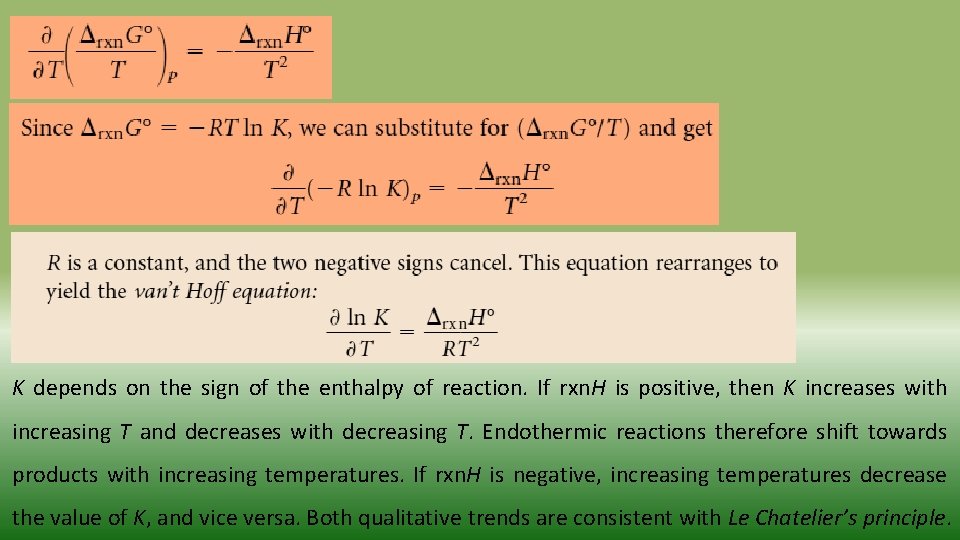
K depends on the sign of the enthalpy of reaction. If rxn. H is positive, then K increases with increasing T and decreases with decreasing T. Endothermic reactions therefore shift towards products with increasing temperatures. If rxn. H is negative, increasing temperatures decrease the value of K, and vice versa. Both qualitative trends are consistent with Le Chatelier’s principle.
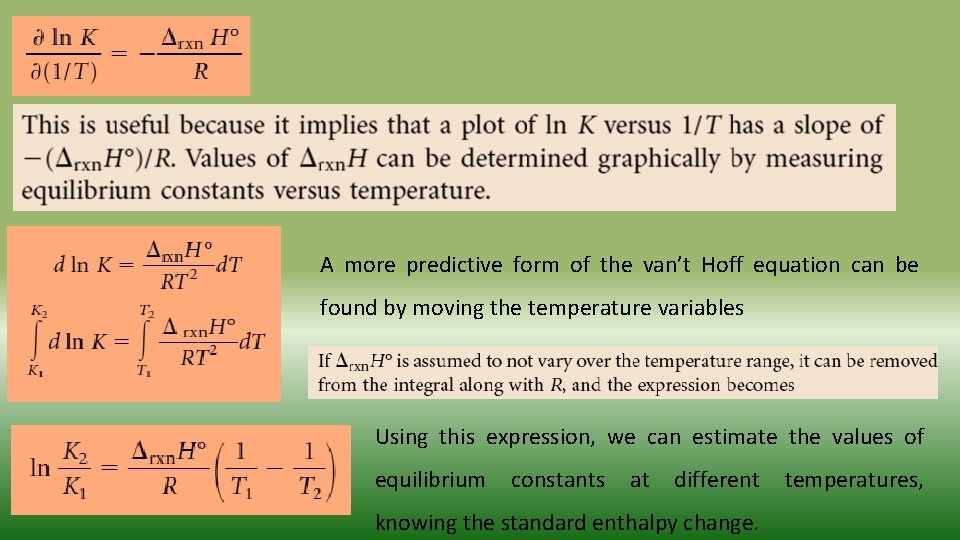
A more predictive form of the van’t Hoff equation can be found by moving the temperature variables Using this expression, we can estimate the values of equilibrium constants at different knowing the standard enthalpy change. temperatures,
- Slides: 9