
Chemical Equilibrium Check out TED ED If molecules
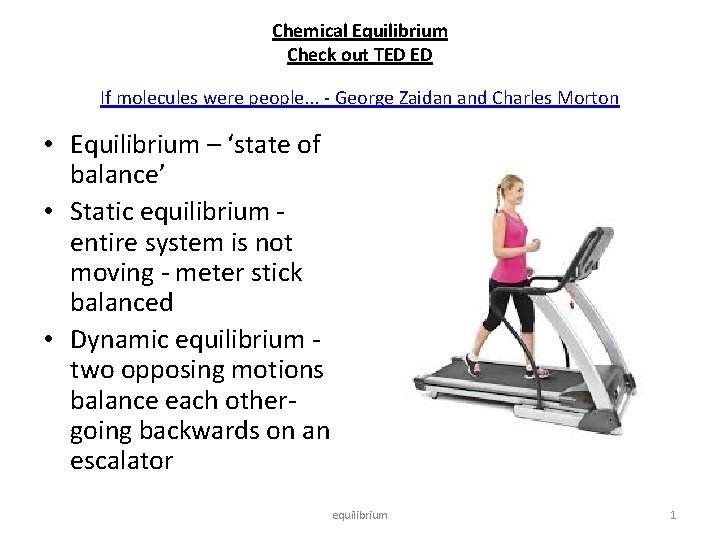
Chemical Equilibrium Check out TED ED If molecules were people. . . - George Zaidan and Charles Morton • Equilibrium – ‘state of balance’ • Static equilibrium - entire system is not moving - meter stick balanced • Dynamic equilibrium - two opposing motions balance each other- going backwards on an escalator equilibrium 1
Chemical equilibrium • Some chemical reactions have a forward and back reaction. • The reaction goes to completion when the concentration of reactants and products are the same. This is known as dynamic equilibrium. • Chemical equilibrium is a state of dynamic balance where the rate of the forward reaction equals the rate of the reverse reaction. equilibrium 2
Le Chatelier’s principle • If a stress is applied to a system at equilibrium, the system readjusts to relieve the stress applied. • A change in stress could be a change in the conditions of the reaction, e. g. • concentration of reactants or products, • temperature, • pressure if in gaseous state equilibrium 3
How does a change in temperature change the state of equilibrium of a reaction? • Exothermic reactions: increased temperature favours the reactants • Endothermic reactions: increased temperature favours the products. • How does a change in pressure alter the state of equilibrium of a reaction? • Le Chatelier’s principle states that in a gaseous reaction an increase in pressure will favour the direction of the reaction that has the least number of moles. • If there are the same number of moles of both sides of an equation, a change in pressure will not effect the state of equilibrium. • A catalyst does not change the yield of product, it simply speeds up the rate at which equilibrium is reached. equilibrium 4

Manufacture of Ammonia by the Haber Process using Le Chatelier’s Principle • Approximately 80% of Ammonia is used in making fertilizers • Ammonia made by reacting N 2 and H 2. • Iron is used as a catalyst to speed up the rate at which equilibrium is reached. • N 2 + 3 H 2 2 NH 3 • Yield of NH 3 produced depends on: • Temperature • The reaction is exothermic therefore the reaction is driven to RHS if temperature is lowered. • Pressure-only applies to gaseous system • 3 moles of reactants on LHS and 2 moles of product on RHS • High pressure will drive reaction to RHS as a result. • High –pressure plant is expensive. • Overall, the best conditions for a high yield of NH 3 are high pressure and low temperature. equilibrium 5
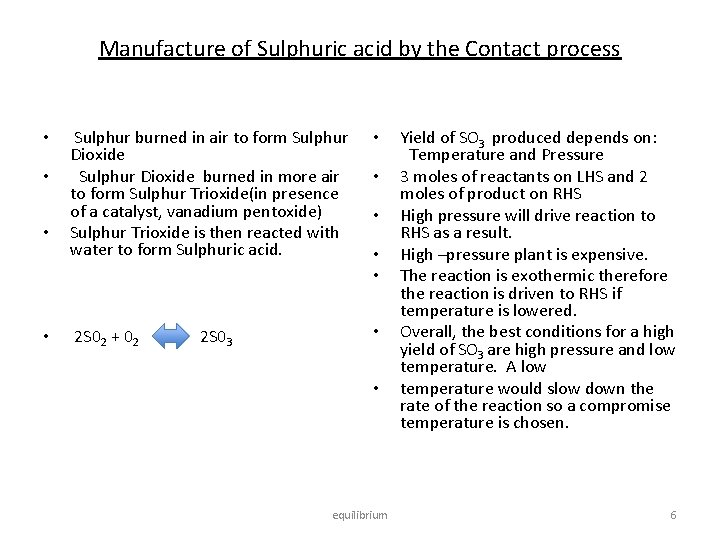
Manufacture of Sulphuric acid by the Contact process • • Sulphur burned in air to form Sulphur Dioxide burned in more air to form Sulphur Trioxide(in presence of a catalyst, vanadium pentoxide) Sulphur Trioxide is then reacted with water to form Sulphuric acid. • 2 S 02 + 02 2 S 03 • • • equilibrium Yield of SO 3 produced depends on: Temperature and Pressure 3 moles of reactants on LHS and 2 moles of product on RHS High pressure will drive reaction to RHS as a result. High –pressure plant is expensive. The reaction is exothermic therefore the reaction is driven to RHS if temperature is lowered. Overall, the best conditions for a high yield of SO 3 are high pressure and low temperature. A low temperature would slow down the rate of the reaction so a compromise temperature is chosen. 6
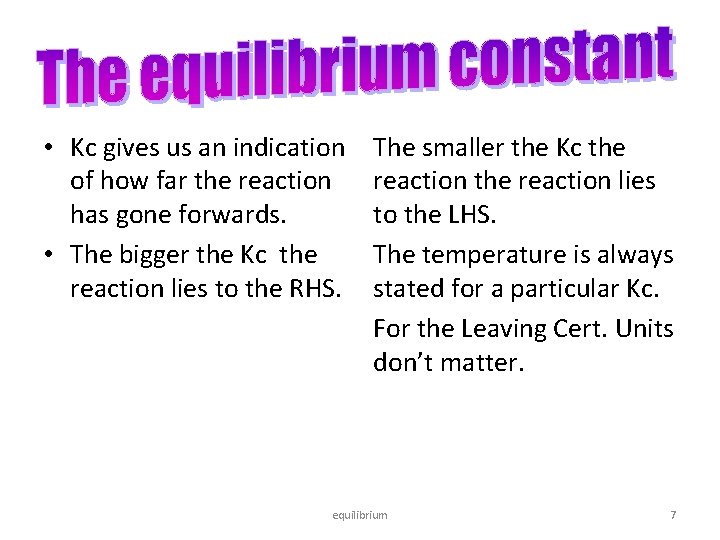
• Kc gives us an indication of how far the reaction has gone forwards. • The bigger the Kc the reaction lies to the RHS. The smaller the Kc the reaction lies to the LHS. The temperature is always stated for a particular Kc. For the Leaving Cert. Units don’t matter. equilibrium 7
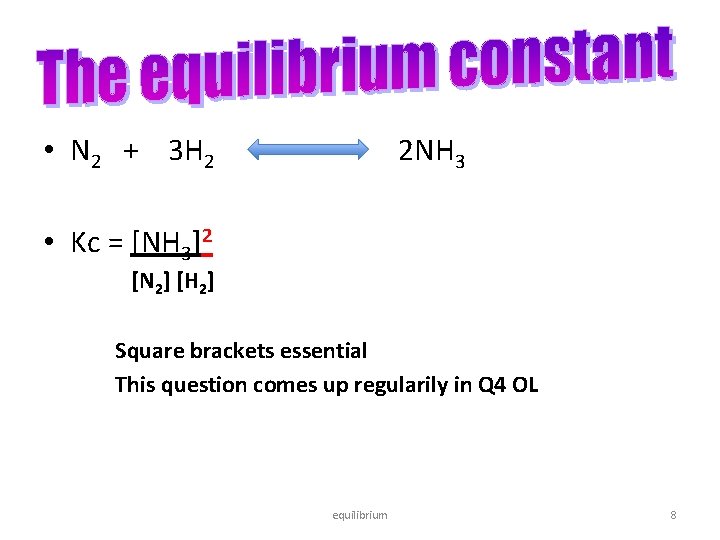
• N 2 + 3 H 2 2 NH 3 • Kc = [NH 3]2 [N 2] [H 2] Square brackets essential This question comes up regularily in Q 4 OL equilibrium 8
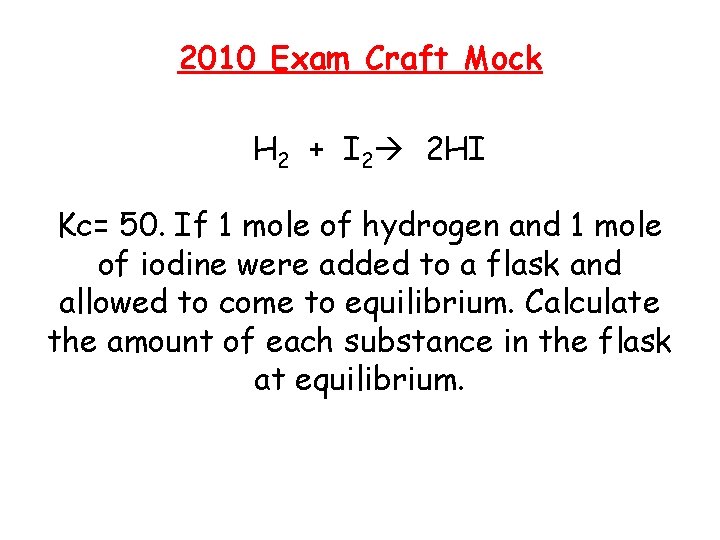
2010 Exam Craft Mock H 2 + I 2 2 HI Kc= 50. If 1 mole of hydrogen and 1 mole of iodine were added to a flask and allowed to come to equilibrium. Calculate the amount of each substance in the flask at equilibrium.
Exam questions to be done for Easter holidays 2014 Q. 9 2013 Q. 9 2012 Q. 11 (b) 2011 Q. 9 (b) not on syllabus anymore • 2010 Q. 7 • 2009 Q. 11(a) • 2008 Q. 7 • • • 2007 Q. 10(a) • 2006 Q. 11 (b) not on syllabus anymore • 2005 Q. 9 • 2004 Q. 9 • 2003 Q. 10 (c) equilibrium 10
- Slides: 10