
Chemical Equilibrium Chapter 16 General Chemistry Principles and

Chemical Equilibrium Chapter 16 General Chemistry - Principles and Modern Applications Petrucci • Harwood • Herring, 8 th Edition; Prentice-Hall © 2002 An Equilibrium is reached when two opposing processes take place at equal rates.
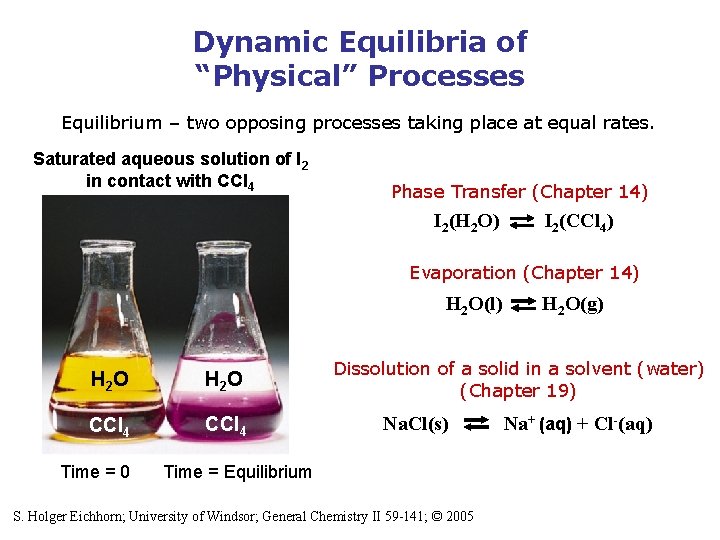
Dynamic Equilibria of “Physical” Processes Equilibrium – two opposing processes taking place at equal rates. Saturated aqueous solution of I 2 in contact with CCl 4 Phase Transfer (Chapter 14) I 2(H 2 O) I 2(CCl 4) Evaporation (Chapter 14) H 2 O(l) H 2 O CCl 4 Time = 0 H 2 O(g) Dissolution of a solid in a solvent (water) (Chapter 19) Na. Cl(s) Time = Equilibrium S. Holger Eichhorn; University of Windsor; General Chemistry II 59 -141; © 2005 Na+ (aq) + Cl-(aq)
S. Holger Eichhorn; University of Windsor; General Chemistry II 59 -141; © 2005
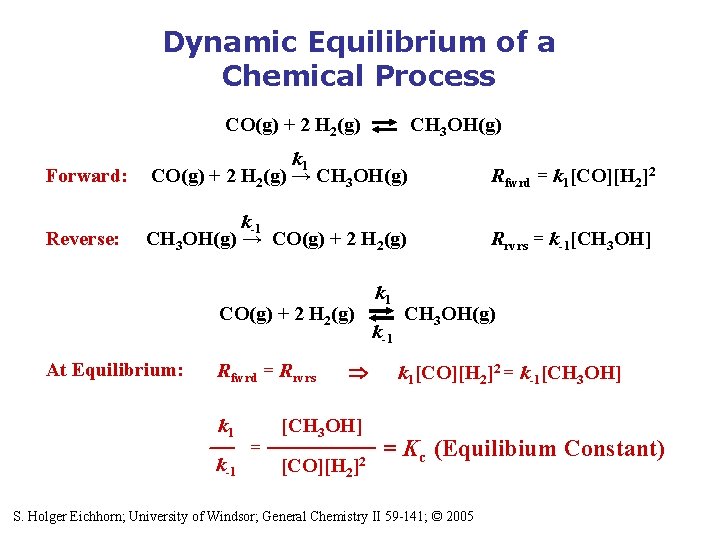
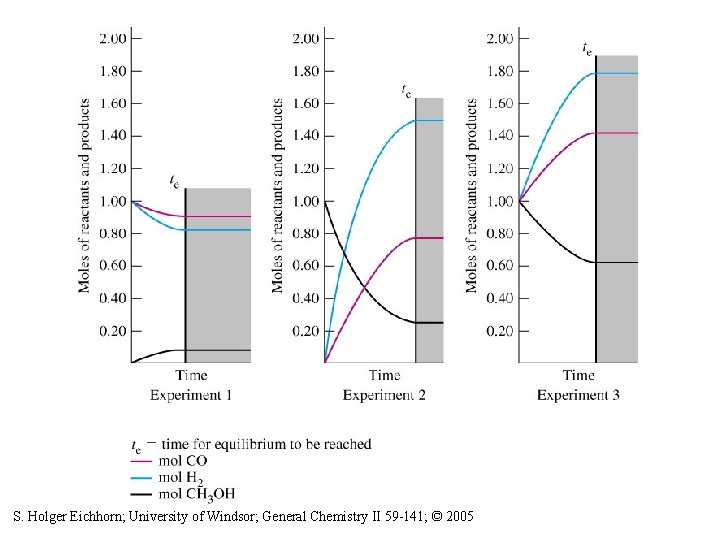
Dynamic Equilibrium of a Chemical Process CO(g) + 2 H 2(g) CH 3 OH(g) Forward: k 1 CO(g) + 2 H 2(g) → CH 3 OH(g) Rfwrd = k 1[CO][H 2]2 Reverse: k-1 CH 3 OH(g) → CO(g) + 2 H 2(g) Rrvrs = k-1[CH 3 OH] CO(g) + 2 H 2(g) At Equilibrium: Rfwrd = Rrvrs k 1 k-1 = [CH 3 OH] [CO][H 2]2 k 1 k-1 CH 3 OH(g) k 1[CO][H 2]2 = k-1[CH 3 OH] = Kc (Equilibium Constant) S. Holger Eichhorn; University of Windsor; General Chemistry II 59 -141; © 2005
S. Holger Eichhorn; University of Windsor; General Chemistry II 59 -141; © 2005
S. Holger Eichhorn; University of Windsor; General Chemistry II 59 -141; © 2005
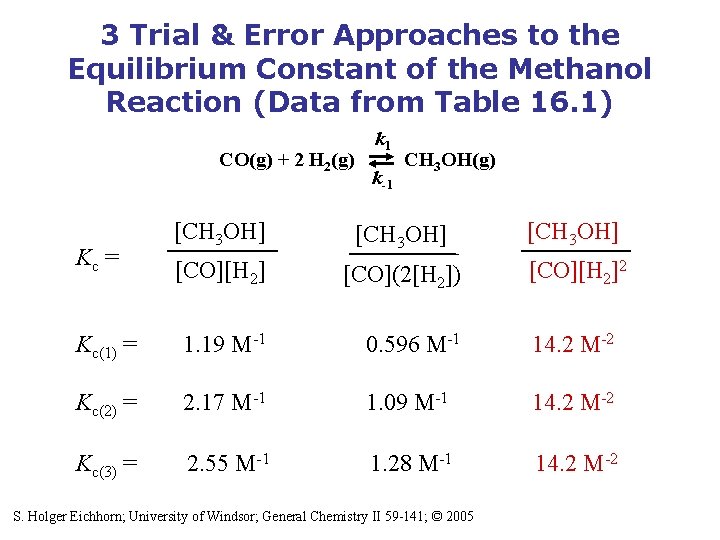
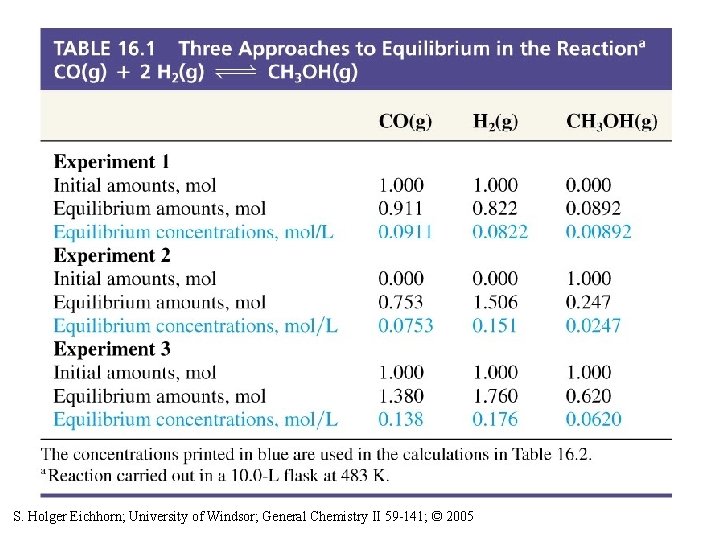
3 Trial & Error Approaches to the Equilibrium Constant of the Methanol Reaction (Data from Table 16. 1) CO(g) + 2 H 2(g) k 1 k-1 CH 3 OH(g) [CH 3 OH] [CO][H 2] [CO](2[H 2]) [CO][H 2]2 Kc(1) = 1. 19 M-1 0. 596 M-1 14. 2 M-2 Kc(2) = 2. 17 M-1 1. 09 M-1 14. 2 M-2 Kc(3) = 2. 55 M-1 1. 28 M-1 14. 2 M-2 Kc = S. Holger Eichhorn; University of Windsor; General Chemistry II 59 -141; © 2005
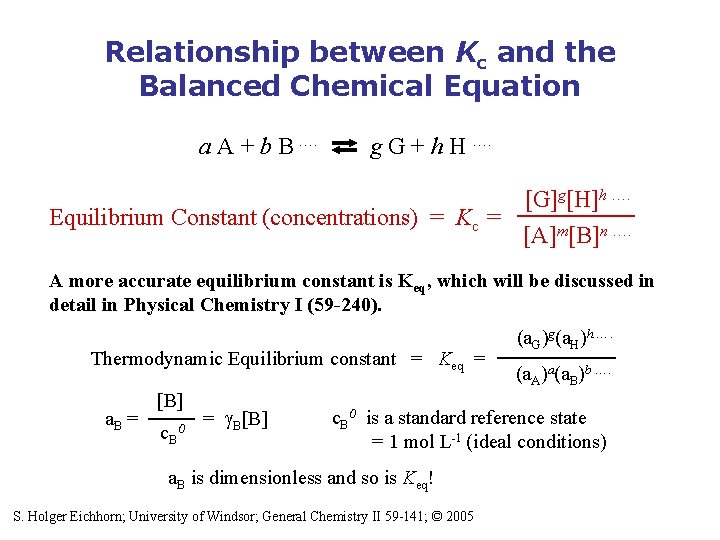
Relationship between Kc and the Balanced Chemical Equation a A + b B …. g G + h H …. [G]g[H]h …. Equilibrium Constant (concentrations) = Kc = [A]m[B]n …. A more accurate equilibrium constant is Keq, which will be discussed in detail in Physical Chemistry I (59 -240). Thermodynamic Equilibrium constant = Keq = a. B = [B] c. B 0 = B[B] (a. G)g(a. H)h …. (a. A)a(a. B)b …. c. B 0 is a standard reference state = 1 mol L-1 (ideal conditions) a. B is dimensionless and so is Keq! S. Holger Eichhorn; University of Windsor; General Chemistry II 59 -141; © 2005
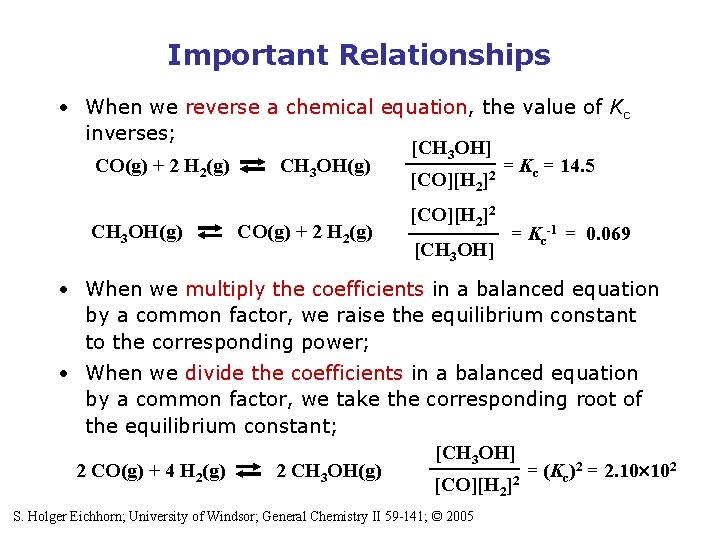
Important Relationships • When we reverse a chemical equation, the value of Kc inverses; [CH 3 OH] CO(g) + 2 H 2(g) CH 3 OH(g) = Kc = 14. 5 2 [CO][H 2] CH 3 OH(g) CO(g) + 2 H 2(g) [CO][H 2]2 [CH 3 OH] = Kc-1 = 0. 069 • When we multiply the coefficients in a balanced equation by a common factor, we raise the equilibrium constant to the corresponding power; • When we divide the coefficients in a balanced equation by a common factor, we take the corresponding root of the equilibrium constant; [CH 3 OH] 2 = 2. 10 102 2 CO(g) + 4 H 2(g) 2 CH 3 OH(g) = (K ) c [CO][H 2]2 S. Holger Eichhorn; University of Windsor; General Chemistry II 59 -141; © 2005
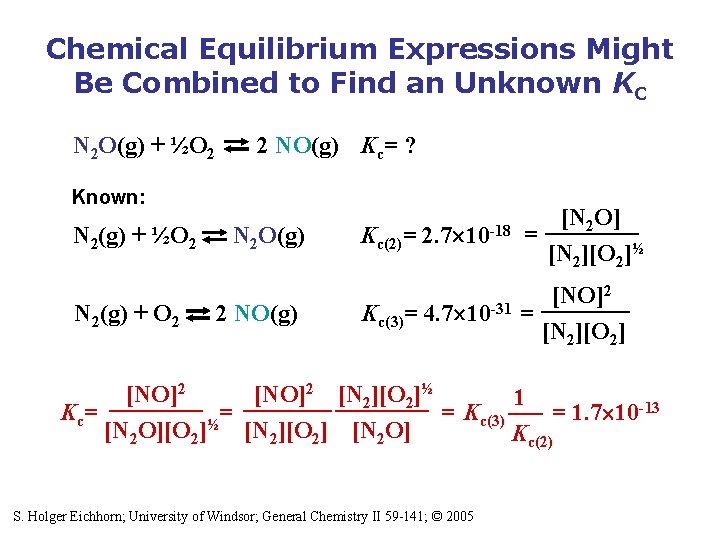
Chemical Equilibrium Expressions Might Be Combined to Find an Unknown KC N 2 O(g) + ½O 2 2 NO(g) Kc= ? Known: N 2(g) + ½O 2 N 2(g) + O 2 N 2 O(g) 2 NO(g) Kc(2)= 2. 7 10 -18 [N 2 O] = [N 2][O 2]½ Kc(3)= 4. 7 10 -31 = [NO]2 [N 2][O 2]½ 1 -13 K c= = K = = 1. 7 10 c(3) [N 2 O][O 2]½ [N 2][O 2] [N 2 O] Kc(2) S. Holger Eichhorn; University of Windsor; General Chemistry II 59 -141; © 2005
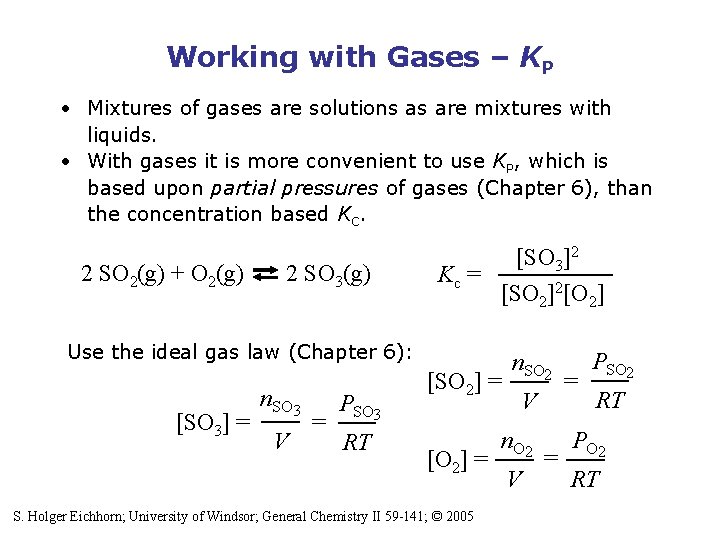
Working with Gases – KP • Mixtures of gases are solutions as are mixtures with liquids. • With gases it is more convenient to use KP, which is based upon partial pressures of gases (Chapter 6), than the concentration based KC. 2 SO 2(g) + O 2(g) 2 SO 3(g) [SO 3]2 Kc = [SO 2]2[O 2] Use the ideal gas law (Chapter 6): [SO 3] = n. SO 3 V = PSO 3 RT [SO 2] = [O 2] = S. Holger Eichhorn; University of Windsor; General Chemistry II 59 -141; © 2005 n. SO 2 V n. O 2 V = = PSO 2 RT P O 2 RT

PSO 3 Kc = [SO 3]2 [SO 2]2[O 2] = 2 RT 2 PSO 2 PO 2 RT = 2 PSO 3 2 PSO 2 PO 2 RT RT KP = 2 PSO 3 PSO 2 PO 2 Kc = KP(RT) and KP = Kc(RT)-1 For a general balanced chemical equation a A + b B …. g G + h H …. KP = Kc(RT)Δn(gas) Dn = the sum of the stoichiometric coefficients of gaseous products minus the sum of the stoichiometric coefficients of gaseous reactants; Dn = (g + h + …) – (a + b + …) S. Holger Eichhorn; University of Windsor; General Chemistry II 59 -141; © 2005 2
Do Examples 16 -2 and 16 -3
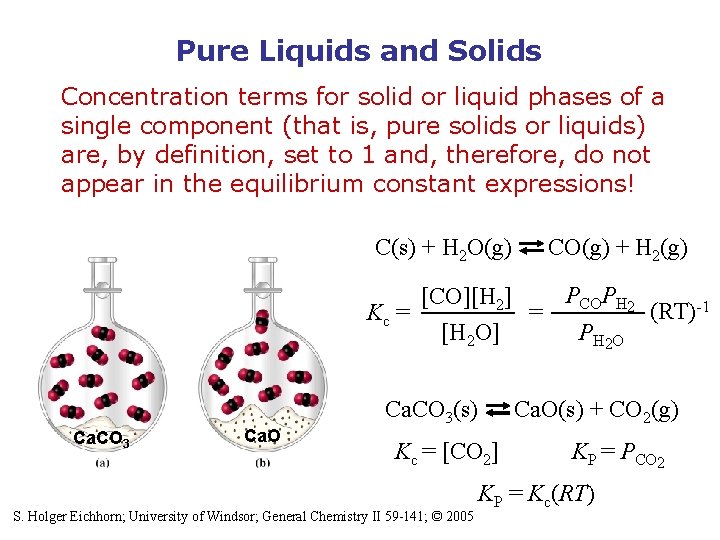
Pure Liquids and Solids Concentration terms for solid or liquid phases of a single component (that is, pure solids or liquids) are, by definition, set to 1 and, therefore, do not appear in the equilibrium constant expressions! C(s) + H 2 O(g) CO(g) + H 2(g) PCOPH 2 [CO][H 2] (RT)-1 Kc = = [H 2 O] PH 2 O Ca. CO 3 Ca. O Ca. CO 3(s) Kc = [CO 2] S. Holger Eichhorn; University of Windsor; General Chemistry II 59 -141; © 2005 Ca. O(s) + CO 2(g) KP = PCO 2 KP = Kc(RT)
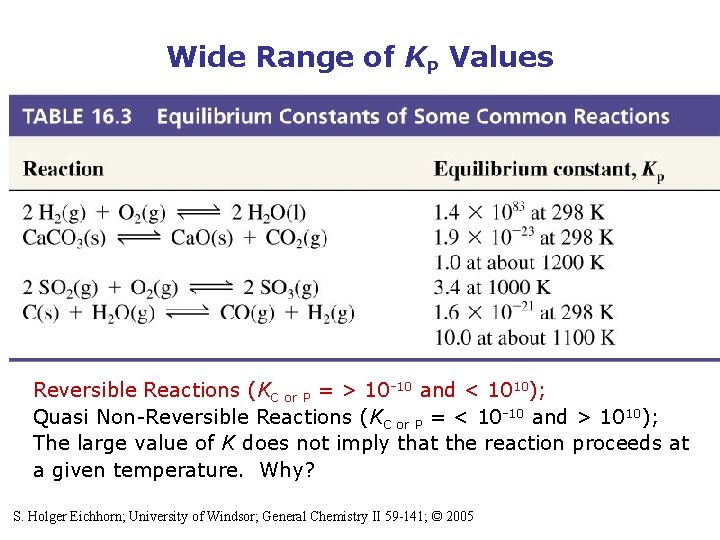
Wide Range of KP Values Reversible Reactions (KC or P = > 10 -10 and < 1010); Quasi Non-Reversible Reactions (KC or P = < 10 -10 and > 1010); The large value of K does not imply that the reaction proceeds at a given temperature. Why? S. Holger Eichhorn; University of Windsor; General Chemistry II 59 -141; © 2005
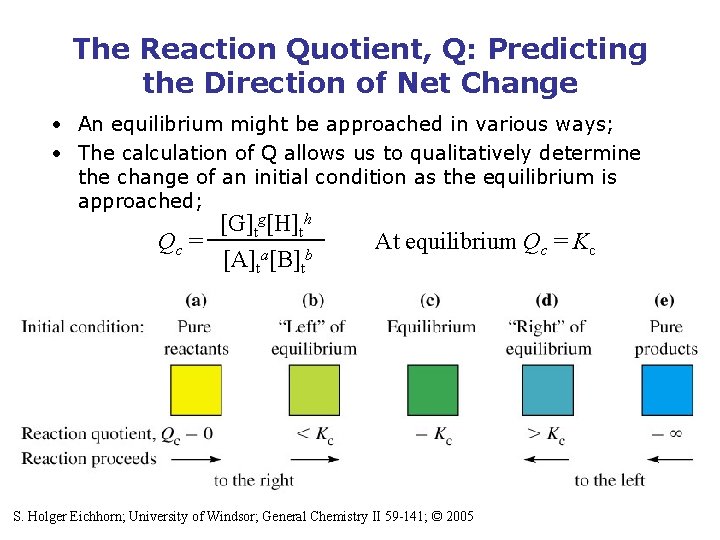
The Reaction Quotient, Q: Predicting the Direction of Net Change • An equilibrium might be approached in various ways; • The calculation of Q allows us to qualitatively determine the change of an initial condition as the equilibrium is approached; Qc = [G]tg[H]th [A]ta[B]tb At equilibrium Qc = Kc S. Holger Eichhorn; University of Windsor; General Chemistry II 59 -141; © 2005

Example 16 -5 CO(g) + 2 H 2(g) k 1 k-1 CH 3 OH(g) Direction of Net Chemical Change in Established Equilibrium KC = 1 at 1100 ºC; Starting amounts are 1 mol each of CO and H 2 O as well as 2 mols each of CO 2 and H 2. Which substance will be present in greater amounts and which in lesser amounts once the equilibrium has been established? S. Holger Eichhorn; University of Windsor; General Chemistry II 59 -141; © 2005
Altering Equilibrium Conditions: Le Châtellier’s Principle When a system in equilibrium is subjected to a change in temperature, pressure, or concentration of a reacting species, the system responds by attaining a new equilibrium that partially offsets the impact of the change. S. Holger Eichhorn; University of Windsor; General Chemistry II 59 -141; © 2005
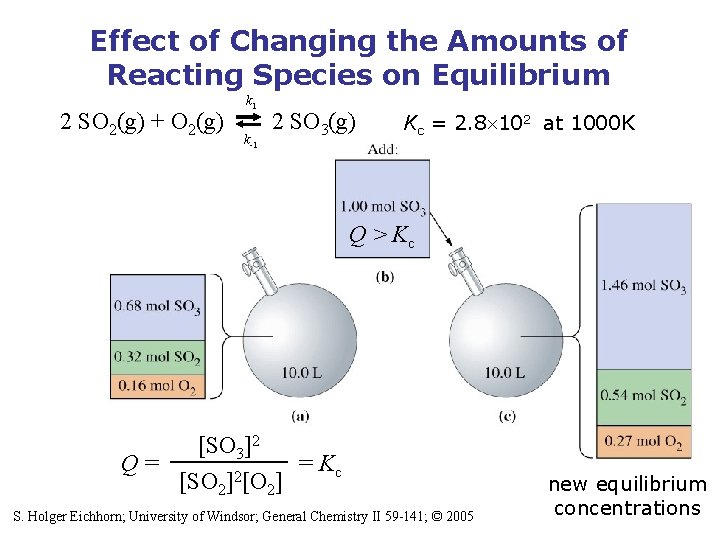
Effect of Changing the Amounts of Reacting Species on Equilibrium 2 SO 2(g) + O 2(g) k 1 k-1 2 SO 3(g) Kc = 2. 8 102 at 1000 K Q > Kc [SO 3]2 Q= = Kc 2 [SO 2] [O 2] S. Holger Eichhorn; University of Windsor; General Chemistry II 59 -141; © 2005 new equilibrium concentrations
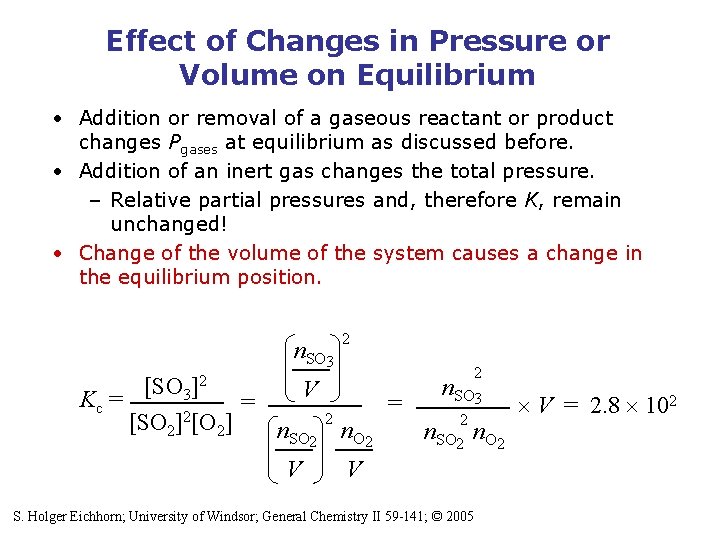
Effect of Changes in Pressure or Volume on Equilibrium • Addition or removal of a gaseous reactant or product changes Pgases at equilibrium as discussed before. • Addition of an inert gas changes the total pressure. – Relative partial pressures and, therefore K, remain unchanged! • Change of the volume of the system causes a change in the equilibrium position. n. SO 3 Kc = [SO 3]2 [SO 2]2[O 2] 2 V = n. SO 2 V 2 = n. O 2 2 n. SO 3 2 n. SO 2 n. O 2 V S. Holger Eichhorn; University of Windsor; General Chemistry II 59 -141; © 2005 V = 2. 8 102

Kc = [G]g[H]h [A]a[B]b [A]a = (n. A / VA)a = n Aa / VAa = = g n. G h n. H b n. Aa n. B g n. G n. Aa V(a+b)-(g+h) h n. H a n. B V-Δn Dn = (g + h + …) – (a + b + …) When the volume of an equilibrium mixture of gases is reduced, a net change occurs in the direction that produces fewer moles of gas. When the volume is increased, a net change occurs in the direction that produces more moles of gas. Do not confuse with Kc = KP(RT) and KP = Kc(RT)-1 S. Holger Eichhorn; University of Windsor; General Chemistry II 59 -141; © 2005
Effect of Temperature on Equilibrium • Raising the temperature of a reaction mixture at equilibrium shifts the equilibrium condition in the direction of the endothermic reaction. • Lowering the temperature causes a shift in the direction of the exothermic reaction. S. Holger Eichhorn; University of Windsor; General Chemistry II 59 -141; © 2005
Effect of a Catalyst on Equilibrium • A catalyst changes the mechanism of a reaction to one with a lower activation energy. • A catalyst has no effect on the equilibrium concentrations and constant. – But does affect the rate at which equilibrium is attained! S. Holger Eichhorn; University of Windsor; General Chemistry II 59 -141; © 2005
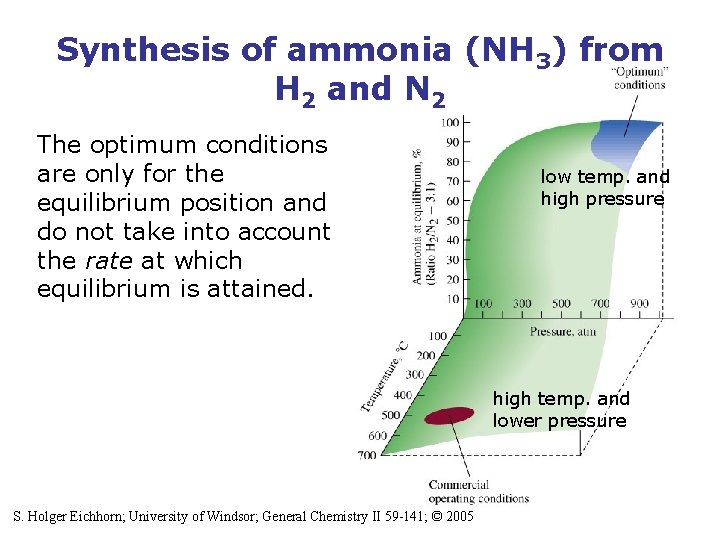
Synthesis of ammonia (NH 3) from H 2 and N 2 The optimum conditions are only for the equilibrium position and do not take into account the rate at which equilibrium is attained. low temp. and high pressure high temp. and lower pressure S. Holger Eichhorn; University of Windsor; General Chemistry II 59 -141; © 2005
Examples 16 -10 to -12 and Feature Problem 91 (p. 664) Do it! S. Holger Eichhorn; University of Windsor; General Chemistry II 59 -141; © 2005
- Slides: 25