
Chemical Equilibrium Chapter 15 The Concept of Equilibrium
Chemical Equilibrium Chapter 15
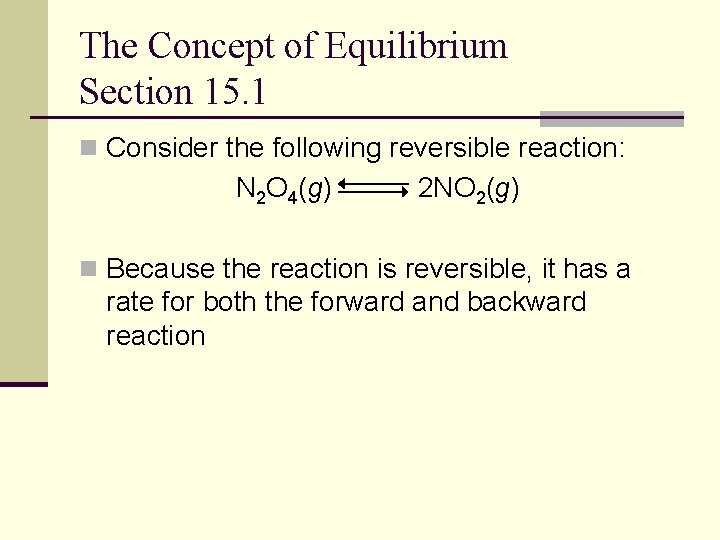
The Concept of Equilibrium Section 15. 1 n Consider the following reversible reaction: N 2 O 4(g) 2 NO 2(g) n Because the reaction is reversible, it has a rate for both the forward and backward reaction

Achieving Equilibrium n At equilibrium, the rate of the forward reaction equals the rate of the backward reaction n Neither reaction stops, they are just in dynamic equilibrium
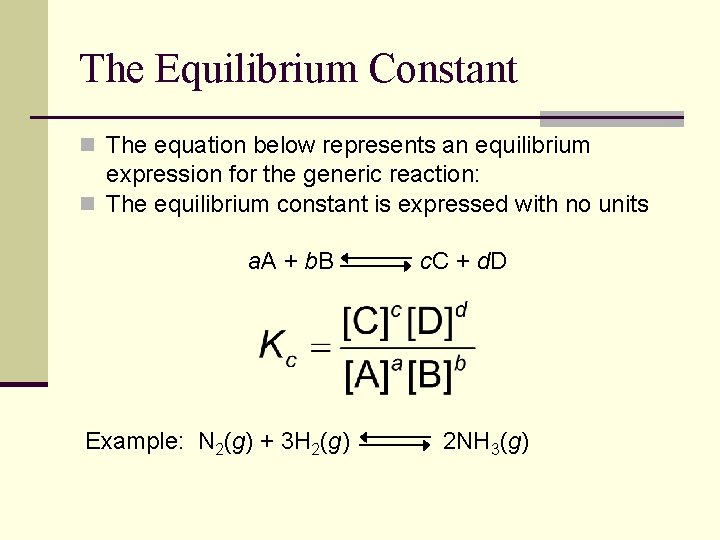
The Equilibrium Constant n The equation below represents an equilibrium expression for the generic reaction: n The equilibrium constant is expressed with no units a. A + b. B Example: N 2(g) + 3 H 2(g) c. C + d. D 2 NH 3(g)
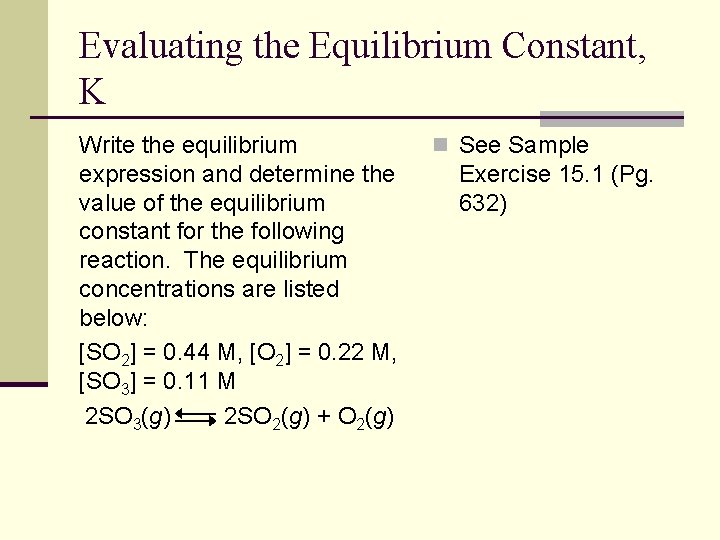
Evaluating the Equilibrium Constant, K Write the equilibrium expression and determine the value of the equilibrium constant for the following reaction. The equilibrium concentrations are listed below: [SO 2] = 0. 44 M, [O 2] = 0. 22 M, [SO 3] = 0. 11 M 2 SO 3(g) 2 SO 2(g) + O 2(g) n See Sample Exercise 15. 1 (Pg. 632)
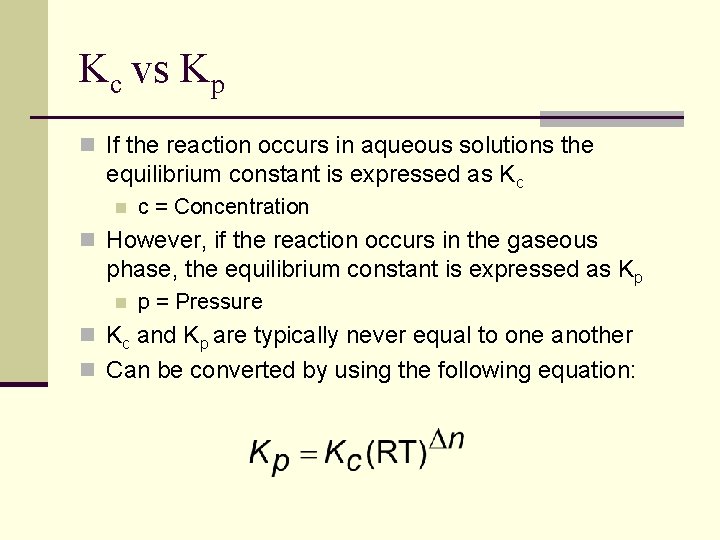
Kc vs Kp n If the reaction occurs in aqueous solutions the equilibrium constant is expressed as Kc n c = Concentration n However, if the reaction occurs in the gaseous phase, the equilibrium constant is expressed as Kp n p = Pressure n Kc and Kp are typically never equal to one another n Can be converted by using the following equation:
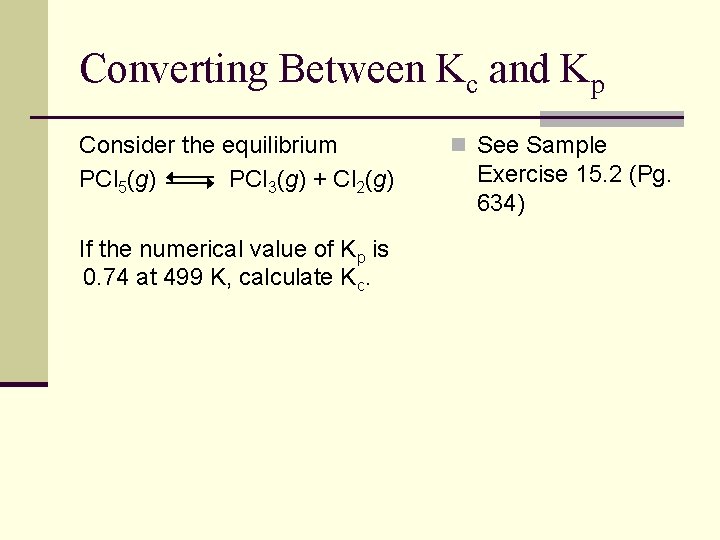
Converting Between Kc and Kp Consider the equilibrium PCl 5(g) PCl 3(g) + Cl 2(g) If the numerical value of Kp is 0. 74 at 499 K, calculate Kc. n See Sample Exercise 15. 2 (Pg. 634)
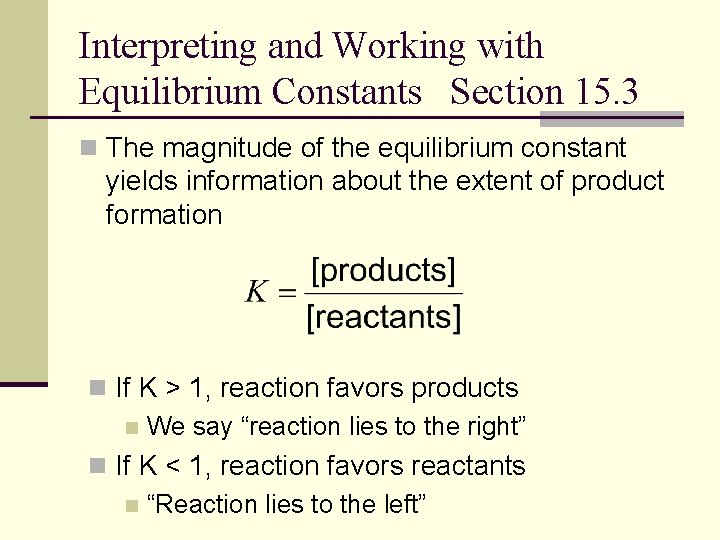
Interpreting and Working with Equilibrium Constants Section 15. 3 n The magnitude of the equilibrium constant yields information about the extent of product formation n If K > 1, reaction favors products n We say “reaction lies to the right” n If K < 1, reaction favors reactants n “Reaction lies to the left”
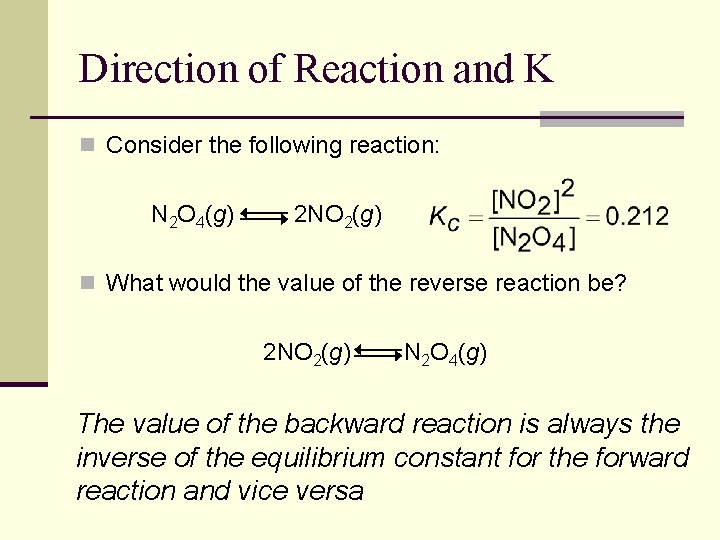
Direction of Reaction and K n Consider the following reaction: N 2 O 4(g) 2 NO 2(g) n What would the value of the reverse reaction be? 2 NO 2(g) N 2 O 4(g) The value of the backward reaction is always the inverse of the equilibrium constant for the forward reaction and vice versa
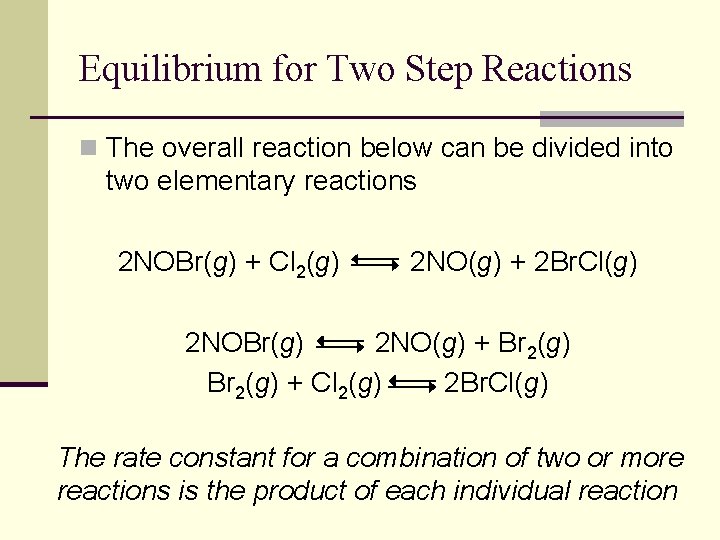
Equilibrium for Two Step Reactions n The overall reaction below can be divided into two elementary reactions 2 NOBr(g) + Cl 2(g) 2 NO(g) + 2 Br. Cl(g) 2 NOBr(g) 2 NO(g) + Br 2(g) + Cl 2(g) 2 Br. Cl(g) The rate constant for a combination of two or more reactions is the product of each individual reaction
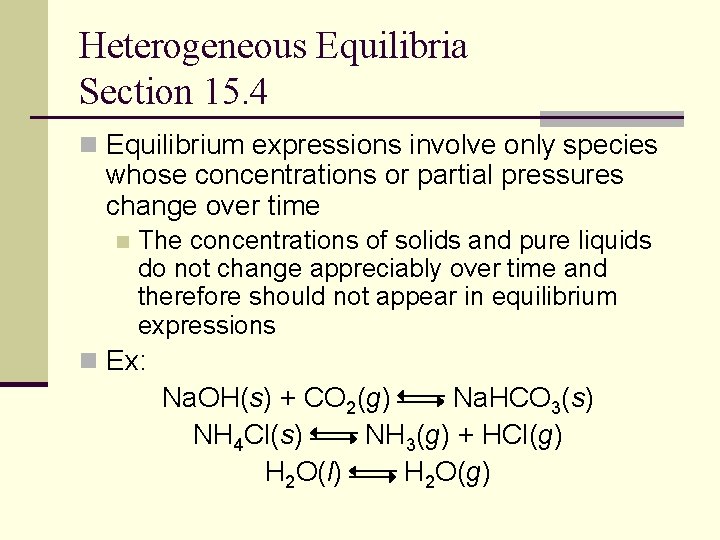
Heterogeneous Equilibria Section 15. 4 n Equilibrium expressions involve only species whose concentrations or partial pressures change over time n The concentrations of solids and pure liquids do not change appreciably over time and therefore should not appear in equilibrium expressions n Ex: Na. OH(s) + CO 2(g) Na. HCO 3(s) NH 4 Cl(s) NH 3(g) + HCl(g) H 2 O(l) H 2 O(g)
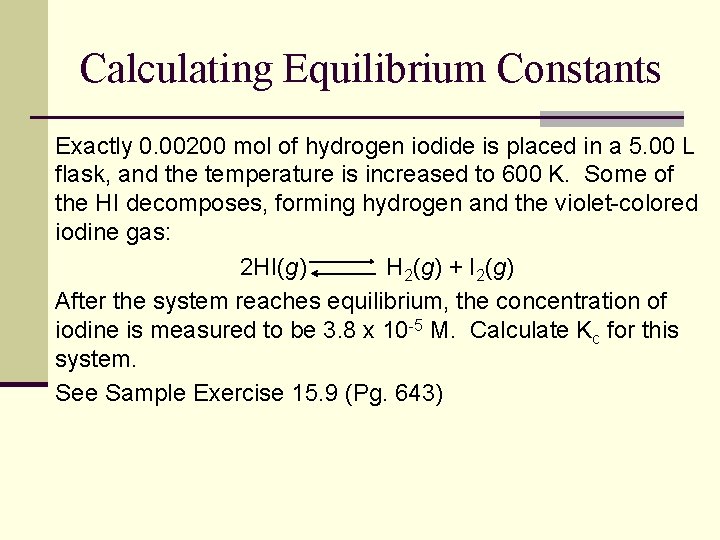
Calculating Equilibrium Constants Exactly 0. 00200 mol of hydrogen iodide is placed in a 5. 00 L flask, and the temperature is increased to 600 K. Some of the HI decomposes, forming hydrogen and the violet-colored iodine gas: 2 HI(g) H 2(g) + I 2(g) After the system reaches equilibrium, the concentration of iodine is measured to be 3. 8 x 10 -5 M. Calculate Kc for this system. See Sample Exercise 15. 9 (Pg. 643)
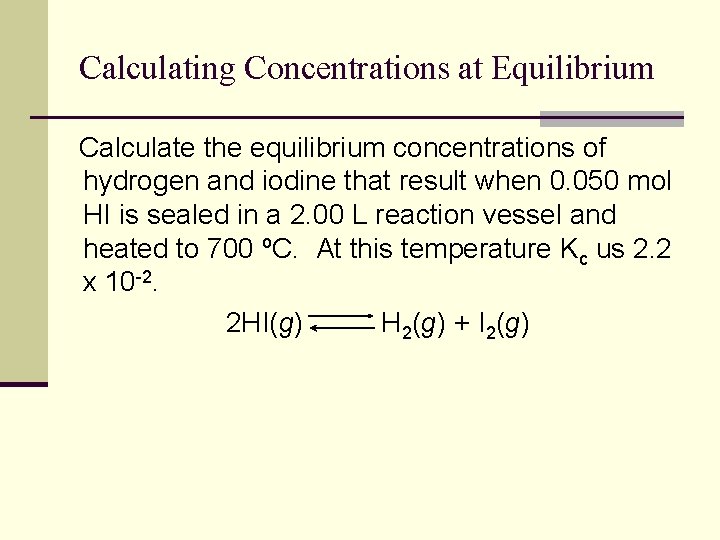
Calculating Concentrations at Equilibrium Calculate the equilibrium concentrations of hydrogen and iodine that result when 0. 050 mol HI is sealed in a 2. 00 L reaction vessel and heated to 700 ºC. At this temperature Kc us 2. 2 x 10 -2. 2 HI(g) H 2(g) + I 2(g)
Calculating Equilibrium Concentrations Phosphorous trichloride and chlorine react to form phosphorous pentachloride. At 544 K Kc is 1. 60 for: PCl 3(g) + Cl 2(g) PCl 5(g) Calculate the concentration of chlorine when 1. 00 L of 0. 600 M PCl 3 is added to 2. 00 L of 0. 150 M Cl 2 and allowed to reach equilibrium.
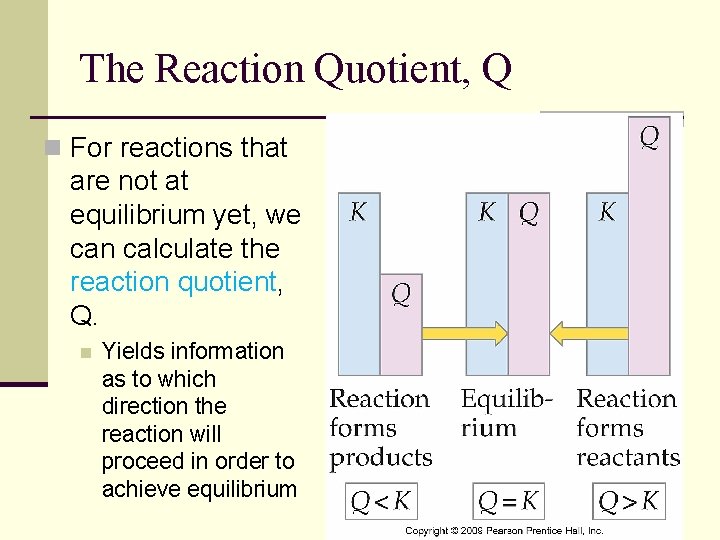
The Reaction Quotient, Q n For reactions that are not at equilibrium yet, we can calculate the reaction quotient, Q. n Yields information as to which direction the reaction will proceed in order to achieve equilibrium
Determining the Direction of a Reaction A scientist mixes 0. 50 mol NO 2 with 0. 30 mol N 2 O 4 in a 2. 0 L flask at 418 K. At this temperature, Kc is 0. 32 for the reaction of 2 mol NO 2 to form 1 mol N 2 O 4. Is the reaction in equilibrium? If not, in which direction does the reaction proceed? See Sample Exercise 15. 10 (Pg. 645)
Le Châtelier's Principle Section 15. 7 n Le Châtelier's principle essentially states that if a system is at equilibrium and that equilibrium is altered, the system will shift so as to reestablish equilibrium n Most common methods of altering equilibrium: n n n Adding reactant or product Volume and/or pressure changes Temperature changes
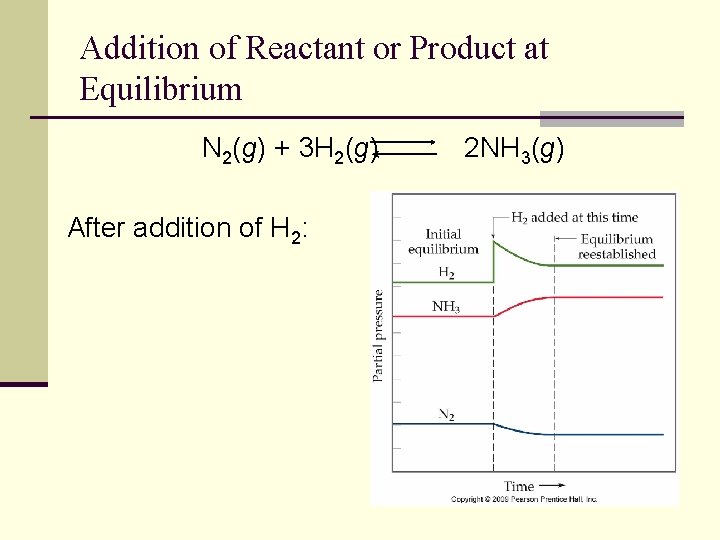
Addition of Reactant or Product at Equilibrium N 2(g) + 3 H 2(g) After addition of H 2: 2 NH 3(g)
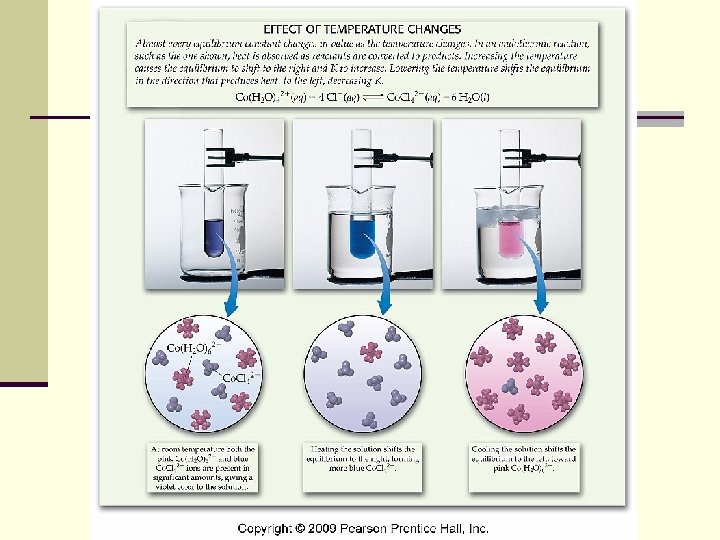
Effect of Temperature on Equilibrium n Consider two different types of reactions: n Exothermic & Endothermic n n Exothermic: Heat can be considered a product Endothermic: Heat can be considered a reactant n Endothermic: Increase in T shifts reaction to the right n Exothermic: Increase in T shifts reaction to the left
Pressure & Volume Effects n Increasing pressure (or decreasing volume) causes a shift in equilibrium to the side with the fewest number of particles n Ex: N 2 O 4(g) 2 NO 2(g)
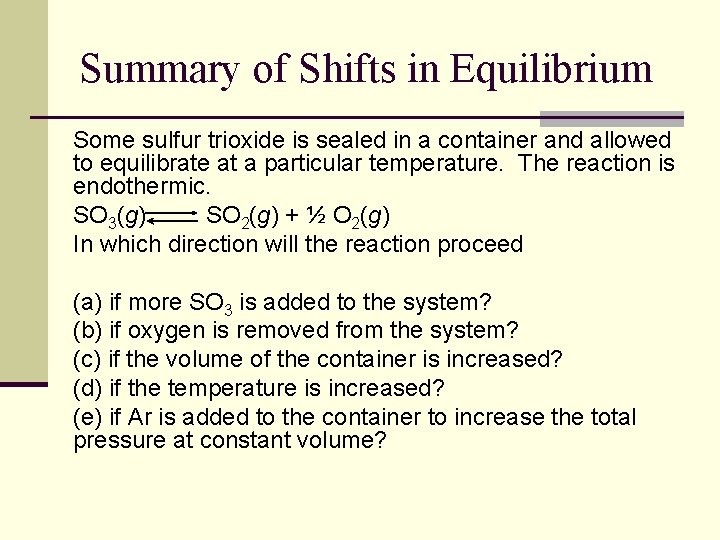
Summary of Shifts in Equilibrium Some sulfur trioxide is sealed in a container and allowed to equilibrate at a particular temperature. The reaction is endothermic. SO 3(g) SO 2(g) + ½ O 2(g) In which direction will the reaction proceed (a) if more SO 3 is added to the system? (b) if oxygen is removed from the system? (c) if the volume of the container is increased? (d) if the temperature is increased? (e) if Ar is added to the container to increase the total pressure at constant volume?
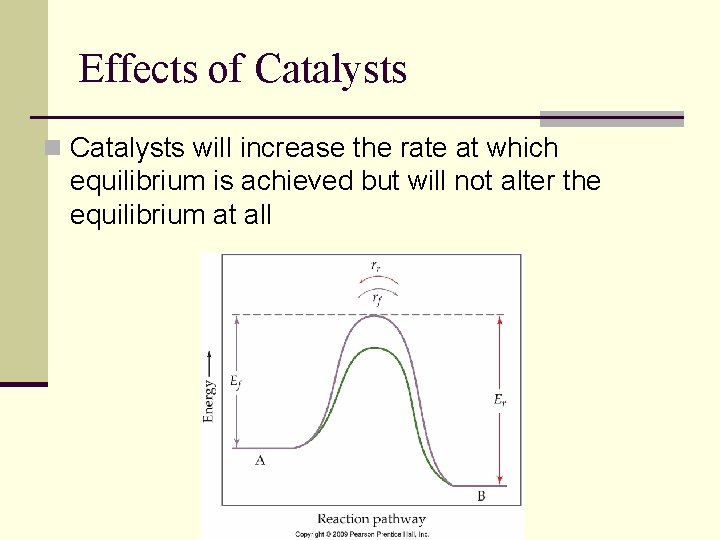
Effects of Catalysts n Catalysts will increase the rate at which equilibrium is achieved but will not alter the equilibrium at all
- Slides: 23