
Chemical Equilibrium Chapter 14 Equilibrium the extent of
Chemical Equilibrium Chapter 14
Equilibrium: the extent of a reaction In stoichiometry we talk about theoretical yields, and the many reasons actual yields may be lower. Another critical reason actual yields may be lower is the reversibility of chemical reactions: some reactions may produce only 70% of the product you may calculate they ought to produce. Equilibrium looks at the extent of a chemical reaction.
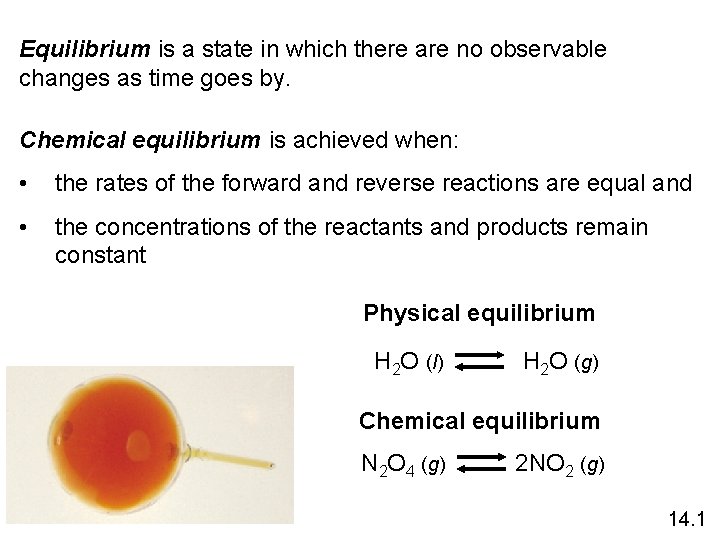
Equilibrium is a state in which there are no observable changes as time goes by. Chemical equilibrium is achieved when: • the rates of the forward and reverse reactions are equal and • the concentrations of the reactants and products remain constant Physical equilibrium H 2 O (l) H 2 O (g) Chemical equilibrium N 2 O 4 (g) 2 NO 2 (g) 14. 1
Rate of sale of cookies = Rate of replacing cookies
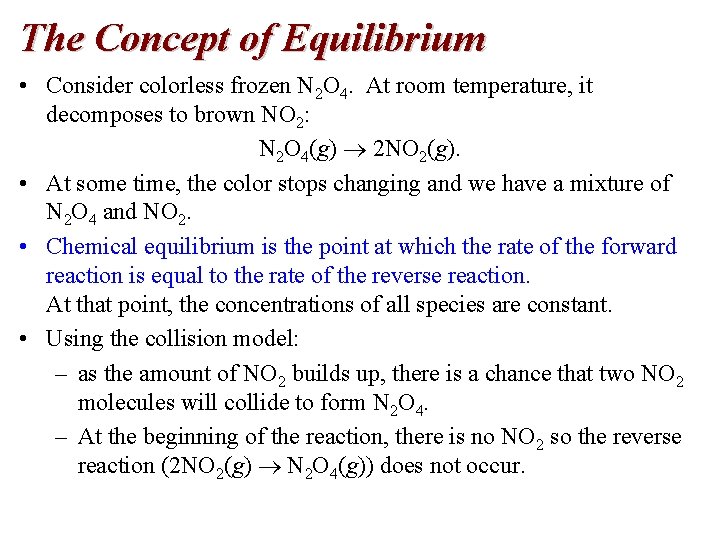
The Concept of Equilibrium • Consider colorless frozen N 2 O 4. At room temperature, it decomposes to brown NO 2: N 2 O 4(g) 2 NO 2(g). • At some time, the color stops changing and we have a mixture of N 2 O 4 and NO 2. • Chemical equilibrium is the point at which the rate of the forward reaction is equal to the rate of the reverse reaction. At that point, the concentrations of all species are constant. • Using the collision model: – as the amount of NO 2 builds up, there is a chance that two NO 2 molecules will collide to form N 2 O 4. – At the beginning of the reaction, there is no NO 2 so the reverse reaction (2 NO 2(g) N 2 O 4(g)) does not occur.
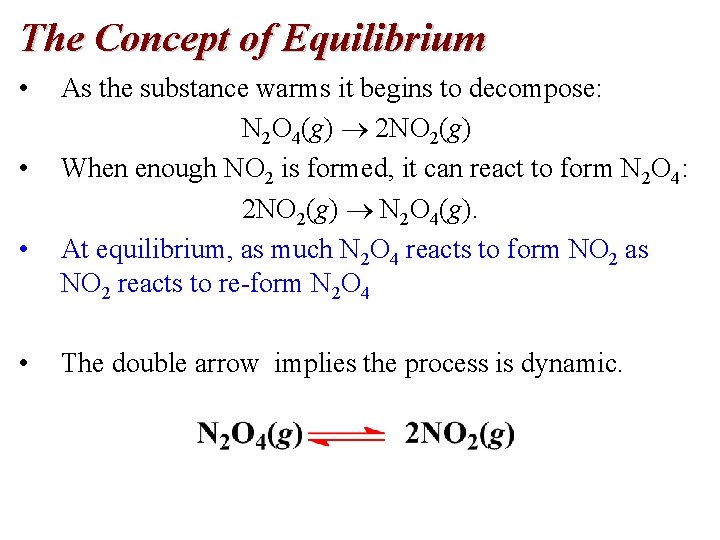
The Concept of Equilibrium • • As the substance warms it begins to decompose: N 2 O 4(g) 2 NO 2(g) When enough NO 2 is formed, it can react to form N 2 O 4: 2 NO 2(g) N 2 O 4(g). At equilibrium, as much N 2 O 4 reacts to form NO 2 as NO 2 reacts to re-form N 2 O 4 The double arrow implies the process is dynamic.
![The Concept of Equilibrium As the reaction progresses – [A] decreases to a constant,](http://slidetodoc.com/presentation_image_h2/821409dca2423146ea658a457ed17720/image-7.jpg "The Concept of Equilibrium As the reaction progresses – [A] decreases to a constant,")
The Concept of Equilibrium As the reaction progresses – [A] decreases to a constant, – [B] increases from zero to a constant. – When [A] and [B] are constant, equilibrium is achieved.
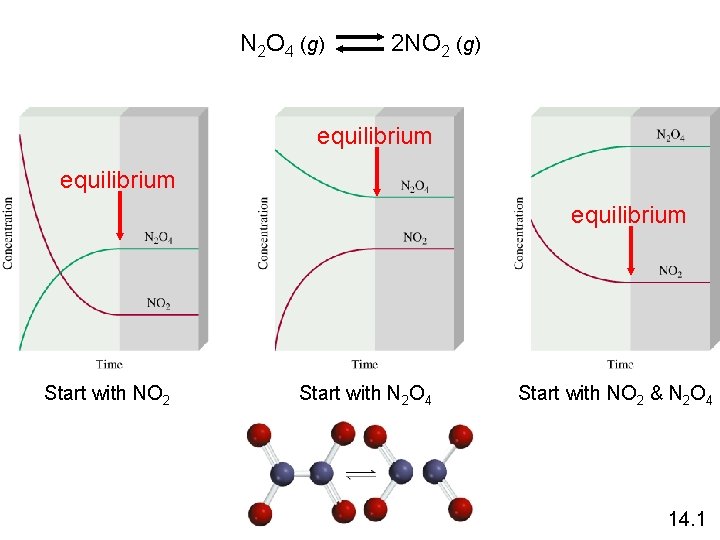
N 2 O 4 (g) 2 NO 2 (g) equilibrium Start with NO 2 Start with N 2 O 4 Start with NO 2 & N 2 O 4 14. 1
constant 14. 1
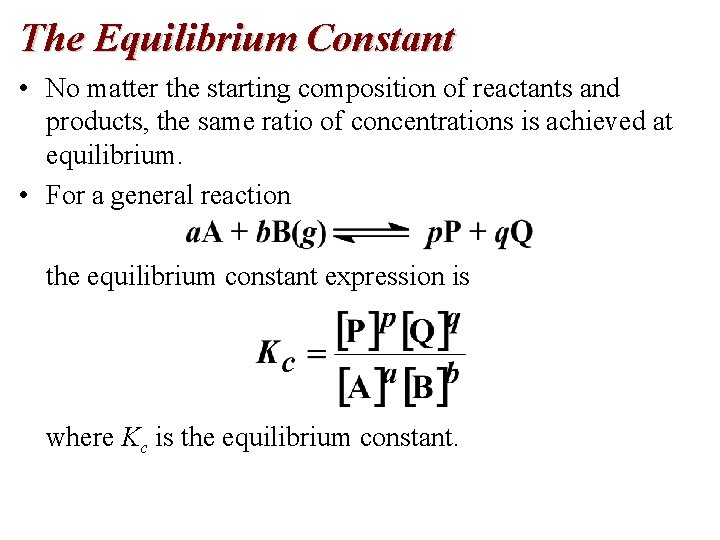
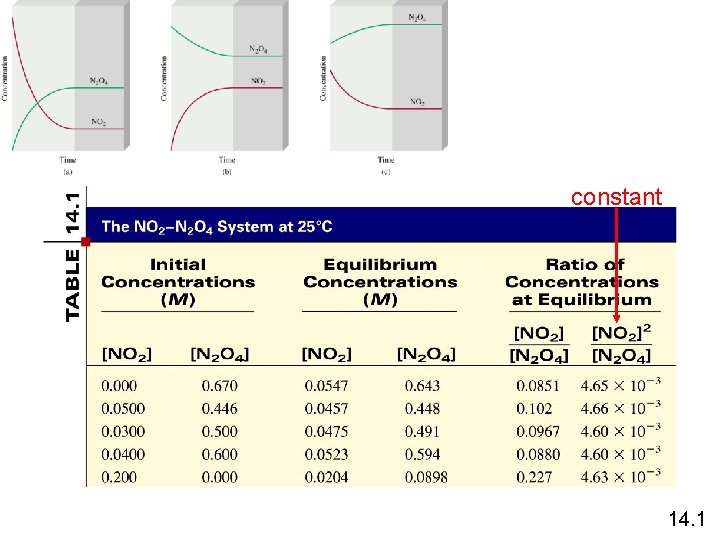
The Equilibrium Constant • No matter the starting composition of reactants and products, the same ratio of concentrations is achieved at equilibrium. • For a general reaction the equilibrium constant expression is where Kc is the equilibrium constant.
![N 2 O 4 (g) K= 2 NO 2 (g) [NO 2]2 [N 2](http://slidetodoc.com/presentation_image_h2/821409dca2423146ea658a457ed17720/image-11.jpg "N 2 O 4 (g) K= 2 NO 2 (g) [NO 2]2 [N 2")
N 2 O 4 (g) K= 2 NO 2 (g) [NO 2]2 [N 2 O 4] = 4. 63 x 10 -3 a. A + b. B K= c. C + d. D [C]c[D]d Law of Mass Action [A]a[B]b Equilibrium Will K >> 1 Lie to the right Favor products K << 1 Lie to the left Favor reactants 14. 1
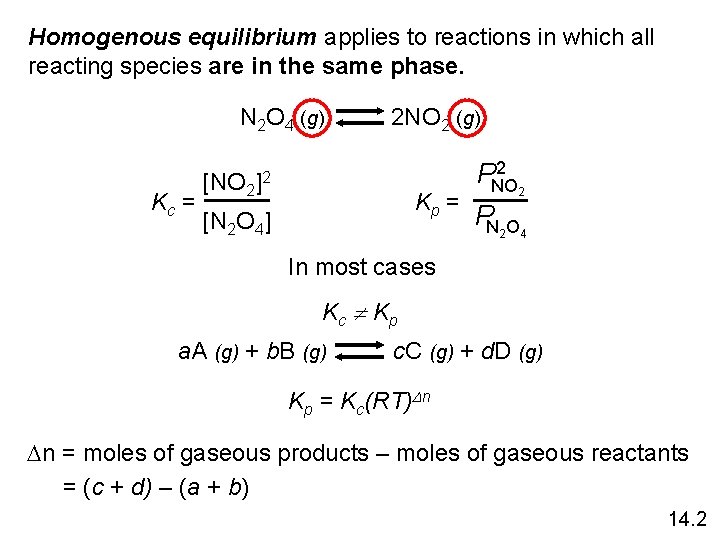
Homogenous equilibrium applies to reactions in which all reacting species are in the same phase. N 2 O 4 (g) Kc = [NO 2 2 NO 2 (g) ]2 Kp = [N 2 O 4] 2 PNO 2 PN 2 O 4 In most cases Kc K p a. A (g) + b. B (g) c. C (g) + d. D (g) Kp = Kc(RT)Dn Dn = moles of gaseous products – moles of gaseous reactants = (c + d) – (a + b) 14. 2
![Homogeneous Equilibrium CH 3 COOH (aq) + H 2 O (l) [CH 3 COO-][H](http://slidetodoc.com/presentation_image_h2/821409dca2423146ea658a457ed17720/image-13.jpg "Homogeneous Equilibrium CH 3 COOH (aq) + H 2 O (l) [CH 3 COO-][H")
Homogeneous Equilibrium CH 3 COOH (aq) + H 2 O (l) [CH 3 COO-][H 3 O+] Kc‘ = [CH 3 COOH][H 2 O] CH 3 COO- (aq) + H 3 O+ (aq) [H 2 O] = constant [CH 3 COO-][H 3 O+] = Kc‘ [H 2 O] Kc = [CH 3 COOH] General practice not to include units for the equilibrium constant. 14. 2
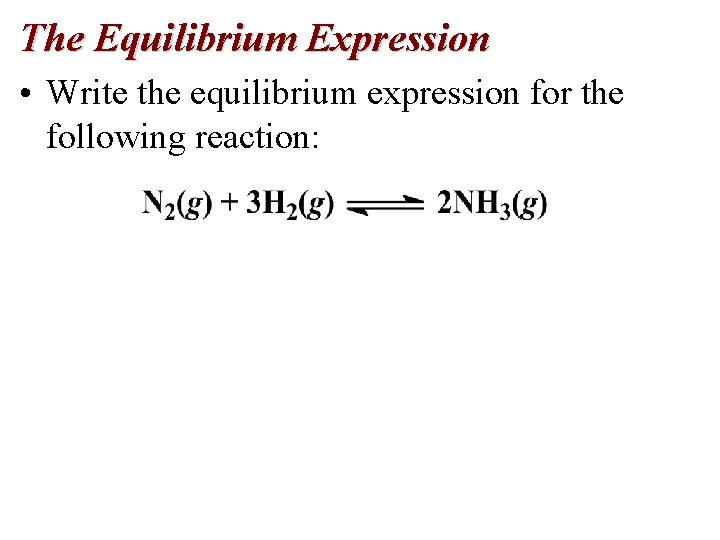
The Equilibrium Expression • Write the equilibrium expression for the following reaction:
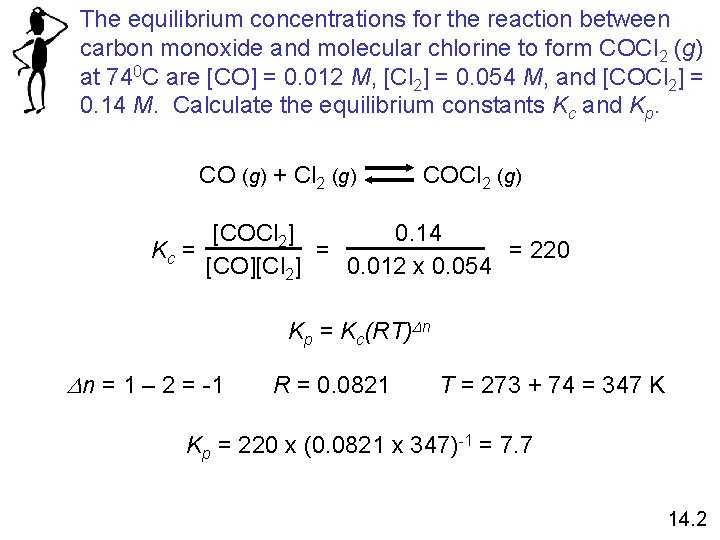
The equilibrium concentrations for the reaction between carbon monoxide and molecular chlorine to form COCl 2 (g) at 740 C are [CO] = 0. 012 M, [Cl 2] = 0. 054 M, and [COCl 2] = 0. 14 M. Calculate the equilibrium constants Kc and Kp. CO (g) + Cl 2 (g) COCl 2 (g) [COCl 2] 0. 14 = = 220 Kc = [CO][Cl 2] 0. 012 x 0. 054 Kp = Kc(RT)Dn Dn = 1 – 2 = -1 R = 0. 0821 T = 273 + 74 = 347 K Kp = 220 x (0. 0821 x 347)-1 = 7. 7 14. 2
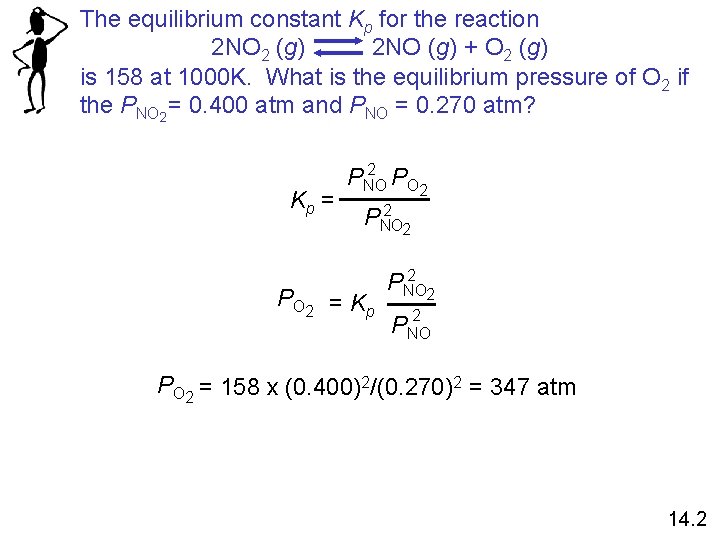
The equilibrium constant Kp for the reaction 2 NO 2 (g) 2 NO (g) + O 2 (g) is 158 at 1000 K. What is the equilibrium pressure of O 2 if the PNO 2 = 0. 400 atm and PNO = 0. 270 atm? Kp = 2 PNO PO 2 2 PNO 2 PO 2 = Kp 2 PNO 2 2 PNO PO 2 = 158 x (0. 400)2/(0. 270)2 = 347 atm 14. 2
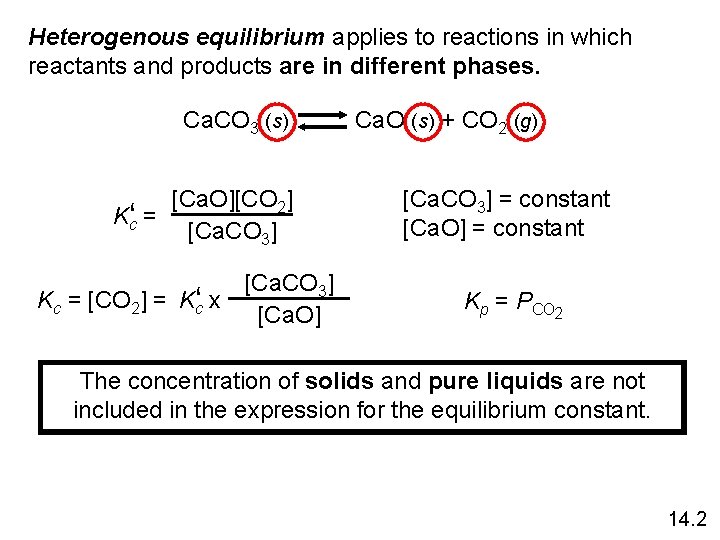
Heterogenous equilibrium applies to reactions in which reactants and products are in different phases. Ca. CO 3 (s) [Ca. O][CO 2] Kc‘ = [Ca. CO 3] Kc = [CO 2] = Kc‘ x [Ca. O] Ca. O (s) + CO 2 (g) [Ca. CO 3] = constant [Ca. O] = constant Kp = PCO 2 The concentration of solids and pure liquids are not included in the expression for the equilibrium constant. 14. 2
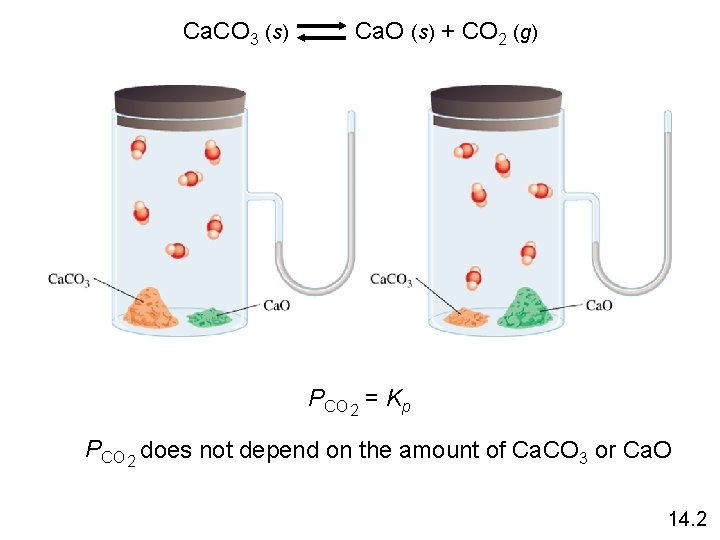
Ca. CO 3 (s) Ca. O (s) + CO 2 (g) PCO 2 = Kp PCO 2 does not depend on the amount of Ca. CO 3 or Ca. O 14. 2
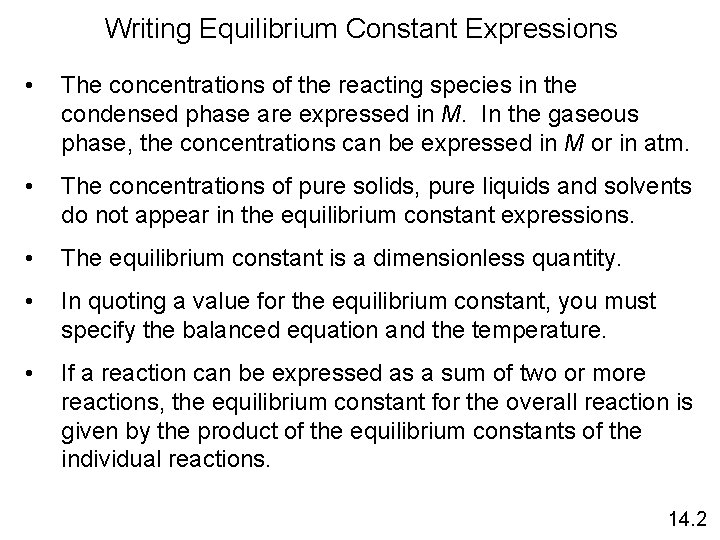
Writing Equilibrium Constant Expressions • The concentrations of the reacting species in the condensed phase are expressed in M. In the gaseous phase, the concentrations can be expressed in M or in atm. • The concentrations of pure solids, pure liquids and solvents do not appear in the equilibrium constant expressions. • The equilibrium constant is a dimensionless quantity. • In quoting a value for the equilibrium constant, you must specify the balanced equation and the temperature. • If a reaction can be expressed as a sum of two or more reactions, the equilibrium constant for the overall reaction is given by the product of the equilibrium constants of the individual reactions. 14. 2
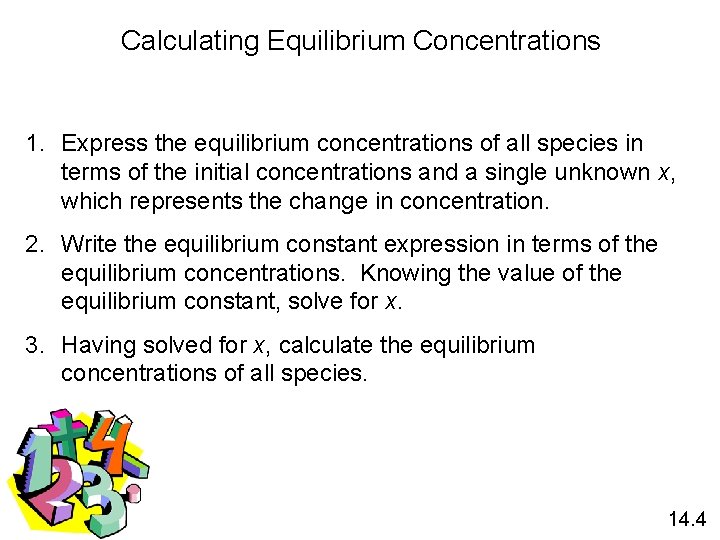
Calculating Equilibrium Concentrations 1. Express the equilibrium concentrations of all species in terms of the initial concentrations and a single unknown x, which represents the change in concentration. 2. Write the equilibrium constant expression in terms of the equilibrium concentrations. Knowing the value of the equilibrium constant, solve for x. 3. Having solved for x, calculate the equilibrium concentrations of all species. 14. 4
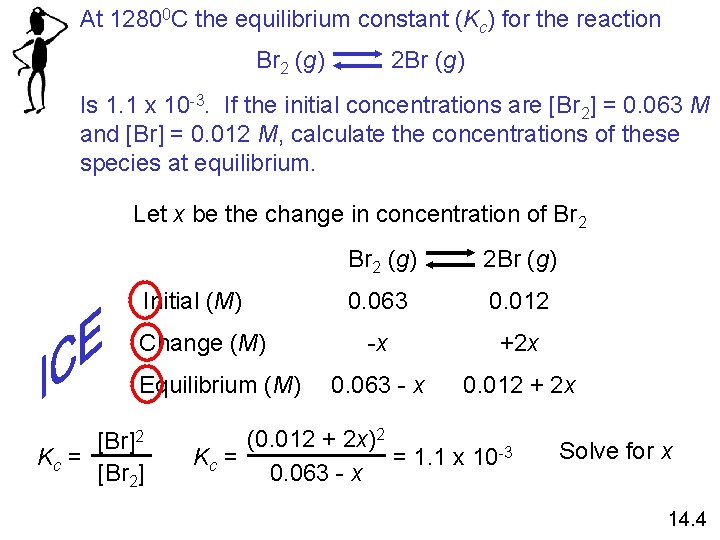
At 12800 C the equilibrium constant (Kc) for the reaction Br 2 (g) 2 Br (g) Is 1. 1 x 10 -3. If the initial concentrations are [Br 2] = 0. 063 M and [Br] = 0. 012 M, calculate the concentrations of these species at equilibrium. Let x be the change in concentration of Br 2 Initial (M) Change (M) Equilibrium (M) [Br]2 Kc = [Br 2] Br 2 (g) 2 Br (g) 0. 063 0. 012 -x +2 x 0. 063 - x 0. 012 + 2 x (0. 012 + 2 x)2 = 1. 1 x 10 -3 Kc = 0. 063 - x Solve for x 14. 4
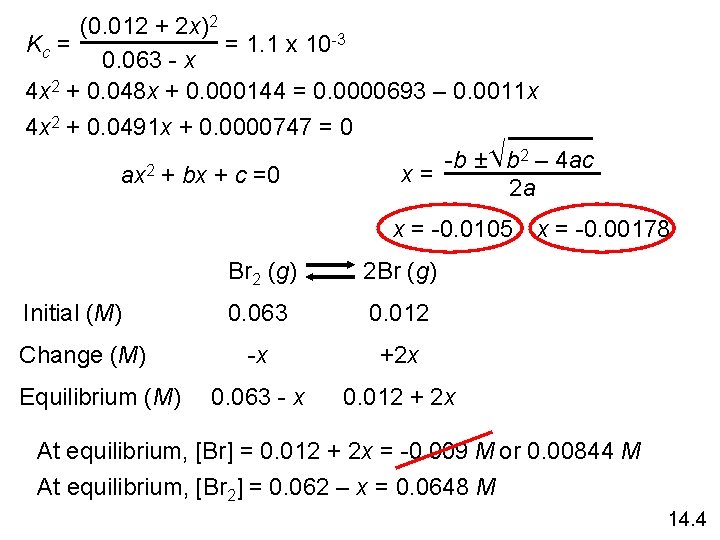
(0. 012 + 2 x)2 = 1. 1 x 10 -3 Kc = 0. 063 - x 4 x 2 + 0. 048 x + 0. 000144 = 0. 0000693 – 0. 0011 x 4 x 2 + 0. 0491 x + 0. 0000747 = 0 -b ± b 2 – 4 ac 2 x= ax + bx + c =0 2 a x = -0. 0105 x = -0. 00178 Initial (M) Change (M) Equilibrium (M) Br 2 (g) 2 Br (g) 0. 063 0. 012 -x +2 x 0. 063 - x 0. 012 + 2 x At equilibrium, [Br] = 0. 012 + 2 x = -0. 009 M or 0. 00844 M At equilibrium, [Br 2] = 0. 062 – x = 0. 0648 M 14. 4
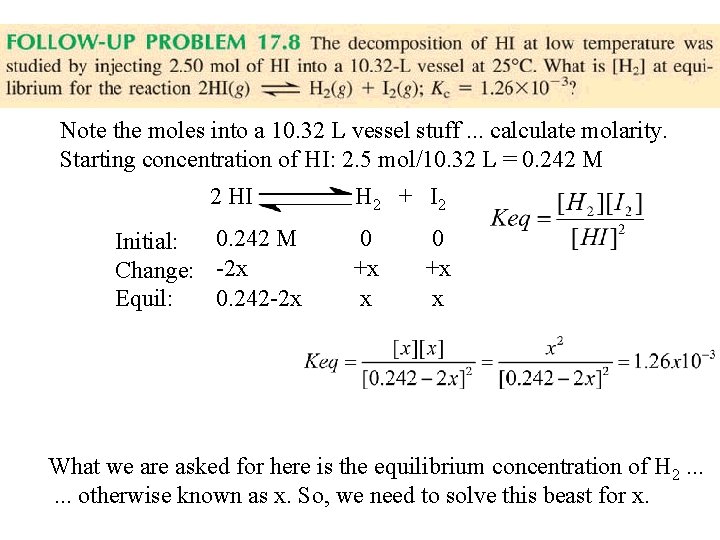
Example Problem: Calculate Concentration Note the moles into a 10. 32 L vessel stuff. . . calculate molarity. Starting concentration of HI: 2. 5 mol/10. 32 L = 0. 242 M 2 HI 0. 242 M Initial: Change: -2 x 0. 242 -2 x Equil: H 2 + I 2 0 +x x What we are asked for here is the equilibrium concentration of H 2. . . otherwise known as x. So, we need to solve this beast for x.
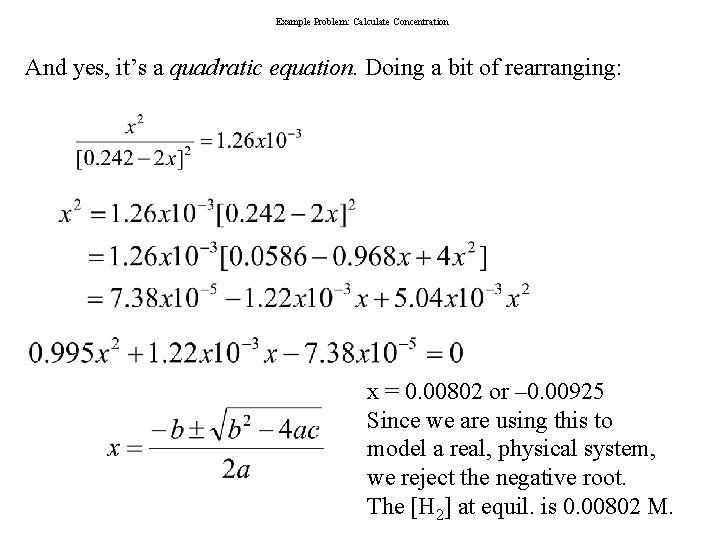
Example Problem: Calculate Concentration And yes, it’s a quadratic equation. Doing a bit of rearranging: x = 0. 00802 or – 0. 00925 Since we are using this to model a real, physical system, we reject the negative root. The [H 2] at equil. is 0. 00802 M.
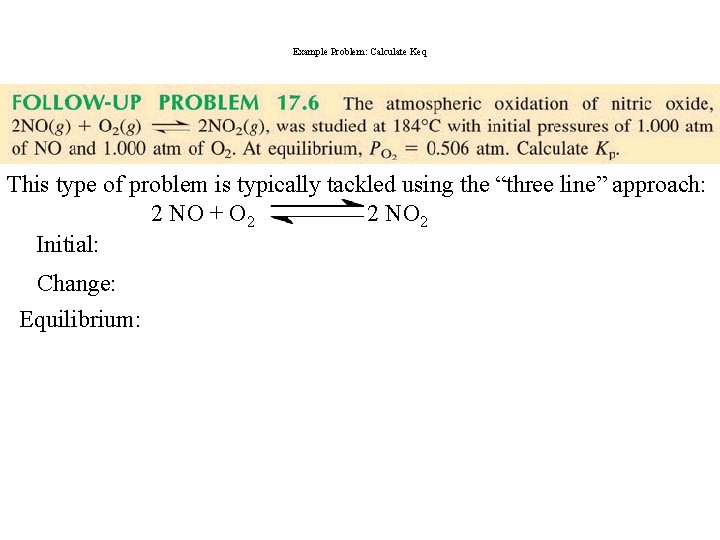
Example Problem: Calculate Keq This type of problem is typically tackled using the “three line” approach: 2 NO + O 2 2 NO 2 Initial: Change: Equilibrium:
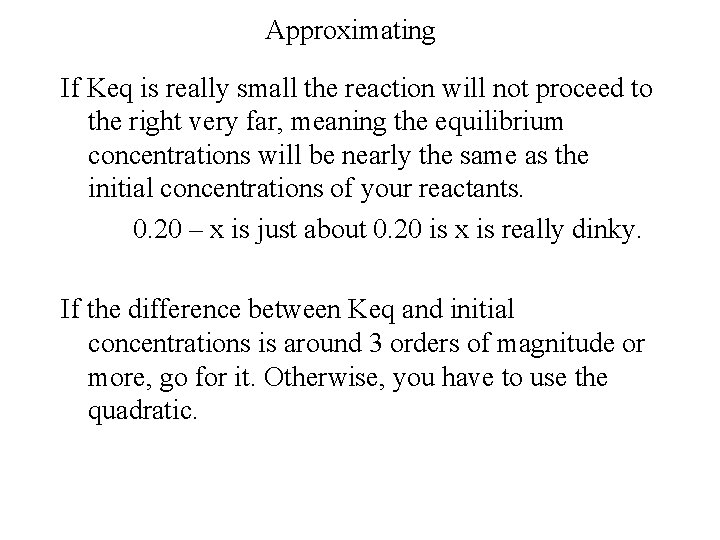
Approximating If Keq is really small the reaction will not proceed to the right very far, meaning the equilibrium concentrations will be nearly the same as the initial concentrations of your reactants. 0. 20 – x is just about 0. 20 is x is really dinky. If the difference between Keq and initial concentrations is around 3 orders of magnitude or more, go for it. Otherwise, you have to use the quadratic.
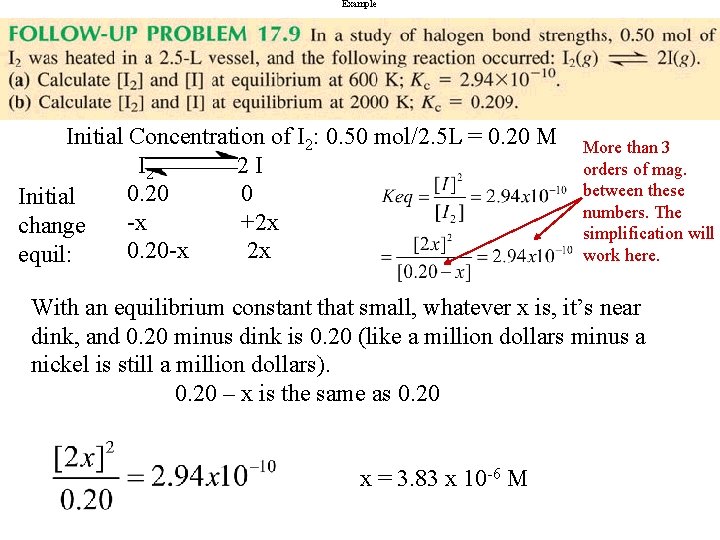
Example Initial Concentration of I 2: 0. 50 mol/2. 5 L = 0. 20 M I 2 2 I 0. 20 0 Initial -x +2 x change 0. 20 -x 2 x equil: More than 3 orders of mag. between these numbers. The simplification will work here. With an equilibrium constant that small, whatever x is, it’s near dink, and 0. 20 minus dink is 0. 20 (like a million dollars minus a nickel is still a million dollars). 0. 20 – x is the same as 0. 20 x = 3. 83 x 10 -6 M
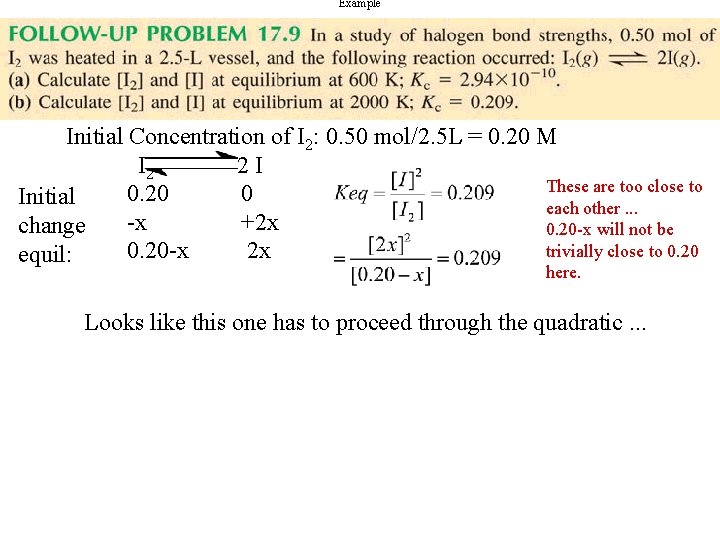
Example Initial Concentration of I 2: 0. 50 mol/2. 5 L = 0. 20 M I 2 2 I These are too close to 0. 20 0 Initial each other. . . -x +2 x change 0. 20 -x will not be trivially close to 0. 20 -x 2 x equil: here. Looks like this one has to proceed through the quadratic. . .
![A+B C+D Kc‘ C+D E+F K‘c‘ A+B E+F Kc [C][D] Kc‘ = [A][B] [E][F]](http://slidetodoc.com/presentation_image_h2/821409dca2423146ea658a457ed17720/image-29.jpg "A+B C+D Kc‘ C+D E+F K‘c‘ A+B E+F Kc [C][D] Kc‘ = [A][B] [E][F]")
A+B C+D Kc‘ C+D E+F K‘c‘ A+B E+F Kc [C][D] Kc‘ = [A][B] [E][F] Kc‘‘ = [C][D] [E][F] Kc = [A][B] Kc = Kc‘ x K‘c‘ If a reaction can be expressed as the sum of two or more reactions, the equilibrium constant for the overall reaction is given by the product of the equilibrium constants of the individual reactions. 14. 2
![N 2 O 4 (g) K= [NO 2]2 [N 2 O 4] 2 NO](http://slidetodoc.com/presentation_image_h2/821409dca2423146ea658a457ed17720/image-30.jpg "N 2 O 4 (g) K= [NO 2]2 [N 2 O 4] 2 NO")
N 2 O 4 (g) K= [NO 2]2 [N 2 O 4] 2 NO 2 (g) = 4. 63 x 10 -3 2 NO 2 (g) N 2 O 4 (g) [N 2 O 4] 1 = 216 = K‘ = 2 K [NO 2] When the equation for a reversible reaction is written in the opposite direction, the equilibrium constant becomes the reciprocal of the original equilibrium constant. 14. 2
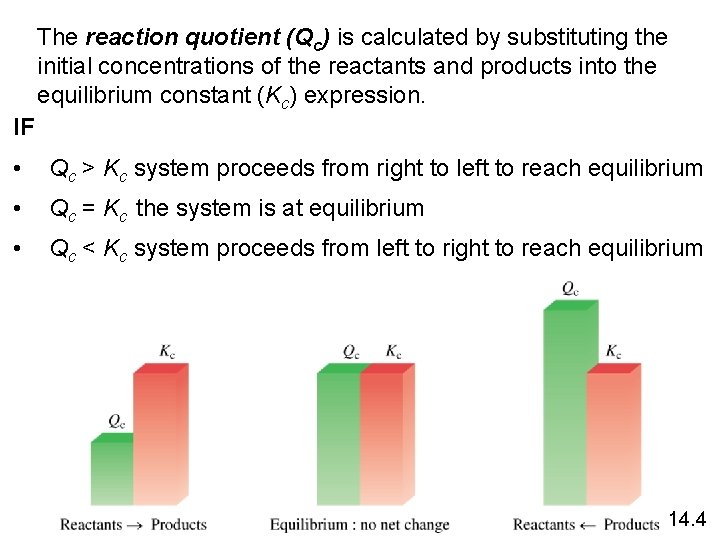
The reaction quotient (Qc) is calculated by substituting the initial concentrations of the reactants and products into the equilibrium constant (Kc) expression. IF • Qc > Kc system proceeds from right to left to reach equilibrium • Qc = Kc the system is at equilibrium • Qc < Kc system proceeds from left to right to reach equilibrium 14. 4
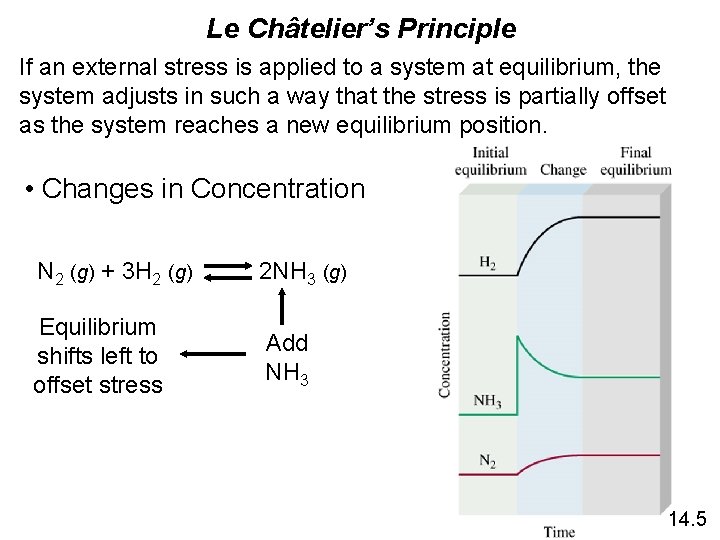
Le Châtelier’s Principle If an external stress is applied to a system at equilibrium, the system adjusts in such a way that the stress is partially offset as the system reaches a new equilibrium position. • Changes in Concentration N 2 (g) + 3 H 2 (g) 2 NH 3 (g) Equilibrium shifts left to offset stress Add NH 3 14. 5
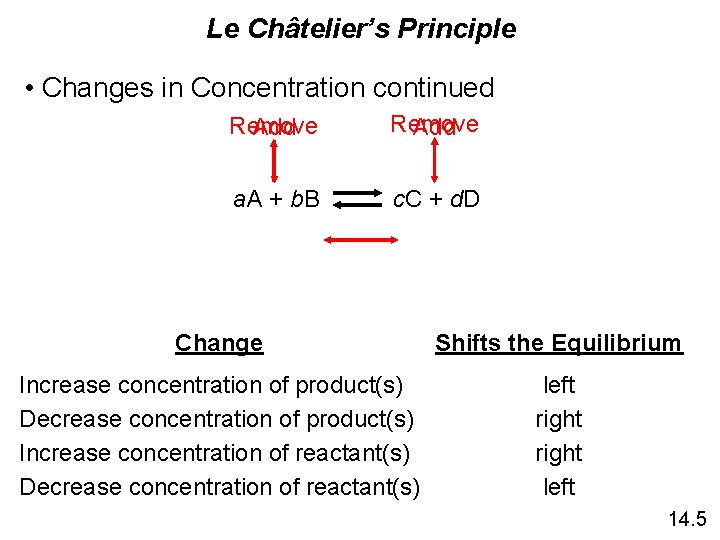
Le Châtelier’s Principle • Changes in Concentration continued Remove Add a. A + b. B c. C + d. D Change Shifts the Equilibrium Increase concentration of product(s) Decrease concentration of product(s) Increase concentration of reactant(s) Decrease concentration of reactant(s) left right left 14. 5
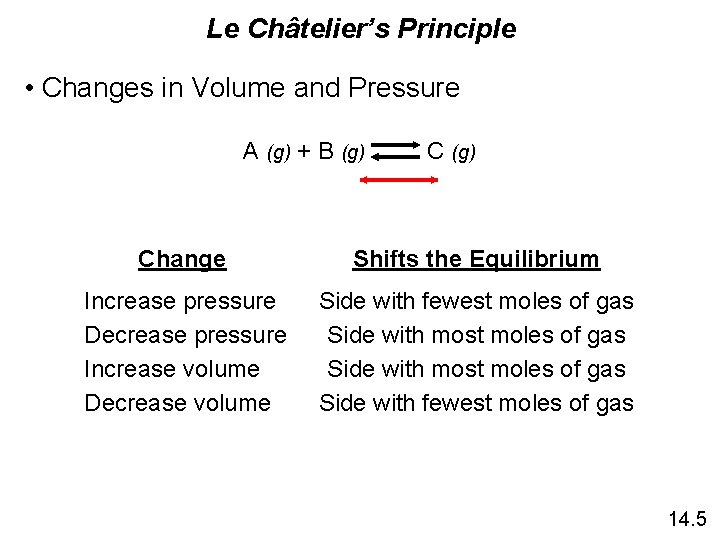
Le Châtelier’s Principle • Changes in Volume and Pressure A (g) + B (g) Change Shifts the Equilibrium Increase pressure Decrease pressure Increase volume Decrease volume Side with fewest moles of gas Side with most moles of gas Side with fewest moles of gas 14. 5
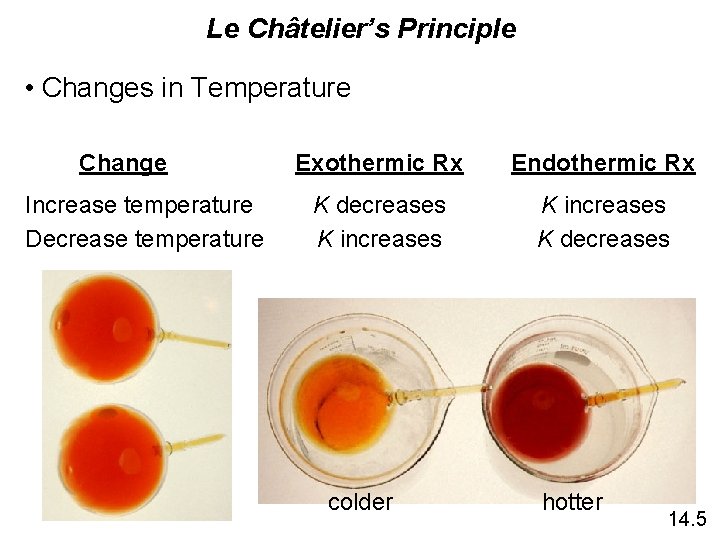
Le Châtelier’s Principle • Changes in Temperature Change Increase temperature Decrease temperature Exothermic Rx Endothermic Rx K decreases K increases K decreases colder hotter 14. 5
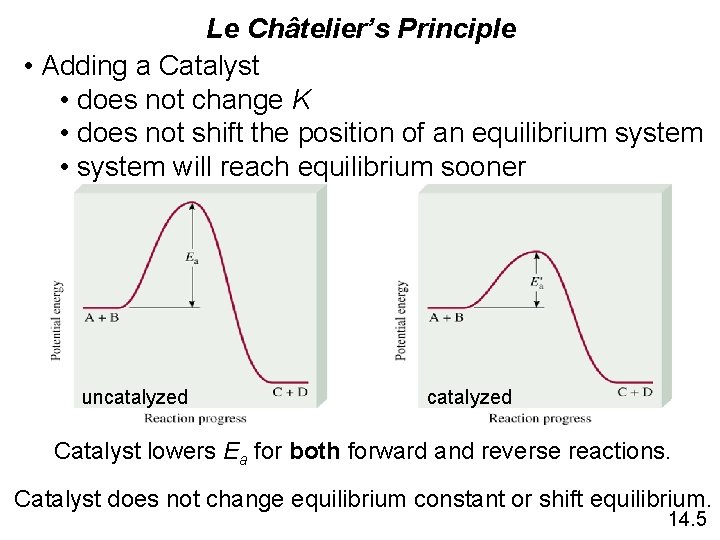
Le Châtelier’s Principle • Adding a Catalyst • does not change K • does not shift the position of an equilibrium system • system will reach equilibrium sooner uncatalyzed Catalyst lowers Ea for both forward and reverse reactions. Catalyst does not change equilibrium constant or shift equilibrium. 14. 5
Example
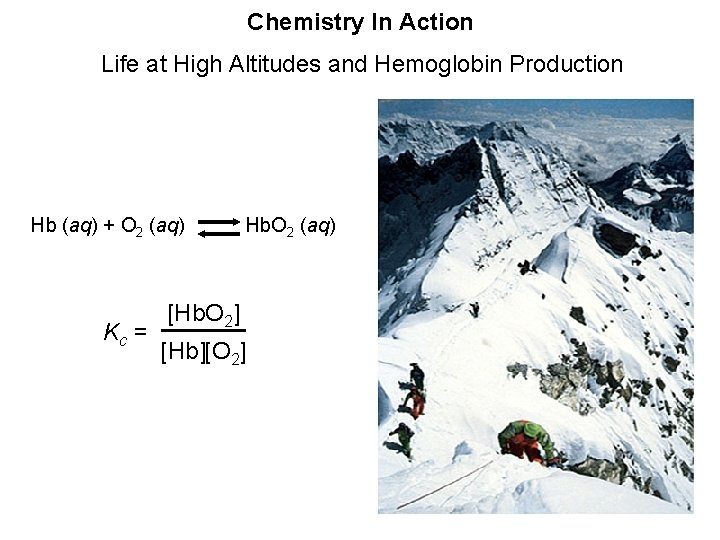
Chemistry In Action Life at High Altitudes and Hemoglobin Production Hb (aq) + O 2 (aq) Kc = Hb. O 2 (aq) [Hb. O 2] [Hb][O 2]
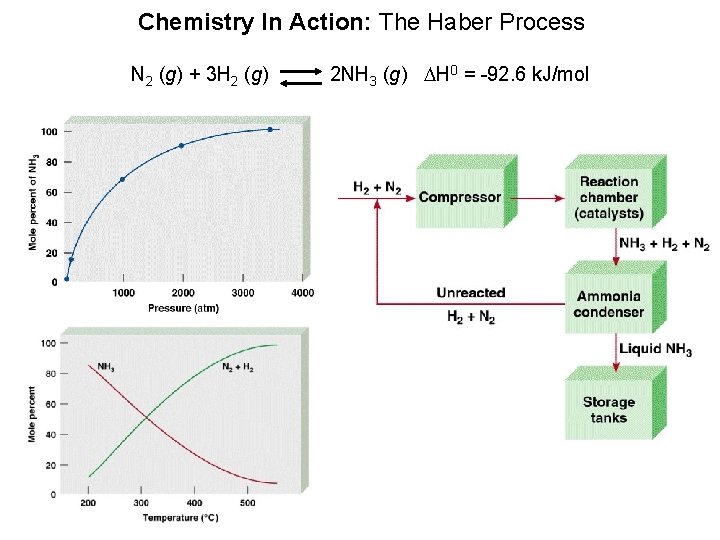
Chemistry In Action: The Haber Process N 2 (g) + 3 H 2 (g) 2 NH 3 (g) DH 0 = -92. 6 k. J/mol
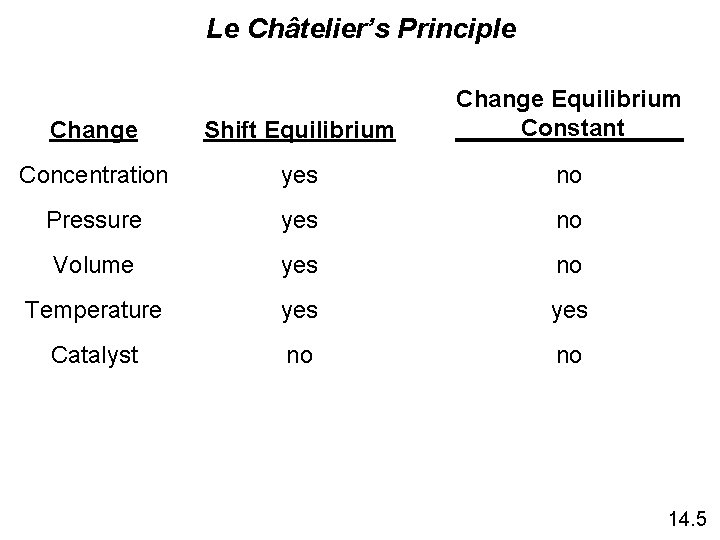
Le Châtelier’s Principle Change Shift Equilibrium Change Equilibrium Constant Concentration yes no Pressure yes no Volume yes no Temperature yes Catalyst no no 14. 5
- Slides: 40