
Chemical Equilibrium and AcidBase Chapter 15 and 16
Chemical Equilibrium and Acid-Base Chapter 15 and 16
Topics Covered Chapter 15 15. 1 - 15. 2: Concept of Equilibrium and the Constant 15. 3 Working with Keq 15. 5 - 15. 6: Calculating Keq and Application 15. 7: Le’Chatelier’s Principle Group Project
Topics Covered Chapter 16 16. 1, 16. 2: Review and Bronsted Lowry 16. 3: Autoionization of Water 16. 4: p. H Scale 16. 5, 16. 6, 16. 7: Strong Acids/Bases, Weak Acid/Base 16. 8: Ka and Kb 16. 9: Acid Base Behavior and Lewis Acid/Base
Problem Set 1, 2, 4, 13, 15, 17, 19, 29, 37, 41, 43, 47, 51, 57, 69, 75, 101
15. 1 Basis of Principle Some reactions are non reversible Others are in dynamic equilibrium (reversible) Le’Chatelier’s principle investigates how equilibrium is effected by outsides stresses on the system Systems at equilibrium are noted by a two way arrow ↔
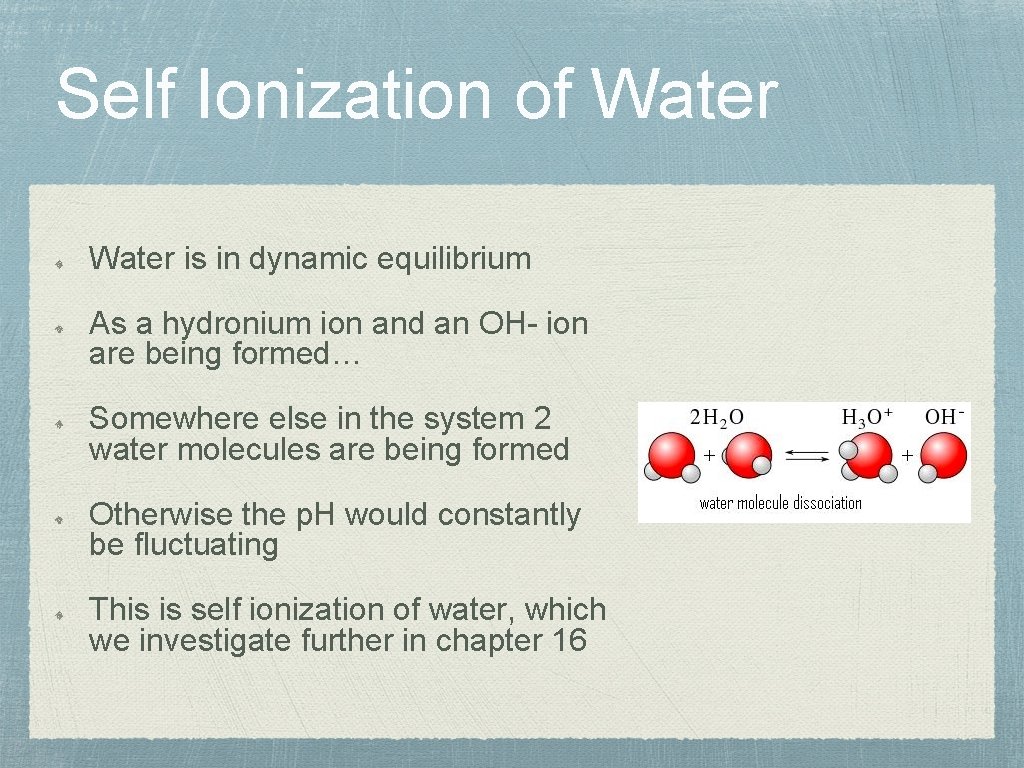
Self Ionization of Water is in dynamic equilibrium As a hydronium ion and an OH- ion are being formed… Somewhere else in the system 2 water molecules are being formed Otherwise the p. H would constantly be fluctuating This is self ionization of water, which we investigate further in chapter 16
What is equilibrium? Equilibrium is accomplished when the forward and reverse reactions are happening at the same rate Seemingly nothing is happening but. . At the molecular level products are being formed while reactants are simultaneously being created at the same rate
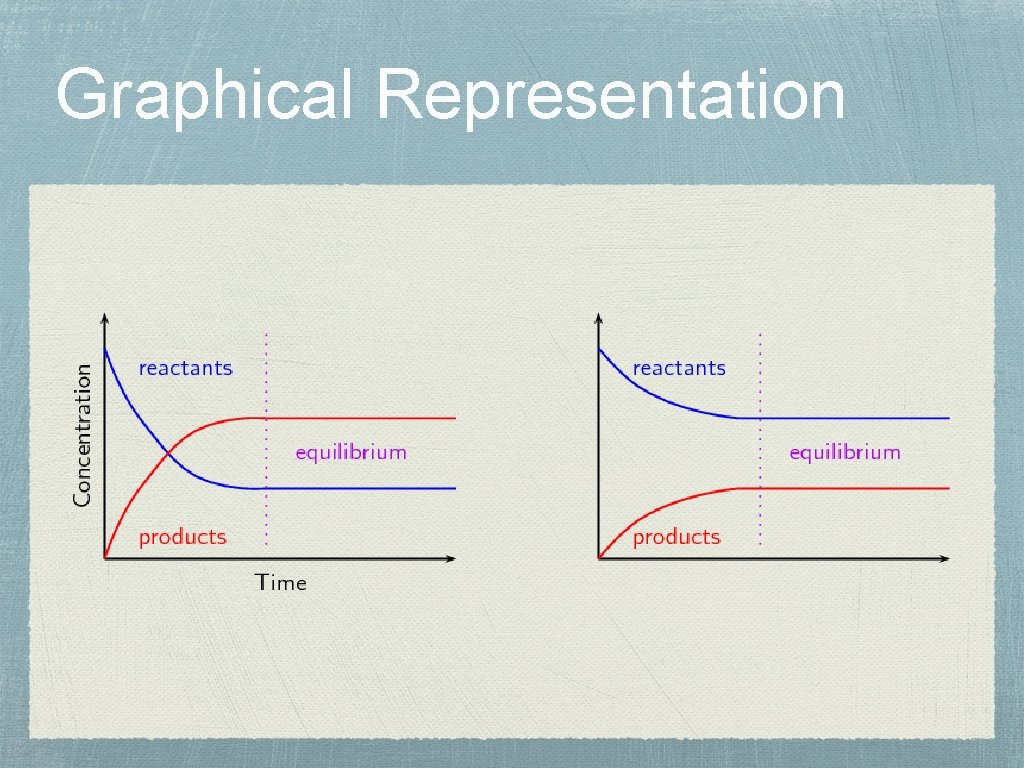
Graphical Representation
15. 5 Calculating Keq or Kp Write the equilibrium expression Substitute known values for reactants and products Interpret the meaning in the value of the equilibrium constant
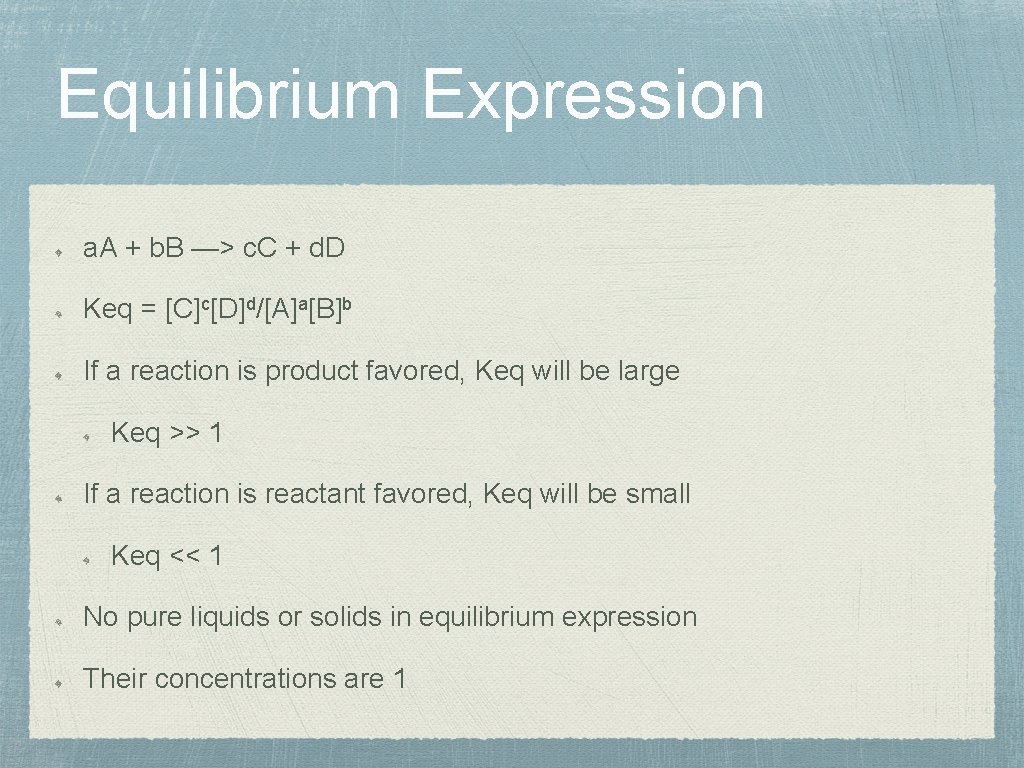
Equilibrium Expression a. A + b. B —> c. C + d. D Keq = [C]c[D]d/[A]a[B]b If a reaction is product favored, Keq will be large Keq >> 1 If a reaction is reactant favored, Keq will be small Keq << 1 No pure liquids or solids in equilibrium expression Their concentrations are 1
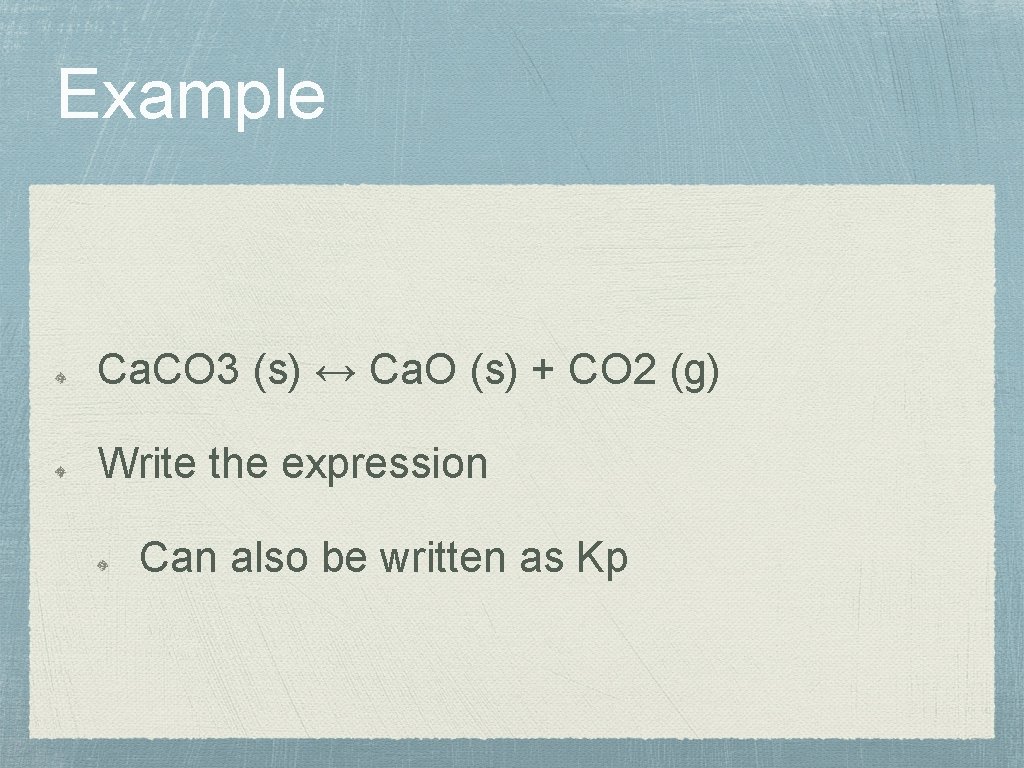
Example Ca. CO 3 (s) ↔ Ca. O (s) + CO 2 (g) Write the expression Can also be written as Kp

Keq Breakdown
Calculating Keq or Kp But we often do not know the concentrations of all species in the system If we know the concentration of one however, then we can use stoich to find the others
Calculating Keq or Kp 1. Tabulate all the known initial and equilibrium concentrations of the species appear in the Keq expression 2. For those species for which both initial and equilibrium concentrations are known, calculate the change in concentration that occurs as the system reaches equilibrium 3. Use stoich to calculate the changes in concentration for other species 4. From initial concentrations and changes in concentration, calculate the equilibrium concentrations
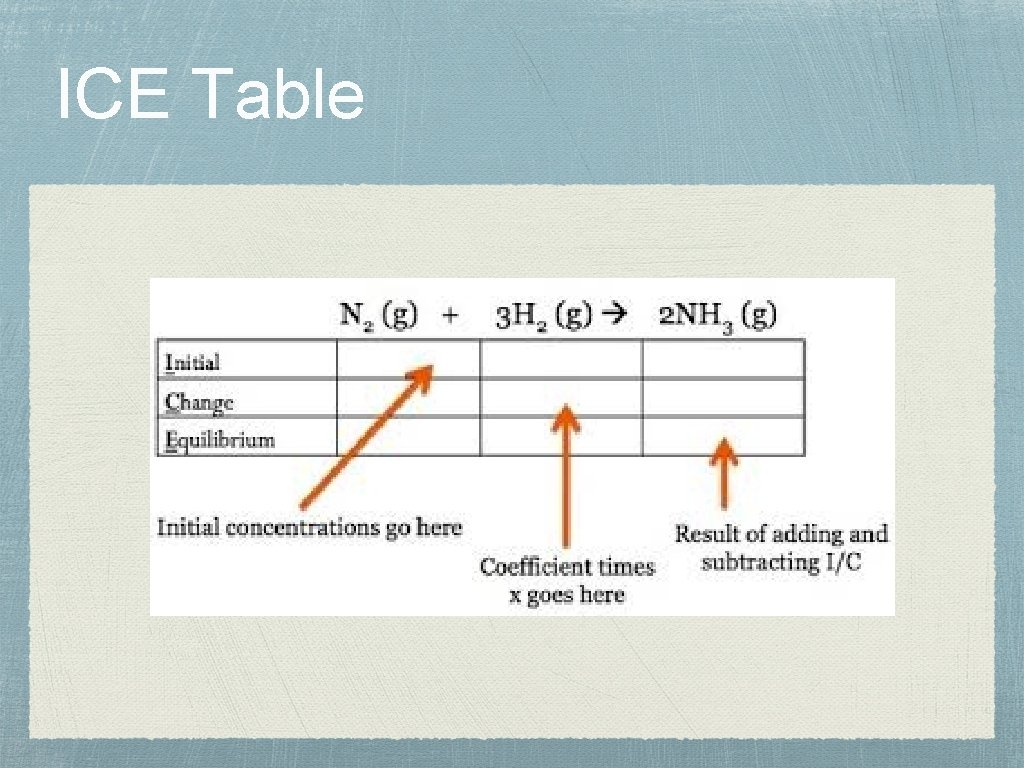
ICE Table
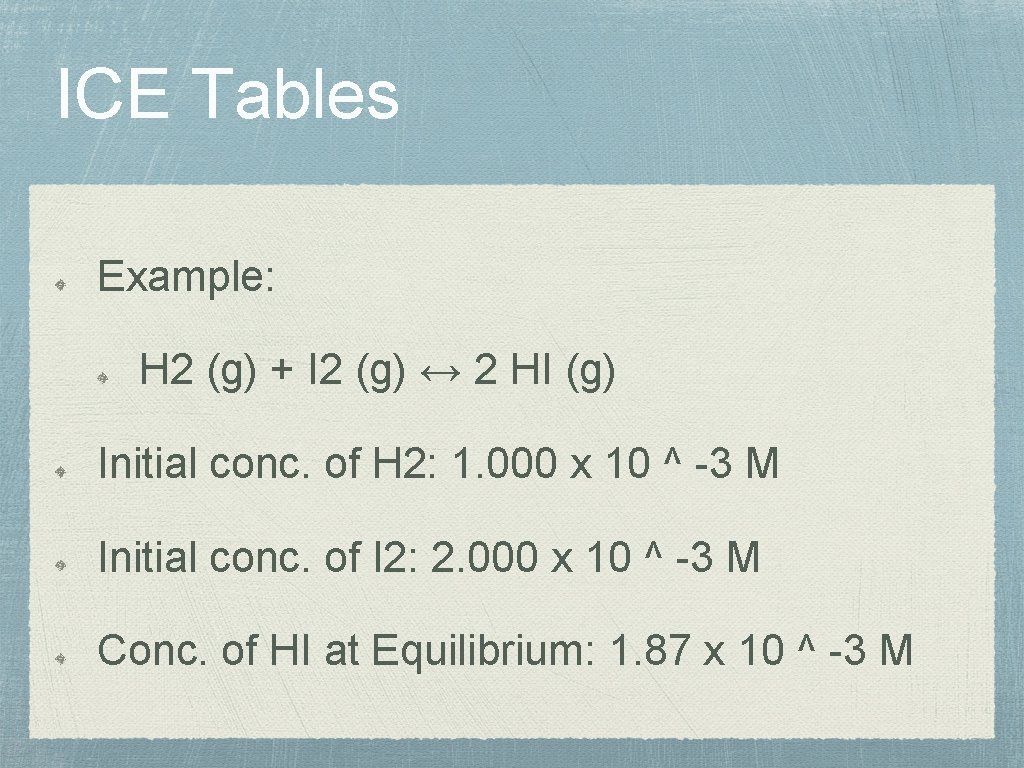
ICE Tables Example: H 2 (g) + I 2 (g) ↔ 2 HI (g) Initial conc. of H 2: 1. 000 x 10 ^ -3 M Initial conc. of I 2: 2. 000 x 10 ^ -3 M Conc. of HI at Equilibrium: 1. 87 x 10 ^ -3 M
15. 6 Applications of Equilibrium Constants Predicting the direction of reaction Q = equilibrium quotient K = Q, reaction is at equilibrium Q > K, Conc. of reactants is too large, reaction is going to shift towards reactants (right to left) Q < K, Conc. of products is too small, reaction will shift toward products (left to right)
![Evaluating Q System at the same temperature has the following concentrations: [HI] - 1.](http://slidetodoc.com/presentation_image_h2/7a292f380f6421e313ec997fb0b7ecb7/image-18.jpg "Evaluating Q System at the same temperature has the following concentrations: [HI] - 1.")
Evaluating Q System at the same temperature has the following concentrations: [HI] - 1. 0 x 10 ^ - 2 M [H 2] - 5. 0 x 10 ^ -3 M [I 2] - 3. 0 x 10 ^ -2 M Calculate Q (reaction quotient) and predict the shift in equilibrium.
Calculating Keq from initial conc. This technique will also come up in acid base Useful in determining Keq from initial concentrations when the concentrations of products at equilibrium are not known
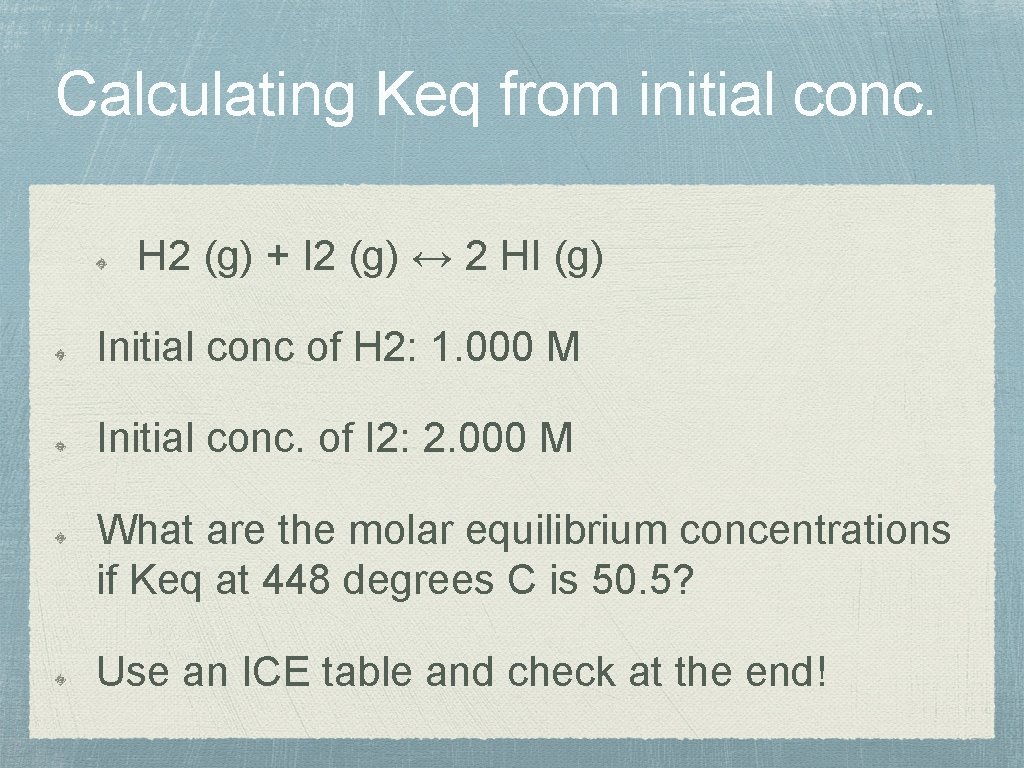
Calculating Keq from initial conc. H 2 (g) + I 2 (g) ↔ 2 HI (g) Initial conc of H 2: 1. 000 M Initial conc. of I 2: 2. 000 M What are the molar equilibrium concentrations if Keq at 448 degrees C is 50. 5? Use an ICE table and check at the end!
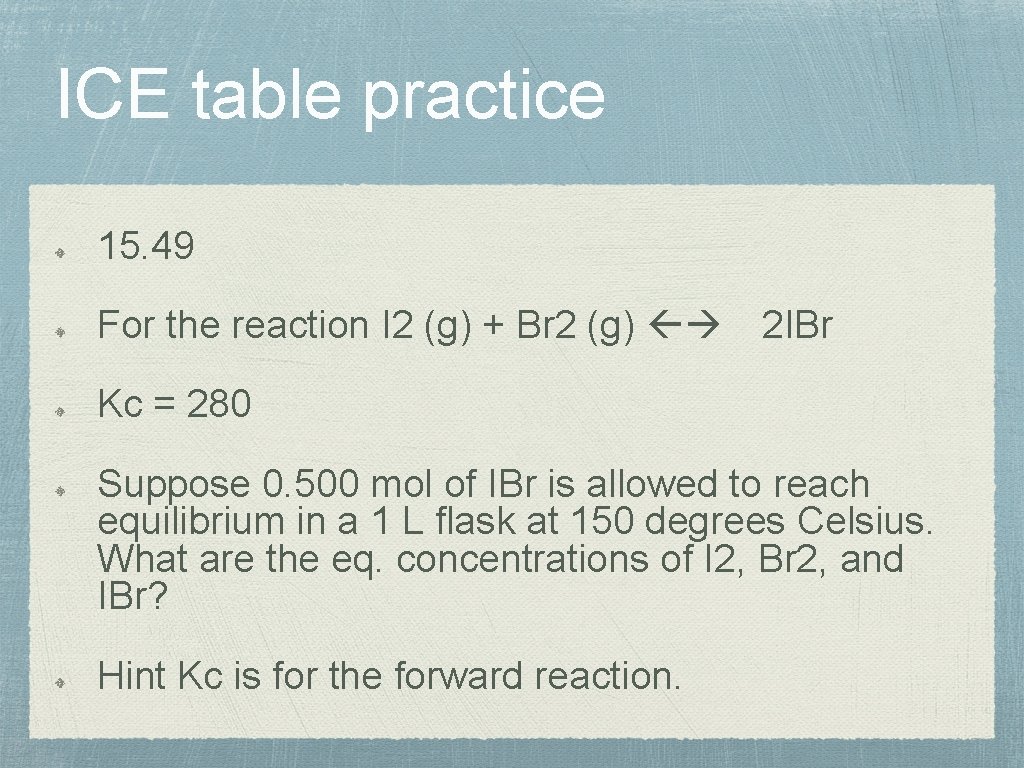
ICE table practice 15. 49 For the reaction I 2 (g) + Br 2 (g) 2 IBr Kc = 280 Suppose 0. 500 mol of IBr is allowed to reach equilibrium in a 1 L flask at 150 degrees Celsius. What are the eq. concentrations of I 2, Br 2, and IBr? Hint Kc is for the forward reaction.
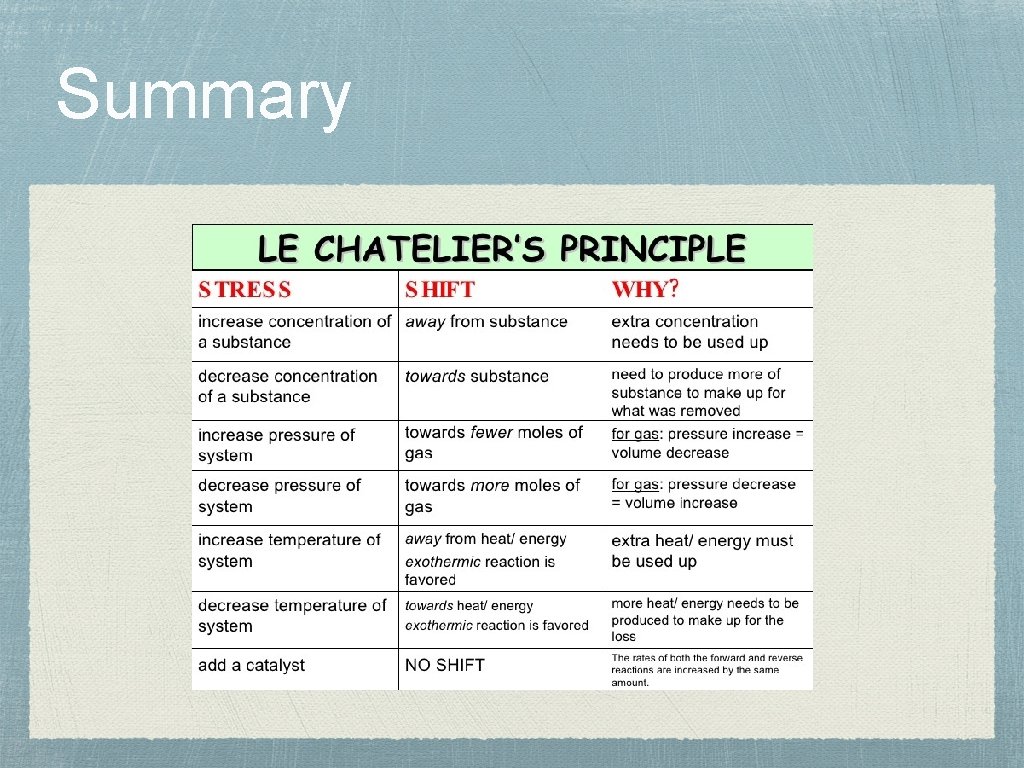
Le’Chateliers Principle Predicts an equilibrium shifts due to stresses on the equilibrium Think about your body… If you are really hot you begin to sweat If you are cold you begin to shiver Your body is attempting to maintain thermal equilibrium
Le’Chateliers Principle Types of stresses we will investigate Adding/Removing a Reactant/Product Changing the pressure by changing volume Changing the Temperature
Adding/Removing (Conc. ) If a chemical system is at equilibrium and we add a substance (reactant or product) the reaction will shift so as to reestablish equilibrium by consuming part of the added substance Conversely, removing a substance shifts equilibrium so that it is reformed
Le’Chateliers Principle Adding/Removing a Reactant Adding a reactant will cause the equilibrium to shift right so that the reactant is consumed and equilibrium is reestablished Removing a reactant will cause the reaction to shift left to produce more reactant and reestablish equilibrium
Le’Chateliers Principle Remember, all of these situations apply to a system that is already at equilibrium Adding/Removing a Product Adding a product will cause the equilibrium to shift left so that the product is consumed Removing a product will…. .
Changing in Volume Reducing the volume of an equilibrium mixture of gas causes the system to shift in the direction of that reduces to the number of moles of gas Converse is also true, increased volume —> more moles of gas Why? This reduces the amount of pressure on the container… Can I change the pressure through volume change on a liquid
Example N 2 O 4 (g) —> 2 NO 2 (g) How will this equilibrium shift due to change in pressure through volume change?
Change in Temperature For Le’Chatliers princible we will treat heat as a product (for exothermic) and as a reactant (for endothermic) Remember, if a system is at equilibrium and something is removed, the shift will be in the direction as to replace it. Therefore, removing heat from an exothermic reaction will cause the reaction to shift to the right and vice versa
Addition of Catalyst Because the forward and reaction occur at the same rate, there is no effect on equilibrium
Summary
Topics Covered Chapter 16 16. 1, 16. 2: Review and Bronsted Lowry 16. 3: Autoionization of Water 16. 4: p. H Scale 16. 5, 16. 6, 16. 7: Strong Acids/Bases, Weak Acid/Base 16. 8: Ka and Kb 16. 9: Acid Base Behavior and Lewis Acid/Base
16. 1 Intro Large portion of chemistry can be understood with acids and bases Typically only takes place in liquids and aqueous solutions (but can occur in gases…rarely) Really acids and bases are like a tug of water on electrons and protons between compounds and elements who are more capable to change their structure Most acid-base systems are in dynamic equilibrium
16. 1 Review Historically chemists have sought to relate acidity and basicity to their molecular structure Svante Arrenhius linked acid behavior with the presence of H+ ions and base behavior with presence OHi. e. HCl, H 2 SO 4, HNO 3 or KOH, Na. OH, etc An Arrhenius acid is a substance that dissociates in water to form hydrogen ions or protons HCl (g) H+ (aq) + Cl- (aq)
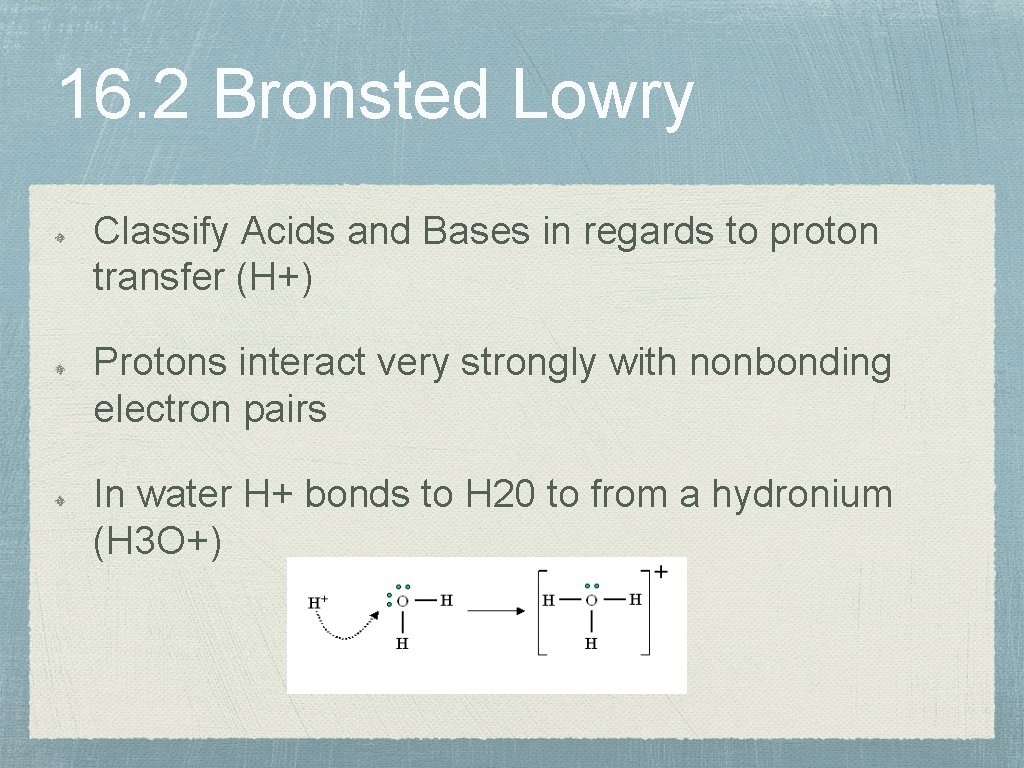
16. 2 Bronsted Lowry Classify Acids and Bases in regards to proton transfer (H+) Protons interact very strongly with nonbonding electron pairs In water H+ bonds to H 20 to from a hydronium (H 3 O+)
16. 2 Bronsted Lowry We will use H+(aq) and H 30+ (aq) interchangeably, which is very common in chem H+(aq) is used shorthand notation, although the formation of a hydronium ion is a more accurate representation
16. 2 Bronsted Lowry Definition: Bronsted - acid : an acid is a molecule or ion that can donate a proton to another substance Bronsted - base: a base is substance that can accept a proton
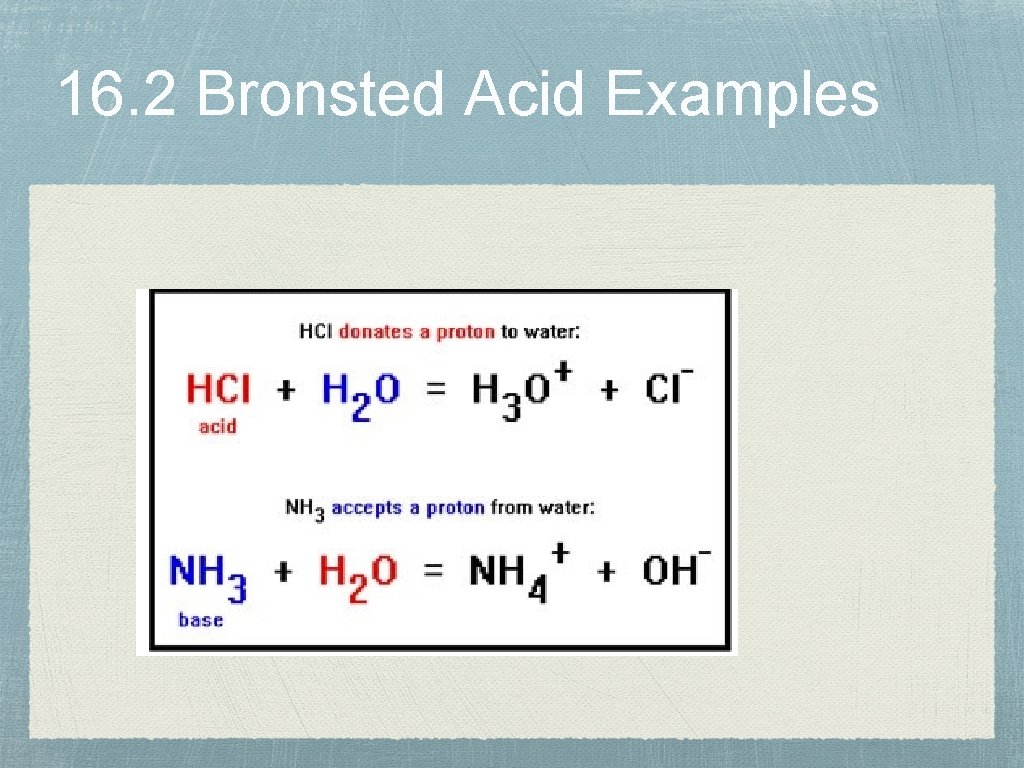
16. 2 Bronsted Acid Examples
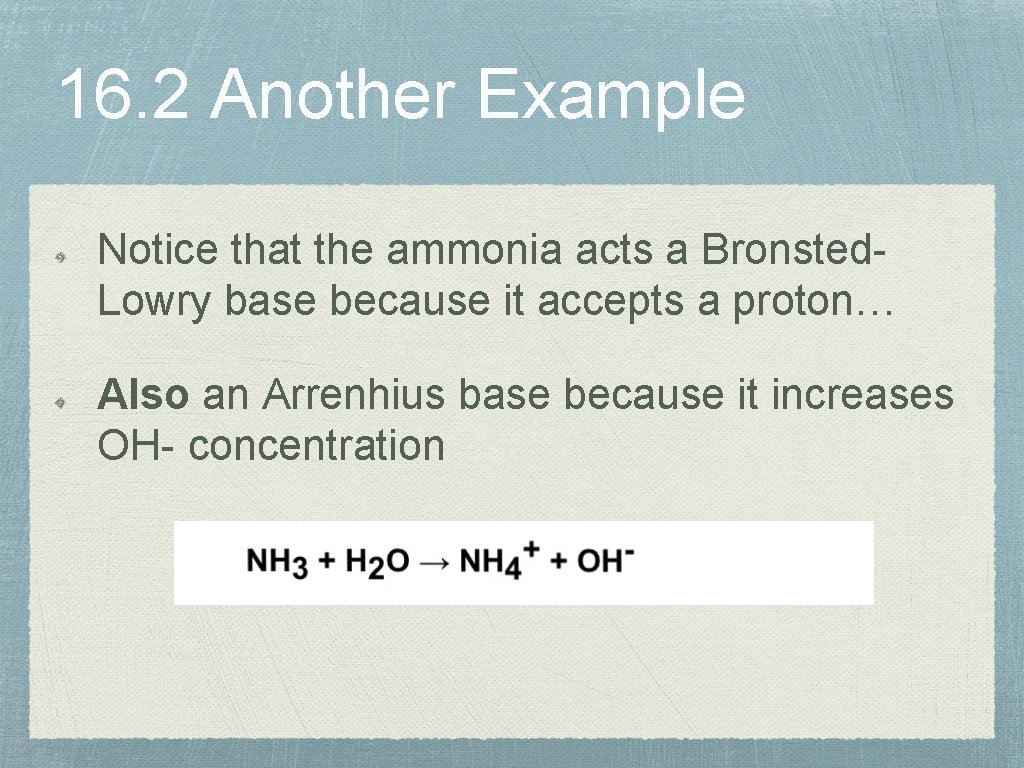
16. 2 Another Example Notice that the ammonia acts a Bronsted. Lowry base because it accepts a proton… Also an Arrenhius base because it increases OH- concentration
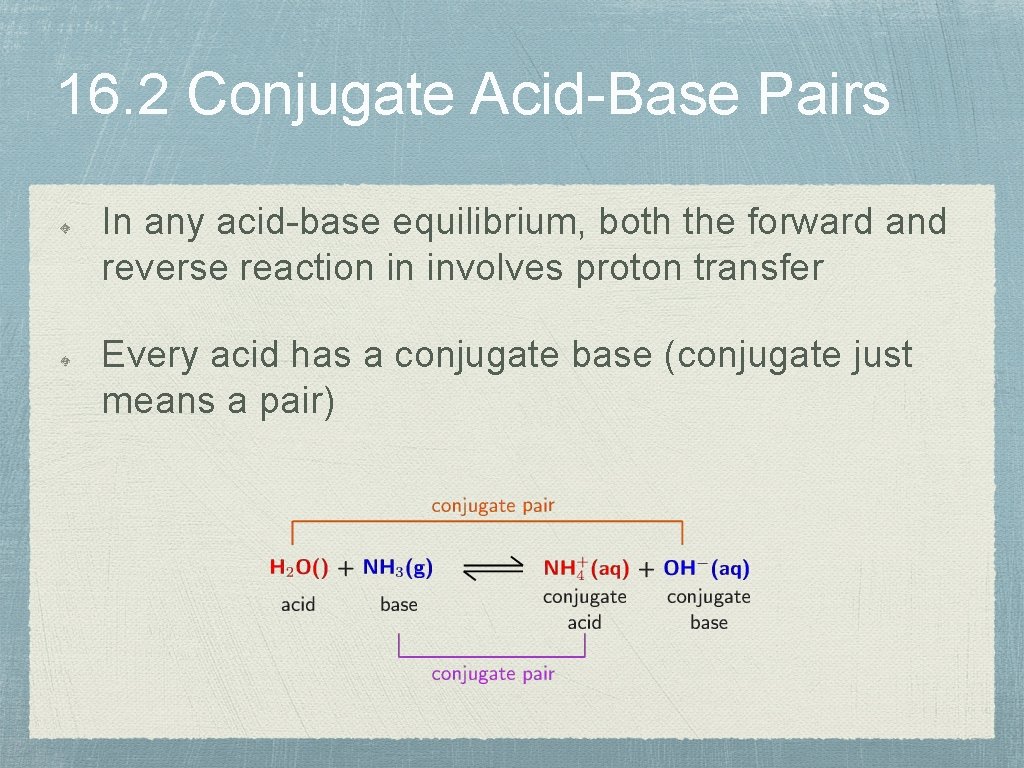
16. 2 Conjugate Acid-Base Pairs In any acid-base equilibrium, both the forward and reverse reaction in involves proton transfer Every acid has a conjugate base (conjugate just means a pair)
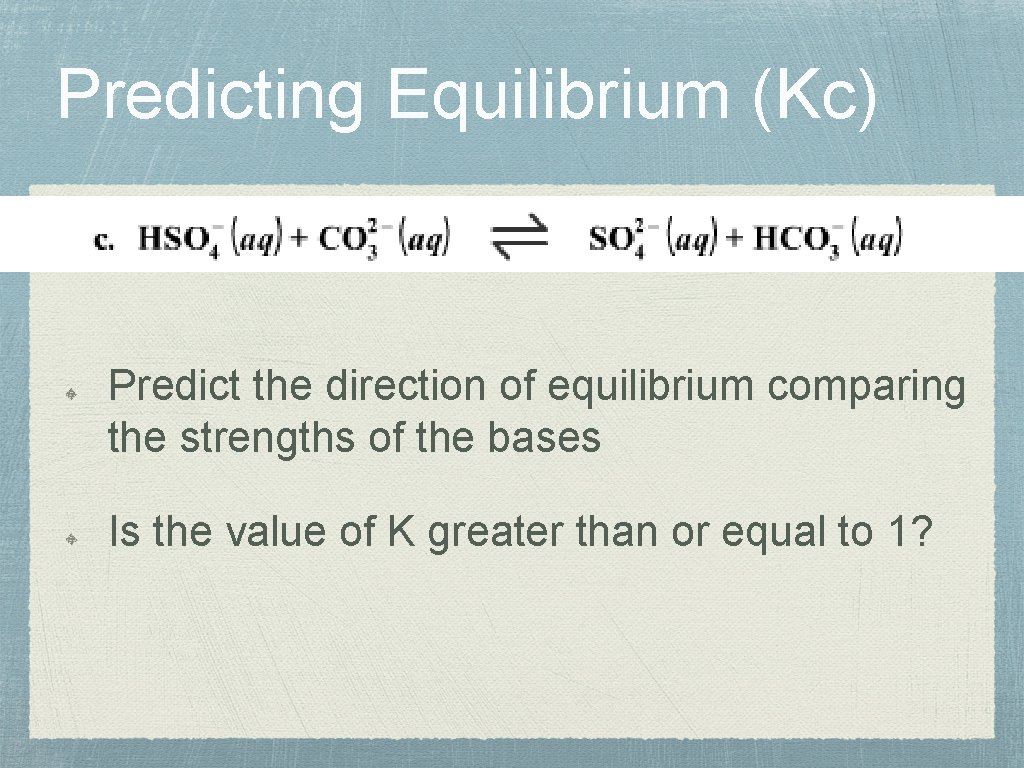
Predicting Equilibrium (Kc) Predict the direction of equilibrium comparing the strengths of the bases Is the value of K greater than or equal to 1?
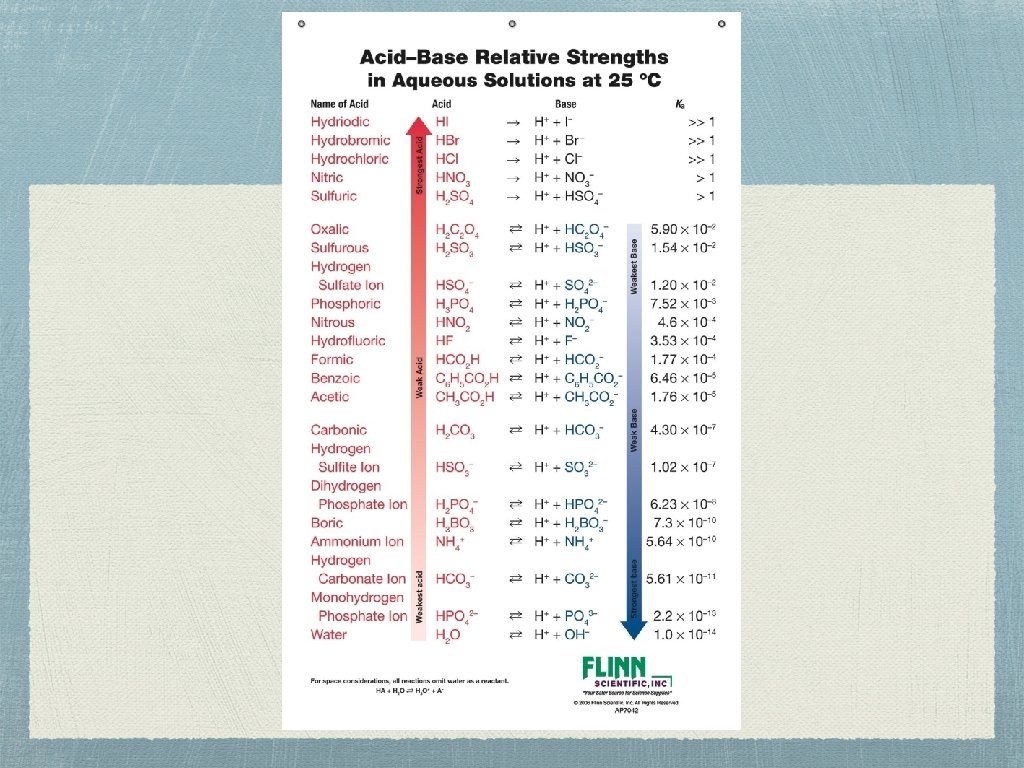
16. 2 Relative Strengths Strong Acids - completely give up their protons and their conjugate bases are weak proton acceptors (100% dissociation) Weak acids - only partially dissociate in aqueous solutions (conjugate bases of conjugate acids are also weak) Negligible activity - (CH 4) molecules who contain hydrogen but show no acidic behavior (their conjugates are very strong bases, 100% protonated in water CH 3 -)
16. 2 Identifying Conjugates Identify the conjugate acids of the following HSO 3 FPO 43 CO
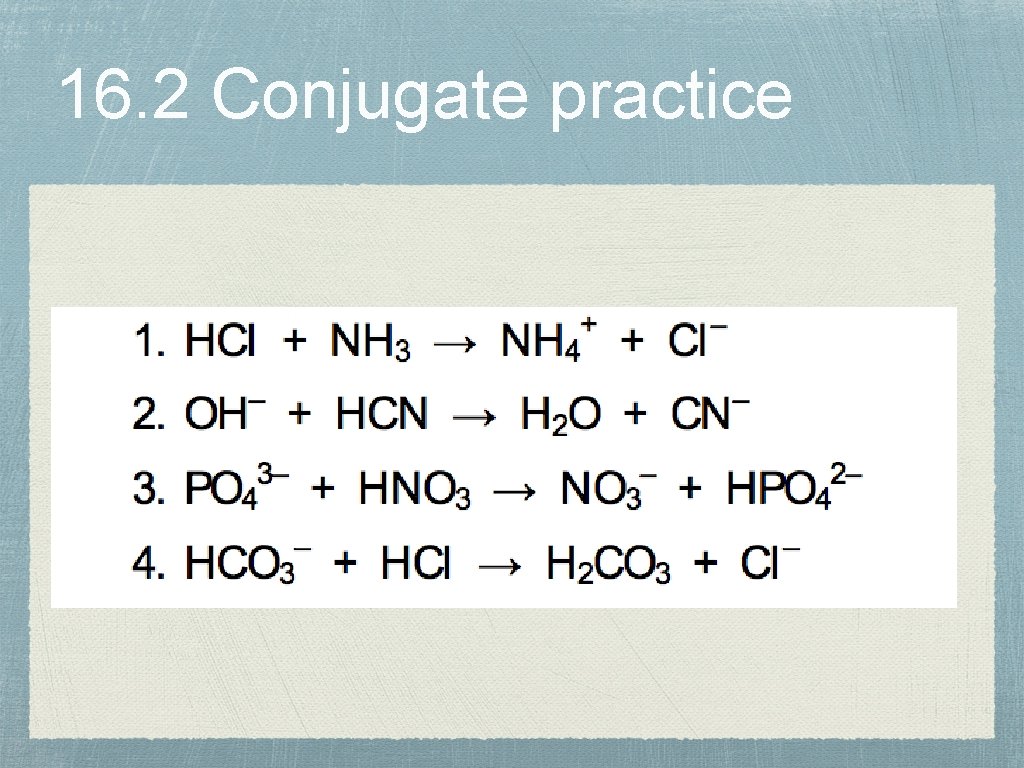
16. 2 Conjugate practice
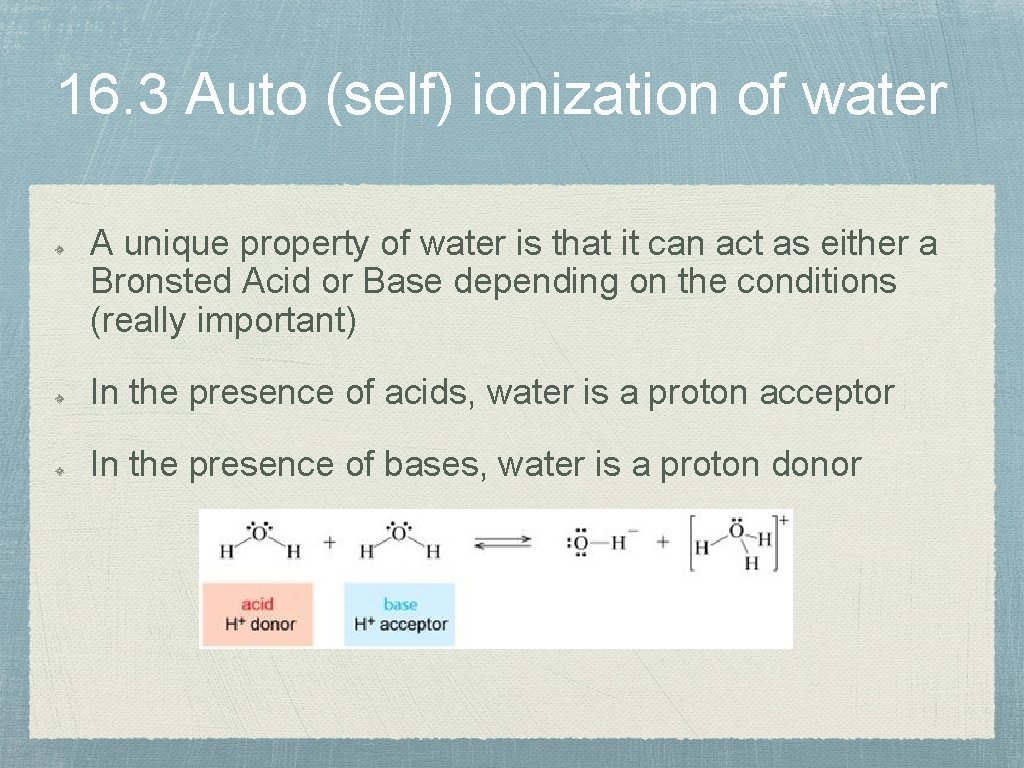
16. 3 Auto (self) ionization of water A unique property of water is that it can act as either a Bronsted Acid or Base depending on the conditions (really important) In the presence of acids, water is a proton acceptor In the presence of bases, water is a proton donor
![16. 3 Ion Product of Water Kw = [H 30+][OH-] (notice water is excluded)](http://slidetodoc.com/presentation_image_h2/7a292f380f6421e313ec997fb0b7ecb7/image-47.jpg "16. 3 Ion Product of Water Kw = [H 30+][OH-] (notice water is excluded)")
16. 3 Ion Product of Water Kw = [H 30+][OH-] (notice water is excluded) Kw = 1. 0 x 10 ^ -14 This value is so low because in a system of water, only about 2 in 1 billion water molecules is ionized The equilibrium is reactant favored
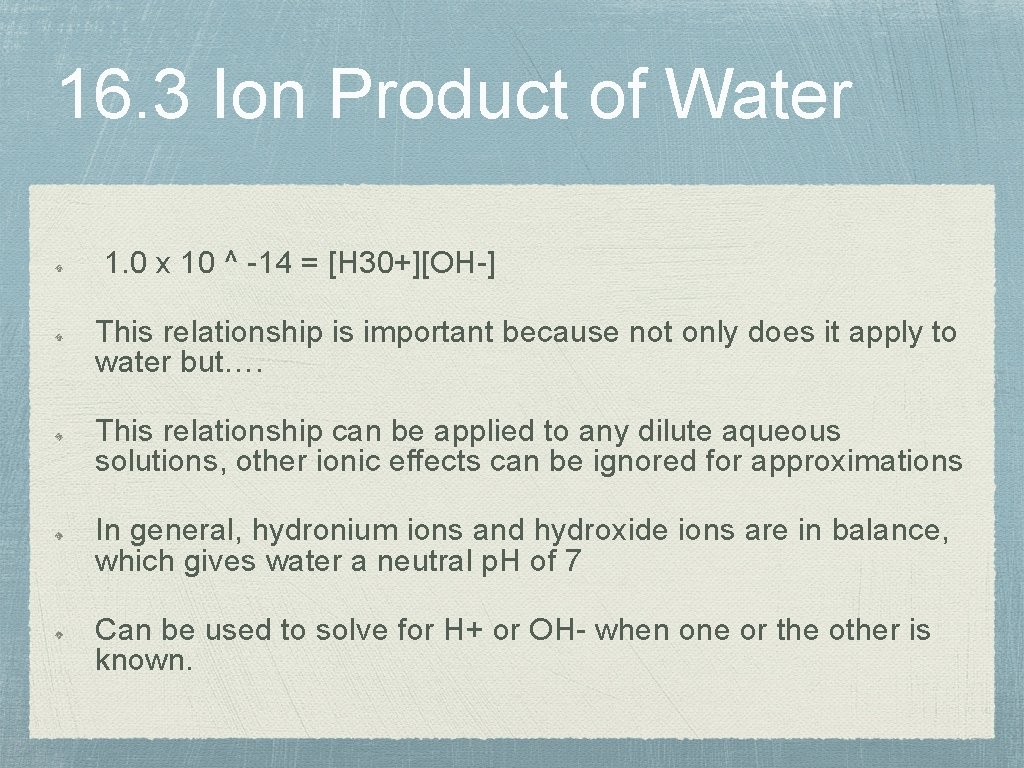
16. 3 Ion Product of Water 1. 0 x 10 ^ -14 = [H 30+][OH-] This relationship is important because not only does it apply to water but…. This relationship can be applied to any dilute aqueous solutions, other ionic effects can be ignored for approximations In general, hydronium ions and hydroxide ions are in balance, which gives water a neutral p. H of 7 Can be used to solve for H+ or OH- when one or the other is known.
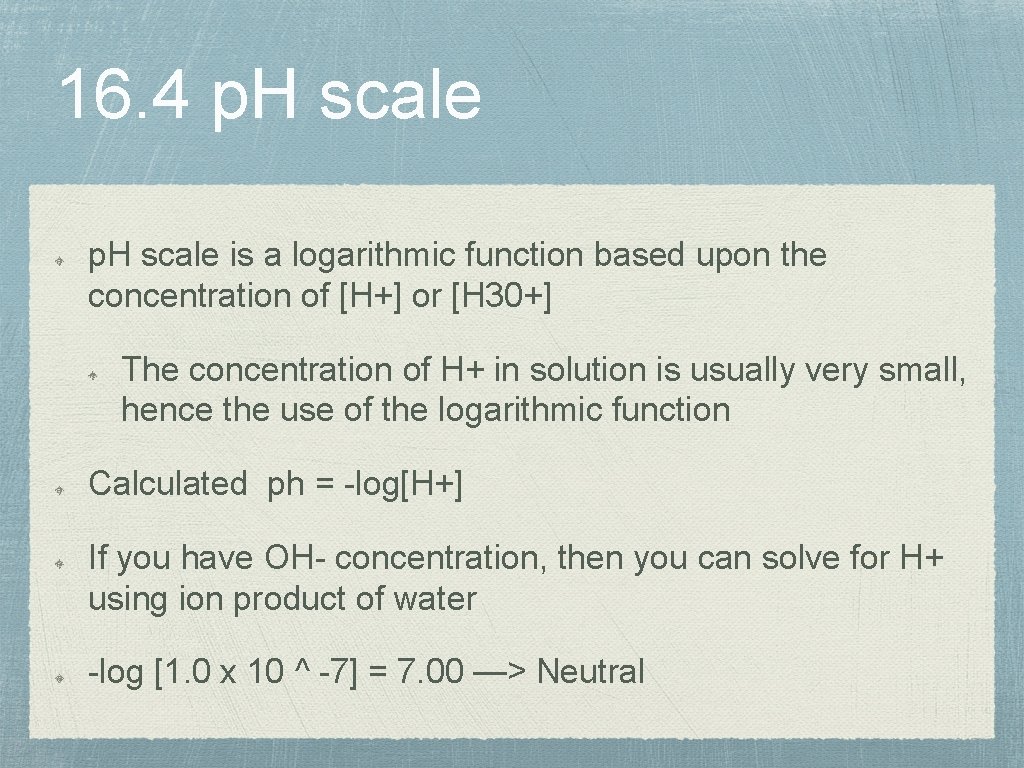
16. 4 p. H scale is a logarithmic function based upon the concentration of [H+] or [H 30+] The concentration of H+ in solution is usually very small, hence the use of the logarithmic function Calculated ph = -log[H+] If you have OH- concentration, then you can solve for H+ using ion product of water -log [1. 0 x 10 ^ -7] = 7. 00 —> Neutral
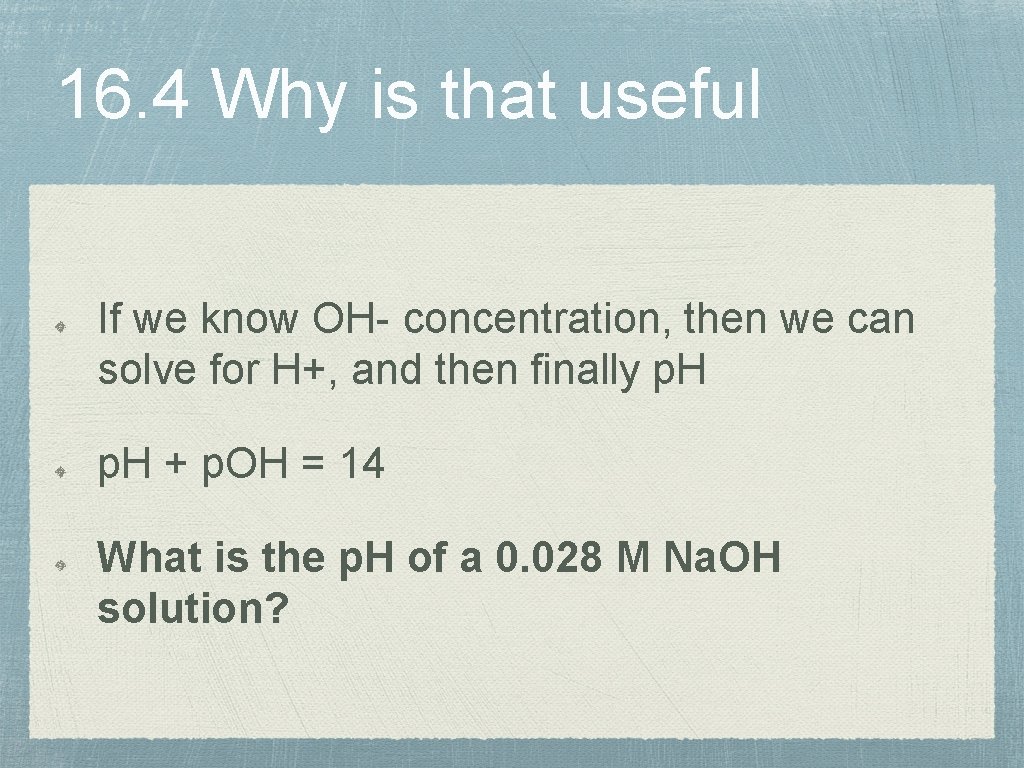
16. 4 Why is that useful If we know OH- concentration, then we can solve for H+, and then finally p. H + p. OH = 14 What is the p. H of a 0. 028 M Na. OH solution?
![16. 4 Calculate the p. H of the following [H+] = 1. 0 x](http://slidetodoc.com/presentation_image_h2/7a292f380f6421e313ec997fb0b7ecb7/image-51.jpg "16. 4 Calculate the p. H of the following [H+] = 1. 0 x")
16. 4 Calculate the p. H of the following [H+] = 1. 0 x 10 ^ -12 M [H+] = 5. 6 x 10 ^ -6 M [H+] = 3. 8 x 10 ^ -4 M [OH-] = 5. 0 x 10 ^ -7 M [OH-] = 1. 2 x 10 ^ -3 M
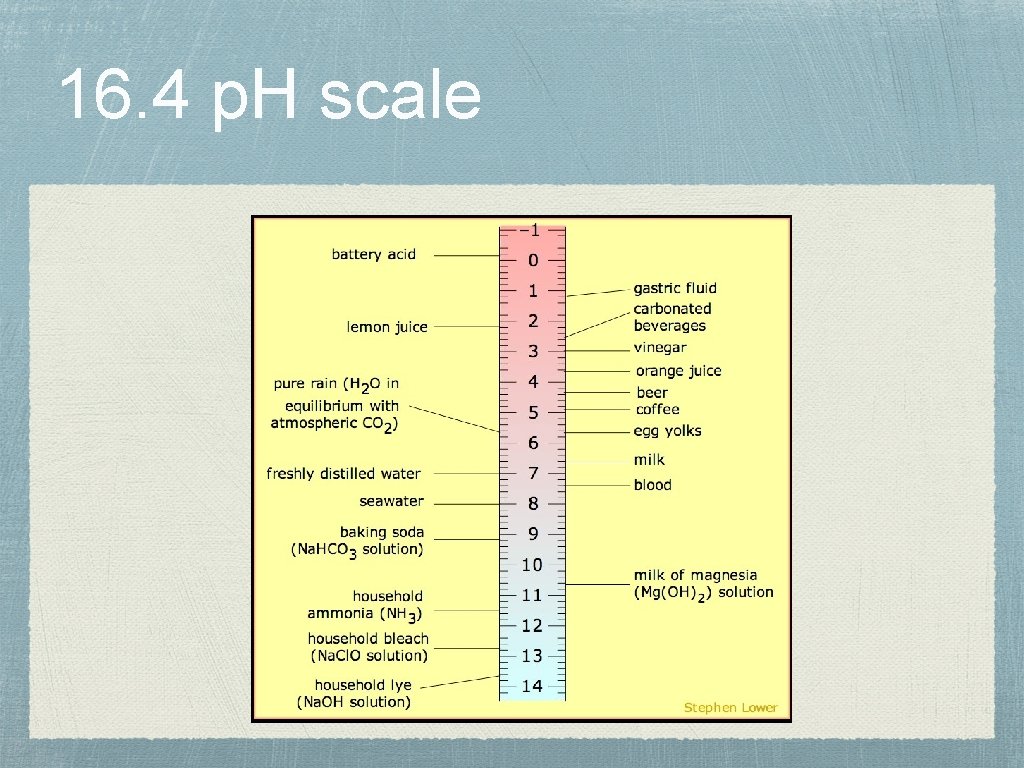
16. 4 p. H scale
![16. 4 Other p scales p. OH = -log[OH-] Based on self ionization of](http://slidetodoc.com/presentation_image_h2/7a292f380f6421e313ec997fb0b7ecb7/image-53.jpg "16. 4 Other p scales p. OH = -log[OH-] Based on self ionization of")
16. 4 Other p scales p. OH = -log[OH-] Based on self ionization of water… [H+][OH-] = 1. 0 x 10 ^ -14 Taking the negative log of both sides… -log[H+] + (-log[OH-]) = 14 Therefore p. H + p. OH = 14
16. 4 Calculating p. H from p. OH What is the p. H of a solution whose p. OH is 3? What is the concentration of OH- ions in a solution whose p. H is 4. 12?
16. 5 Strong Acids and Bases Strong Acids - the seven most common strong acids are listed below Monoprotic: HCl, HI, HNO 3, HBr, HCl. O 3, and HCl. O 4 Diprotic: H 2 SO 4 For all practical purposes, an aqueous solution of HNO 3 consists entirely of H 3 O+ and NO 3 - ions…. If concentrations are less 1. 0 x 10^-6 M, we must take into account the auto ionization of water
16. 5 Strong Acids For a monoprotic strong acid, the p. H of the solution is very straightforward [H+] is equal to the concentration of the original solution p. H can easily be calculated from -log[H+] A 0. 20 M HNO 3 solution has an [H+] of 0. 20 M as well (complete ionization)
16. 6 Strong Basee There relatively few common bases…. Mostly ionic hydroxides of group 2 a such as KOH, Na. OH, and Ca(OH)2 A 0. 30 M Na. OH (aq) solution is “completely” ionized and is also 0. 30 M OH 0. 30 M Na. OH (aq) —> 0. 30 M Na+ (aq) + 0. 30 M OH- (aq)
16. 6 Strong Base Calculate the p. H of a 0. 028 M solution of Na. OH Calculate the p. H of a 0. 0011 M solution of Ca(OH)2
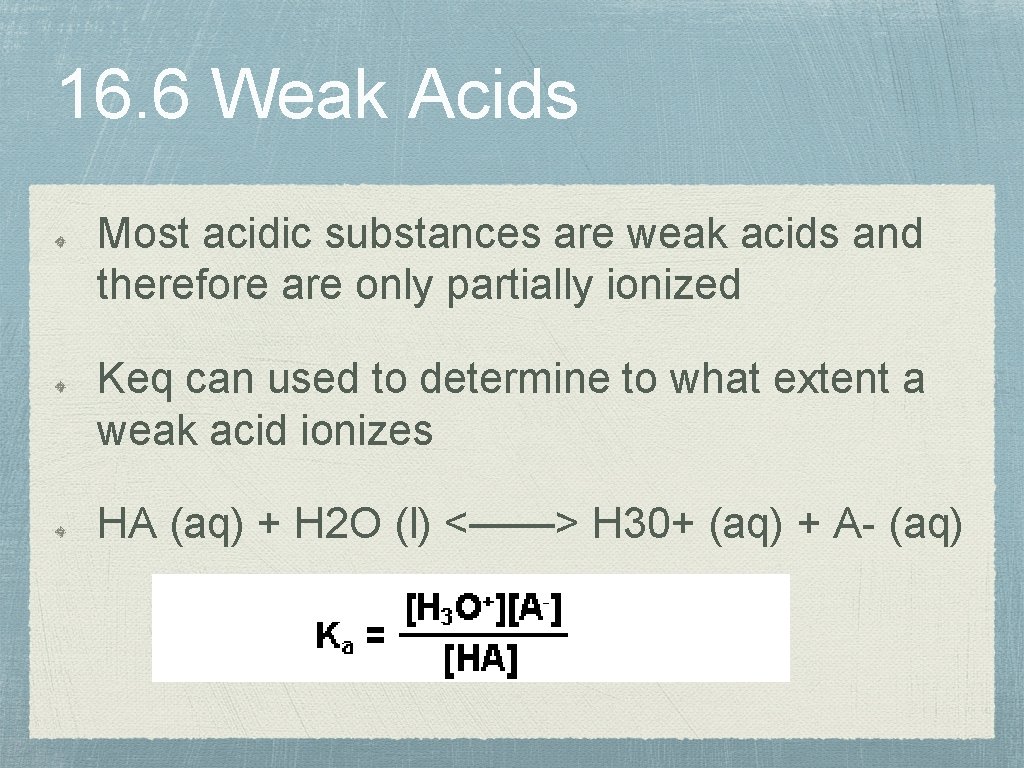
16. 6 Weak Acids Most acidic substances are weak acids and therefore are only partially ionized Keq can used to determine to what extent a weak acid ionizes HA (aq) + H 2 O (l) <——> H 30+ (aq) + A- (aq)
16. 6 Weak acids Are typically organic compounds composed entirely of hydrogen, carbon, and oxygen They contain some hydrogen atoms and some bonded to oxygen atoms In most cases the hydrogens attached to carbon do not ionize, whereas those bound to oxygen will
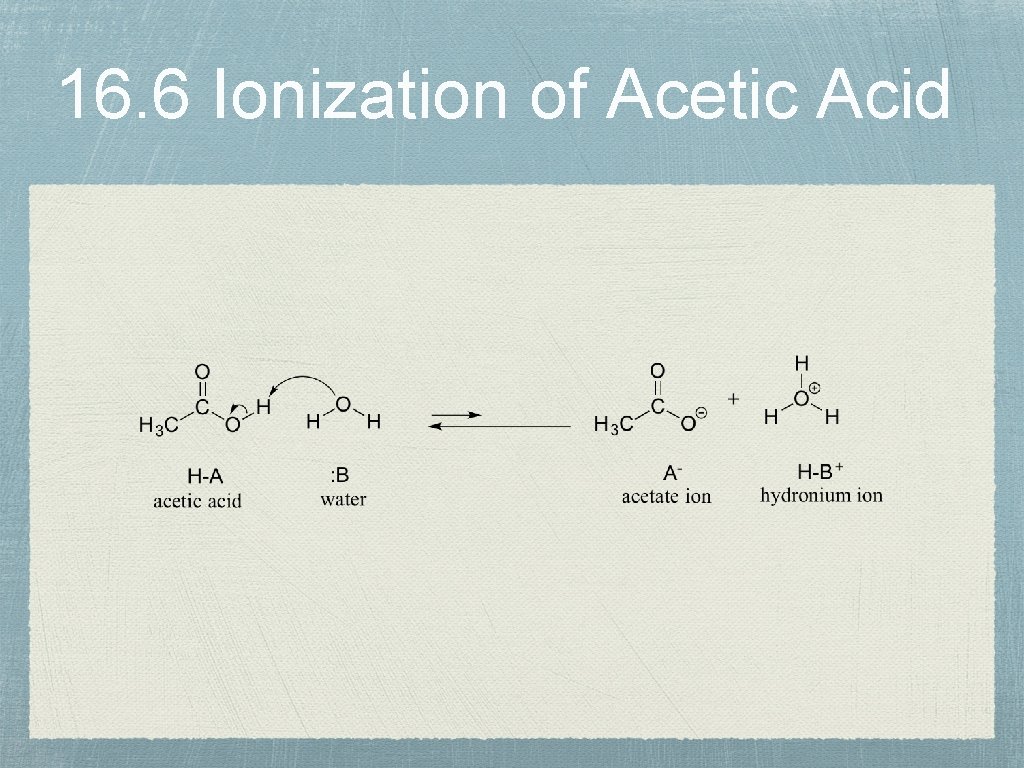
16. 6 Ionization of Acetic Acid
16. 6 Ka Ka - acid dissociation constant (another version of Keq) Smaller value of Ka, the weaker the acid Larger value of Ka, the stronger the acid
16. 6 Calculating Ka of p. H To calculate Ka from p. H, we must first determine the concentration of H+ in solution Typically you will also known the prepared concentration From there we can make an ICE table to determine concentrations of the weak acid and dissociated ions to calculate Ka
16. 6 5% Approximation During the calculation of Ka, if the ionization of the weak acid is less than 5%. . . Then we can drop the extra x in the denominator based up significant figures Approximation = [H+]/[HA] x 100% must be less than 5%
16. 6 ICE table practice Calculate the OH- concentration in a 0. 15 M Na. OH solution of NH 3 Write the chemical equation first Kb = 1. 8 x 10 ^ -5
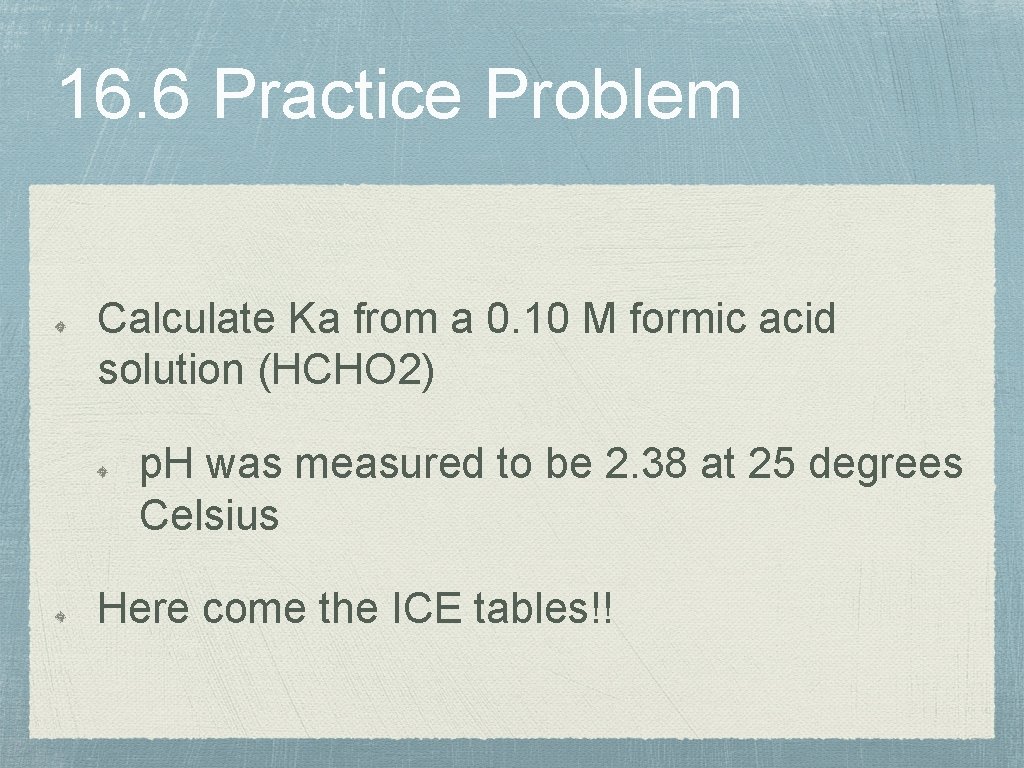
16. 6 Practice Problem Calculate Ka from a 0. 10 M formic acid solution (HCHO 2) p. H was measured to be 2. 38 at 25 degrees Celsius Here come the ICE tables!!
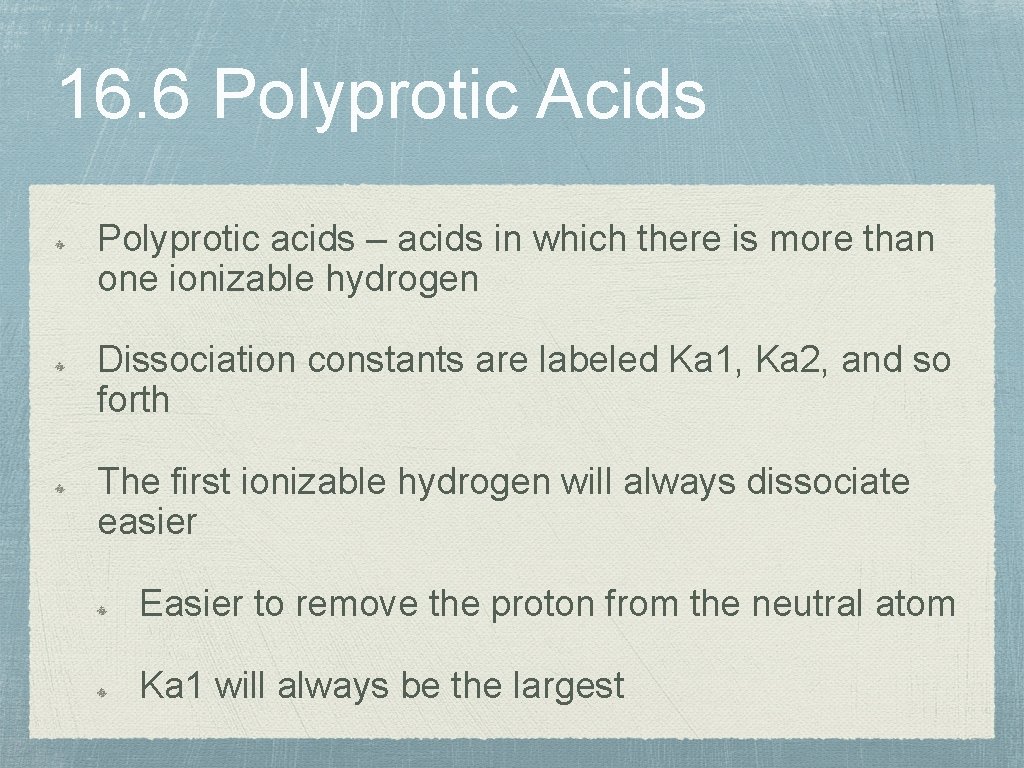
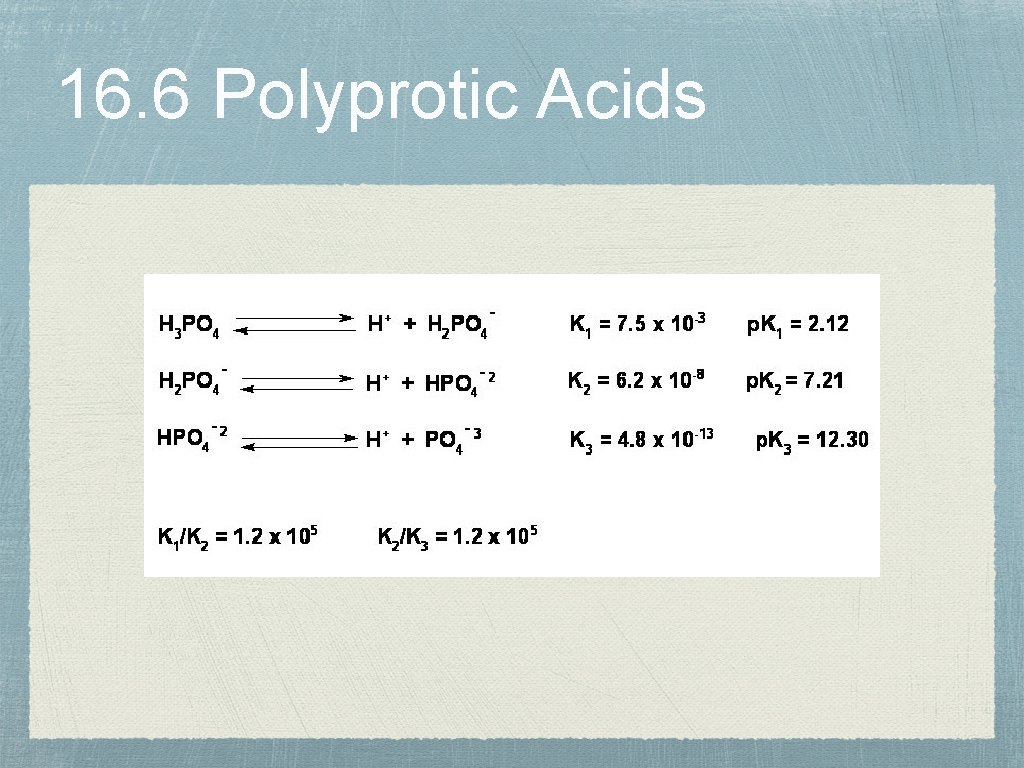
16. 6 Polyprotic Acids Polyprotic acids – acids in which there is more than one ionizable hydrogen Dissociation constants are labeled Ka 1, Ka 2, and so forth The first ionizable hydrogen will always dissociate easier Easier to remove the proton from the neutral atom Ka 1 will always be the largest
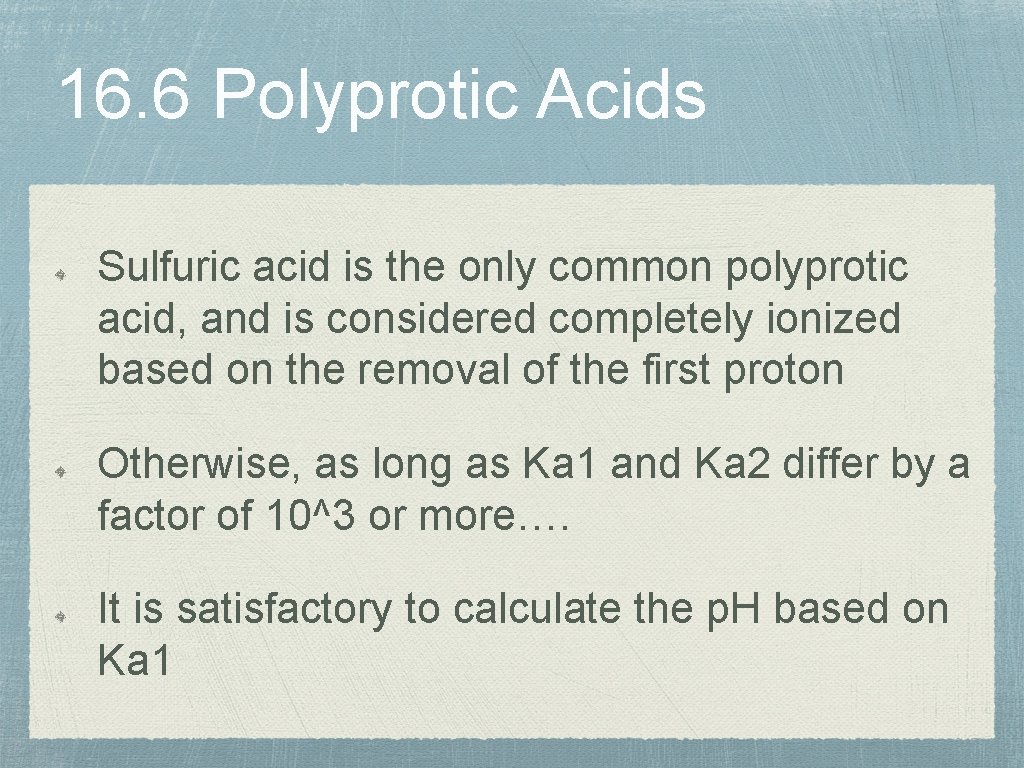
16. 6 Polyprotic Acids Sulfuric acid is the only common polyprotic acid, and is considered completely ionized based on the removal of the first proton Otherwise, as long as Ka 1 and Ka 2 differ by a factor of 10^3 or more…. It is satisfactory to calculate the p. H based on Ka 1
16. 6 Polyprotic Acids
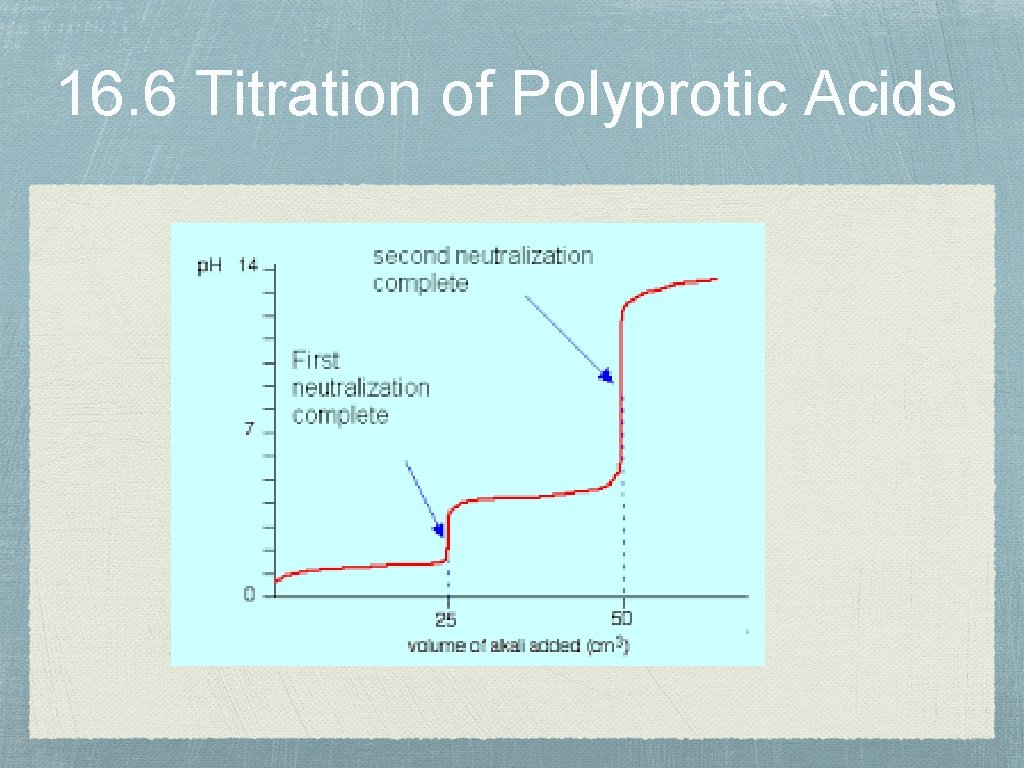
16. 6 Titration of Polyprotic Acids
16. 7 Weak Bases Many substances act as weak bases in water Important take away from this… Weak bases attract a proton Strength of the base can be interpreted as the value of its Kb
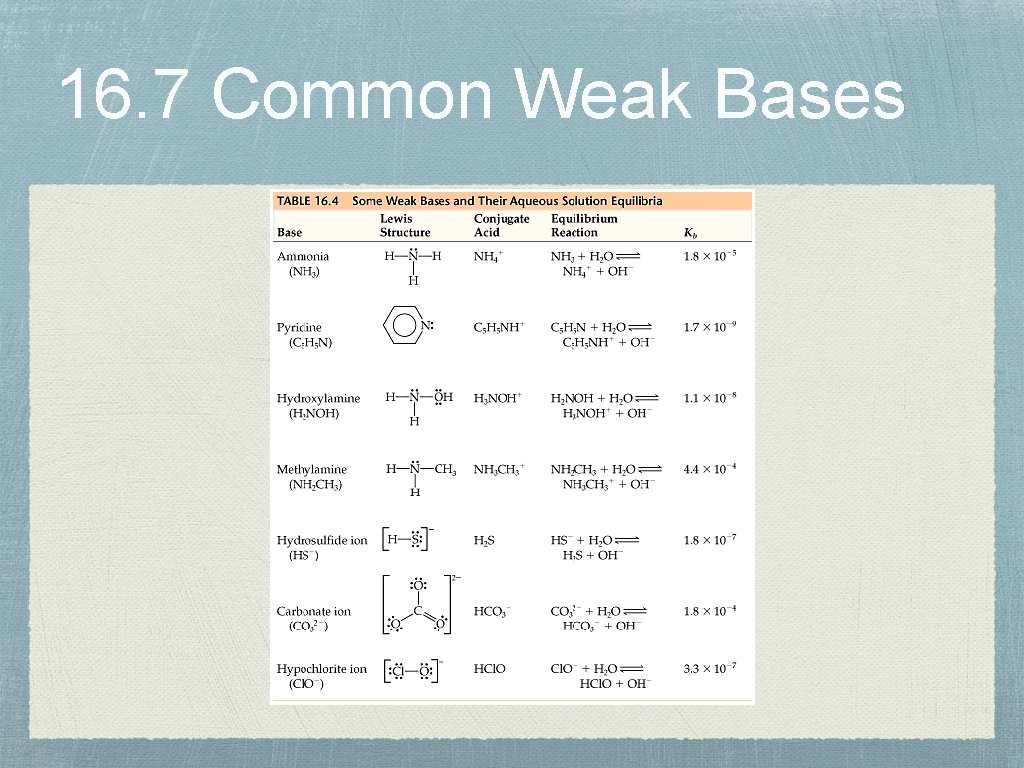
16. 7 Common Weak Bases
16. 8 Types of Weak Bases Type 1: Have a lone pair of electrons, typically nitrogen Lone pair is necessary to form the bond with H+ Type 2: Are the anion of a weak acid ( conjugate base) Kw = Ka x Kb Last little tid bit of info in terms of constants, if you know one you can find the other (at 25 degrees C)
16. 9 What determines the Strength of Acids? At the molecular level… Binary acids H-X, depends on the bond strength Bond strength decreases as atomic size increases Acidity increases as size increases (down a group) Across a row, as electronegativity increases, acidity increases
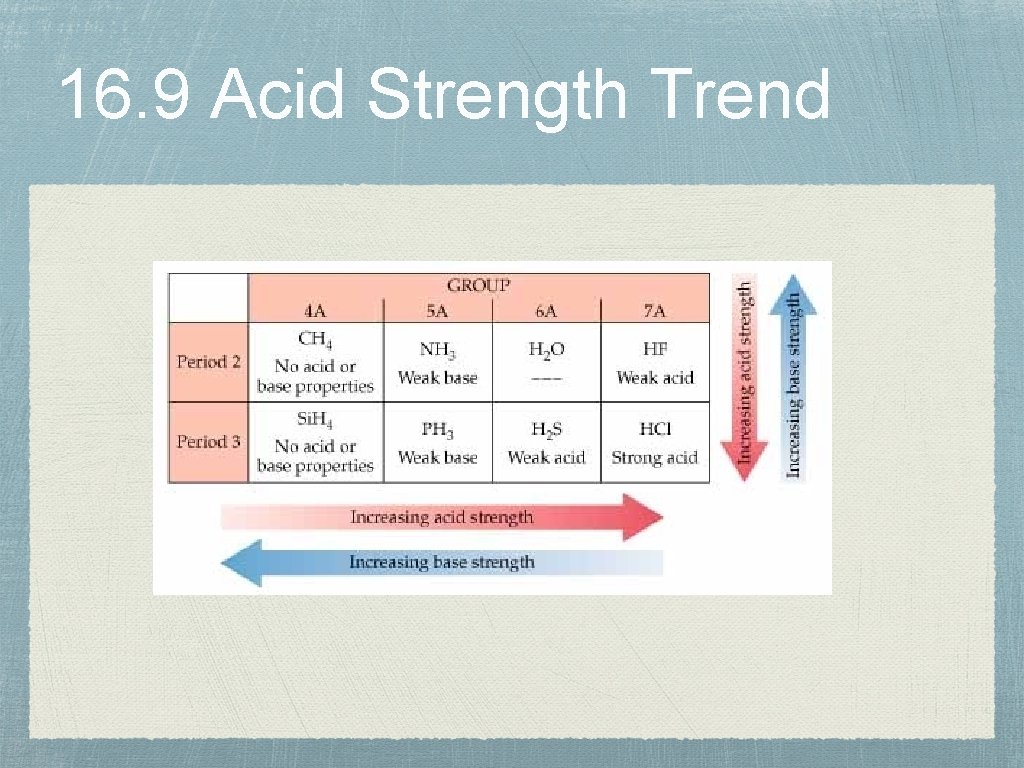
16. 9 Acid Strength Trend
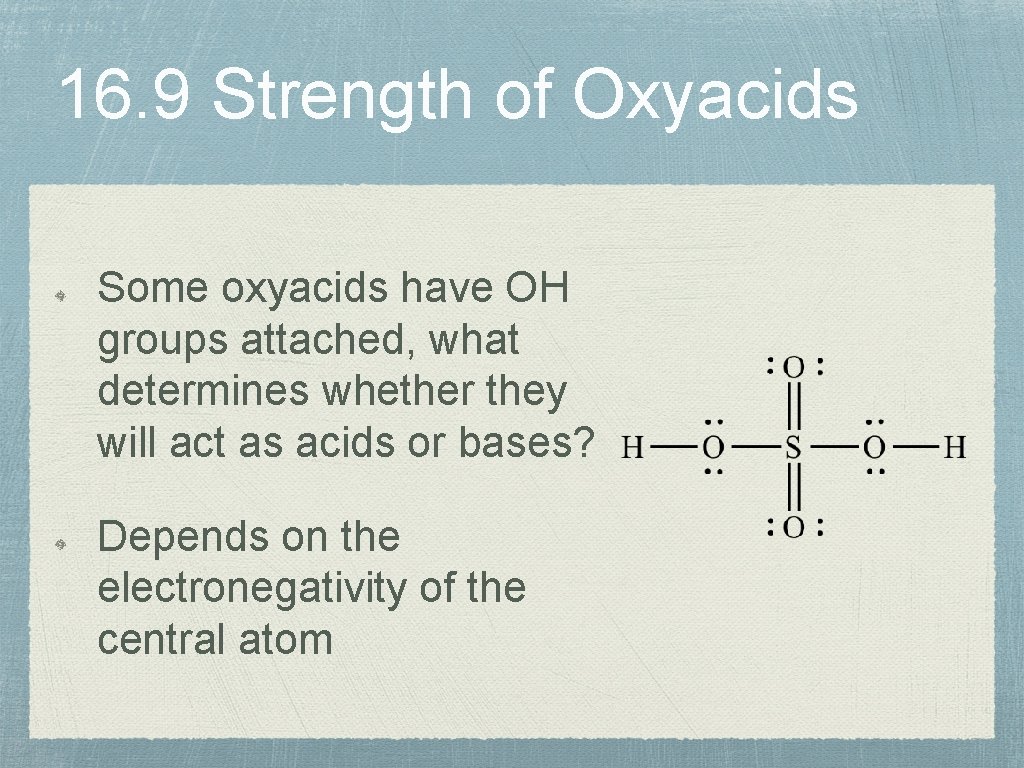
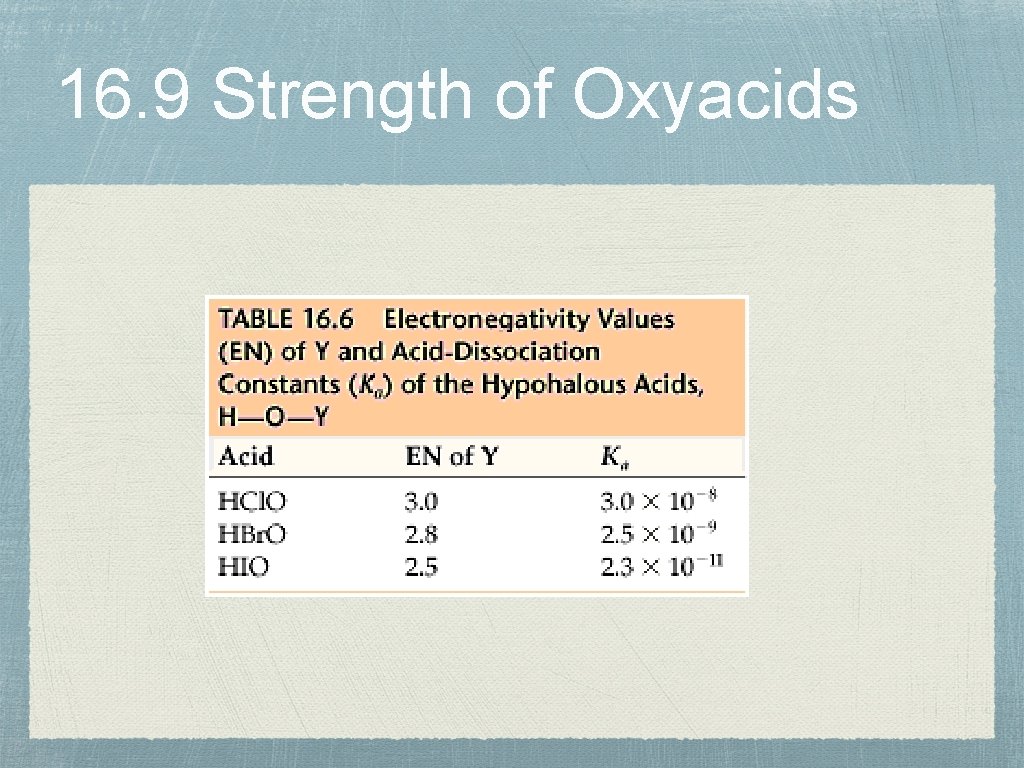
16. 9 Strength of Oxyacids Some oxyacids have OH groups attached, what determines whether they will act as acids or bases? Depends on the electronegativity of the central atom
16. 9 Strength of Oxyacids If we consider the bonded group attached to an OH- ion… Y–O-H If Y is a metal (Na, K, or Mg), which has low electronegativity, Y completely transfers its electrons to an OH- group and acts as a base
16. 9 Strength of Oxyacids Y-O-H If Y is a nonmetal, the bond to O is covalent, and the substance does not readily lose OH 2 Reasons Electron density is favored by the Oxygen atom, and is more likely to form H+ Electronegative elements form a more stable anion (A-) as the conjugate base.
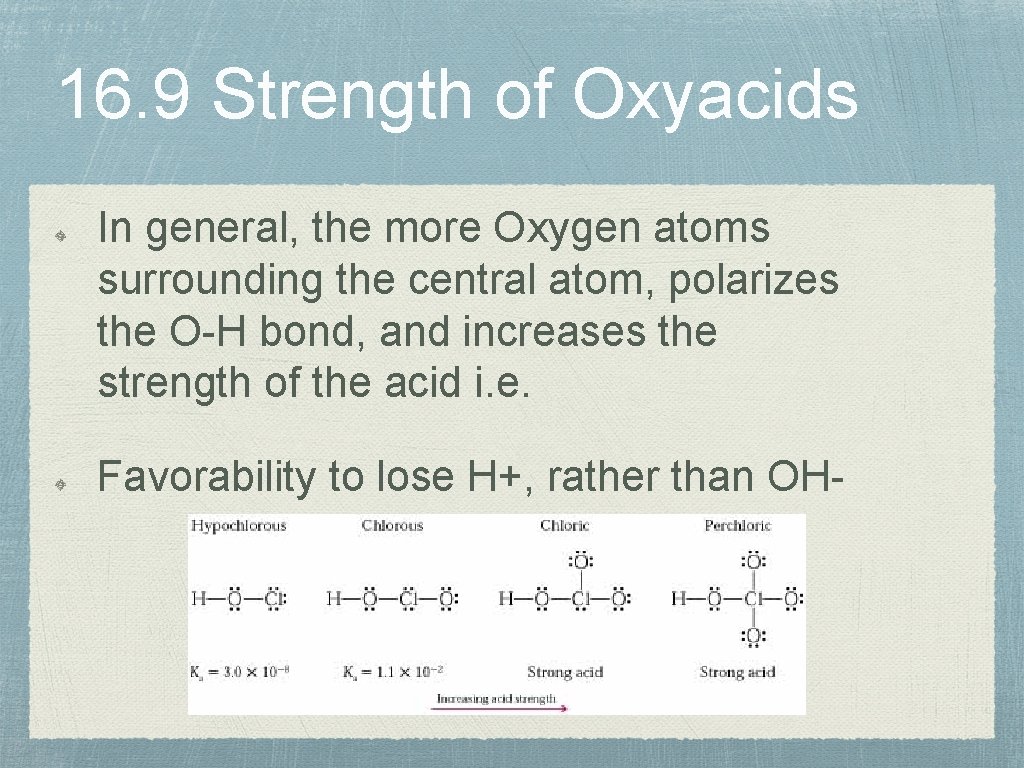
16. 9 Strength of Oxyacids In general, the more Oxygen atoms surrounding the central atom, polarizes the O-H bond, and increases the strength of the acid i. e. Favorability to lose H+, rather than OH-
16. 9 Strength of Oxyacids
16. 10 Lewis Acids Lewis acid – electron pair acceptor Lewis base – electron pair donator Lewis bases can donate their electrons to other compounds besides H+ which greatly increases the number of species that can be considered acids We have already mentioned this in that bases need to have a lone pair of electrons to react with H+
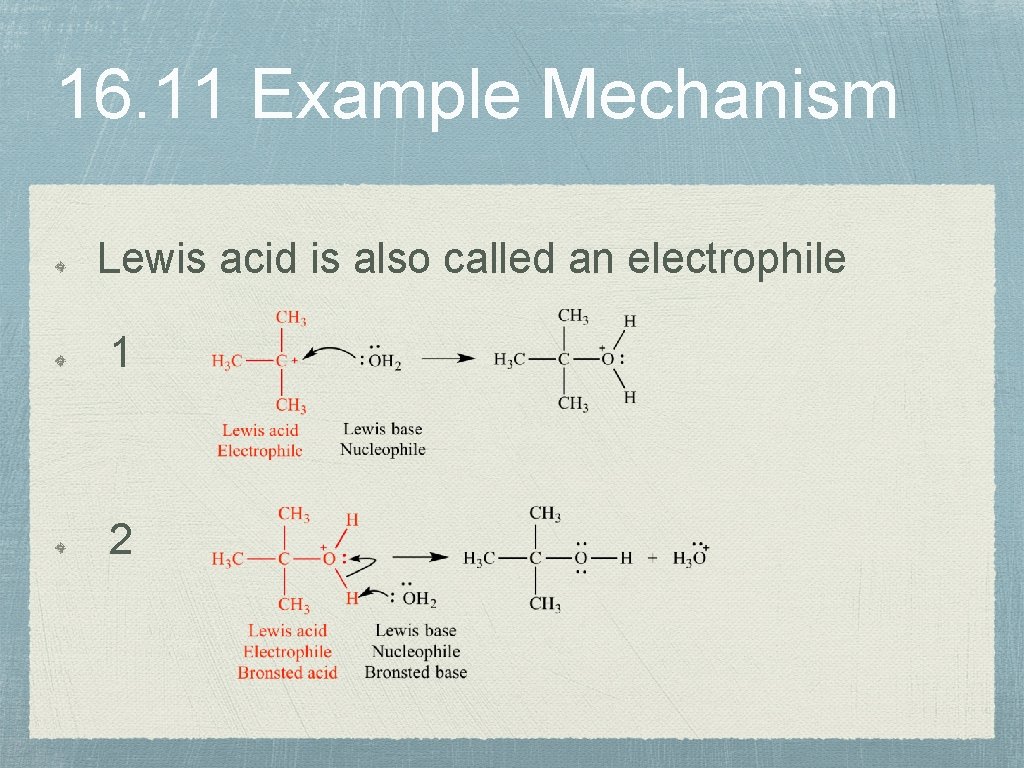
16. 11 Example Mechanism Lewis acid is also called an electrophile 1 2
- Slides: 82