
Chemical Equilibrium Acids Bases in Aqueous Solution Acids
Chemical Equilibrium Acids & Bases in Aqueous Solution
Acids and Bases Definitions
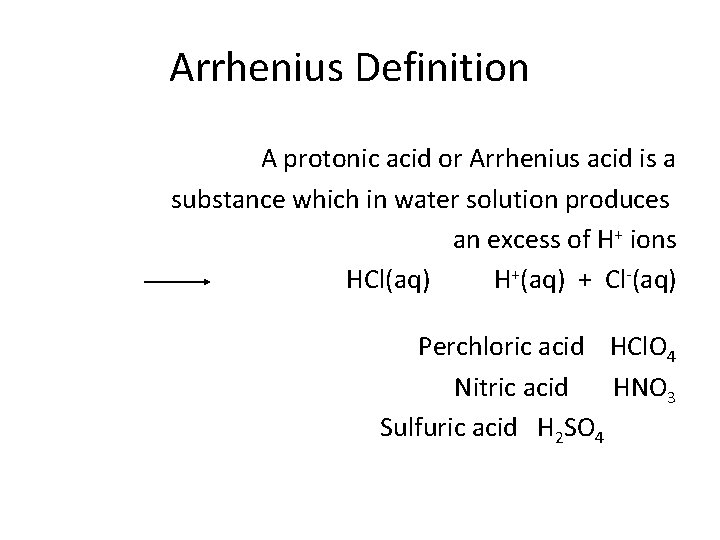
Arrhenius Definition A protonic acid or Arrhenius acid is a substance which in water solution produces an excess of H+ ions HCl(aq) H+(aq) + Cl (aq) Perchloric acid HCl. O 4 Nitric acid HNO 3 Sulfuric acid H 2 SO 4
Base Arrhenius base is a substance which directly or indirectly, forms excess OH- ion in solution. Na. OH, KOH , Ca(OH)2
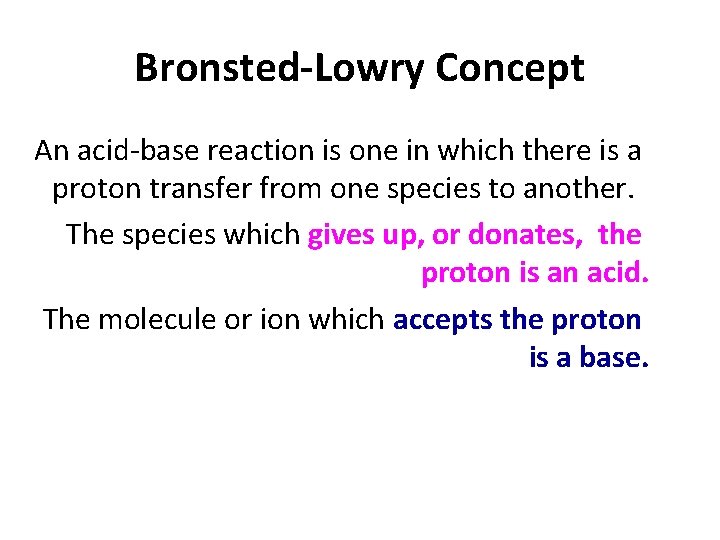
Bronsted-Lowry Concept An acid base reaction is one in which there is a proton transfer from one species to another. The species which gives up, or donates, the proton is an acid. The molecule or ion which accepts the proton is a base.
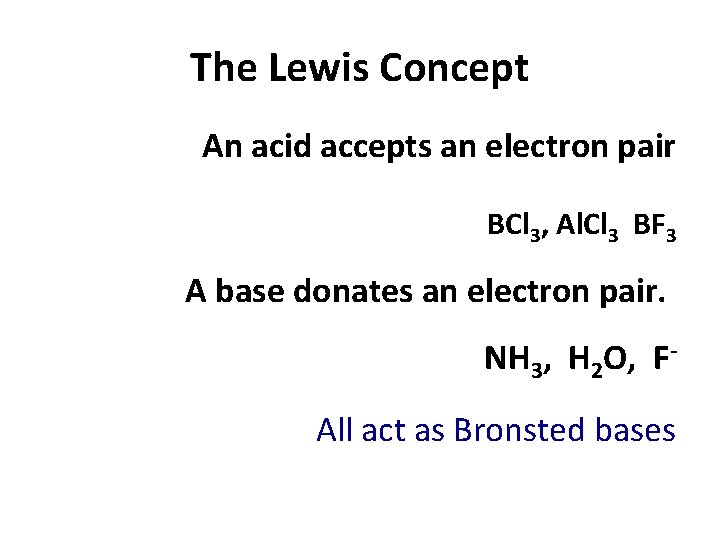
The Lewis Concept An acid accepts an electron pair BCl 3, Al. Cl 3 BF 3 A base donates an electron pair. NH 3, H 2 O, FAll act as Bronsted bases
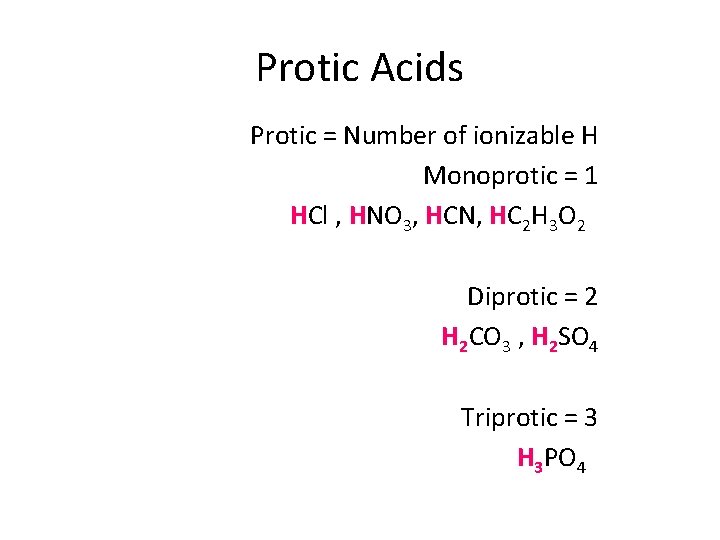
Protic Acids Protic = Number of ionizable H Monoprotic = 1 HCl , HNO 3, HCN, HC 2 H 3 O 2 Diprotic = 2 H 2 CO 3 , H 2 SO 4 Triprotic = 3 H 3 PO 4
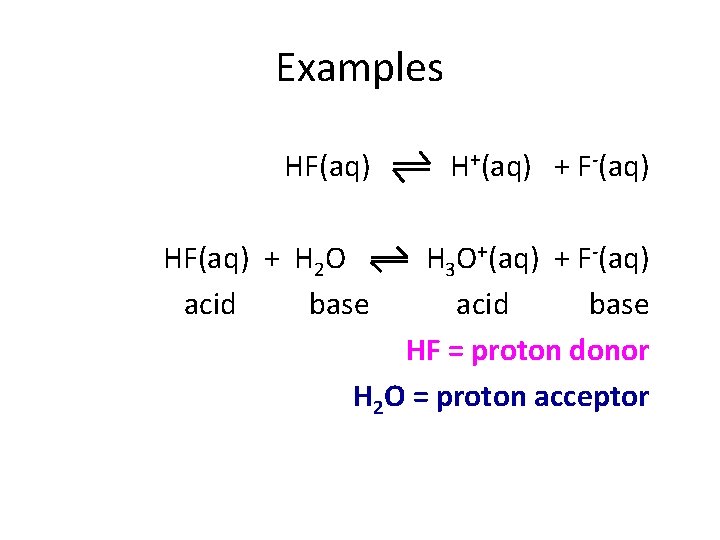
Examples HF(aq) + H 2 O acid base H+(aq) + F (aq) H 3 O+(aq) + F (aq) acid base HF = proton donor H 2 O = proton acceptor
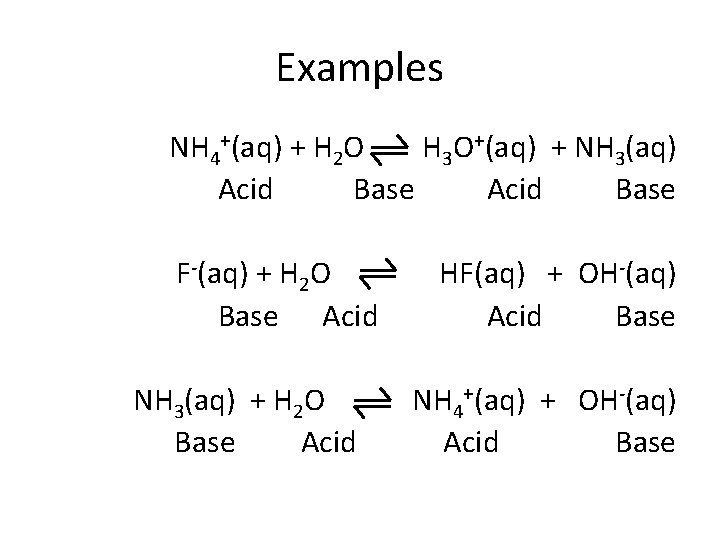
Examples NH 4+(aq) + H 2 O H 3 O+(aq) + NH 3(aq) Acid Base F (aq) + H 2 O Base Acid NH 3(aq) + H 2 O Base Acid HF(aq) + OH (aq) Acid Base NH 4+(aq) + OH (aq) Acid Base
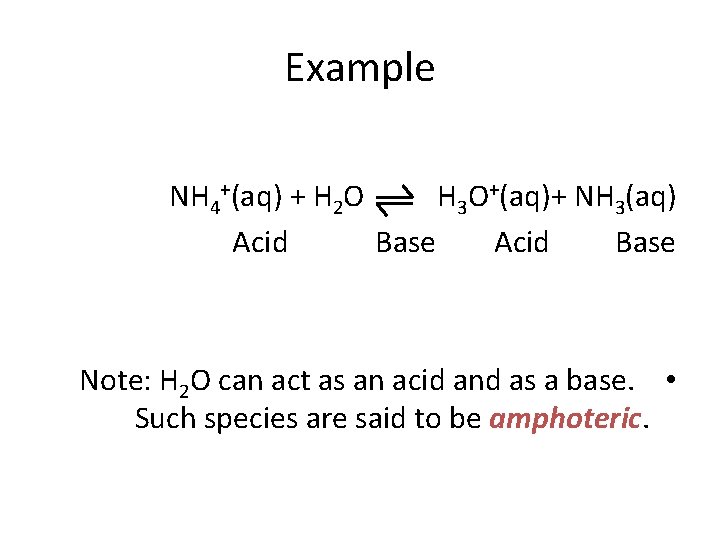
Example NH 4+(aq) + H 2 O H 3 O+(aq)+ NH 3(aq) Acid Base Note: H 2 O can act as an acid and as a base. • Such species are said to be amphoteric.
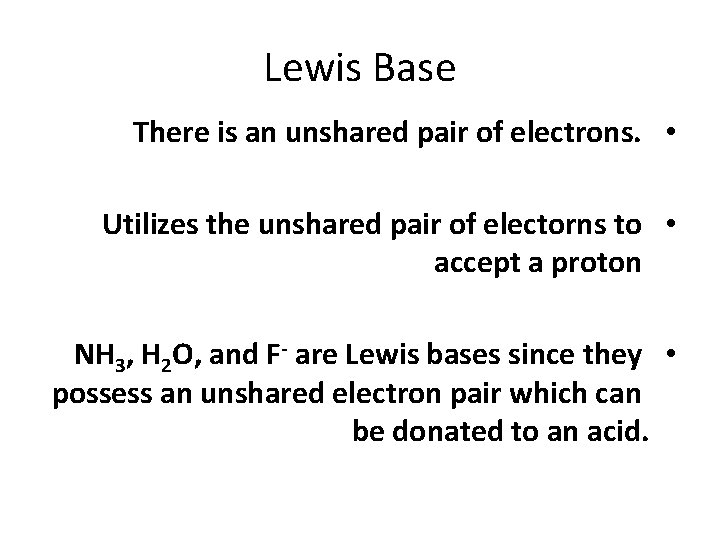
Lewis Base There is an unshared pair of electrons. • Utilizes the unshared pair of electorns to • accept a proton NH 3, H 2 O, and F- are Lewis bases since they • possess an unshared electron pair which can be donated to an acid.
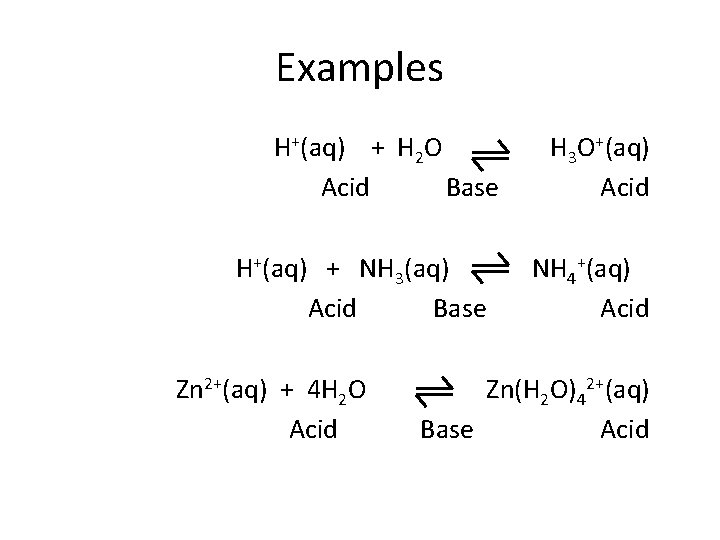
Examples H+(aq) + H 2 O Acid Base H+(aq) + NH 3(aq) Acid Base Zn 2+(aq) + 4 H 2 O Acid H 3 O+(aq) Acid NH 4+(aq) Acid Zn(H 2 O)42+(aq) Base Acid
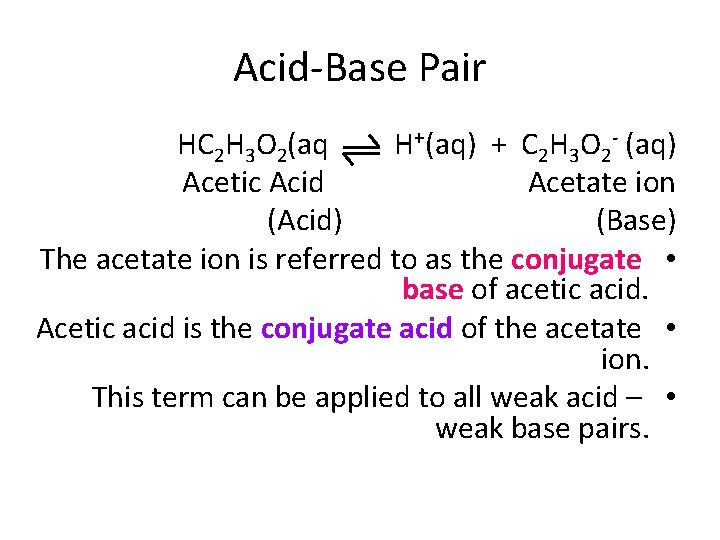
Acid Base Pair HC 2 H 3 O 2(aq H+(aq) + C 2 H 3 O 2 (aq) Acetic Acid Acetate ion (Acid) (Base) The acetate ion is referred to as the conjugate • base of acetic acid. Acetic acid is the conjugate acid of the acetate • ion. This term can be applied to all weak acid – • weak base pairs.
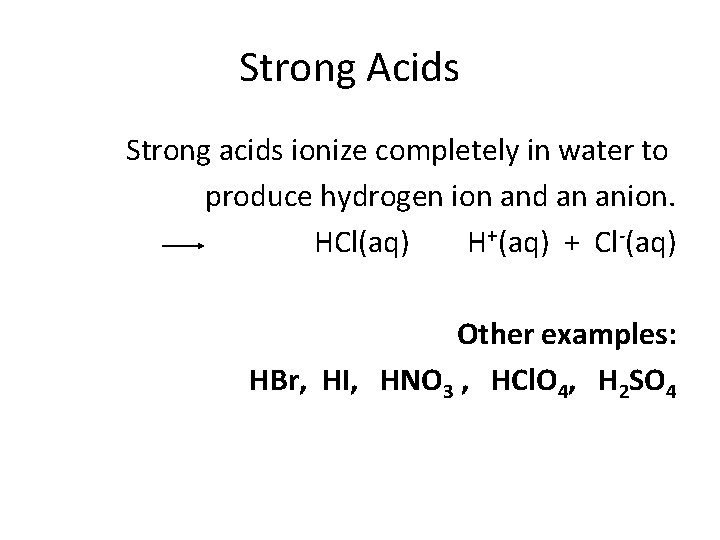
Strong Acids Strong acids ionize completely in water to produce hydrogen ion and an anion. HCl(aq) H+(aq) + Cl (aq) Other examples: HBr, HI, HNO 3 , HCl. O 4, H 2 SO 4
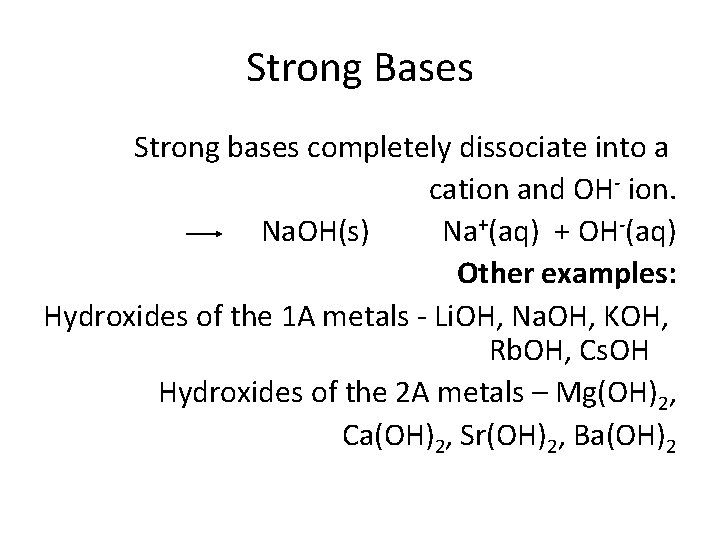
Strong Bases Strong bases completely dissociate into a cation and OH ion. Na. OH(s) Na+(aq) + OH (aq) Other examples: Hydroxides of the 1 A metals Li. OH, Na. OH, KOH, Rb. OH, Cs. OH Hydroxides of the 2 A metals – Mg(OH)2, Ca(OH)2, Sr(OH)2, Ba(OH)2
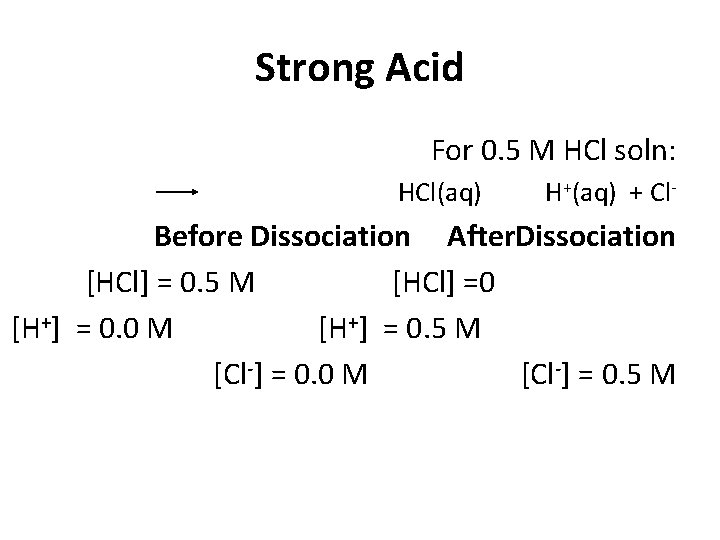
Strong Acid For 0. 5 M HCl soln: HCl(aq) H+(aq) + Cl Before Dissociation After. Dissociation [HCl] = 0. 5 M [HCl] =0 [H+] = 0. 0 M [H+] = 0. 5 M [Cl ] = 0. 0 M [Cl ] = 0. 5 M
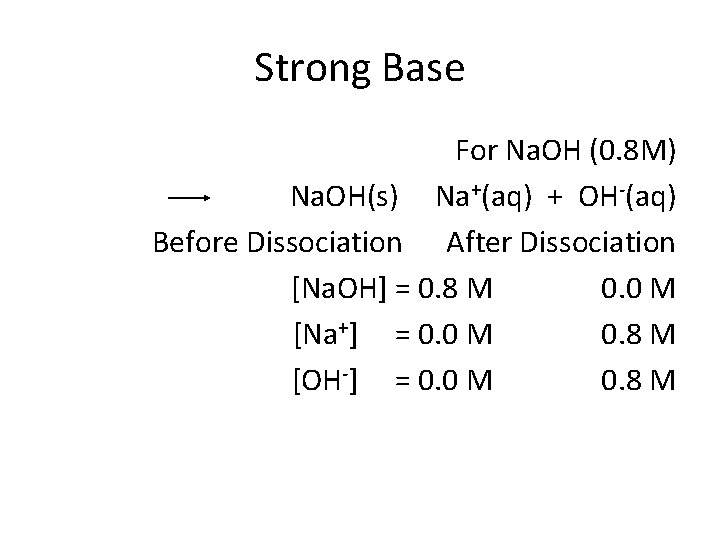
Strong Base For Na. OH (0. 8 M) Na. OH(s) Na+(aq) + OH (aq) Before Dissociation After Dissociation [Na. OH] = 0. 8 M 0. 0 M [Na+] = 0. 0 M 0. 8 M [OH ] = 0. 0 M 0. 8 M
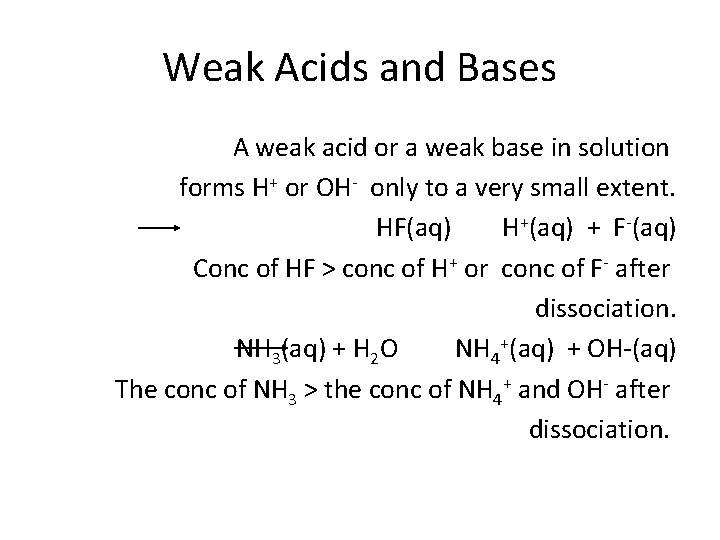
Weak Acids and Bases A weak acid or a weak base in solution forms H+ or OH only to a very small extent. HF(aq) H+(aq) + F (aq) Conc of HF > conc of H+ or conc of F after dissociation. NH 3(aq) + H 2 O NH 4+(aq) + OH (aq) The conc of NH 3 > the conc of NH 4+ and OH after dissociation.
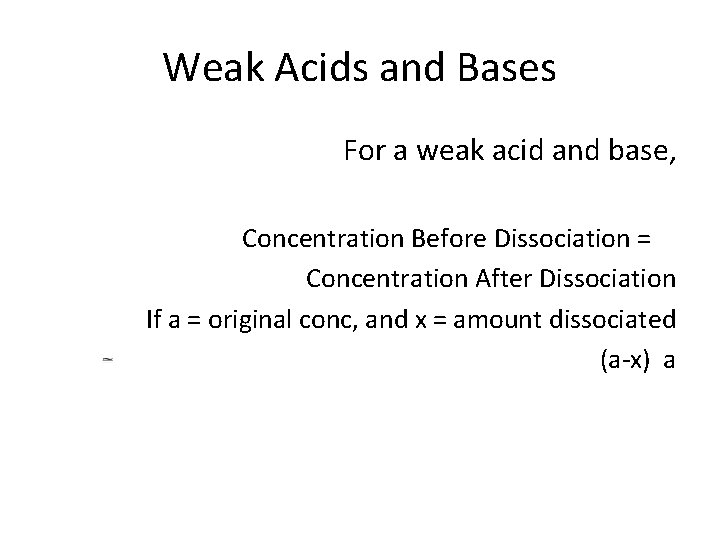
Weak Acids and Bases For a weak acid and base, Concentration Before Dissociation = Concentration After Dissociation If a = original conc, and x = amount dissociated (a x) a
![p. H Instead of using [H+] or [OH ] to describe how acidic or](http://slidetodoc.com/presentation_image_h2/a03979209373a6d995840436c5466d0a/image-20.jpg "p. H Instead of using [H+] or [OH ] to describe how acidic or")
p. H Instead of using [H+] or [OH ] to describe how acidic or basic a solution is, the term p. H is preferred. p. H = log 10[H+]
![Acidic OR Basic? Neutral soln: [H+] = 10 7; Acidic soln: [H+] > 10](http://slidetodoc.com/presentation_image_h2/a03979209373a6d995840436c5466d0a/image-21.jpg "Acidic OR Basic? Neutral soln: [H+] = 10 7; Acidic soln: [H+] > 10")
Acidic OR Basic? Neutral soln: [H+] = 10 7; Acidic soln: [H+] > 10 7; Basic soln: [H+] < 10 7; p. H = 7. 0 p. H = or < 7. 0 p. H = or > 7. 0
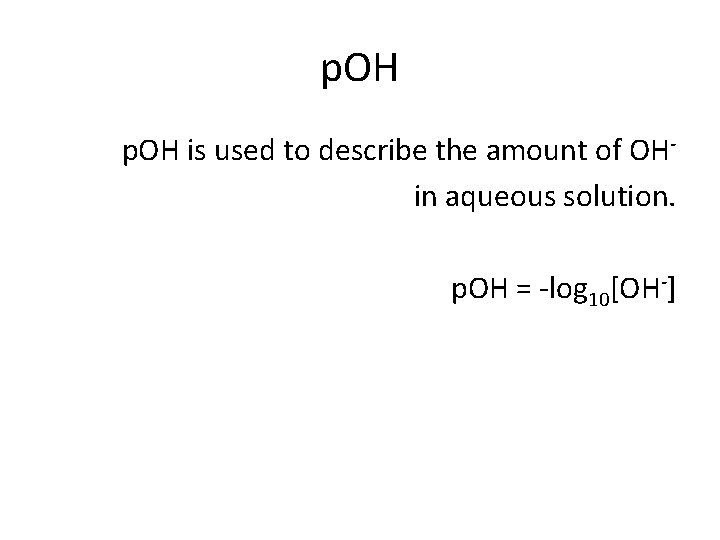
p. OH is used to describe the amount of OH in aqueous solution. p. OH = log 10[OH ]
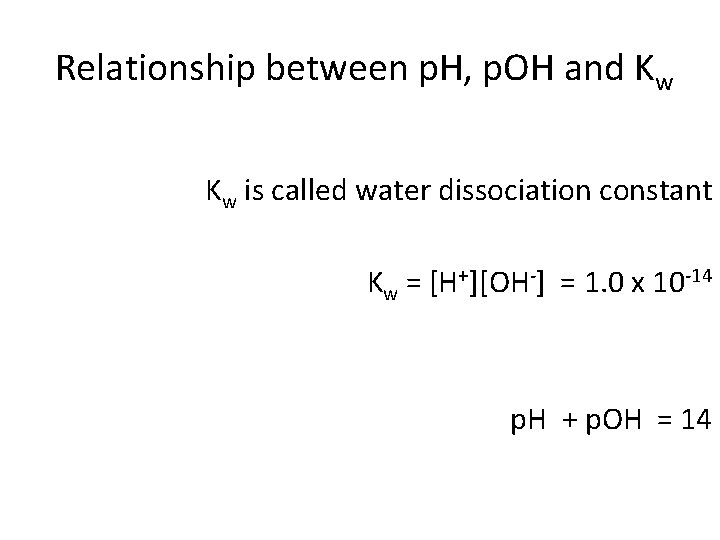
Relationship between p. H, p. OH and Kw Kw is called water dissociation constant Kw = [H+][OH ] = 1. 0 x 10 14 p. H + p. OH = 14
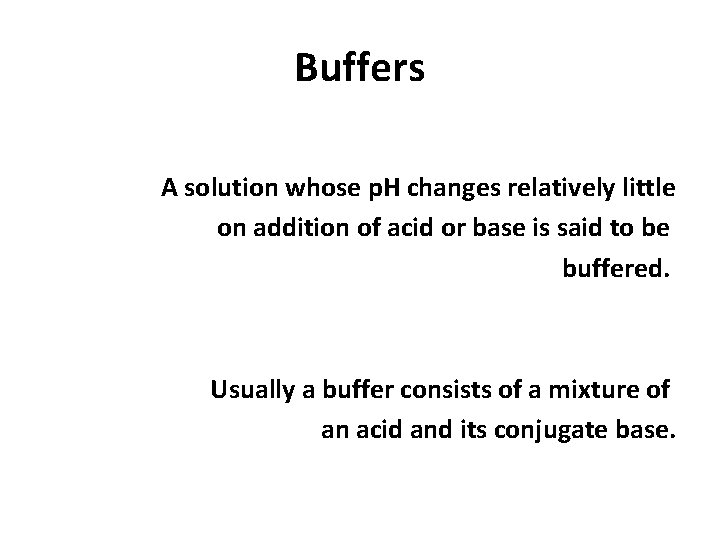
Buffers A solution whose p. H changes relatively little on addition of acid or base is said to be buffered. Usually a buffer consists of a mixture of an acid and its conjugate base.
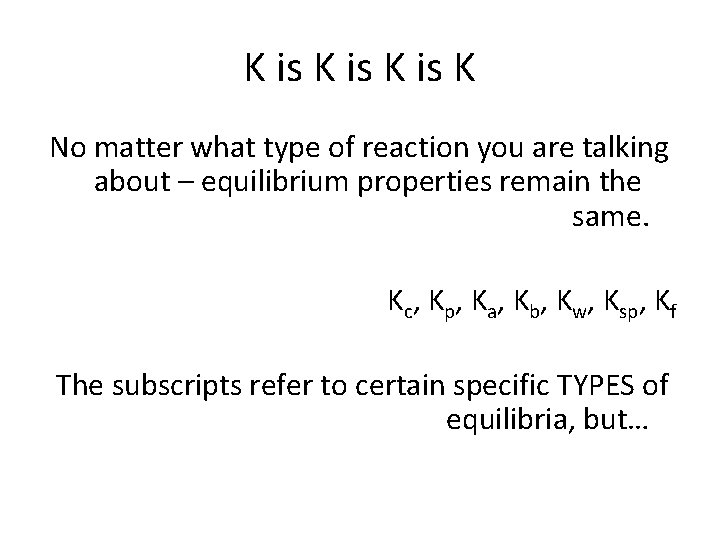
K is K No matter what type of reaction you are talking about – equilibrium properties remain the same. Kc, Kp, Ka, Kb, Kw, Ksp, Kf The subscripts refer to certain specific TYPES of equilibria, but…
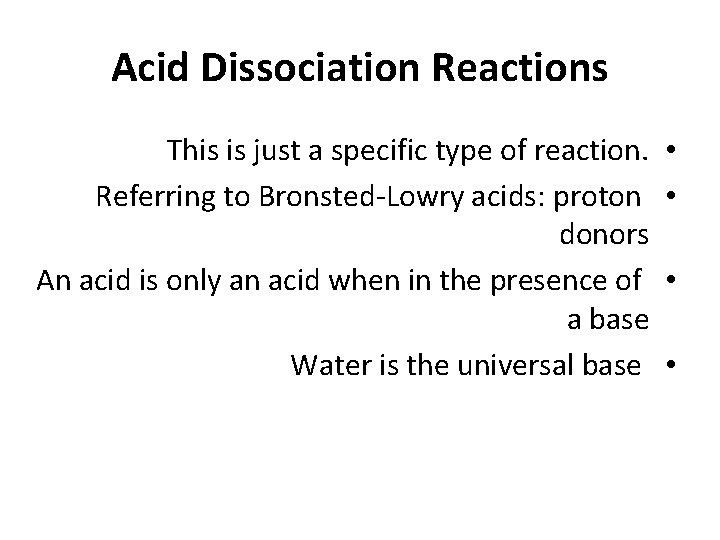
Acid Dissociation Reactions This is just a specific type of reaction. Referring to Bronsted Lowry acids: proton donors An acid is only an acid when in the presence of a base Water is the universal base • •
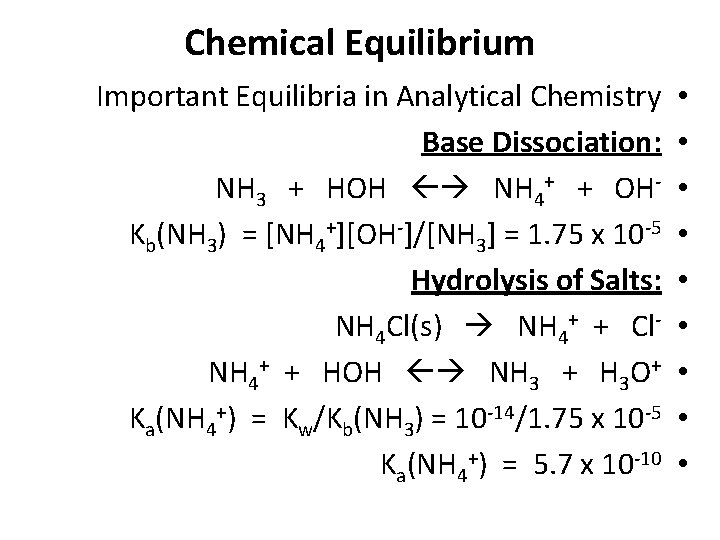
Chemical Equilibrium Important Equilibria in Analytical Chemistry Base Dissociation: NH 3 + HOH NH 4+ + OH Kb(NH 3) = [NH 4+][OH ]/[NH 3] = 1. 75 x 10 5 Hydrolysis of Salts: NH 4 Cl(s) NH 4+ + Cl NH 4+ + HOH NH 3 + H 3 O+ Ka(NH 4+) = Kw/Kb(NH 3) = 10 14/1. 75 x 10 5 Ka(NH 4+) = 5. 7 x 10 10 • • •
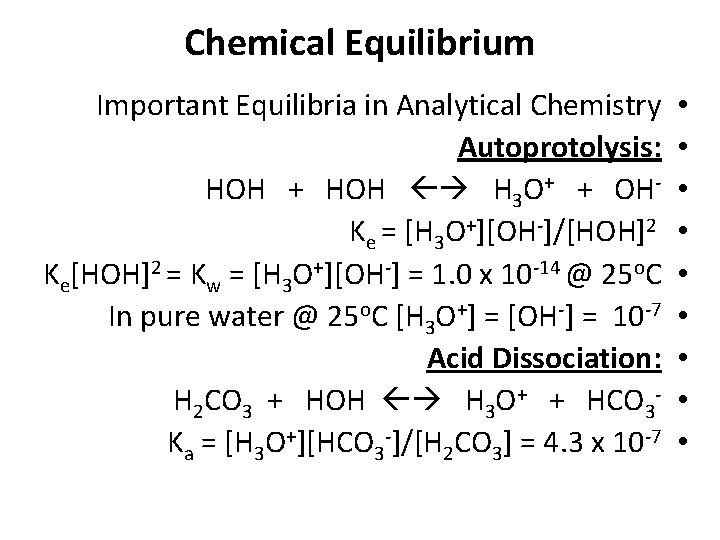
Chemical Equilibrium Important Equilibria in Analytical Chemistry Autoprotolysis: HOH + HOH H 3 O+ + OH Ke = [H 3 O+][OH ]/[HOH]2 Ke[HOH]2 = Kw = [H 3 O+][OH ] = 1. 0 x 10 14 @ 25 o. C In pure water @ 25 o. C [H 3 O+] = [OH ] = 10 7 Acid Dissociation: H 2 CO 3 + HOH H 3 O+ + HCO 3 Ka = [H 3 O+][HCO 3 ]/[H 2 CO 3] = 4. 3 x 10 7 • • •
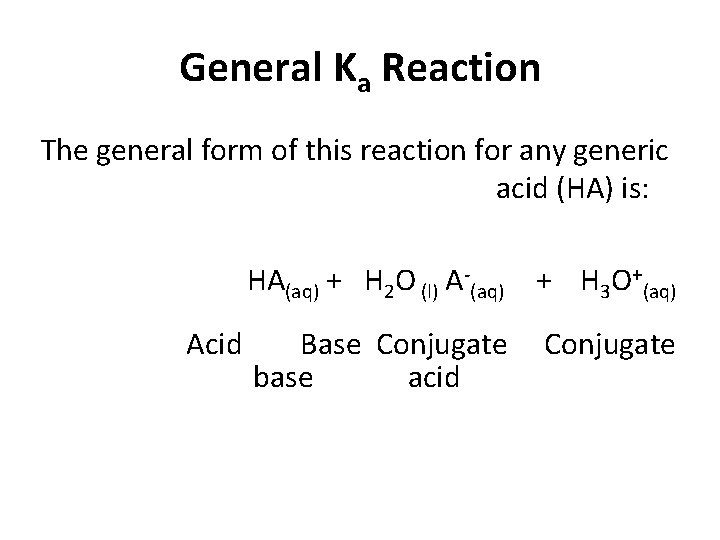
General Ka Reaction The general form of this reaction for any generic acid (HA) is: HA(aq) + H 2 O (l) A (aq) + H 3 O+(aq) Acid Base Conjugate base acid Conjugate
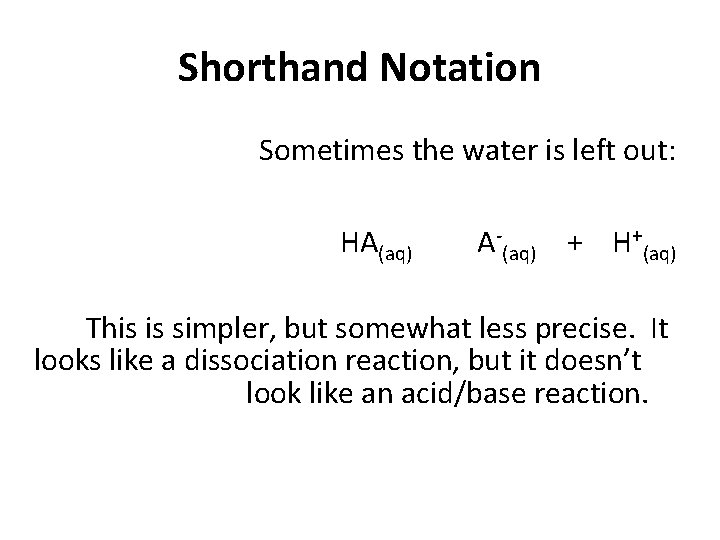
Shorthand Notation Sometimes the water is left out: HA(aq) A (aq) + H+(aq) This is simpler, but somewhat less precise. It looks like a dissociation reaction, but it doesn’t look like an acid/base reaction.
![Equilibrium Constant Expression Ka = [H 3 O+][A ] [HA] NOTE: This is just](http://slidetodoc.com/presentation_image_h2/a03979209373a6d995840436c5466d0a/image-31.jpg "Equilibrium Constant Expression Ka = [H 3 O+][A ] [HA] NOTE: This is just")
Equilibrium Constant Expression Ka = [H 3 O+][A ] [HA] NOTE: This is just a Keq, there is nothing new here. It is just a specific type of reaction. So, ICE charts, quadratic formula, etc. all still apply!
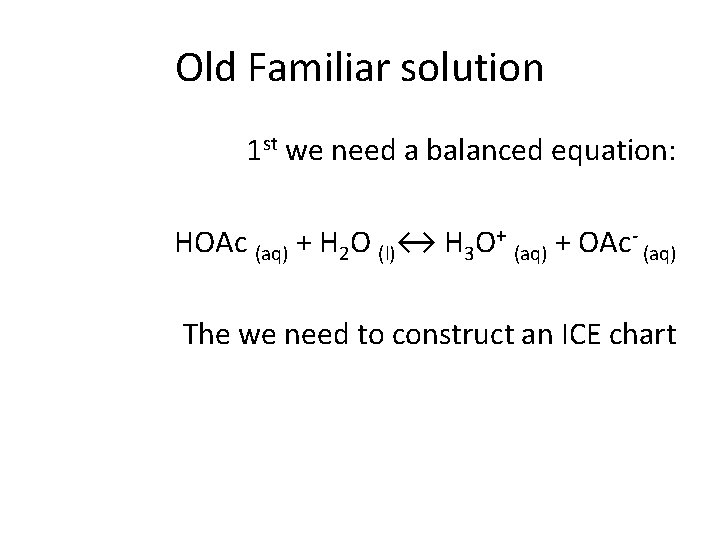
Old Familiar solution 1 st we need a balanced equation: HOAc (aq) + H 2 O (l)↔ H 3 O+ (aq) + OAc (aq) The we need to construct an ICE chart
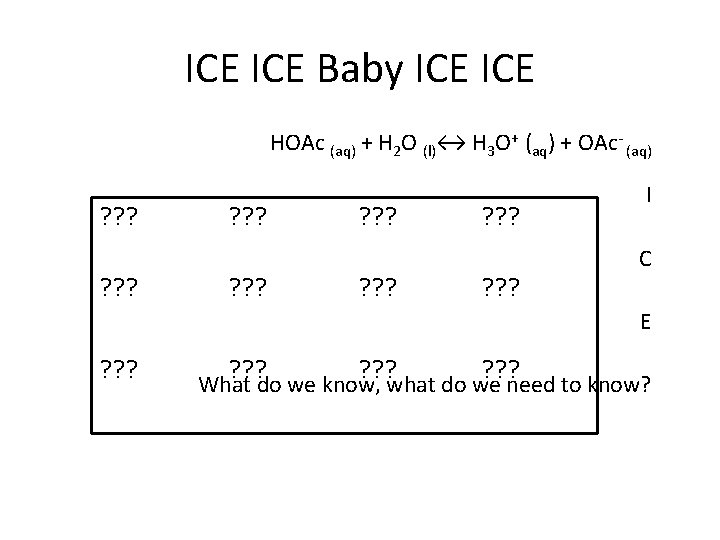
ICE Baby ICE HOAc (aq) + H 2 O (l)↔ H 3 O+ (aq) + OAc (aq) ? ? ? ? ? ? I C E ? ? ? What do we know, what do we need to know?
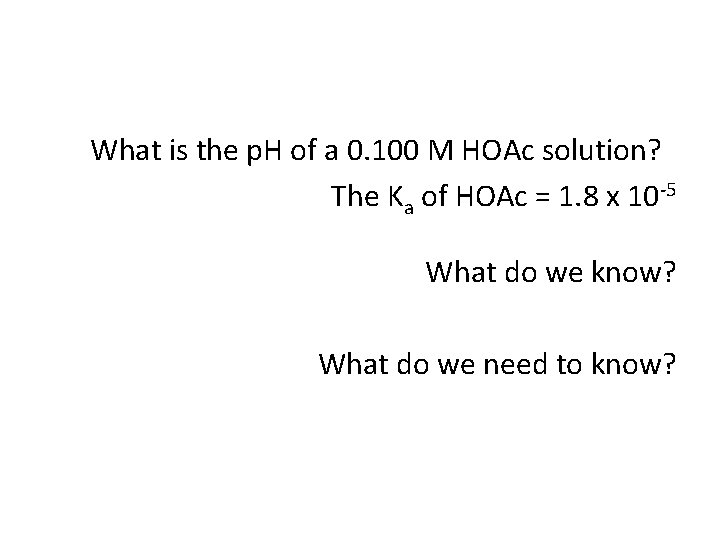
What is the p. H of a 0. 100 M HOAc solution? The Ka of HOAc = 1. 8 x 10 5 What do we know? What do we need to know?
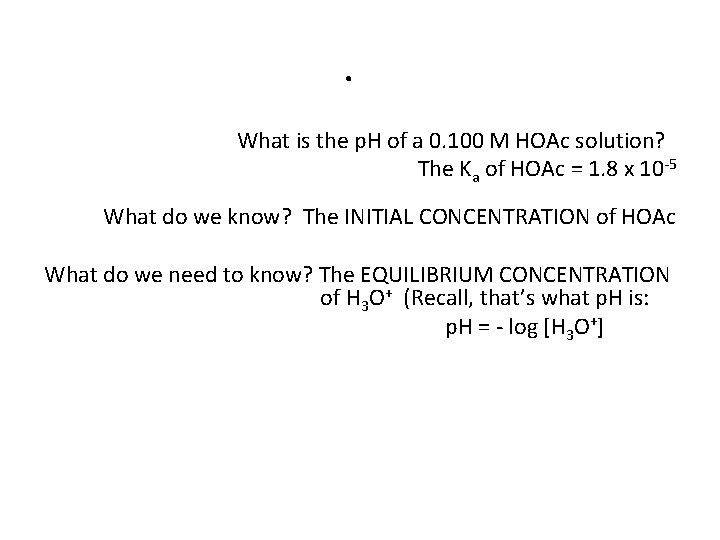
. What is the p. H of a 0. 100 M HOAc solution? The Ka of HOAc = 1. 8 x 10 5 What do we know? The INITIAL CONCENTRATION of HOAc What do we need to know? The EQUILIBRIUM CONCENTRATION of H 3 O+ (Recall, that’s what p. H is: p. H = log [H 3 O+]
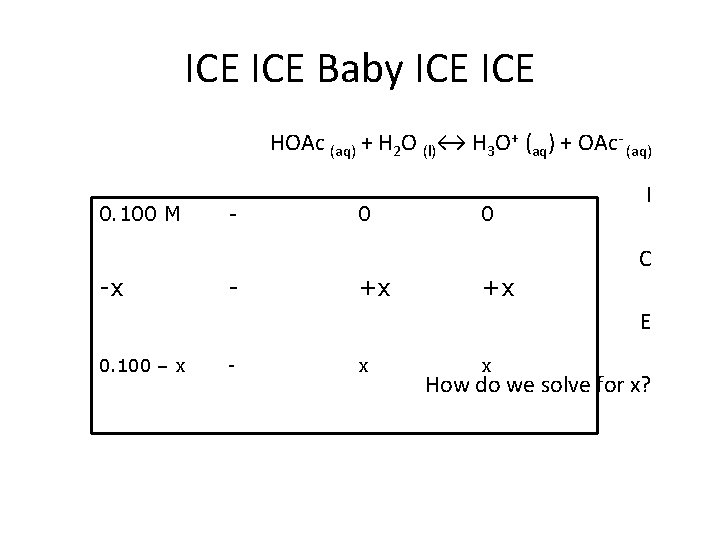
ICE Baby ICE HOAc (aq) + H 2 O (l)↔ H 3 O+ (aq) + OAc (aq) 0. 100 M -x - - 0 +x I C E 0. 100 – x - x x How do we solve for x?
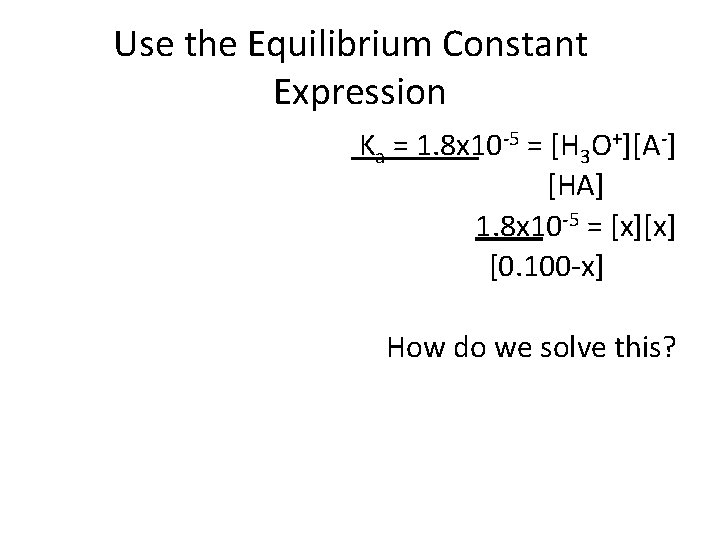
Use the Equilibrium Constant Expression Ka = 1. 8 x 10 5 = [H 3 O+][A ] [HA] 1. 8 x 10 5 = [x][x] [0. 100 x] How do we solve this?
![2 Possibilities 1. 8 x 10 5 = [x][x] [0. 100 x] Assume x](http://slidetodoc.com/presentation_image_h2/a03979209373a6d995840436c5466d0a/image-38.jpg "2 Possibilities 1. 8 x 10 5 = [x][x] [0. 100 x] Assume x")
2 Possibilities 1. 8 x 10 5 = [x][x] [0. 100 x] Assume x <<0. 100. 1 Don’t assume x<<0. 100 and use quadratic. 2 formula
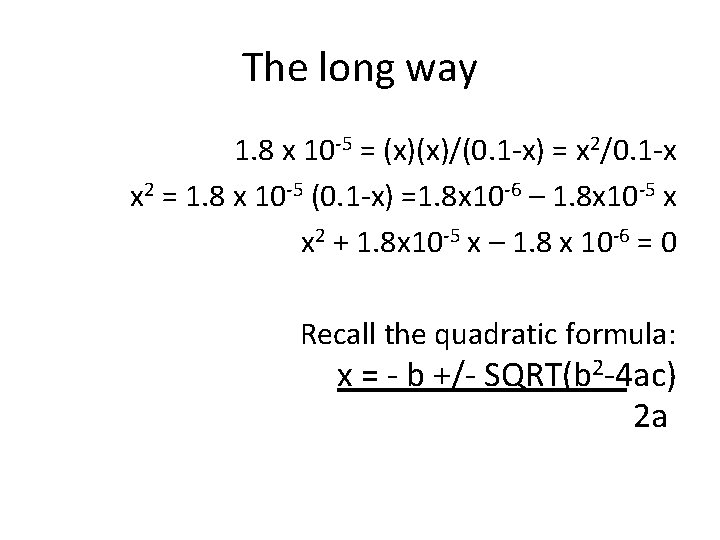
The long way 1. 8 x 10 5 = (x)(x)/(0. 1 x) = x 2/0. 1 x x 2 = 1. 8 x 10 5 (0. 1 x) =1. 8 x 10 6 – 1. 8 x 10 5 x x 2 + 1. 8 x 10 5 x – 1. 8 x 10 6 = 0 Recall the quadratic formula: x = b +/ SQRT(b 2 4 ac) 2 a
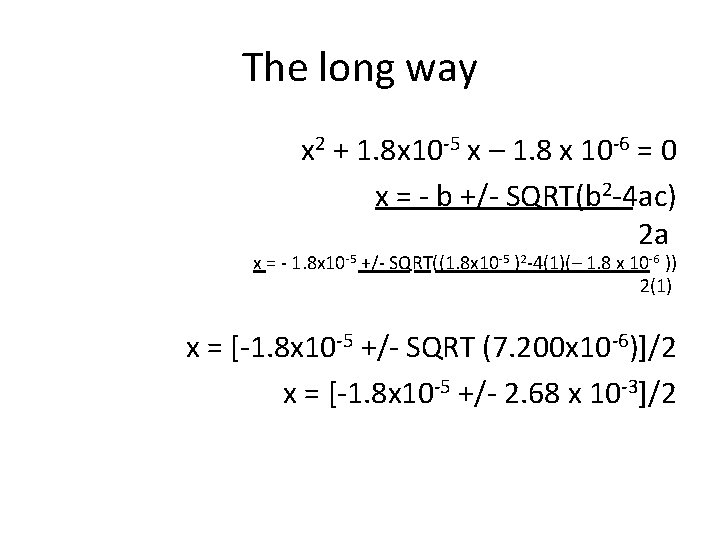
The long way x 2 + 1. 8 x 10 5 x – 1. 8 x 10 6 = 0 x = b +/ SQRT(b 2 4 ac) 2 a x = 1. 8 x 10 5 +/ SQRT((1. 8 x 10 5 )2 4(1)(– 1. 8 x 10 6 )) 2(1) x = [ 1. 8 x 10 5 +/ SQRT (7. 200 x 10 6)]/2 x = [ 1. 8 x 10 5 +/ 2. 68 x 10 3]/2
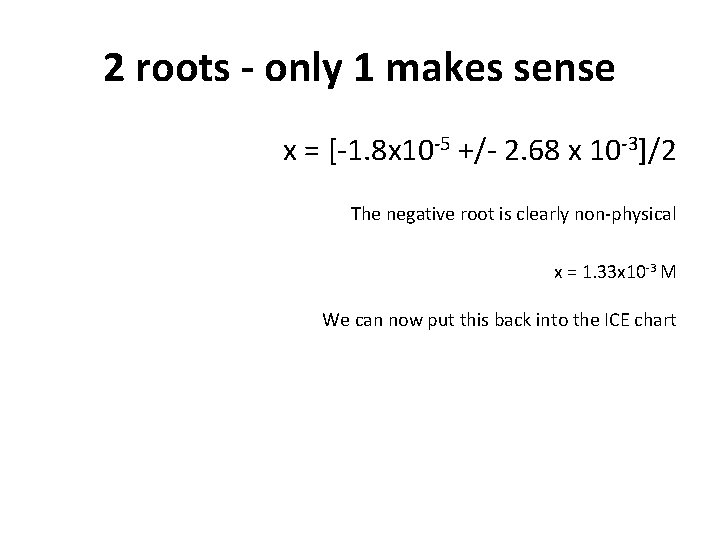
2 roots - only 1 makes sense x = [ 1. 8 x 10 5 +/ 2. 68 x 10 3]/2 The negative root is clearly non physical x = 1. 33 x 10 3 M We can now put this back into the ICE chart
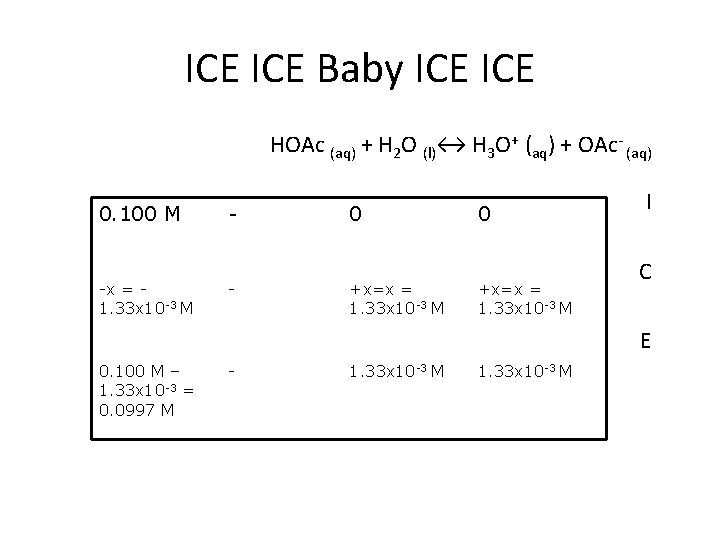
ICE Baby ICE HOAc (aq) + H 2 O (l)↔ H 3 O+ (aq) + OAc (aq) 0. 100 M -x = 1. 33 x 10 -3 M - - 0 +x=x = 1. 33 x 10 -3 M I C E 0. 100 M – 1. 33 x 10 -3 = 0. 0997 M - 1. 33 x 10 -3 M
![p. H = log [H 3 O+] = log (1. 33 x 10 3)](http://slidetodoc.com/presentation_image_h2/a03979209373a6d995840436c5466d0a/image-43.jpg "p. H = log [H 3 O+] = log (1. 33 x 10 3)")
p. H = log [H 3 O+] = log (1. 33 x 10 3) = 2. 88 Was all of that work necessary? Let’s look at making the assumption!
![Assume x<<0. 100 1. 8 x 10 5 = [x][x] [0. 100 x] If](http://slidetodoc.com/presentation_image_h2/a03979209373a6d995840436c5466d0a/image-44.jpg "Assume x<<0. 100 1. 8 x 10 5 = [x][x] [0. 100 x] If")
Assume x<<0. 100 1. 8 x 10 5 = [x][x] [0. 100 x] If x<<0. 100, then 0. 100 x≈0. 100 1. 8 x 10 5 = [x][x] [0. 100] 1. 8 x 10 6 = [x][x] = x 2 x = 1. 34 x 10 3 M
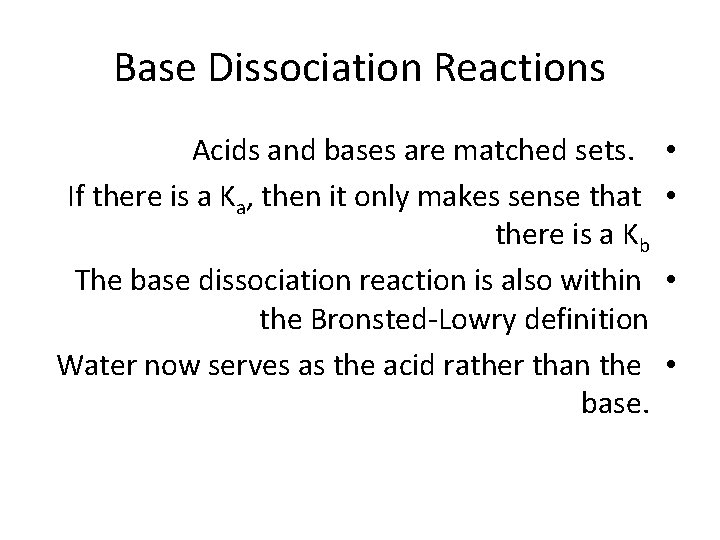
Base Dissociation Reactions Acids and bases are matched sets. If there is a Ka, then it only makes sense that there is a Kb The base dissociation reaction is also within the Bronsted Lowry definition Water now serves as the acid rather than the base. • •
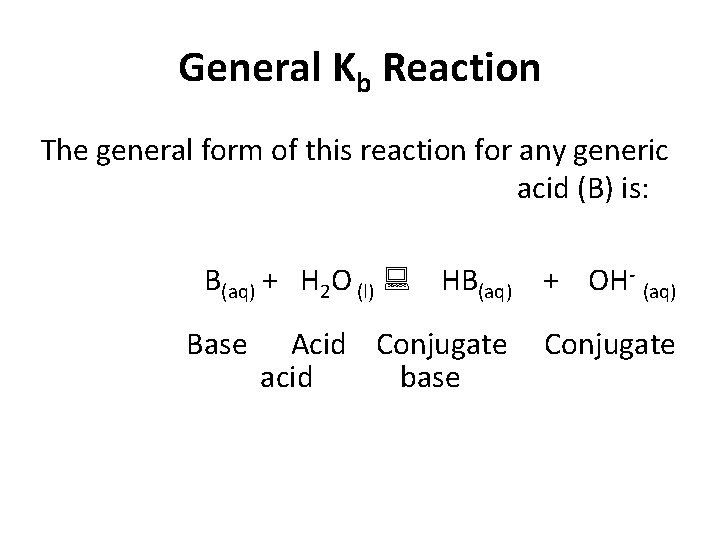
General Kb Reaction The general form of this reaction for any generic acid (B) is: B(aq) + H 2 O (l) HB(aq) + OH (aq) Base Acid Conjugate acid base Conjugate
![Kb It is, after all, just another “K” Kb = [HB][OH ] [B] And](http://slidetodoc.com/presentation_image_h2/a03979209373a6d995840436c5466d0a/image-47.jpg "Kb It is, after all, just another “K” Kb = [HB][OH ] [B] And")
Kb It is, after all, just another “K” Kb = [HB][OH ] [B] And this gets used just like any other equilibrium constant expression.
Water, water everywhere Both Ka and Kb reactions are made possible by the role of water. Water acts as either an acid or a base. Water is amphiprotic. If water is both an acid and a base, why doesn’t it react with itself?
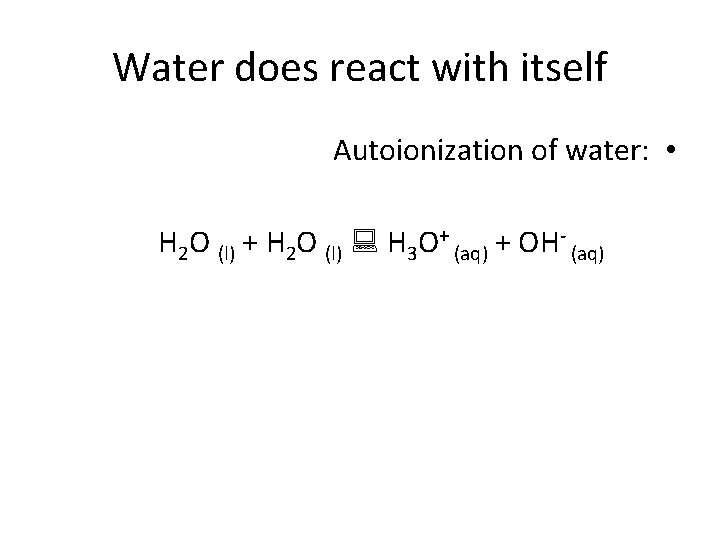
Water does react with itself Autoionization of water: • H 2 O (l) + H 2 O (l) H 3 O+ (aq) + OH (aq)
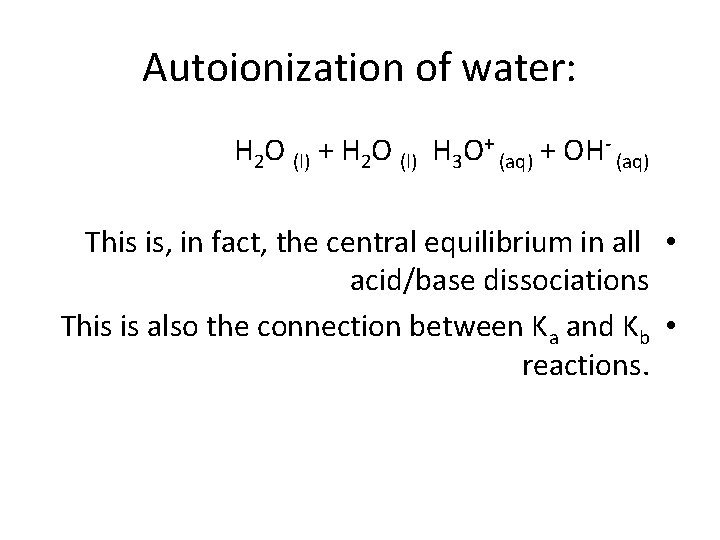
Autoionization of water: H 2 O (l) + H 2 O (l) H 3 O+ (aq) + OH (aq) This is, in fact, the central equilibrium in all • acid/base dissociations This is also the connection between Ka and Kb • reactions.
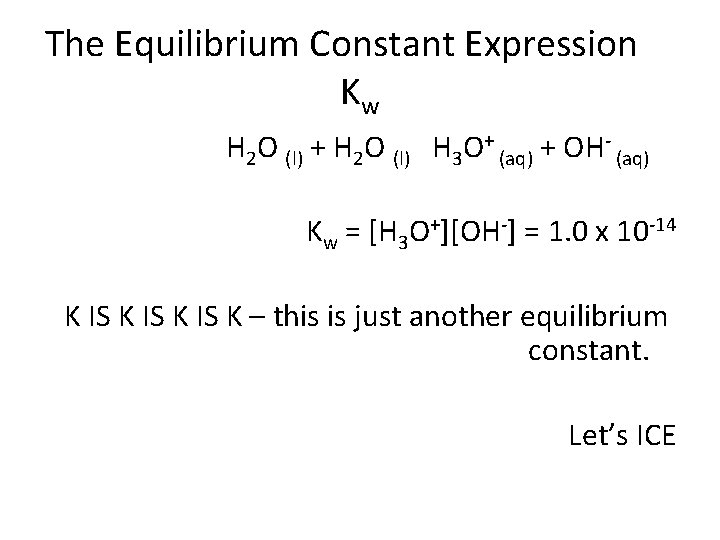
The Equilibrium Constant Expression Kw H 2 O (l) + H 2 O (l) H 3 O+ (aq) + OH (aq) Kw = [H 3 O+][OH ] = 1. 0 x 10 14 K IS K – this is just another equilibrium constant. Let’s ICE
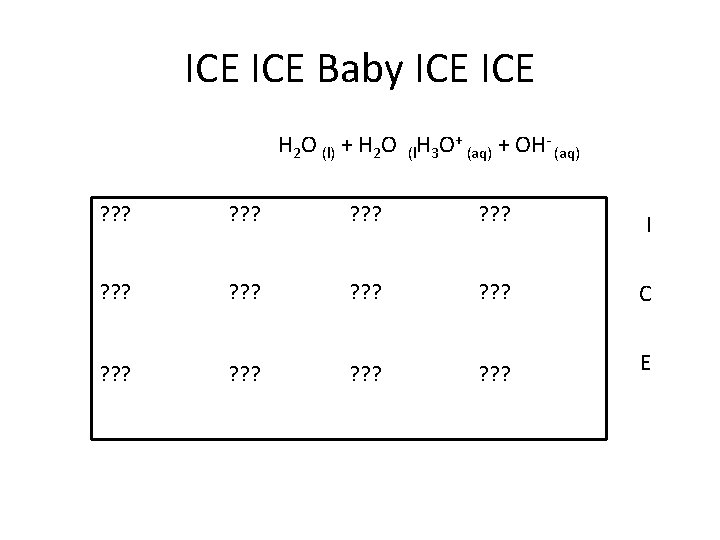
ICE Baby ICE H 2 O (l) + H 2 O (l. H 3 O+ (aq) + OH (aq) ? ? ? I ? ? ? C ? ? ? E
![Evaluating Kw Kw = [H 3 O+][OH ] = 1. 0 x 10 14](http://slidetodoc.com/presentation_image_h2/a03979209373a6d995840436c5466d0a/image-53.jpg "Evaluating Kw Kw = [H 3 O+][OH ] = 1. 0 x 10 14")
Evaluating Kw Kw = [H 3 O+][OH ] = 1. 0 x 10 14 [x] = 1. 0 x 10 14 x 2 = 1. 0 x 10 14 x = 1. 0 x 10 7
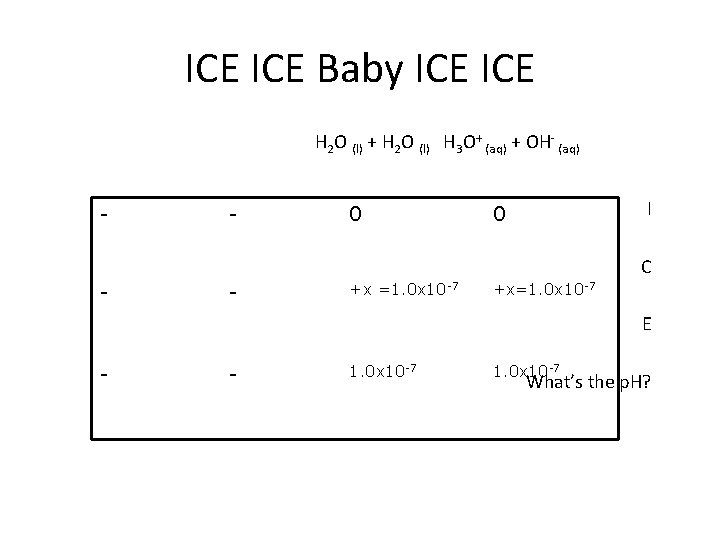
ICE Baby ICE H 2 O (l) + H 2 O (l) H 3 O+ (aq) + OH (aq) - - 0 I 0 C - - +x =1. 0 x 10 -7 +x=1. 0 x 10 -7 E - - 1. 0 x 10 -7 What’s the p. H?
![p. H = - log [H 3 O+] p. H = log (1. 0](http://slidetodoc.com/presentation_image_h2/a03979209373a6d995840436c5466d0a/image-55.jpg "p. H = - log [H 3 O+] p. H = log (1. 0")
p. H = - log [H 3 O+] p. H = log (1. 0 x 10 7) p. H = 7 This is why “ 7” is considered neutral p. H. It is the natural p. H of water. Neutral water doesn’t have NO acid, it has the EQUILIBRIUM (Kw) amount!!!
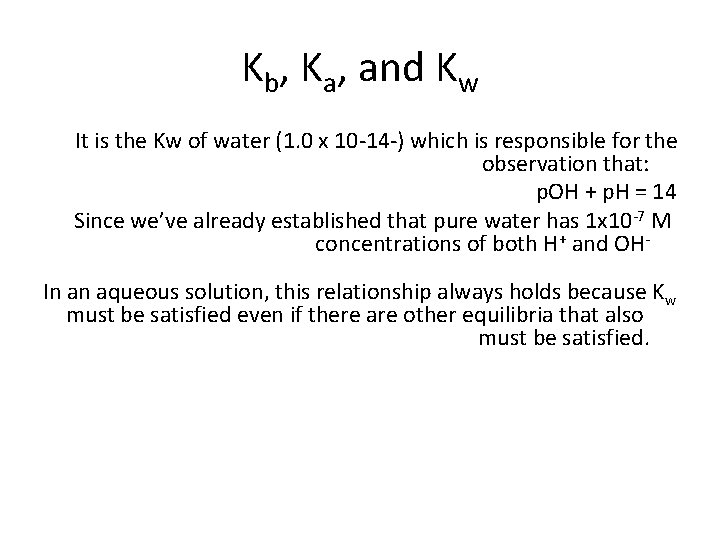
Kb, Ka, and Kw It is the Kw of water (1. 0 x 10 14 ) which is responsible for the observation that: p. OH + p. H = 14 Since we’ve already established that pure water has 1 x 10 7 M concentrations of both H+ and OH In an aqueous solution, this relationship always holds because Kw must be satisfied even if there are other equilibria that also must be satisfied.
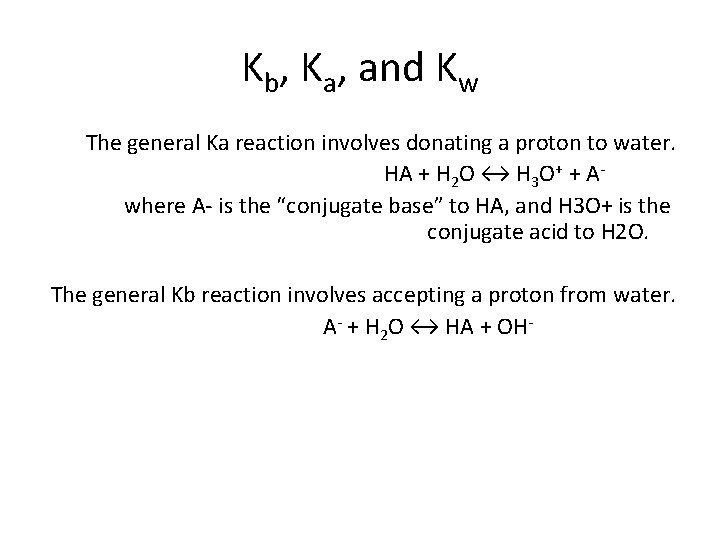
Kb, Ka, and Kw The general Ka reaction involves donating a proton to water. HA + H 2 O ↔ H 3 O+ + A where A is the “conjugate base” to HA, and H 3 O+ is the conjugate acid to H 2 O. The general Kb reaction involves accepting a proton from water. A + H 2 O ↔ HA + OH
![Writing the K for both reactions Ka = [H 3 O+][A ] [HA] Kb](http://slidetodoc.com/presentation_image_h2/a03979209373a6d995840436c5466d0a/image-58.jpg "Writing the K for both reactions Ka = [H 3 O+][A ] [HA] Kb")
Writing the K for both reactions Ka = [H 3 O+][A ] [HA] Kb = [HA][OH ] [A ] If you multiply Ka by Kb: Ka*Kb = [H 3 O+][A ] [HA][OH ] [HA] [A ] = [H 3 O+][OH ] =Kw So, if you know Kb, you know Ka and vice versa because: Ka*Kb=Kw
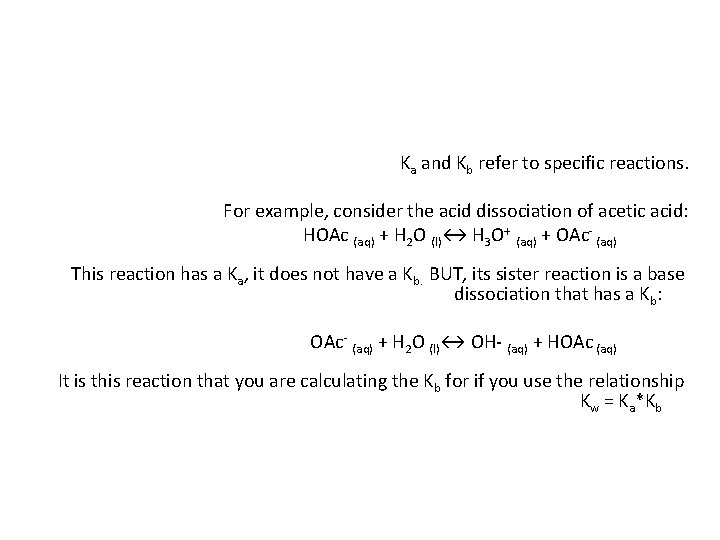
Ka and Kb refer to specific reactions. For example, consider the acid dissociation of acetic acid: HOAc (aq) + H 2 O (l)↔ H 3 O+ (aq) + OAc (aq) This reaction has a Ka, it does not have a Kb. BUT, its sister reaction is a base dissociation that has a Kb: OAc (aq) + H 2 O (l)↔ OH (aq) + HOAc (aq) It is this reaction that you are calculating the Kb for if you use the relationship Kw = Ka*Kb
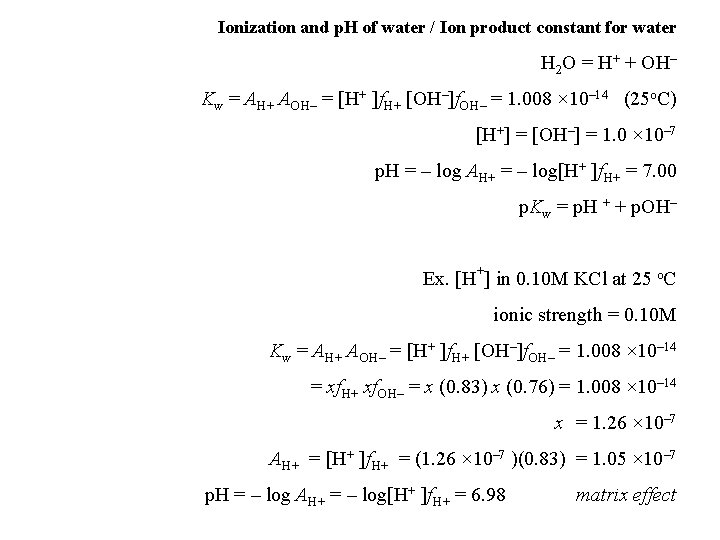
Ionization and p. H of water / Ion product constant for water H 2 O = H+ + OH– Kw = AH+ AOH– = [H+ ]f. H+ [OH–]f. OH– = 1. 008 × 10– 14 (25 o. C) [H+] = [OH–] = 1. 0 × 10– 7 p. H = – log AH+ = – log[H+ ]f. H+ = 7. 00 p. Kw = p. H + + p. OH– Ex. [H+] in 0. 10 M KCl at 25 o. C ionic strength = 0. 10 M Kw = AH+ AOH– = [H+ ]f. H+ [OH–]f. OH– = 1. 008 × 10– 14 = xf. H+ xf. OH– = x (0. 83) x (0. 76) = 1. 008 × 10– 14 x = 1. 26 × 10– 7 AH+ = [H+ ]f. H+ = (1. 26 × 10– 7 )(0. 83) = 1. 05 × 10– 7 p. H = – log AH+ = – log[H+ ]f. H+ = 6. 98 matrix effect
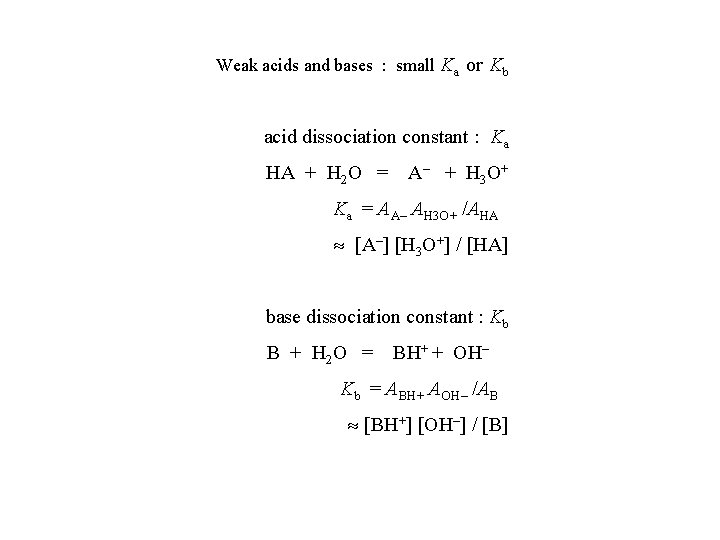
Weak acids and bases : small Ka or Kb acid dissociation constant : Ka HA + H 2 O = A– + H 3 O+ Ka = AA– AH 3 O+ /AHA [A–] [H 3 O+] / [HA] base dissociation constant : Kb B + H 2 O = BH+ + OH– Kb = ABH+ AOH– /AB [BH+] [OH–] / [B]
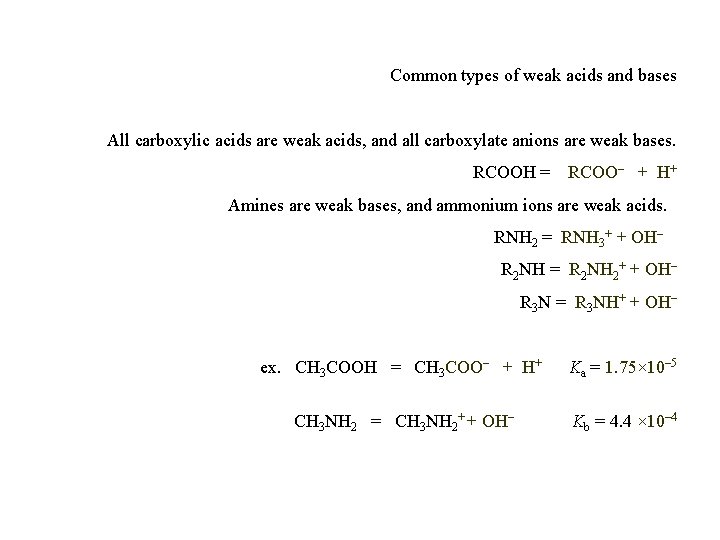
Common types of weak acids and bases All carboxylic acids are weak acids, and all carboxylate anions are weak bases. RCOOH = RCOO– + H+ Amines are weak bases, and ammonium ions are weak acids. RNH 2 = RNH 3+ + OH– R 2 NH = R 2 NH 2+ + OH– R 3 N = R 3 NH+ + OH– ex. CH 3 COOH = CH 3 COO– + H+ Ka = 1. 75× 10– 5 CH 3 NH 2 = CH 3 NH 2+ + OH– Kb = 4. 4 × 10– 4
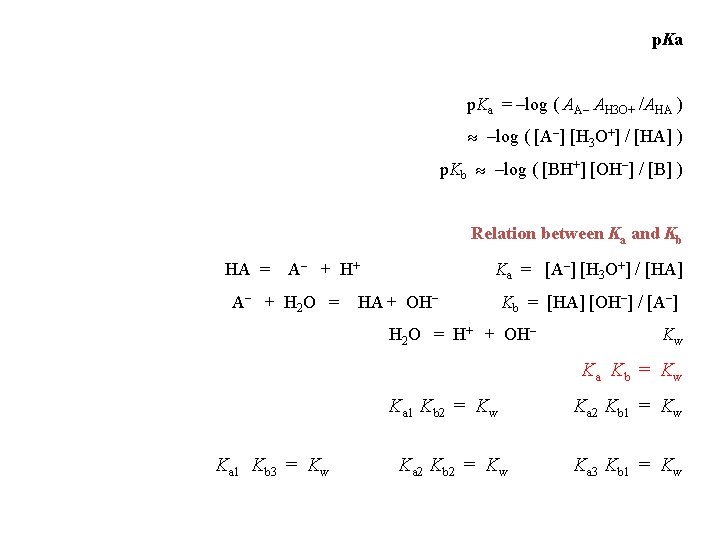
p. K a p. Ka = –log ( AA– AH 3 O+ /AHA ) –log ( [A–] [H 3 O+] / [HA] ) p. Kb –log ( [BH+] [OH–] / [B] ) Relation between Ka and Kb HA = A– + H + A– + H 2 O = Ka = [A–] [H 3 O+] / [HA] HA + OH– Kb = [HA] [OH–] / [A–] H 2 O = H+ + OH– Kw Ka Kb = Kw Ka 1 Kb 2 = Kw Ka 1 Kb 3 = Kw Ka 2 Kb 2 = Kw Ka 2 Kb 1 = Kw Ka 3 Kb 1 = Kw
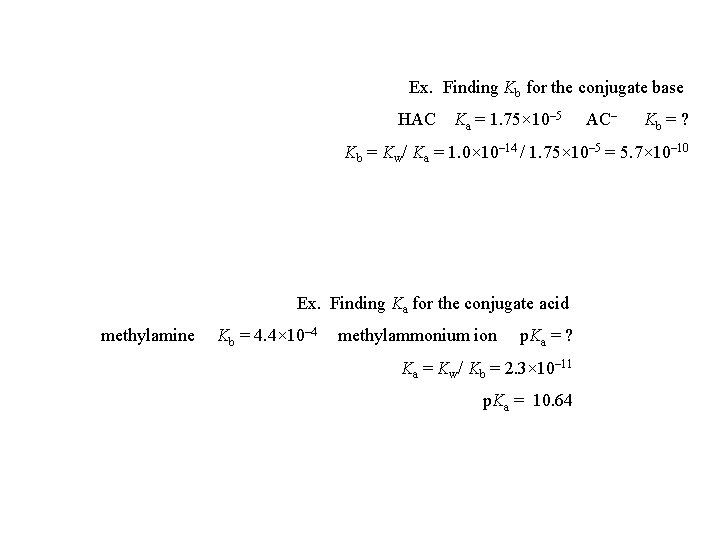
Ex. Finding Kb for the conjugate base HAC Ka = 1. 75× 10– 5 AC– Kb = ? Kb = Kw/ Ka = 1. 0× 10– 14 / 1. 75× 10– 5 = 5. 7× 10– 10 Ex. Finding Ka for the conjugate acid methylamine Kb = 4. 4× 10– 4 methylammonium ion p Ka = ? Ka = Kw/ Kb = 2. 3× 10– 11 p. Ka = 10. 64
![Acidic OR Basic? Neutral soln: [H+] = 10 7; Acidic soln: [H+] > 10](http://slidetodoc.com/presentation_image_h2/a03979209373a6d995840436c5466d0a/image-65.jpg "Acidic OR Basic? Neutral soln: [H+] = 10 7; Acidic soln: [H+] > 10")
Acidic OR Basic? Neutral soln: [H+] = 10 7; Acidic soln: [H+] > 10 7; Basic soln: [H+] < 10 7; p. H = 7. 0 p. H = or < 7. 0 p. H = or > 7. 0
![p. H = - log [H 3 O+] p. H = log (1. 0](http://slidetodoc.com/presentation_image_h2/a03979209373a6d995840436c5466d0a/image-66.jpg "p. H = - log [H 3 O+] p. H = log (1. 0")
p. H = - log [H 3 O+] p. H = log (1. 0 x 10 7) p. H = 7 This is why “ 7” is considered neutral p. H. It is the natural p. H of water. Neutral water doesn’t have NO acid, it has the EQUILIBRIUM (Kw) amount!!!
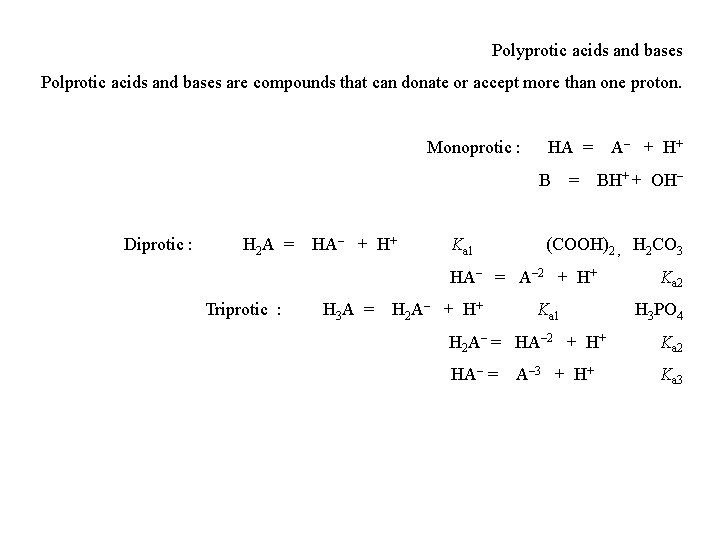
Polyprotic acids and bases Polprotic acids and bases are compounds that can donate or accept more than one proton. Monoprotic : HA = B = Diprotic : H 2 A = HA– + H+ Ka 1 A– + H + BH+ + OH– (COOH)2 , H 2 CO 3 HA– = A– 2 + H+ Triprotic : H 3 A = H 2 A– + H + Ka 1 Ka 2 H 3 PO 4 H 2 A– = HA– 2 + H+ Ka 2 HA– = Ka 3 A– 3 + H+
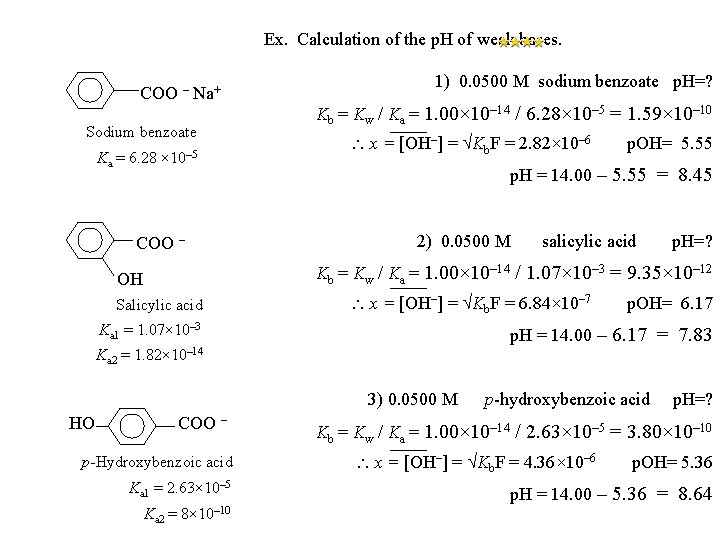
Ex. Calculation of the p. H of weak bases. COO – Na+ Sodium benzoate Ka = 6. 28 × 10– 5 COO – 1) 0. 0500 M sodium benzoate p. H=? Kb = Kw / Ka = 1. 00× 10– 14 / 6. 28× 10– 5 = 1. 59× 10– 10 x = [OH–] = Kb. F = 2. 82× 10– 6 p. H = 14. 00 – 5. 55 = 8. 45 2) 0. 0500 M Salicylic acid x = [OH–] = Kb. F = 6. 84× 10– 7 Ka 1 = 1. 07× 10– 3 p. H=? p. OH= 6. 17 p. H = 14. 00 – 6. 17 = 7. 83 1. 82× 10– 14 3) 0. 0500 M HO salicylic acid Kb = Kw / Ka = 1. 00× 10– 14 / 1. 07× 10– 3 = 9. 35× 10– 12 OH Ka 2 = p. OH= 5. 55 COO – p-Hydroxybenzoic acid Ka 1 = 2. 63× 10– 5 Ka 2 = 8× 10– 10 p-hydroxybenzoic acid p. H=? Kb = Kw / Ka = 1. 00× 10– 14 / 2. 63× 10– 5 = 3. 80× 10– 10 x = [OH–] = Kb. F = 4. 36× 10– 6 p. OH= 5. 36 p. H = 14. 00 – 5. 36 = 8. 64
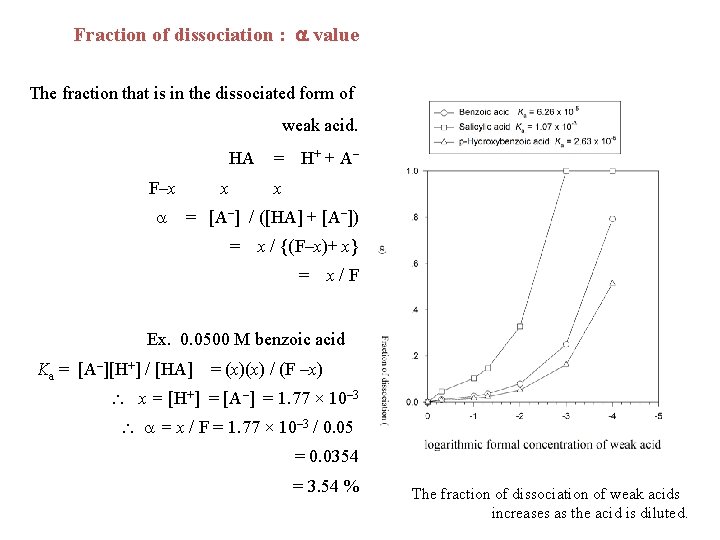
Fraction of dissociation : value The fraction that is in the dissociated form of weak acid. HA F–x x = H+ + A – x = [A–] / ([HA] + [A–]) = x / {(F–x)+ x} = x/F Ex. 0. 0500 M benzoic acid Ka = [A–][H+] / [HA] = (x)(x) / (F –x) x = [H+] = [A–] = 1. 77 × 10– 3 = x / F = 1. 77 × 10– 3 / 0. 05 = 0. 0354 = 3. 54 % The fraction of dissociation of weak acids increases as the acid is diluted.
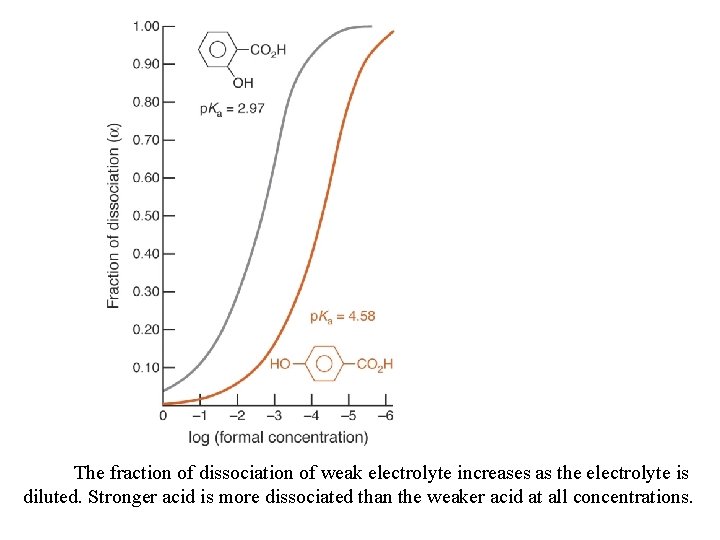
The fraction of dissociation of weak electrolyte increases as the electrolyte is diluted. Stronger acid is more dissociated than the weaker acid at all concentrations.
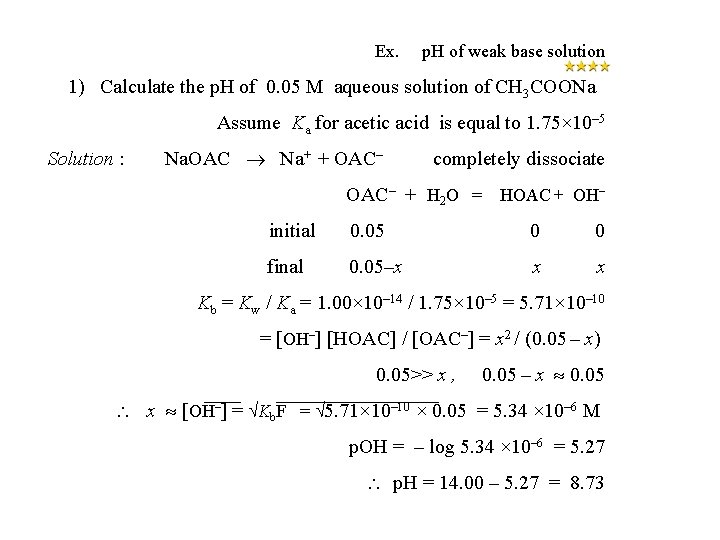
Ex. p. H of weak base solution 1) Calculate the p. H of 0. 05 M aqueous solution of CH 3 COONa Assume Ka for acetic acid is equal to 1. 75× 10– 5 Solution : Na. OAC Na+ + OAC– completely dissociate OAC– + H 2 O = HOAC + OH– initial 0. 05 0 0 final 0. 05–x x x Kb = Kw / Ka = 1. 00× 10– 14 / 1. 75× 10– 5 = 5. 71× 10– 10 = [OH–] [HOAC] / [OAC–] = x 2 / (0. 05 – x) 0. 05>> x , 0. 05 – x 0. 05 x [OH–] = Kb. F = 5. 71× 10– 10 × 0. 05 = 5. 34 × 10– 6 M p. OH = – log 5. 34 × 10– 6 = 5. 27 p. H = 14. 00 – 5. 27 = 8. 73
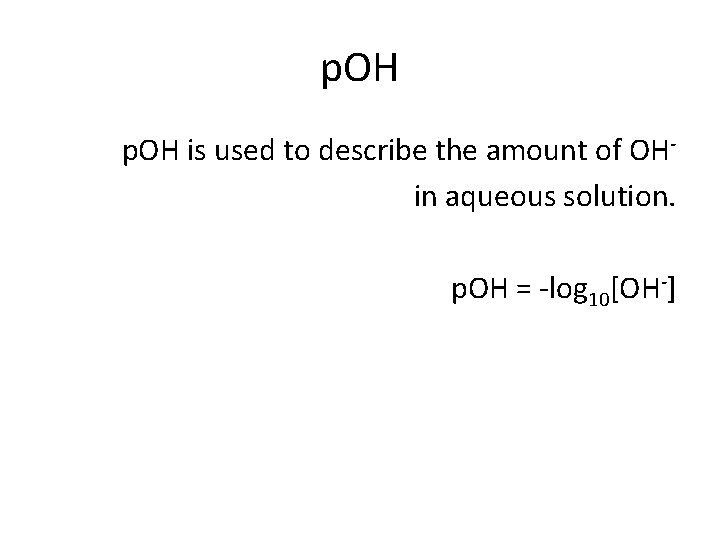
p. OH is used to describe the amount of OH in aqueous solution. p. OH = log 10[OH ]
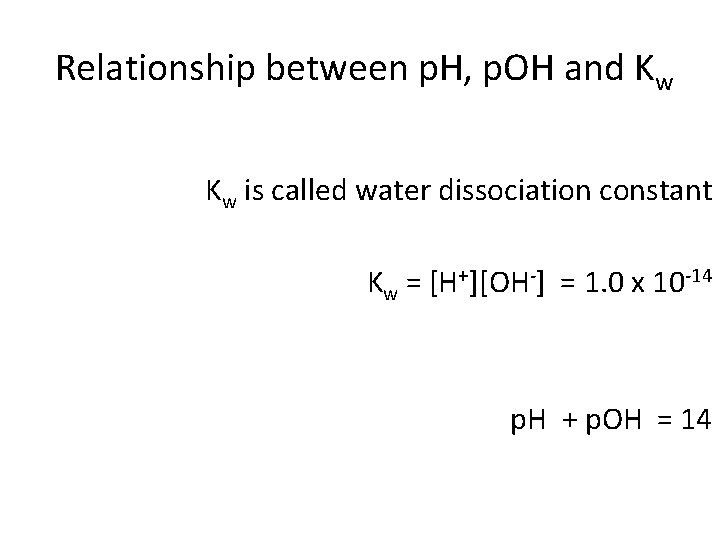
Relationship between p. H, p. OH and Kw Kw is called water dissociation constant Kw = [H+][OH ] = 1. 0 x 10 14 p. H + p. OH = 14
- Slides: 73