
Chemical Equations Preparation for College Chemistry Columbia University
Chemical Equations Preparation for College Chemistry Columbia University Department of Chemistry
Chapter Outline The Chemical Equation Writing and Balancing Equations Information in an Equation Types of Chemical Equations Heat in Chemical Equations The Greenhouse Effect
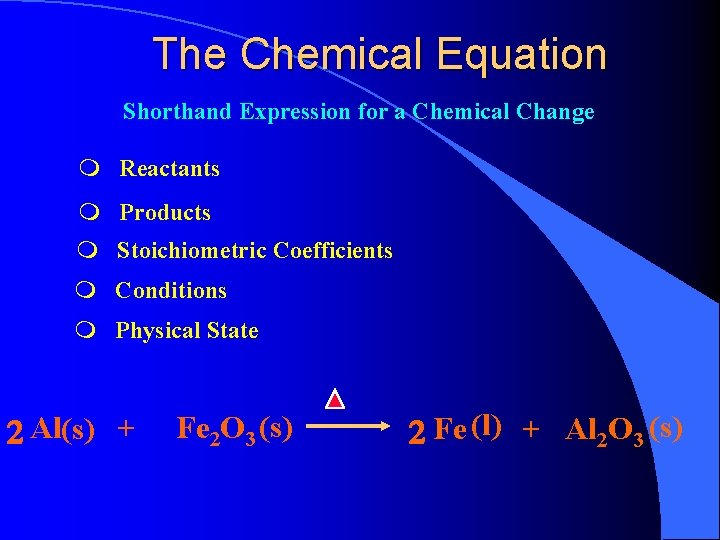
The Chemical Equation Shorthand Expression for a Chemical Change m Reactants m Products m Stoichiometric Coefficients m Conditions m Physical State 2 Al(s) + Fe 2 O 3 (s) 2 Fe (l) + Al 2 O 3 (s)

Writing Chemical Equations 1 Identify the Reaction magnesium hydroxide + phosphoric acid magnesium phosphate + water 2 Write the skeleton equation 3 Find the Stoichiometric Coefficients (Balance) 3 Mg(OH)2 + 2 H 3 PO 4 Mg 3(PO 4)2 + 6 H 2 O R 3 Mg 2 PO 4 14 O 12 H P 3 Mg 2 PO 4 14 O 12 H
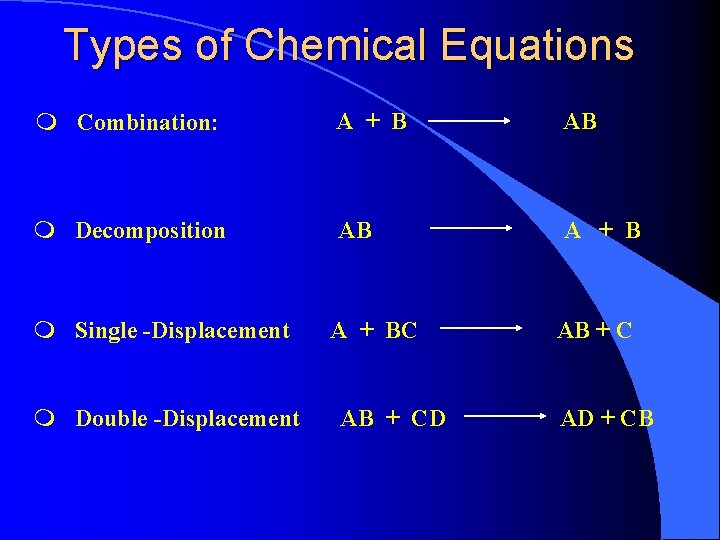
Types of Chemical Equations m Combination: A + B AB m Decomposition AB A + B m Single -Displacement m Double -Displacement A + BC AB + CD AB + C AD + CB
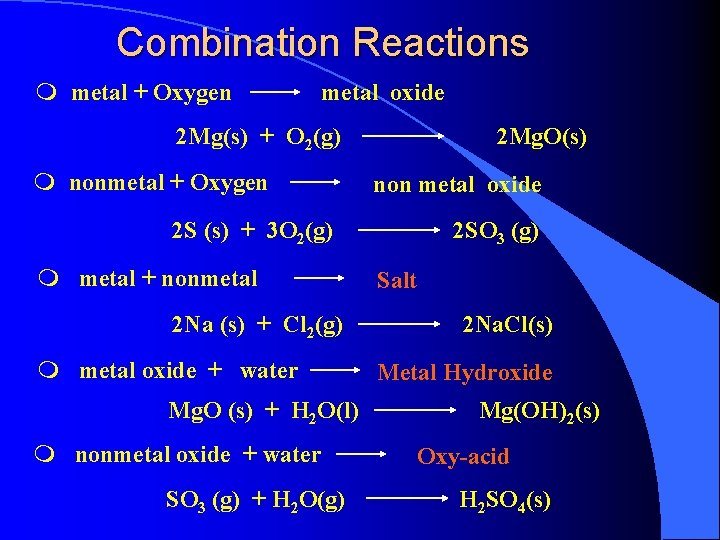
Combination Reactions m metal + Oxygen metal oxide 2 Mg(s) + O 2(g) m nonmetal + Oxygen 2 Mg. O(s) non metal oxide 2 S (s) + 3 O 2(g) m metal + nonmetal 2 Na (s) + Cl 2(g) m metal oxide + water Mg. O (s) + H 2 O(l) m nonmetal oxide + water SO 3 (g) + H 2 O(g) 2 SO 3 (g) Salt 2 Na. Cl(s) Metal Hydroxide Mg(OH)2(s) Oxy-acid H 2 SO 4(s)
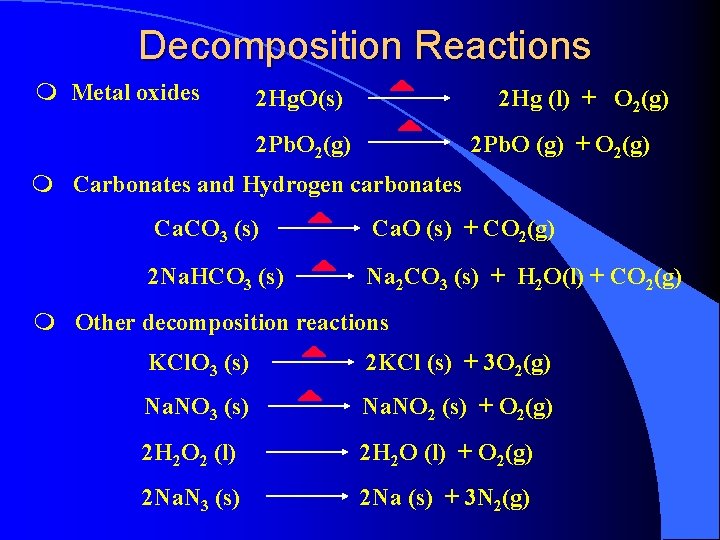
Decomposition Reactions m Metal oxides 2 Hg. O(s) 2 Hg (l) + O 2(g) 2 Pb. O (g) + O 2(g) m Carbonates and Hydrogen carbonates Ca. CO 3 (s) Ca. O (s) + CO 2(g) 2 Na. HCO 3 (s) Na 2 CO 3 (s) + H 2 O(l) + CO 2(g) m Other decomposition reactions KCl. O 3 (s) 2 KCl (s) + 3 O 2(g) Na. NO 3 (s) Na. NO 2 (s) + O 2(g) 2 H 2 O 2 (l) 2 H 2 O (l) + O 2(g) 2 Na. N 3 (s) 2 Na (s) + 3 N 2(g)
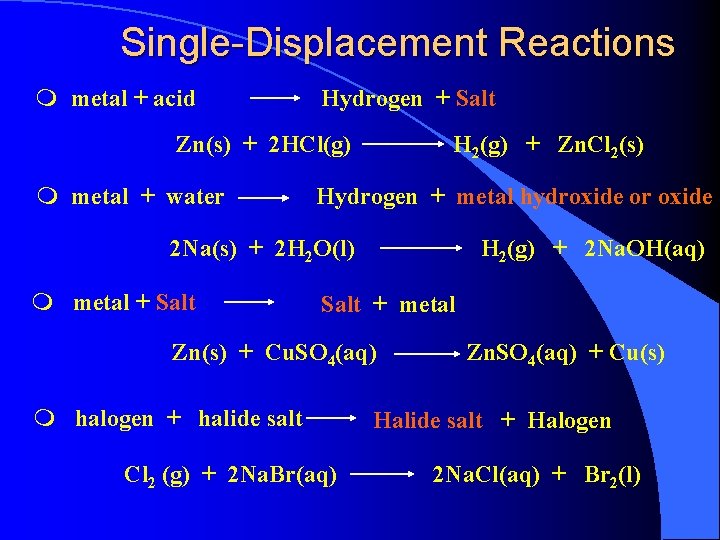
Single-Displacement Reactions m metal + acid Hydrogen + Salt Zn(s) + 2 HCl(g) m metal + water H 2(g) + Zn. Cl 2(s) Hydrogen + metal hydroxide or oxide 2 Na(s) + 2 H 2 O(l) m metal + Salt H 2(g) + 2 Na. OH(aq) Salt + metal Zn(s) + Cu. SO 4(aq) m halogen + halide salt Cl 2 (g) + 2 Na. Br(aq) Zn. SO 4(aq) + Cu(s) Halide salt + Halogen 2 Na. Cl(aq) + Br 2(l)
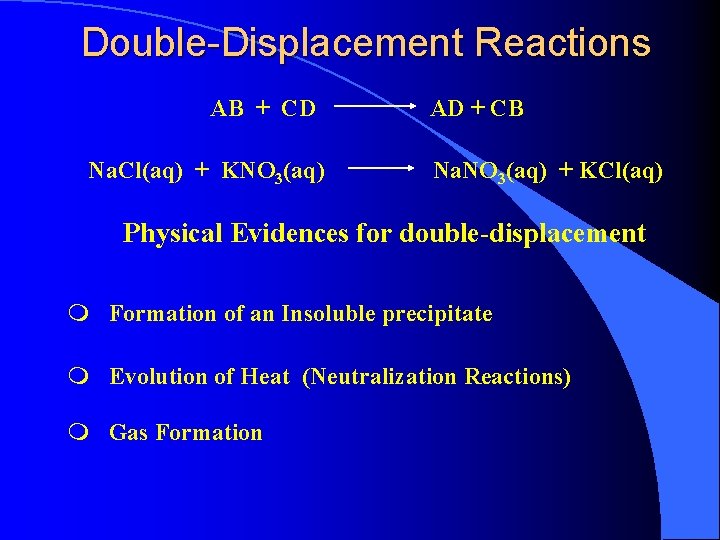
Double-Displacement Reactions AB + CD Na. Cl(aq) + KNO 3(aq) AD + CB Na. NO 3(aq) + KCl(aq) Physical Evidences for double-displacement m Formation of an Insoluble precipitate m Evolution of Heat (Neutralization Reactions) m Gas Formation

Ionic Dissolution - + - + + + + + - - - + + + + +
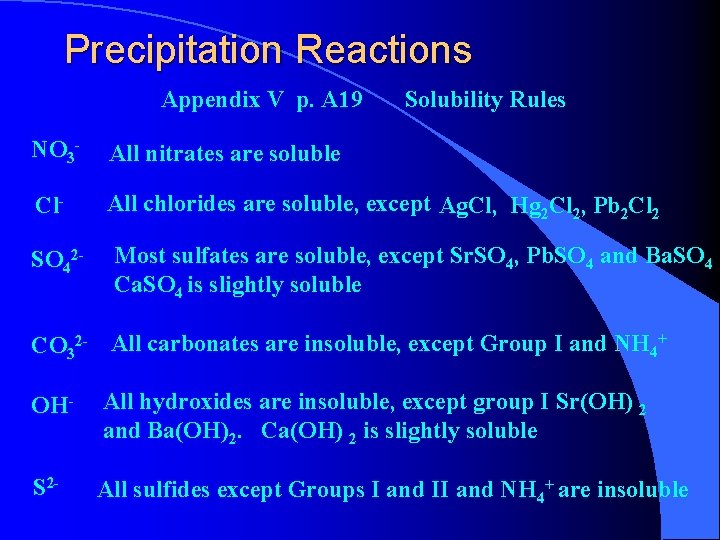
Precipitation Reactions Appendix V p. A 19 Solubility Rules NO 3 - All nitrates are soluble Cl- All chlorides are soluble, except Ag. Cl, Hg 2 Cl 2, Pb 2 Cl 2 SO 42 - Most sulfates are soluble, except Sr. SO 4, Pb. SO 4 and Ba. SO 4 Ca. SO 4 is slightly soluble CO 32 - All carbonates are insoluble, except Group I and NH 4+ OH- All hydroxides are insoluble, except group I Sr(OH) 2 and Ba(OH)2. Ca(OH) 2 is slightly soluble S 2 - All sulfides except Groups I and II and NH 4+ are insoluble
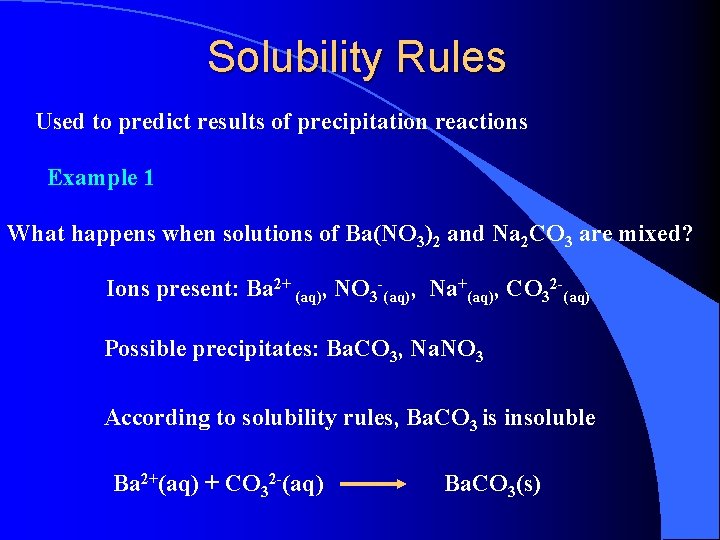
Solubility Rules Used to predict results of precipitation reactions Example 1 What happens when solutions of Ba(NO 3)2 and Na 2 CO 3 are mixed? Ions present: Ba 2+ (aq), NO 3 -(aq), Na+(aq), CO 32 -(aq) Possible precipitates: Ba. CO 3, Na. NO 3 According to solubility rules, Ba. CO 3 is insoluble Ba 2+(aq) + CO 32 -(aq) Ba. CO 3(s)
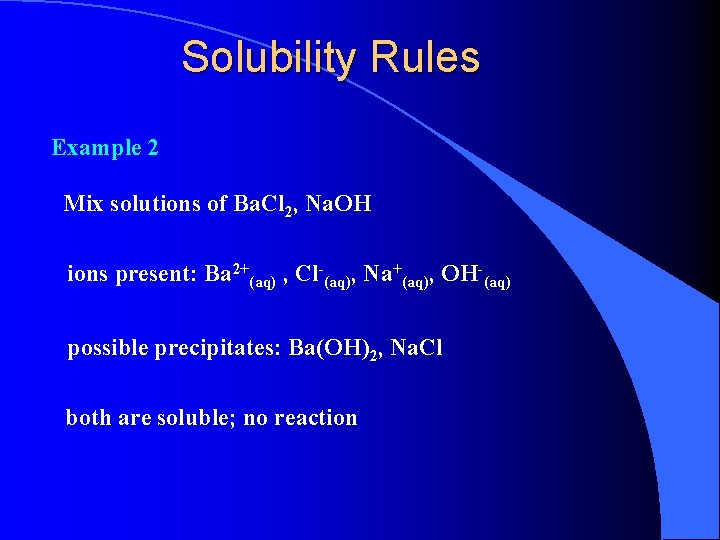
Solubility Rules Example 2 Mix solutions of Ba. Cl 2, Na. OH ions present: Ba 2+(aq) , Cl-(aq), Na+(aq), OH-(aq) possible precipitates: Ba(OH)2, Na. Cl both are soluble; no reaction
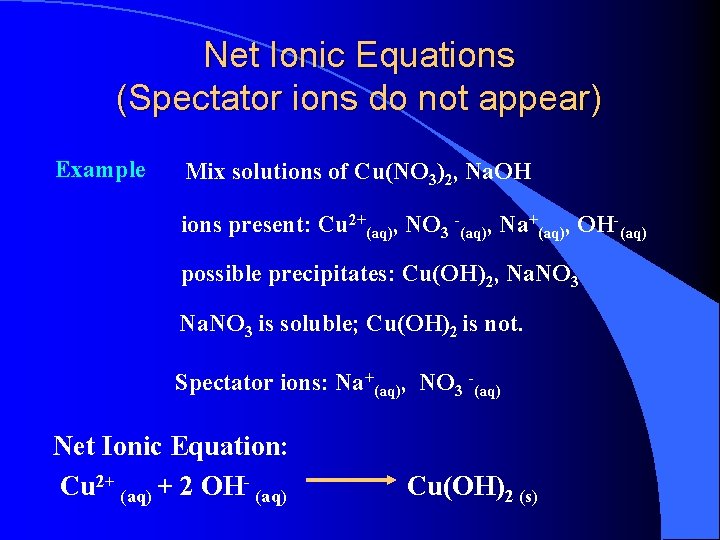
Net Ionic Equations (Spectator ions do not appear) Example Mix solutions of Cu(NO 3)2, Na. OH ions present: Cu 2+(aq), NO 3 -(aq), Na+(aq), OH-(aq) possible precipitates: Cu(OH)2, Na. NO 3 is soluble; Cu(OH)2 is not. Spectator ions: Na+(aq), NO 3 -(aq) Net Ionic Equation: Cu 2+ (aq) + 2 OH- (aq) Cu(OH)2 (s)
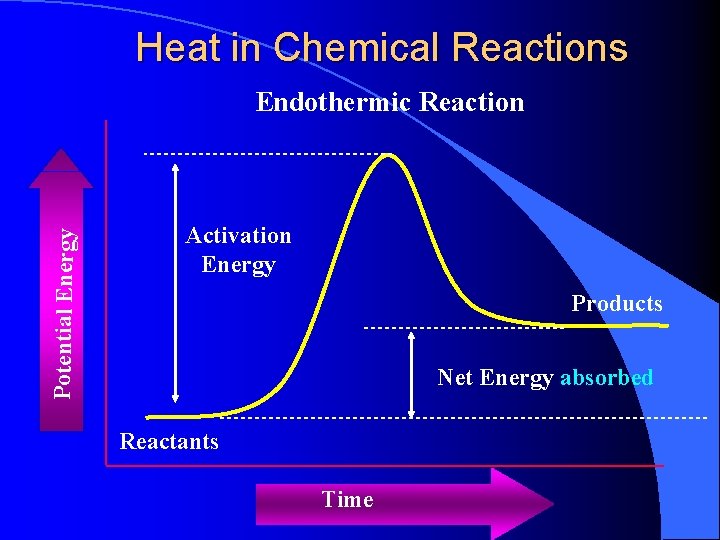
Heat in Chemical Reactions Potential Energy Endothermic Reaction Activation Energy Products Net Energy absorbed Reactants Time
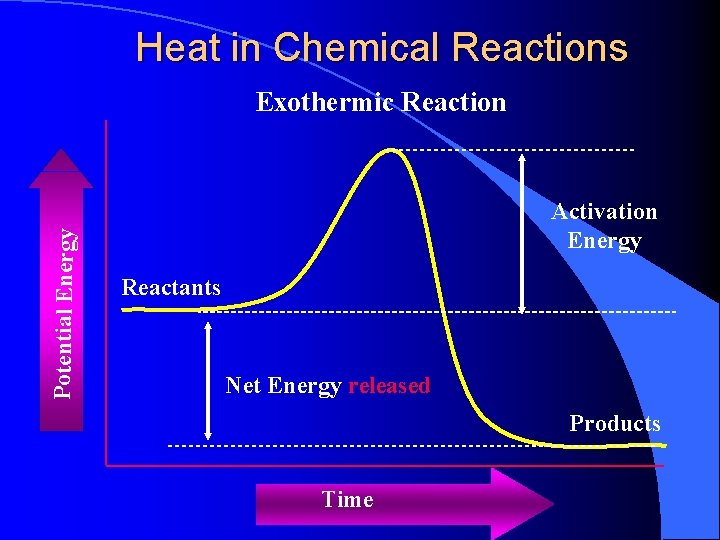
Heat in Chemical Reactions Potential Energy Exothermic Reaction Activation Energy Reactants Net Energy released Products Time

Greenhouse Effect http: //web 1. infotrac-college. com/wadsworth/ session/61/39/3567398/27!xrn_2_0_A 17279460 session/61/39/3567398/12!xrn_39_0_A 20080477 session/61/39/3567398/25!xrn_4_0_A 15273396 session/61/39/3567398/8!xrn_29_0_A 20571782&bkm_8_29
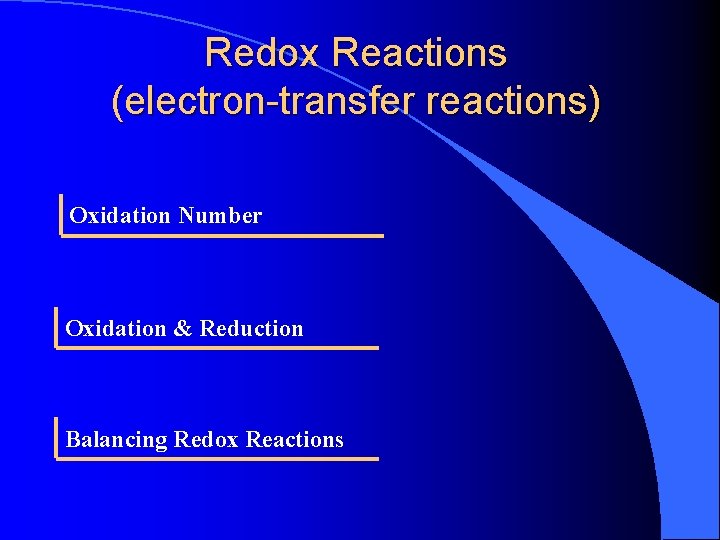
Redox Reactions (electron-transfer reactions) Oxidation Number Oxidation & Reduction Balancing Redox Reactions
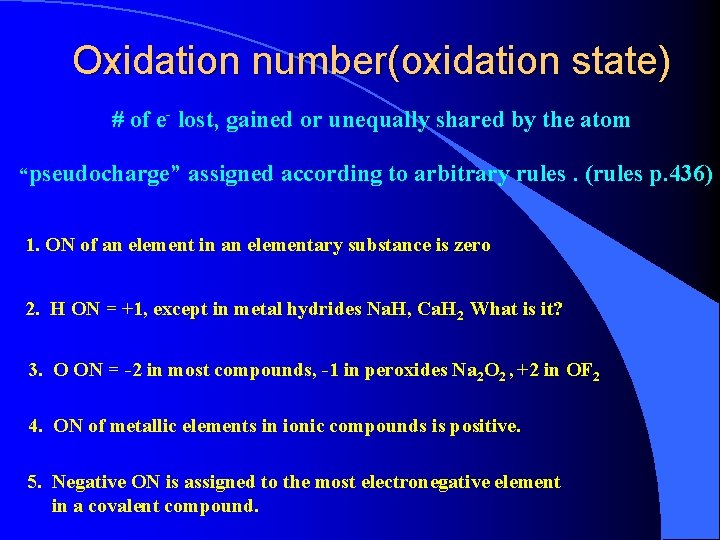
Oxidation number(oxidation state) # of e- lost, gained or unequally shared by the atom “pseudocharge” assigned according to arbitrary rules. (rules p. 436) 1. ON of an element in an elementary substance is zero 2. H ON = +1, except in metal hydrides Na. H, Ca. H 2 What is it? 3. O ON = -2 in most compounds, -1 in peroxides Na 2 O 2 , +2 in OF 2 4. ON of metallic elements in ionic compounds is positive. 5. Negative ON is assigned to the most electronegative element in a covalent compound.
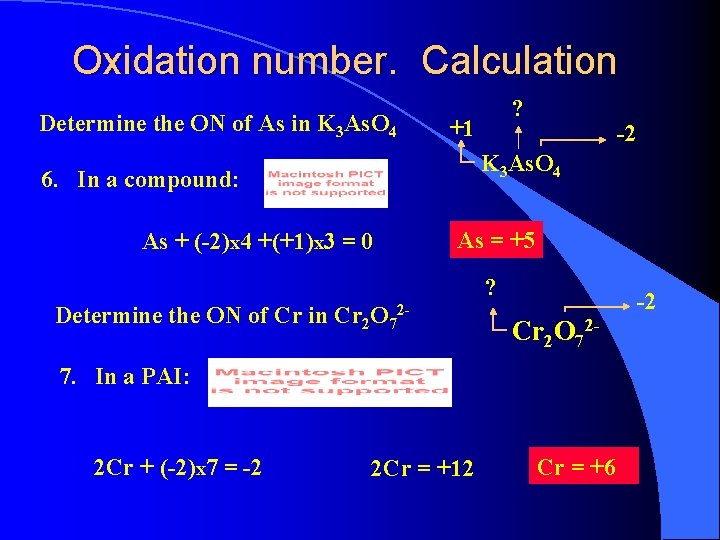
Oxidation number. Calculation Determine the ON of As in K 3 As. O 4 ? +1 -2 K 3 As. O 4 6. In a compound: As + (-2)x 4 +(+1)x 3 = 0 As = +5 ? Determine the ON of Cr in Cr 2 O 72 - -2 Cr 2 O 72 - 7. In a PAI: 2 Cr + (-2)x 7 = -2 2 Cr = +12 Cr = +6
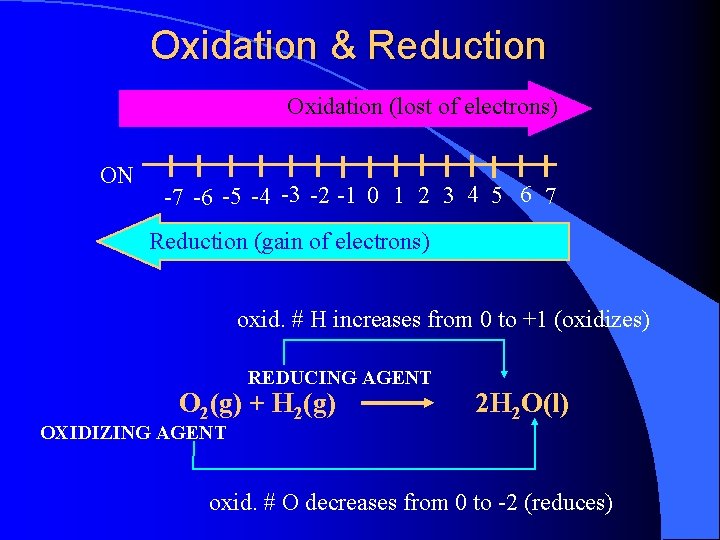
Oxidation & Reduction Oxidation (lost of electrons) ON -7 -6 -5 -4 -3 -2 -1 0 1 2 3 4 5 6 7 Reduction (gain of electrons) oxid. # H increases from 0 to +1 (oxidizes) REDUCING AGENT O 2(g) + H 2(g) OXIDIZING AGENT 2 H 2 O(l) oxid. # O decreases from 0 to -2 (reduces)
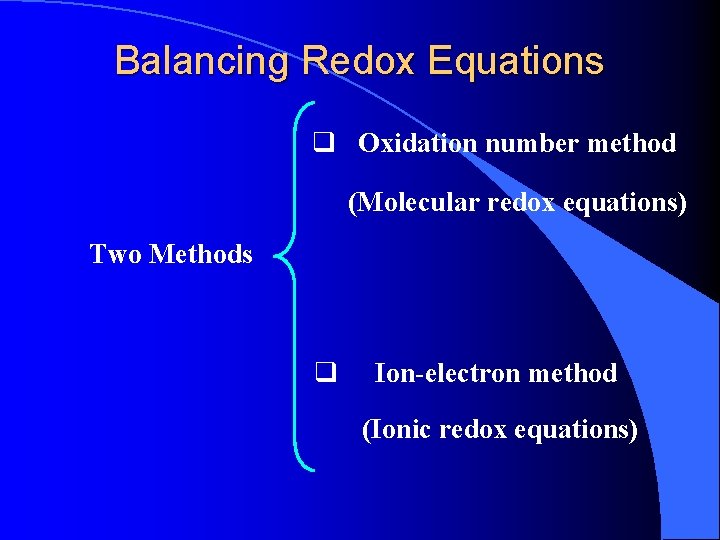
Balancing Redox Equations q Oxidation number method (Molecular redox equations) Two Methods q Ion-electron method (Ionic redox equations)
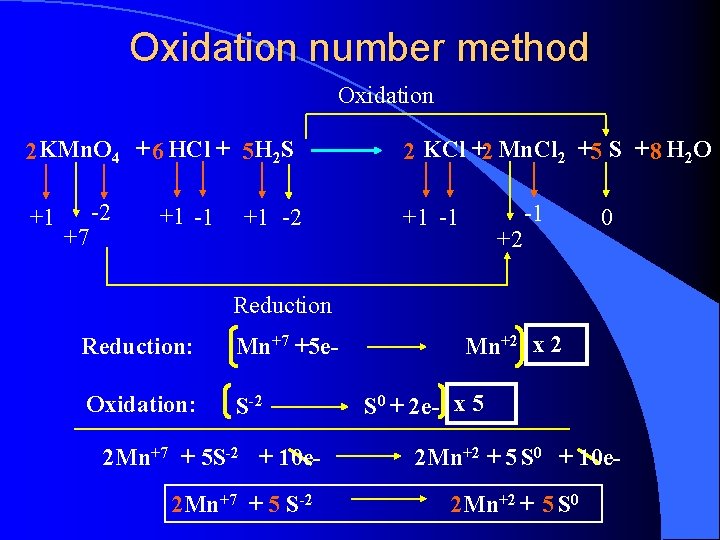
Oxidation number method Oxidation 2 KMn. O 4 + 6 HCl + 5 H 2 S +1 +7 -2 +1 -1 +1 -2 2 KCl +2 Mn. Cl 2 +5 S + 8 H 2 O +1 -1 +2 -1 0 Reduction: Mn+7 +5 e- Oxidation: S-2 2 Mn+7 + 5 S-2 + 10 e 2 Mn+7 + 5 S-2 Mn+2 x 2 S 0 + 2 e- x 5 2 Mn+2 + 5 S 0 + 10 e 2 Mn+2 + 5 S 0
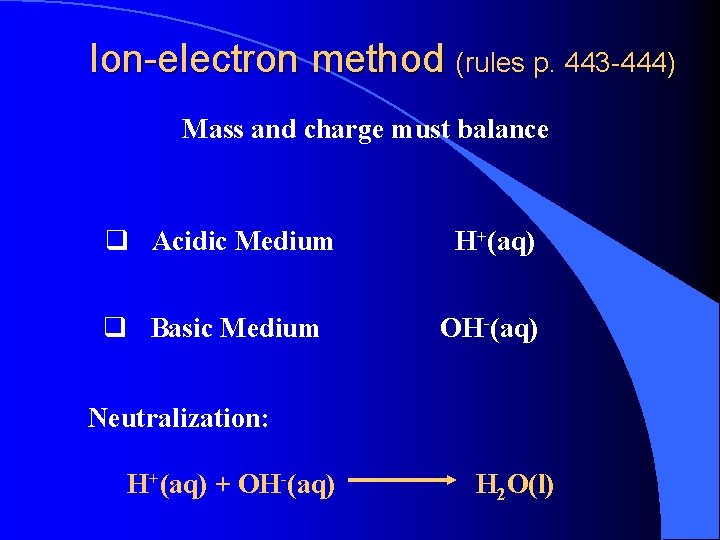
Ion-electron method (rules p. 443 -444) Mass and charge must balance q Acidic Medium H+(aq) q Basic Medium OH-(aq) Neutralization: H+(aq) + OH-(aq) H 2 O(l)
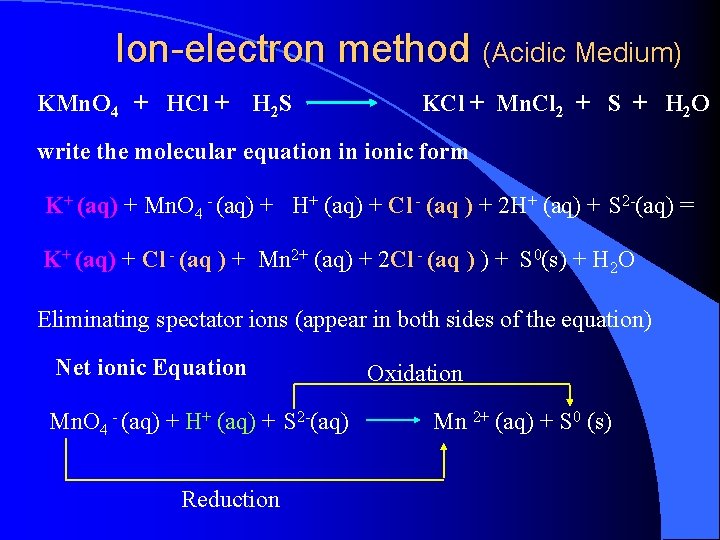
Ion-electron method (Acidic Medium) KMn. O 4 + HCl + H 2 S KCl + Mn. Cl 2 + S + H 2 O write the molecular equation in ionic form K+ (aq) + Mn. O 4 - (aq) + H+ (aq) + Cl - (aq ) + 2 H+ (aq) + S 2 -(aq) = K+ (aq) + Cl - (aq ) + Mn 2+ (aq) + 2 Cl - (aq ) ) + S 0(s) + H 2 O Eliminating spectator ions (appear in both sides of the equation) Net ionic Equation Mn. O 4 - (aq) + H+ (aq) + S 2 -(aq) Reduction Oxidation Mn 2+ (aq) + S 0 (s)
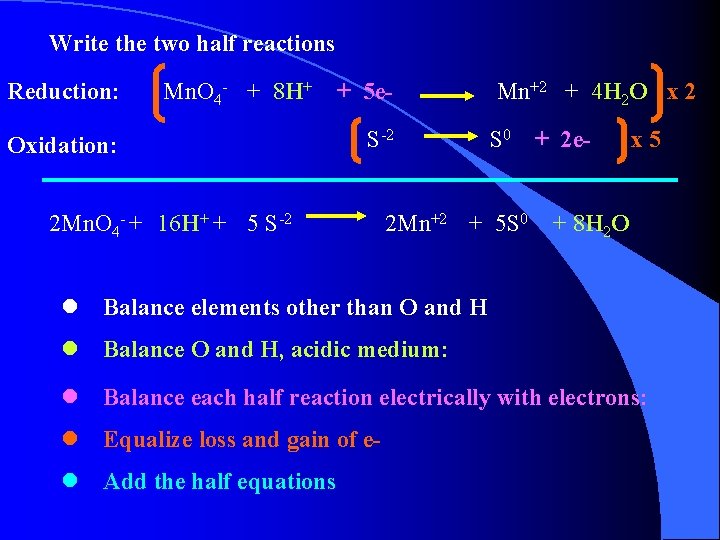
Write the two half reactions Reduction: Mn. O 4 - + 8 H+ Oxidation: + 5 e. S-2 2 Mn. O 4 - + 16 H+ + 5 S-2 Mn+2 + 4 H 2 O x 2 S 0 2 Mn+2 + 5 S 0 + 2 e- x 5 + 8 H 2 O l Balance elements other than O and H l Balance O and H, acidic medium: l Balance each half reaction electrically with electrons: l Equalize loss and gain of el Add the half equations
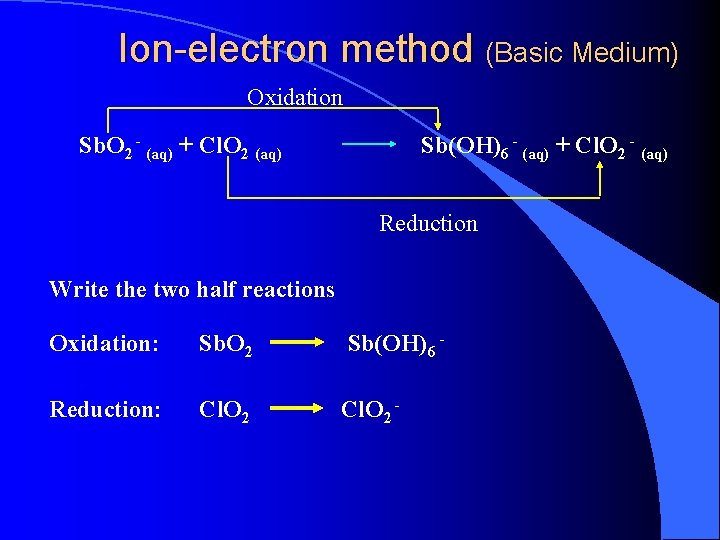
Ion-electron method (Basic Medium) Oxidation Sb. O 2 - (aq) + Cl. O 2 (aq) Sb(OH)6 - (aq) + Cl. O 2 - (aq) Reduction Write the two half reactions Oxidation: Sb. O 2 Sb(OH)6 - Reduction: Cl. O 2 -
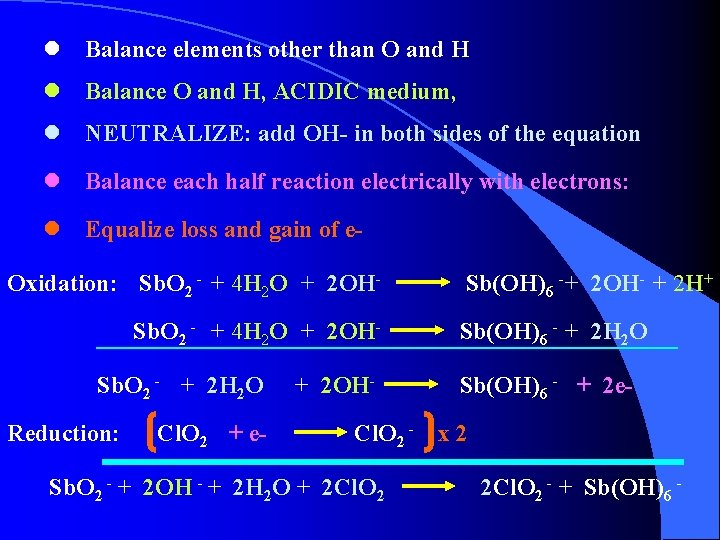
l Balance elements other than O and H l Balance O and H, ACIDIC medium, l NEUTRALIZE: add OH- in both sides of the equation l Balance each half reaction electrically with electrons: l Equalize loss and gain of e. Oxidation: Sb. O 2 - + 4 H 2 O + 2 OHSb. O 2 - + 2 H 2 O Reduction: Cl. O 2 + e- + 2 OHCl. O 2 - Sb. O 2 - + 2 OH - + 2 H 2 O + 2 Cl. O 2 Sb(OH)6 - + 2 OH- + 2 H+ Sb(OH)6 - + 2 H 2 O Sb(OH)6 - + 2 ex 2 2 Cl. O 2 - + Sb(OH)6 -
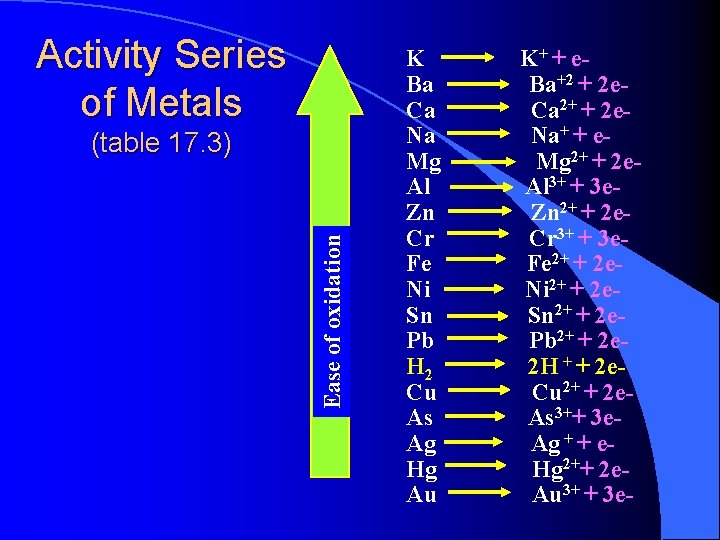
Activity Series of Metals Ease of oxidation (table 17. 3) K Ba Ca Na Mg Al Zn Cr Fe Ni Sn Pb H 2 Cu As Ag Hg Au K+ + e. Ba+2 + 2 e. Ca 2+ + 2 e. Na+ + e. Mg 2+ + 2 e. Al 3+ + 3 e. Zn 2+ + 2 e. Cr 3+ + 3 e. Fe 2+ + 2 e. Ni 2+ + 2 e. Sn 2+ + 2 e. Pb 2+ + 2 e 2 H + + 2 e. Cu 2+ + 2 e. As 3++ 3 e. Ag + + e. Hg 2++ 2 e. Au 3+ + 3 e-
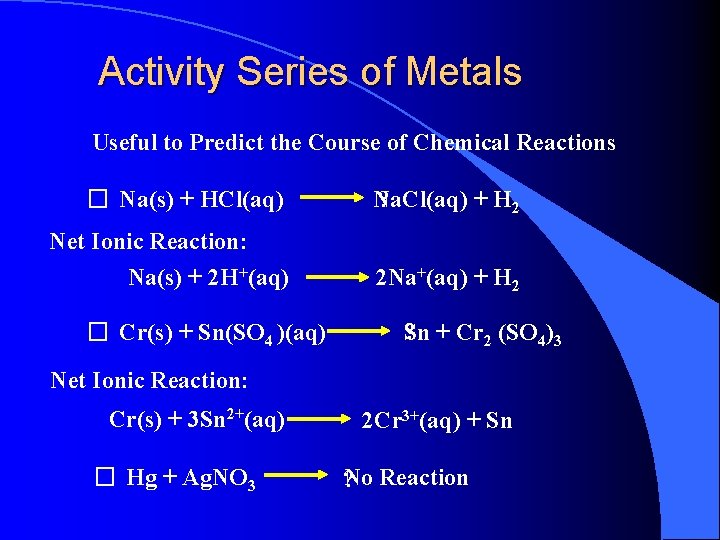
Activity Series of Metals Useful to Predict the Course of Chemical Reactions � Na(s) + HCl(aq) Na. Cl(aq) ? + H 2 Net Ionic Reaction: Na(s) + 2 H+(aq) � Cr(s) + Sn(SO 4 )(aq) 2 Na+(aq) + H 2 ? Sn + Cr 2 (SO 4)3 Net Ionic Reaction: Cr(s) + 3 Sn 2+(aq) � Hg + Ag. NO 3 2 Cr 3+(aq) + Sn ? No Reaction
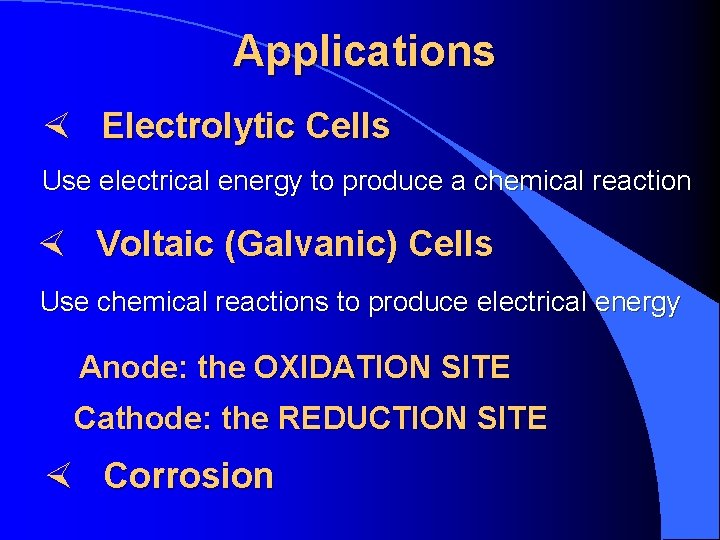
Applications × Electrolytic Cells Use electrical energy to produce a chemical reaction × Voltaic (Galvanic) Cells Use chemical reactions to produce electrical energy Anode: the OXIDATION SITE Cathode: the REDUCTION SITE × Corrosion
- Slides: 31