
CHEMICAL EQUATIONS AND REACTIONS PART I CHEMICAL RXNS





















- Slides: 65
CHEMICAL EQUATIONS AND REACTIONS
PART I: CHEMICAL RXNS BASICS, ENERGY, TYPES OF RXNS, BALANCING RXNS
CHEMICAL REACTIONS TERMS • REACTANTS - Original substance(s) entering into a chemical reaction • PRODUCTS – The resulting substance(s) from a chemical reaction • CHEMICAL EQUATIONS – Use symbols and formulas to represent & identify the relative amounts of reactants & products in a chemical reaction
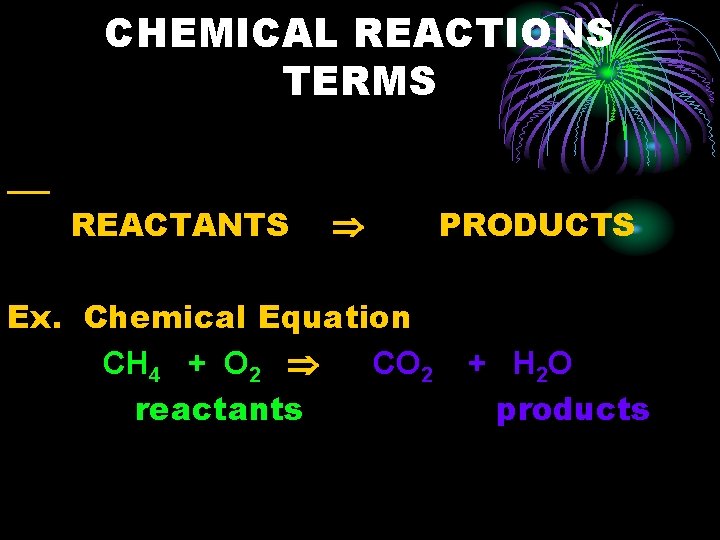
CHEMICAL REACTIONS TERMS REACTANTS Ex. Chemical Equation CH 4 + O 2 CO 2 reactants PRODUCTS + H 2 O products
Signs of Chemical Rxns • Evolution of (you make) heat or light • Production of a gas (fizzy bubbles) • Formation of a Precipitate (the rxn vessel becomes cloudy) • Color Change
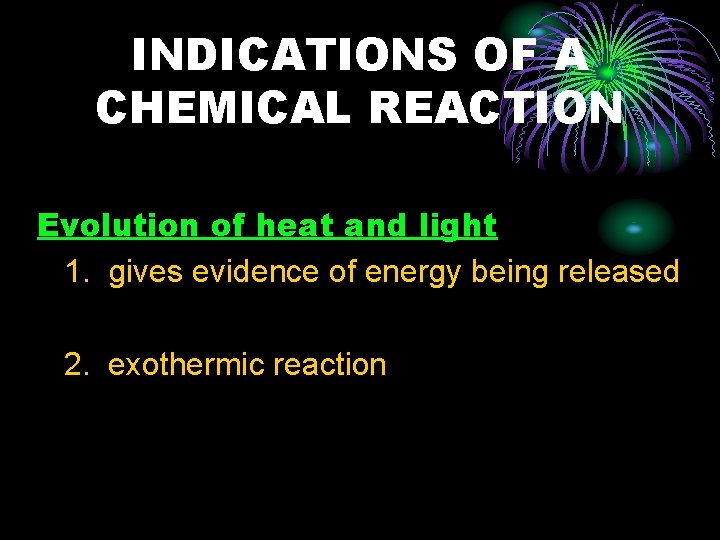
INDICATIONS OF A CHEMICAL REACTION Evolution of heat and light 1. gives evidence of energy being released 2. exothermic reaction
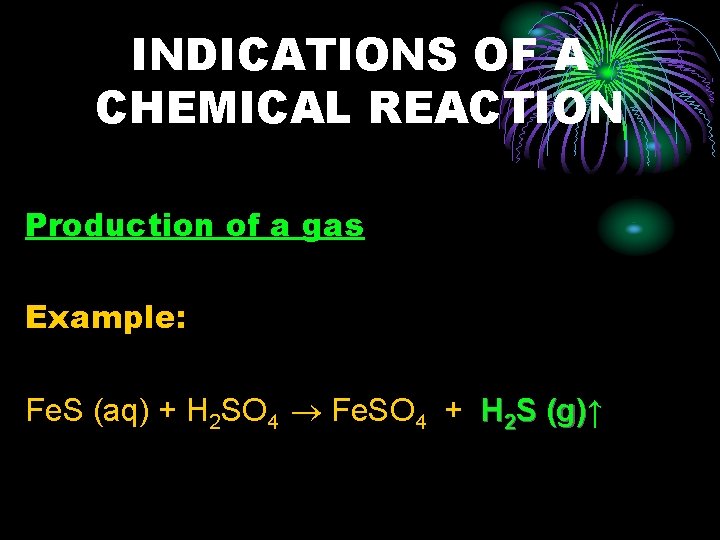
INDICATIONS OF A CHEMICAL REACTION Production of a gas Example: Fe. S (aq) + H 2 SO 4 Fe. SO 4 + H 2 S (g)↑ (g)
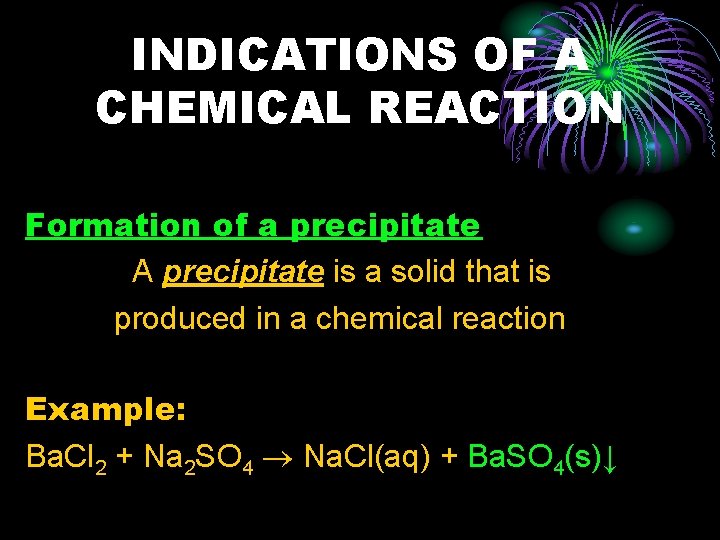
INDICATIONS OF A CHEMICAL REACTION Formation of a precipitate A precipitate is a solid that is produced in a chemical reaction Example: Ba. Cl 2 + Na 2 SO 4 Na. Cl(aq) + Ba. SO 4(s)↓
Energy and Reactions • Energy must be added to break bonds • Energy is released when bonds are formed • Total Energy of Reactants=Total Energy of Products
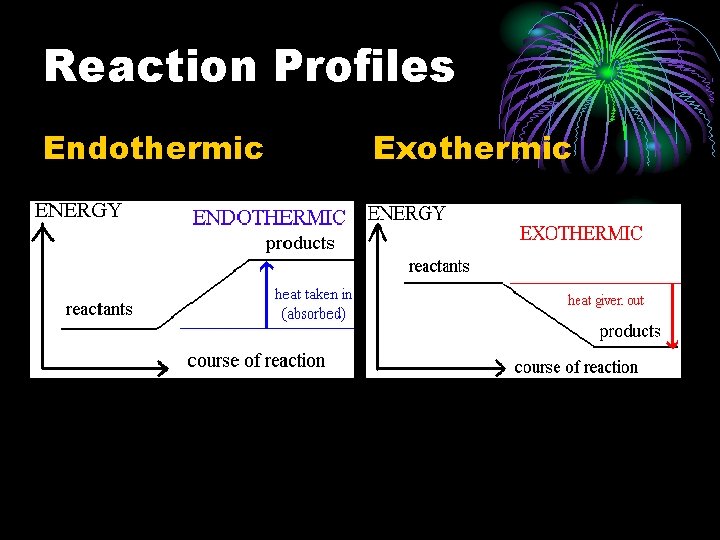
Endothermic vs Exothermic Endothermic Exothermic • A chemical reaction that requires heat • More energy is needed to break the bonds in the reactants than is given off by forming bonds in the products • Examples: melting ice, photosynthesis, evaporating water, cooking an egg, baking bread • A chemical reaction that does not require heat • Heat is given off in the reaction as a product; heat is released to surrounding • More energy is released by forming products than is needed to break the bonds of the reactants • Examples: all combustion reactions, digestion, condensation, explosions
Reaction Profiles Endothermic Exothermic
Factors affecting Reaction Rate • Reaction rate-how fast the reaction goes from reactants to products • Factors affecting reaction rate • • • Temperature Surface Area Concentration Pressure Size and shape of molecules Presence of a catalyst
Temperature and Surface Area Temperature Surface Area • Most reactions go faster at a higher temperature • This is because of the Kinetic theory • Higher temp means molecules going faster, more likely to collide • A large surface area speeds up reactions • Solids that have a large surface area react more quickly because more particles come in contact with the other reactants
Concentration and Pressure Concentration Pressure • Most reactions go faster at a higher concentration (3% vs 30% solution) • Think of doing laundry • Reactions are faster at a higher pressure • Gases are more concentrated at higher pressures because it has been squeezed into a smaller volume and have more collisions
Size/Shape and Catalysts Size and Shape Catalyst • Massive, Bulky molecules react slower • Because of Kinetic Molecular theory: • Bigger molecules move more slowly, collide less • A substance that changes the rate of a chemical rxn without being consumed • Not reactants or products • Do not play a role in the equilbrium (we will get to this)
Catalysts • Catalysts: speed up reactions • Inhibitors: slow down reactions • Enzymes: biological catalysts • Ex. Lipase breaks down fat into smaller molecules • Substrate: the reactant in reactions catalyzed by enzymes
TYPES OF CHEMICAL REACTIONS SYNTHESIS REACTIONS (COMPOSITION REACTIONS) Two or more substances combine to form a more complex product or substance A + X AX
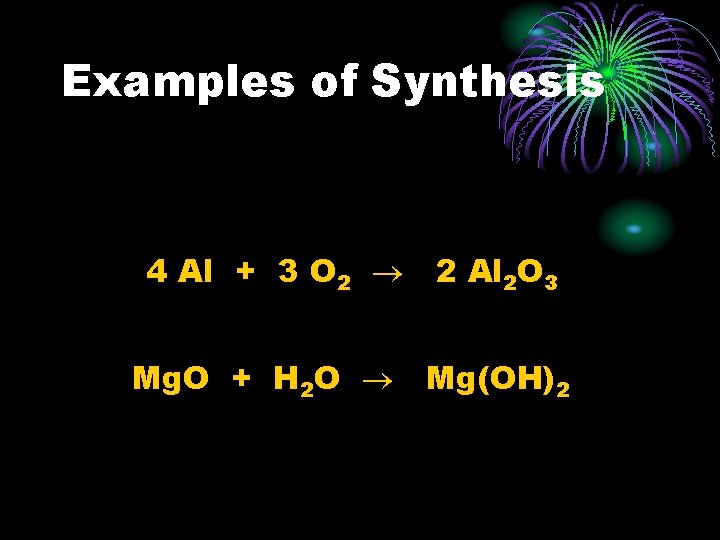
Examples of Synthesis 4 Al + 3 O 2 2 Al 2 O 3 Mg. O + H 2 O Mg(OH)2
TYPES OF CHEMICAL REACTIONS DECOMPOSITION REACTIONS One substance breaks down to form two or more simpler substances. AX A + X
Examples of Decomposition Ca. CO 3 2 Na. Cl Ca. O + CO 2 2 Na + Cl 2
TYPES OF CHEMICAL REACTIONS SINGLE-REPLACEMENT REACTIONS One substance is replaced in its compound by another substance A + BY AY + BX BY + X
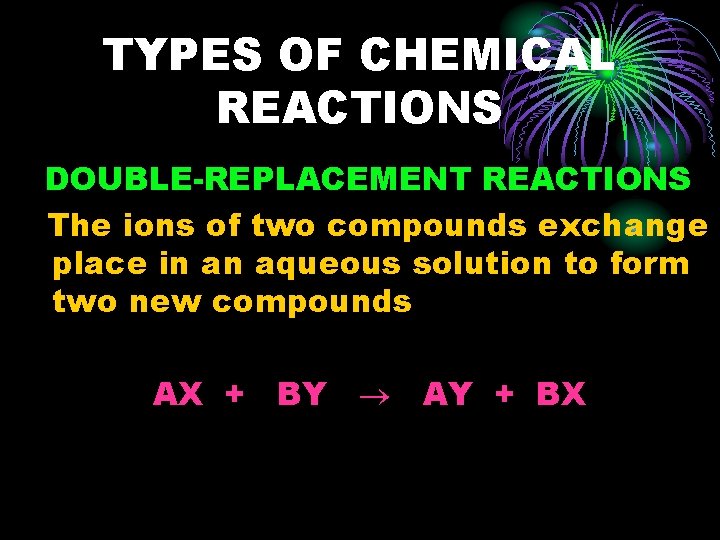
TYPES OF CHEMICAL REACTIONS DOUBLE-REPLACEMENT REACTIONS The ions of two compounds exchange place in an aqueous solution to form two new compounds AX + BY AY + BX
Double Replacement Reactions The ions of two compounds exchange places in an aqueous solution to form two new compounds. AX + BY AY + BX One of the compounds formed is usually a precipitate, an insoluble gas that bubbles out of solution, or a molecular compound, usually water.
TYPES OF CHEMICAL REACTIONS COMBUSITON REACTIONS A substance combines with oxygen, releasing a large amount of energy in the form of light and heat
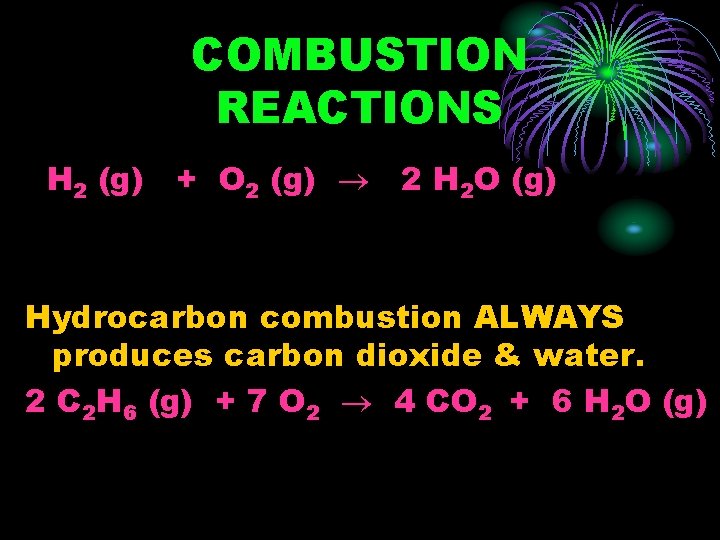
COMBUSTION REACTIONS H 2 (g) + O 2 (g) 2 H 2 O (g) Hydrocarbon combustion ALWAYS produces carbon dioxide & water. 2 C 2 H 6 (g) + 7 O 2 4 CO 2 + 6 H 2 O (g)
ID Types Flow Chart
ID Rxn Practice
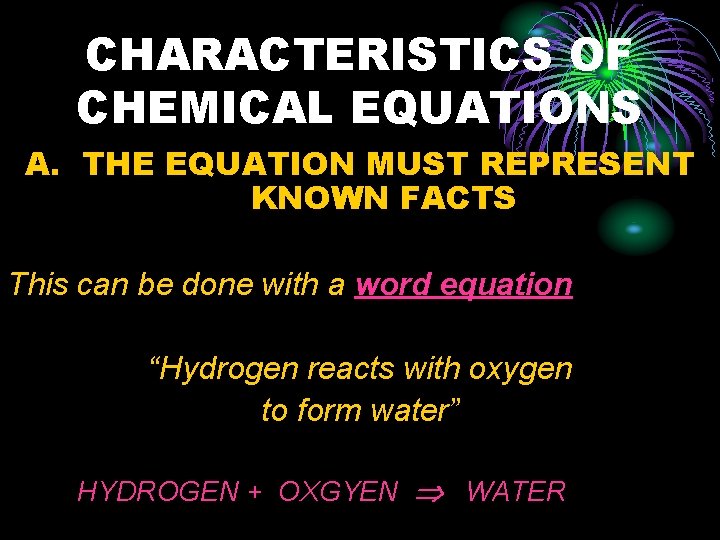
CHARACTERISTICS OF CHEMICAL EQUATIONS A. THE EQUATION MUST REPRESENT KNOWN FACTS This can be done with a word equation “Hydrogen reacts with oxygen to form water” HYDROGEN + OXGYEN WATER
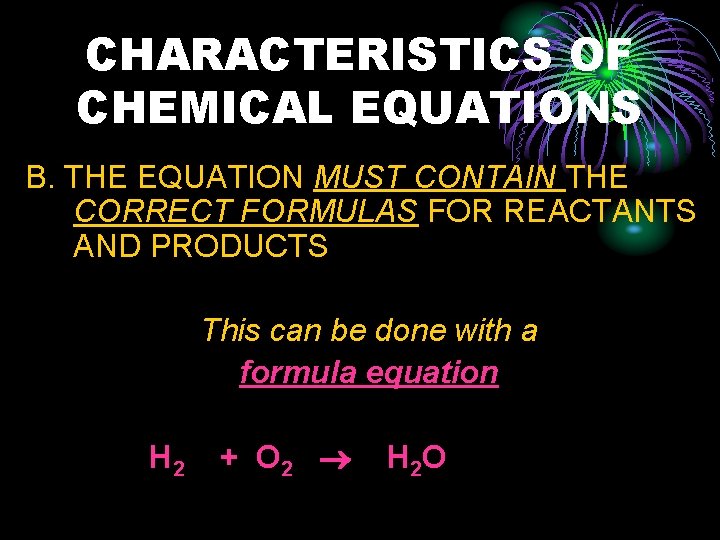
CHARACTERISTICS OF CHEMICAL EQUATIONS B. THE EQUATION MUST CONTAIN THE CORRECT FORMULAS FOR REACTANTS AND PRODUCTS This can be done with a formula equation H 2 + O 2 H 2 O
CHARACTERISTICS OF CHEMICAL EQUATIONS C. THE LAW OF CONSERVATION OF MASS (ATOMS) MUST BE SATISFIED Balancing the equation is done with coefficients – small whole numbers that appear in front of a formula 2 H 2 + O 2 2 H 2 O ↑ ↑ These numbers are called COEFFICIENTS
NEVER, NEVER………. YOU CAN NEVER BALANCE AN EQUATION BY CHANGING A FORMULA FOR A REACTANT OR PRODUCT …………… YOU BALANCE AN EQUATION ONLY BY ADDING OR CHANGING COEFFICIENTS!!
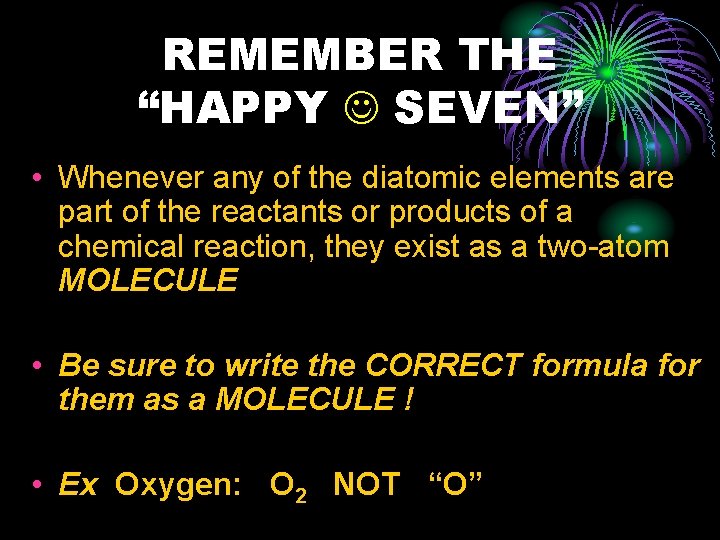
REMEMBER THE “HAPPY SEVEN” • Whenever any of the diatomic elements are part of the reactants or products of a chemical reaction, they exist as a two-atom MOLECULE • Be sure to write the CORRECT formula for them as a MOLECULE ! • Ex Oxygen: O 2 NOT “O”
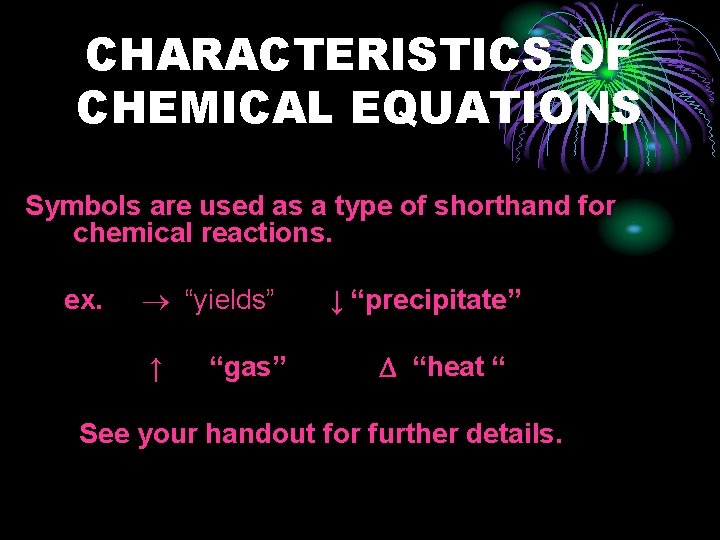
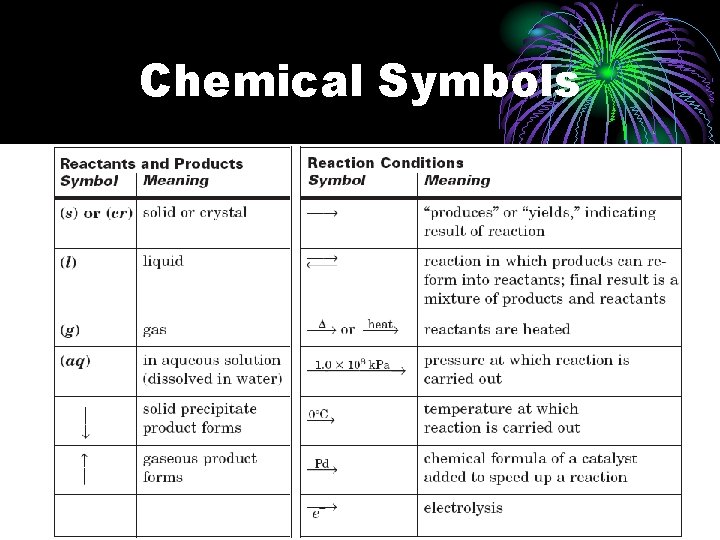
CHARACTERISTICS OF CHEMICAL EQUATIONS Symbols are used as a type of shorthand for chemical reactions. ex. “yields” ↑ “gas” ↓ “precipitate” “heat “ See your handout for further details.
Chemical Symbols
SIGNIFICANCE OF A CHEMICAL REACTION A. Gives quantitative information - shows number of moles, atoms, and compound in a reaction
SIGNIFICANCE OF A CHEMICAL REACTION A. Gives quantitative information - you start and end with the same number & types of atoms although possibly rearranged
NOTE: The fact that a reaction can be written does not mean that it CAN take place…….
BALANCING CHEMICAL EQUATIONS A. Identify reactants & products B. List elements in same order on both sides C. Count the number of atoms of each element on each side D. Starting with the largest difference (or weird like 2/3 must equal 6), Balance the formula equation using coefficients ONLY E. Double check the balanced equation by counting the numbers & types of atoms on both sides of the equation
BALANCING CHEMICAL EQUATIONS BALANCING EQUATIONS IS A TRIAL AND ERROR PROCESS !!!!!
Meaning of Conservation of Mass in Balancing Equations
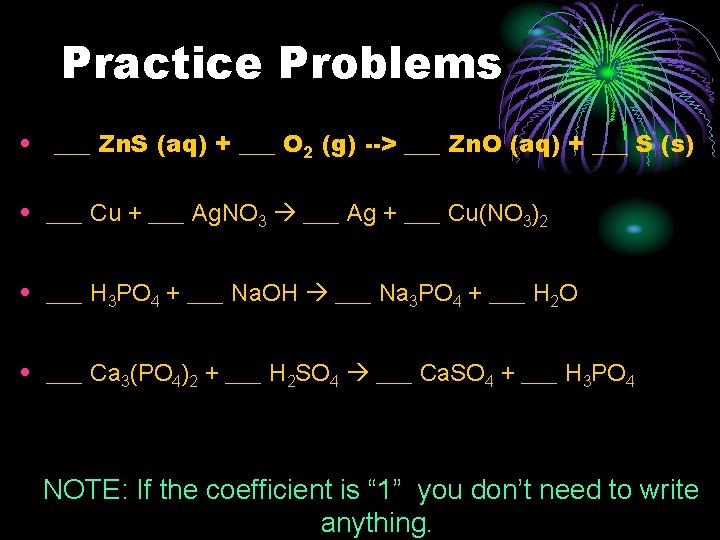
Practice Problems • ___ Zn. S (aq) + ___ O 2 (g) --> ___ Zn. O (aq) + ___ S (s) • ___ Cu + ___ Ag. NO 3 ___ Ag + ___ Cu(NO 3)2 • ___ H 3 PO 4 + ___ Na. OH ___ Na 3 PO 4 + ___ H 2 O • ___ Ca 3(PO 4)2 + ___ H 2 SO 4 ___ Ca. SO 4 + ___ H 3 PO 4 NOTE: If the coefficient is “ 1” you don’t need to write anything.
More Practice… • ___ H 2 O + ___ CH 4 ___ H 2 + ___ CO 2 • ___ Cl 2 + ___ Na. Br ___ Na. Cl + ___ Br 2 • ___ Al(OH)3 + ___ H 2 SO 4 ___ H 2 O + ___ Al 2(SO 4)3 • ___ C 3 H 8 + ___ O 2 ___ H 2 O + ___ CO 2
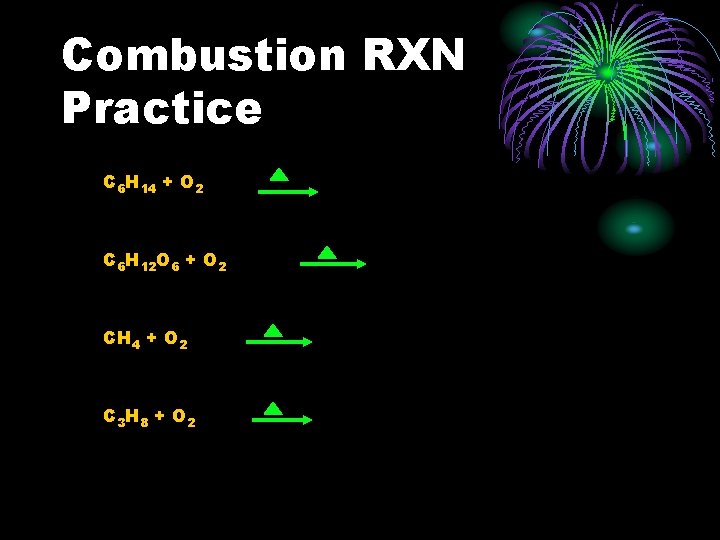
Combustion RXN Practice C 6 H 14 + O 2 C 6 H 12 O 6 + O 2 CH 4 + O 2 C 3 H 8 + O 2
Starting with words, then balancing • Aqueous iron (III) bromide reacts with chlorine gas to form iron (III) chloride and bromine gas. • Write the formulas in the skeleton equation • Then balance - DO NOT change the subscripts once you decide you have the formulas written correctly! • Solutions of barium hydroxide and sulfuric acid (H 2 SO 4) react to yield water and solid barium sulfate.
PART II: PRODUCT PREDICTION & SOLUBILITY
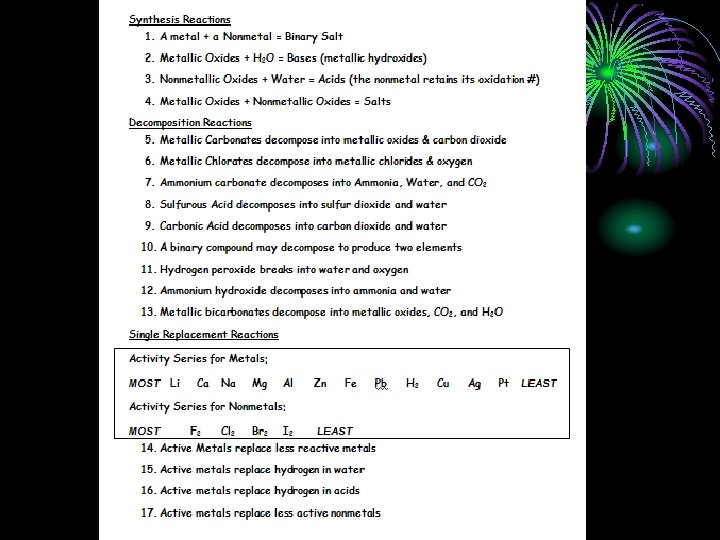
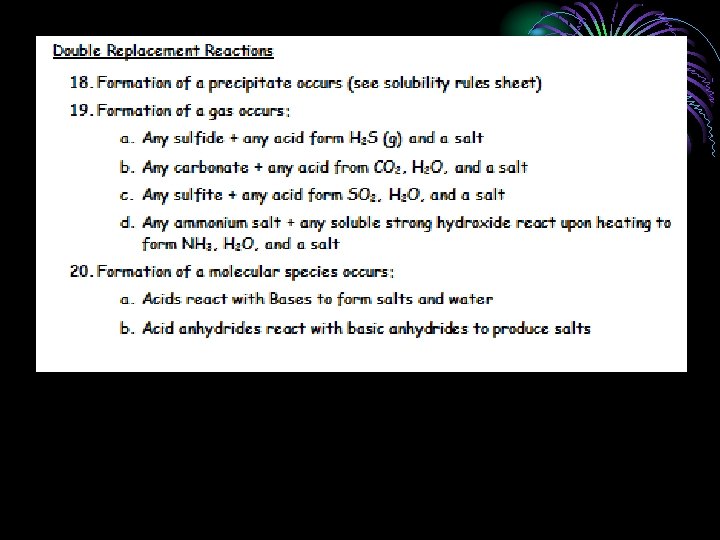
Product Prediction • Depending on the types of reaction we have and the reactants present, we can predict what products will form • You will have access to the following reference on the next quiz!
Predict products for the following synthesis RXNs Ba(s) + S 8(s) Fe(III)(s) + O 2(g) S 8(s) + O 2(g) K(s) + F 2(g) H 2(g) + O 2(g) Mg. O(s) + H 2 O(l)
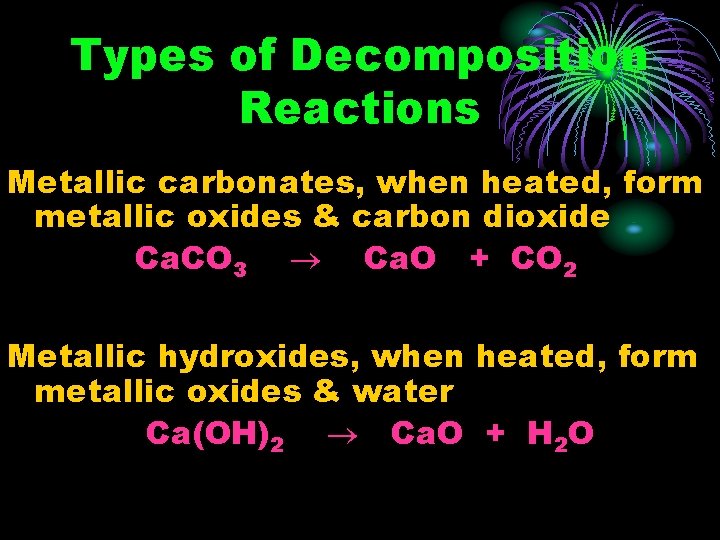
Types of Decomposition Reactions Metallic carbonates, when heated, form metallic oxides & carbon dioxide Ca. CO 3 Ca. O + CO 2 Metallic hydroxides, when heated, form metallic oxides & water Ca(OH)2 Ca. O + H 2 O
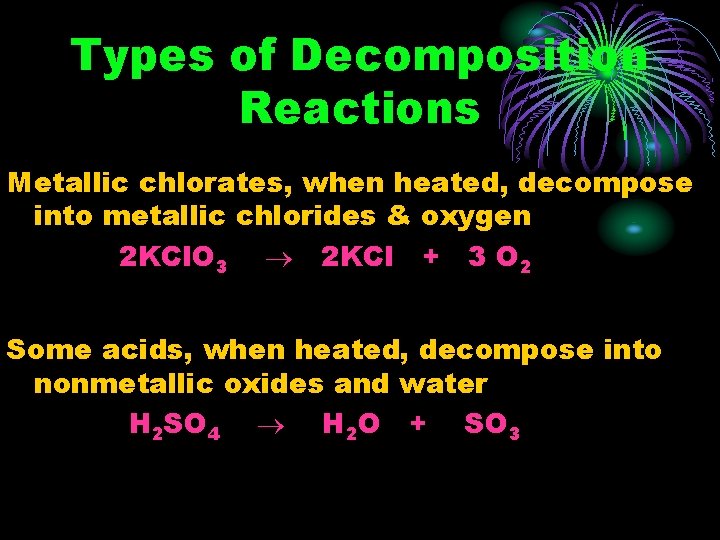
Types of Decomposition Reactions Metallic chlorates, when heated, decompose into metallic chlorides & oxygen 2 KCl. O 3 2 KCl + 3 O 2 Some acids, when heated, decompose into nonmetallic oxides and water H 2 SO 4 H 2 O + SO 3
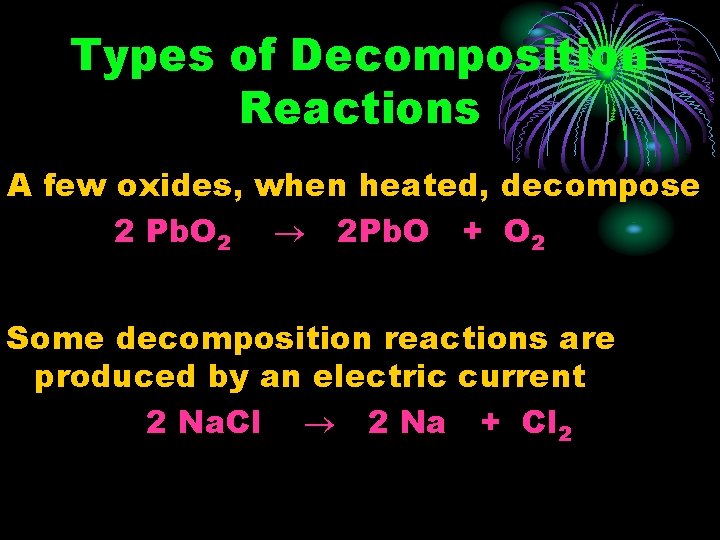
Types of Decomposition Reactions A few oxides, when heated, decompose 2 Pb. O 2 2 Pb. O + O 2 Some decomposition reactions are produced by an electric current 2 Na. Cl 2 Na + Cl 2
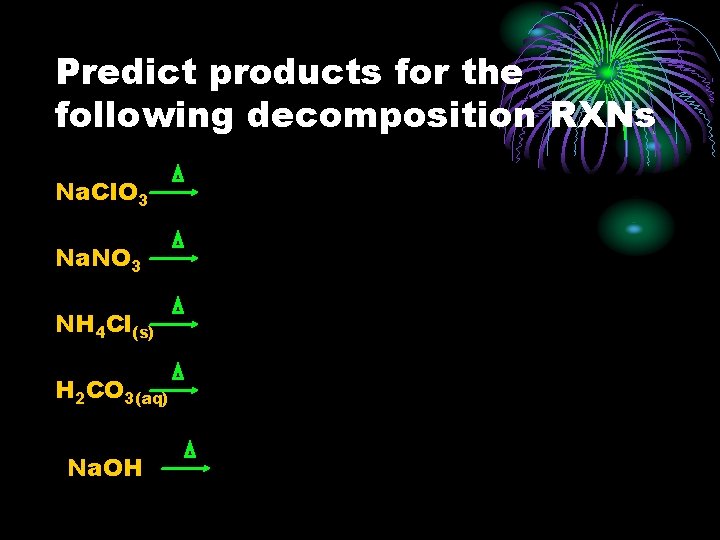
Predict products for the following decomposition RXNs Na. Cl. O 3 Na. NO 3 NH 4 Cl(s) H 2 CO 3(aq) Na. OH
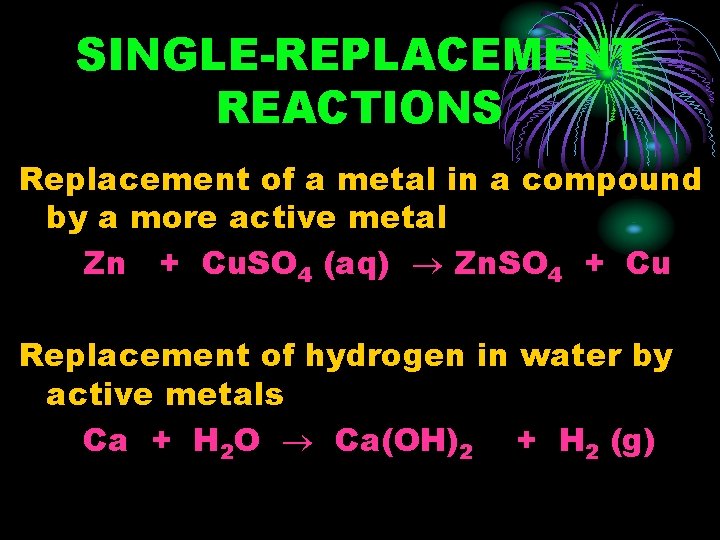
SINGLE-REPLACEMENT REACTIONS Replacement of a metal in a compound by a more active metal Zn + Cu. SO 4 (aq) Zn. SO 4 + Cu Replacement of hydrogen in water by active metals Ca + H 2 O Ca(OH)2 + H 2 (g)
SINGLE-REPLACEMENT REACTIONS Replacement of hydrogen in acids by metals Zn + H 2 SO 4 Zn. SO 4 + H 2 Replacement of halogens by more active halogens Cl 2 + 2 KBr 2 KCl + Br 2
The Activity Series of the Metals Lithium Potassium Calcium Sodium Magnesium Aluminum Zinc Chromium Iron Nickel Lead Hydrogen Bismuth Copper Mercury Silver Platinum Gold Metals can replace other metals provided that they are above the metal that they are trying to replace. Metals above hydrogen can replace hydrogen in acids.
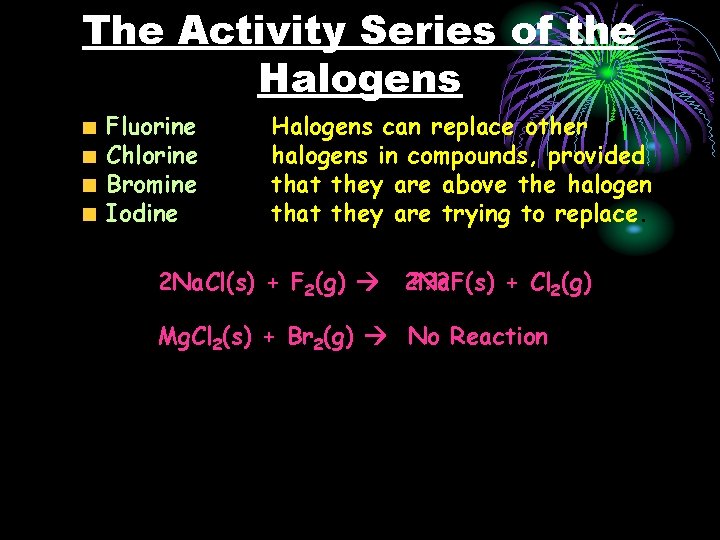
The Activity Series of the Halogens Fluorine Chlorine Bromine Iodine Halogens can replace other halogens in compounds, provided that they are above the halogen that they are trying to replace. 2 Na. Cl(s) + F 2(g) 2 Na. F(s) ? ? ? + Cl 2(g) Mg. Cl 2(s) + Br 2(g) No ? ? ? Reaction
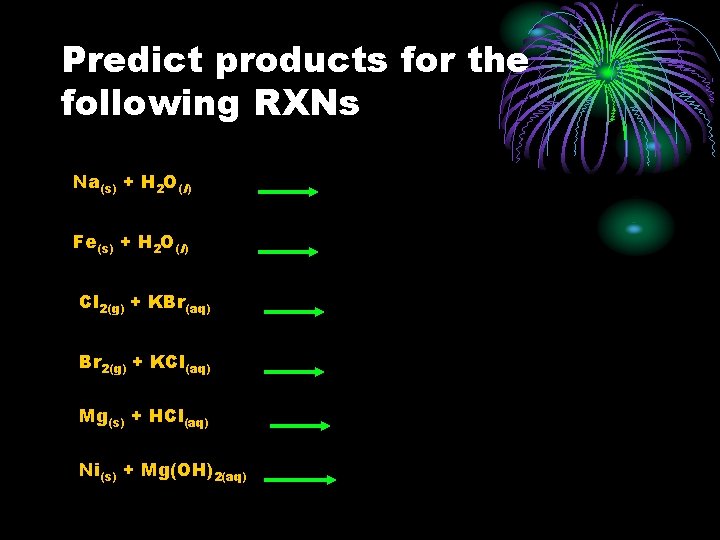
Predict products for the following RXNs Na(s) + H 2 O(l) Fe(s) + H 2 O(l) Cl 2(g) + KBr(aq) Br 2(g) + KCl(aq) Mg(s) + HCl(aq) Ni(s) + Mg(OH)2(aq)
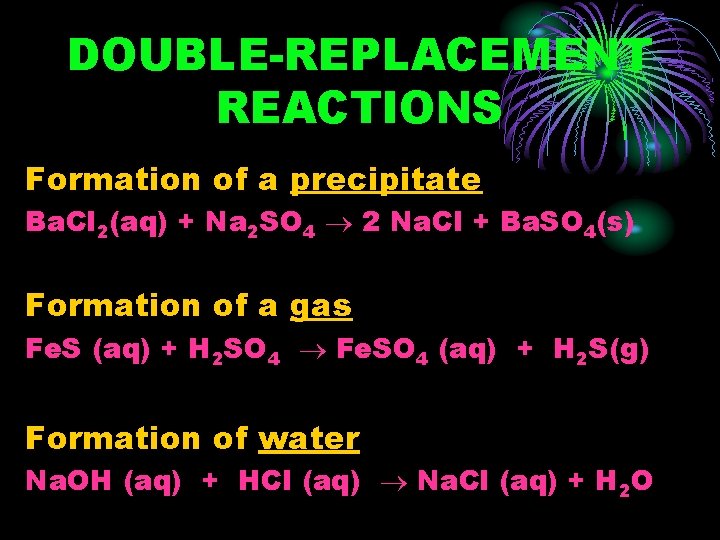
DOUBLE-REPLACEMENT REACTIONS Formation of a precipitate Ba. Cl 2(aq) + Na 2 SO 4 2 Na. Cl + Ba. SO 4(s) Formation of a gas Fe. S (aq) + H 2 SO 4 Fe. SO 4 (aq) + H 2 S(g) Formation of water Na. OH (aq) + HCl (aq) Na. Cl (aq) + H 2 O
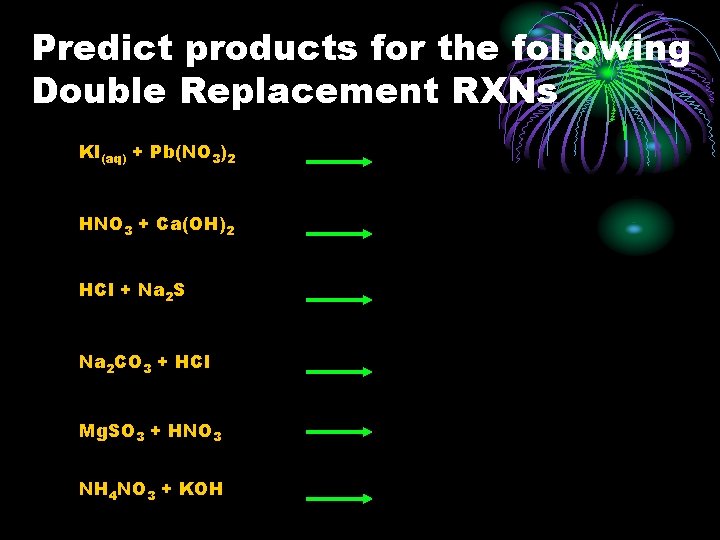
Predict products for the following Double Replacement RXNs KI(aq) + Pb(NO 3)2 HNO 3 + Ca(OH)2 HCl + Na 2 S Na 2 CO 3 + HCl Mg. SO 3 + HNO 3 NH 4 NO 3 + KOH
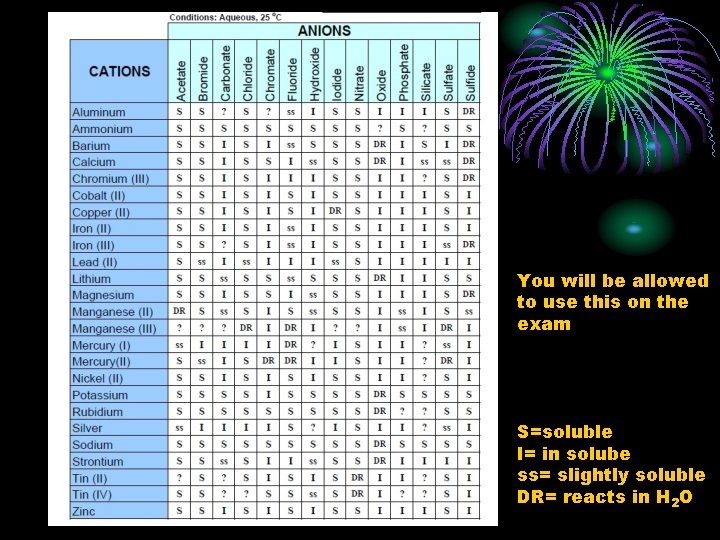
Solubility • If a reaction forms a precipitate, it is because a produce is INSOLUBLE • You need to be able to read a solubility chart to see if certain compounds are soluble or insoluble and predict if precipitation occurs • It helps to be generally aware of basic solubility rules to help speed up the time it takes to solve problems
You will be allowed to use this on the exam S=soluble I= in solube ss= slightly soluble DR= reacts in H 2 O
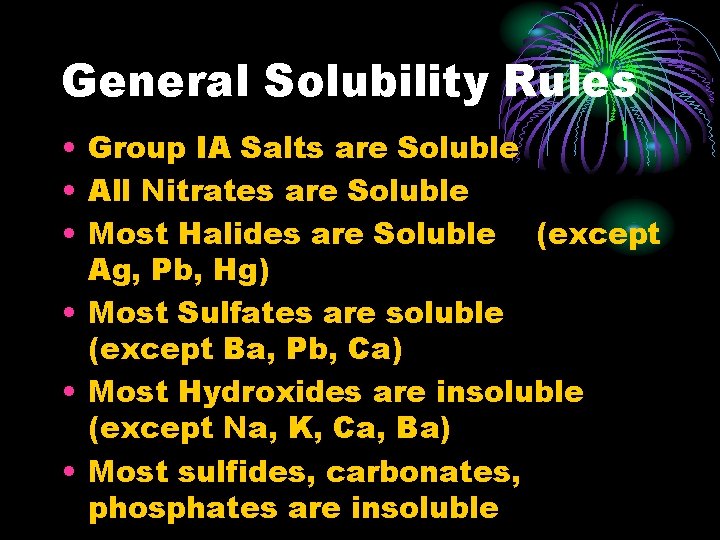
General Solubility Rules • Group IA Salts are Soluble • All Nitrates are Soluble • Most Halides are Soluble (except Ag, Pb, Hg) • Most Sulfates are soluble (except Ba, Pb, Ca) • Most Hydroxides are insoluble (except Na, K, Ca, Ba) • Most sulfides, carbonates, phosphates are insoluble
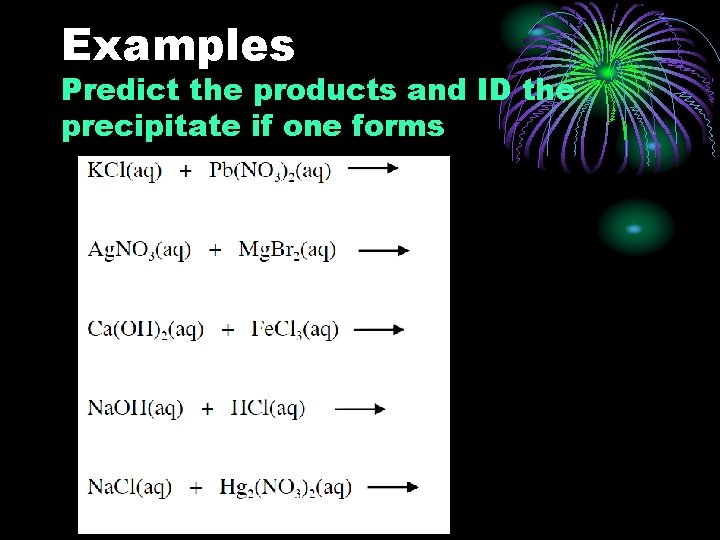
Examples Predict the products and ID the precipitate if one forms