
Chemical Bonds Reactions WORD SPLASH Product Bond Reactant
Chemical Bonds & Reactions
WORD SPLASH �Product �Bond �Reactant �Stable �Yields �Synthesis �Equation � Decomposition �Subscript � Compound �Catalyst �Element �Ionic �Covalent � Replacement �Write a story using the words on the list �Underline each word used �Circle words you’ve never heard in RED �Circle words you’re familiar with but unsure of in YELLOW �Circle words you know well in GREEN
BONDING �Valence Electrons - all the electrons on the outer-most energy level (ROMAN NUMERAL) �Dot Diagram
BONDING �Chemical Bond – a force that holds two or more atoms together when their outermost energy levels become filled by each other. �Creates a chemical reaction
�Stable – when all of an atom’s energy levels are filled and it can no longer react �Stable atoms become charged �Unstable atoms have empty spaces on their energy levels and have no charge because their e- balance out with p+
How Do Atoms Bond? ? �Ionic Bond – when an atom becomes stable by giving or taking (exchanging) electrons from another atom. �Ion- an atom that has gained or lost electrons and has a charge
�Cation –gives away e-, has a positive charge � clue to remember (ca+ion) �Anion- takes e-, has a negative charge � clue to remember (/-nion) �Ions with opposite charges bond together – opposites attract
�An atom’s charge is neutral if its p+ and e- are balanced �Atoms are usually unstable if they are neutral (except column VIII)
�Covalent Bond – when 2 atoms fill their outer energy levels by SHARING a pair of electrons �Both atoms keep their electrons on the outer ring �Charge doesn’t change, atoms stay neutral AND become stable
Ionic Covalent
Chemical Formulas �Chemical Formula- a way to write the name of bonded atoms (compounds) �Ex. Na. Cl: uses Chemical Symbols �Compound - ___________
Chemical Formulas �Chemical formulas show many of each atom are in the compound �Subscript- a number written to the lower right of a chemical symbol in the chemical formula �DO NOT WRITE ONE (1)! �Ex. H 2 O, Na. Cl, C 6 H 12 O 6
Chemical Reactions �Chemical Reaction- when new substances are created from chemical bonds being formed or broken �These new substances have new properties and are often compounds! �Two parts: �Reactants – what you start with (what reacts) �Products – what you end with (what is created)
�Conservation of Matter - matter can’t be created or destroyed in a reaction �The items and the amount of items you start with MUST be the same as what you end with �LIKE BAKING A CAKE �Catalyst – changes how reactions happen, doesn’t actually react �Speed up or slow down
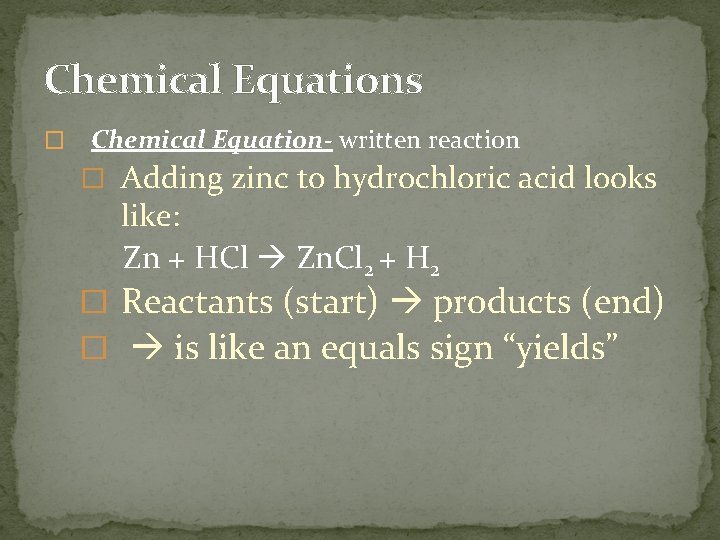
Chemical Equations � Chemical Equation- written reaction � Adding zinc to hydrochloric acid looks like: Zn + HCl Zn. Cl 2 + H 2 � Reactants (start) products (end) � is like an equals sign “yields”
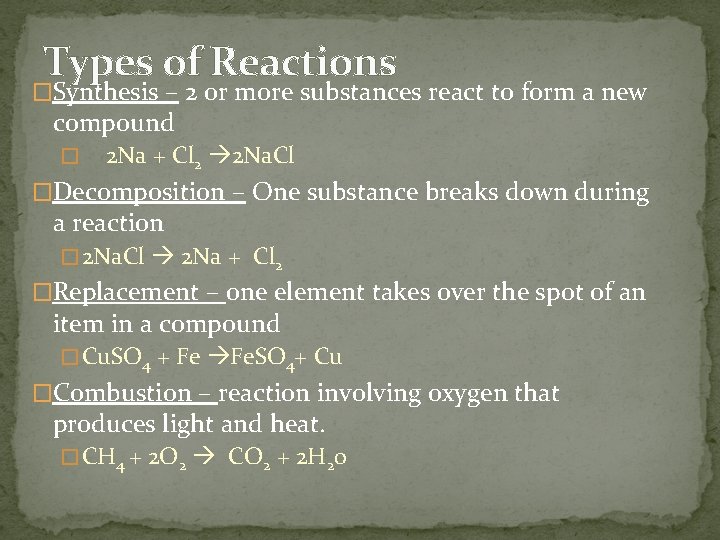
Types of Reactions �Synthesis – 2 or more substances react to form a new compound � 2 Na + Cl 2 2 Na. Cl �Decomposition – One substance breaks down during a reaction � 2 Na. Cl 2 Na + Cl 2 �Replacement – one element takes over the spot of an item in a compound � Cu. SO 4 + Fe Fe. SO 4+ Cu �Combustion – reaction involving oxygen that produces light and heat. � CH 4 + 2 O 2 CO 2 + 2 H 20
- Slides: 16