
Chemical Bonding Valence Bond Theory in a nutshell
Chemical Bonding: Valence Bond Theory “in a nutshell” Chapter 10 Section 4 through 6 of Jespersen 6 th Ed) Dr. C. Yau Spring 2014 1
VSEPR Theory • You had previously learned how to predict the molecular geometry of a species from examining its Lewis structure. • It utilizes the concept of repulsion amongst the charge clouds of the central atoms. • This was the Valence Shell Electron Pair Repulsion Theory (VSEPR Theory). • It does not explain how a bond is formed and how bonding relates to the s, p, d orbitals. 2

Valence Bond Theory (VB Theory) The VB Theory explains bonding as an overlap of valence orbitals. H 2 bonds are due to the overlap of their 1 s valence orbitals. 1 s 1 s A B 2 separate H atoms H 2 molecule with covalent bond due to overlap of the 1 s orbitals. 3

Hybridization in VB Theory • Atomic orbitals are mixed to allow formation of bonds that have realistic bond angles • The newly mixed orbitals that result are called “hybrid orbitals” with specified shapes: Review: # charge clouds 2 3 4 5 6 Hybridization Bond Angles sp sp 2 sp 3 d 2 180 o 120 o 109. 5 o 120 o & 90 o & 180 o 4
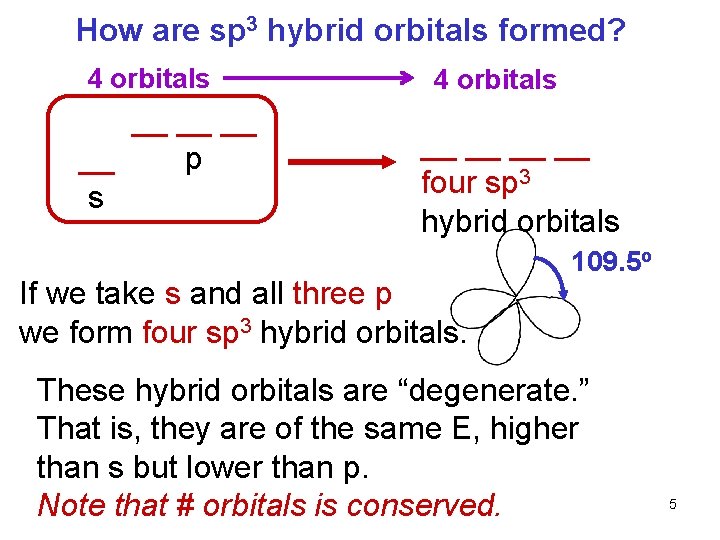
How are sp 3 hybrid orbitals formed? 4 orbitals __ __ p s 4 orbitals __ __ four sp 3 hybrid orbitals If we take s and all three p we form four sp 3 hybrid orbitals. 109. 5 o These hybrid orbitals are “degenerate. ” That is, they are of the same E, higher than s but lower than p. Note that # orbitals is conserved. 5

How are sp 2 hybrid orbitals formed? __ __ p s __ __ p three sp 2 hybrid orbitals p If we take s and just two p orbitals, we form three sp 2 hybrid orbitals leaving one pure p untouched. sp 2 These three sp 2 hybrid orbitals are planar with angles of 120 o. The un-hybridized p (pure p) are used in double and triple bonds. 6
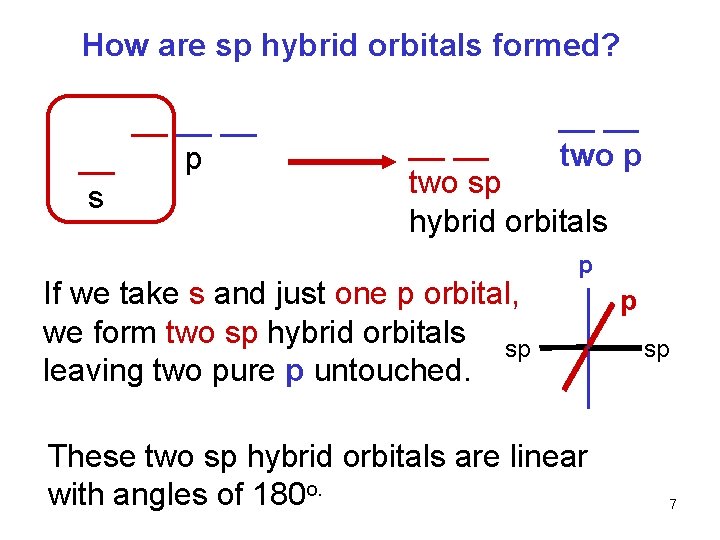
How are sp hybrid orbitals formed? __ __ p s __ __ two p __ __ two sp hybrid orbitals If we take s and just one p orbital, we form two sp hybrid orbitals sp leaving two pure p untouched. p These two sp hybrid orbitals are linear with angles of 180 o. p sp 7
Hybrid Orbitals Involving d-Orbitals Hybrids from one s and three p can only make a maximum of 4 hybrid orbitals. When we run out of p orbitals, we start using d orbitals. Thus we have sp 3 d hybrid orbitals and sp 3 d 2 hybrid orbitals (but only for elements larger than Ne, beyond Period 2). Remember that elements smaller than Ne do not have d-orbitals and therefore cannot have sp 3 d and sp 3 d 2 hybrids. 8
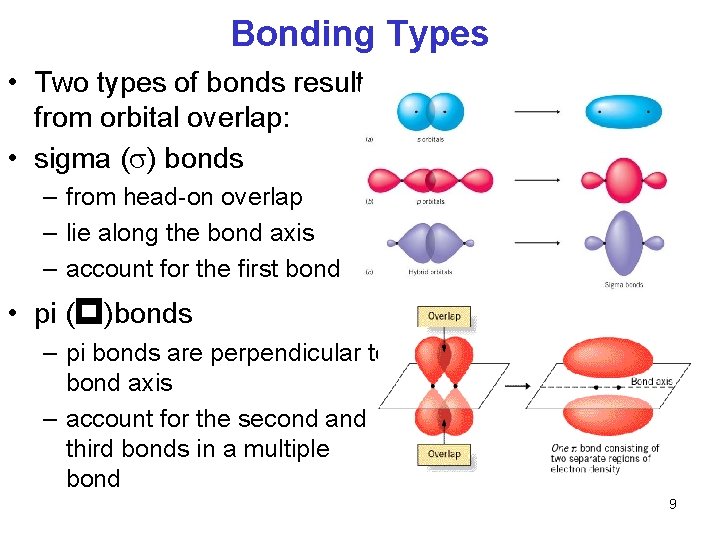
Bonding Types • Two types of bonds result from orbital overlap: • sigma ( ) bonds – from head-on overlap – lie along the bond axis – account for the first bond • pi ( )bonds – pi bonds are perpendicular to bond axis – account for the second and third bonds in a multiple bond 9
Sigma and Pi Bonding Given the structural formula of a compound, be able to specify the hybridization of each atom, state the bond angles and determine the # of sigma and pi bonds. 10
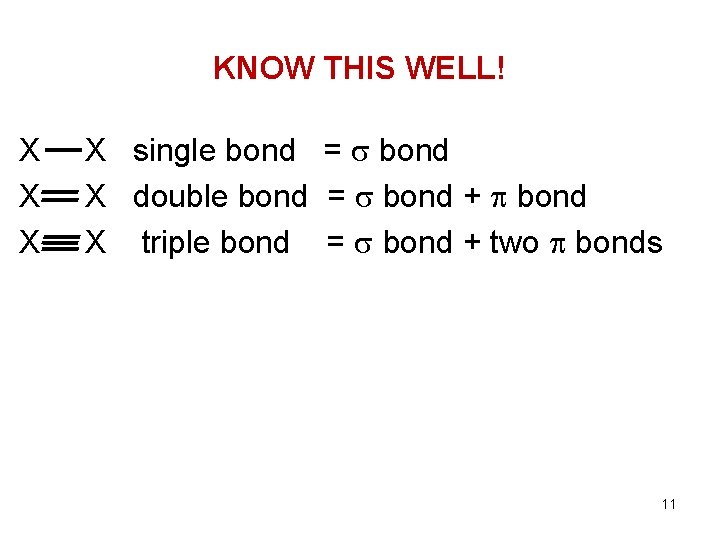
KNOW THIS WELL! X X single bond = bond X double bond = bond + bond X triple bond = bond + two bonds 11
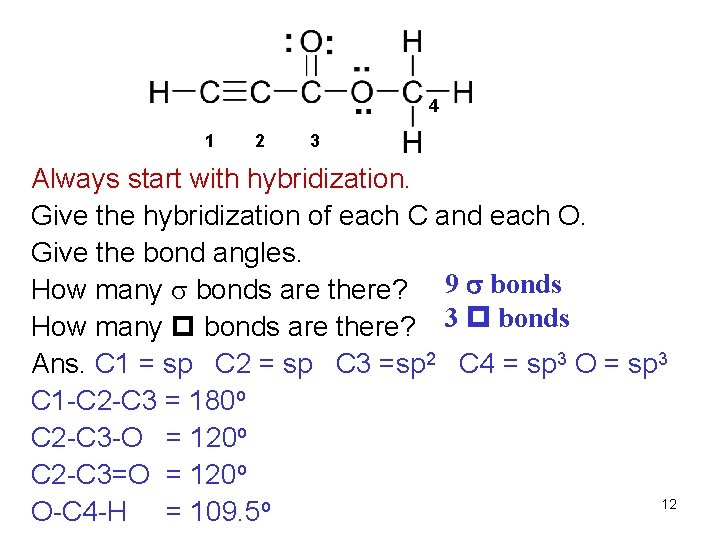
4 1 2 3 Always start with hybridization. Give the hybridization of each C and each O. Give the bond angles. How many bonds are there? 9 bonds How many bonds are there? 3 bonds Ans. C 1 = sp C 2 = sp C 3 =sp 2 C 4 = sp 3 O = sp 3 C 1 -C 2 -C 3 = 180 o C 2 -C 3 -O = 120 o C 2 -C 3=O = 120 o 12 O-C 4 -H = 109. 5 o
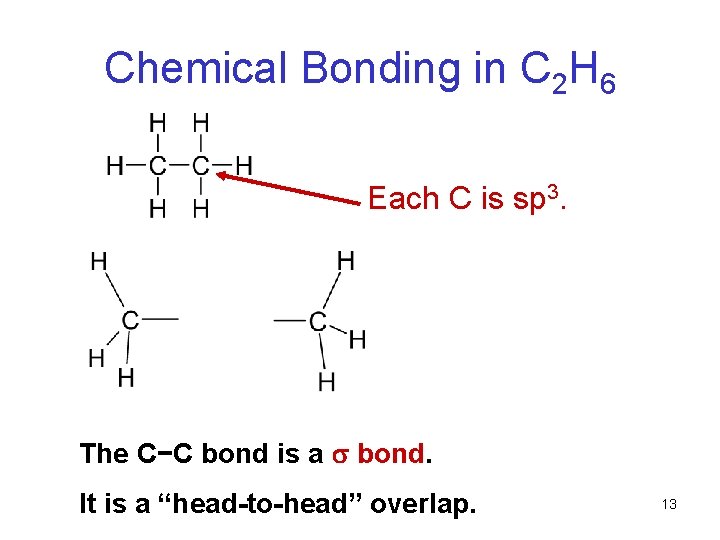
Chemical Bonding in C 2 H 6 Each C is sp 3. The C−C bond is a bond. It is a “head-to-head” overlap. 13
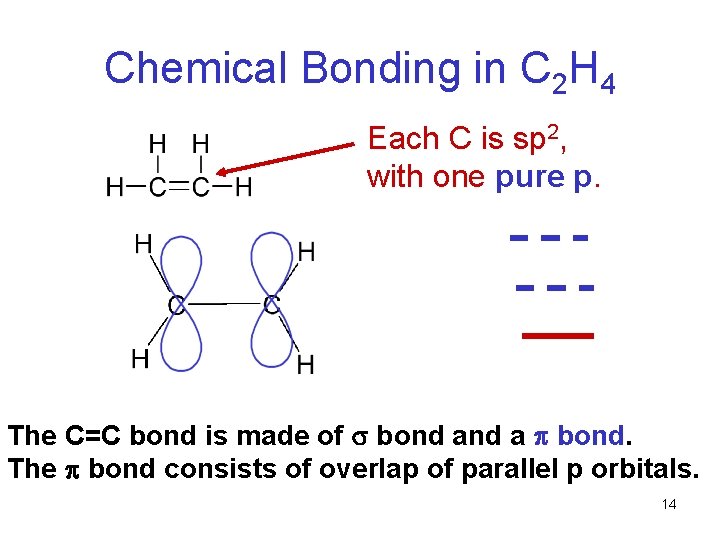
Chemical Bonding in C 2 H 4 Each C is sp 2, with one pure p. The C=C bond is made of bond a bond. The bond consists of overlap of parallel p orbitals. 14
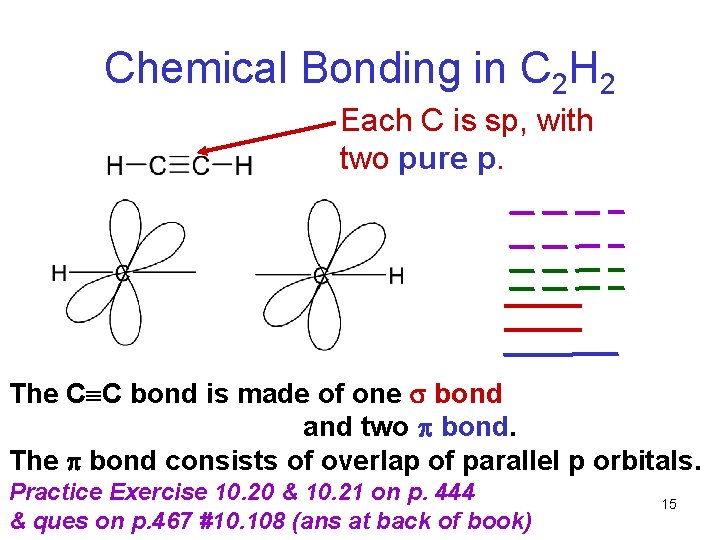
Chemical Bonding in C 2 H 2 Each C is sp, with two pure p. The C C bond is made of one bond and two bond. The bond consists of overlap of parallel p orbitals. Practice Exercise 10. 20 & 10. 21 on p. 444 & ques on p. 467 #10. 108 (ans at back of book) 15
- Slides: 15