
Chemical Bonding Naming Drawing the bond Chapter 13
Chemical Bonding – Naming & Drawing the bond Chapter 13: part 2
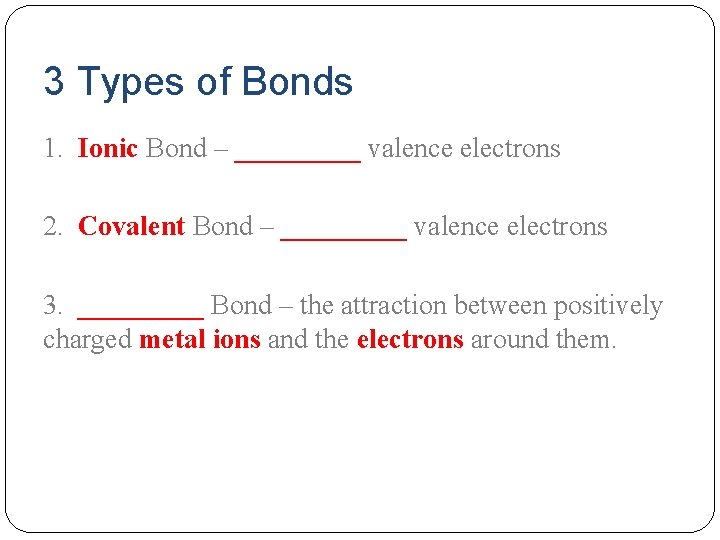
3 Types of Bonds 1. Ionic Bond – _____ valence electrons 2. Covalent Bond – _____ valence electrons 3. _____ Bond – the attraction between positively charged metal ions and the electrons around them.
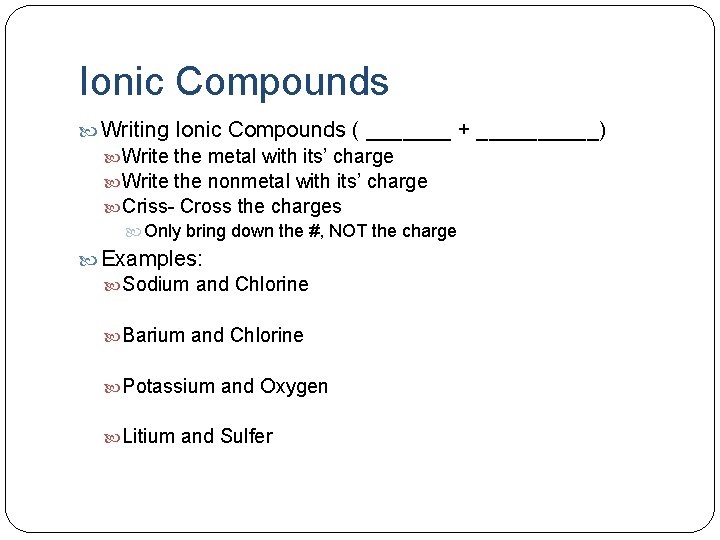
Ionic Compounds Writing Ionic Compounds ( _______ + _____) Write the metal with its’ charge Write the nonmetal with its’ charge Criss- Cross the charges Only bring down the #, NOT the charge Examples: Sodium and Chlorine Barium and Chlorine Potassium and Oxygen Litium and Sulfer
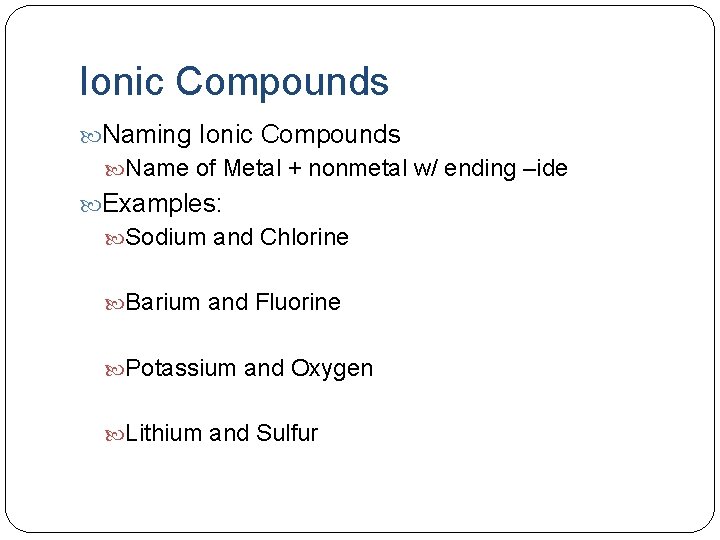
Ionic Compounds Naming Ionic Compounds Name of Metal + nonmetal w/ ending –ide Examples: Sodium and Chlorine Barium and Fluorine Potassium and Oxygen Lithium and Sulfur
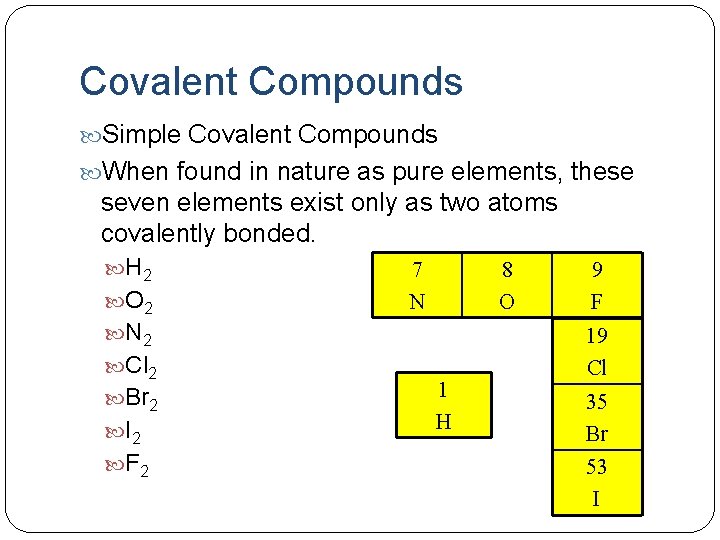
Covalent Compounds Simple Covalent Compounds When found in nature as pure elements, these seven elements exist only as two atoms covalently bonded. H 2 O 2 7 N 8 O N 2 Cl 2 Br 2 I 2 F 2 1 H 9 F 19 Cl 35 Br 53 I

Covalent Compounds How to draw covalent molecules: using electron dot diagrams 1. Write the symbol of the element and place one dot around the symbol for every valence electron in the atom. Examples: Carbon Oxygen Krypton Hydrogen
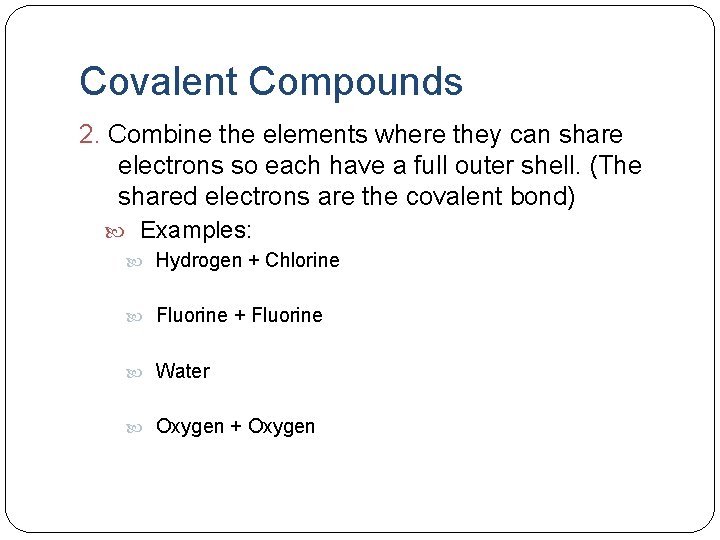
Covalent Compounds 2. Combine the elements where they can share electrons so each have a full outer shell. (The shared electrons are the covalent bond) Examples: Hydrogen + Chlorine Fluorine + Fluorine Water Oxygen + Oxygen
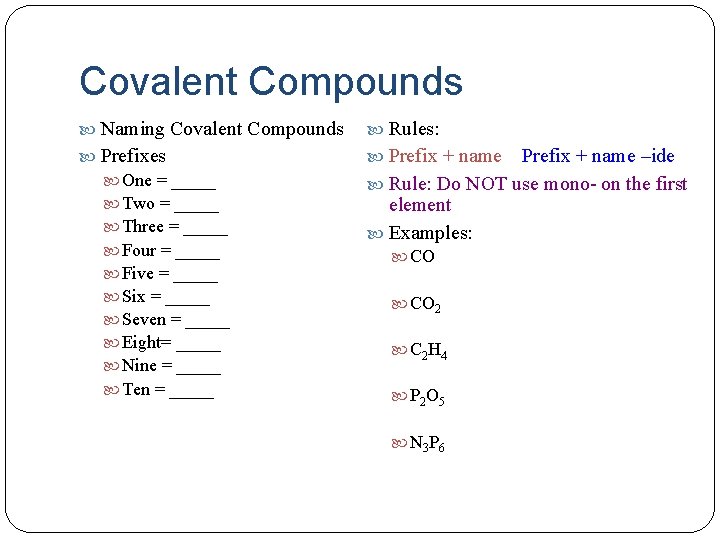
Covalent Compounds Naming Covalent Compounds Rules: Prefixes One = _____ Two = _____ Three = _____ Four = _____ Five = _____ Six = _____ Seven = _____ Eight= _____ Nine = _____ Ten = _____ Prefix + name –ide Rule: Do NOT use mono- on the first element Examples: CO 2 C 2 H 4 P 2 O 5 N 3 P 6
- Slides: 8