
CHEMICAL BONDING Cocaine 1 Chemistry I Chapter 16

CHEMICAL BONDING Cocaine 1 Chemistry I – Chapter 16
Chemical Bonding Problems and questions — How is a molecule or polyatomic ion held together? Why are atoms distributed at strange angles? Why are molecules not flat? Can we predict the structure? How is structure related to chemical and physical properties? 2
Review of Chemical Bonds Most bonds are somewhere in between ionic and covalent. 3 We discussed 2 kinds of bonding: Ionic • _____ —complete transfer of 1 or more electrons from one atom to another (one loses, the other gains) forming oppositely charged ions that attract one another Covalent —some valence • _____ electrons shared between atoms
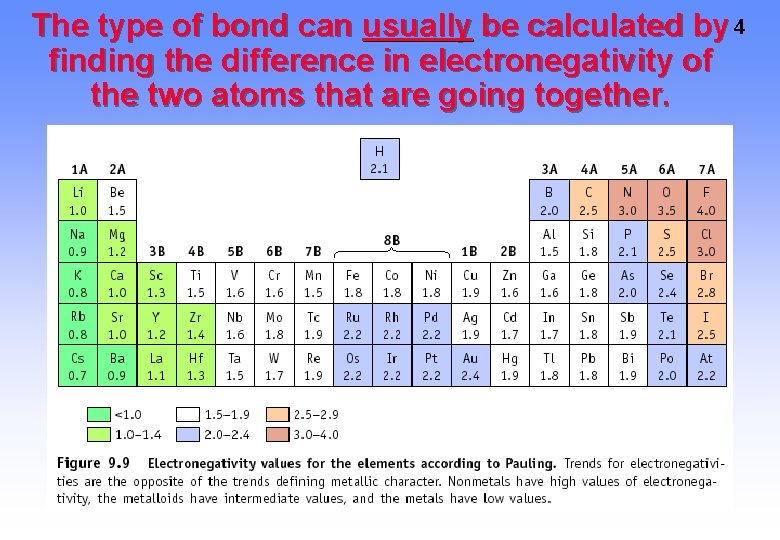
The type of bond can usually be calculated by 4 finding the difference in electronegativity of the two atoms that are going together.
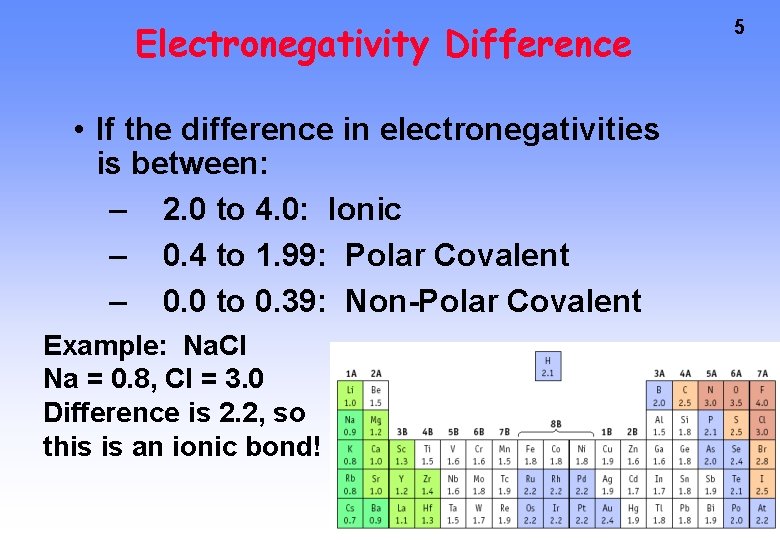
Electronegativity Difference • If the difference in electronegativities is between: – 2. 0 to 4. 0: Ionic – 0. 4 to 1. 99: Polar Covalent – 0. 0 to 0. 39: Non-Polar Covalent Example: Na. Cl Na = 0. 8, Cl = 3. 0 Difference is 2. 2, so this is an ionic bond! 5
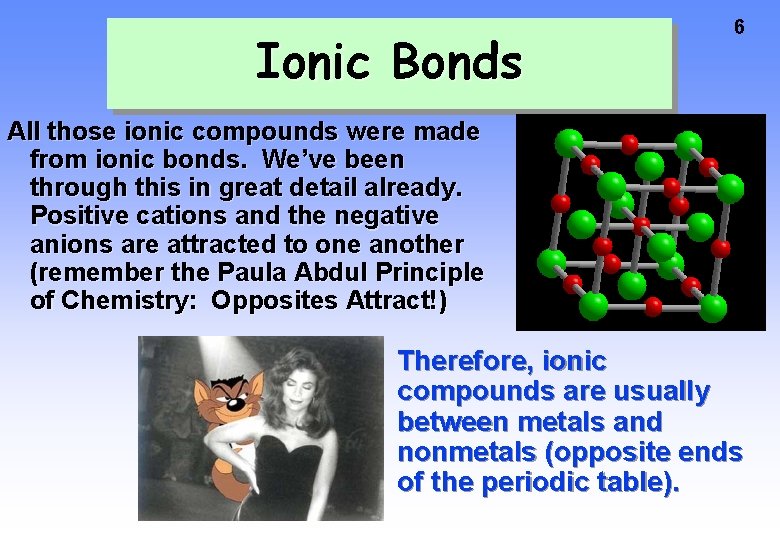
Ionic Bonds 6 All those ionic compounds were made from ionic bonds. We’ve been through this in great detail already. Positive cations and the negative anions are attracted to one another (remember the Paula Abdul Principle of Chemistry: Opposites Attract!) Therefore, ionic compounds are usually between metals and nonmetals (opposite ends of the periodic table).
7 Electron Distribution in Molecules G. N. Lewis 1875 - 1946 • Electron distribution is depicted with Lewis (electron dot) structures • This is how you decide how many atoms will bond covalently! (In ionic bonds, it was decided with charges)
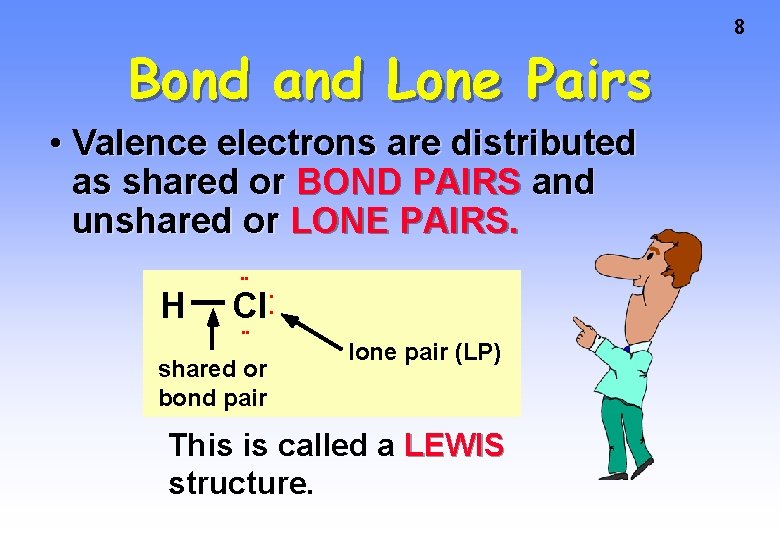
Bond and Lone Pairs • Valence electrons are distributed as shared or BOND PAIRS and unshared or LONE PAIRS. • • H Cl • • shared or bond pair • • lone pair (LP) This is called a LEWIS structure. 8
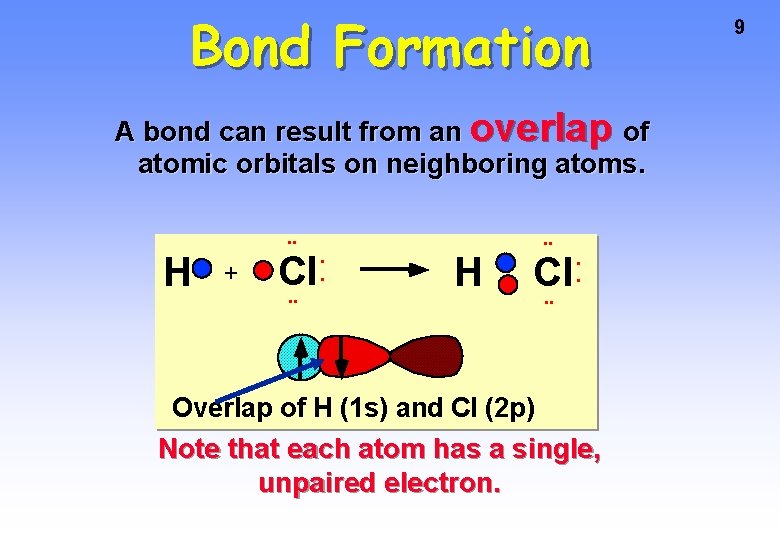
Bond Formation A bond can result from an overlap of atomic orbitals on neighboring atoms. • • H + Cl • • • • H • • Cl • • • • Overlap of H (1 s) and Cl (2 p) Note that each atom has a single, unpaired electron. 9
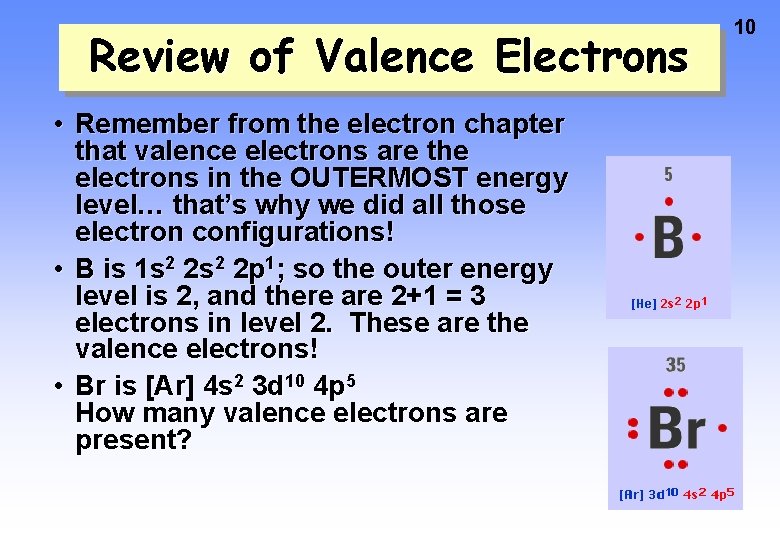
Review of Valence Electrons • Remember from the electron chapter that valence electrons are the electrons in the OUTERMOST energy level… that’s why we did all those electron configurations! • B is 1 s 2 2 p 1; so the outer energy level is 2, and there are 2+1 = 3 electrons in level 2. These are the valence electrons! • Br is [Ar] 4 s 2 3 d 10 4 p 5 How many valence electrons are present? 10
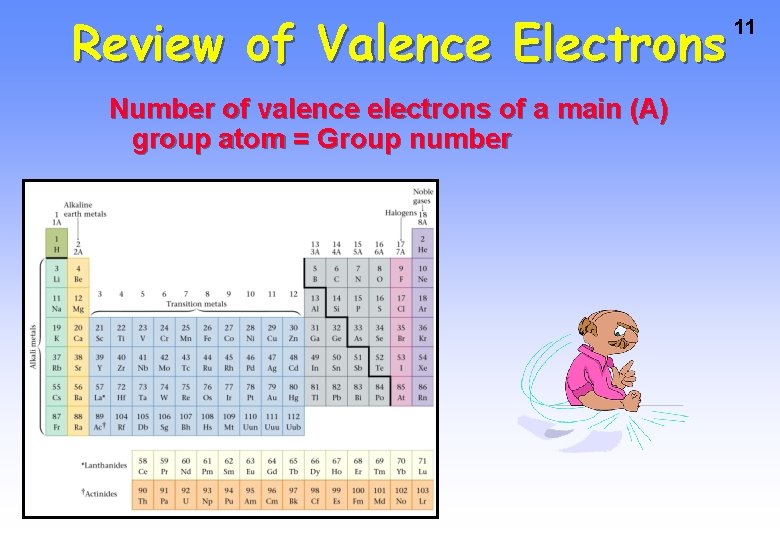
Review of Valence Electrons Number of valence electrons of a main (A) group atom = Group number 11
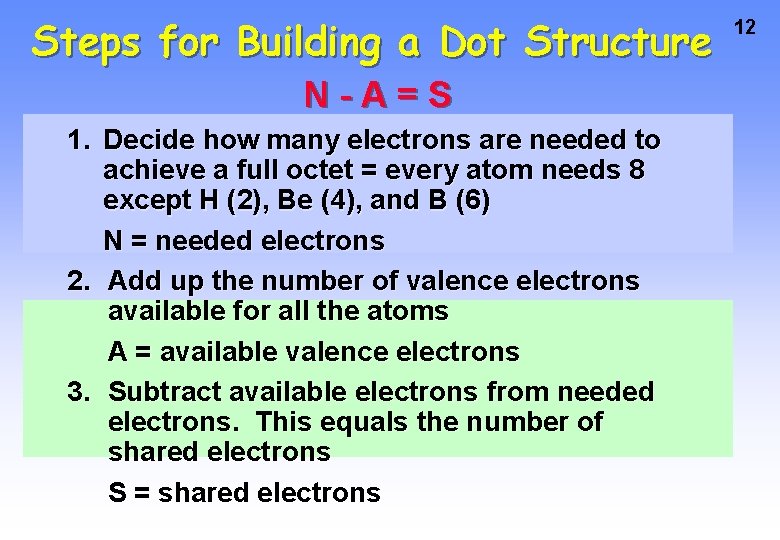
Steps for Building a Dot Structure N-A=S 1. Decide how many electrons are needed to achieve a full octet = every atom needs 8 except H (2), Be (4), and B (6) N = needed electrons 2. Add up the number of valence electrons available for all the atoms A = available valence electrons 3. Subtract available electrons from needed electrons. This equals the number of shared electrons S = shared electrons 12
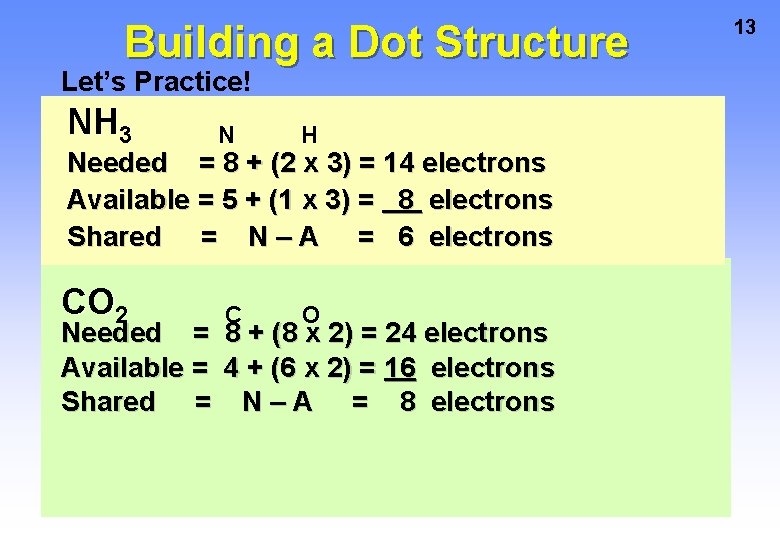
Building a Dot Structure Let’s Practice! NH 3 N H Needed = 8 + (2 x 3) = 14 electrons Available = 5 + (1 x 3) = 8 electrons Shared = N – A = 6 electrons CO 2 C O Needed = 8 + (8 x 2) = 24 electrons Available = 4 + (6 x 2) = 16 electrons Shared = N – A = 8 electrons 13
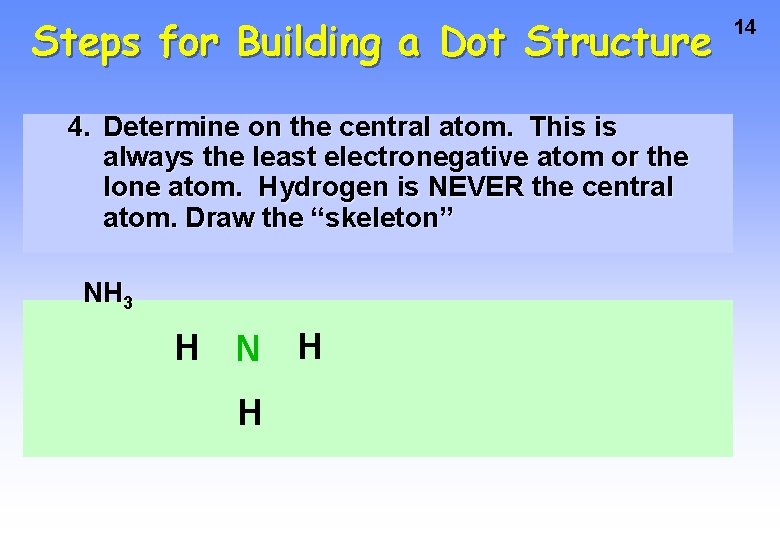
Steps for Building a Dot Structure 4. Determine on the central atom. This is always the least electronegative atom or the lone atom. Hydrogen is NEVER the central atom. Draw the “skeleton” NH 3 H N H H 14
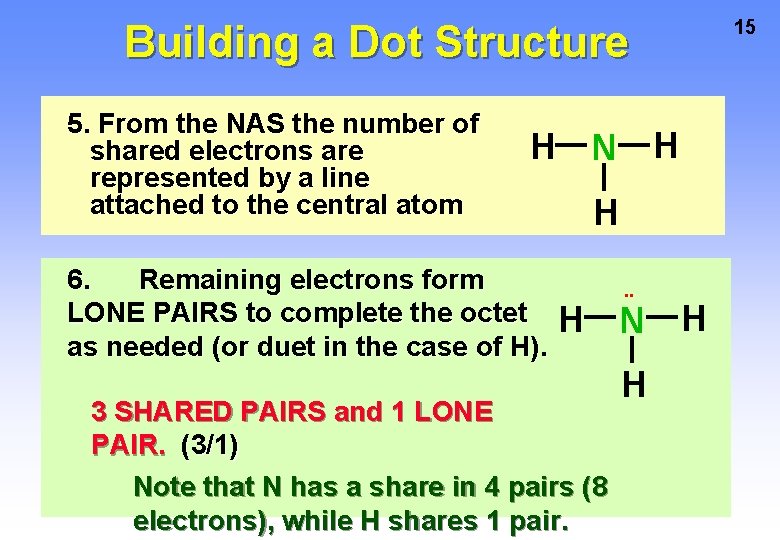
Building a Dot Structure 5. From the NAS the number of shared electrons are represented by a line attached to the central atom H N H 6. Remaining electrons form LONE PAIRS to complete the octet as needed (or duet in the case of H). H • • H N H 3 SHARED PAIRS and 1 LONE PAIR. (3/1) Note that N has a share in 4 pairs (8 electrons), while H shares 1 pair. H 15
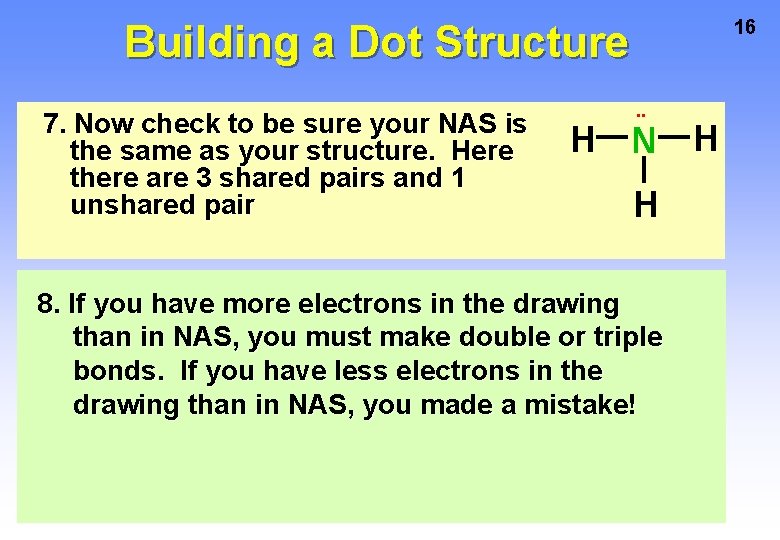
16 Building a Dot Structure 7. Now check to be sure your NAS is the same as your structure. Here there are 3 shared pairs and 1 unshared pair • • H N H H 8. If you have more electrons in the drawing than in NAS, you must make double or triple bonds. If you have less electrons in the drawing than in NAS, you made a mistake!
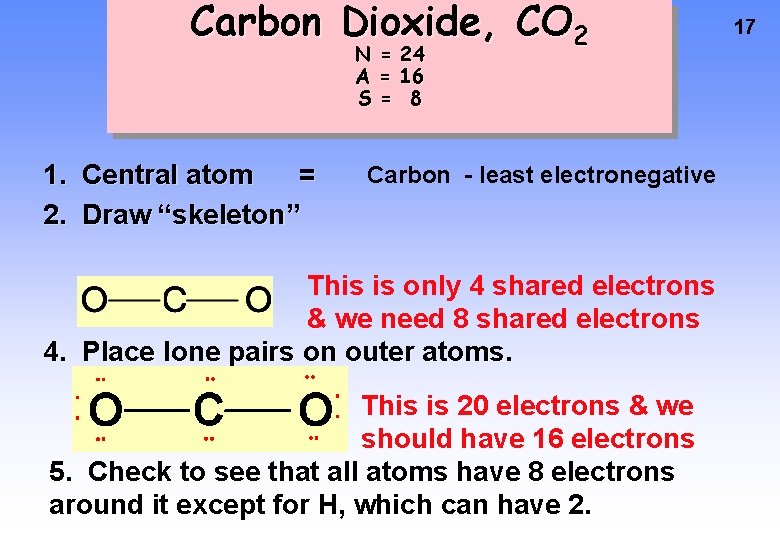
Carbon Dioxide, CO 2 N A S 1. Central atom = 2. Draw “skeleton” = = = 24 16 8 Carbon - least electronegative This is only 4 shared electrons & we need 8 shared electrons 4. Place lone pairs on outer atoms. This is 20 electrons & we should have 16 electrons 5. Check to see that all atoms have 8 electrons around it except for H, which can have 2. 17
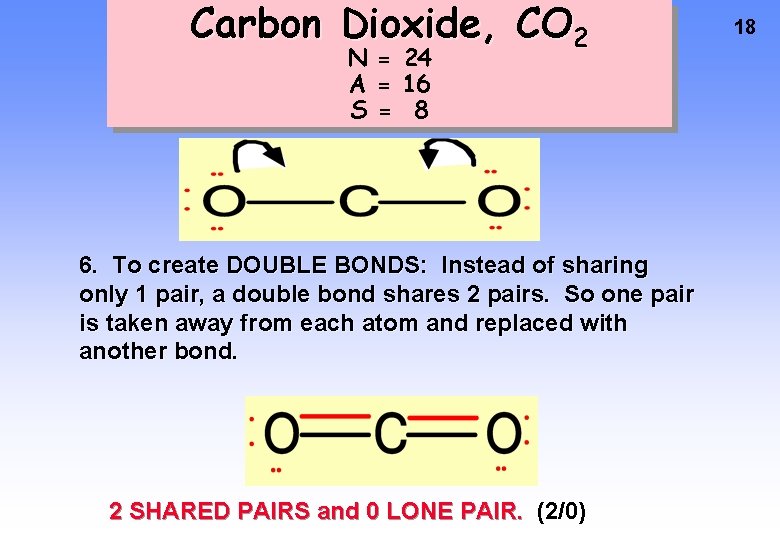
Carbon Dioxide, CO 2 N = 24 A = 16 S = 8 6. To create DOUBLE BONDS: Instead of sharing only 1 pair, a double bond shares 2 pairs. So one pair is taken away from each atom and replaced with another bond. 2 SHARED PAIRS and 0 LONE PAIR. (2/0) 18
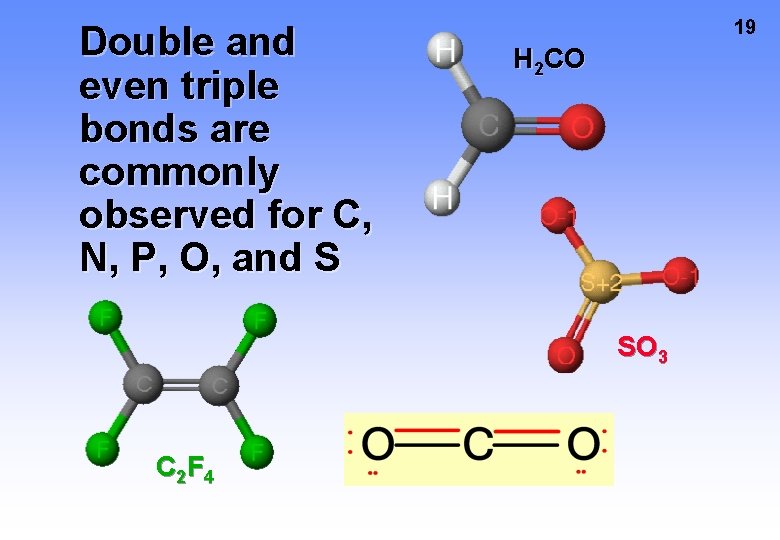
Double and even triple bonds are commonly observed for C, N, P, O, and S 19 H 2 CO SO 3 C 2 F 4
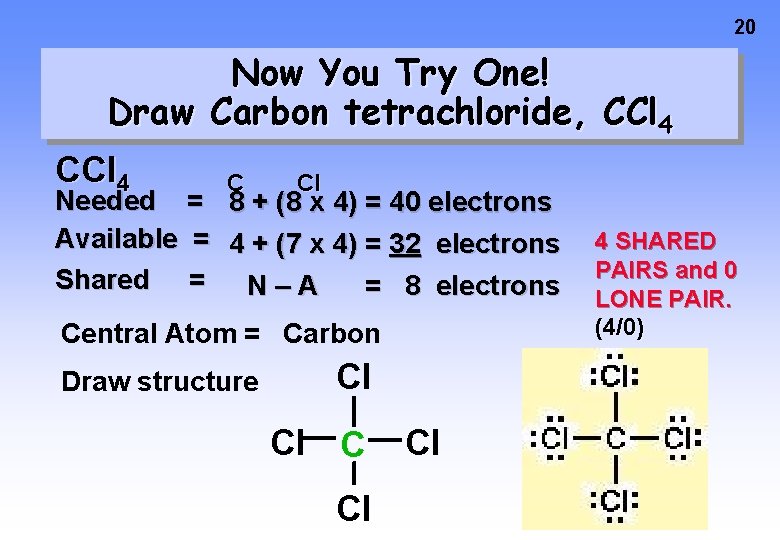
20 Now You Try One! Draw Carbon tetrachloride, CCl 4 C Cl Needed = 8 + (8 x 4) = 40 electrons Available = 4 + (7 x 4) = 32 electrons Shared = N–A = 8 electrons Central Atom = Carbon Draw structure Cl Cl Cl 4 SHARED PAIRS and 0 LONE PAIR. (4/0)
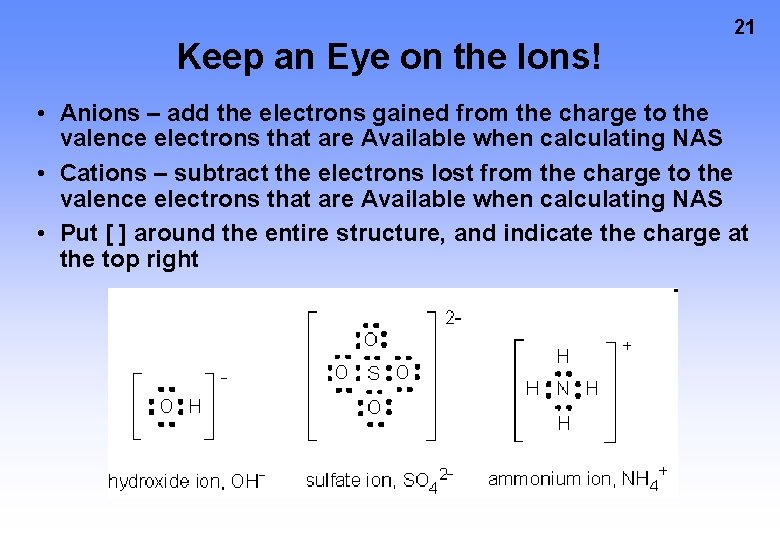
Keep an Eye on the Ions! 21 • Anions – add the electrons gained from the charge to the valence electrons that are Available when calculating NAS • Cations – subtract the electrons lost from the charge to the valence electrons that are Available when calculating NAS • Put [ ] around the entire structure, and indicate the charge at the top right
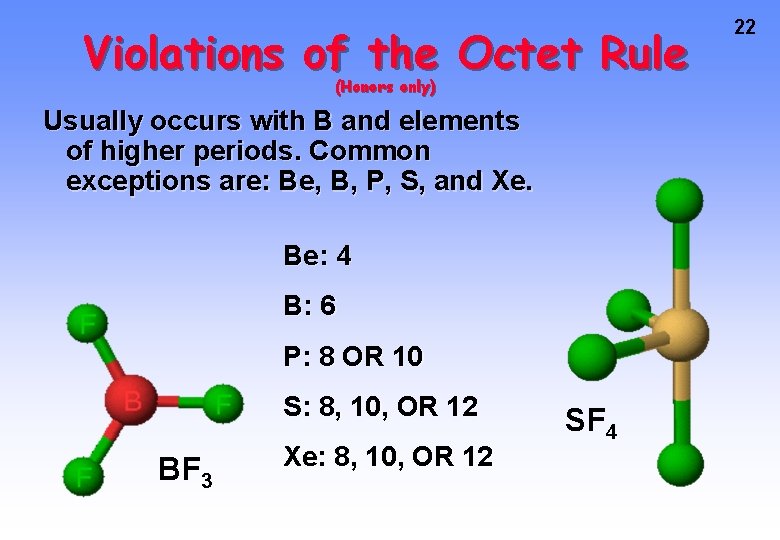
Violations of the Octet Rule (Honors only) Usually occurs with B and elements of higher periods. Common exceptions are: Be, B, P, S, and Xe. Be: 4 B: 6 P: 8 OR 10 S: 8, 10, OR 12 BF 3 Xe: 8, 10, OR 12 SF 4 22
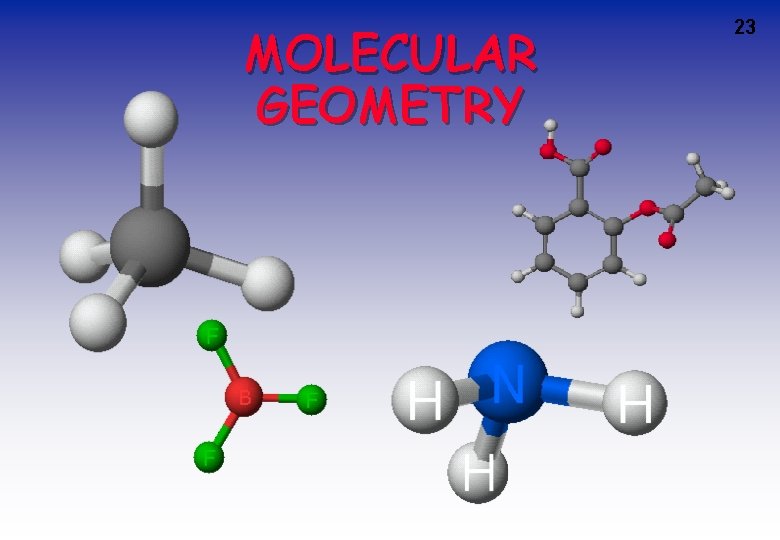
MOLECULAR GEOMETRY 23
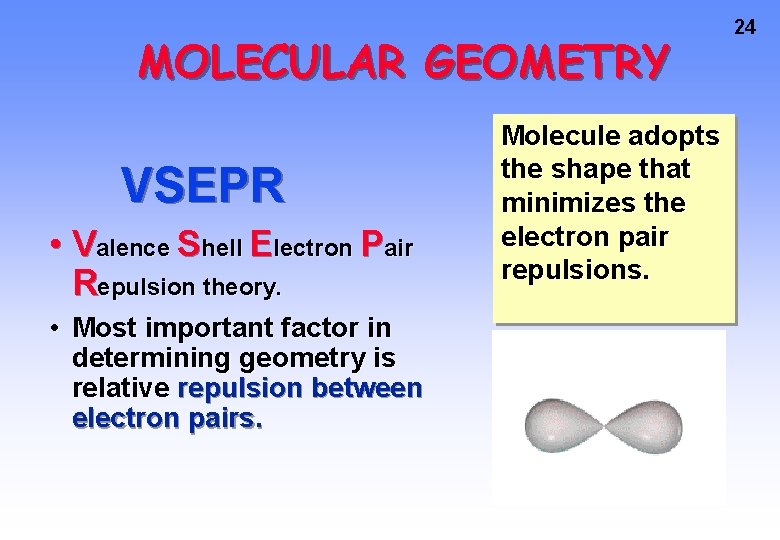
MOLECULAR GEOMETRY VSEPR • Valence Shell Electron Pair Repulsion theory. • Most important factor in determining geometry is relative repulsion between electron pairs. Molecule adopts the shape that minimizes the electron pair repulsions. 24
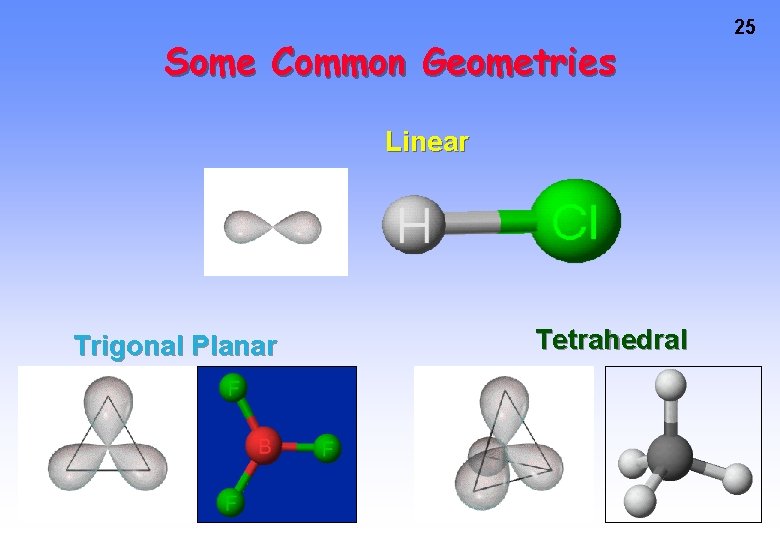
Some Common Geometries Linear Trigonal Planar Tetrahedral 25
VSEPR charts 26 1. Use the Lewis structure to determine the geometry of the molecule 2. Determine the number of shared and unshared pairs of electrons around the CENTRAL atom only. A double bond counts as 1 shared pair A triple bond counts as 1 shared pair 3. The number of paired electrons determines hybridization The first pair of electrons goes to the “s” orbital The next three pairs go to the “p” orbital The remaining pairs go to the “d” orbital
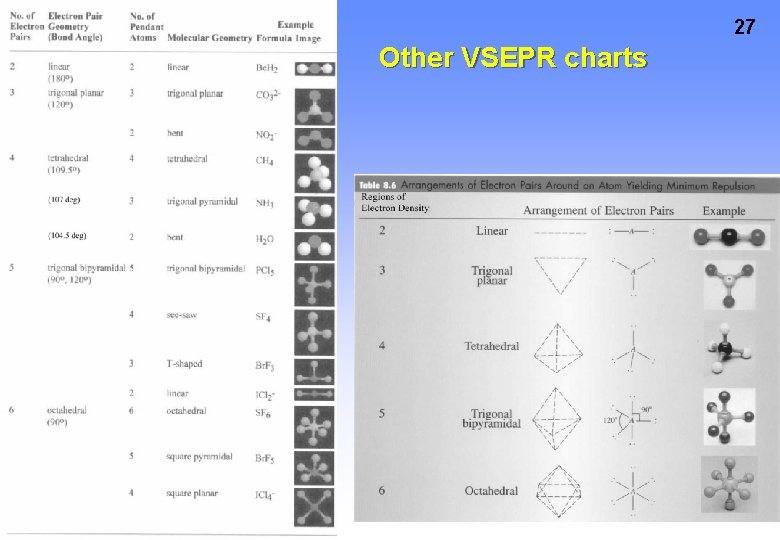
27 Other VSEPR charts
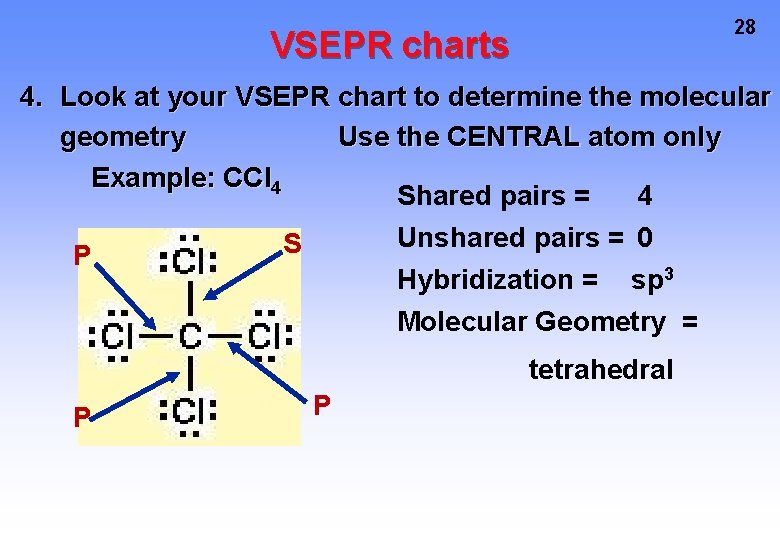
28 VSEPR charts 4. Look at your VSEPR chart to determine the molecular geometry Use the CENTRAL atom only Example: CCl 4 Shared pairs = 4 Unshared pairs = 0 S P Hybridization = sp 3 Molecular Geometry = tetrahedral P P
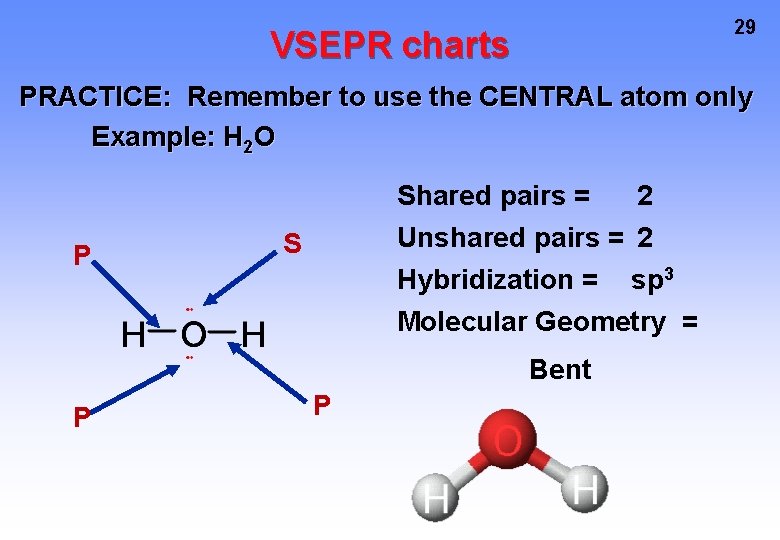
29 VSEPR charts PRACTICE: Remember to use the CENTRAL atom only Example: H 2 O P Shared pairs = 2 Unshared pairs = 2 S Hybridization = sp 3 Molecular Geometry = Bent P P
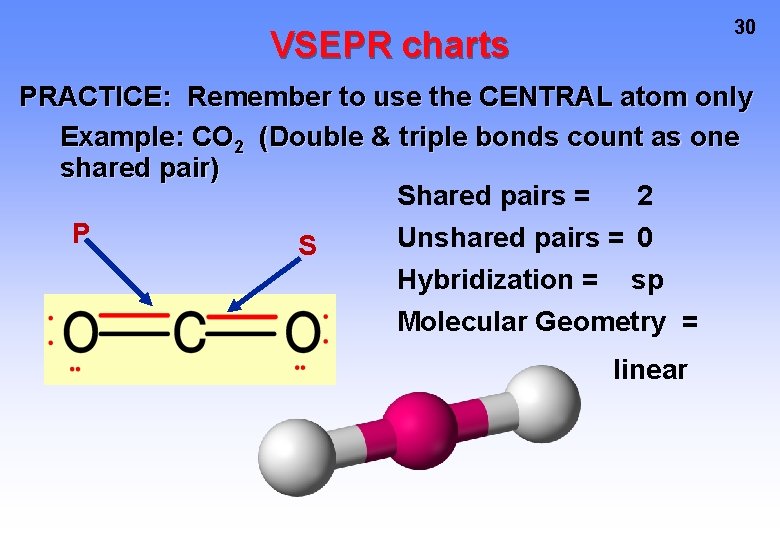
30 VSEPR charts PRACTICE: Remember to use the CENTRAL atom only Example: CO 2 (Double & triple bonds count as one shared pair) Shared pairs = 2 P Unshared pairs = 0 S Hybridization = sp Molecular Geometry = linear
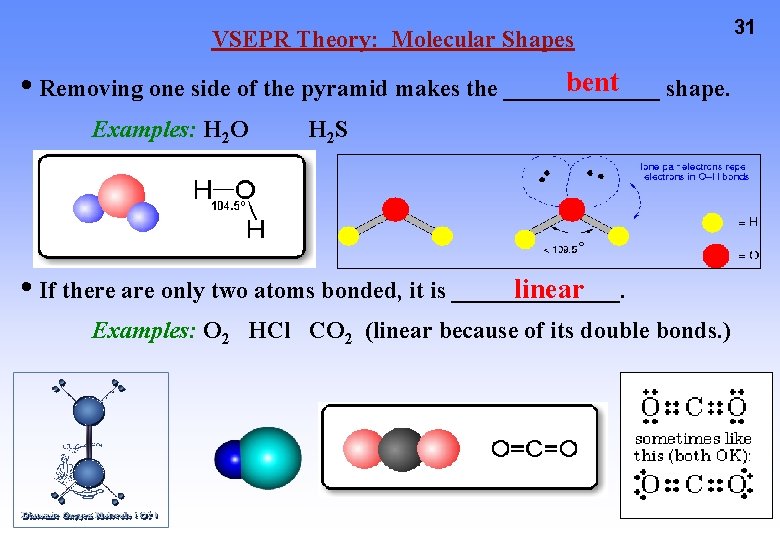
VSEPR Theory: Molecular Shapes bent • Removing one side of the pyramid makes the _______ shape. Examples: H 2 O H 2 S • If there are only two atoms bonded, it is _______. linear Examples: O 2 HCl CO 2 (linear because of its double bonds. ) 31
Polar and Nonpolar Bonds 32 • Even though the electrons in a covalent bond are shared, sometimes the electronegativity is uneven. attraction for the bonded pair, (the ___________), This gives rise to 3 bond types. equal sharing of the e- pair • nonpolar covalent bonds: ______ unequal • polar covalent bonds: ________ sharing of the e- pair transfer of e-’s from the metal to the nonmetal • ionic bonds: a ______ This last type of bond will be discussed in detail in Chapter 15. How To Determine the Bond Type difference between the • Bond type is based on the electronegativity _______ two bonded atoms. (Look at the periodic table with the electronegativity values. )
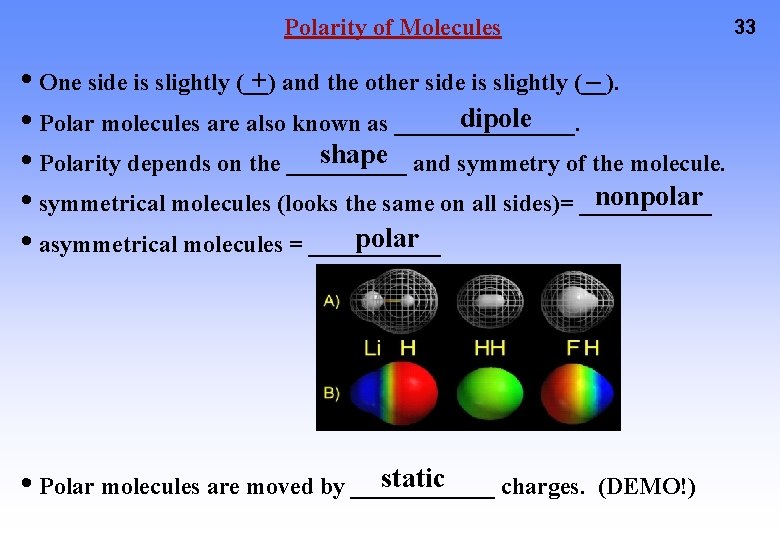
Polarity of Molecules 33 + and the other side is slightly (__). – • One side is slightly (__) dipole • Polar molecules are also known as ________. shape and symmetry of the molecule. • Polarity depends on the _____ nonpolar • symmetrical molecules (looks the same on all sides)= ______ polar • asymmetrical molecules = ______ static • Polar molecules are moved by ______ charges. (DEMO!)
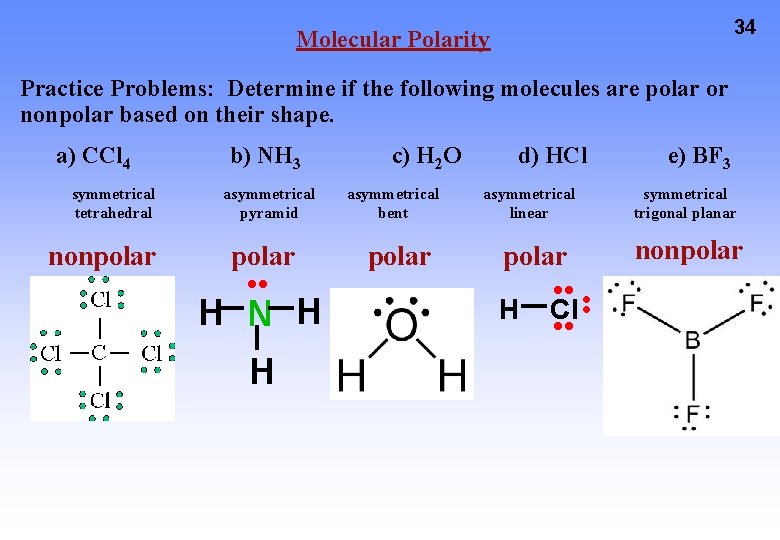
34 Molecular Polarity Practice Problems: Determine if the following molecules are polar or nonpolar based on their shape. a) CCl 4 symmetrical tetrahedral nonpolar b) NH 3 asymmetrical pyramid polar H N H H asymmetrical bent polar d) HCl asymmetrical linear e) BF 3 symmetrical trigonal planar nonpolar • • H Cl • • c) H 2 O
35 Diatomic Elements H 2, N 2, O 2, F 2, Cl 2, Br 2, I 2 • These elements do not exist as a single atom; they always appear as pairs • Their geometry is always linear • They are all NONPOLAR • NOT all sp hybridization
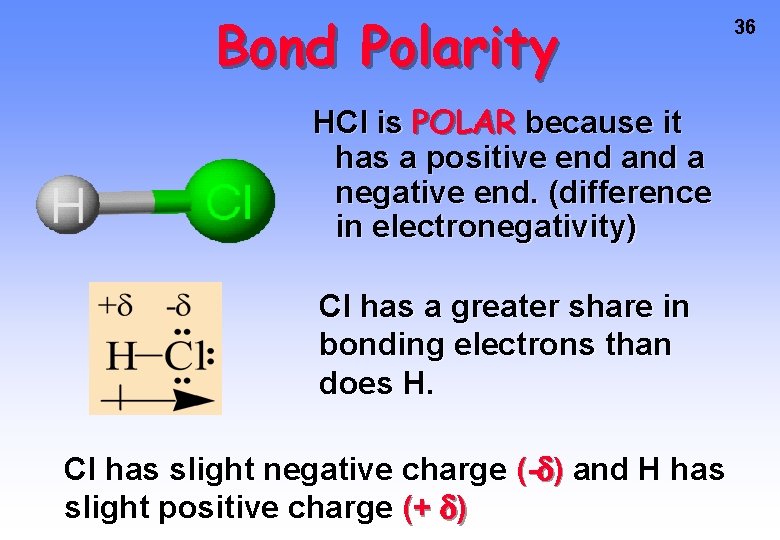
Bond Polarity HCl is POLAR because it has a positive end a negative end. (difference in electronegativity) Cl has a greater share in bonding electrons than does H. Cl has slight negative charge (-d) and H has slight positive charge (+ d) 36
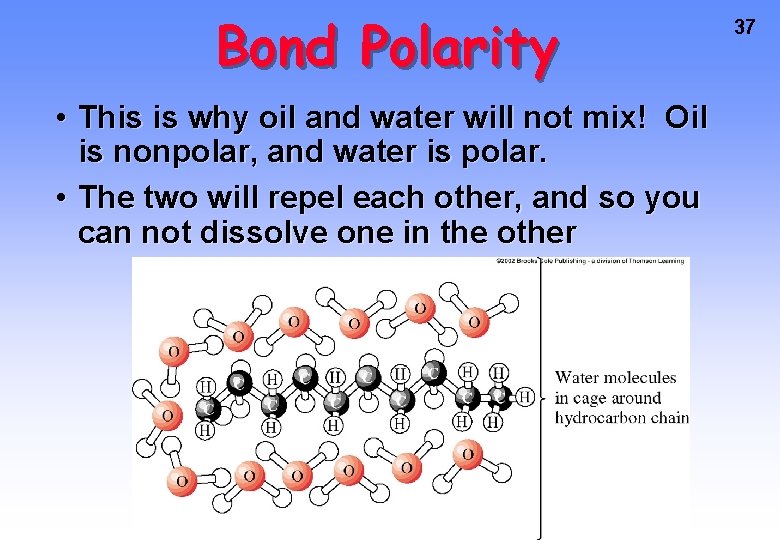
Bond Polarity • This is why oil and water will not mix! Oil is nonpolar, and water is polar. • The two will repel each other, and so you can not dissolve one in the other 37
Bond Polarity • “Like Dissolves Like” –Polar dissolves Polar –Nonpolar dissolves Nonpolar 38
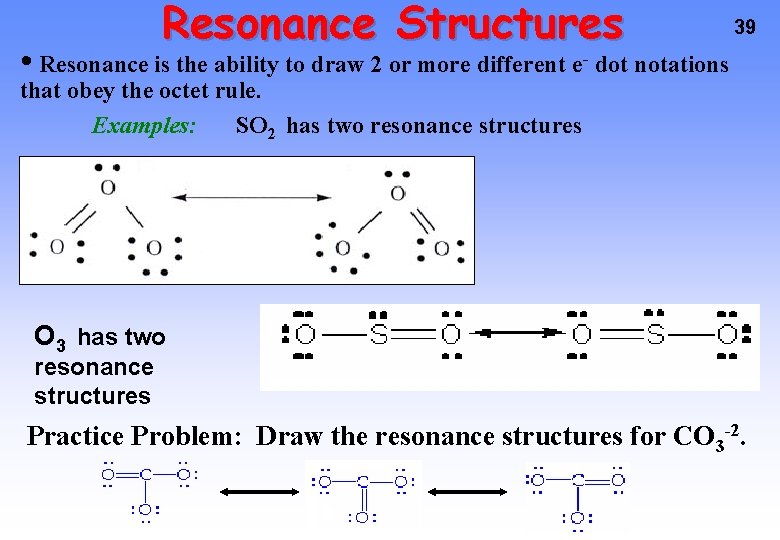
Resonance Structures 39 • Resonance is the ability to draw 2 or more different e- dot notations that obey the octet rule. Examples: SO 2 has two resonance structures O 3 has two resonance structures Practice Problem: Draw the resonance structures for CO 3 -2.
- Slides: 39