
CHEMICAL BONDING Cocaine 1 Chemical Bonding Problems and
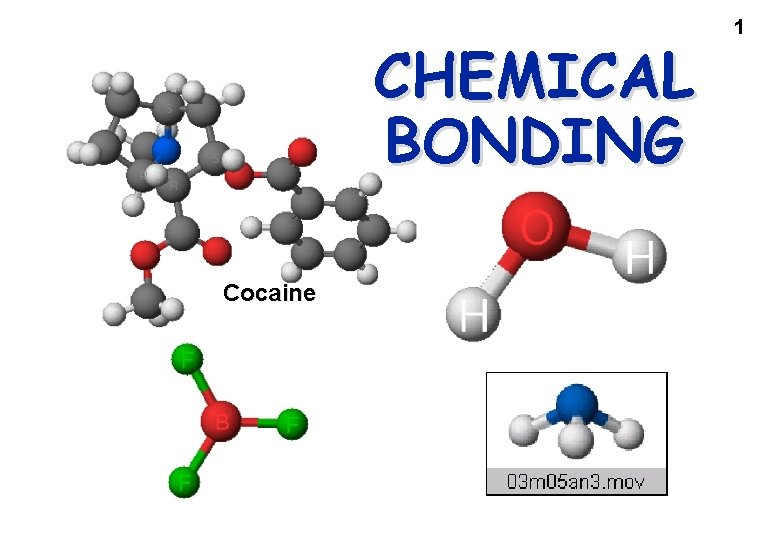
CHEMICAL BONDING Cocaine 1
Chemical Bonding Problems and questions — How is a molecule or polyatomic ion held together? Why are atoms distributed at strange angles? Why are molecules not flat? Can we predict the structure? How is structure related to chemical and physical properties? 2
Forms of Chemical Bonds • There are 2 extreme forms of connecting or bonding atoms: • Ionic—complete transfer of 1 or more electrons from one atom to another • Covalent—some valence electrons shared between atoms • Most bonds are somewhere in between. 3
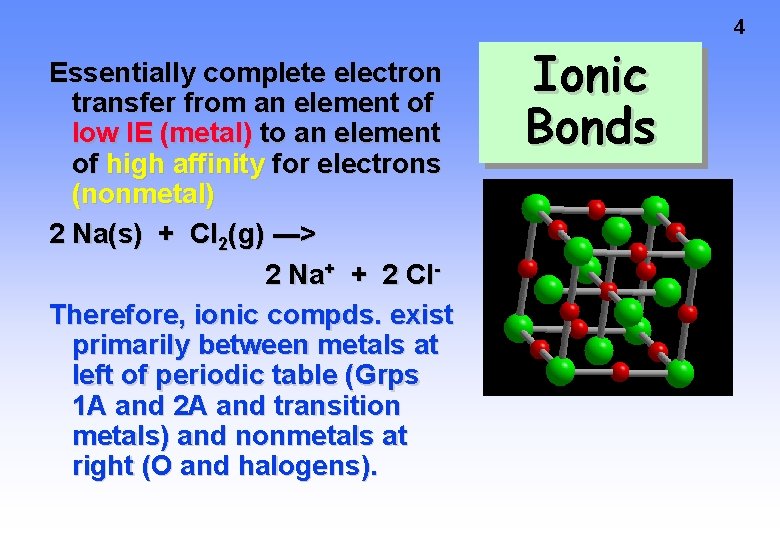
Essentially complete electron transfer from an element of low IE (metal) to an element of high affinity for electrons (nonmetal) 2 Na(s) + Cl 2(g) ---> 2 Na+ + 2 Cl. Therefore, ionic compds. exist primarily between metals at left of periodic table (Grps 1 A and 2 A and transition metals) and nonmetals at right (O and halogens). Ionic Bonds 4
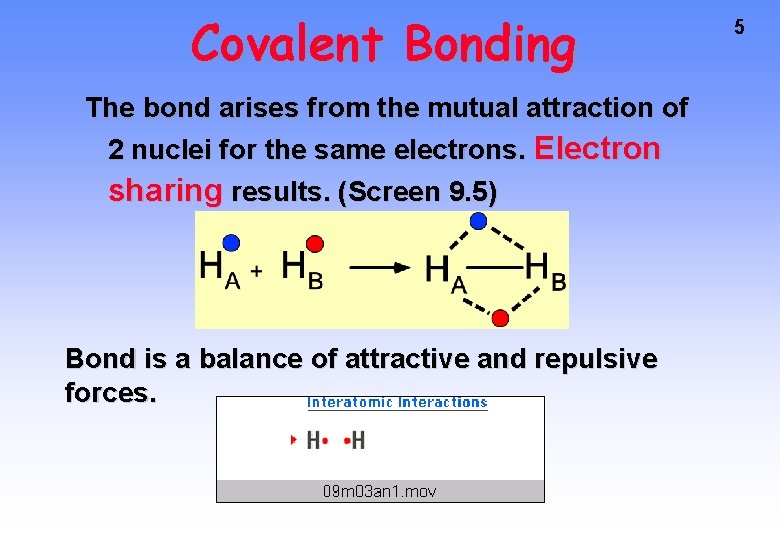
Covalent Bonding The bond arises from the mutual attraction of 2 nuclei for the same electrons. Electron sharing results. (Screen 9. 5) Bond is a balance of attractive and repulsive forces. 5
Chemical Bonding: Objectives are to understand: 1. valence e- distribution in molecules and ions. 2. molecular structures 3. bond properties and their effect on molecular properties. 6
7 Electron Distribution in Molecules • Electron distribution is depicted with Lewis electron dot structures • Valence electrons are distributed as shared or BOND PAIRS and unshared or LONE PAIRS. G. N. Lewis 1875 - 1946
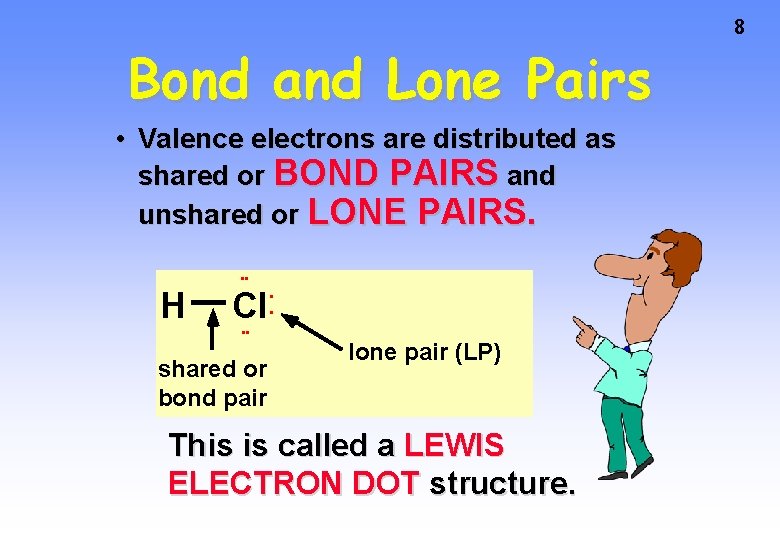
Bond and Lone Pairs • Valence electrons are distributed as shared or BOND PAIRS and unshared or LONE PAIRS. • • H Cl • • shared or bond pair • • lone pair (LP) This is called a LEWIS ELECTRON DOT structure. 8
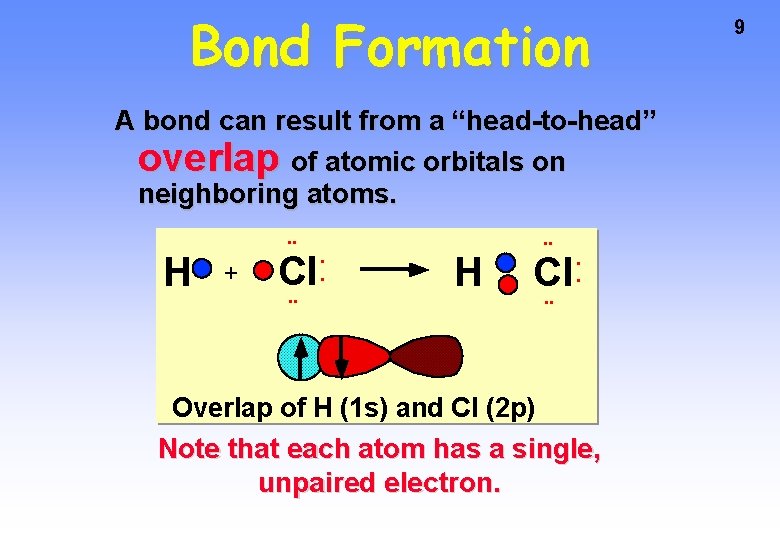
Bond Formation A bond can result from a “head-to-head” overlap of atomic orbitals on neighboring atoms. • • H + Cl • • • • H • • Cl • • • • Overlap of H (1 s) and Cl (2 p) Note that each atom has a single, unpaired electron. 9
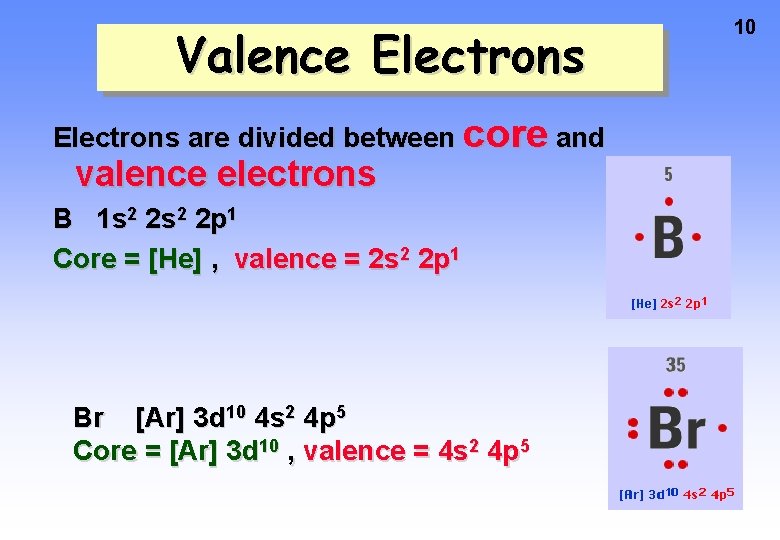
Valence Electrons are divided between core and valence electrons B 1 s 2 2 p 1 Core = [He] , valence = 2 s 2 2 p 1 Br [Ar] 3 d 10 4 s 2 4 p 5 Core = [Ar] 3 d 10 , valence = 4 s 2 4 p 5 10
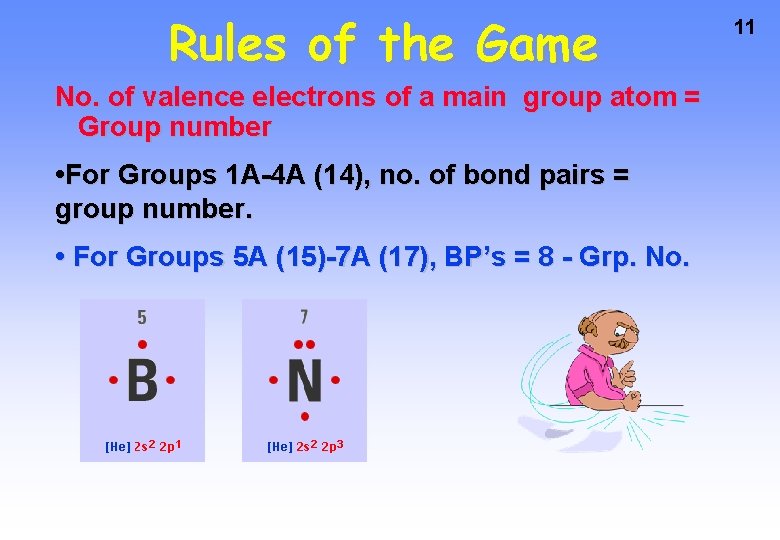
Rules of the Game No. of valence electrons of a main group atom = Group number • For Groups 1 A-4 A (14), no. of bond pairs = group number. • For Groups 5 A (15)-7 A (17), BP’s = 8 - Grp. No. 11
Rules of the Game • No. of valence electrons of an atom = Group number • For Groups 1 A-4 A (14), no. of bond pairs = group number • For Groups 5 A (15)-7 A (17), BP’s = 8 - Grp. No. • Except for H (and sometimes atoms of 3 rd and higher periods), BP’s + LP’s = 4 This observation is called the OCTET RULE 12
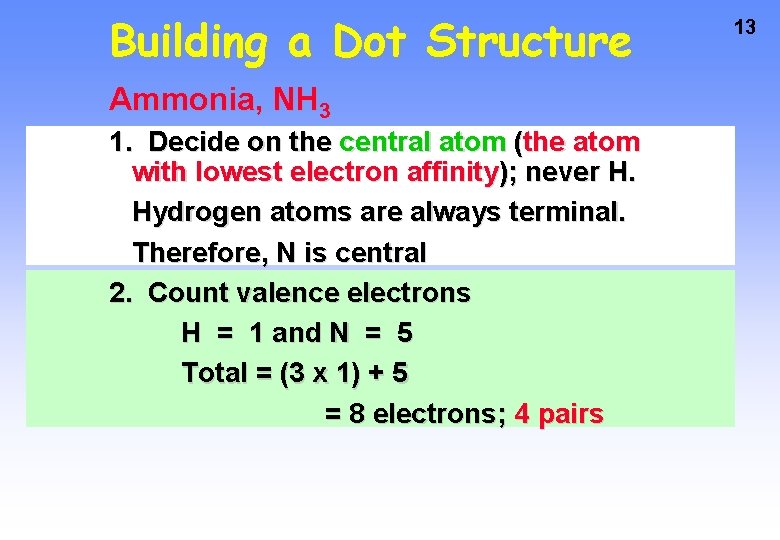
Building a Dot Structure Ammonia, NH 3 1. Decide on the central atom (the atom with lowest electron affinity); never H. Hydrogen atoms are always terminal. Therefore, N is central 2. Count valence electrons H = 1 and N = 5 Total = (3 x 1) + 5 = 8 electrons; 4 pairs 13
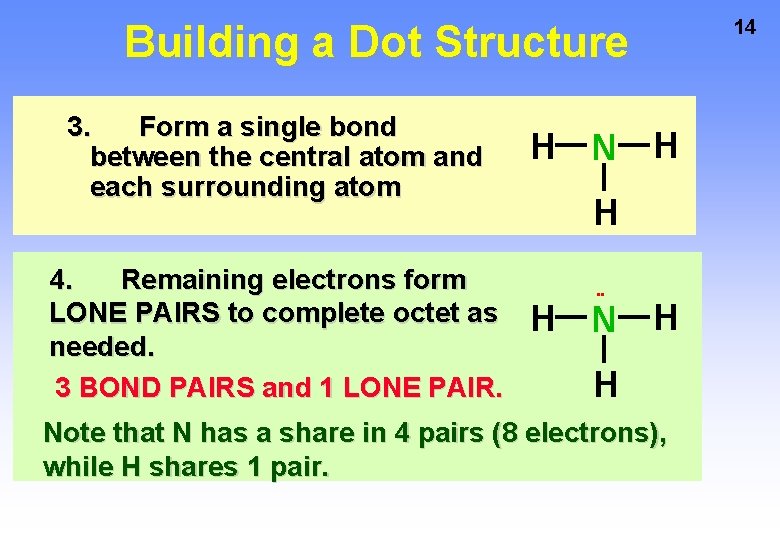
Building a Dot Structure 3. Form a single bond between the central atom and each surrounding atom 4. Remaining electrons form LONE PAIRS to complete octet as needed. 3 BOND PAIRS and 1 LONE PAIR. H N H H • • H N H H Note that N has a share in 4 pairs (8 electrons), while H shares 1 pair. 14
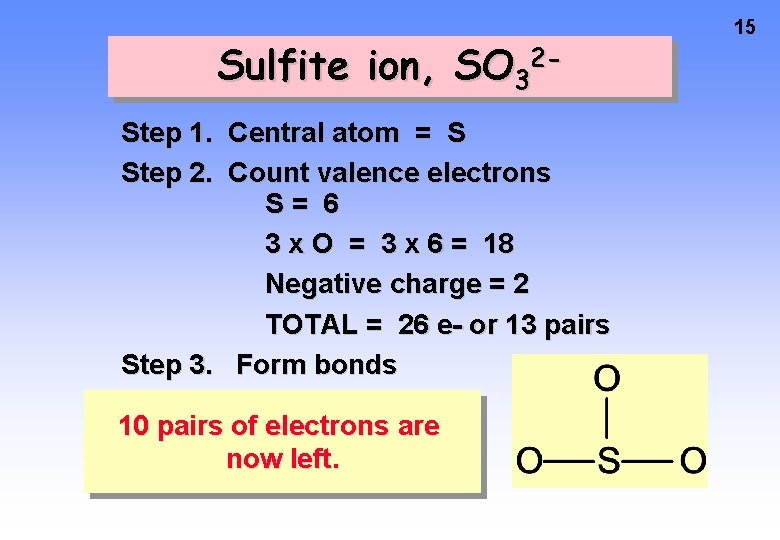
Sulfite ion, SO 32 Step 1. Central atom = S Step 2. Count valence electrons S= 6 3 x O = 3 x 6 = 18 Negative charge = 2 TOTAL = 26 e- or 13 pairs Step 3. Form bonds 10 pairs of electrons are now left. 15
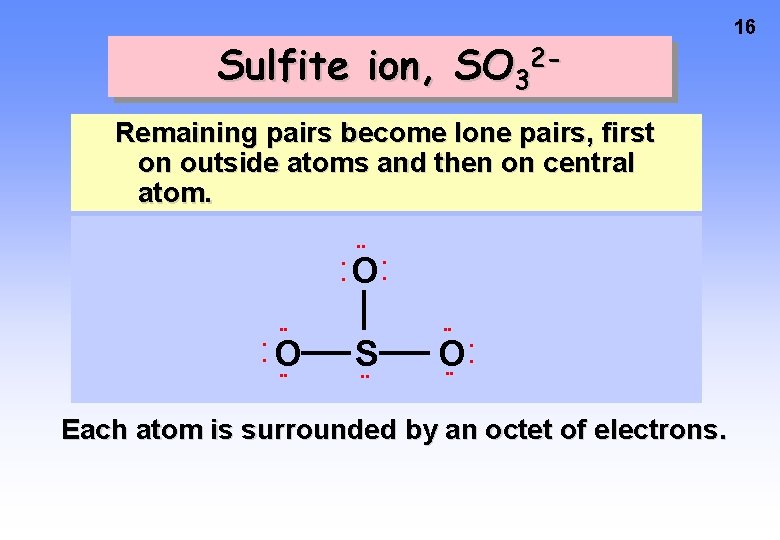
Sulfite ion, SO 32 Remaining pairs become lone pairs, first on outside atoms and then on central atom. • • • • O • • O S • • O • • • • Each atom is surrounded by an octet of electrons. 16
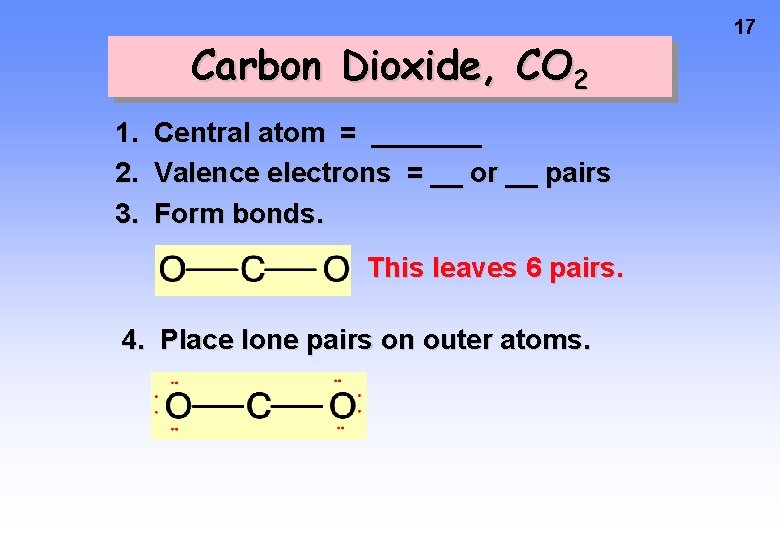
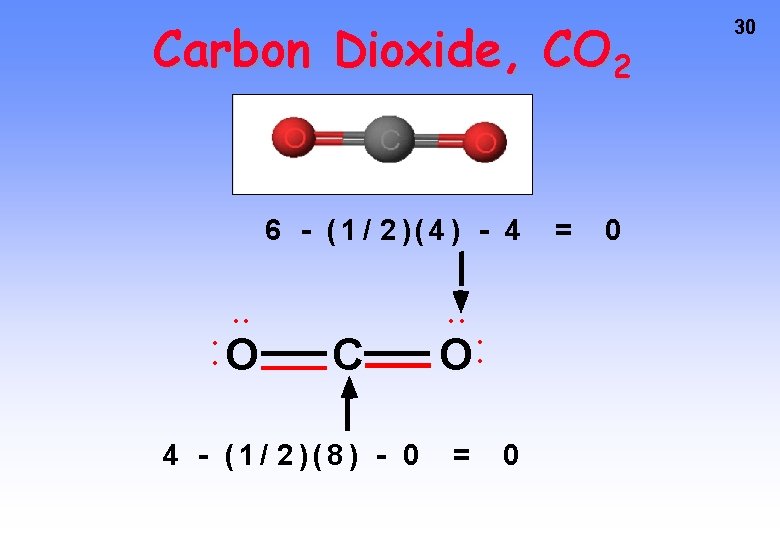
Carbon Dioxide, CO 2 1. Central atom = _______ 2. Valence electrons = __ or __ pairs 3. Form bonds. This leaves 6 pairs. 4. Place lone pairs on outer atoms. 17
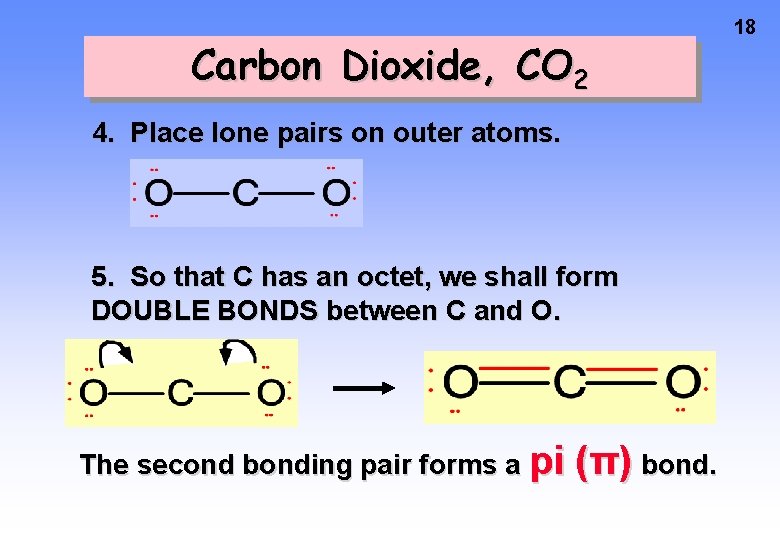
Carbon Dioxide, CO 2 4. Place lone pairs on outer atoms. 5. So that C has an octet, we shall form DOUBLE BONDS between C and O. The second bonding pair forms a pi (π) bond. 18

Double and even triple bonds are commonly observed for C, N, P, O, and S 19 H 2 CO SO 3 C 2 F 4
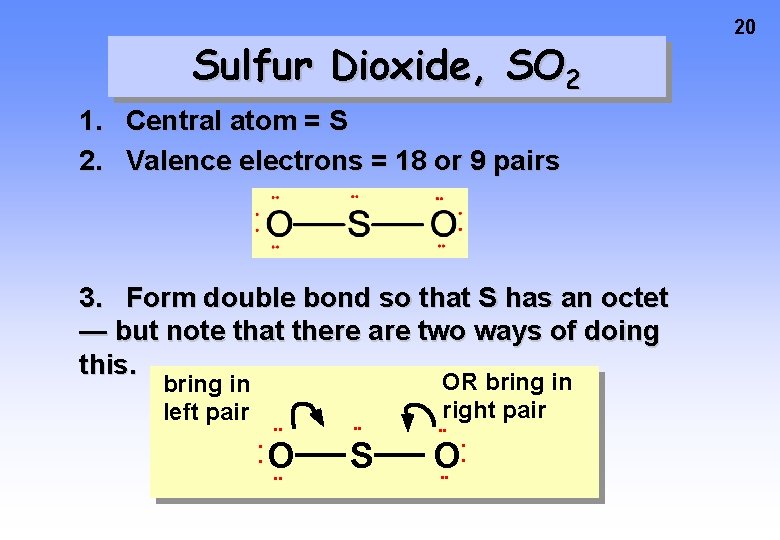
Sulfur Dioxide, SO 2 1. Central atom = S 2. Valence electrons = 18 or 9 pairs 3. Form double bond so that S has an octet — but note that there are two ways of doing this. bring in left pair • • • • O • • S OR bring in right pair • • O • • • • 20
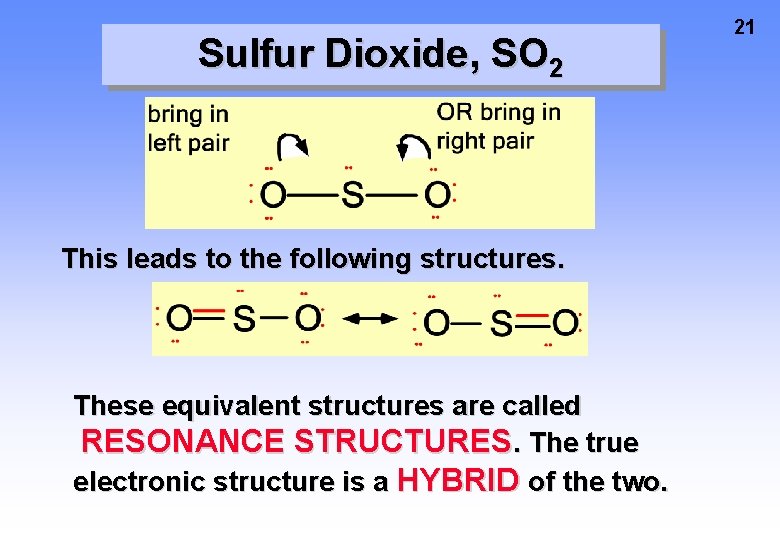
Sulfur Dioxide, SO 2 This leads to the following structures. These equivalent structures are called RESONANCE STRUCTURES. The true electronic structure is a HYBRID of the two. 21
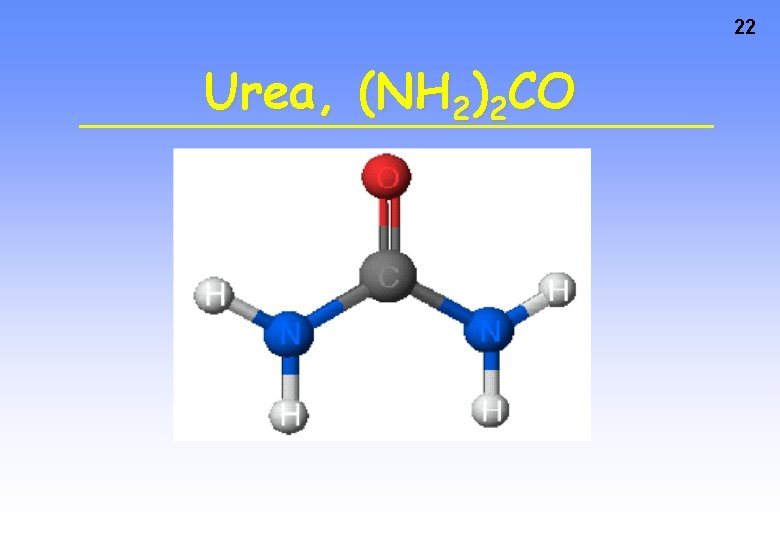
22 Urea, (NH 2)2 CO
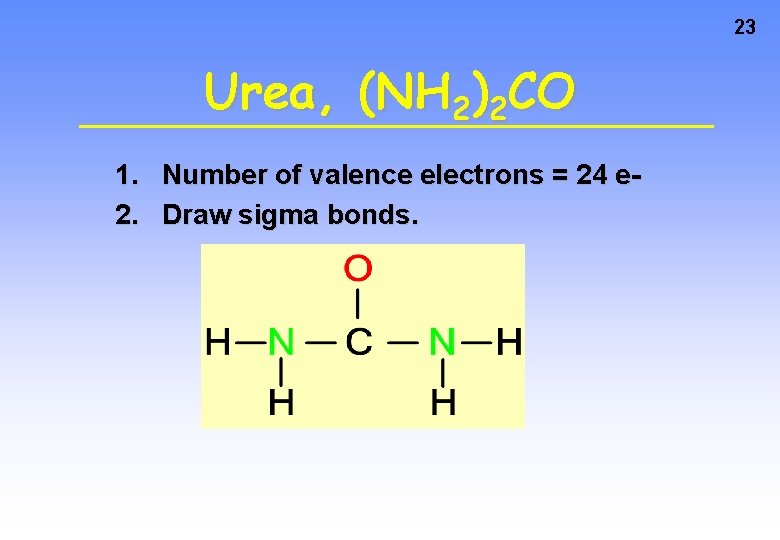
23 Urea, (NH 2)2 CO 1. Number of valence electrons = 24 e 2. Draw sigma bonds.
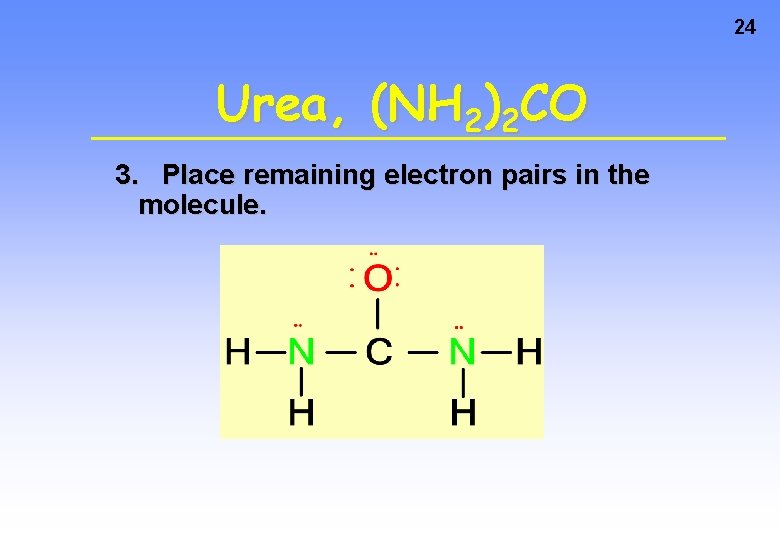
24 Urea, (NH 2)2 CO 3. Place remaining electron pairs in the molecule.
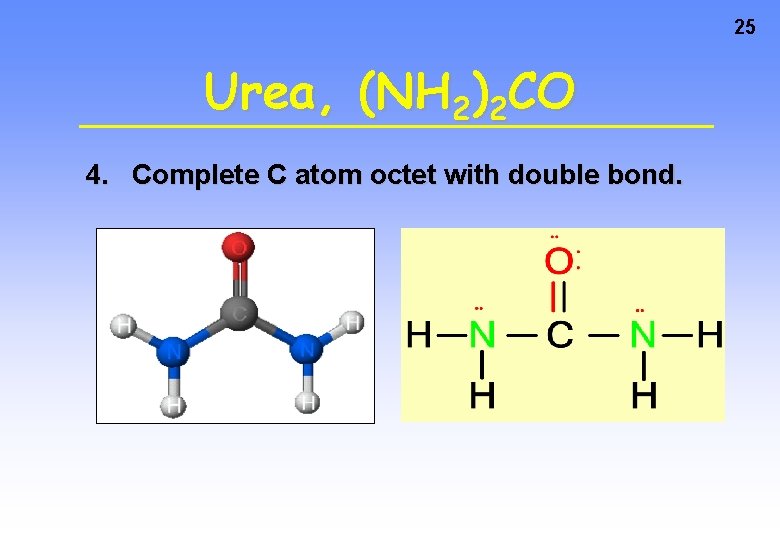
25 Urea, (NH 2)2 CO 4. Complete C atom octet with double bond.
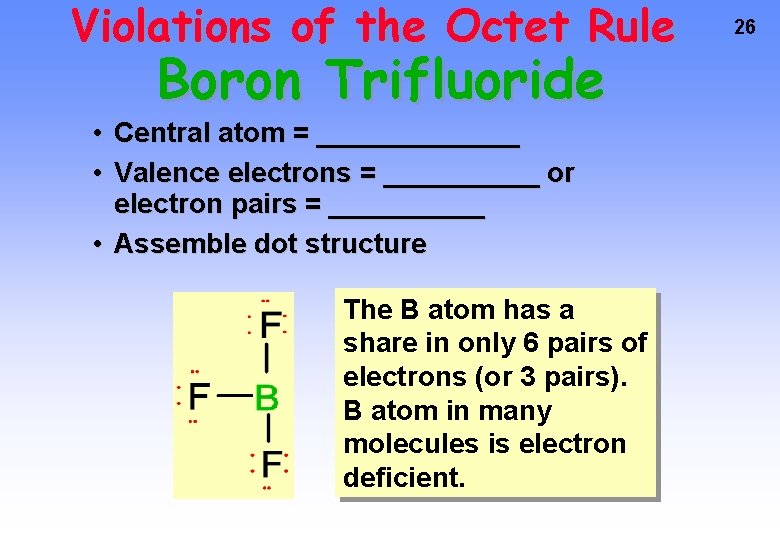
Violations of the Octet Rule Boron Trifluoride • Central atom = _______ • Valence electrons = _____ or electron pairs = _____ • Assemble dot structure The B atom has a share in only 6 pairs of electrons (or 3 pairs). B atom in many molecules is electron deficient. 26
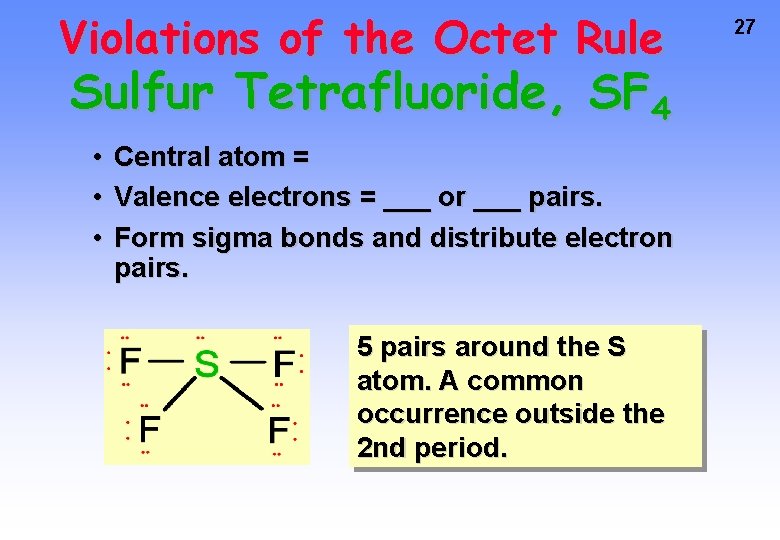
Violations of the Octet Rule Sulfur Tetrafluoride, SF 4 • Central atom = • Valence electrons = ___ or ___ pairs. • Form sigma bonds and distribute electron pairs. 5 pairs around the S atom. A common occurrence outside the 2 nd period. 27
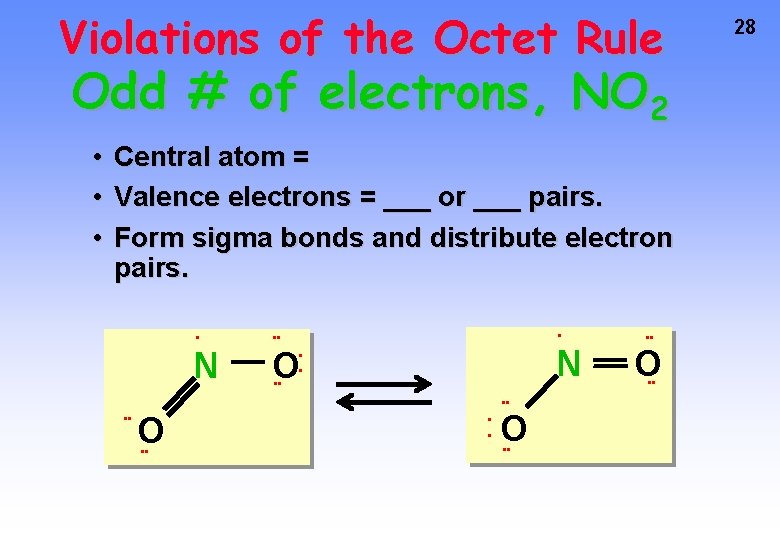
Violations of the Octet Rule Odd # of electrons, NO 2 • Central atom = • Valence electrons = ___ or ___ pairs. • Form sigma bonds and distribute electron pairs. • • • • N O • • N • • • • O • • 28
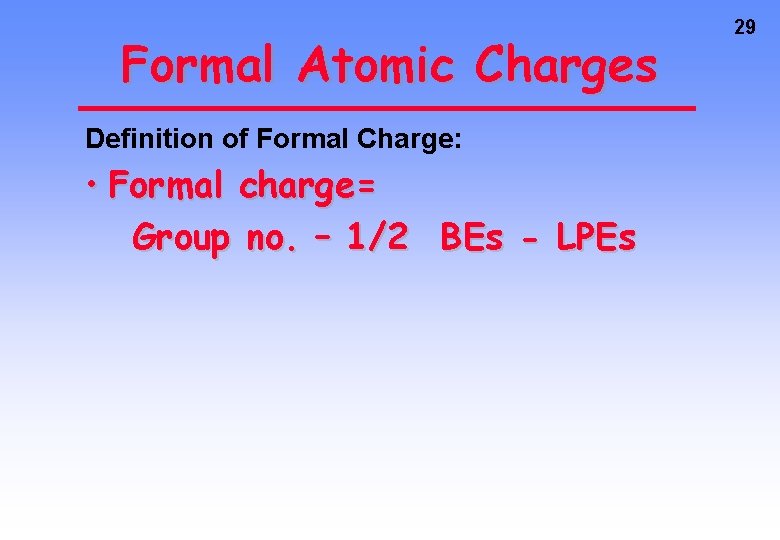
Formal Atomic Charges Definition of Formal Charge: • Formal charge= Group no. – 1/2 BEs - LPEs 29
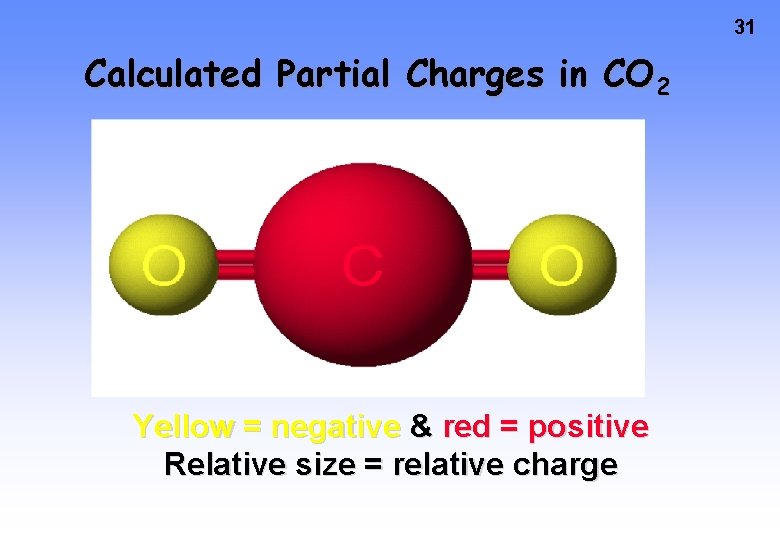
31 Calculated Partial Charges in CO 2 Yellow = negative & red = positive Relative size = relative charge
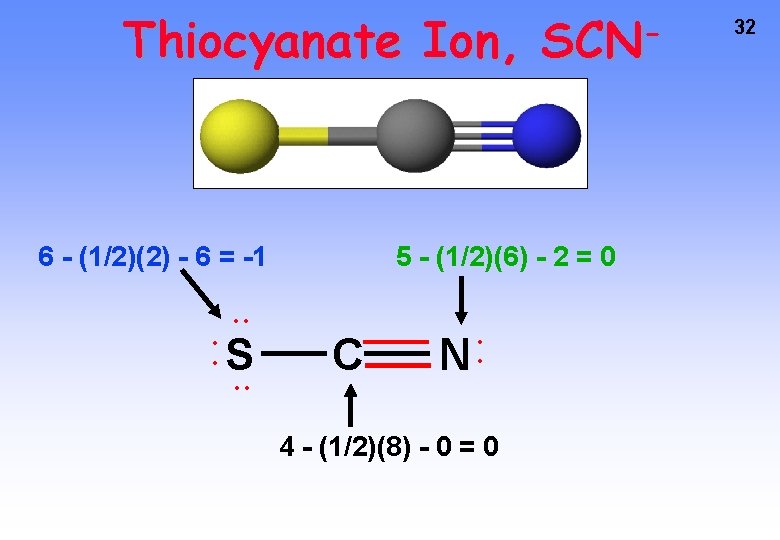
Thiocyanate Ion, 6 - (1/2)(2) - 6 = -1 5 - (1/2)(6) - 2 = 0 • • • • S SCN C N • • • • 4 - (1/2)(8) - 0 = 0 32
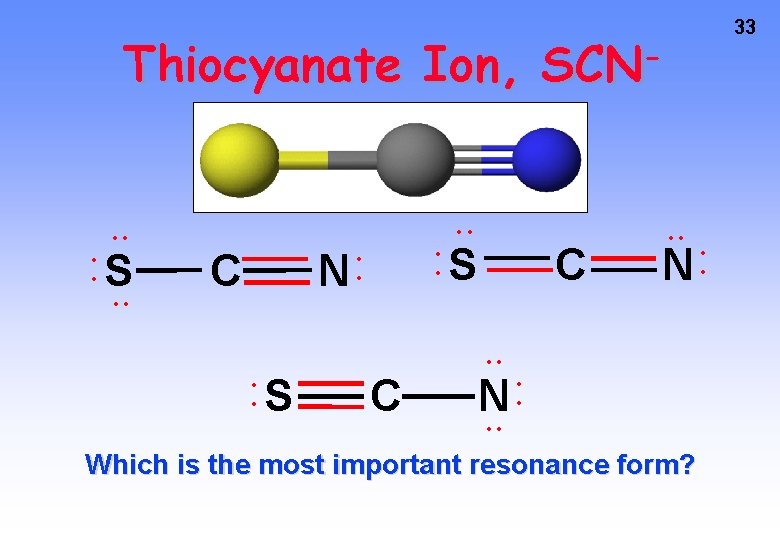
Thiocyanate Ion, • • S SCN • • C N • • S 33 C • • N • • • • S C N • • • • Which is the most important resonance form? • •
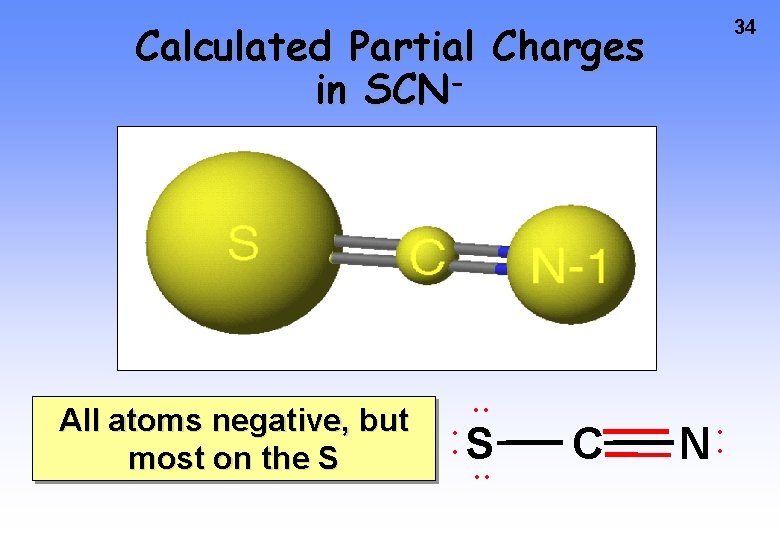
Calculated Partial Charges in SCN- All atoms negative, but most on the S 34 • • • • S • • C N • •
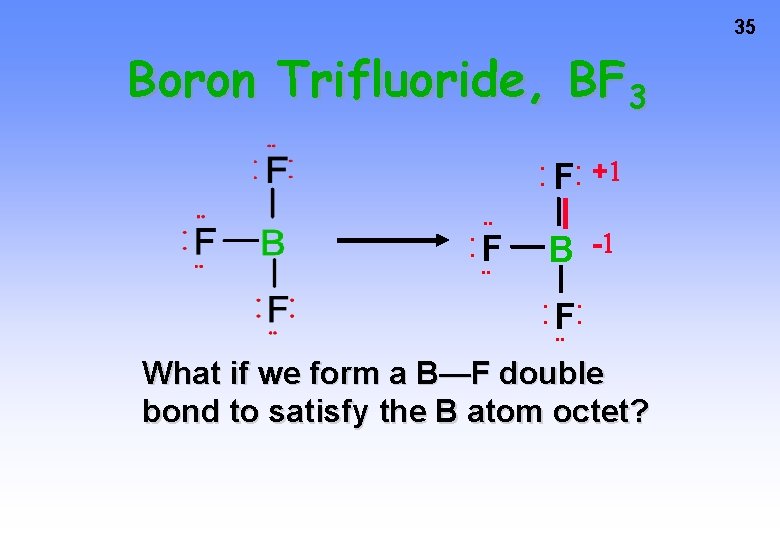
35 Boron Trifluoride, BF 3 F • • • F • • • • -1 B • • F +1 • • • • What if we form a B—F double bond to satisfy the B atom octet?
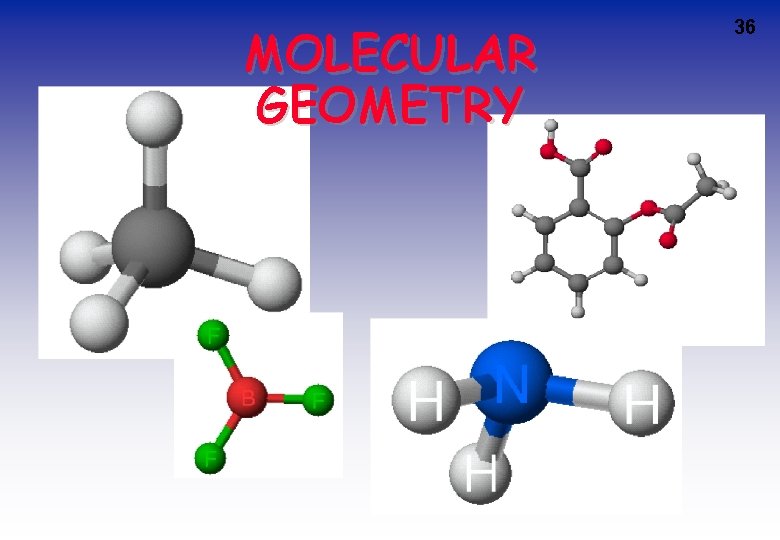
MOLECULAR GEOMETRY 36
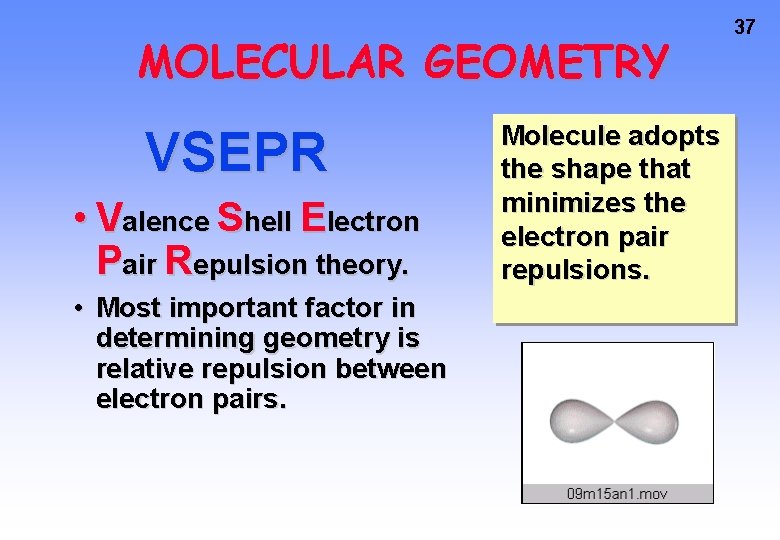
MOLECULAR GEOMETRY VSEPR • Valence Shell Electron Pair Repulsion theory. • Most important factor in determining geometry is relative repulsion between electron pairs. Molecule adopts the shape that minimizes the electron pair repulsions. 37
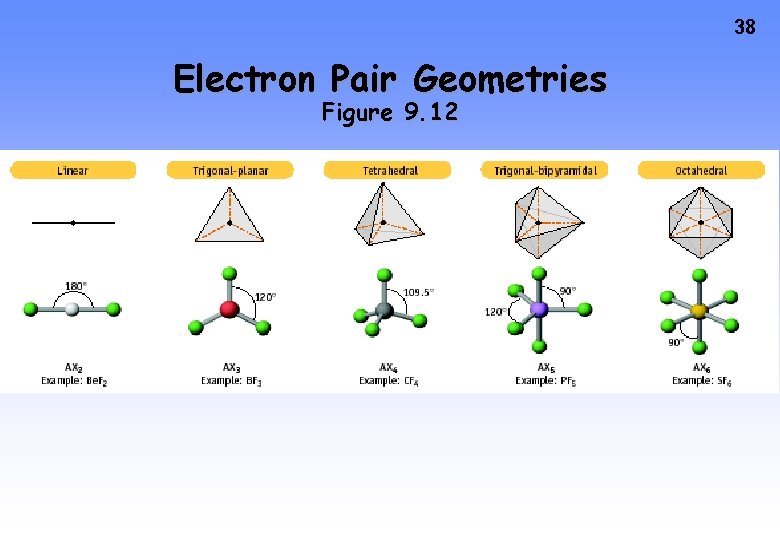
38 Electron Pair Geometries Figure 9. 12
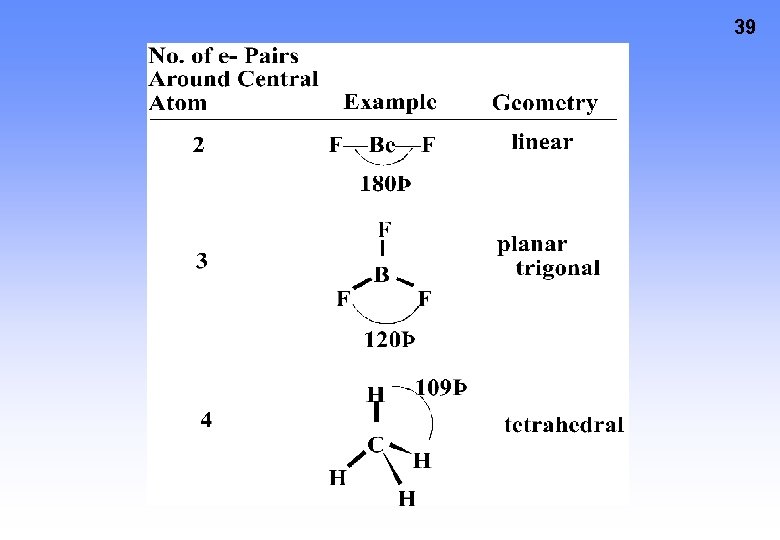
39
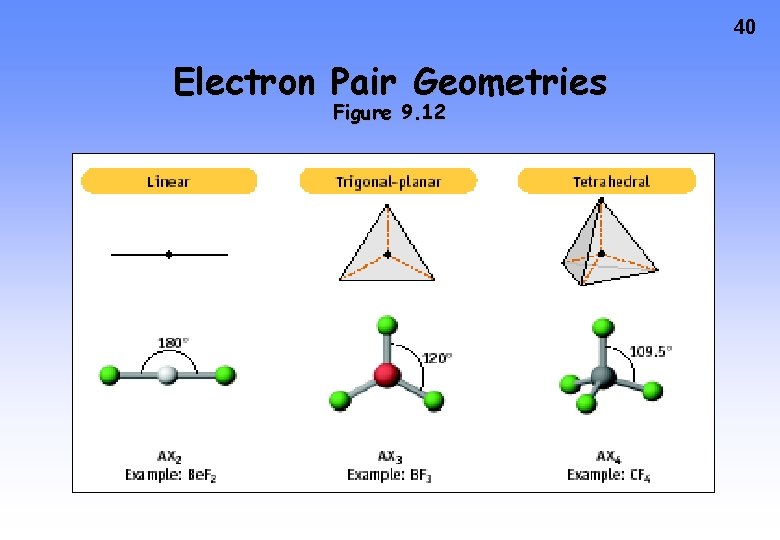
40 Electron Pair Geometries Figure 9. 12
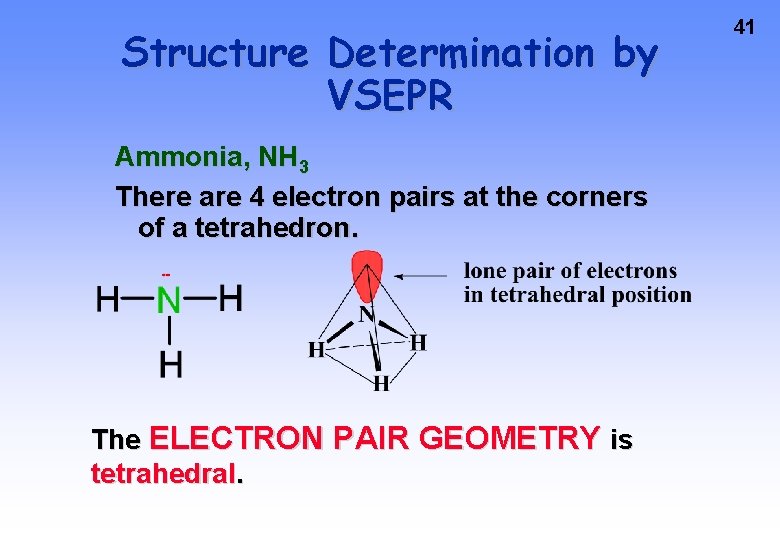
Structure Determination by VSEPR Ammonia, NH 3 There are 4 electron pairs at the corners of a tetrahedron. The ELECTRON PAIR GEOMETRY is tetrahedral. 41
Bond Properties 42 bond order, bond length, bond energy, bond polarity Buckyball in HIV-protease
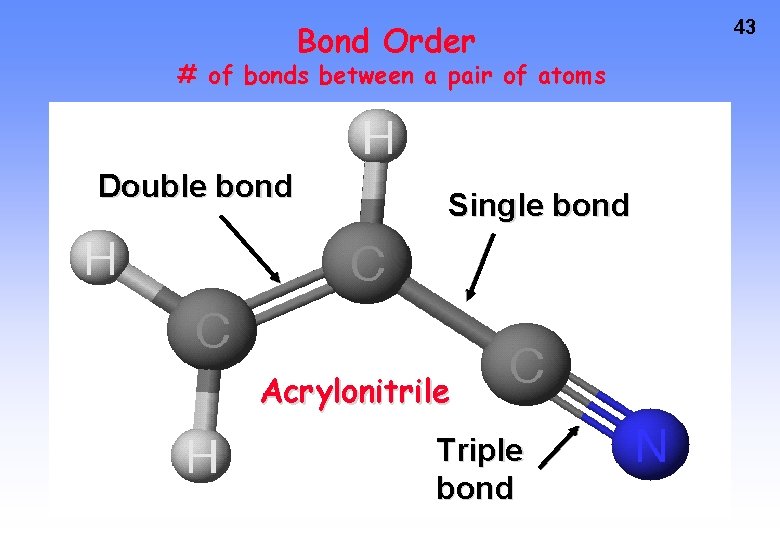
Bond Order # of bonds between a pair of atoms Double bond Single bond Acrylonitrile Triple bond 43
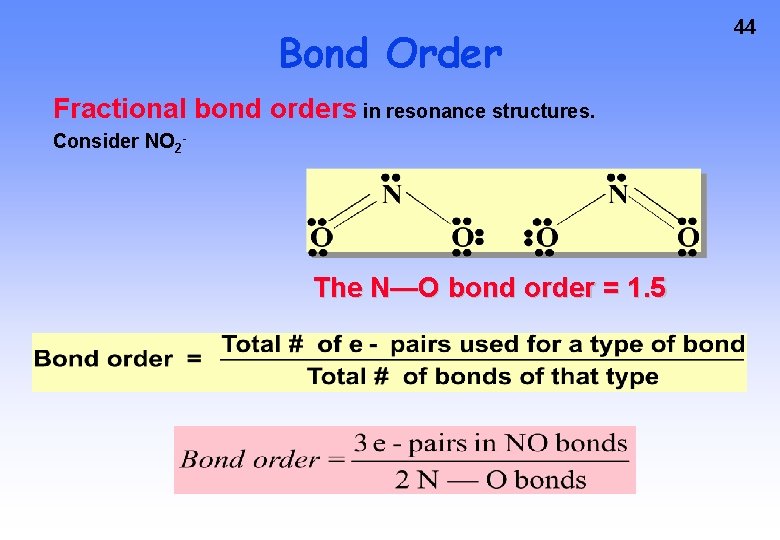
Bond Order Fractional bond orders in resonance structures. Consider NO 2 - The N—O bond order = 1. 5 44
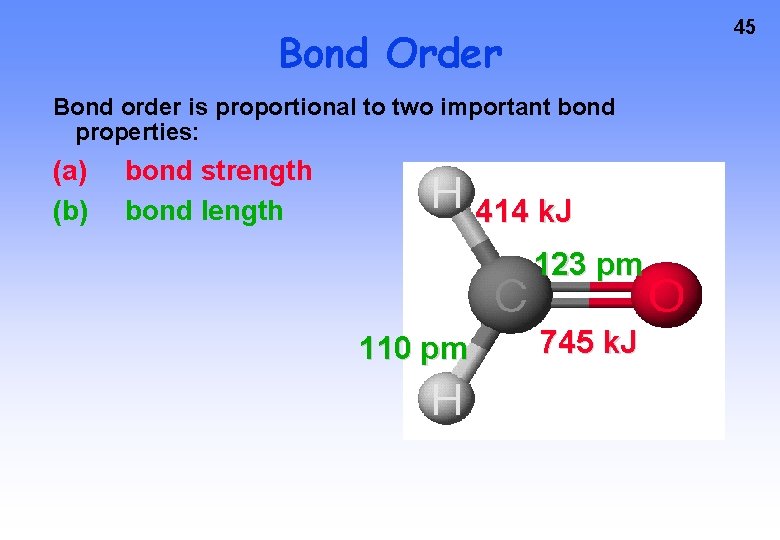
45 Bond Order Bond order is proportional to two important bond properties: (a) (b) bond strength bond length 414 k. J 123 pm 110 pm 745 k. J
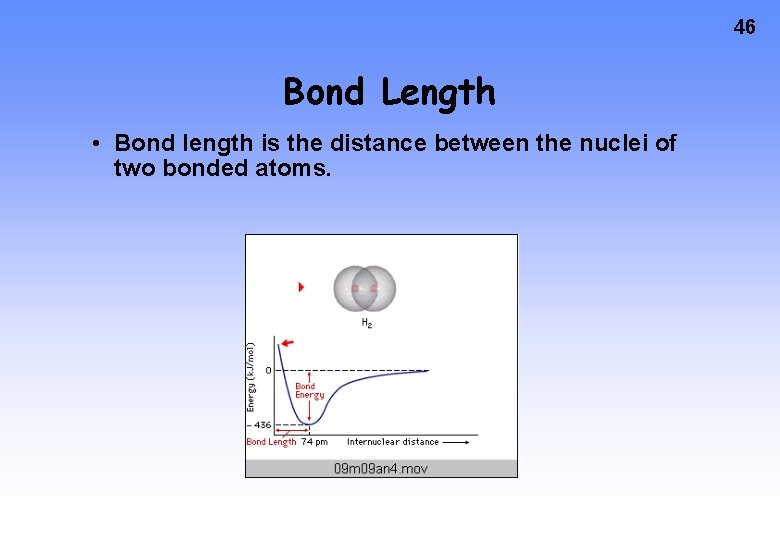
46 Bond Length • Bond length is the distance between the nuclei of two bonded atoms.
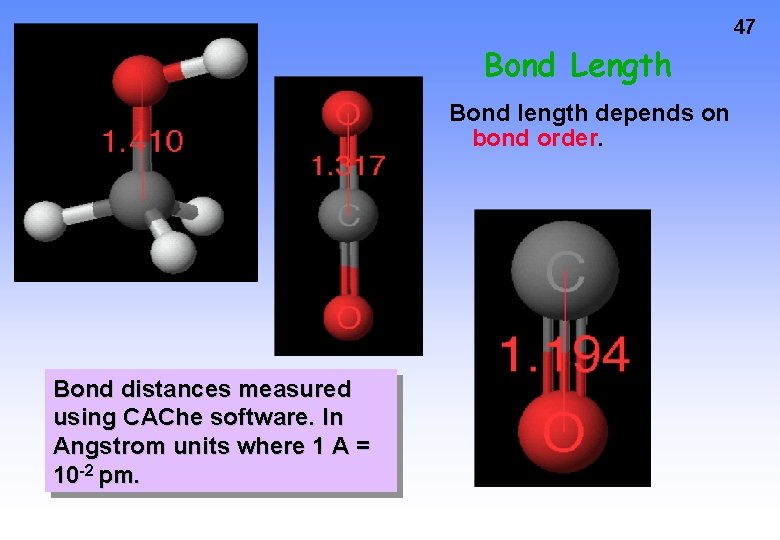
47 Bond Length Bond length depends on bond order. Bond distances measured using CAChe software. In Angstrom units where 1 A = 10 -2 pm.
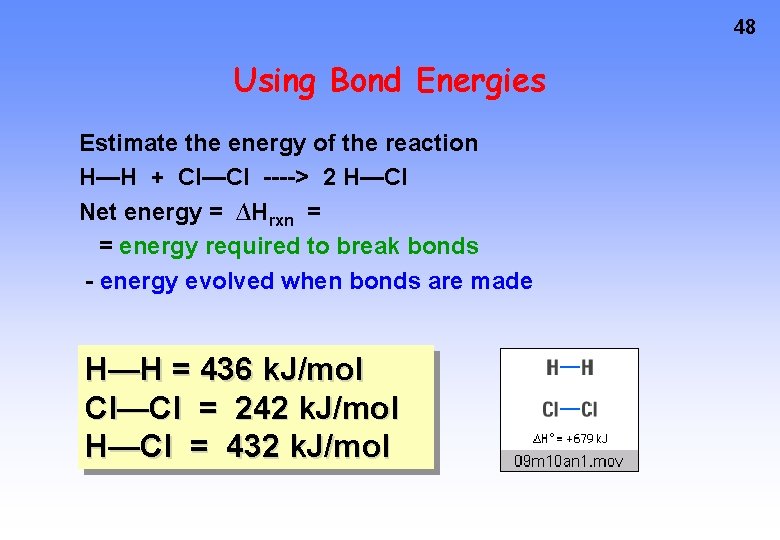
48 Using Bond Energies Estimate the energy of the reaction H—H + Cl—Cl ----> 2 H—Cl Net energy = ∆Hrxn = = energy required to break bonds - energy evolved when bonds are made H—H = 436 k. J/mol Cl—Cl = 242 k. J/mol H—Cl = 432 k. J/mol
49 Using Bond Energies Estimate the energy of the reaction H—H + Cl—Cl ----> 2 H—Cl H—H = 436 k. J/mol Cl—Cl = 242 k. J/mol H—Cl = 432 k. J/mol Sum of H-H + Cl-Cl bond energies = 436 k. J + 242 k. J = +678 k. J 2 mol H-Cl bond energies = 864 k. J Net = ∆H = +678 k. J - 864 k. J = -186 k. J
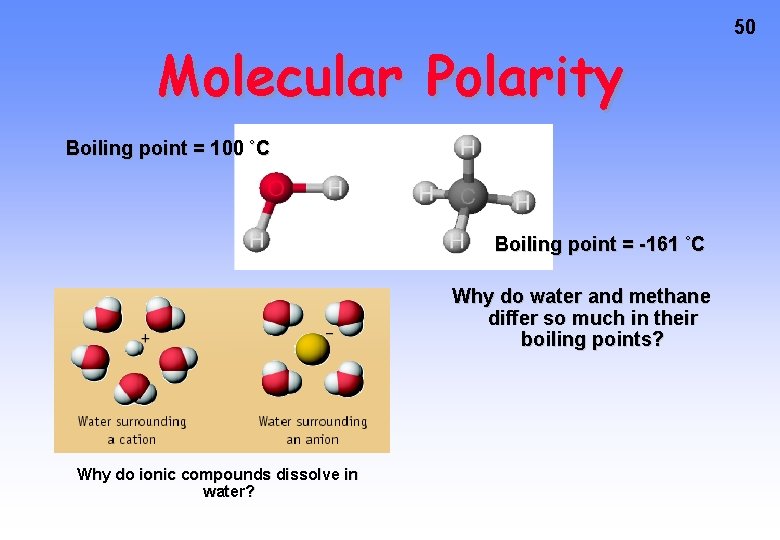
Molecular Polarity Boiling point = 100 ˚C Boiling point = -161 ˚C Why do water and methane differ so much in their boiling points? Why do ionic compounds dissolve in water? 50
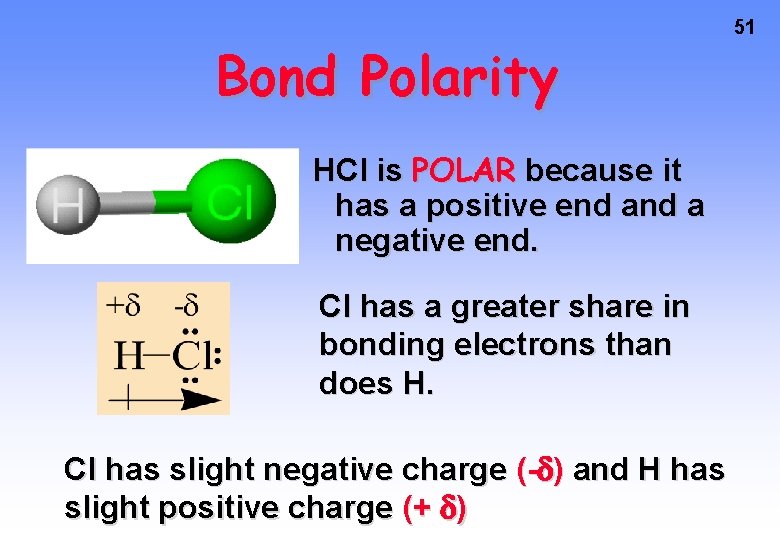
Bond Polarity HCl is POLAR because it has a positive end a negative end. Cl has a greater share in bonding electrons than does H. Cl has slight negative charge (-d) and H has slight positive charge (+ d) 51
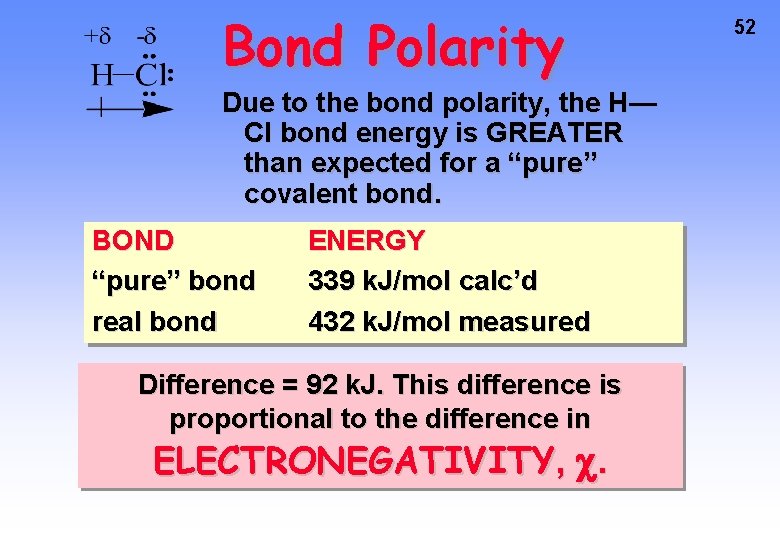
Bond Polarity Due to the bond polarity, the H— Cl bond energy is GREATER than expected for a “pure” covalent bond. BOND “pure” bond real bond ENERGY 339 k. J/mol calc’d 432 k. J/mol measured Difference = 92 k. J. This difference is proportional to the difference in ELECTRONEGATIVITY, . 52
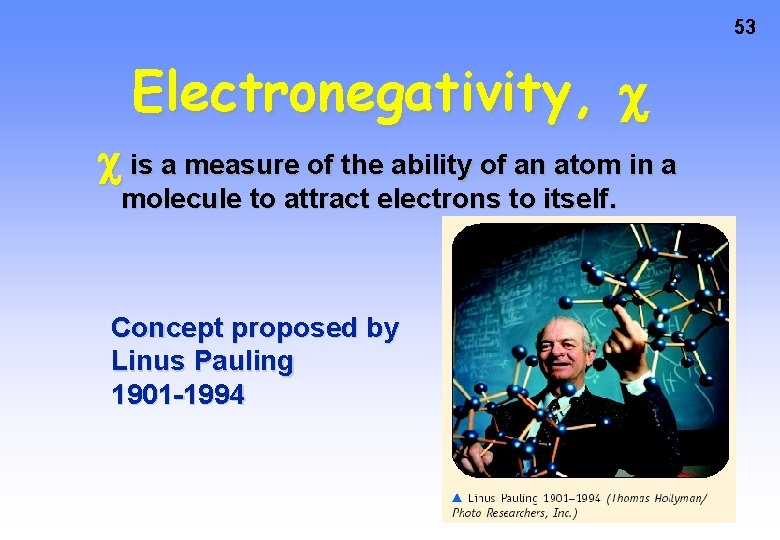
53 Electronegativity, is a measure of the ability of an atom in a molecule to attract electrons to itself. Concept proposed by Linus Pauling 1901 -1994
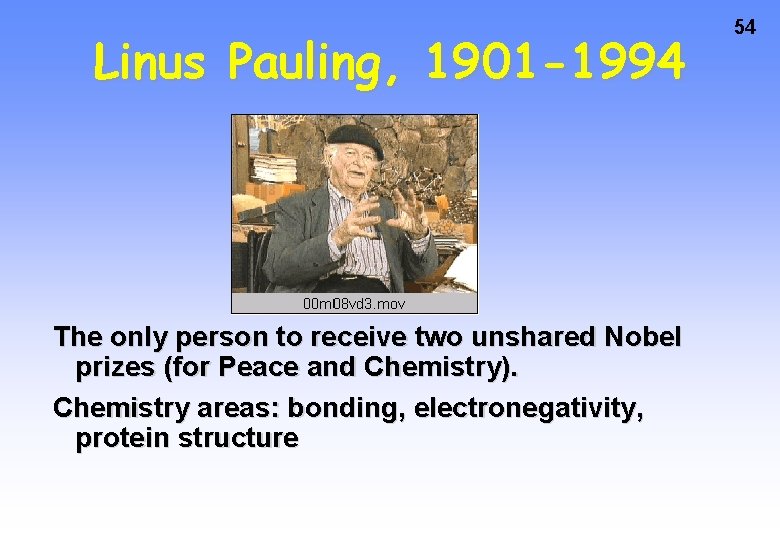
Linus Pauling, 1901 -1994 The only person to receive two unshared Nobel prizes (for Peace and Chemistry). Chemistry areas: bonding, electronegativity, protein structure 54
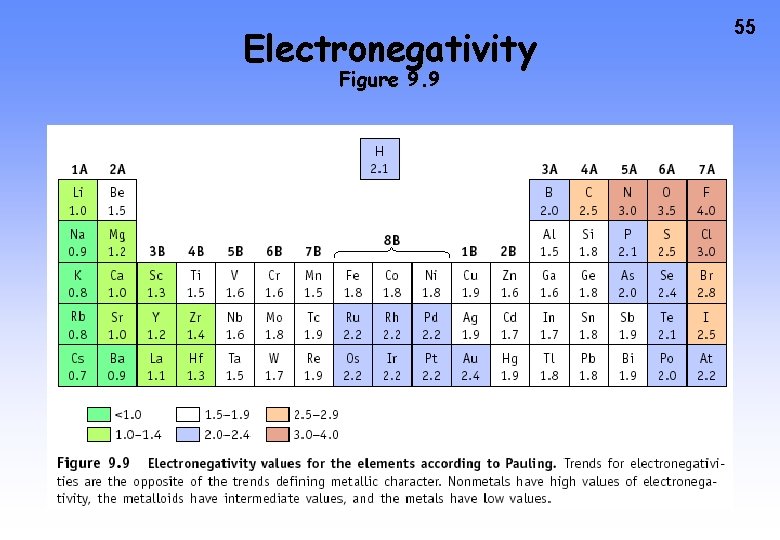
Electronegativity Figure 9. 9 55
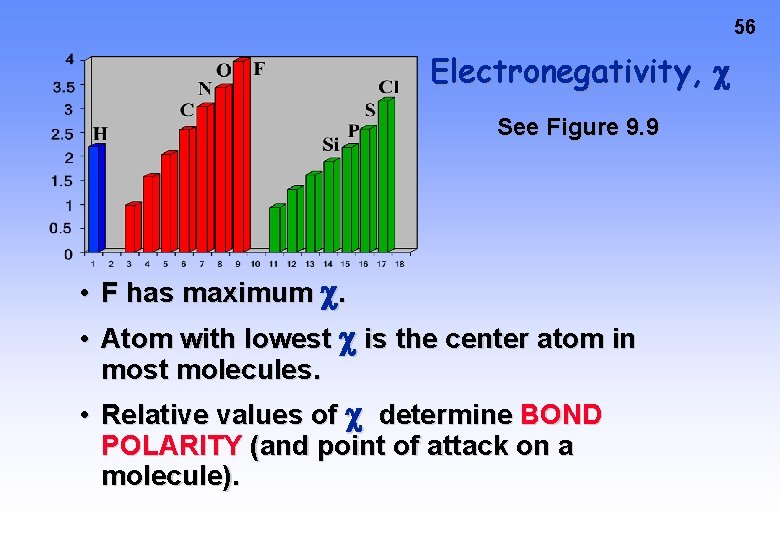
56 Electronegativity, See Figure 9. 9 • F has maximum . • Atom with lowest is the center atom in most molecules. • Relative values of determine BOND POLARITY (and point of attack on a molecule).
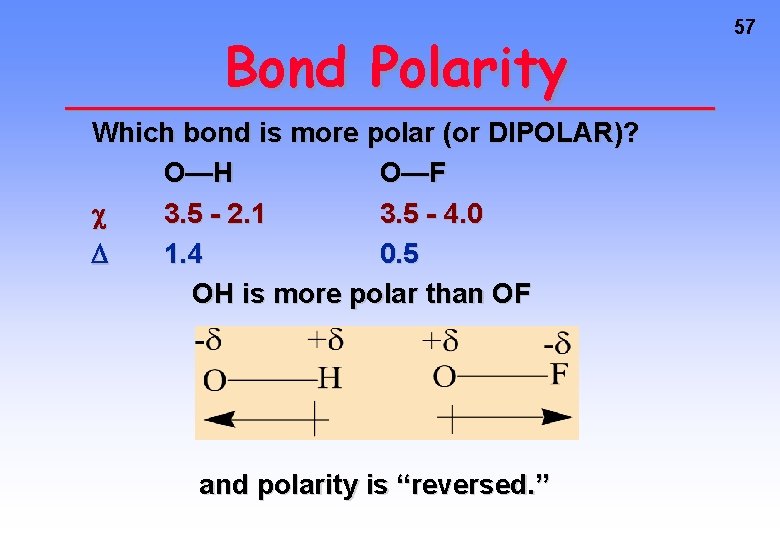
Bond Polarity Which bond is more polar (or DIPOLAR)? O—H O—F 3. 5 - 2. 1 3. 5 - 4. 0 1. 4 0. 5 OH is more polar than OF and polarity is “reversed. ” 57
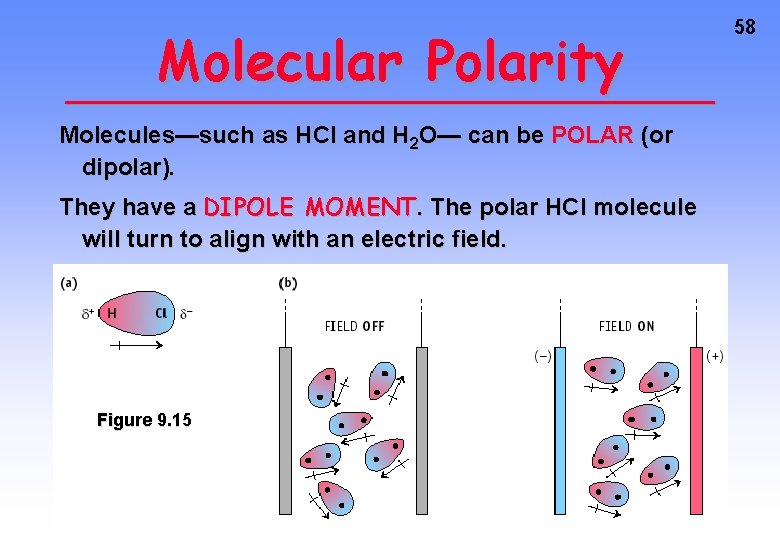
Molecular Polarity Molecules—such as HCl and H 2 O— can be POLAR (or dipolar). They have a DIPOLE MOMENT. The polar HCl molecule will turn to align with an electric field. Figure 9. 15 58
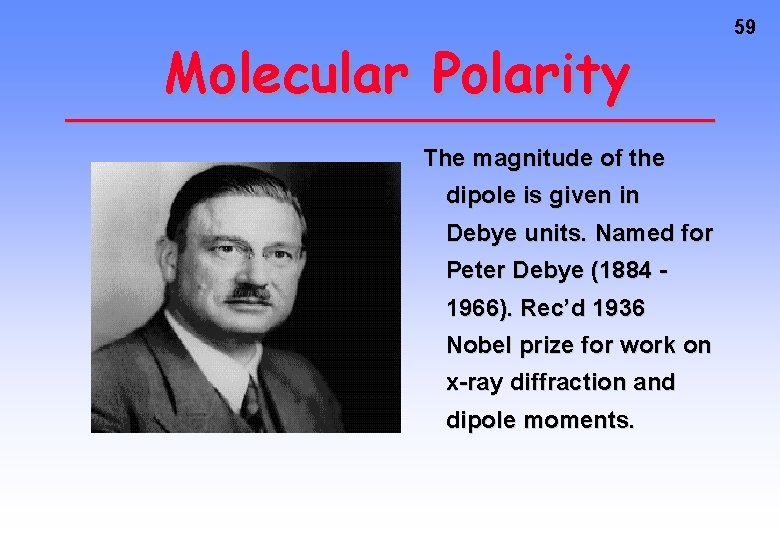
Molecular Polarity The magnitude of the dipole is given in Debye units. Named for Peter Debye (1884 1966). Rec’d 1936 Nobel prize for work on x-ray diffraction and dipole moments. 59
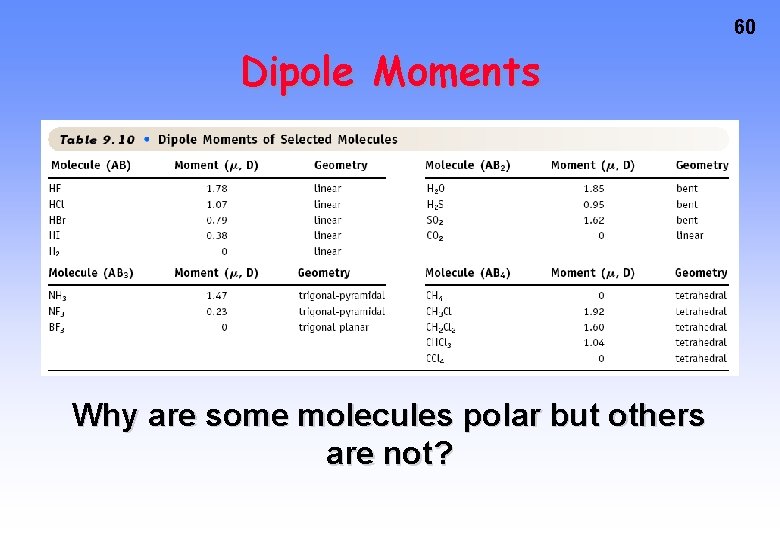
60 Dipole Moments Why are some molecules polar but others are not?
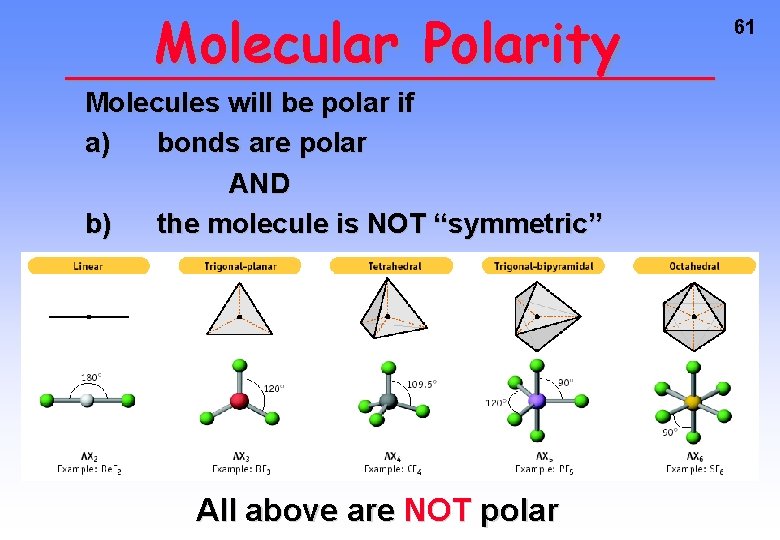
Molecular Polarity Molecules will be polar if a) bonds are polar AND b) the molecule is NOT “symmetric” All above are NOT polar 61
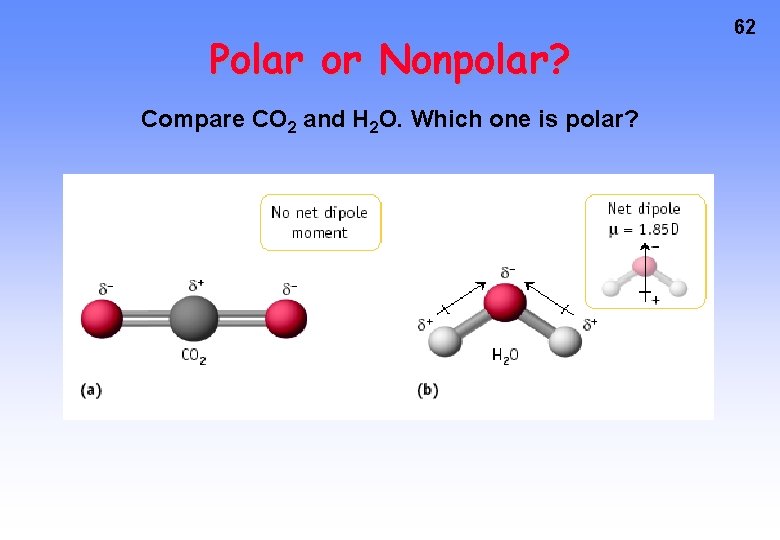
Polar or Nonpolar? Compare CO 2 and H 2 O. Which one is polar? 62
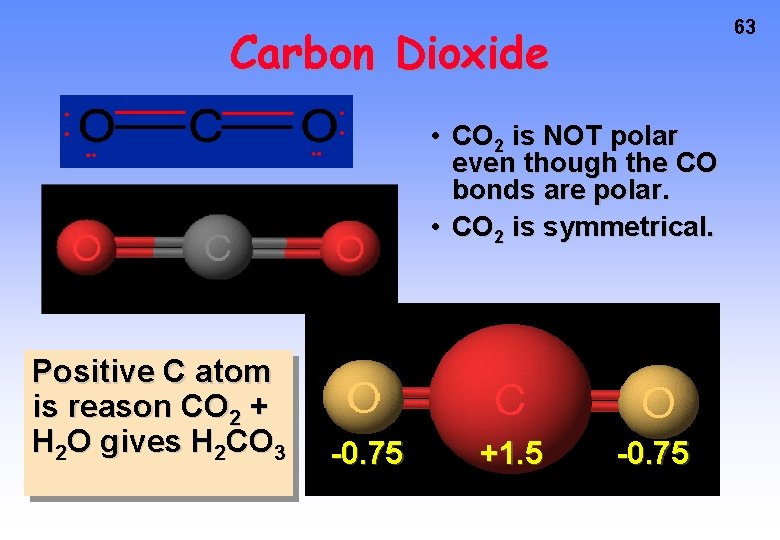
63 Carbon Dioxide • CO 2 is NOT polar even though the CO bonds are polar. • CO 2 is symmetrical. Positive C atom is reason CO 2 + H 2 O gives H 2 CO 3 -0. 75 +1. 5 -0. 75
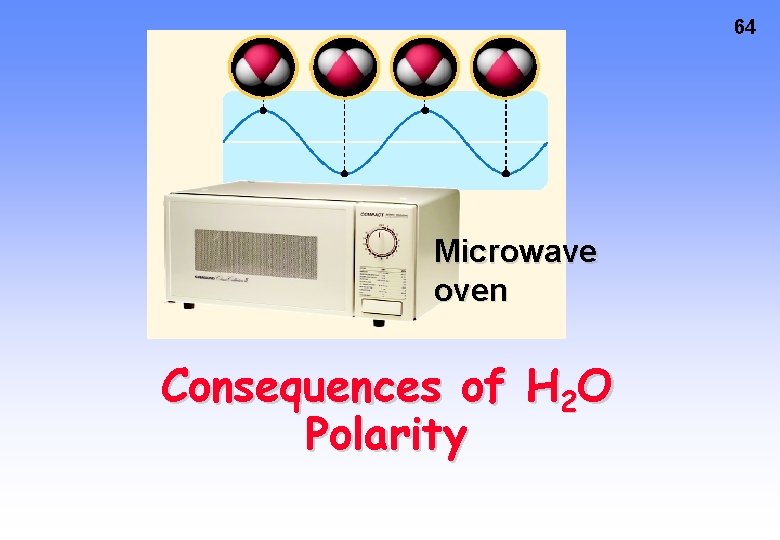
64 Microwave oven Consequences of H 2 O Polarity
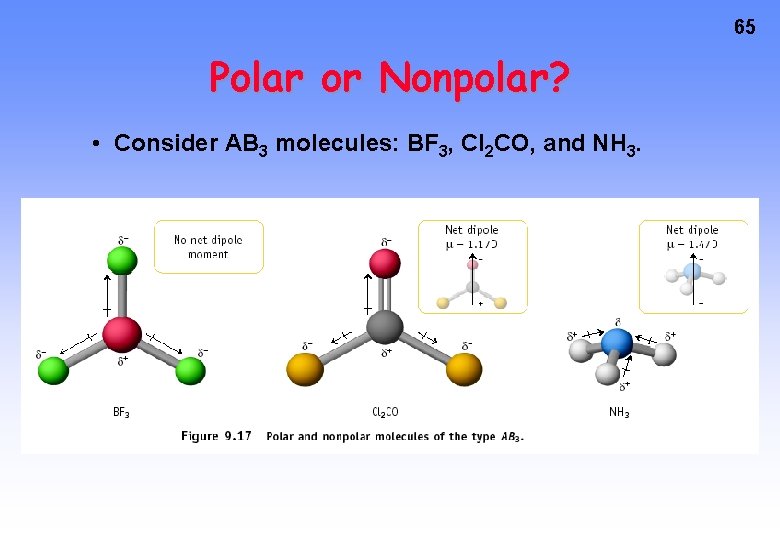
65 Polar or Nonpolar? • Consider AB 3 molecules: BF 3, Cl 2 CO, and NH 3.
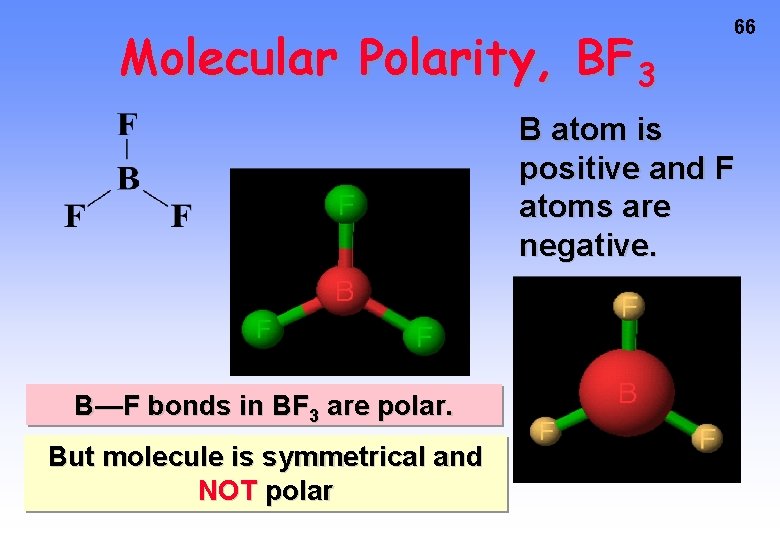
Molecular Polarity, BF 3 66 B atom is positive and F atoms are negative. B—F bonds in BF 3 are polar. But molecule is symmetrical and NOT polar
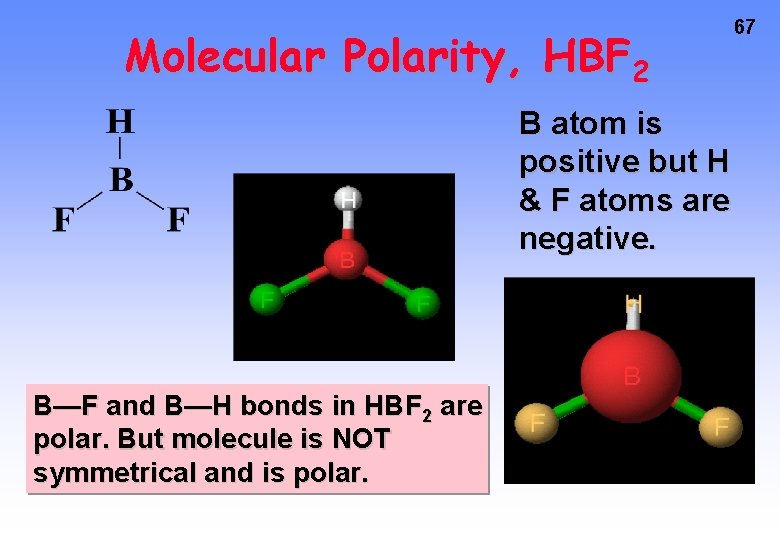
Molecular Polarity, HBF 2 B atom is positive but H & F atoms are negative. B—F and B—H bonds in HBF 2 are polar. But molecule is NOT symmetrical and is polar. 67
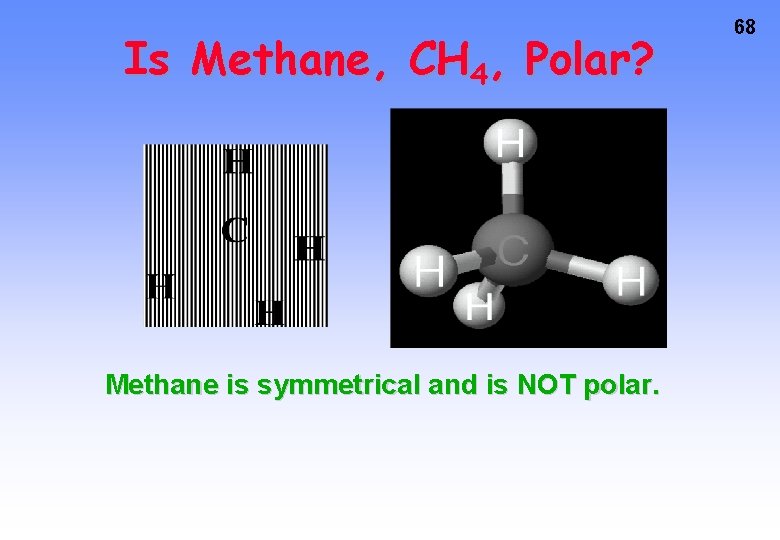
Is Methane, CH 4, Polar? Methane is symmetrical and is NOT polar. 68
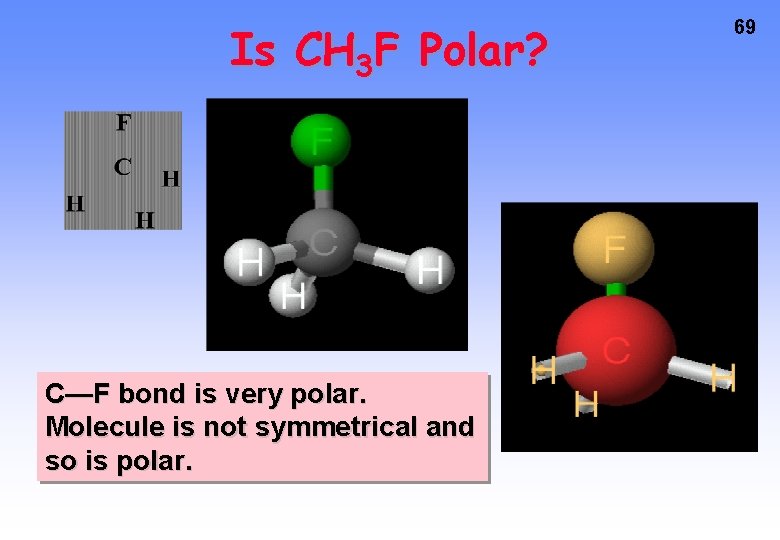
Is CH 3 F Polar? C—F bond is very polar. Molecule is not symmetrical and so is polar. 69
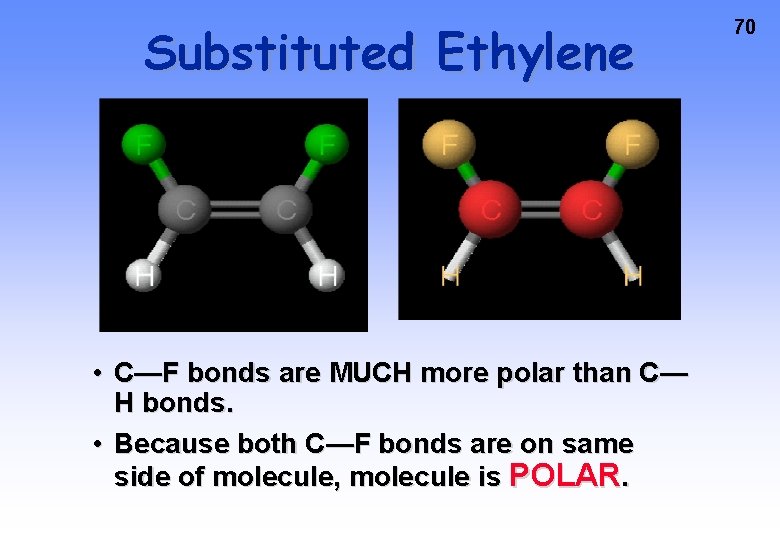
Substituted Ethylene • C—F bonds are MUCH more polar than C— H bonds. • Because both C—F bonds are on same side of molecule, molecule is POLAR. 70
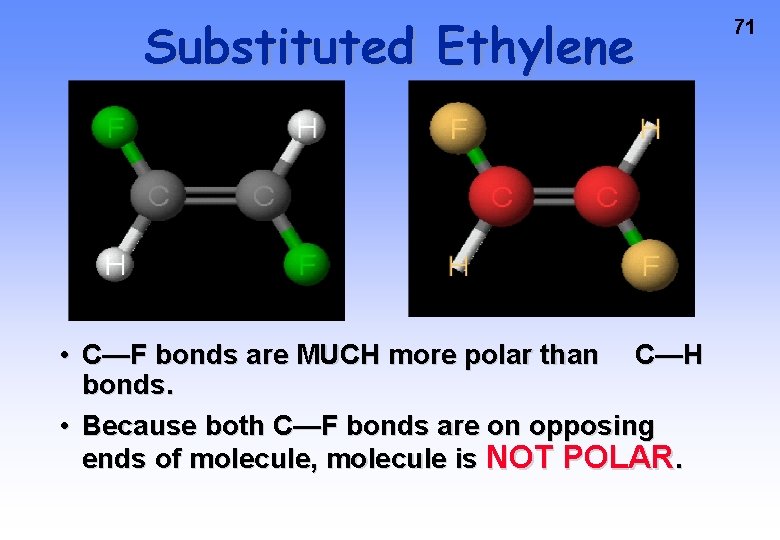
Substituted Ethylene • C—F bonds are MUCH more polar than C—H bonds. • Because both C—F bonds are on opposing ends of molecule, molecule is NOT POLAR. 71
- Slides: 71