
Chemical Bonding Chapter 6 Chemical Bonding Structure Molecular
Chemical Bonding Chapter 6

Chemical Bonding & Structure Molecular bonding and structure play the central role in determining the course of chemical reactions.

Bonds Forces that hold groups of atoms together and make them function as a unit.
Bond Energy - It is the energy required to break a bond. - It gives us information about the strength of a bonding interaction.

Bond Energies Bond breaking requires energy (endothermic). Bond formation releases energy (exothermic).
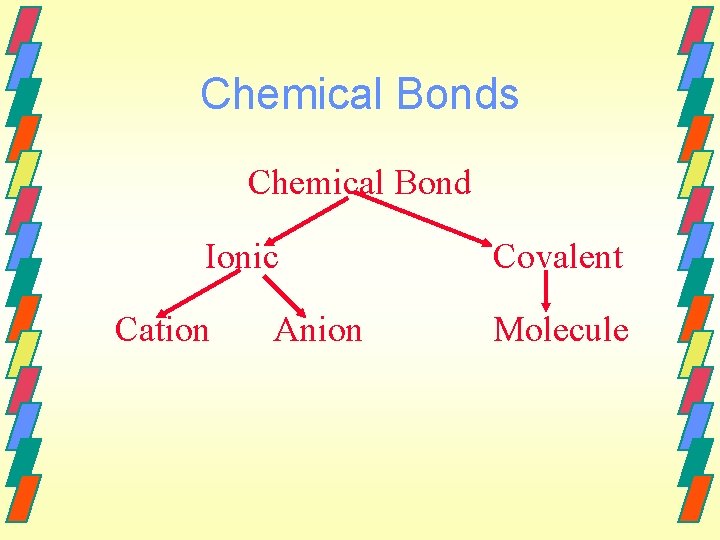
Chemical Bonds Chemical Bond Ionic Cation Anion Covalent Molecule

Ionic Bonds - Formed from electrostatic attractions of closely packed, oppositely charged ions. - Formed when an atom that easily loses electrons (metal) reacts with one that has a high electron affinity(nonmetal). - 2 Na(s) + Cl 2(g) ----> 2 Na+(aq) + 2 Cl-(aq)
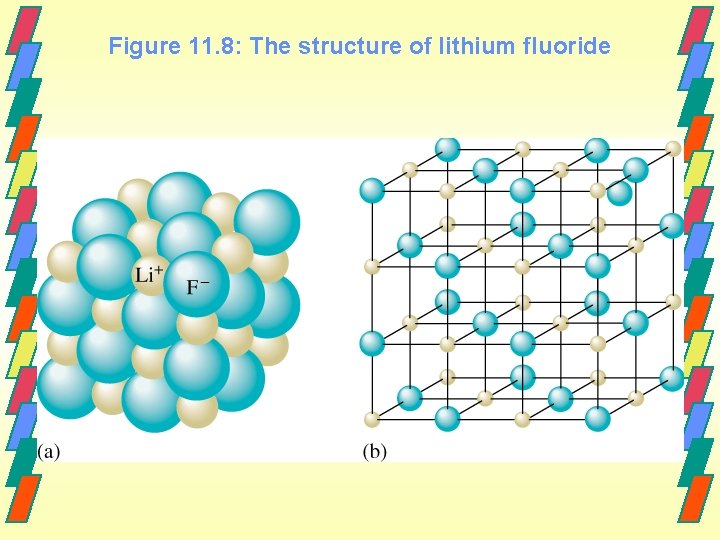
Figure 11. 8: The structure of lithium fluoride
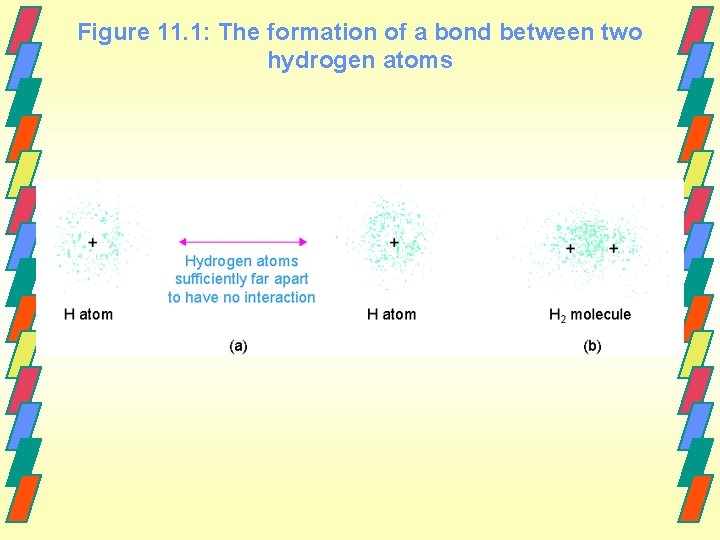
Figure 11. 1: The formation of a bond between two hydrogen atoms
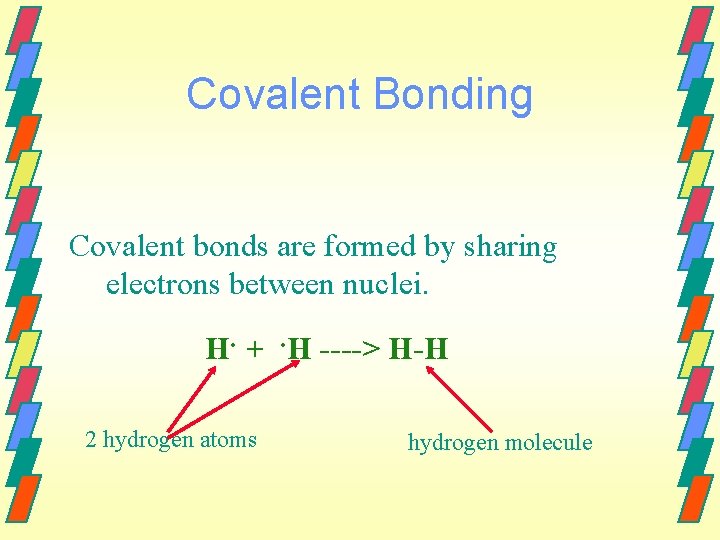
Covalent Bonding Covalent bonds are formed by sharing electrons between nuclei. H. +. H ----> H-H 2 hydrogen atoms hydrogen molecule
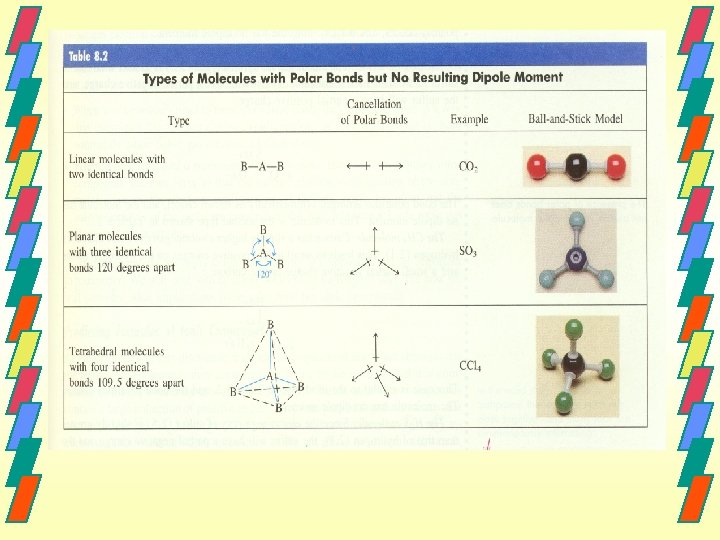
Types of Covalent Bonds Polar covalent bond -- covalent bond in which the electrons are not shared equally because one atom attracts them more strongly than the other. A dipole moment exists. HOH, HCl, & CO Nonpolar covalent bond -- covalent bond in which the electrons are shared equally between both atoms. No dipole moment exists. CO 2, CH 4, & Cl 2
Electronegativity The ability of an atom in a molecule to attract shared electrons to itself. As electronegativity increases, the attraction for electrons increases. Fluorine has the highest value at 4. 0 and cesium and francium are lowest at 0. 7.
Pauling Electronegativity Values
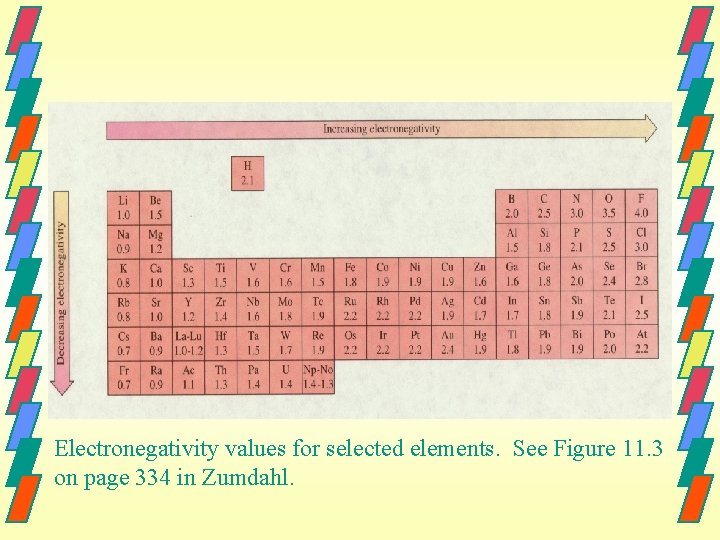
Electronegativity values for selected elements. See Figure 11. 3 on page 334 in Zumdahl.
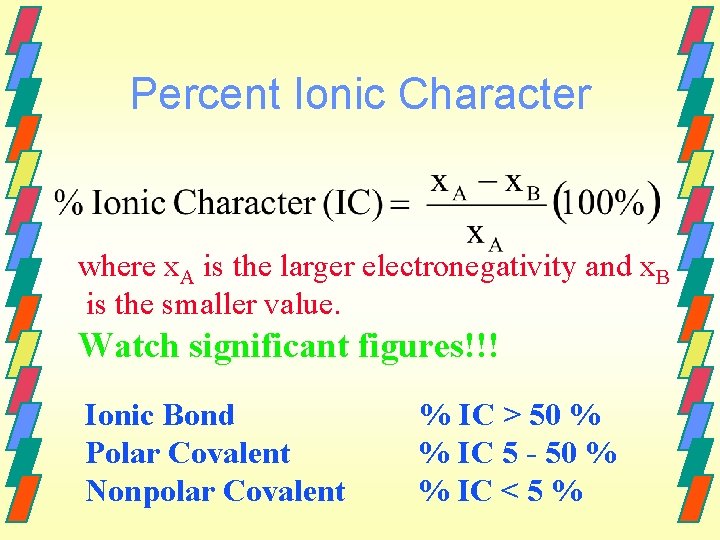
Percent Ionic Character where x. A is the larger electronegativity and x. B is the smaller value. Watch significant figures!!! Ionic Bond Polar Covalent Nonpolar Covalent % IC > 50 % % IC 5 - 50 % % IC < 5 %
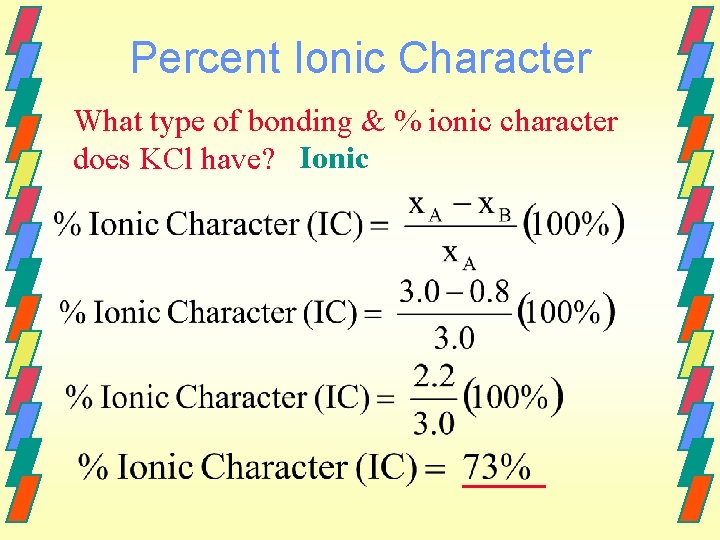
Percent Ionic Character What type of bonding & % ionic character does KCl have? Ionic

Percent Ionic Character What type of bonding & % ionic character does HOH have? Polar covalent

Percent Ionic Character What type of bonding & % ionic character does N 2 have? Nonpolar covalent
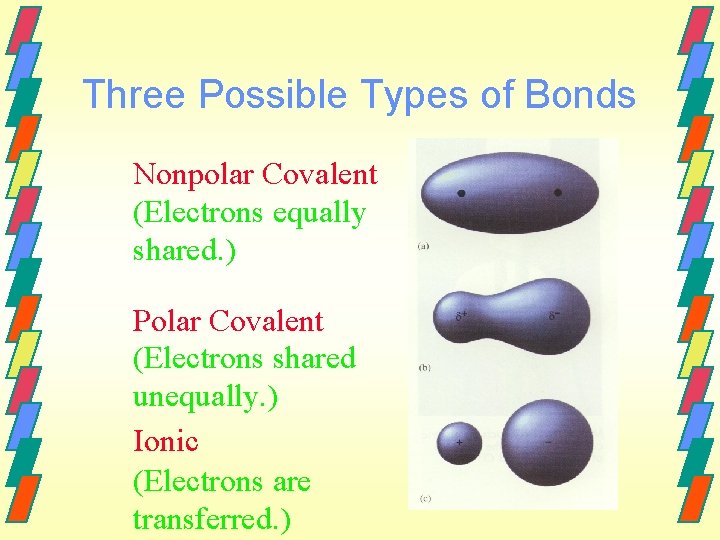
Three Possible Types of Bonds Nonpolar Covalent (Electrons equally shared. ) Polar Covalent (Electrons shared unequally. ) Ionic (Electrons are transferred. )
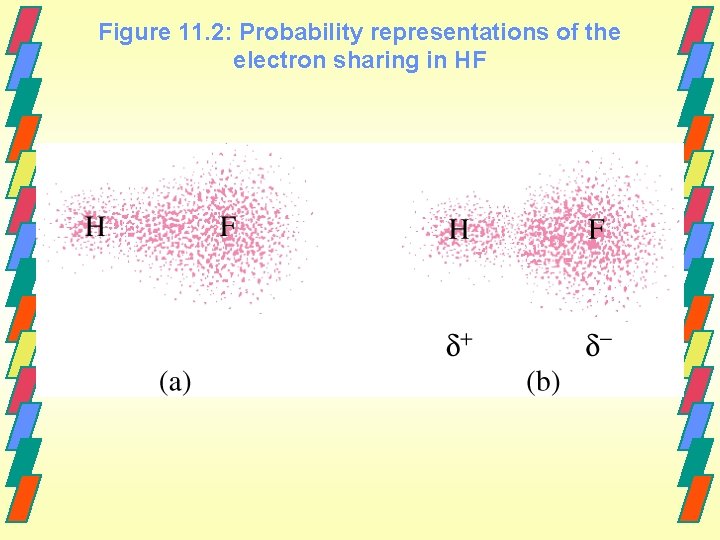
Figure 11. 2: Probability representations of the electron sharing in HF
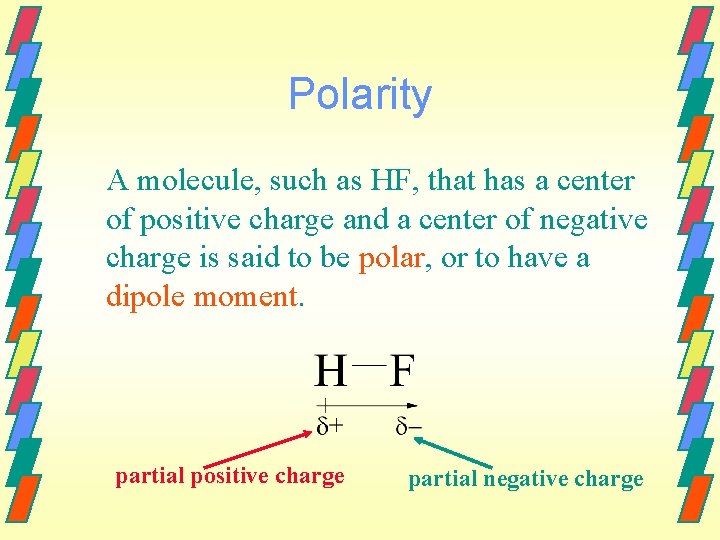
Polarity A molecule, such as HF, that has a center of positive charge and a center of negative charge is said to be polar, or to have a dipole moment. partial positive charge partial negative charge
The Effect of an electric field on hydrogen fluoride molecules.
Dipole Moment for the water molecule.
Polar Water Molecule The polarity of water allows it to dissolve ionic materials which are essential for life. The polarity of the water molecule allows water molecules to attract each other strongly (hydrogen bonds). Because of this fact water remains as a liquid at room temperatures and allows the existence of life as we know it.
Dipole moment for the ammonia molecule.
Nonpolar molecule--zero dipole moment.

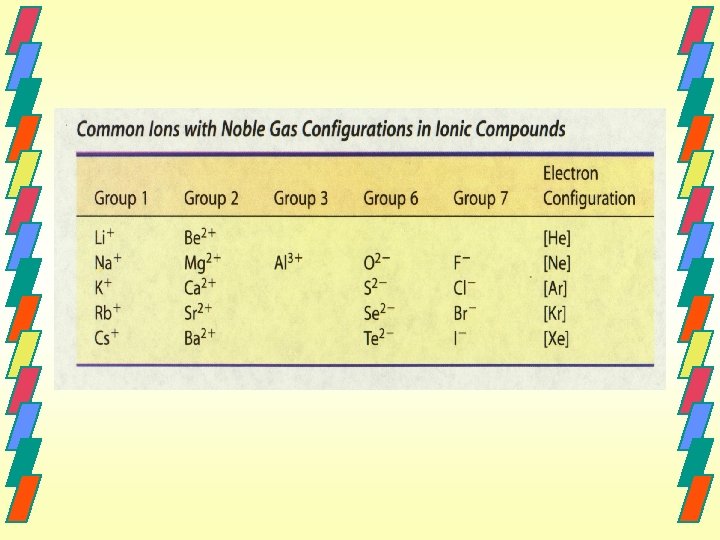
Achieving Noble Gas Electron Configurations (NGEC) Two nonmetals react: They share electrons to achieve NGEC. A nonmetal and a representative group metal react (ionic compound): The valence orbitals of the metal are emptied to achieve NGEC. The valence electron configuration of the nonmetal achieves NGEC.
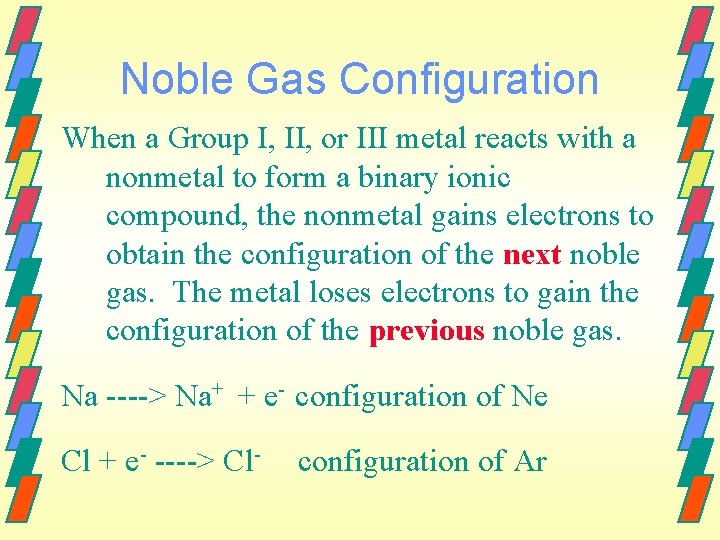
Noble Gas Configuration When a Group I, II, or III metal reacts with a nonmetal to form a binary ionic compound, the nonmetal gains electrons to obtain the configuration of the next noble gas. The metal loses electrons to gain the configuration of the previous noble gas. Na ----> Na+ + e- configuration of Ne Cl + e- ----> Cl- configuration of Ar
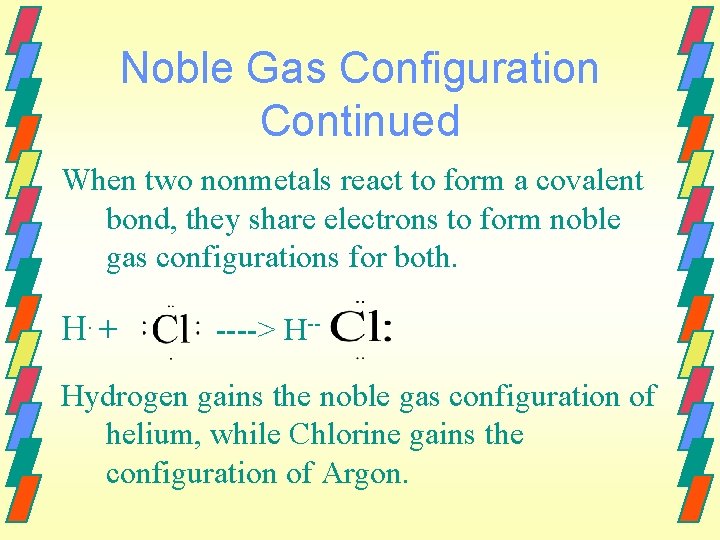
Noble Gas Configuration Continued When two nonmetals react to form a covalent bond, they share electrons to form noble gas configurations for both. H. + ----> H-- Hydrogen gains the noble gas configuration of helium, while Chlorine gains the configuration of Argon.
Anion Size Anions are always larger than the parent atom because they have added electrons which repel each other. As well, the number of protons is less than the number of electrons so they are not held as tightly.
Cation Size Cations are always smaller than the parent atom because they have lost an entire electron shell. As well, the number of protons is greater than the number of electrons so the electrons are held tighter.
Relative sizes of some ions and their parent atoms.
Lewis Structure - Shows how valence electrons are arranged among atoms in a molecule. - Reflects central idea that stability of a compound relates to noble gas electron configuration. - Developed by G. N. Lewis in 1902.
![Lewis Structures Na. sodium atom sulfur atom [Na]+ sodium ion [ ] sulfide ion](http://slidetodoc.com/presentation_image/b7cbf84d09b23bfe13c2e91b60bdb645/image-36.jpg "Lewis Structures Na. sodium atom sulfur atom [Na]+ sodium ion [ ] sulfide ion")
Lewis Structures Na. sodium atom sulfur atom [Na]+ sodium ion [ ] sulfide ion
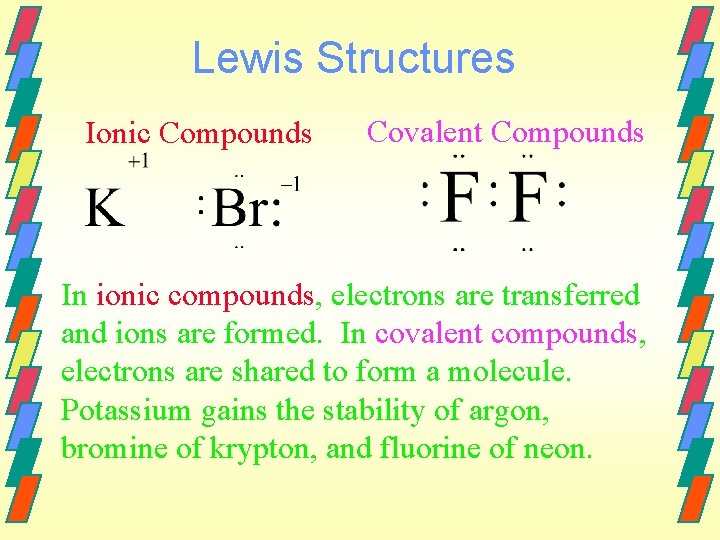
Lewis Structures Ionic Compounds Covalent Compounds In ionic compounds, electrons are transferred and ions are formed. In covalent compounds, electrons are shared to form a molecule. Potassium gains the stability of argon, bromine of krypton, and fluorine of neon.
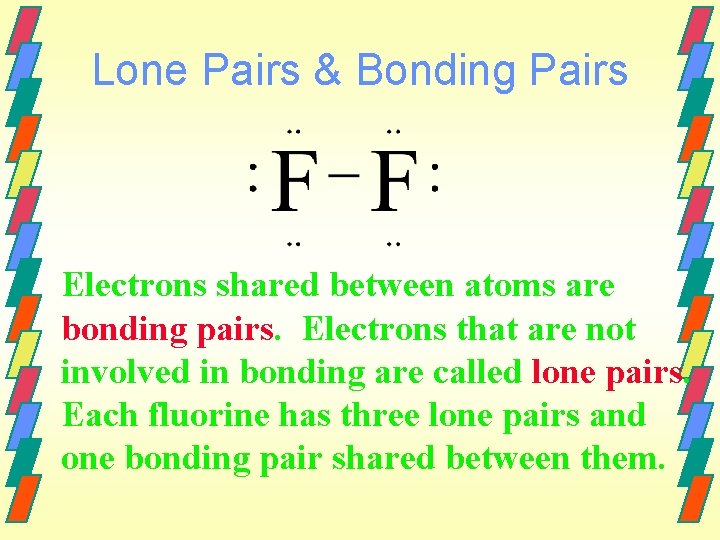
Lone Pairs & Bonding Pairs Electrons shared between atoms are bonding pairs. Electrons that are not involved in bonding are called lone pairs. Each fluorine has three lone pairs and one bonding pair shared between them.
Octet Neon does not form bonds because it has a full outer shell of electrons--an octet. An octet is four pairs of electrons and represents extra stability for atoms and ions.
Rules for Writing Lewis Structures • Sum the valence electrons from all the atoms. • Use a pair of electrons to form a bond between each pair of bound atoms. • Arrange remaining electrons to satisfy the duet rule for hydrogen and the octet rule for the second-row elements.
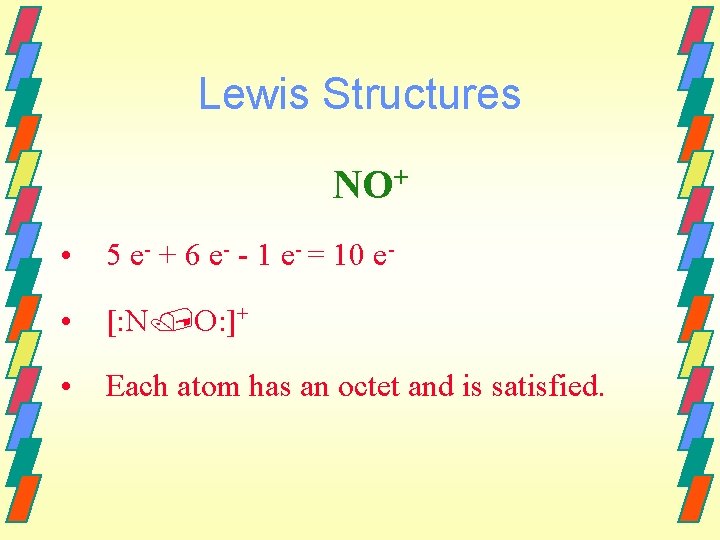
Lewis Structures NO+ • 5 e- + 6 e- - 1 e- = 10 e- • [: N O: ]+ • Each atom has an octet and is satisfied.

Single, Double, & Triple Bonds Single bonds -- one shared pair of electrons. Double bonds -- two shared pairs of electrons. Triple bonds -- three shared pairs of electrons.
• Bond Strength = Triple > Double > Single –For bonds between same atoms, C N > C=N > C—N –Though Double not 2 x the strength of Single and Triple not 3 x the strength of Single • Bond Length = Single > Double > Triple –For bonds between same atoms, C—N > C=N > C N

Comments About the Octet Rule - 2 nd row elements C, N, O, F observe the octet rule. - 2 nd row elements B and Be often have fewer than 8 electrons around themselves - they are very reactive. - 3 rd row and heavier elements CAN exceed the octet rule using empty valence d orbitals. - When writing Lewis structures, satisfy octets first, then place electrons around elements having available d orbitals.
Electron Deficient Molecules Beryllium chloride -- Be. Cl 2 -- is electron deficient with four electrons. It forms a linear molecule. Boron trifluoride -- BF 3 -- is electron deficient with six electrons. It forms a trigonal planar molecule. See page 351 for the reaction between boron trifluoride and ammonia.
Four Failures of Lewis Structures cannot adequately explain: 1. electron-deficient molecules. 2. the paramagnetism of oxygen and other similar substances. 3. odd-electron molecules. 4. resonance.
Odd-Electron Molecules NO 2 • contains 17 electrons. • cannot satisfy the octet rule. • a more sophisticated model is neededthe molecular orbital model.
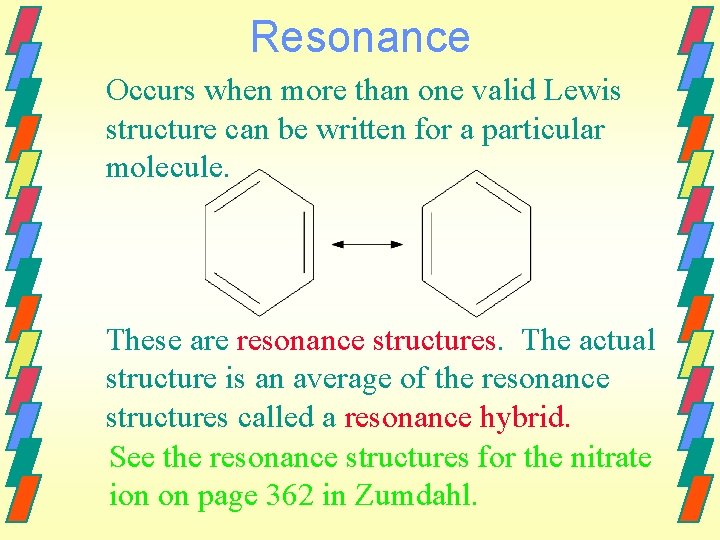
Resonance Occurs when more than one valid Lewis structure can be written for a particular molecule. These are resonance structures. The actual structure is an average of the resonance structures called a resonance hybrid. See the resonance structures for the nitrate ion on page 362 in Zumdahl.
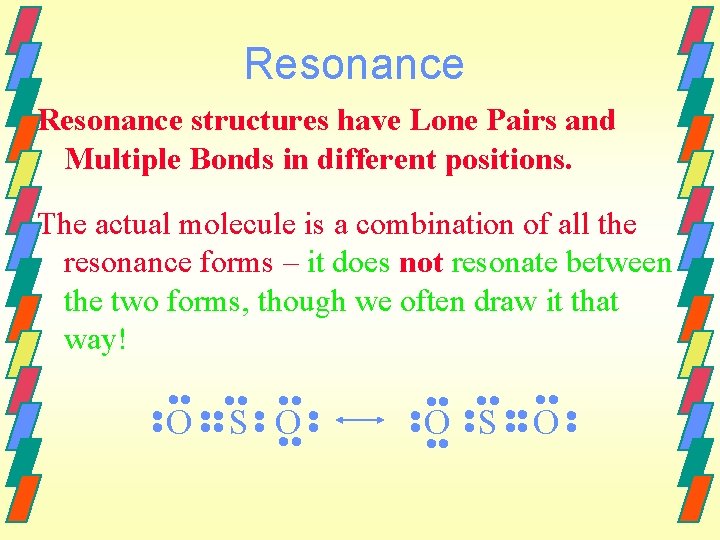
Resonance structures have Lone Pairs and Multiple Bonds in different positions. The actual molecule is a combination of all the resonance forms – it does not resonate between the two forms, though we often draw it that way! • • O • • • • S • • O • •
Stereochemistry The study of the threedimensional arrangement (molecular structure) of atoms or groups of atoms within molecules and the properties which follow such arrangement.
VSEPR Model Valence Shell Electron Pair Repulsion -- The structure around a given atom is determined principally by minimizing electron pair repulsions.
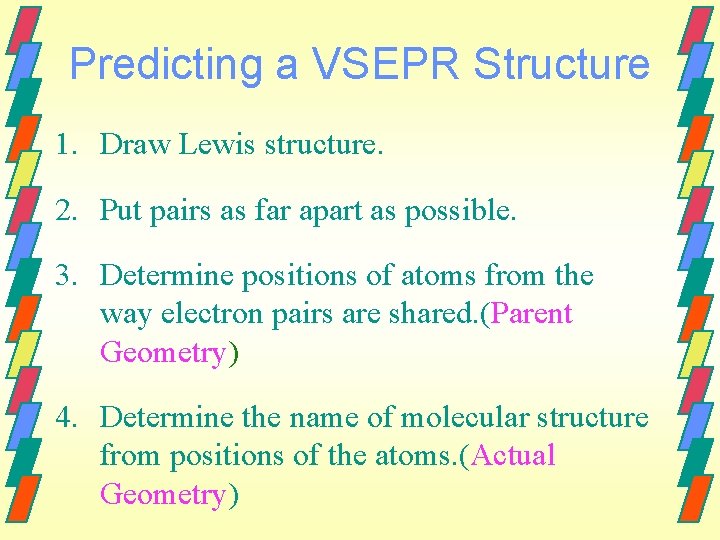
Predicting a VSEPR Structure 1. Draw Lewis structure. 2. Put pairs as far apart as possible. 3. Determine positions of atoms from the way electron pairs are shared. (Parent Geometry) 4. Determine the name of molecular structure from positions of the atoms. (Actual Geometry)
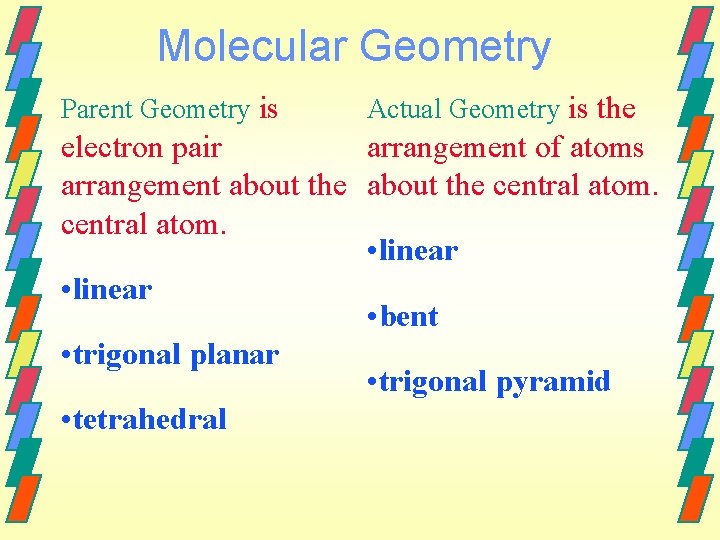
Molecular Geometry Parent Geometry is Actual Geometry is the electron pair arrangement of atoms arrangement about the central atom. • linear • bent • trigonal planar • trigonal pyramid • tetrahedral
Lone pair of electrons on the ammonia molecule.

08_143 Lone pair Bonding pair O H (a) H Lone pair (b) O H (c) H Lone pairs on the water molecule.
VSEPR Two pairs of electrons are placed 180 o apart -linear arrangement. Three pairs of electrons are placed 120 o apart - trigonal planar arrangement. Four pairs of electrons are placed 109. 5 o apart -- tetrahedral arrangement. Double bonds and triple bonds count as one effective pair of electrons.

Electron pair arrangement is the parent geometry. Molecular structure is the actual geometry.

Parent & Actual Geometry When every pair of electrons on the central atom is shared with another atom, the parent and actual geometry are the same. When one or more pair of electron pairs around a central atom are unshared(lone pairs), the parent and actual geometry are different.
VSEPR Model Summary • Determine the Lewis structure(s) for the molecule. • For molecules with resonance structures, use any of the structures to predict the molecular structure. • Sum the electron pairs around the central atom to determine the parent geometry. • The arrangement of the pairs is determined by minimizing electron-pair repulsions. (Actual Geometry)
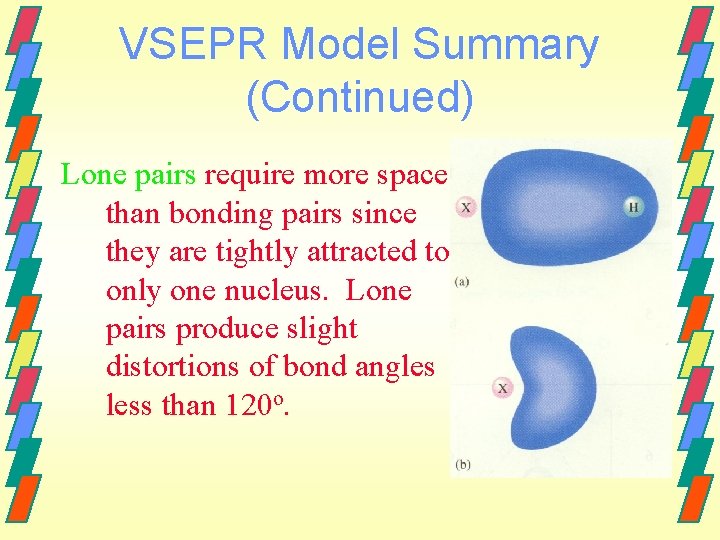
VSEPR Model Summary (Continued) Lone pairs require more space than bonding pairs since they are tightly attracted to only one nucleus. Lone pairs produce slight distortions of bond angles less than 120 o.
- Slides: 60