
Chemical Bonding and Molecular Geometry Ionic Bond Formation
Chemical Bonding and Molecular Geometry • • Ionic Bond Formation of Ions Electron Configurations of Ions Ionic Size and Charge density, Relative Strength of Ionic Bonds Lattice Energy Steps in the Formation of an Ionic Compound The Born-Haber Cycle
Chemical Bonding and Molecular Geometry • • • Covalent Bonds Electronegativity Polarity of Covalent Bonds Lewis Structures and the Octet Rule Exceptions to the Octet Rule Resonance Lewis Structures Bond Energies Calculating Enthalpy using Bond Energy Molecular Shape - The VSEPR Model
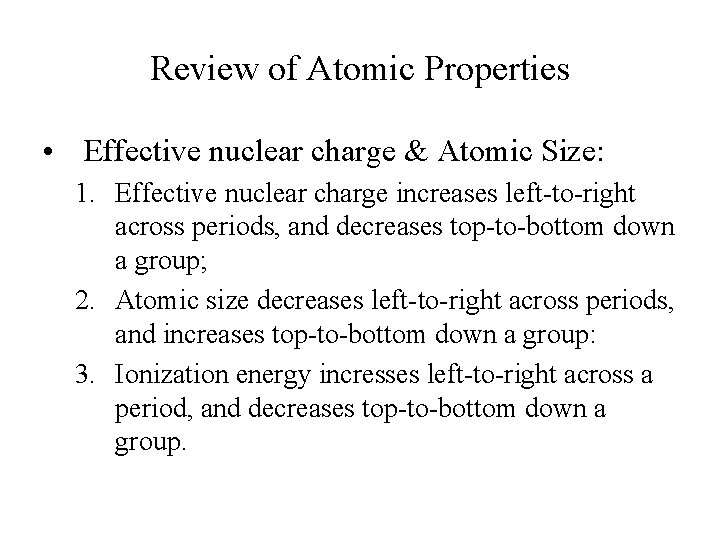
Review of Atomic Properties • Effective nuclear charge & Atomic Size: 1. Effective nuclear charge increases left-to-right across periods, and decreases top-to-bottom down a group; 2. Atomic size decreases left-to-right across periods, and increases top-to-bottom down a group: 3. Ionization energy incresses left-to-right across a period, and decreases top-to-bottom down a group.
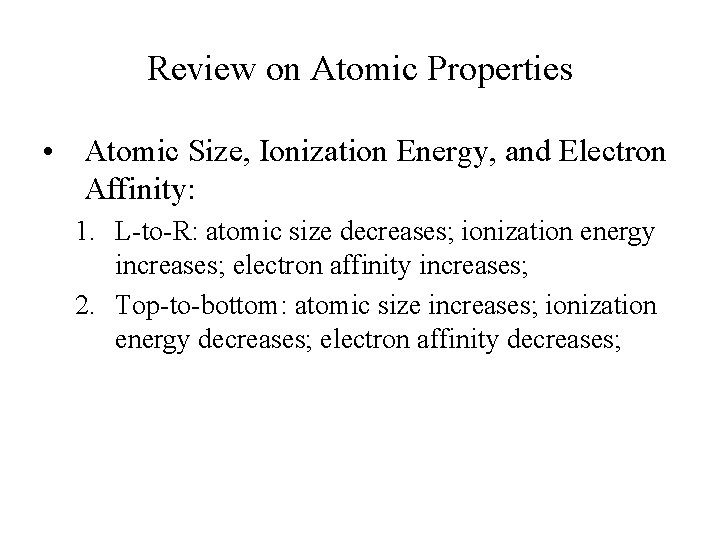
Review on Atomic Properties • Atomic Size, Ionization Energy, and Electron Affinity: 1. L-to-R: atomic size decreases; ionization energy increases; electron affinity increases; 2. Top-to-bottom: atomic size increases; ionization energy decreases; electron affinity decreases;
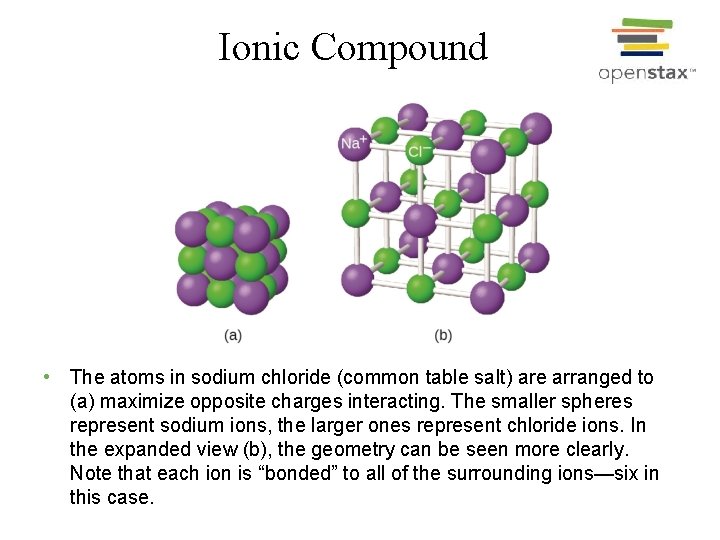
Ionic Compound • The atoms in sodium chloride (common table salt) are arranged to (a) maximize opposite charges interacting. The smaller spheres represent sodium ions, the larger ones represent chloride ions. In the expanded view (b), the geometry can be seen more clearly. Note that each ion is “bonded” to all of the surrounding ions—six in this case.
Ionic bonds • Attractions between cations and anions; • Bonds formed between metals and nonmetals
Formation of Cations • Ions are formed when metals react with nonmetals – the metal atom loses one or more of its valence electrons to the nonmetal atom; • Atoms of representative metals lose valence electrons to acquire the noble gas electron configurations; • Cations of representative metals have noble gas electron configurations;
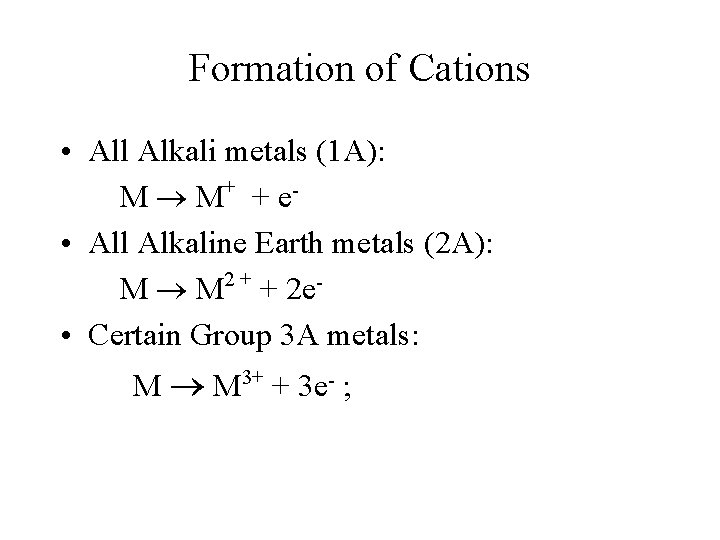
Formation of Cations • All Alkali metals (1 A): M M+ + e • All Alkaline Earth metals (2 A): M M 2 + + 2 e • Certain Group 3 A metals: M M + 3 e- ; 3+
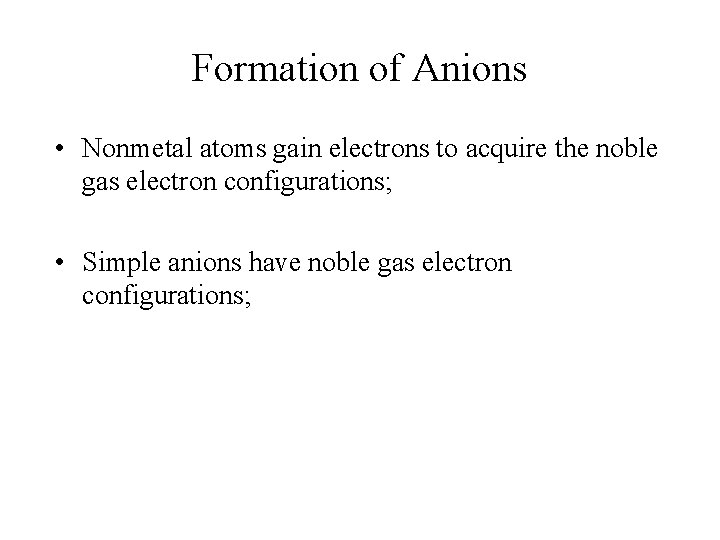
Formation of Anions • Nonmetal atoms gain electrons to acquire the noble gas electron configurations; • Simple anions have noble gas electron configurations;
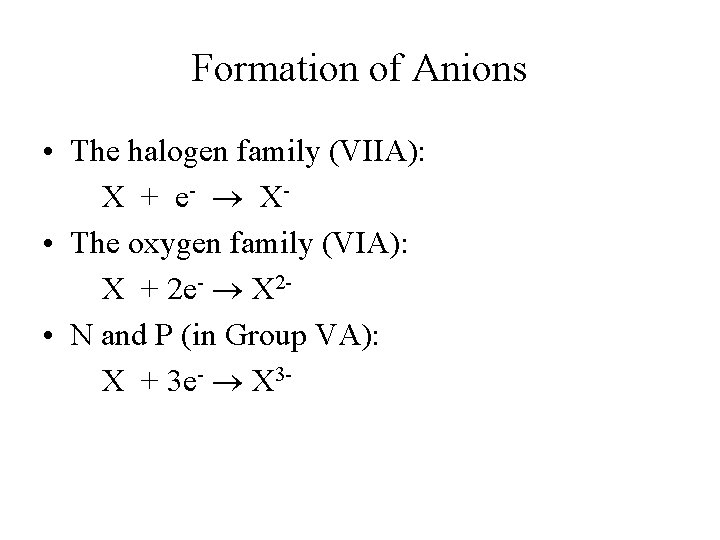
Formation of Anions • The halogen family (VIIA): X + e - X • The oxygen family (VIA): X + 2 e- X 2 • N and P (in Group VA): X + 3 e- X 3 -
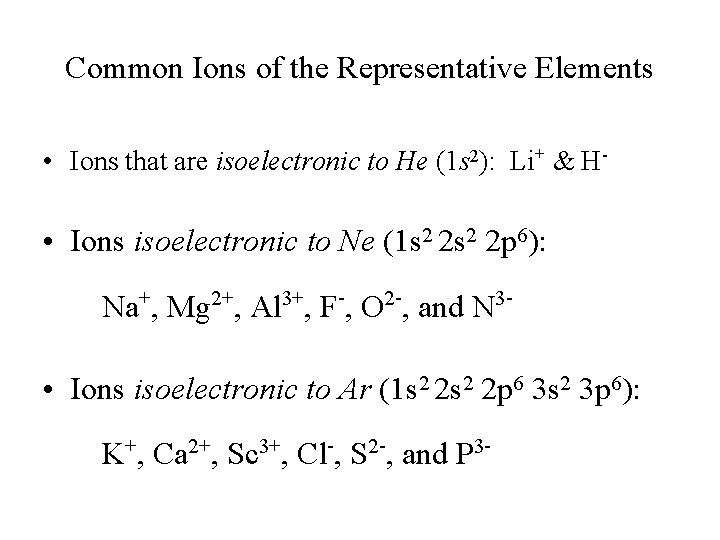
Common Ions of the Representative Elements • Ions that are isoelectronic to He (1 s 2): Li+ & H- • Ions isoelectronic to Ne (1 s 2 2 p 6): Na+, Mg 2+, Al 3+, F-, O 2 -, and N 3 - • Ions isoelectronic to Ar (1 s 2 2 p 6 3 s 2 3 p 6): K+, Ca 2+, Sc 3+, Cl-, S 2 -, and P 3 -
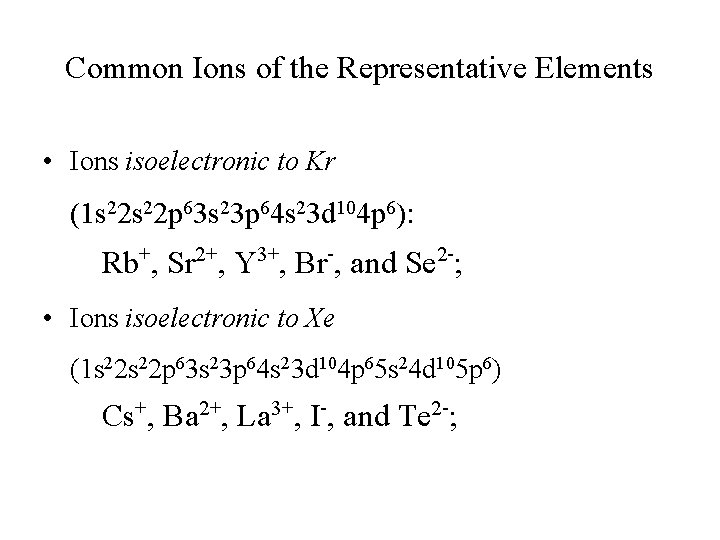
Common Ions of the Representative Elements • Ions isoelectronic to Kr (1 s 22 p 63 s 23 p 64 s 23 d 104 p 6): Rb+, Sr 2+, Y 3+, Br-, and Se 2 -; • Ions isoelectronic to Xe (1 s 22 p 63 s 23 p 64 s 23 d 104 p 65 s 24 d 105 p 6) Cs+, Ba 2+, La 3+, I-, and Te 2 -;
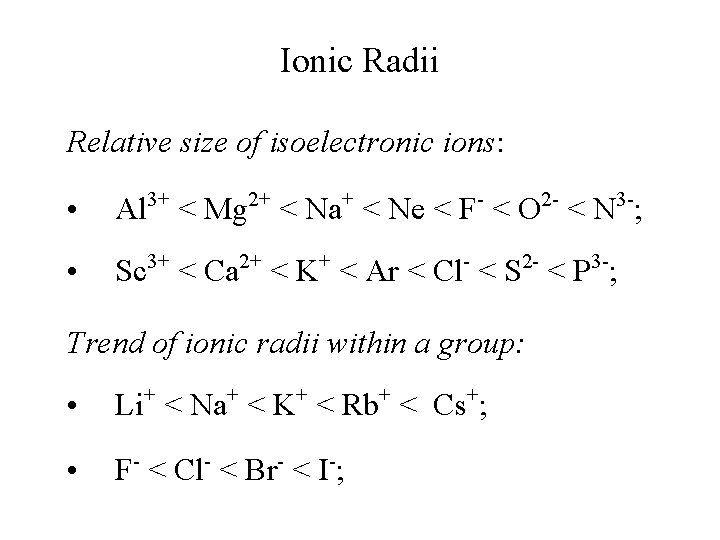
Ionic Radii Relative size of isoelectronic ions: • • Al 3+ < Mg 2+ < Na+ < Ne < F- < O 2 - < N 3 -; 3+ 2+ + - 2 - 3 - Sc < Ca < K < Ar < Cl < S < P ; Trend of ionic radii within a group: • Li+ < Na+ < K+ < Rb+ < Cs+; • F- < Cl- < Br- < I-;
Cations From Transition Metals • Atoms of the transition metals lose variable number of electrons; • Cations have variable charges; • Cations derived from transition metal group do not acquire the noble gas electron configuration;
![Electron Configurations of Selected Cations from Transition Metals • Examples: Cr: [Ar] 4 s](http://slidetodoc.com/presentation_image_h2/5ef240c2aa906a8a29588d219d2b11d6/image-15.jpg "Electron Configurations of Selected Cations from Transition Metals • Examples: Cr: [Ar] 4 s")
Electron Configurations of Selected Cations from Transition Metals • Examples: Cr: [Ar] 4 s 13 d 5 Cr 2+ + 2 e-; Cr 2+: [Ar] 3 d 4 Cr 3+ + 3 e-; Cr 3+: [Ar] 3 d 3 Fe: [Ar] 4 s 23 d 6 Fe 2+ + 2 e-; Fe 3+ + 3 e-; Fe 2+: [Ar] 3 d 6 Fe 3+: [Ar] 3 d 5
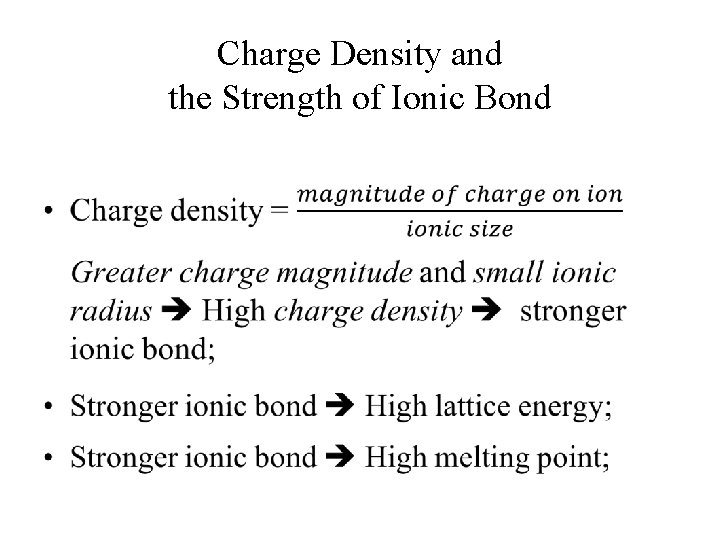
Charge Density and the Strength of Ionic Bond •
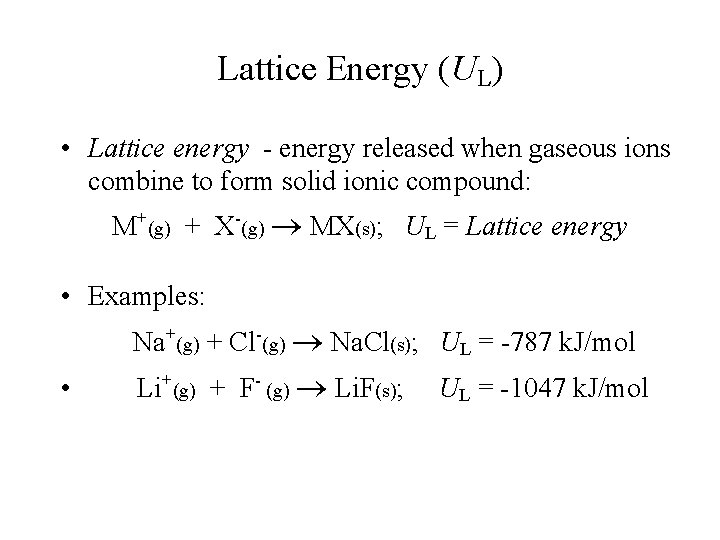
Lattice Energy (UL) • Lattice energy - energy released when gaseous ions combine to form solid ionic compound: M+(g) + X-(g) MX(s); UL = Lattice energy • Examples: Na+(g) + Cl-(g) Na. Cl(s); UL = -787 k. J/mol • Li+(g) + F- (g) Li. F(s); UL = -1047 k. J/mol
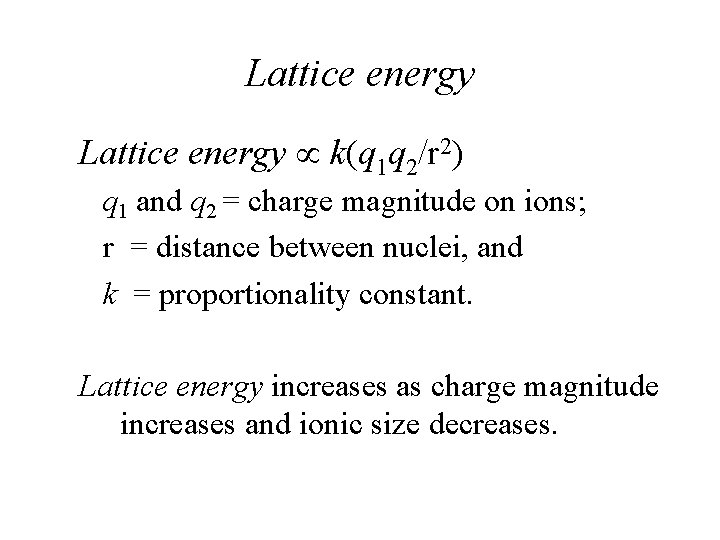
Lattice energy k(q 1 q 2/r 2) q 1 and q 2 = charge magnitude on ions; r = distance between nuclei, and k = proportionality constant. Lattice energy increases as charge magnitude increases and ionic size decreases.
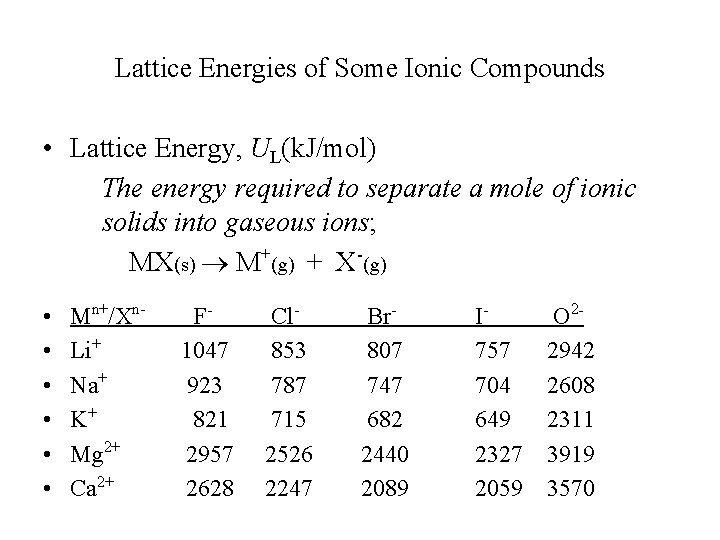
Lattice Energies of Some Ionic Compounds • Lattice Energy, UL(k. J/mol) The energy required to separate a mole of ionic solids into gaseous ions; MX(s) M+(g) + X-(g) • • • Mn+/Xn. Li+ Na+ K+ Mg 2+ Ca 2+ F 1047 923 821 2957 2628 Cl 853 787 715 2526 2247 Br 807 747 682 2440 2089 I 757 704 649 2327 2059 O 22942 2608 2311 3919 3570
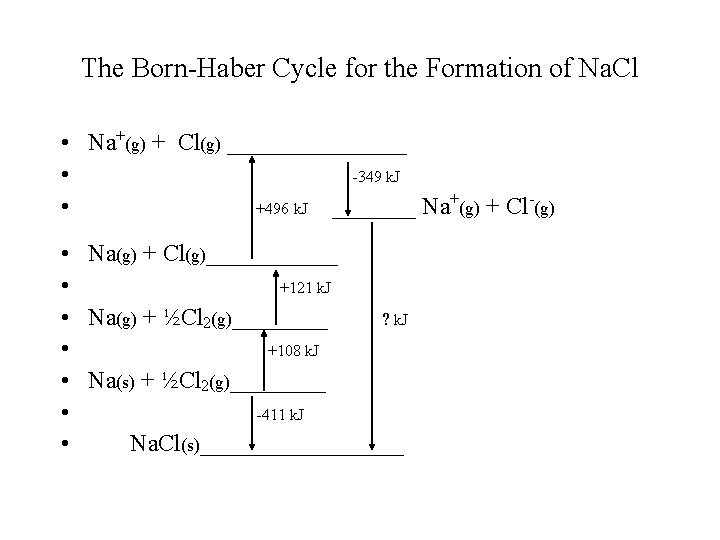
The Born-Haber Cycle for the Formation of Na. Cl • Na+(g) + Cl(g) ________ • -349 k. J • +496 k. J _______ Na+(g) + Cl-(g) • Na(g) + Cl(g)______ • +121 k. J • Na(g) + ½Cl 2(g)____ ? k. J • +108 k. J • Na(s) + ½Cl 2(g)____ • -411 k. J • Na. Cl(s)_________
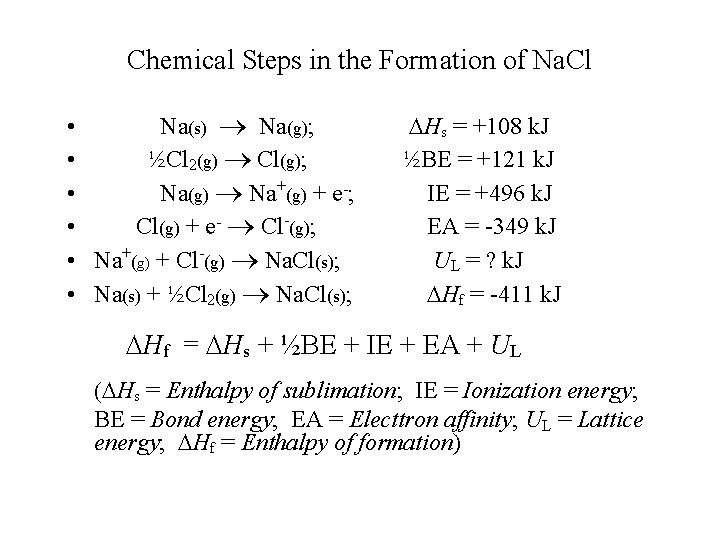
Chemical Steps in the Formation of Na. Cl • Na(s) Na(g); • ½Cl 2(g) Cl(g); • Na(g) Na+(g) + e-; • Cl(g) + e- Cl-(g); • Na+(g) + Cl-(g) Na. Cl(s); • Na(s) + ½Cl 2(g) Na. Cl(s); DHs = +108 k. J ½BE = +121 k. J IE = +496 k. J EA = -349 k. J UL = ? k. J DHf = -411 k. J DHf = DHs + ½BE + IE + EA + UL (DHs = Enthalpy of sublimation; IE = Ionization energy; BE = Bond energy; EA = Electtron affinity; UL = Lattice energy; DHf = Enthalpy of formation)
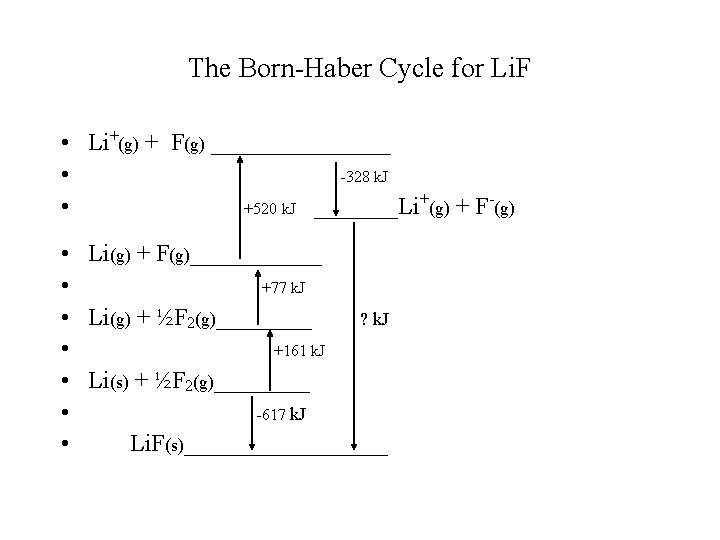
The Born-Haber Cycle for Li. F • Li+(g) + F(g) ________ • -328 k. J + • +520 k. J _______Li (g) + F (g) • Li(g) + F(g)______ • +77 k. J • Li(g) + ½F 2(g)____ ? k. J • +161 k. J • Li(s) + ½F 2(g)____ • -617 k. J • Li. F(s)_________
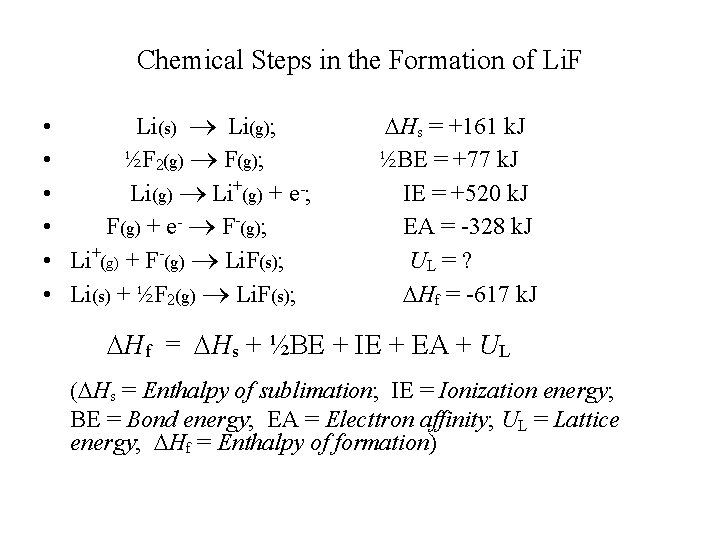
Chemical Steps in the Formation of Li. F • Li(s) Li(g); • ½F 2(g) F(g); • Li(g) Li+(g) + e-; • F(g) + e- F-(g); • Li+(g) + F-(g) Li. F(s); • Li(s) + ½F 2(g) Li. F(s); DHs = +161 k. J ½BE = +77 k. J IE = +520 k. J EA = -328 k. J UL = ? DHf = -617 k. J DHf = DHs + ½BE + IE + EA + UL (DHs = Enthalpy of sublimation; IE = Ionization energy; BE = Bond energy; EA = Electtron affinity; UL = Lattice energy; DHf = Enthalpy of formation)
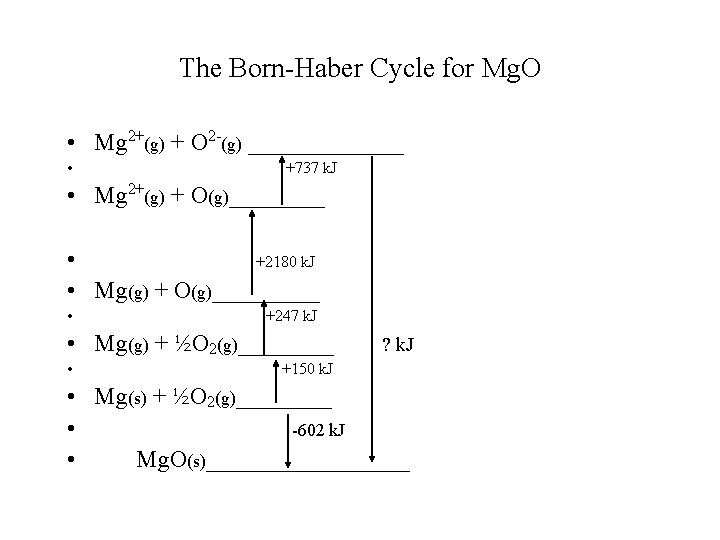
The Born-Haber Cycle for Mg. O • Mg 2+(g) + O 2 -(g) _______ • +737 k. J • Mg 2+(g) + O(g)____ • +2180 k. J • Mg(g) + O(g)_____ • +247 k. J • Mg(g) + ½O 2(g)____ • ? k. J +150 k. J • Mg(s) + ½O 2(g)____ • -602 k. J • Mg. O(s)_________
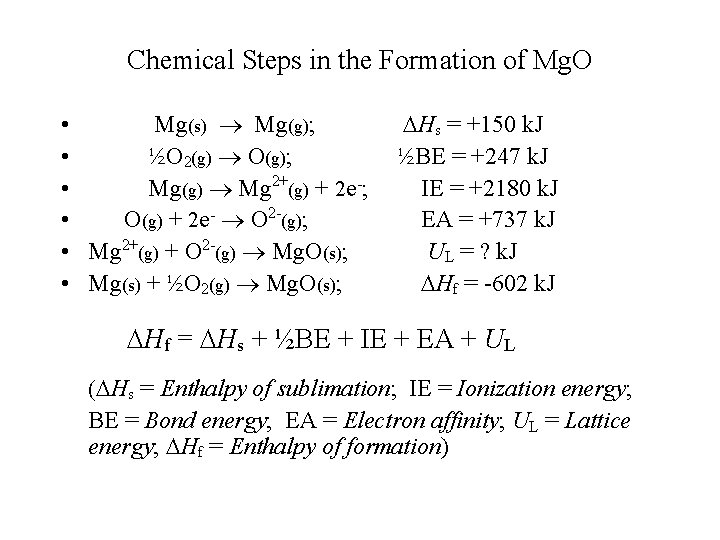
Chemical Steps in the Formation of Mg. O • Mg(s) Mg(g); • ½O 2(g) O(g); • Mg(g) Mg 2+(g) + 2 e-; • O(g) + 2 e- O 2 -(g); • Mg 2+(g) + O 2 -(g) Mg. O(s); • Mg(s) + ½O 2(g) Mg. O(s); DHs = +150 k. J ½BE = +247 k. J IE = +2180 k. J EA = +737 k. J UL = ? k. J DHf = -602 k. J DHf = DHs + ½BE + IE + EA + UL (DHs = Enthalpy of sublimation; IE = Ionization energy; BE = Bond energy; EA = Electron affinity; UL = Lattice energy; DHf = Enthalpy of formation)
Covalent Bonds • Bonds between two nonmetal atoms, or between an atom of semimetal and an atom of nonmetal; • Bonds are formed by sharing one or more electron pairs; • One, two or three pairs of electrons may be shared between two atoms to form a single, double, or triple covalent bonds, respectively.
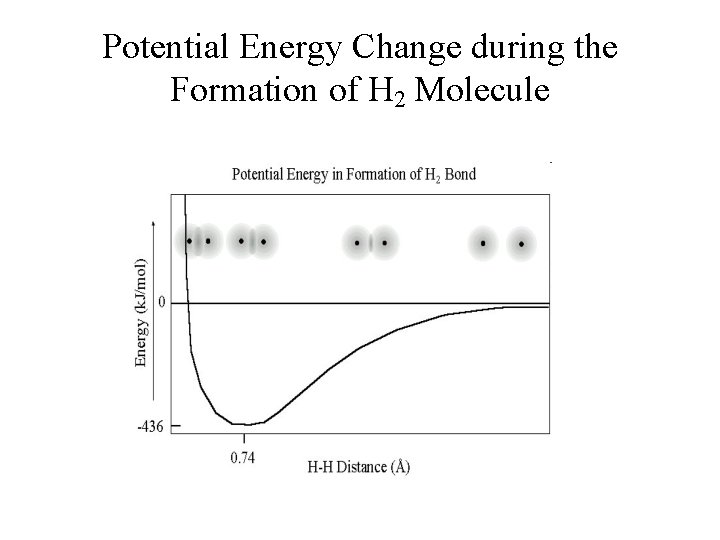
Potential Energy Change during the Formation of H 2 Molecule
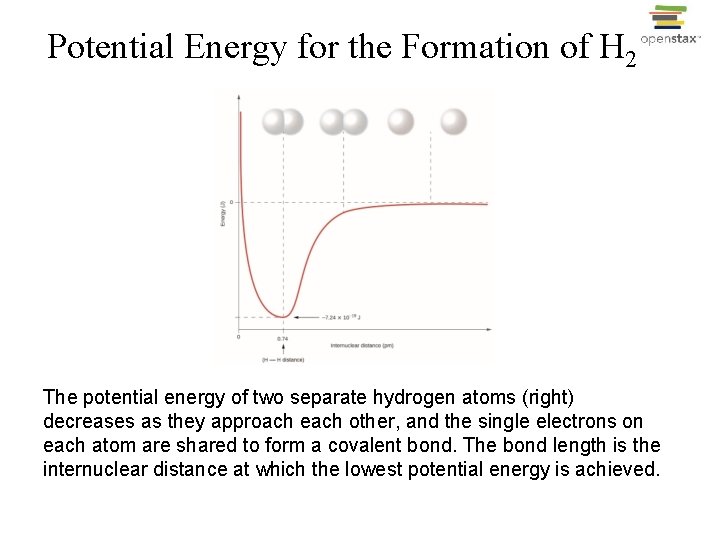
Potential Energy for the Formation of H 2 The potential energy of two separate hydrogen atoms (right) decreases as they approach each other, and the single electrons on each atom are shared to form a covalent bond. The bond length is the internuclear distance at which the lowest potential energy is achieved.
Polarity of Covalent Bonds 1. Covalent bonds can be polar or nonpolar; 2. Nonpolar covalent bonds - bonds between identical atoms or atoms having the same electronegativity. 3. Polar covalent bonds - bonds between atoms with different electronegativity;
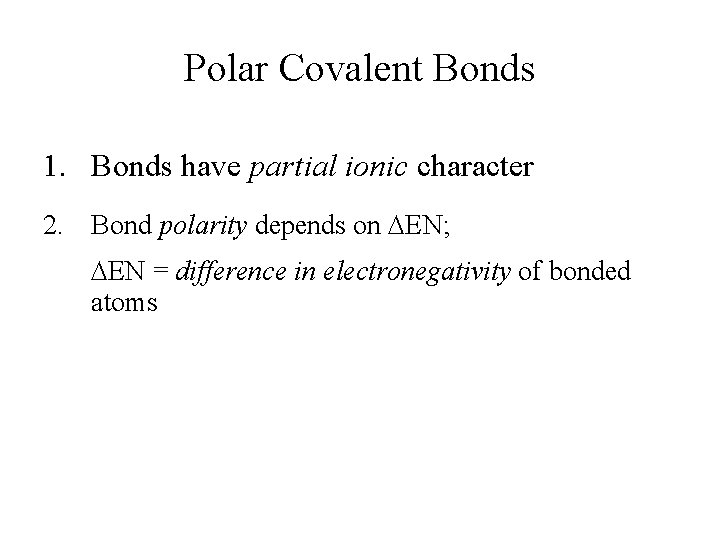
Polar Covalent Bonds 1. Bonds have partial ionic character 2. Bond polarity depends on DEN; DEN = difference in electronegativity of bonded atoms
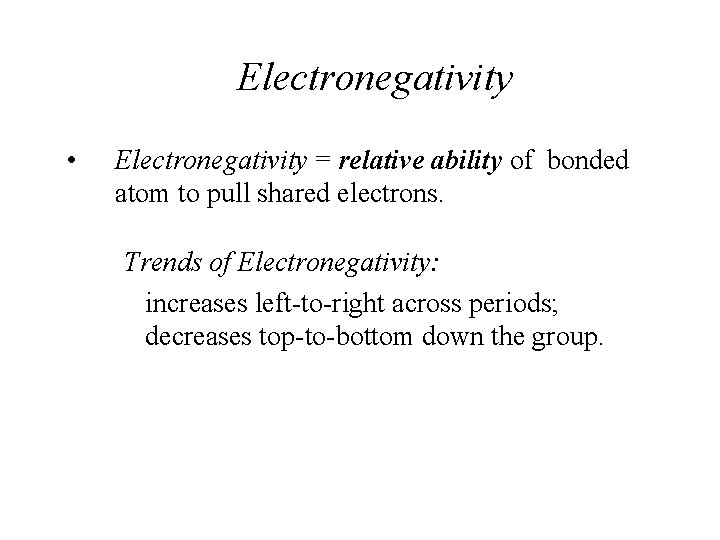
Electronegativity • Electronegativity = relative ability of bonded atom to pull shared electrons. Trends of Electronegativity: increases left-to-right across periods; decreases top-to-bottom down the group.
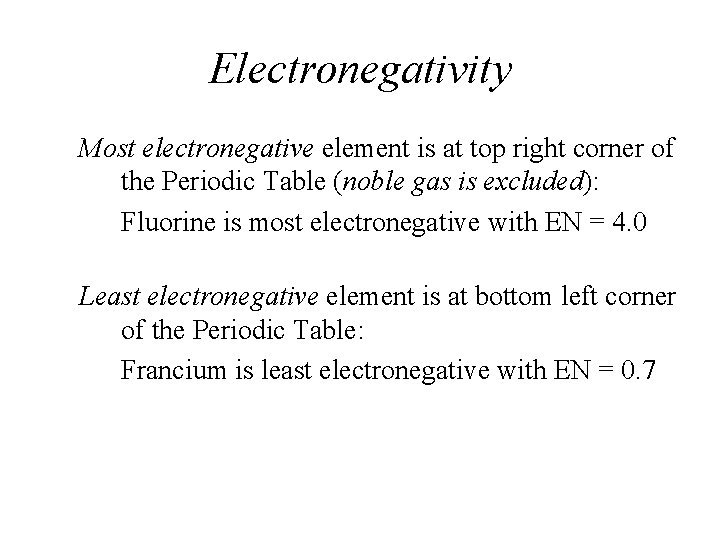
Electronegativity Most electronegative element is at top right corner of the Periodic Table (noble gas is excluded): Fluorine is most electronegative with EN = 4. 0 Least electronegative element is at bottom left corner of the Periodic Table: Francium is least electronegative with EN = 0. 7
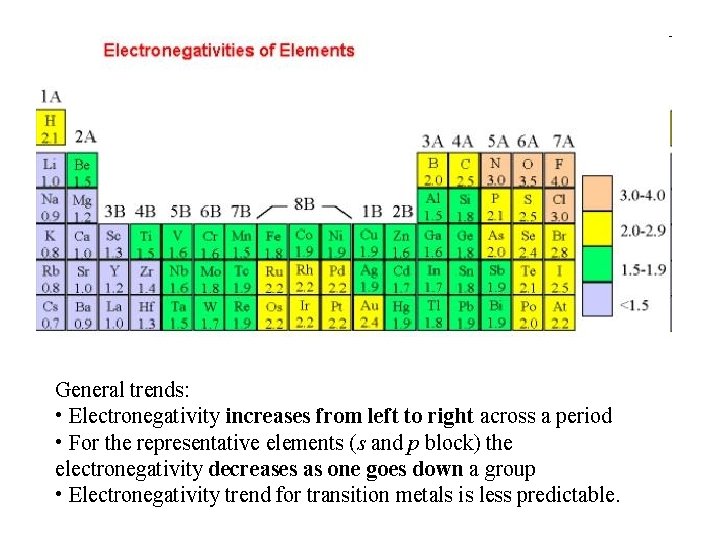
General trends: • Electronegativity increases from left to right across a period • For the representative elements (s and p block) the electronegativity decreases as one goes down a group • Electronegativity trend for transition metals is less predictable.
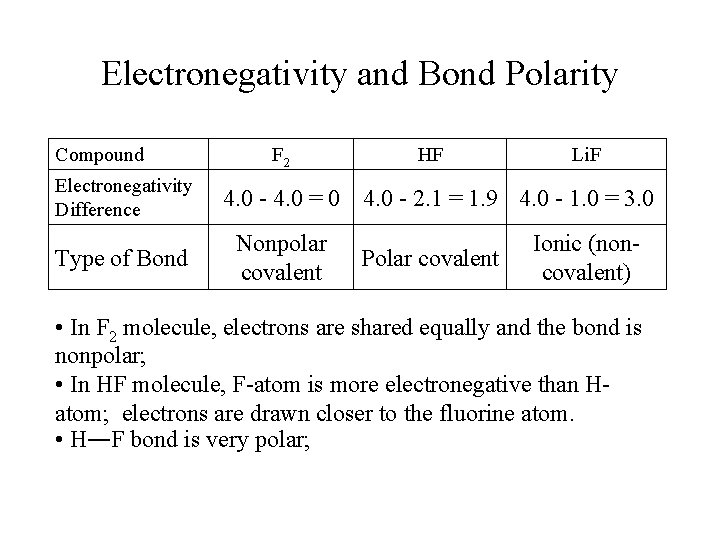
Electronegativity and Bond Polarity Compound Electronegativity Difference Type of Bond F 2 HF Li. F 4. 0 - 4. 0 = 0 4. 0 - 2. 1 = 1. 9 4. 0 - 1. 0 = 3. 0 Nonpolar covalent Polar covalent Ionic (noncovalent) • In F 2 molecule, electrons are shared equally and the bond is nonpolar; • In HF molecule, F-atom is more electronegative than Hatom; electrons are drawn closer to the fluorine atom. • H―F bond is very polar;
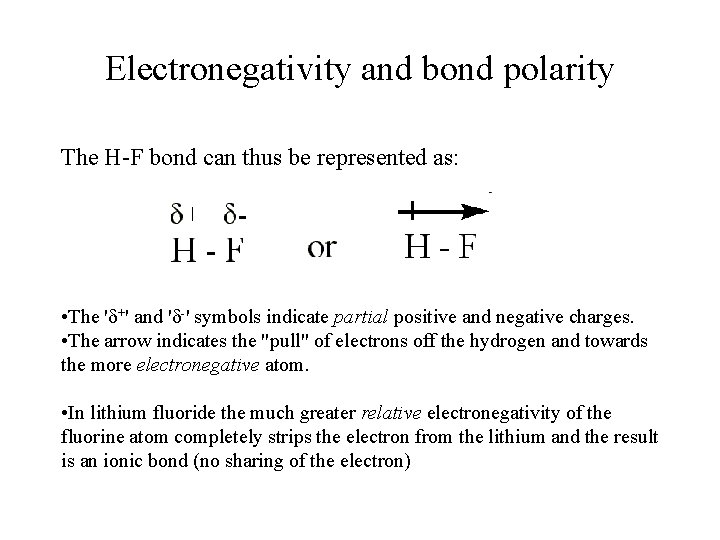
Electronegativity and bond polarity The H-F bond can thus be represented as: • The 'd+' and 'd-' symbols indicate partial positive and negative charges. • The arrow indicates the "pull" of electrons off the hydrogen and towards the more electronegative atom. • In lithium fluoride the much greater relative electronegativity of the fluorine atom completely strips the electron from the lithium and the result is an ionic bond (no sharing of the electron)
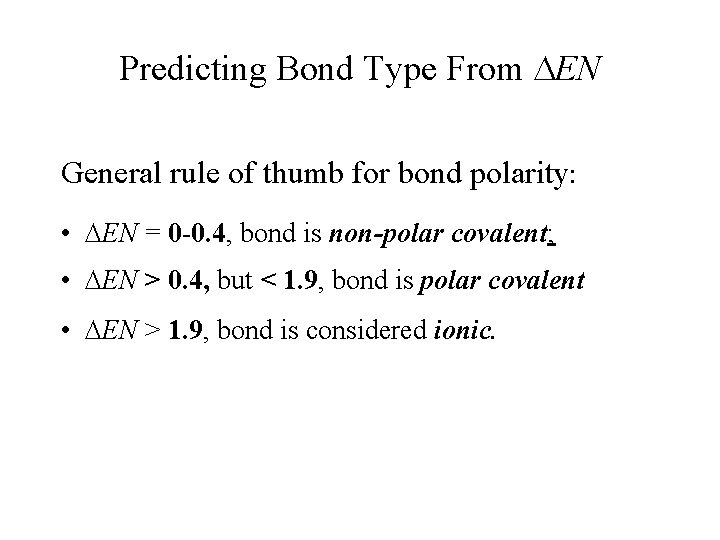
Predicting Bond Type From DEN General rule of thumb for bond polarity: • DEN = 0 -0. 4, bond is non-polar covalent; • DEN > 0. 4, but < 1. 9, bond is polar covalent • DEN > 1. 9, bond is considered ionic.
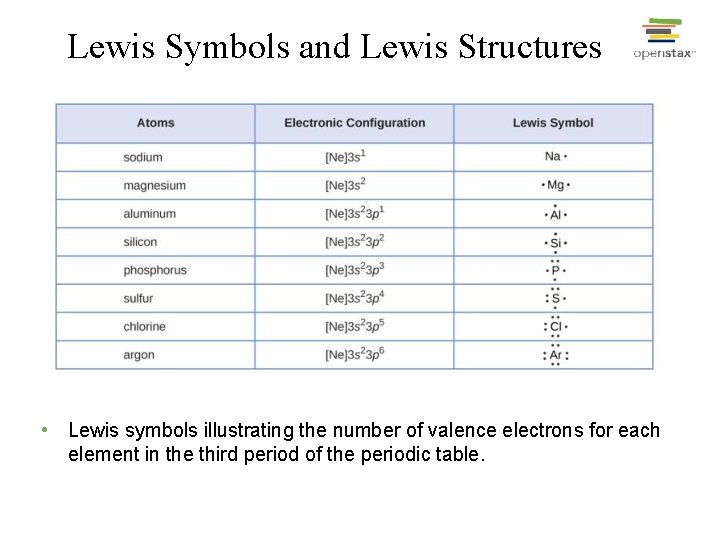
Lewis Symbols and Lewis Structures • Lewis symbols illustrating the number of valence electrons for each element in the third period of the periodic table.
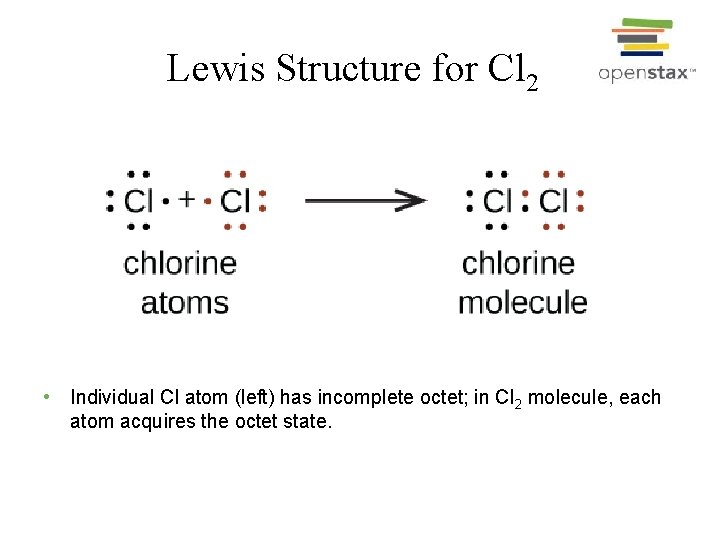
Lewis Structure for Cl 2 • Individual Cl atom (left) has incomplete octet; in Cl 2 molecule, each atom acquires the octet state.
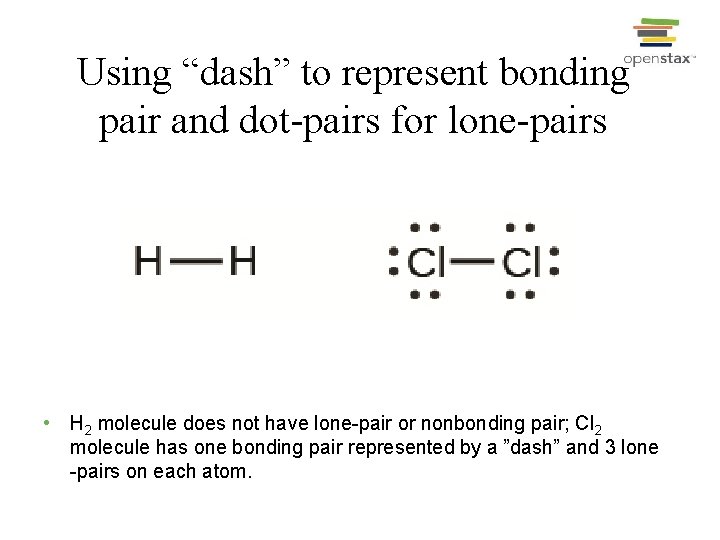
Using “dash” to represent bonding pair and dot-pairs for lone-pairs • H 2 molecule does not have lone-pair or nonbonding pair; Cl 2 molecule has one bonding pair represented by a ”dash” and 3 lone -pairs on each atom.
Drawing Lewis Structures for Molecules or Polyatomic Ions Step-1: • Calculate the total number of valence electrons; • For polyatomic ions, add one additional electron for each negative charge, or subtract one for each positive charge on the ion.
Lewis Structures for Molecules and Polyatomic ions Step-2: • Choose a central atom; normally the least electronegative atom in the group; (Hydrogen and Fluorine cannot become central atoms) • Connect other atoms to the central atom with single bonds (a pair of electrons).
Lewis Structures for Molecules and Polyatomic ions Step-3: • Complete the octet state of all terminal atoms, except hydrogen, using available valence electron pairs; • Place remaining pairs of electrons (if present) on central atom as lone pairs.
Octet State of Central Atom Step-4: • If the central atom has not achieved the octet state, but all valence electrons have been used, move one or more lone-pair electrons from “terminal” atoms, one pair at a time, to form a double or triple bonds to complete octet of the central atom.
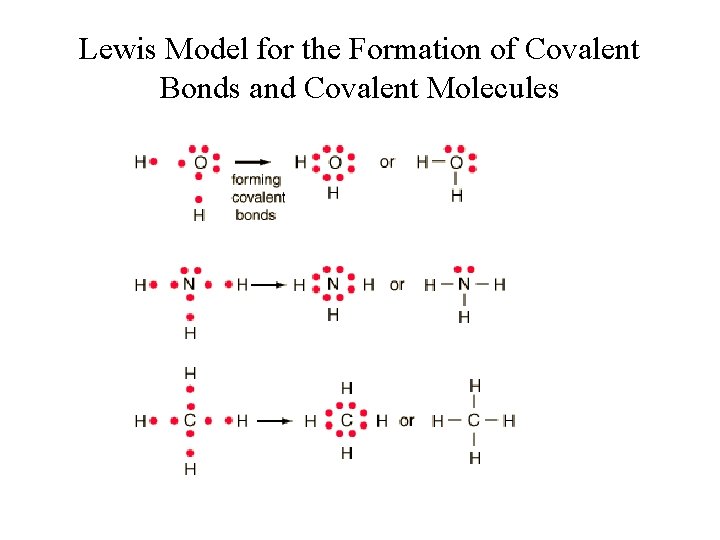
Lewis Model for the Formation of Covalent Bonds and Covalent Molecules
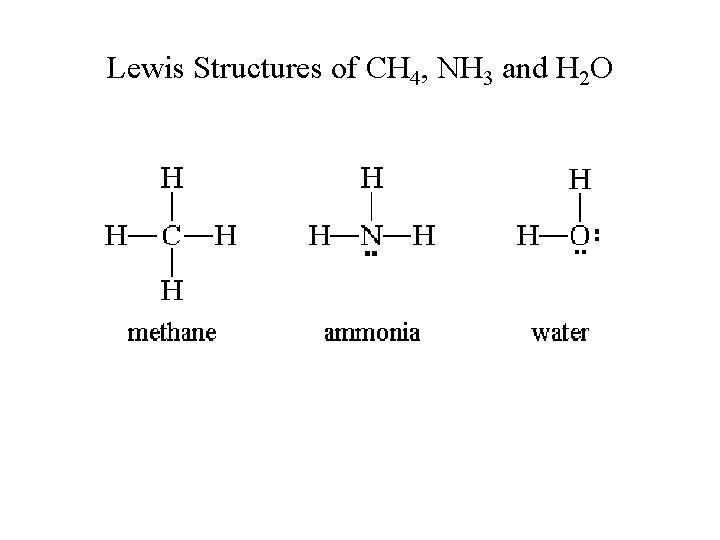
Lewis Structures of CH 4, NH 3 and H 2 O
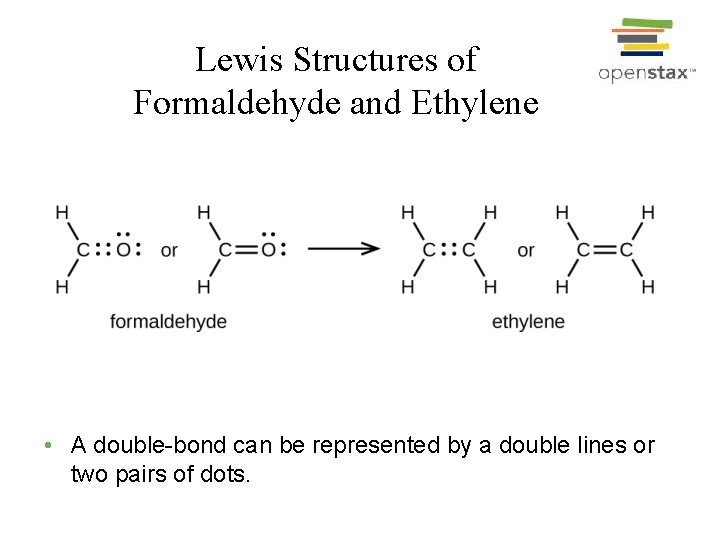
Lewis Structures of Formaldehyde and Ethylene • A double-bond can be represented by a double lines or two pairs of dots.
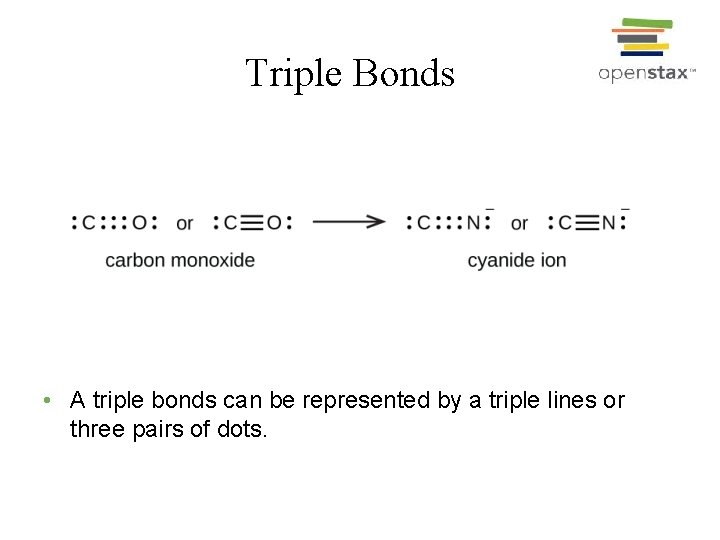
Triple Bonds • A triple bonds can be represented by a triple lines or three pairs of dots.
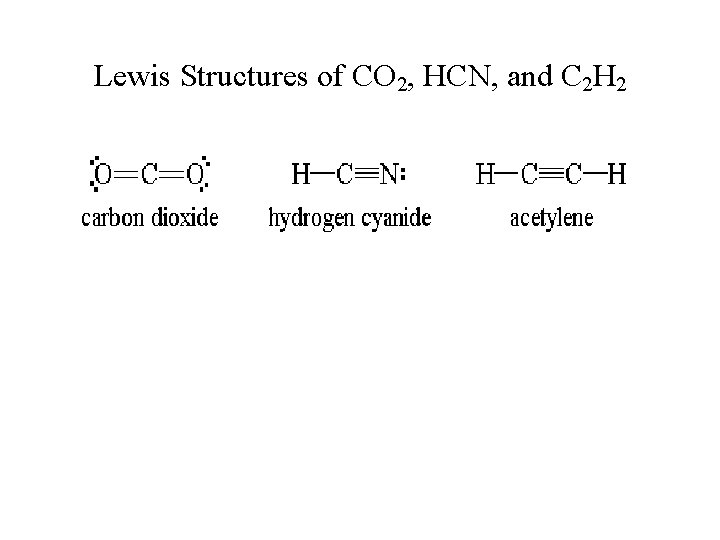
Lewis Structures of CO 2, HCN, and C 2 H 2
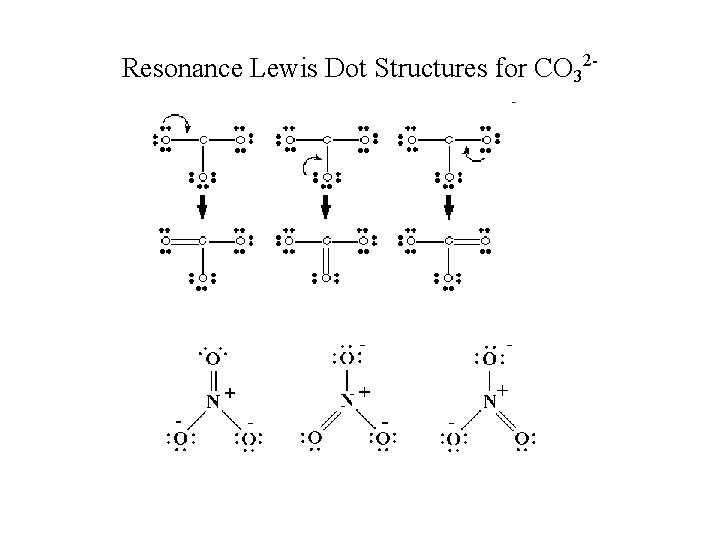
Resonance Lewis Dot Structures for CO 32 -
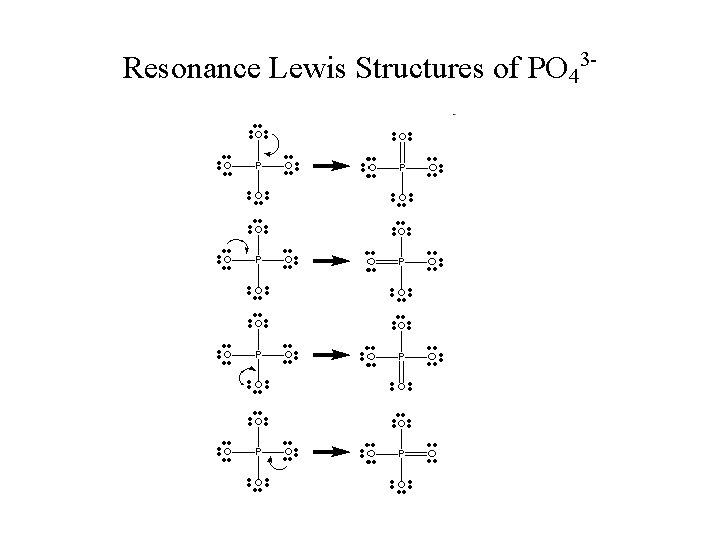
Resonance Lewis Structures of PO 43 -
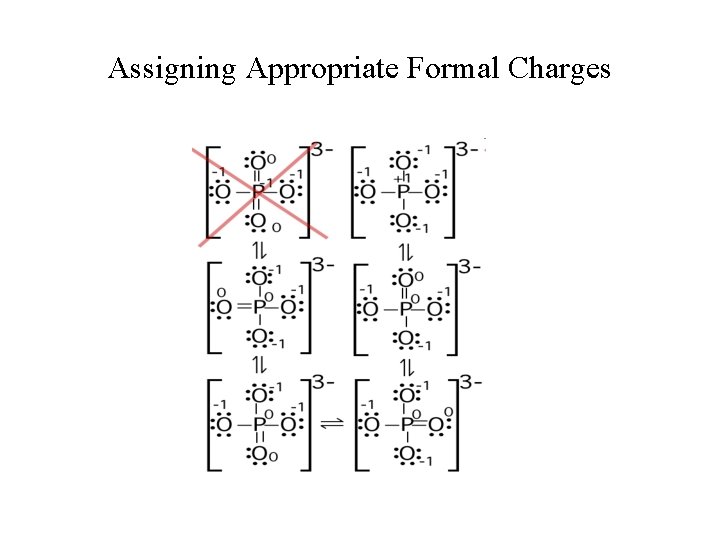
Assigning Appropriate Formal Charges
Exception to Octet Rule 1. If the central atom is from group 2 A or 3 A, and the octet state is not achieved, the central atom is said to have incomplete octet. 2. Central atoms from periods 3, 4, 5, …may have more than 8 valence electrons, and it is said to have an expanded octet; 3. Some molecules contain odd numbers of electrons; one of the atoms in it will contain unpaired electrons.
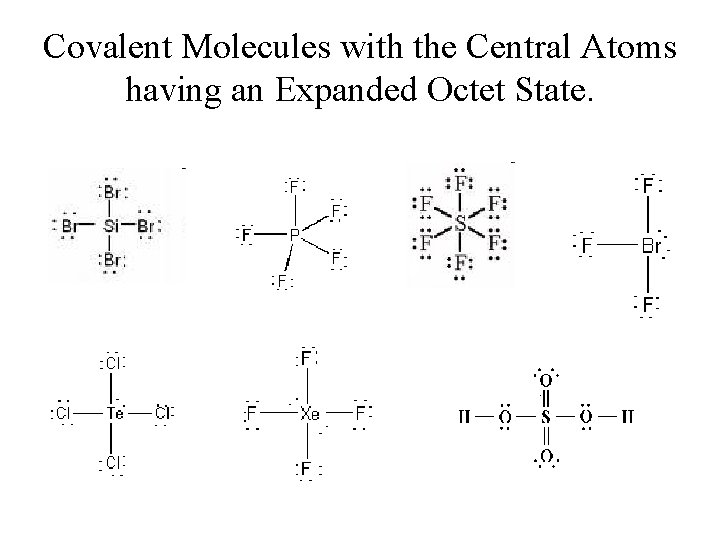
Covalent Molecules with the Central Atoms having an Expanded Octet State.
Evaluate Formal Charge • Evaluate formal charges (fc) on each atom in the molecule to determine best correct or best Lewis structures. • Formal charge is apparent charge on an atom in a Lewis formula; it is determined as follows: • Formal charge (fc) = (Group # of atom) – (# of lone-pair electrons on the atom) – (# of covalent bonds the atom forms)
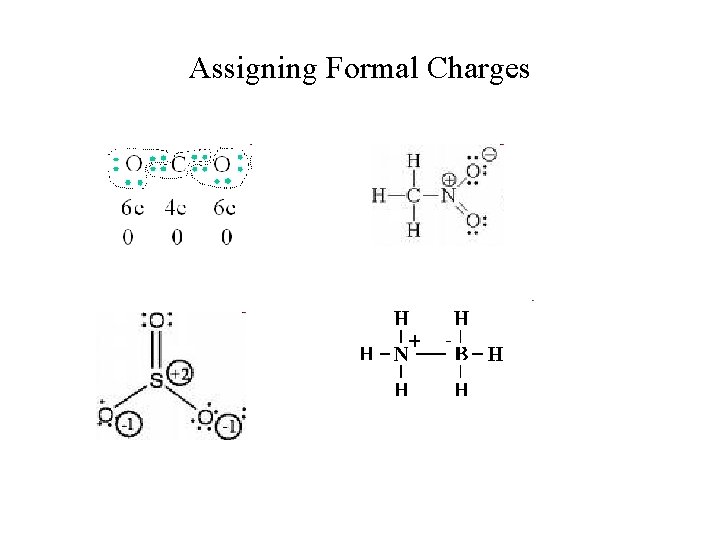
Assigning Formal Charges
Choosing the correct or best Lewis structures based on formal charges • If two or more Lewis structures that satisfy the octet rule can be drawn for a given molecule or polyatomic ions, the preferred structure would be one in which: 1. The formal charges used are the smallest; 2. Negative fc are located on more electronegative atoms, and positive fc on less electronegative atoms.
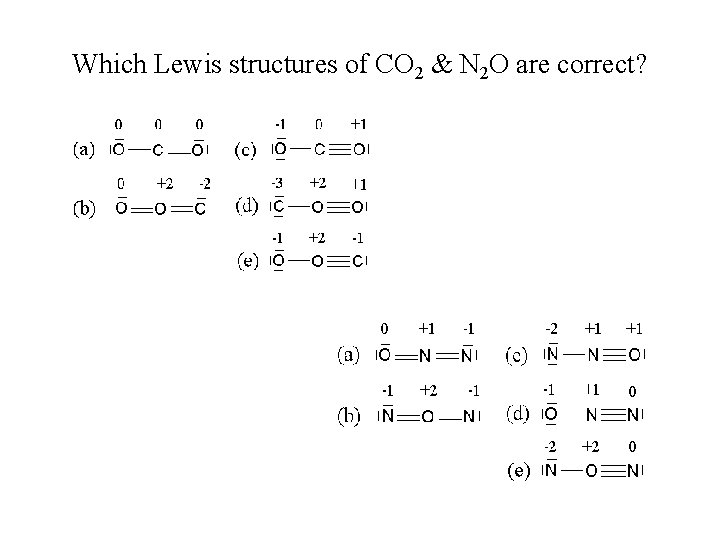
Which Lewis structures of CO 2 & N 2 O are correct?
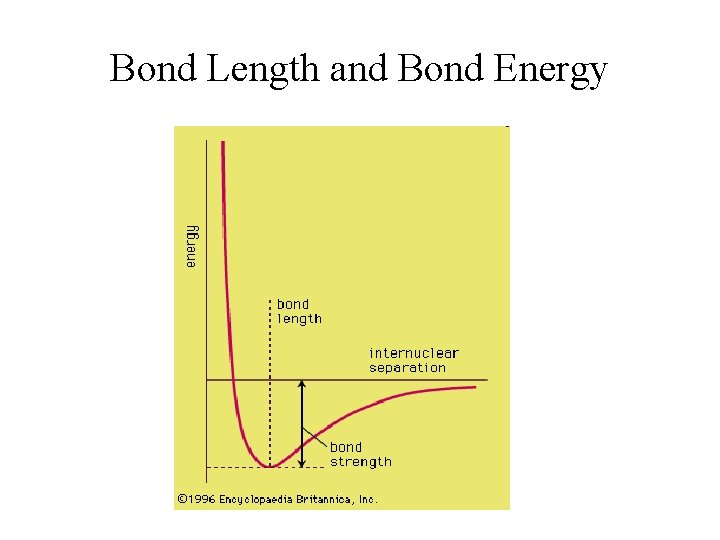
Bond Length and Bond Energy
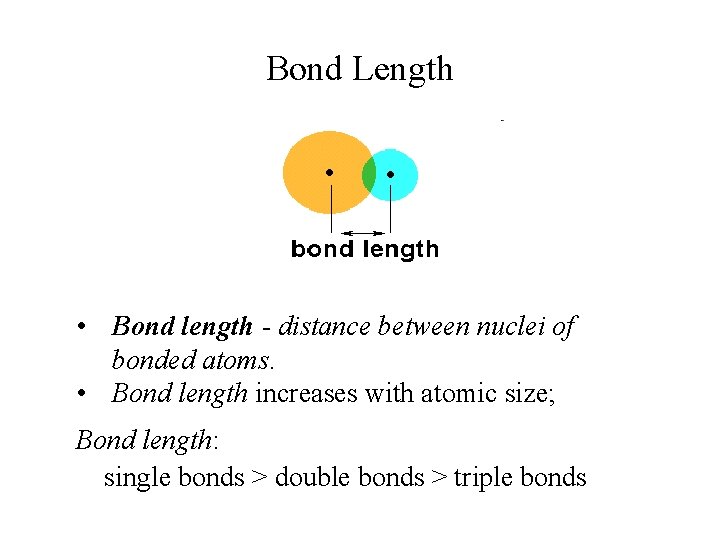
Bond Length . • Bond length - distance between nuclei of bonded atoms. • Bond length increases with atomic size; Bond length: single bonds > double bonds > triple bonds
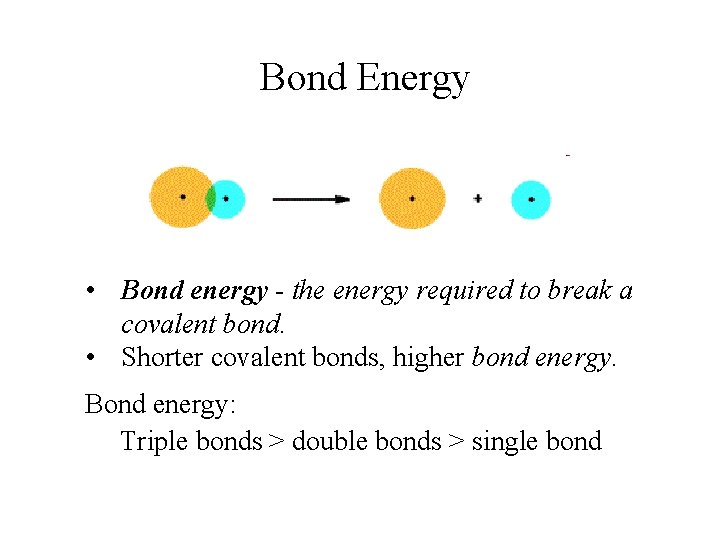
Bond Energy • Bond energy - the energy required to break a covalent bond. • Shorter covalent bonds, higher bond energy. Bond energy: Triple bonds > double bonds > single bond
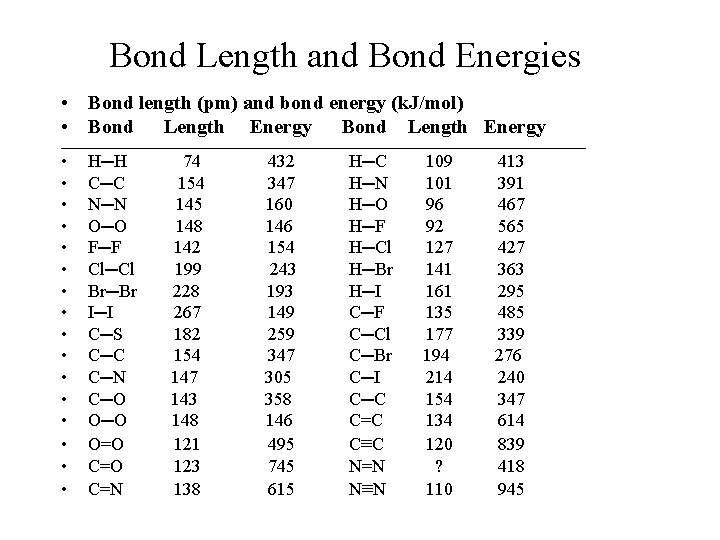
Bond Length and Bond Energies • Bond length (pm) and bond energy (k. J/mol) • Bond Length Energy _____________________________________________________ • • • • H─H C─C N─N O─O F─F Cl─Cl Br─Br I─I C─S C─C C─N C─O O=O C=N 74 154 145 148 142 199 228 267 182 154 147 143 148 121 123 138 432 347 160 146 154 243 193 149 259 347 305 358 146 495 745 615 H─C H─N H─O H─F H─Cl H─Br H─I C─F C─Cl C─Br C─I C─C C=C C≡C N=N N≡ N 109 101 96 92 127 141 161 135 177 194 214 154 134 120 ? 110 413 391 467 565 427 363 295 485 339 276 240 347 614 839 418 945
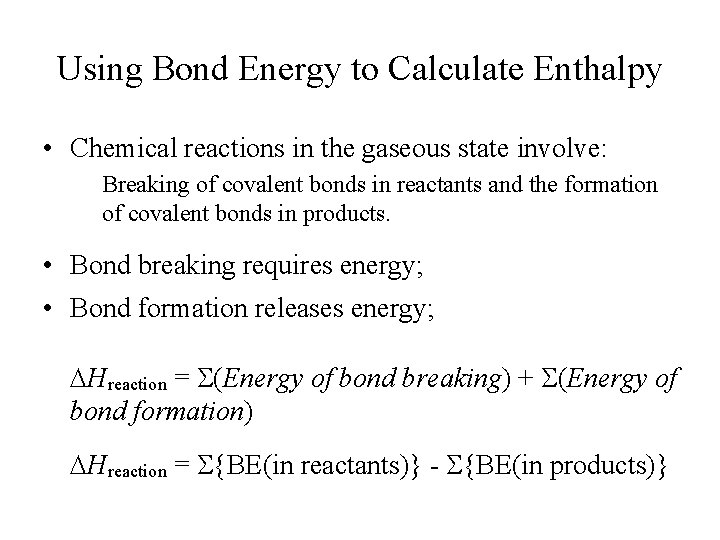
Using Bond Energy to Calculate Enthalpy • Chemical reactions in the gaseous state involve: Breaking of covalent bonds in reactants and the formation of covalent bonds in products. • Bond breaking requires energy; • Bond formation releases energy; DHreaction = S(Energy of bond breaking) + S(Energy of bond formation) DHreaction = S{BE(in reactants)} - S{BE(in products)}
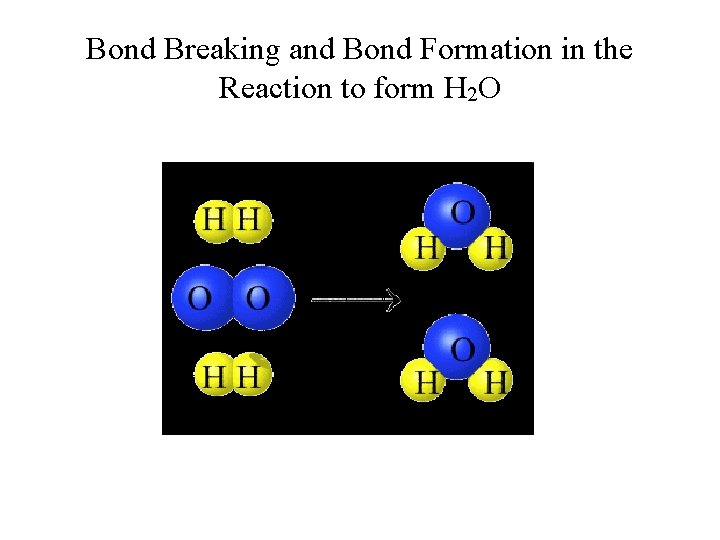
Bond Breaking and Bond Formation in the Reaction to form H 2 O
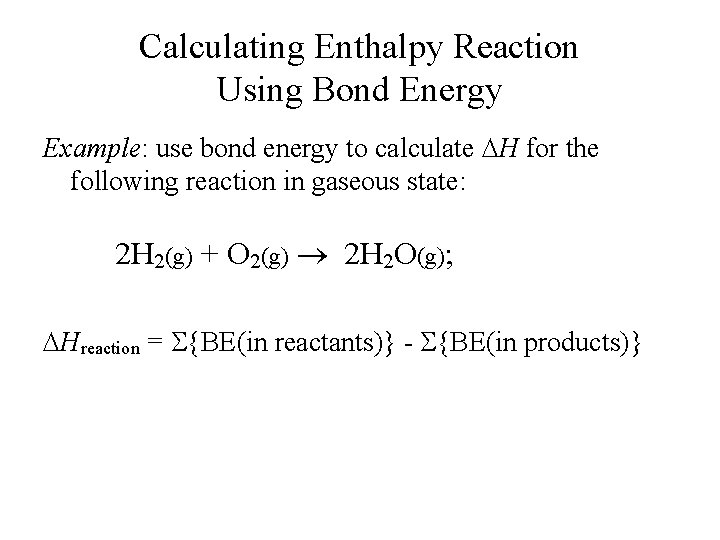
Calculating Enthalpy Reaction Using Bond Energy Example: use bond energy to calculate DH for the following reaction in gaseous state: 2 H 2(g) + O 2(g) 2 H 2 O(g); DHreaction = S{BE(in reactants)} - S{BE(in products)}
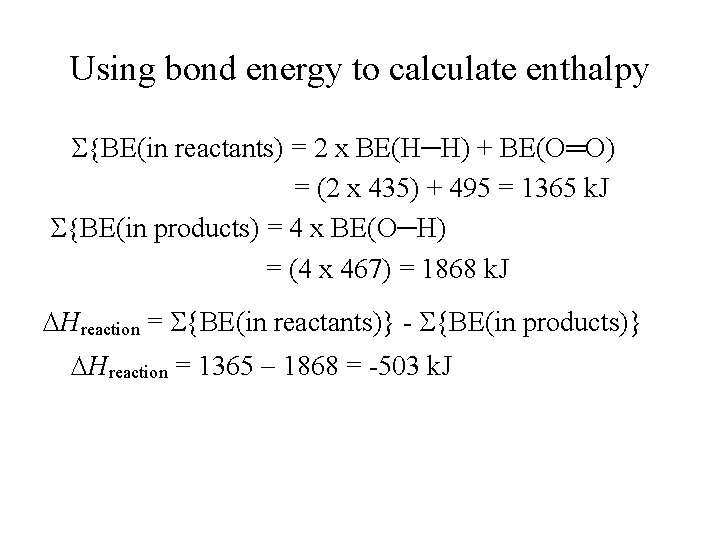
Using bond energy to calculate enthalpy S{BE(in reactants) = 2 x BE(H─H) + BE(O═O) = (2 x 435) + 495 = 1365 k. J S{BE(in products) = 4 x BE(O─H) = (4 x 467) = 1868 k. J DHreaction = S{BE(in reactants)} - S{BE(in products)} DHreaction = 1365 1868 = -503 k. J
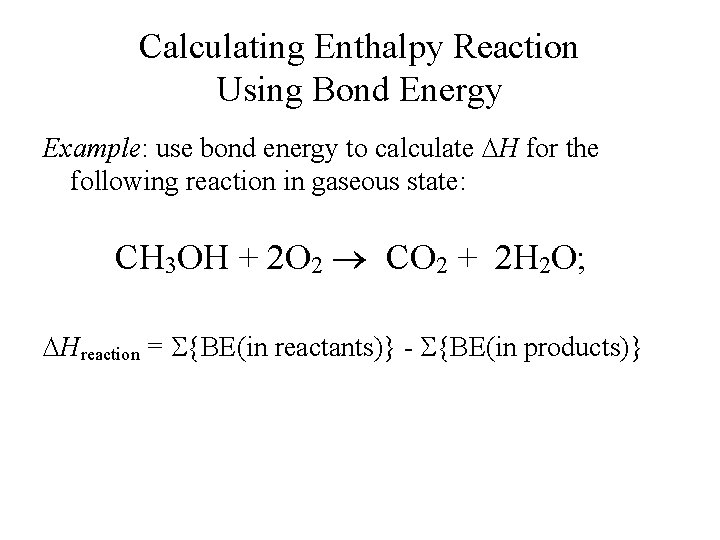
Calculating Enthalpy Reaction Using Bond Energy Example: use bond energy to calculate DH for the following reaction in gaseous state: CH 3 OH + 2 O 2 CO 2 + 2 H 2 O; DHreaction = S{BE(in reactants)} - S{BE(in products)}
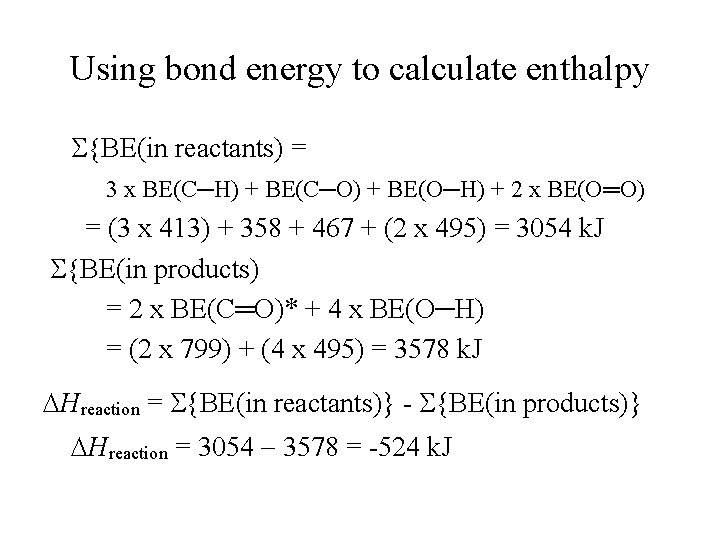
Using bond energy to calculate enthalpy S{BE(in reactants) = 3 x BE(C─H) + BE(C─O) + BE(O─H) + 2 x BE(O═O) = (3 x 413) + 358 + 467 + (2 x 495) = 3054 k. J S{BE(in products) = 2 x BE(C═O)* + 4 x BE(O─H) = (2 x 799) + (4 x 495) = 3578 k. J DHreaction = S{BE(in reactants)} - S{BE(in products)} DHreaction = 3054 3578 = -524 k. J
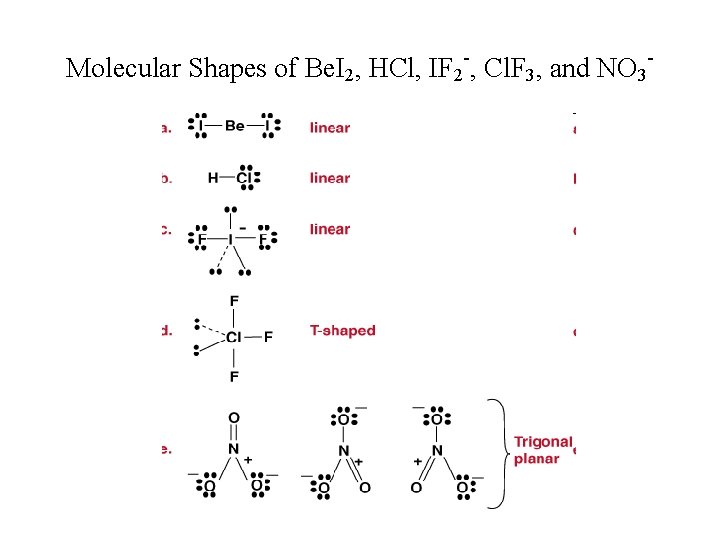
Molecular Shapes of Be. I 2, HCl, IF 2 -, Cl. F 3, and NO 3 -
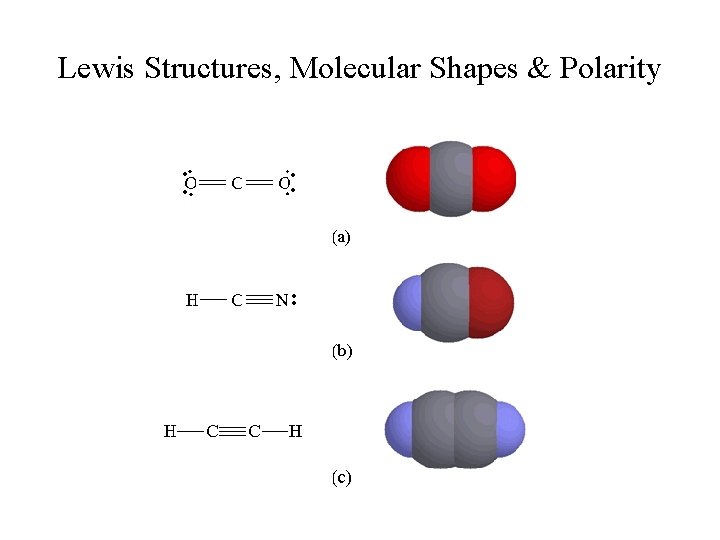
Lewis Structures, Molecular Shapes & Polarity
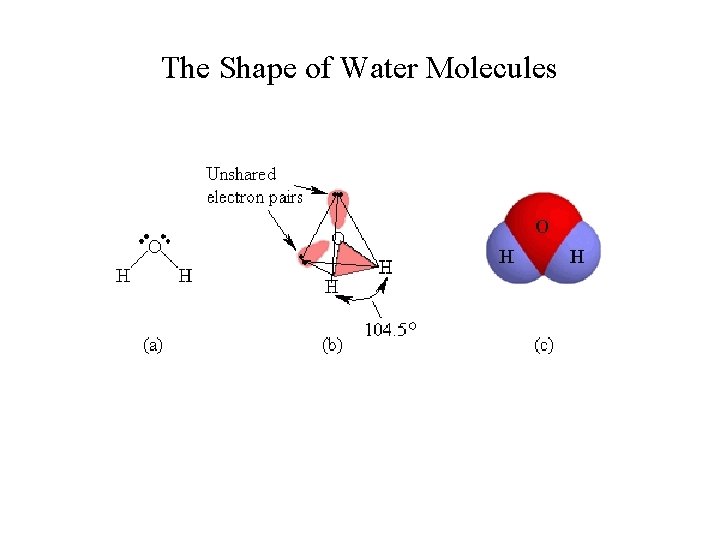
The Shape of Water Molecules
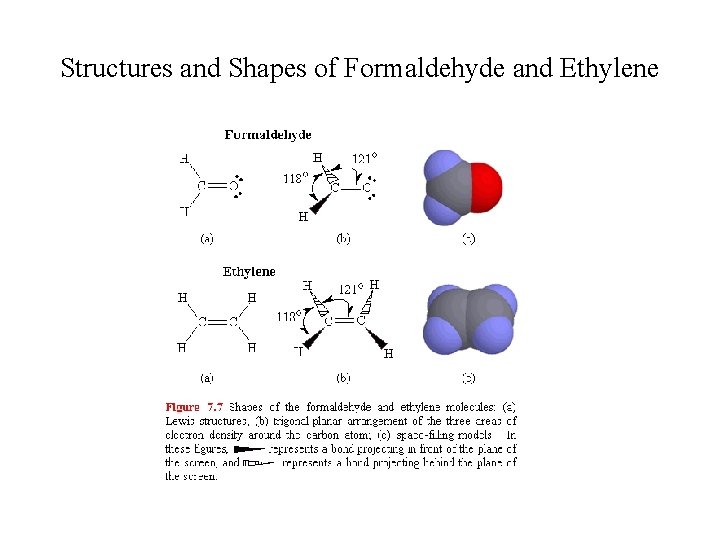
Structures and Shapes of Formaldehyde and Ethylene
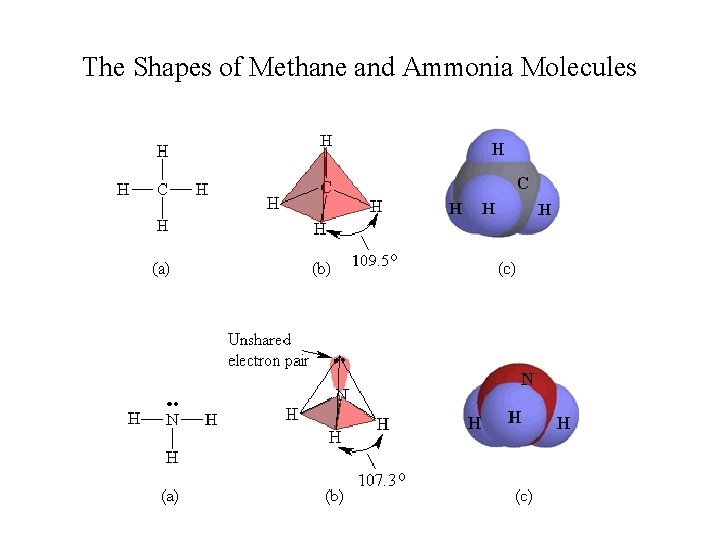
The Shapes of Methane and Ammonia Molecules
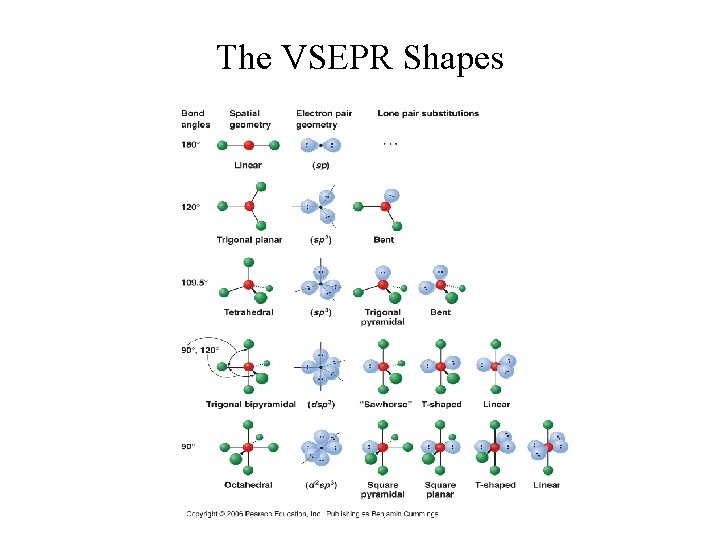
The VSEPR Shapes
- Slides: 73