
Chemical bonding A topic where understanding is developed
Chemical bonding A topic where understanding is developed through diverse models, and where learners are expected to interpret a disparate range of symbolic representation. Many of the ideas used to understand chemical bonds would be not accessible at an introductory level. It is a topic where learners commonly develop a wide range of alternative conceptions. The optimum level of simplification balances what the learner is ready to understand with what provides a valid basis for further learning.
Key concepts From K. S. Taber and R. K. Coll (not MV) • The chemical bond is due to electrical forces • Bonding need no imply molecules • Not all chemical bonds are covalent or ionic • Bonding may be intermediate between covalent or ionic
Source of misconceptions • Learners hold an incorrect and inappropriate rationale for why bonding should occur • Understand the nature of ionic, metallic and giant covalent structures (going beyond electron sharing or electron transfer) • Bond polarity • Tendency of students to focus on separate atoms when thinking of bonding or chemical reactions. • Energetic: bond breaking releases energy and bond making involves energy input. • Shifts between the macroscopic and molecular levels. • Students commonly have difficulties progressing beyond the notion of the shared pair of electrons.
The octet framework ‘Atoms form bonds in order to obtain full shells of electrons’ Not useful for chemical reactions: both reactants and products seem to have atoms with full shells. Not useful beyond the second period. Atomic ontology: all molecular species are considered to derive from atoms. ‘All things are made of atoms’. Anthropomorphic vocabulary: atoms are said to need, share, own, donate, accept
Dichotomy between covalent and ionic bond • Covalent/ionic dimension should be seen as a continuum - Polarity: the notion of bond polarity indicates the covalent/ionic dimension as a continuum. - Electronegativity: electron transfer vs. electron sharing - This dichotomy persists also in graduate students exposed to more sophisticated models, like molecular orbital theory.
‘The chemical bond is due to electrical forces’ A teaching model used to introduce chemical bonding, at an optimum level of simplification, would be based upon the effect of electrical forces. (K. S. Taber, 2002 Misconceptions in chemistry – prevention, diagnosis and cure. London: Royal Society of Chemistry) • Spin of electrons does not fit into this scheme
Beyond the molecule • Metals and salts are bonded, but do not consist of molecules. • Sodium chloride: Na. Cl individual molecules held together by ionic forces (octet model). • Attraction between two oppositely charged species may be thought to result in neutralisation rather than bond formation. • Ions could only bond to the number of counterions allowed by their valency. Ex. Each ion in the Na. Cl lattice could only form one bond.
Metallic bonding • There is no bonding or proper chemical bonding in metals • Metals have covalent and/or ionic bonding • Metallic bonding is a sea of electrons (but often students had learnt the term with little understanding of this model).

A teaching order for solid structures
Intermolecular interactions • Differences between intramolecular and intermolecular interactions (A conceptual change). • Status of hydrogen bond
Recommendations for teachers • Build on physical principles - Avoid magic (octet) or vitalistic (affinity) concepts • Focus on molecules and ions rather than atoms - Most real chemistry involves molecules, or ions, or more extensive systems. - introduce chemical structures (3 D) • Emphasise the non-molecular nature of non-molecular lattices. - The concept of valency is limiting
• Take care with Language - substances and not molecules evaporate, melt, reflect, conduct, and so forth. - avoid anthropomorphic terms - Bonding has a peculiar position in the molar-molecular scheme.
Barker, V. and Millar, R. (2000) Students’ reasoning about basic chemical thermodynamics and chemical bonding: what changes occur during a contextbased post-16 chemistry course? , International Journal of Science Education, 22 (11), 1171 -1200. Birk, J. P. and Kurtz, M. J. (1999) Effect of experience on retention and elimination of misconceptions about molecular structure and bonding. Journal of Chemical Education, 76(1), 124 -128. Boo, H. K. (1998) Students’ understandings of chemical bonds and the energetics of chemical reactions. Journal of Research in Science Teaching, 35(5), 569 -581.
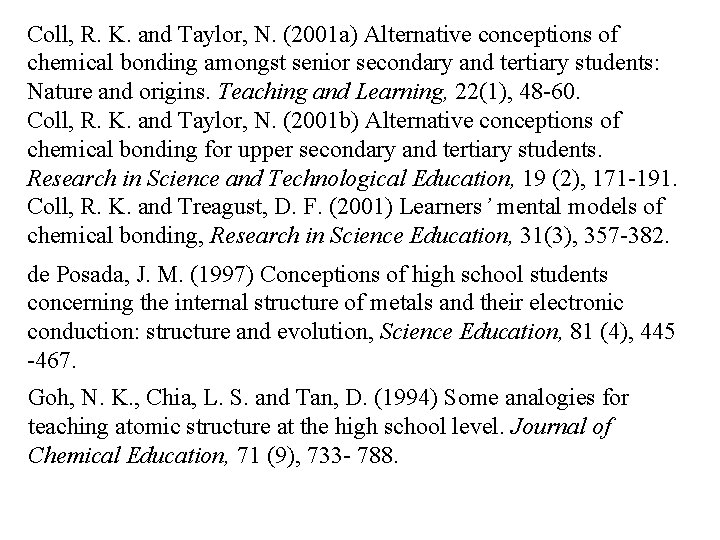
Coll, R. K. and Taylor, N. (2001 a) Alternative conceptions of chemical bonding amongst senior secondary and tertiary students: Nature and origins. Teaching and Learning, 22(1), 48 -60. Coll, R. K. and Taylor, N. (2001 b) Alternative conceptions of chemical bonding for upper secondary and tertiary students. Research in Science and Technological Education, 19 (2), 171 -191. Coll, R. K. and Treagust, D. F. (2001) Learners’ mental models of chemical bonding, Research in Science Education, 31(3), 357 -382. de Posada, J. M. (1997) Conceptions of high school students concerning the internal structure of metals and their electronic conduction: structure and evolution, Science Education, 81 (4), 445 -467. Goh, N. K. , Chia, L. S. and Tan, D. (1994) Some analogies for teaching atomic structure at the high school level. Journal of Chemical Education, 71 (9), 733 - 788.
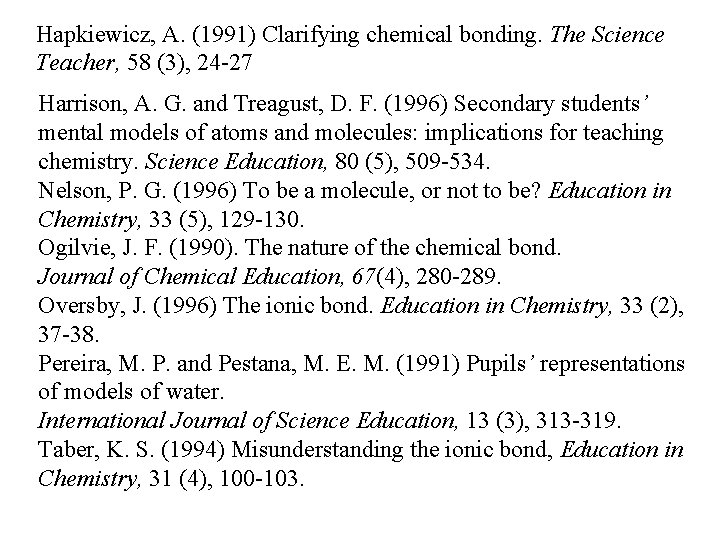
Hapkiewicz, A. (1991) Clarifying chemical bonding. The Science Teacher, 58 (3), 24 -27 Harrison, A. G. and Treagust, D. F. (1996) Secondary students’ mental models of atoms and molecules: implications for teaching chemistry. Science Education, 80 (5), 509 -534. Nelson, P. G. (1996) To be a molecule, or not to be? Education in Chemistry, 33 (5), 129 -130. Ogilvie, J. F. (1990). The nature of the chemical bond. Journal of Chemical Education, 67(4), 280 -289. Oversby, J. (1996) The ionic bond. Education in Chemistry, 33 (2), 37 -38. Pereira, M. P. and Pestana, M. E. M. (1991) Pupils’ representations of models of water. International Journal of Science Education, 13 (3), 313 -319. Taber, K. S. (1994) Misunderstanding the ionic bond, Education in Chemistry, 31 (4), 100 -103.
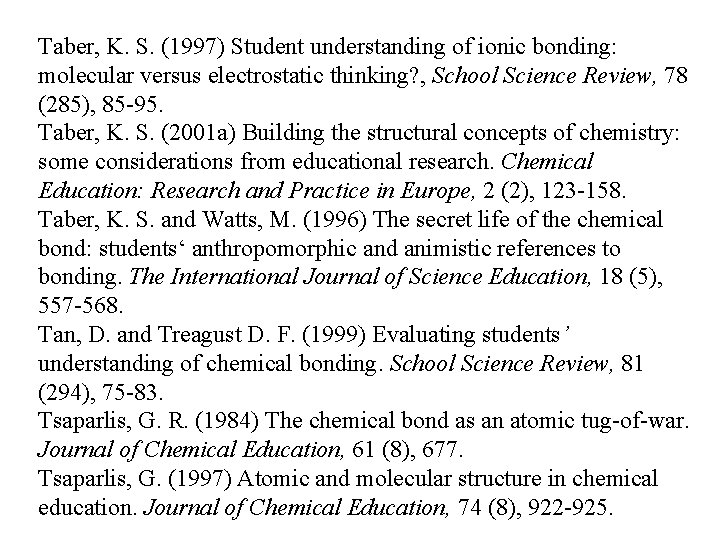
Taber, K. S. (1997) Student understanding of ionic bonding: molecular versus electrostatic thinking? , School Science Review, 78 (285), 85 -95. Taber, K. S. (2001 a) Building the structural concepts of chemistry: some considerations from educational research. Chemical Education: Research and Practice in Europe, 2 (2), 123 -158. Taber, K. S. and Watts, M. (1996) The secret life of the chemical bond: students‘ anthropomorphic and animistic references to bonding. The International Journal of Science Education, 18 (5), 557 -568. Tan, D. and Treagust D. F. (1999) Evaluating students’ understanding of chemical bonding. School Science Review, 81 (294), 75 -83. Tsaparlis, G. R. (1984) The chemical bond as an atomic tug-of-war. Journal of Chemical Education, 61 (8), 677. Tsaparlis, G. (1997) Atomic and molecular structure in chemical education. Journal of Chemical Education, 74 (8), 922 -925.
- Slides: 16