
Chemical Basis of Life Atoms and their interactions
Chemical Basis of Life Atoms and their interactions
Atoms…. � Proton = + charge Electrons = - charge Neutrons = no charge � Element = pure substance; only 1 kind of atom; can’t be broken down = 2 or more different atoms combined; outer levels are full ex Na. Cl � Compounds � Molecule = 2 or more of the same atoms combined ex. O 2
Con’t. � Electrons are found in energy levels around the nucleus. � Level 1 = 2 e- Levels above 1 hold 8 e- � E- are rearranged so that outer levels are full when cmpds are formed. � On the Periodic Table, the # of e- in the outer shell can be determined by what column it is in.
IONS!! � Losing e- gives the atom a (+) charge. � Gaining � Ion e- makes it (-) = charged atom � If the outer shell is full unreactive/ inert/ stable ex. Ne, He � If not full reactive/ unstable ex. H, C Why are ions important in Anatomy? ?
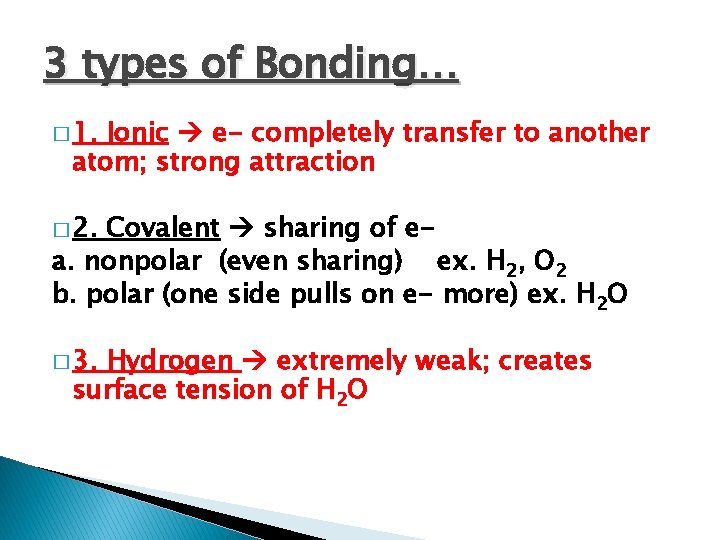
3 types of Bonding… � 1. Ionic e- completely transfer to another atom; strong attraction � 2. Covalent sharing of ea. nonpolar (even sharing) ex. H 2, O 2 b. polar (one side pulls on e- more) ex. H 2 O � 3. Hydrogen extremely weak; creates surface tension of H 2 O
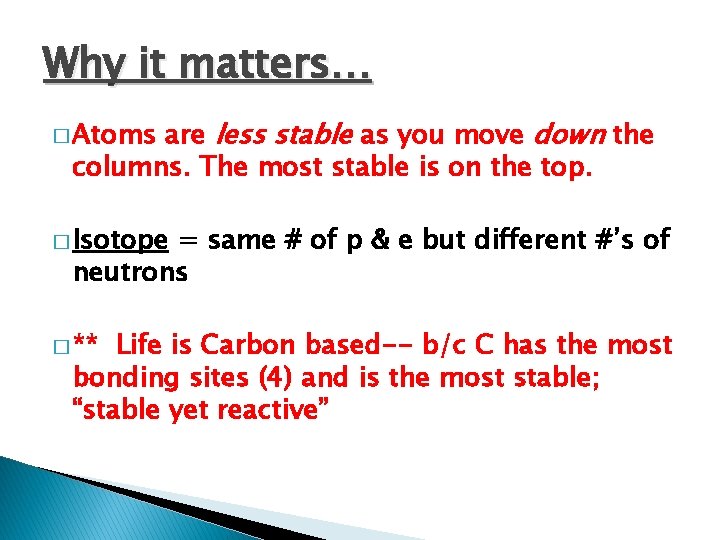
Why it matters… are less stable as you move down the columns. The most stable is on the top. � Atoms � Isotope = same # of p & e but different #’s of neutrons � ** Life is Carbon based-- b/c C has the most bonding sites (4) and is the most stable; “stable yet reactive”
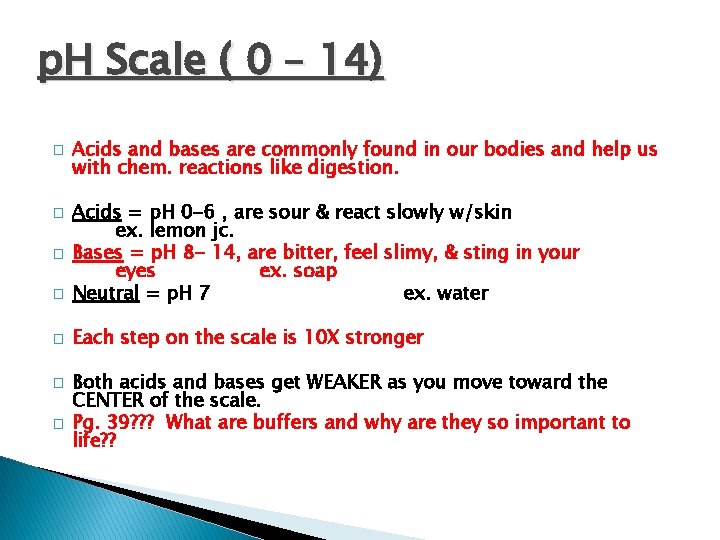
p. H Scale ( 0 – 14) � Acids and bases are commonly found in our bodies and help us with chem. reactions like digestion. � Acids = p. H 0 -6 , are sour & react slowly w/skin ex. lemon jc. Bases = p. H 8 - 14, are bitter, feel slimy, & sting in your eyes ex. soap Neutral = p. H 7 ex. water � Each step on the scale is 10 X stronger � � Both acids and bases get WEAKER as you move toward the CENTER of the scale. Pg. 39? ? ? What are buffers and why are they so important to life? ?
- Slides: 7