
Chemical Agents Risk Assessment a practical side Michelle




- Slides: 48
Chemical Agents Risk Assessment: a practical side Michelle Mc. Dermott
Chemical Agent Risk Assessment
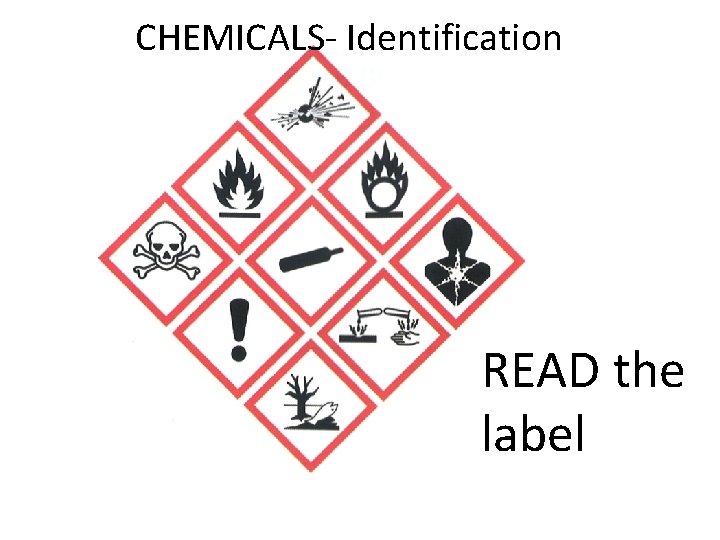
CHEMICALS- Identification READ the label
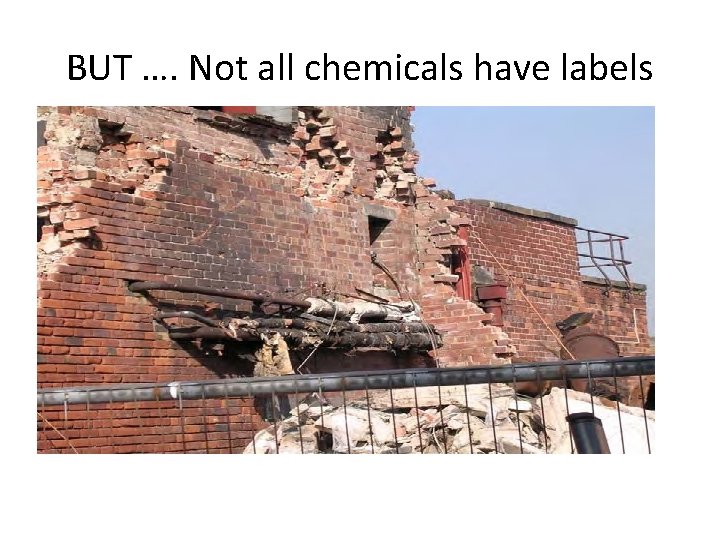
BUT …. Not all chemicals have labels
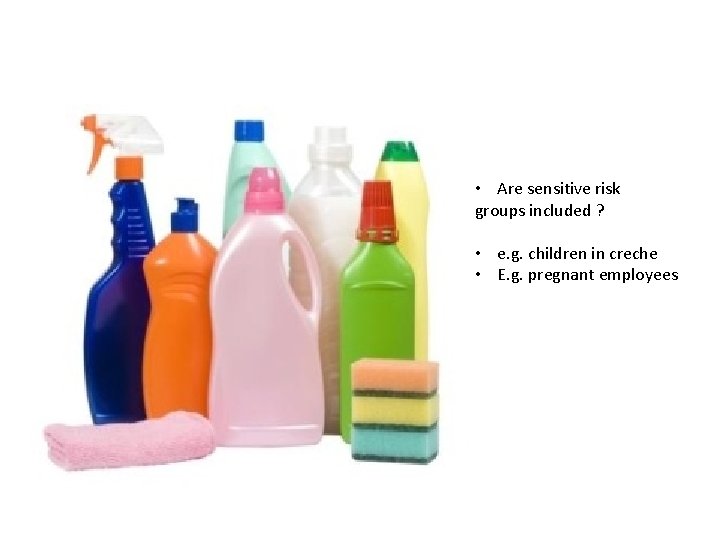
• Are sensitive risk groups included ? • e. g. children in creche • E. g. pregnant employees
Compliance • www. irishstatutebook. ie • Safety, Health and Welfare at Work, (Chemical Agents) Regulations 2001 • Safety, Health and Welfare at Work, (Chemical Agents) (Amendment)Regulations 2015 Only the courts can interpret statutory legislation with any authority
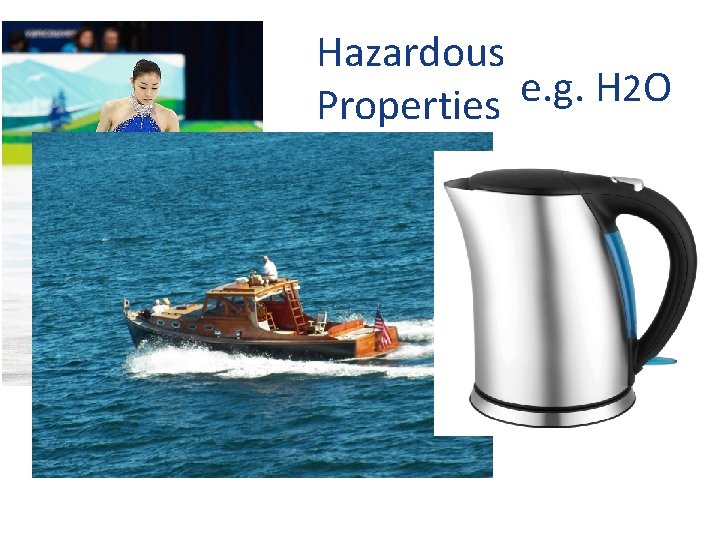
Hazardous e. g. H 2 O Properties
Information • Examples Include ? – Asbestos Survey – Incidents – Equipment Manuals – Maintenance Requirements – Regulatory Websites – Safety Alerts – Noise Survey – Etc….
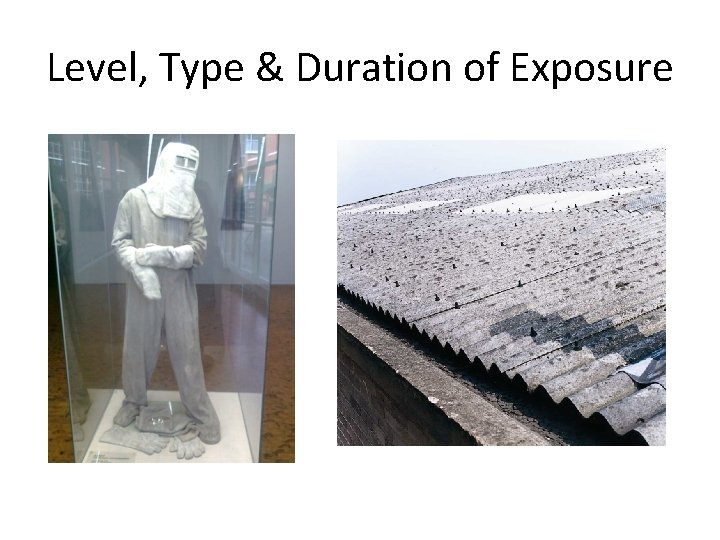
Level, Type & Duration of Exposure
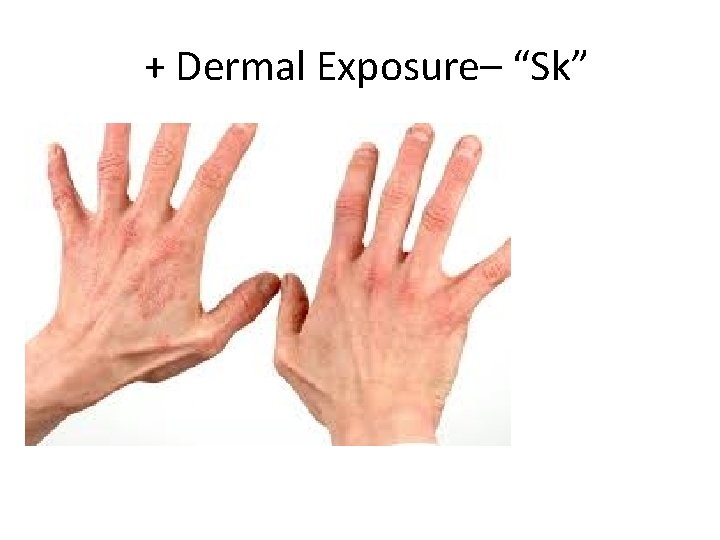
+ Dermal Exposure– “Sk”
Circumstances of work
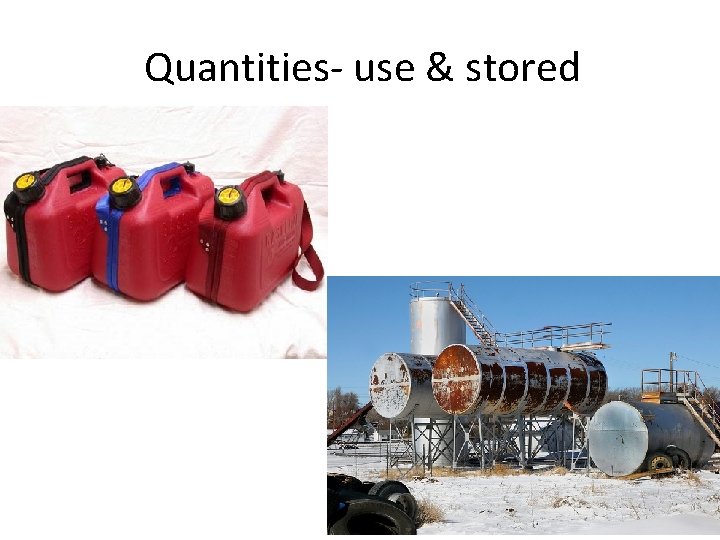
Quantities- use & stored
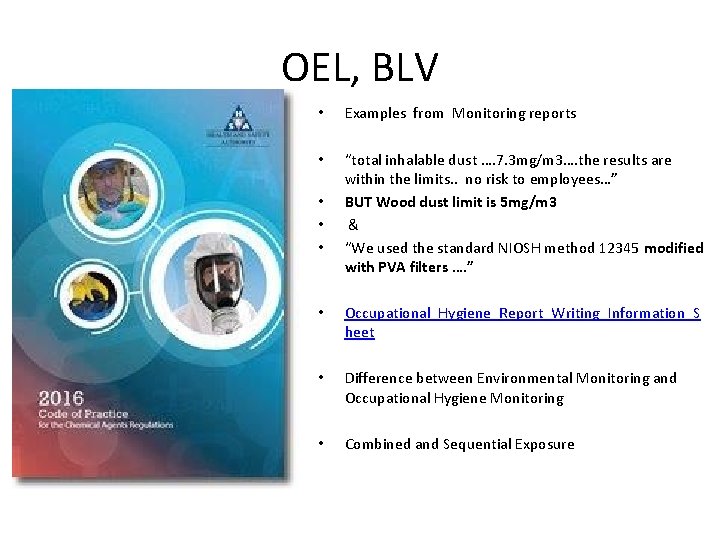
OEL, BLV • Examples from Monitoring reports • “total inhalable dust …. 7. 3 mg/m 3…. the results are within the limits. . no risk to employees…” BUT Wood dust limit is 5 mg/m 3 & “We used the standard NIOSH method 12345 modified with PVA filters …. ” • • Occupational_Hygiene_Report_Writing_Information_S heet • Difference between Environmental Monitoring and Occupational Hygiene Monitoring • Combined and Sequential Exposure
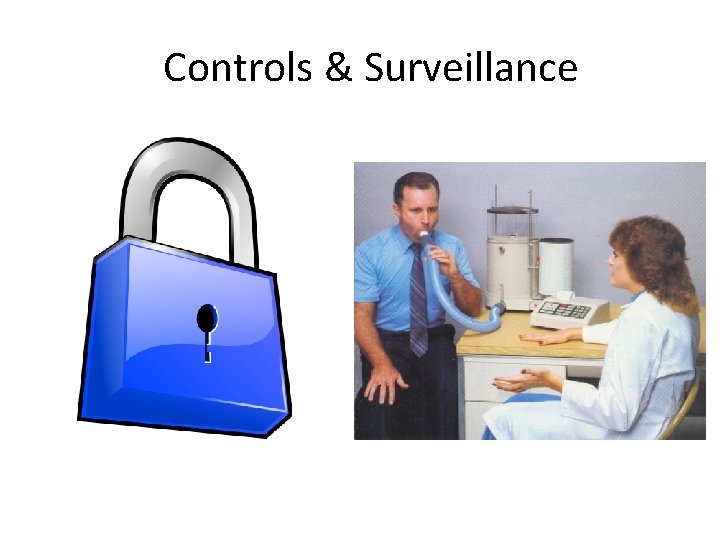
Controls & Surveillance
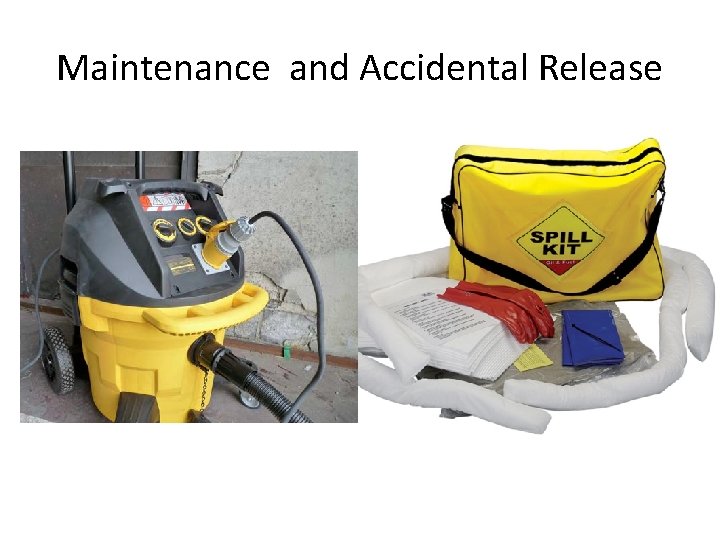
Maintenance and Accidental Release
Storage Transport
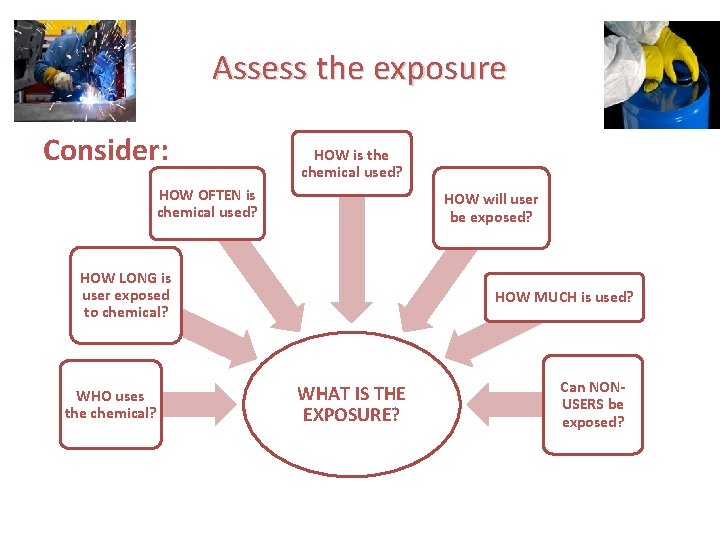
Assess the exposure Consider: HOW is the chemical used? HOW OFTEN is chemical used? HOW will user be exposed? HOW LONG is user exposed to chemical? WHO uses the chemical? HOW MUCH is used? WHAT IS THE EXPOSURE? Can NONUSERS be exposed?
Risk Assessment • SDS & Label & Other • Environment • Process / Task • Who & How? Risk Assessment Controls • Process ? • LEV ? • PPE ? • Training • Maintenance • Monitoring – audit, air, HS CHECK
Can you combine with other documents ? • Cleaning Regime? • SOP? • NOP? • Method Statement ? • Quality Procedure? • Laboratory Protocol?
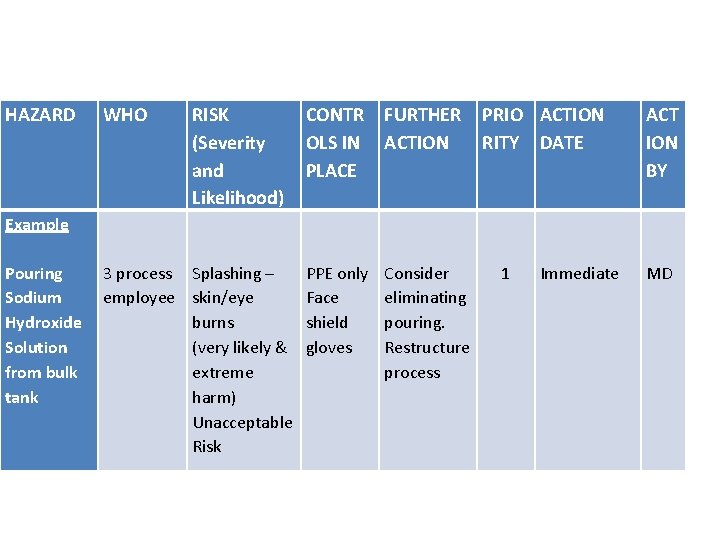
HAZARD WHO RISK (Severity and Likelihood) CONTR FURTHER PRIO ACTION OLS IN ACTION RITY DATE PLACE ACT ION BY Example PPE only Face shield gloves Consider eliminating pouring. Restructure process 1 Immediate MD Pouring 3 process Splashing – Sodium employee skin/eye Hydroxide burns Solution (very likely & from bulk extreme tank harm) Unacceptable Risk
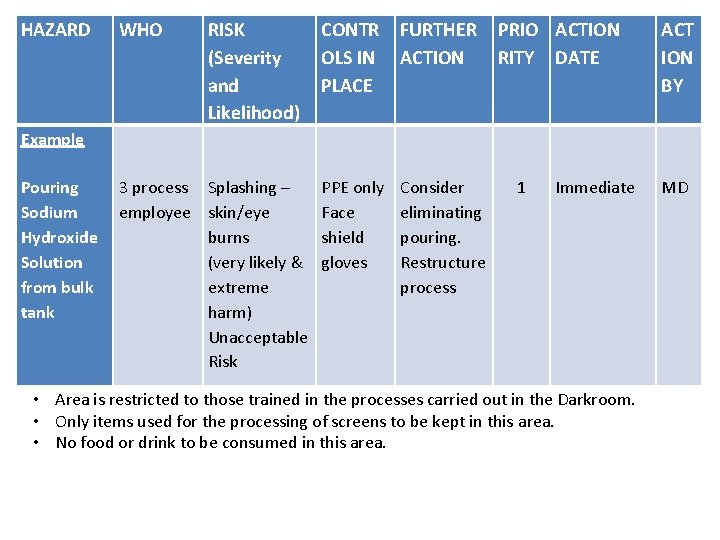
HAZARD WHO RISK (Severity and Likelihood) CONTR FURTHER PRIO ACTION OLS IN ACTION RITY DATE PLACE ACT ION BY Example PPE only Face shield gloves Consider eliminating pouring. Restructure process 1 Immediate MD Pouring 3 process Splashing – Sodium employee skin/eye Hydroxide burns Solution (very likely & from bulk extreme tank harm) Unacceptable Risk • Area is restricted to those trained in the processes carried out in the Darkroom. • Only items used for the processing of screens to be kept in this area. • No food or drink to be consumed in this area.
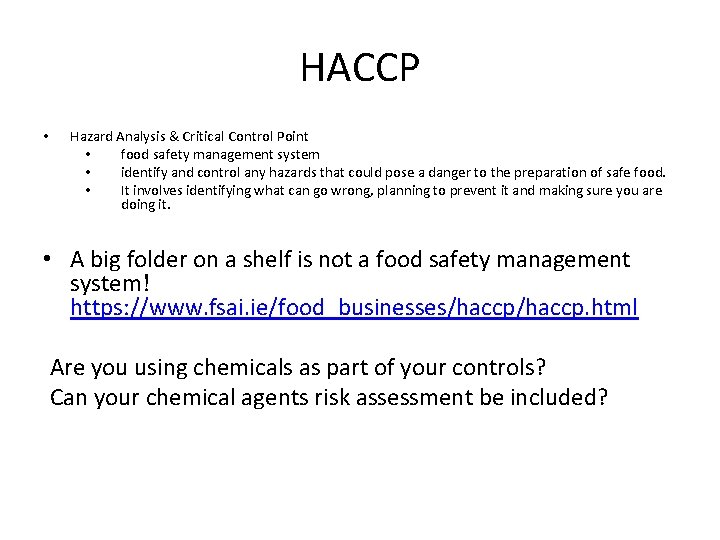
HACCP • Hazard Analysis & Critical Control Point • food safety management system • identify and control any hazards that could pose a danger to the preparation of safe food. • It involves identifying what can go wrong, planning to prevent it and making sure you are doing it. • A big folder on a shelf is not a food safety management system! https: //www. fsai. ie/food_businesses/haccp. html Are you using chemicals as part of your controls? Can your chemical agents risk assessment be included?
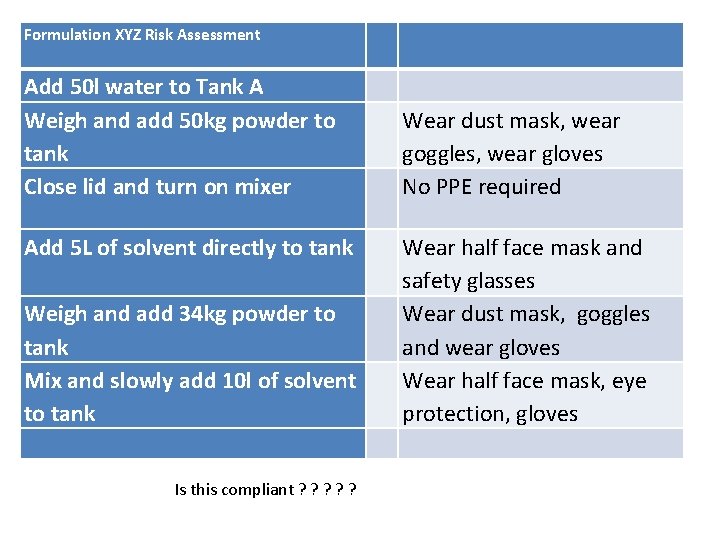
Formulation XYZ Risk Assessment Add 50 l water to Tank A Weigh and add 50 kg powder to tank Close lid and turn on mixer Wear dust mask, wear goggles, wear gloves No PPE required Add 5 L of solvent directly to tank Weigh and add 34 kg powder to tank Mix and slowly add 10 l of solvent to tank Wear half face mask and safety glasses Wear dust mask, goggles and wear gloves Wear half face mask, eye protection, gloves Is this compliant ? ? ?
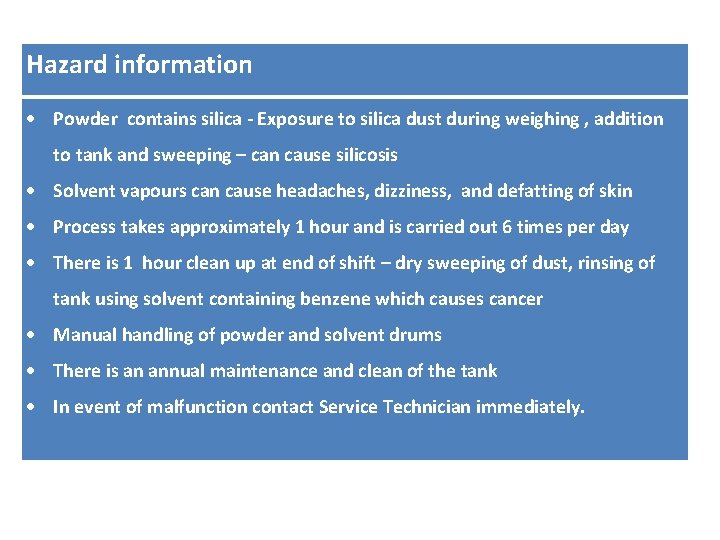
Hazard information Powder contains silica - Exposure to silica dust during weighing , addition to tank and sweeping – can cause silicosis Solvent vapours can cause headaches, dizziness, and defatting of skin Process takes approximately 1 hour and is carried out 6 times per day There is 1 hour clean up at end of shift – dry sweeping of dust, rinsing of tank using solvent containing benzene which causes cancer Manual handling of powder and solvent drums There is an annual maintenance and clean of the tank In event of malfunction contact Service Technician immediately.
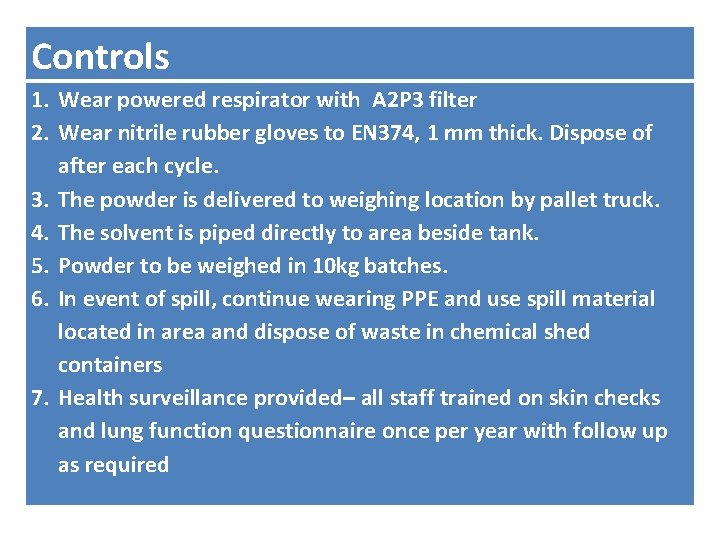
Controls 1. Wear powered respirator with A 2 P 3 filter 2. Wear nitrile rubber gloves to EN 374, 1 mm thick. Dispose of after each cycle. 3. The powder is delivered to weighing location by pallet truck. 4. The solvent is piped directly to area beside tank. 5. Powder to be weighed in 10 kg batches. 6. In event of spill, continue wearing PPE and use spill material located in area and dispose of waste in chemical shed containers 7. Health surveillance provided– all staff trained on skin checks and lung function questionnaire once per year with follow up as required
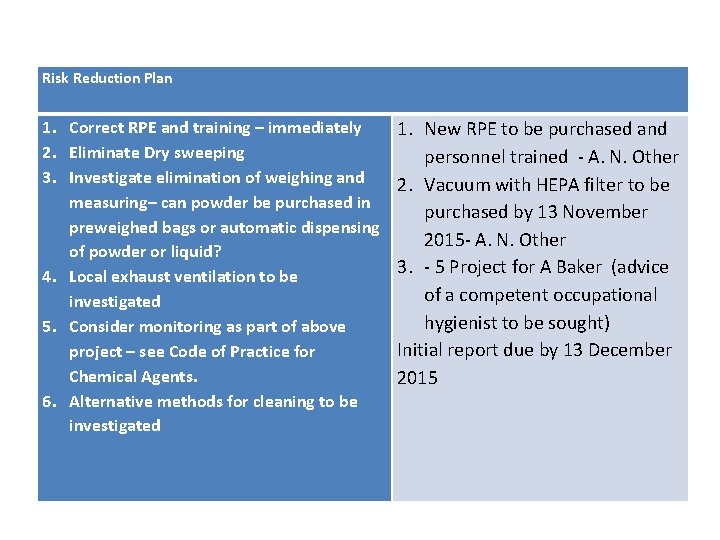
Risk Reduction Plan 1. Correct RPE and training – immediately 2. Eliminate Dry sweeping 3. Investigate elimination of weighing and measuring– can powder be purchased in preweighed bags or automatic dispensing of powder or liquid? 4. Local exhaust ventilation to be investigated 5. Consider monitoring as part of above project – see Code of Practice for Chemical Agents. 6. Alternative methods for cleaning to be investigated 1. New RPE to be purchased and personnel trained - A. N. Other 2. Vacuum with HEPA filter to be purchased by 13 November 2015 - A. N. Other 3. - 5 Project for A Baker (advice of a competent occupational hygienist to be sought) Initial report due by 13 December 2015
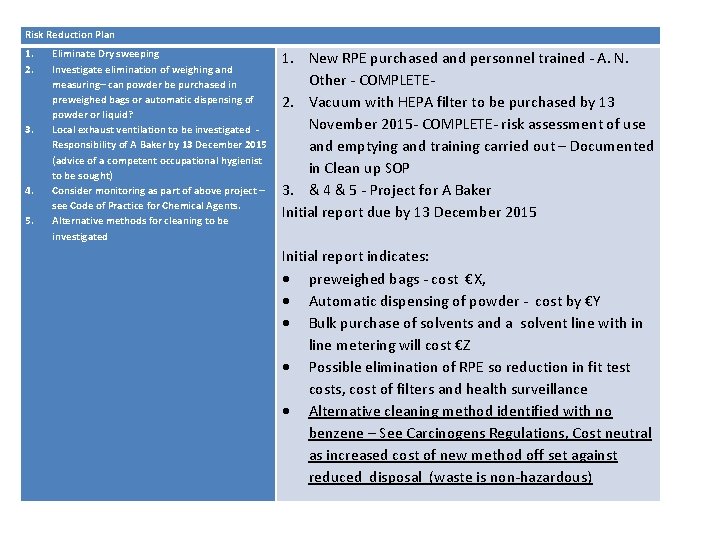
Risk Reduction Plan 1. 2. 3. 4. 5. Eliminate Dry sweeping Investigate elimination of weighing and measuring– can powder be purchased in preweighed bags or automatic dispensing of powder or liquid? Local exhaust ventilation to be investigated - Responsibility of A Baker by 13 December 2015 (advice of a competent occupational hygienist to be sought) Consider monitoring as part of above project – see Code of Practice for Chemical Agents. Alternative methods for cleaning to be investigated 1. New RPE purchased and personnel trained - A. N. Other - COMPLETE 2. Vacuum with HEPA filter to be purchased by 13 November 2015 - COMPLETE- risk assessment of use and emptying and training carried out – Documented in Clean up SOP 3. & 4 & 5 - Project for A Baker Initial report due by 13 December 2015 Initial report indicates: preweighed bags - cost €X, Automatic dispensing of powder - cost by €Y Bulk purchase of solvents and a solvent line with in line metering will cost €Z Possible elimination of RPE so reduction in fit test costs, cost of filters and health surveillance Alternative cleaning method identified with no benzene – See Carcinogens Regulations, Cost neutral as increased cost of new method off set against reduced disposal (waste is non-hazardous)
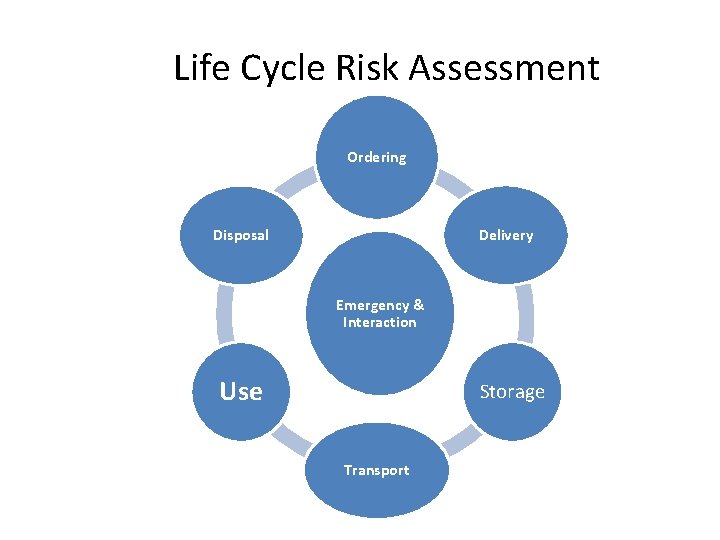
Life Cycle Risk Assessment Ordering Delivery Disposal Emergency & Interaction Use Storage Transport
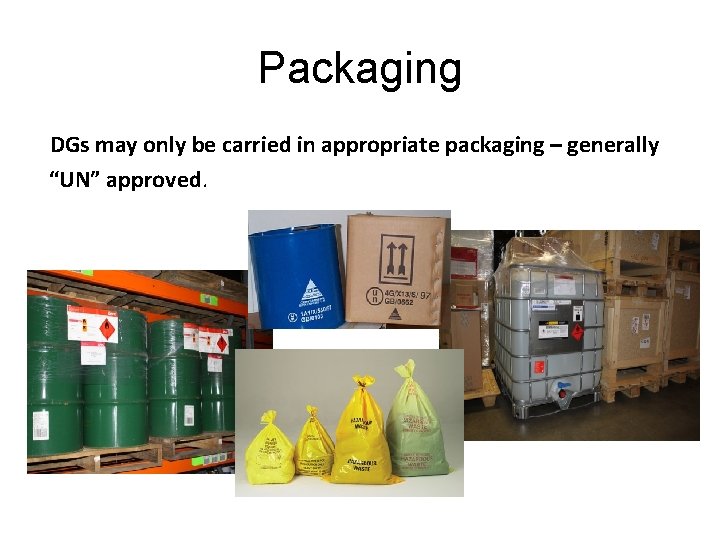
Packaging DGs may only be carried in appropriate packaging – generally “UN” approved.
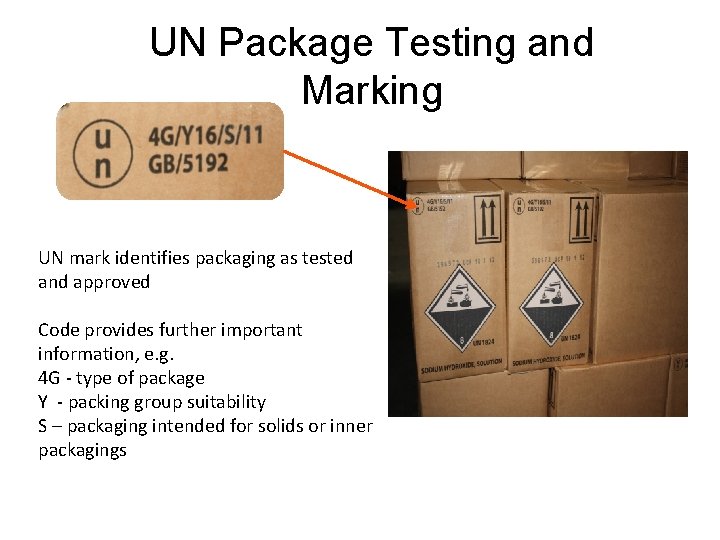
UN Package Testing and Marking UN mark identifies packaging as tested and approved Code provides further important information, e. g. 4 G - type of package Y - packing group suitability S – packaging intended for solids or inner packagings
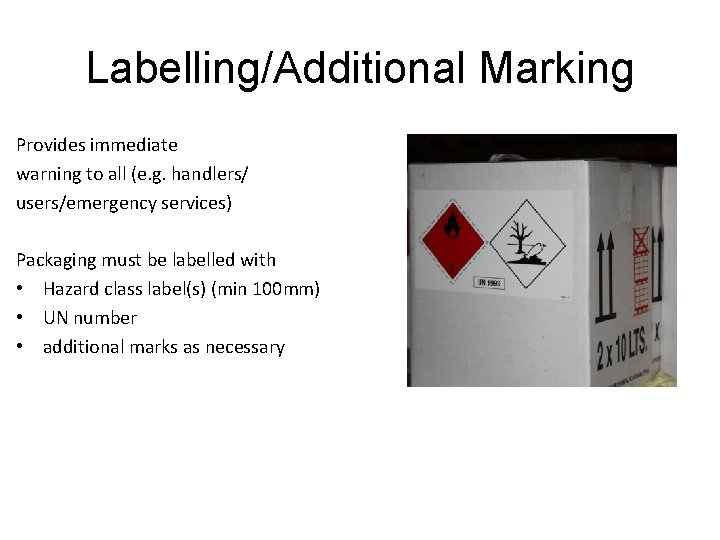
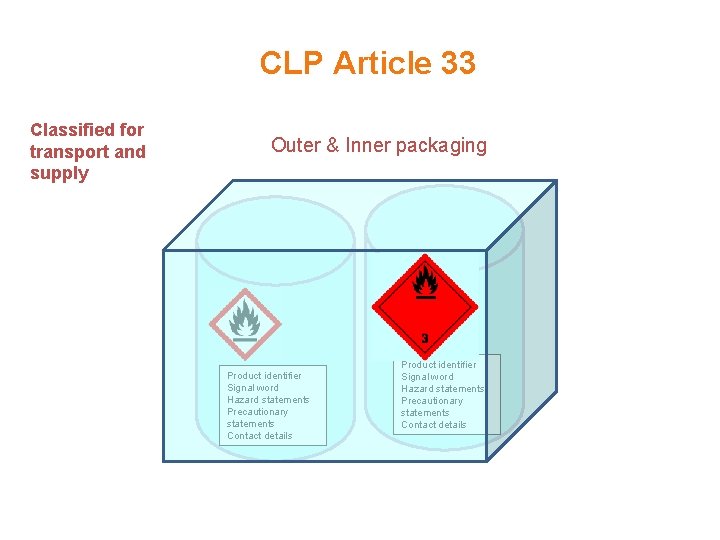
Labelling/Additional Marking Provides immediate warning to all (e. g. handlers/ users/emergency services) Packaging must be labelled with • Hazard class label(s) (min 100 mm) • UN number • additional marks as necessary
CLP Article 33 Classified for transport and supply Outer & Inner packaging Product identifier Signal word Hazard statements Precautionary statements Contact details
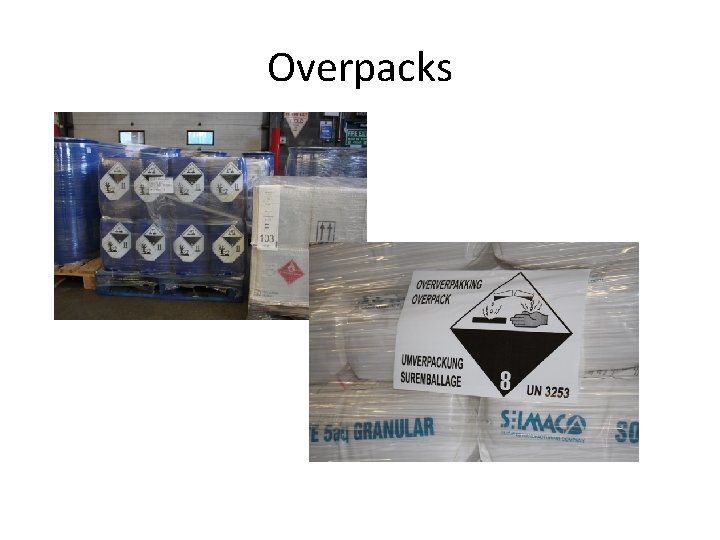
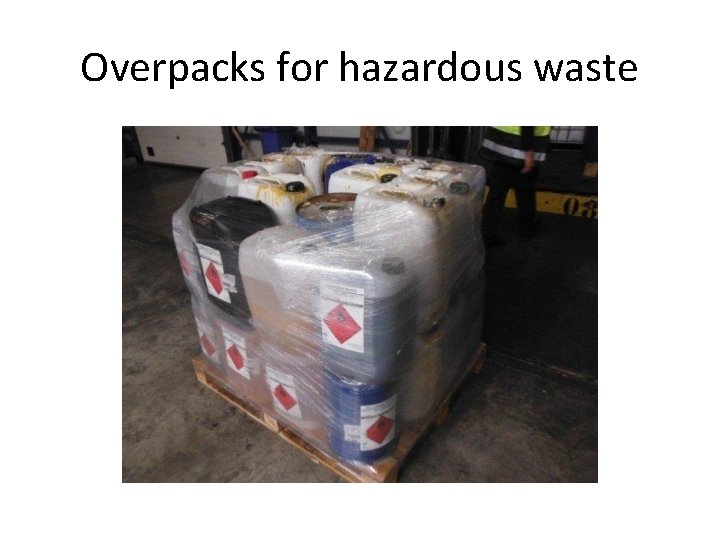
Overpacks
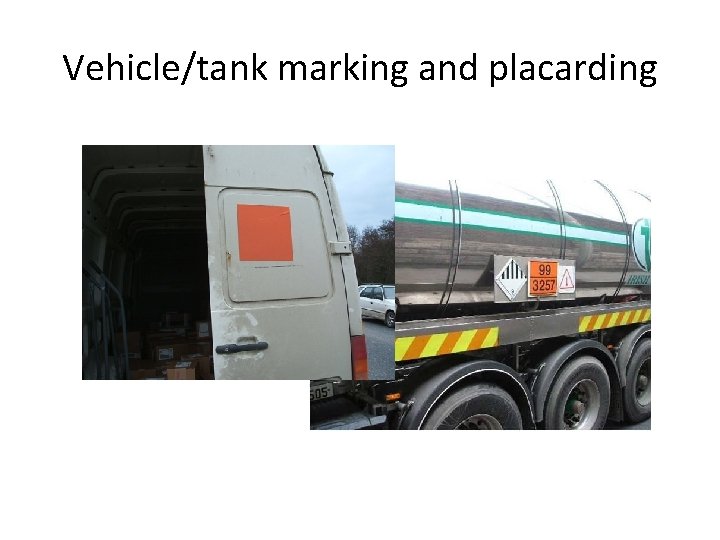
Vehicle/tank marking and placarding
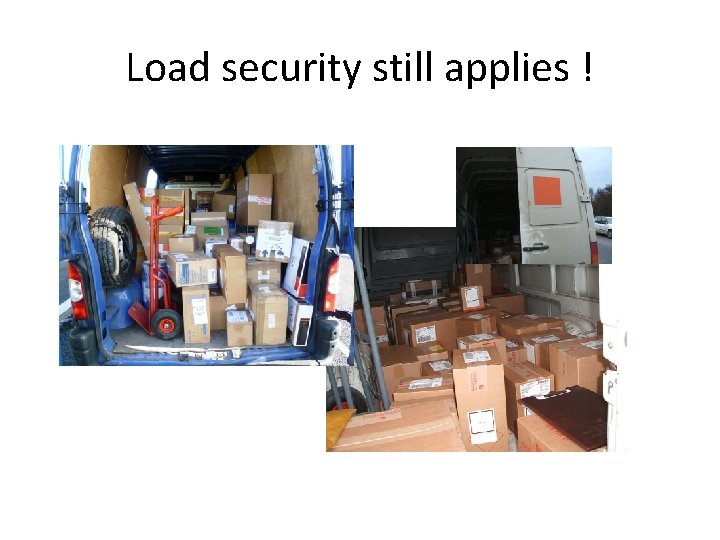
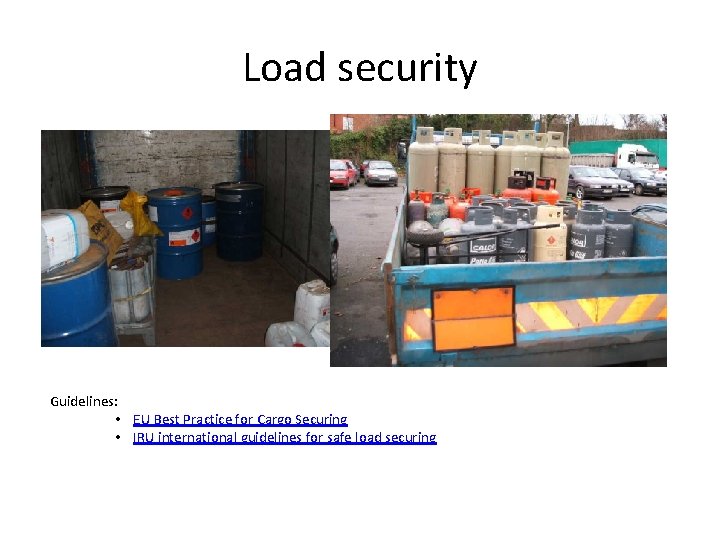
Load security still applies !
Load security Guidelines: • EU Best Practice for Cargo Securing • IRU international guidelines for safe load securing
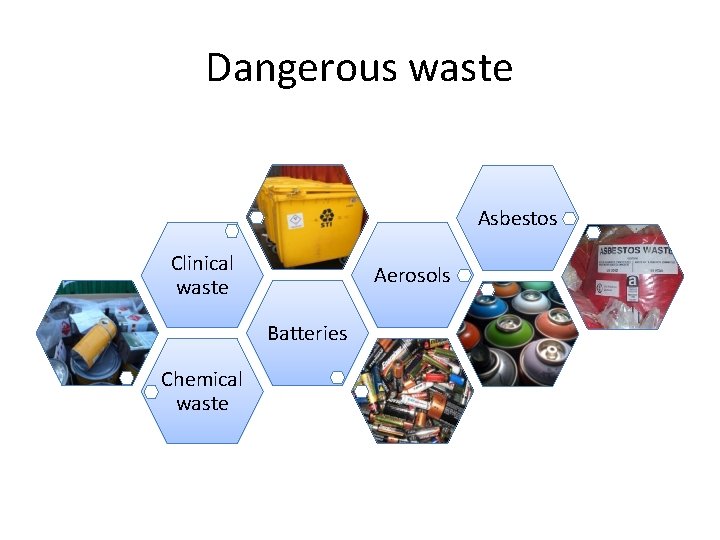
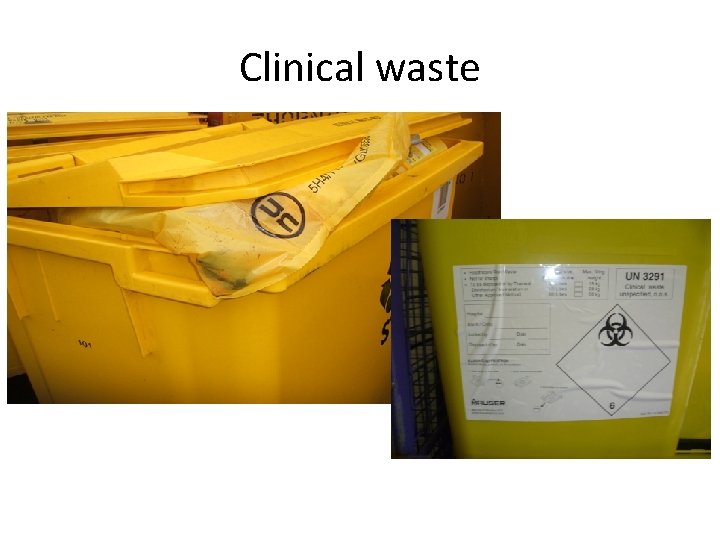
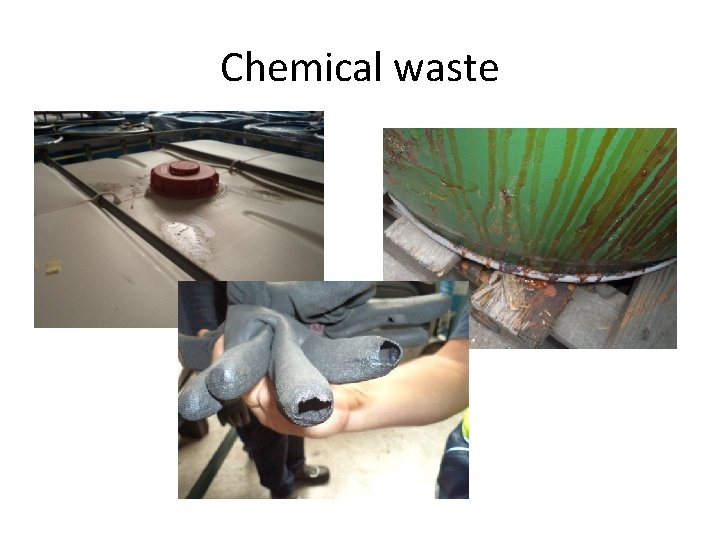
Dangerous waste Asbestos Clinical waste Aerosols Batteries Chemical waste
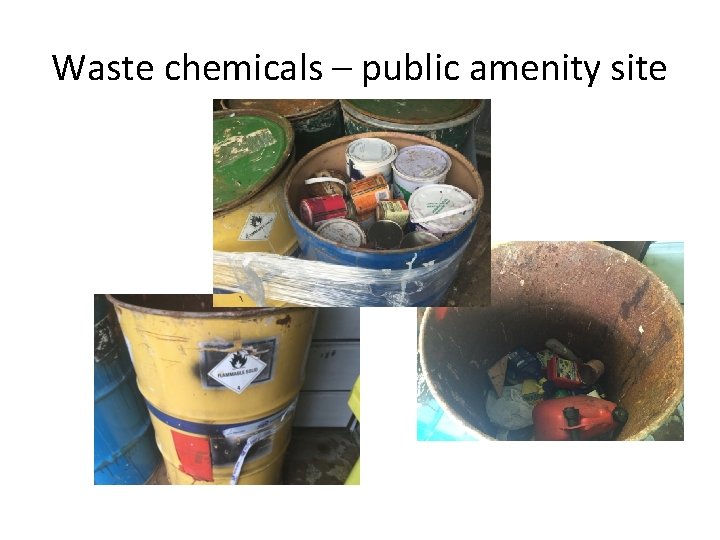
Waste chemicals – public amenity site
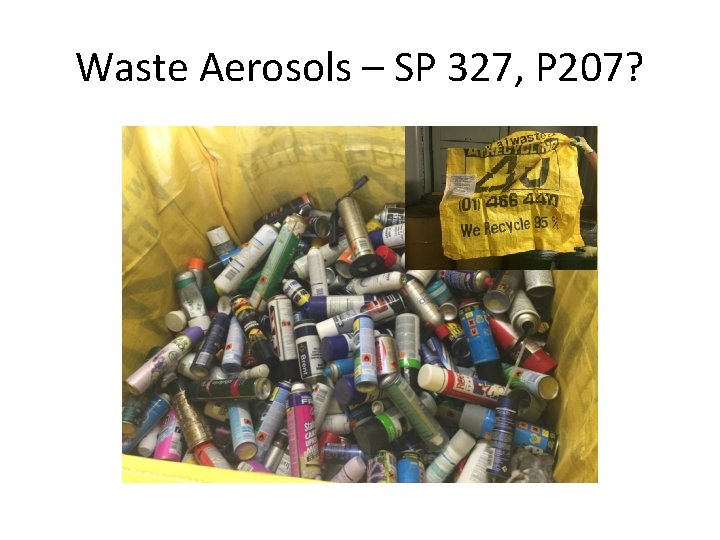
Waste Aerosols – SP 327, P 207?
Clinical waste
Chemical waste
Overpacks for hazardous waste