
CHEM342 Jigsaw Group Assignment Construct a Concept Map



- Slides: 22
CHEM-342 Jigsaw Group Assignment Construct a Concept Map that summarizes the significance of the articles you are studying and can be useful to the rest of the class.
What does it mean when you say, I understand? . . Does it mean the same thing to you that it does to another student or to the professor? . . … How can you demonstrate you understanding to others?
Concept Mapping • What is a concept map? • What are the features of a concept map? • How do you construct a concept map?
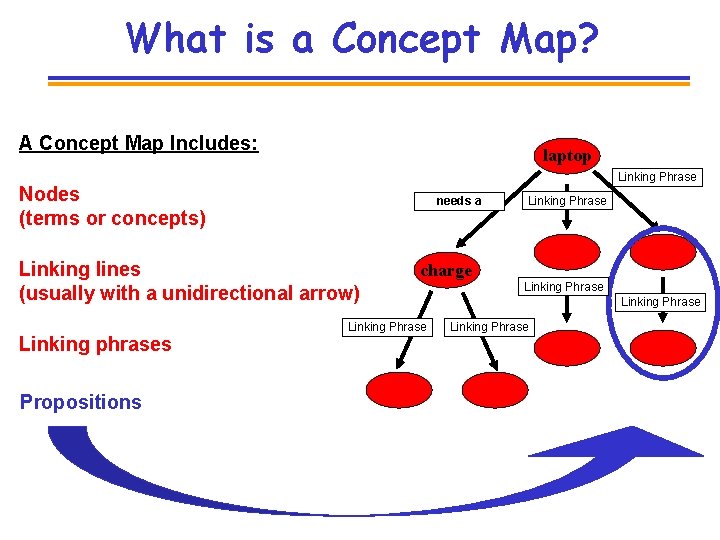
What is a Concept Map? A Concept Map Includes: laptop Linking Phrase Nodes (terms or concepts) needs a Linking lines (usually with a unidirectional arrow) Linking phrases Propositions Linking Phrase charge Linking Phrase
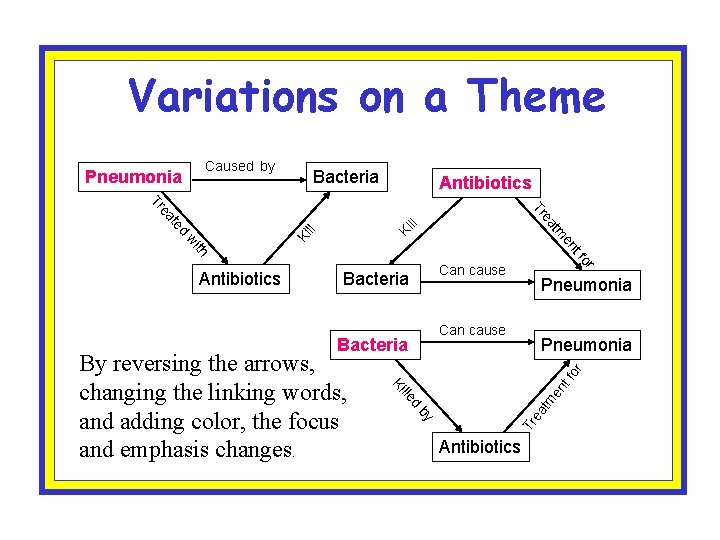
Short Assignment Arrange the following three terms and connect them with arrows and linking phrases Bacteria Pneumonia Antibiotics
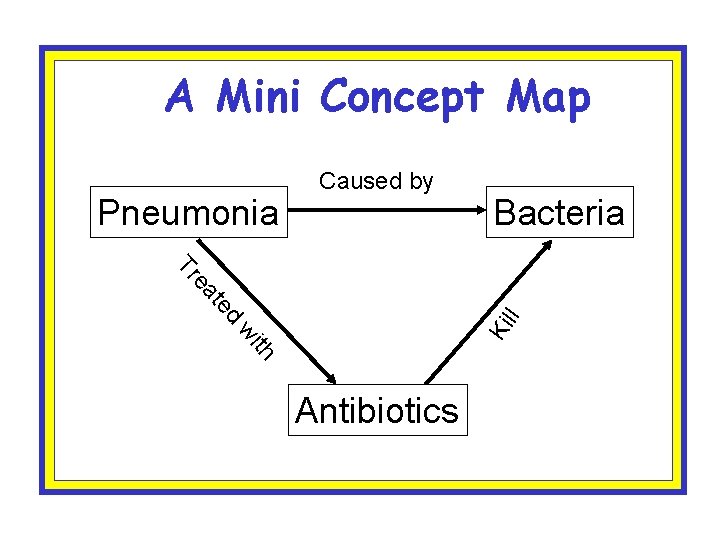
A Mini Concept Map Pneumonia Caused by Bacteria te ea Tr wi Ki ll d th Antibiotics
Variations on a Theme Caused by Pneumonia Bacteria Antibiotics Can cause ll Ki Bacteria Pneumonia Can cause Pneumonia Tr by ea d tm lle en Ki tf or Bacteria By reversing the arrows, changing the linking words, and adding color, the focus and emphasis changes. or tf th en wi tm Ki ll ea d te ea Tr Tr Antibiotics
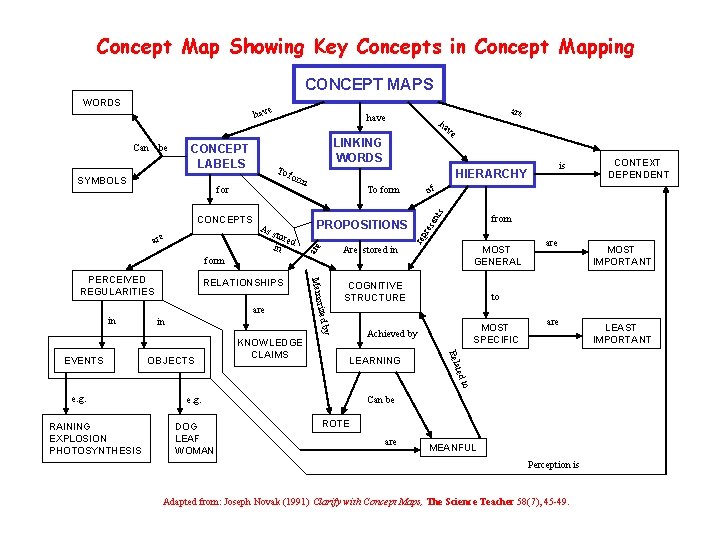
Concept Map Showing Key Concepts in Concept Mapping CONCEPT MAPS e hav CONCEPT LABELS CONCEPTS As st ored in are PROPOSITIONS Are stored in in MOST GENERAL MOST SPECIFIC are ated to e. g. RAINING EXPLOSION PHOTOSYNTHESIS e. g. DOG LEAF WOMAN Can be ROTE are MOST IMPORTANT to Achieved by LEARNING are Rel OBJECTS KNOWLEDGE CLAIMS from COGNITIVE STRUCTURE ized by EVENTS are Memor in RELATIONSHIPS CONTEXT DEPENDENT of To form PERCEIVED REGULARITIES is HIERARCHY form ts for ve res en SYMBOLS To e be are ha LINKING WORDS ar Can have rep WORDS MEANFUL Perception is Adapted from: Joseph Novak (1991) Clarify with Concept Maps, The Science Teacher 58(7), 45 -49. LEAST IMPORTANT
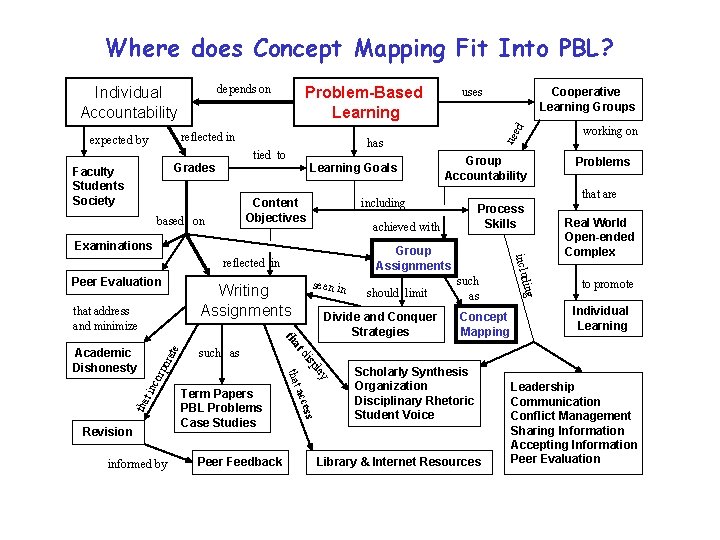
Where does Concept Mapping Fit Into PBL? depends on Problem-Based Learning reflected in expected by has tied to Grades Faculty Students Society Learning Goals Content Objectives based on ate por cor t in tha Concept Mapping ss acce Peer Feedback lay sp Term Papers PBL Problems Case Studies that informed by Divide and Conquer Strategies such as includ such as should limit Problems Real World Open-ended Complex to promote Individual Learning di Revision seen in at th Academic Dishonesty Process Skills Group Assignments Writing Assignments working on that are achieved with reflected in that address and minimize Cooperative Learning Groups Group Accountability including Examinations Peer Evaluation uses ne ed Individual Accountability Scholarly Synthesis Organization Disciplinary Rhetoric Student Voice Library & Internet Resources Leadership Communication Conflict Management Sharing Information Accepting Information Peer Evaluation
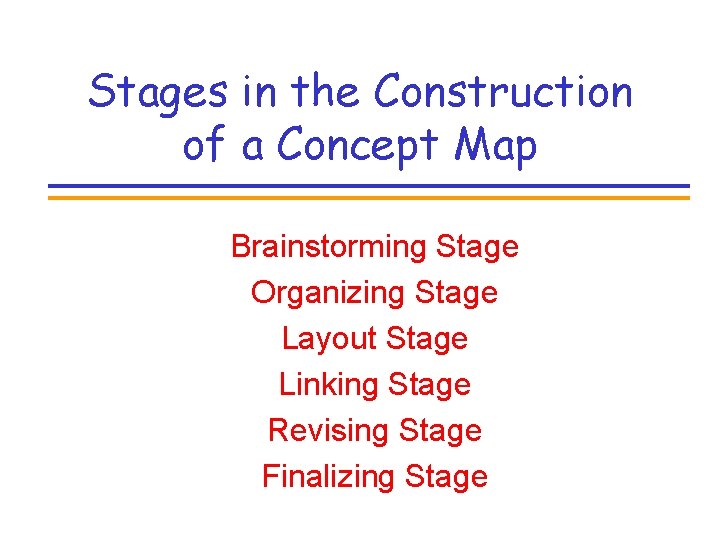
Stages in the Construction of a Concept Map Brainstorming Stage Organizing Stage Layout Stage Linking Stage Revising Stage Finalizing Stage
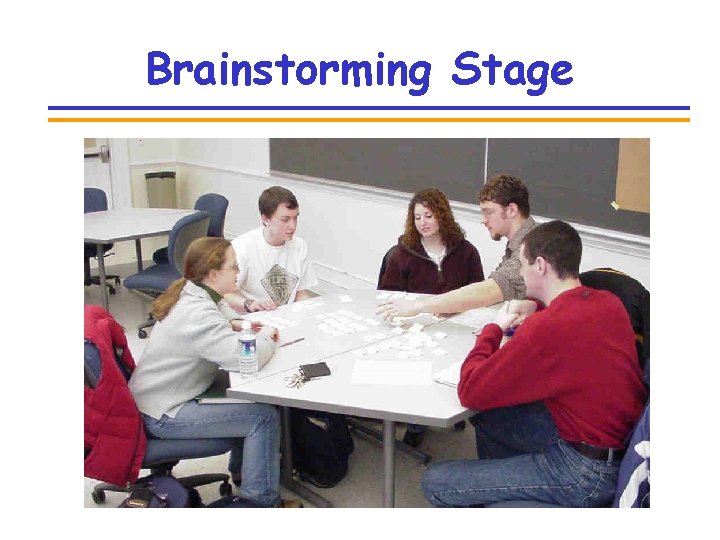
Brainstorming Stage • List any and all terms and concepts associated with the topic of interest. • Write them on Post It Notes, one word or phrase per note. • Don't worry about redundancy, relative importance, or relationships at this point. • The objective is to generate the largest possible list.
Brainstorming Stage
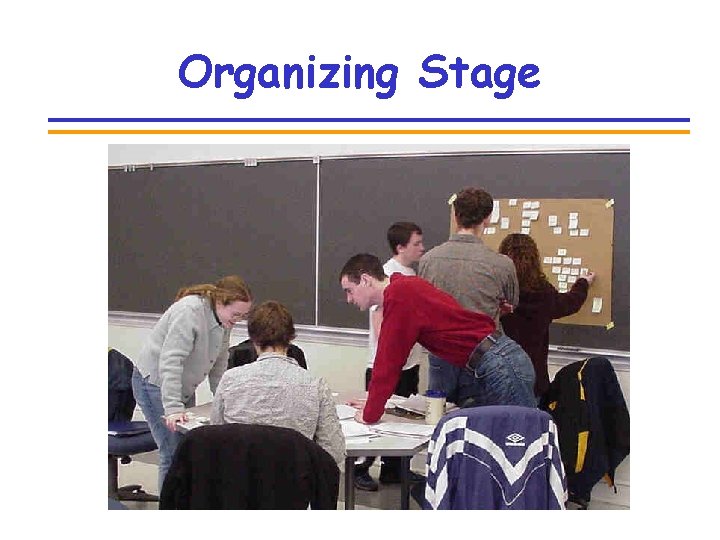
Organizing Stage • Spread concepts on a table or blackboard so that all can be read easily. • Create groups and sub-groups of related items. Try to group items to emphasize hierarchies. • Identify terms that represent higher categories and add them. • Feel free to rearrange items and introduce new items omitted initially. • Some concepts will fall into multiple groupings. This will become important in the linking stage.
Organizing Stage
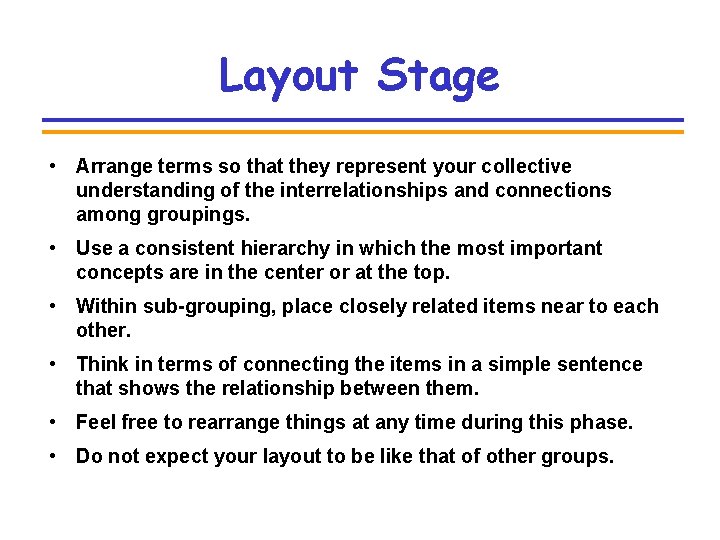
Layout Stage • Arrange terms so that they represent your collective understanding of the interrelationships and connections among groupings. • Use a consistent hierarchy in which the most important concepts are in the center or at the top. • Within sub-grouping, place closely related items near to each other. • Think in terms of connecting the items in a simple sentence that shows the relationship between them. • Feel free to rearrange things at any time during this phase. • Do not expect your layout to be like that of other groups.
Layout Stage
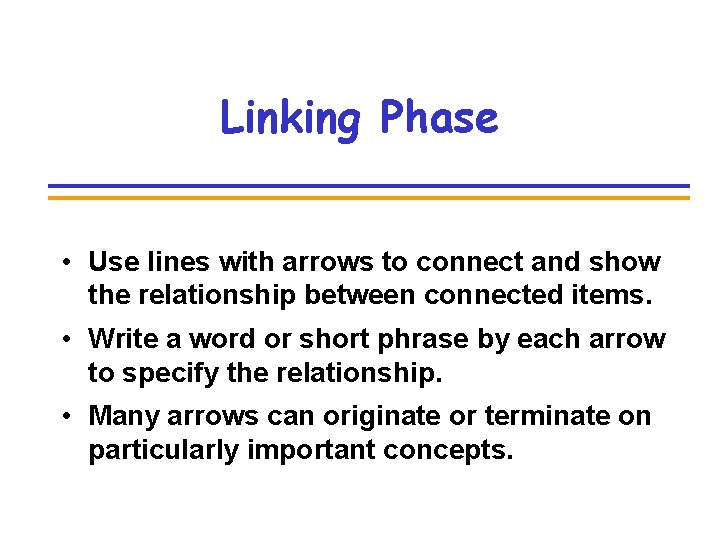
Linking Phase • Use lines with arrows to connect and show the relationship between connected items. • Write a word or short phrase by each arrow to specify the relationship. • Many arrows can originate or terminate on particularly important concepts.
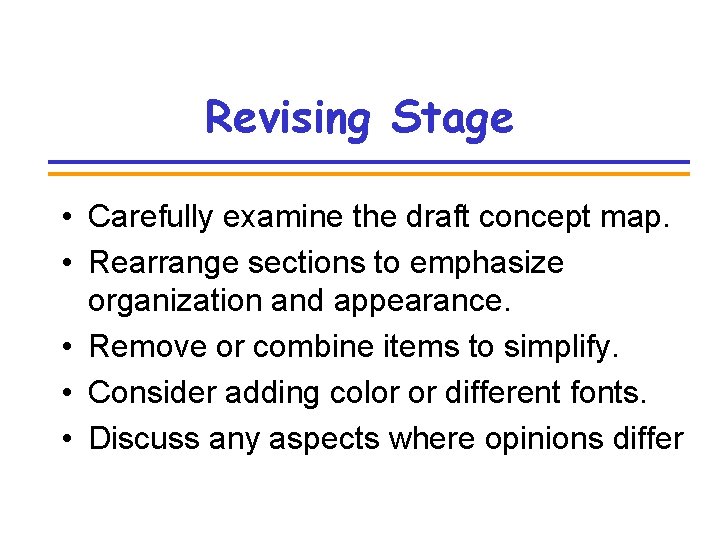
Revising Stage • Carefully examine the draft concept map. • Rearrange sections to emphasize organization and appearance. • Remove or combine items to simplify. • Consider adding color or different fonts. • Discuss any aspects where opinions differ
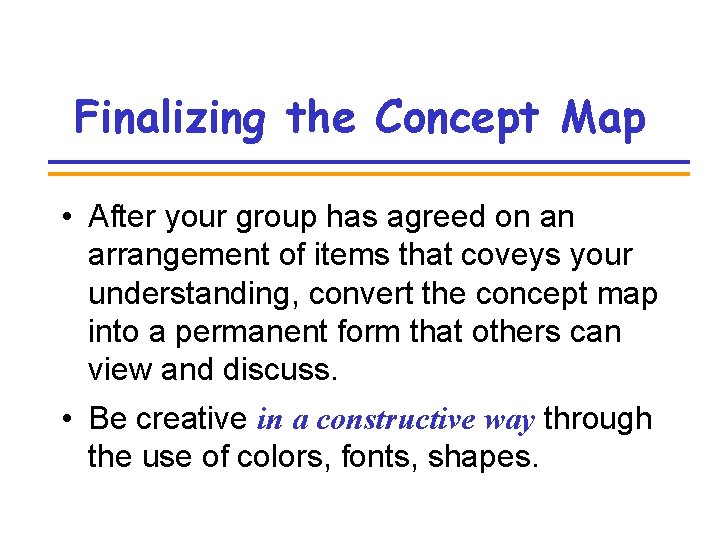
Finalizing the Concept Map • After your group has agreed on an arrangement of items that coveys your understanding, convert the concept map into a permanent form that others can view and discuss. • Be creative in a constructive way through the use of colors, fonts, shapes.
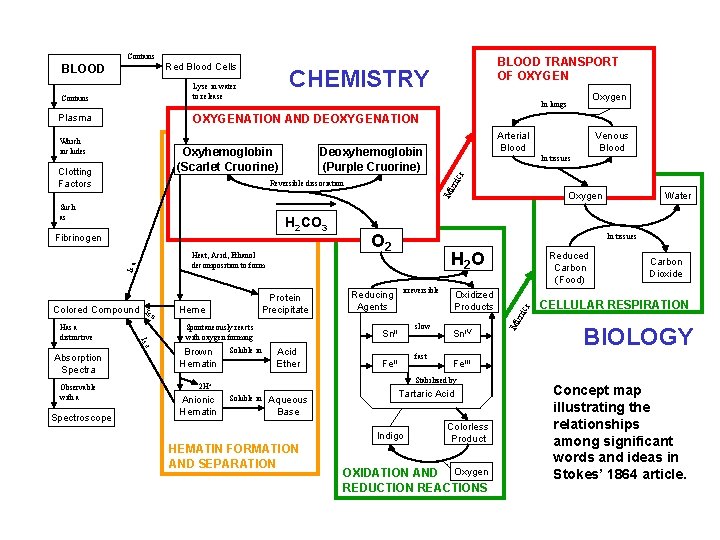
Contains BLOOD Red Blood Cells CHEMISTRY Lyse in water to release Contains Plasma Is a Spectroscope Is a Heme Spontaneously reacts with oxygen forming Brown Hematin Soluble in Mi m H 2 O irreversible slow Sn. II Acid Ether Oxidized Products fast Fe. II Sn. IV Soluble in Aqueous Base Tartaric Acid Indigo HEMATIN FORMATION AND SEPARATION Reduced Carbon (Food) Carbon Dioxide CELLULAR RESPIRATION BIOLOGY Fe. III Stabilized by 2 H+ Anionic Hematin Reducing Agents Water In tissues cs Colored Compound Protein Precipitate O 2 Oxygen mi Is a Heat, Acid, Ethanol decomposition to form Venous Blood In tissues Mi H 2 CO 3 Fibrinogen Observable with a Deoxyhemoglobin (Purple Cruorine) Reversible dissociation Such as Arterial Blood ics Oxyhemoglobin (Scarlet Cruorine) Clotting Factors Absorption Spectra Oxygen In lungs OXYGENATION AND DEOXYGENATION Which includes Has a distinctive BLOOD TRANSPORT OF OXYGEN Colorless Product OXIDATION AND Oxygen REDUCTION REACTIONS Concept map illustrating the relationships among significant words and ideas in Stokes’ 1864 article.
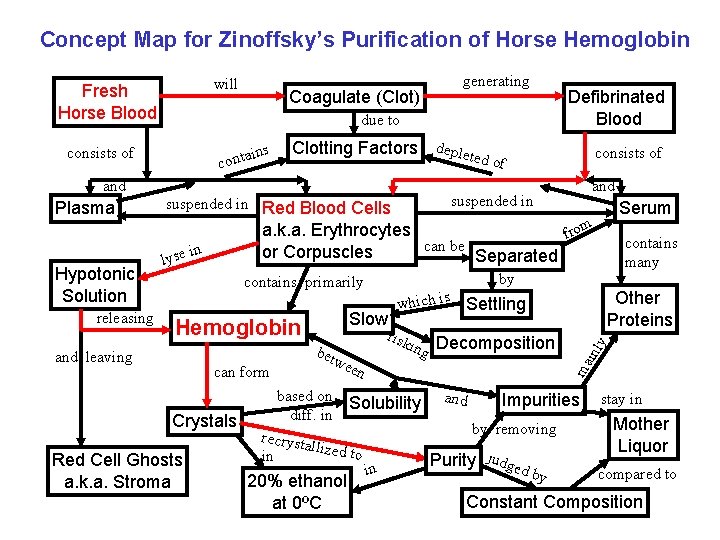
Concept Map for Zinoffsky’s Purification of Horse Hemoglobin will Coagulate (Clot) due to ins a cont Clotting Factors deplete d of and releasing n can form Crystals bet which is Settling risk ing Decomposition we en based on Solubility diff. in recrysta llized to in 20% ethanol at 0ºC contains many by Slow Hemoglobin Red Cell Ghosts a. k. a. Stroma Serum m a. k. a. Erythrocytes fro can be or Corpuscles Separated contains primarily and leaving and Other Proteins ma Hypotonic Solution consists of suspended in Red Blood Cells i lyse Defibrinated Blood y consists of Plasma generating inl Fresh Horse Blood in and Impurities by removing stay in Mother Liquor Purity judged by compared to Constant Composition
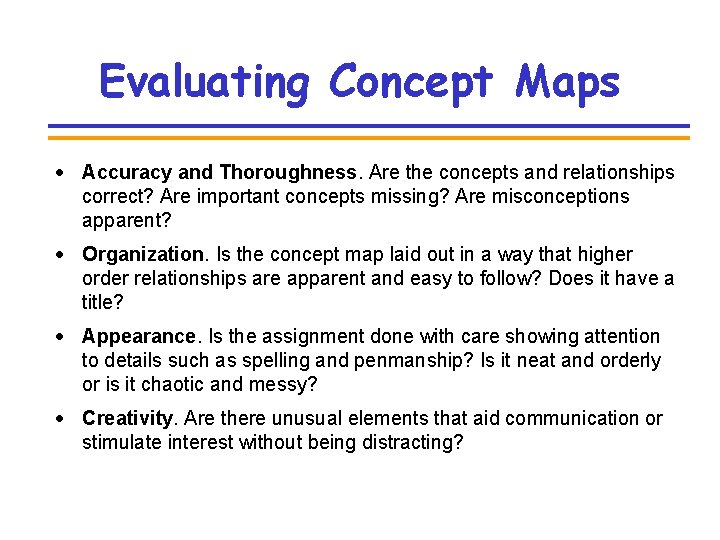
Evaluating Concept Maps · Accuracy and Thoroughness. Are the concepts and relationships correct? Are important concepts missing? Are misconceptions apparent? · Organization. Is the concept map laid out in a way that higher order relationships are apparent and easy to follow? Does it have a title? · Appearance. Is the assignment done with care showing attention to details such as spelling and penmanship? Is it neat and orderly or is it chaotic and messy? · Creativity. Are there unusual elements that aid communication or stimulate interest without being distracting?