
Chem 1 B 920 Lecture Announcements I Second
Chem. 1 B – 9/20 Lecture
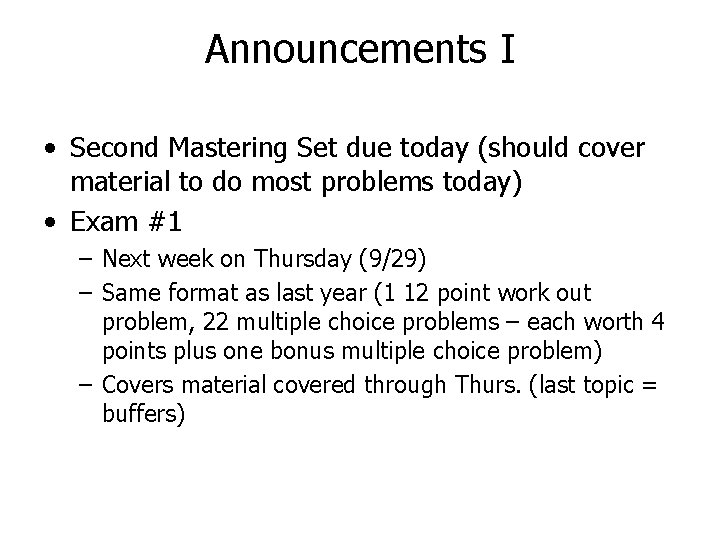
Announcements I • Second Mastering Set due today (should cover material to do most problems today) • Exam #1 – Next week on Thursday (9/29) – Same format as last year (1 12 point work out problem, 22 multiple choice problems – each worth 4 points plus one bonus multiple choice problem) – Covers material covered through Thurs. (last topic = buffers)
Announcements II • Today’s Lecture – – Polyprotic acids – conjugate bases Dependence of Ka on acid structure Buffers (Chapter 16)
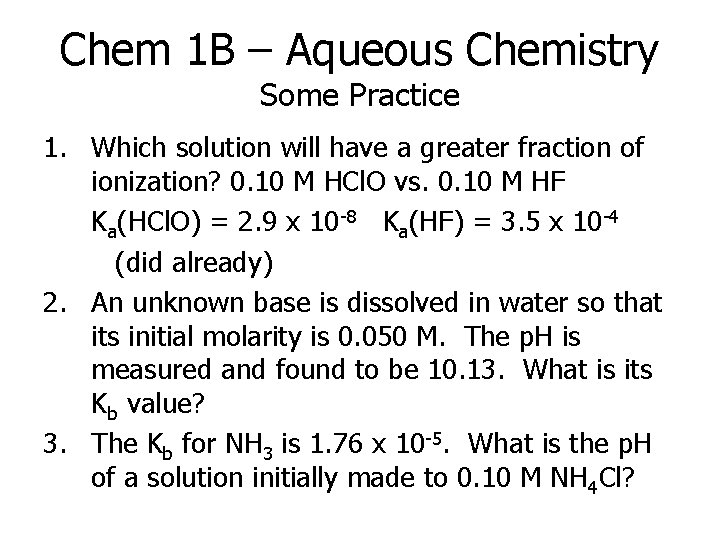
Chem 1 B – Aqueous Chemistry Some Practice 1. Which solution will have a greater fraction of ionization? 0. 10 M HCl. O vs. 0. 10 M HF Ka(HCl. O) = 2. 9 x 10 -8 Ka(HF) = 3. 5 x 10 -4 (did already) 2. An unknown base is dissolved in water so that its initial molarity is 0. 050 M. The p. H is measured and found to be 10. 13. What is its Kb value? 3. The Kb for NH 3 is 1. 76 x 10 -5. What is the p. H of a solution initially made to 0. 10 M NH 4 Cl?
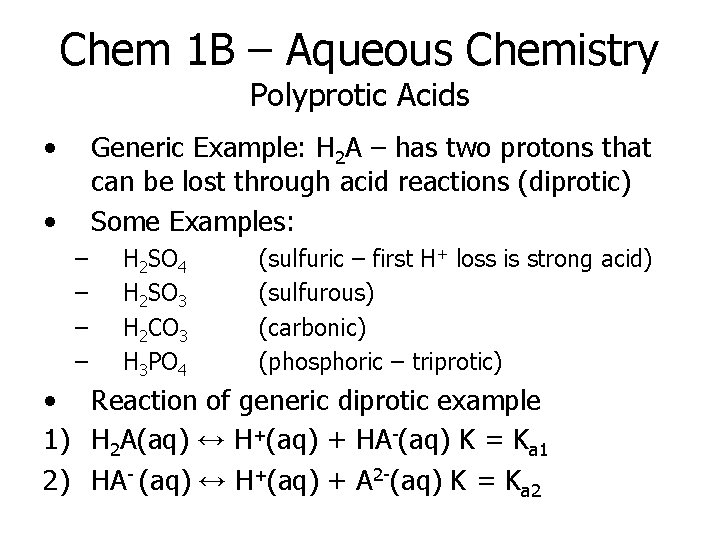
Chem 1 B – Aqueous Chemistry Polyprotic Acids • Generic Example: H 2 A – has two protons that can be lost through acid reactions (diprotic) Some Examples: • – – H 2 SO 4 H 2 SO 3 H 2 CO 3 H 3 PO 4 (sulfuric – first H+ loss is strong acid) (sulfurous) (carbonic) (phosphoric – triprotic) • Reaction of generic diprotic example 1) H 2 A(aq) ↔ H+(aq) + HA-(aq) K = Ka 1 2) HA- (aq) ↔ H+(aq) + A 2 -(aq) K = Ka 2
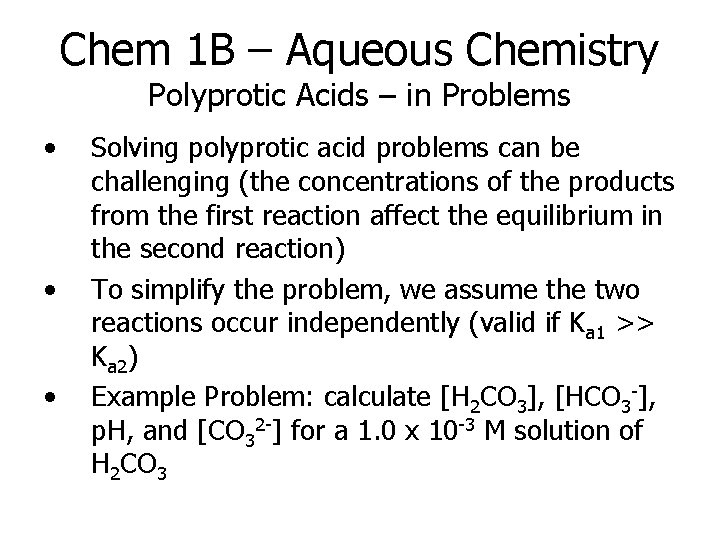
Chem 1 B – Aqueous Chemistry Polyprotic Acids – in Problems • • • Solving polyprotic acid problems can be challenging (the concentrations of the products from the first reaction affect the equilibrium in the second reaction) To simplify the problem, we assume the two reactions occur independently (valid if Ka 1 >> Ka 2) Example Problem: calculate [H 2 CO 3], [HCO 3 -], p. H, and [CO 32 -] for a 1. 0 x 10 -3 M solution of H 2 CO 3
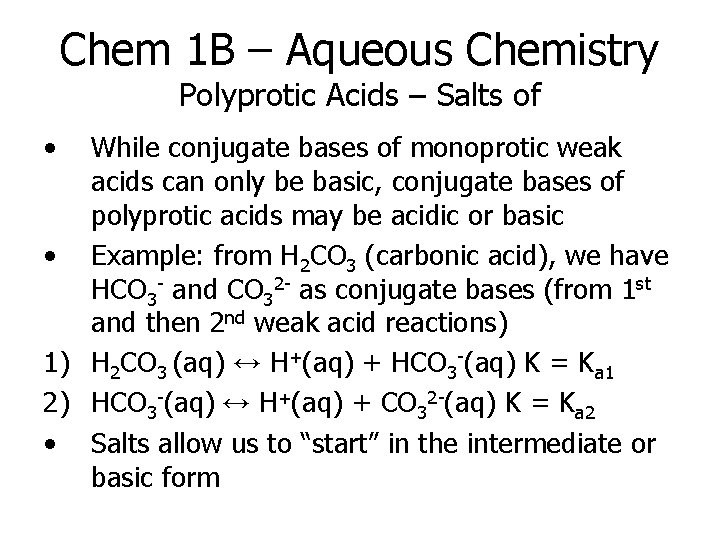
Chem 1 B – Aqueous Chemistry Polyprotic Acids – Salts of • While conjugate bases of monoprotic weak acids can only be basic, conjugate bases of polyprotic acids may be acidic or basic • Example: from H 2 CO 3 (carbonic acid), we have HCO 3 - and CO 32 - as conjugate bases (from 1 st and then 2 nd weak acid reactions) 1) H 2 CO 3 (aq) ↔ H+(aq) + HCO 3 -(aq) K = Ka 1 2) HCO 3 -(aq) ↔ H+(aq) + CO 32 -(aq) K = Ka 2 • Salts allow us to “start” in the intermediate or basic form
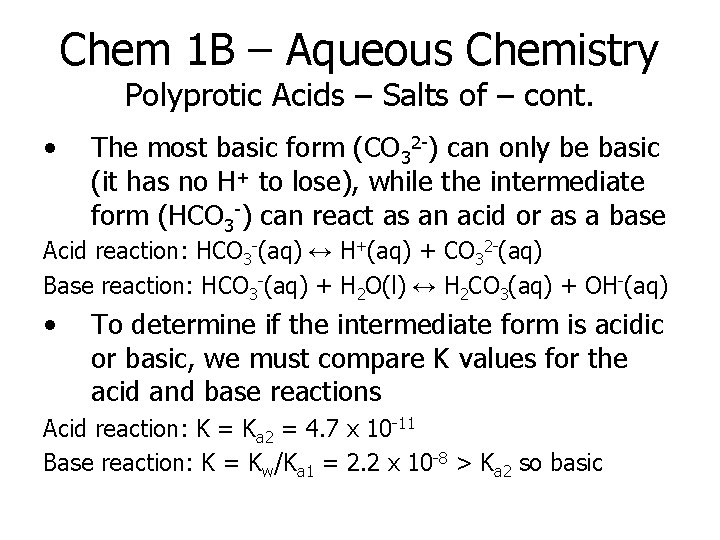
Chem 1 B – Aqueous Chemistry Polyprotic Acids – Salts of – cont. • The most basic form (CO 32 -) can only be basic (it has no H+ to lose), while the intermediate form (HCO 3 -) can react as an acid or as a base Acid reaction: HCO 3 -(aq) ↔ H+(aq) + CO 32 -(aq) Base reaction: HCO 3 -(aq) + H 2 O(l) ↔ H 2 CO 3(aq) + OH-(aq) • To determine if the intermediate form is acidic or basic, we must compare K values for the acid and base reactions Acid reaction: K = Ka 2 = 4. 7 x 10 -11 Base reaction: K = Kw/Ka 1 = 2. 2 x 10 -8 > Ka 2 so basic
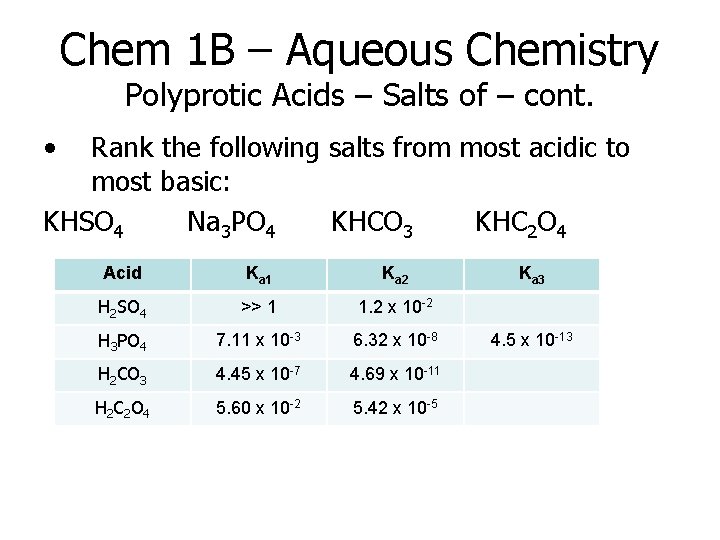
Chem 1 B – Aqueous Chemistry Polyprotic Acids – Salts of – cont. • Rank the following salts from most acidic to most basic: KHSO 4 Na 3 PO 4 KHCO 3 KHC 2 O 4 Acid Ka 1 Ka 2 H 2 SO 4 >> 1 1. 2 x 10 -2 H 3 PO 4 7. 11 x 10 -3 6. 32 x 10 -8 H 2 CO 3 4. 45 x 10 -7 4. 69 x 10 -11 H 2 C 2 O 4 5. 60 x 10 -2 5. 42 x 10 -5 Ka 3 4. 5 x 10 -13
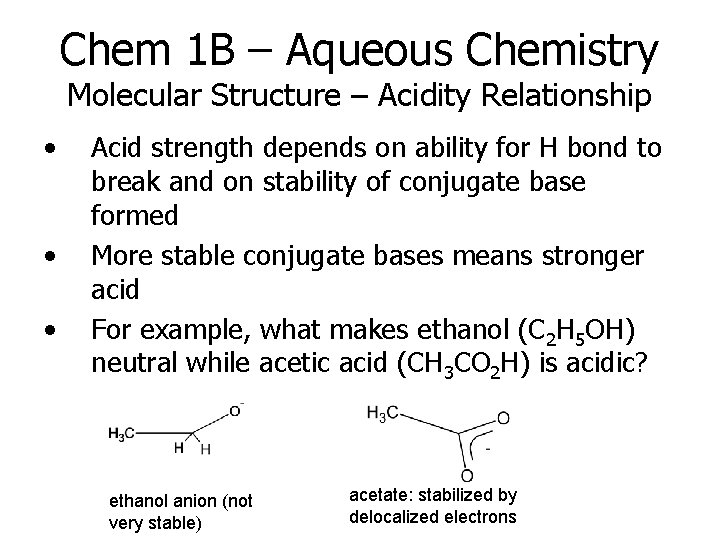
Chem 1 B – Aqueous Chemistry Molecular Structure – Acidity Relationship • • • Acid strength depends on ability for H bond to break and on stability of conjugate base formed More stable conjugate bases means stronger acid For example, what makes ethanol (C 2 H 5 OH) neutral while acetic acid (CH 3 CO 2 H) is acidic? ethanol anion (not very stable) acetate: stabilized by delocalized electrons
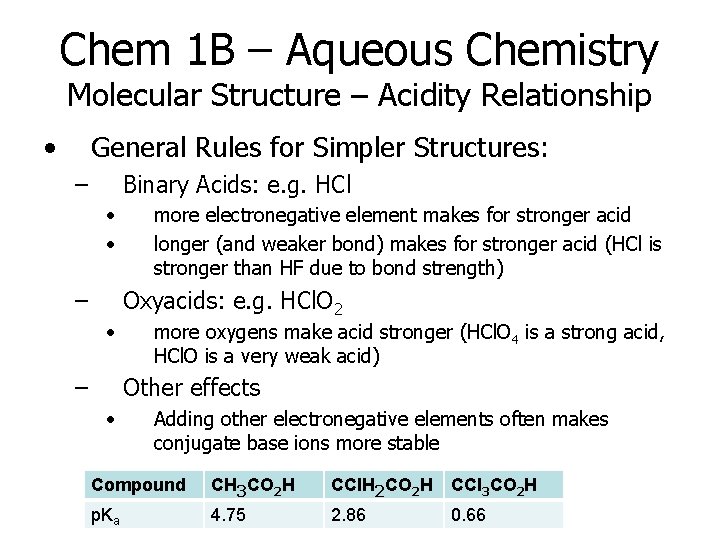
Chem 1 B – Aqueous Chemistry Molecular Structure – Acidity Relationship • General Rules for Simpler Structures: – Binary Acids: e. g. HCl • • – more electronegative element makes for stronger acid longer (and weaker bond) makes for stronger acid (HCl is stronger than HF due to bond strength) Oxyacids: e. g. HCl. O 2 more oxygens make acid stronger (HCl. O 4 is a strong acid, HCl. O is a very weak acid) Other effects • Adding other electronegative elements often makes conjugate base ions more stable Compound CH 3 CO 2 H CCl. H 2 CO 2 H CCl 3 CO 2 H p. Ka 4. 75 2. 86 0. 66
Chem 1 B – Aqueous Chemistry Buffers (Chapter 16) • • We have discussed some mixtures briefly (e. g. strong acid + weak acid) One particular type of mixture: weak acid + conjugate base (or weak base + conjugate acid) makes a solution called a buffer Buffers are desirable because they keep the p. H nearly constant even if an acid or base is added Buffers are very important in biology because many enzymes (protein catalysts) will only work over a narrow p. H range
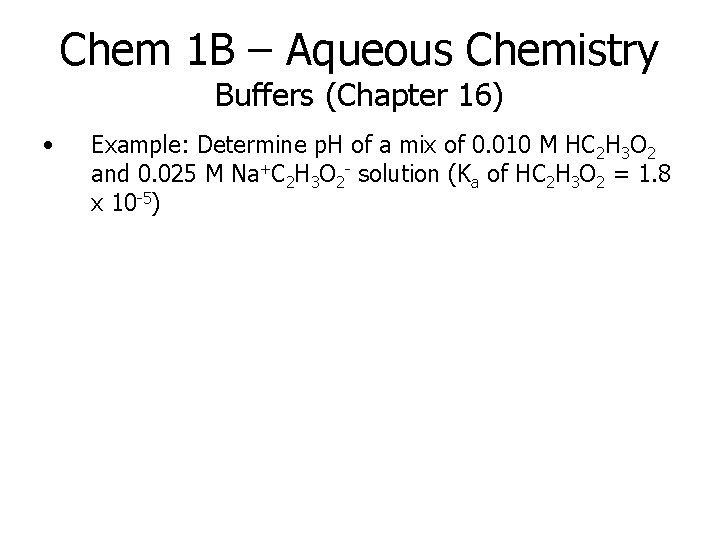
Chem 1 B – Aqueous Chemistry Buffers (Chapter 16) • Example: Determine p. H of a mix of 0. 010 M HC 2 H 3 O 2 and 0. 025 M Na+C 2 H 3 O 2 - solution (Ka of HC 2 H 3 O 2 = 1. 8 x 10 -5)
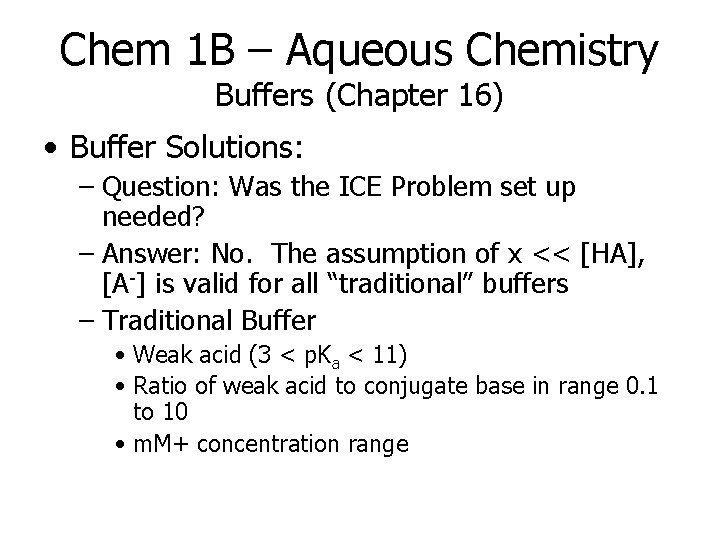
Chem 1 B – Aqueous Chemistry Buffers (Chapter 16) • Buffer Solutions: – Question: Was the ICE Problem set up needed? – Answer: No. The assumption of x << [HA], [A-] is valid for all “traditional” buffers – Traditional Buffer • Weak acid (3 < p. Ka < 11) • Ratio of weak acid to conjugate base in range 0. 1 to 10 • m. M+ concentration range
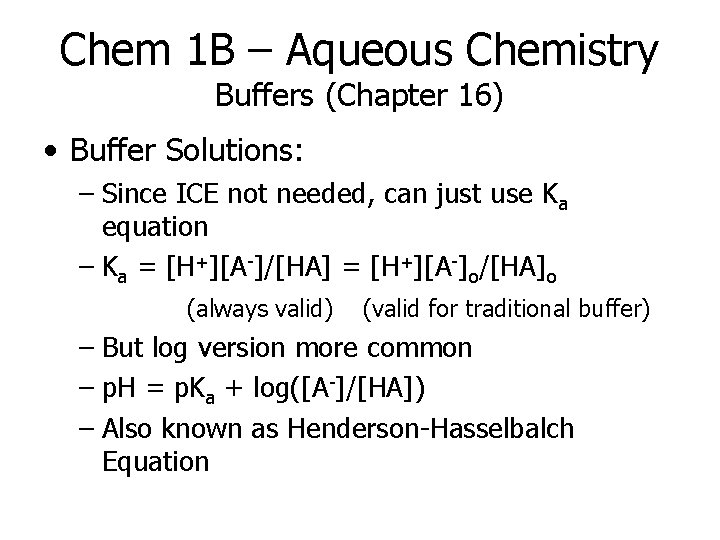
Chem 1 B – Aqueous Chemistry Buffers (Chapter 16) • Buffer Solutions: – Since ICE not needed, can just use Ka equation – Ka = [H+][A-]/[HA] = [H+][A-]o/[HA]o (always valid) (valid for traditional buffer) – But log version more common – p. H = p. Ka + log([A-]/[HA]) – Also known as Henderson-Hasselbalch Equation
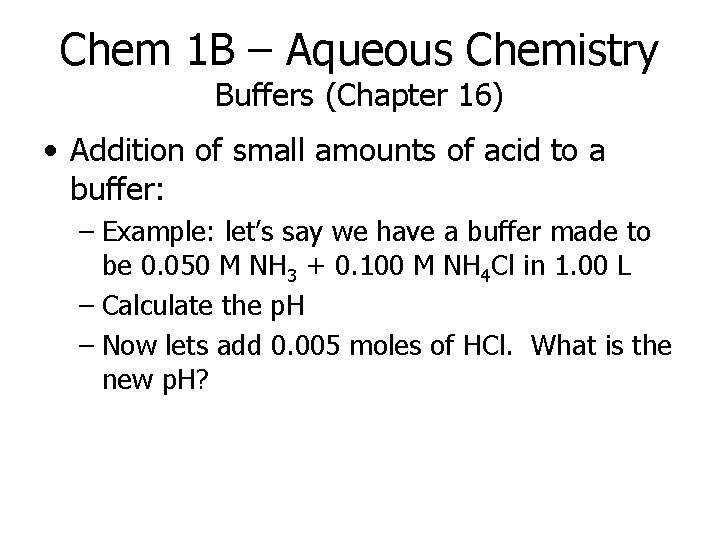
Chem 1 B – Aqueous Chemistry Buffers (Chapter 16) • Addition of small amounts of acid to a buffer: – Example: let’s say we have a buffer made to be 0. 050 M NH 3 + 0. 100 M NH 4 Cl in 1. 00 L – Calculate the p. H – Now lets add 0. 005 moles of HCl. What is the new p. H?
Chem 1 B – Aqueous Chemistry Buffers (Chapter 16) • Change of p. H and Buffer Capacity – A buffer is designed to minimize the change in p. H from addition of base or acid – What is the most effective p. H? • (show next slide) – Can we add too much acid or base to a buffer? – Does the absolute concentration of acid/base affect p. H? Why is a higher concentration better? – Buffer Capacity is the ability of the buffer to absorb acid or base without the p. H changing significantly
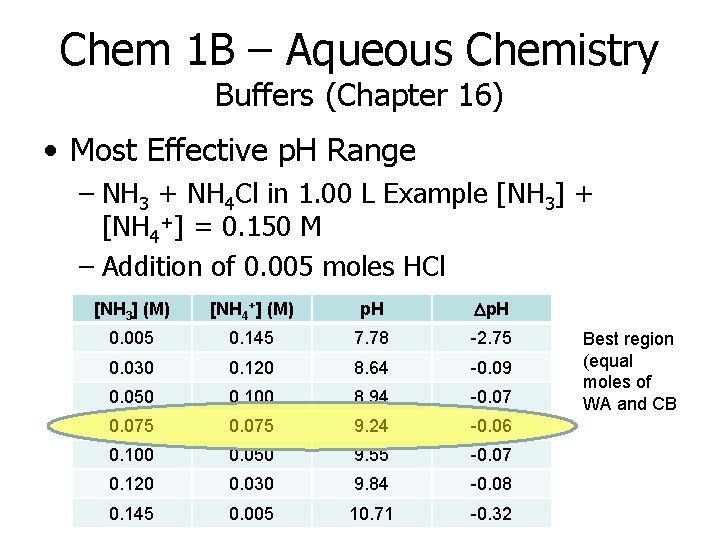
Chem 1 B – Aqueous Chemistry Buffers (Chapter 16) • Most Effective p. H Range – NH 3 + NH 4 Cl in 1. 00 L Example [NH 3] + [NH 4+] = 0. 150 M – Addition of 0. 005 moles HCl [NH 3] (M) [NH 4+] (M) p. H Dp. H 0. 005 0. 145 7. 78 -2. 75 0. 030 0. 120 8. 64 -0. 09 0. 050 0. 100 8. 94 -0. 075 9. 24 -0. 06 0. 100 0. 050 9. 55 -0. 07 0. 120 0. 030 9. 84 -0. 08 0. 145 0. 005 10. 71 -0. 32 Best region (equal moles of WA and CB
- Slides: 18