
Chehalis Basin Strategy Community Flood Assistance Resilience CFAR
Chehalis Basin Strategy Community Flood Assistance & Resilience (CFAR) Program Chehalis River Basin Flood Authority January 23, 2020
Why CFAR? Element of multiple reports and recommendations: • Work Group OFM report (Ruckelshaus Center), December 2012 • Work Group recommendations report (Ruckelshaus Center), November 2014 • Bucoda Foundation Flood Opening Lessons Learned (Flood Authority), July 2016 • Work Group budget recommendations to the Governor, December 2016 “Reduce the cost of repetitive damage to residences in the floodplain through a strategic program of buyouts and flood proofing, and encourage a comprehensive effort to prevent new development in the Basin from increasing flood damages. ” “Further enhancements to state and local land use policies will help ensure new development and other land management activities do not increase the risk of additional flood-related damages and, to the extent possible, reduce damages and costs to existing development affected by flooding. ” 2
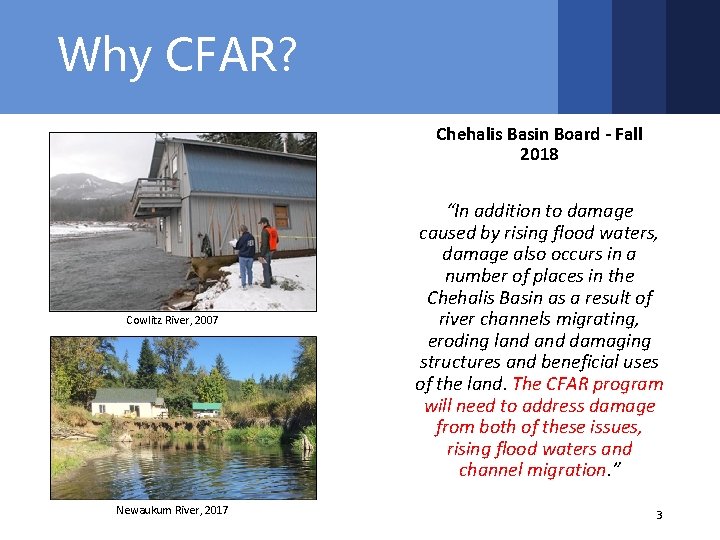
Why CFAR? Chehalis Basin Board - Fall 2018 Cowlitz River, 2007 Newaukum River, 2017 “In addition to damage caused by rising flood waters, damage also occurs in a number of places in the Chehalis Basin as a result of river channels migrating, eroding land damaging structures and beneficial uses of the land. The CFAR program will need to address damage from both of these issues, rising flood waters and channel migration. ” 3
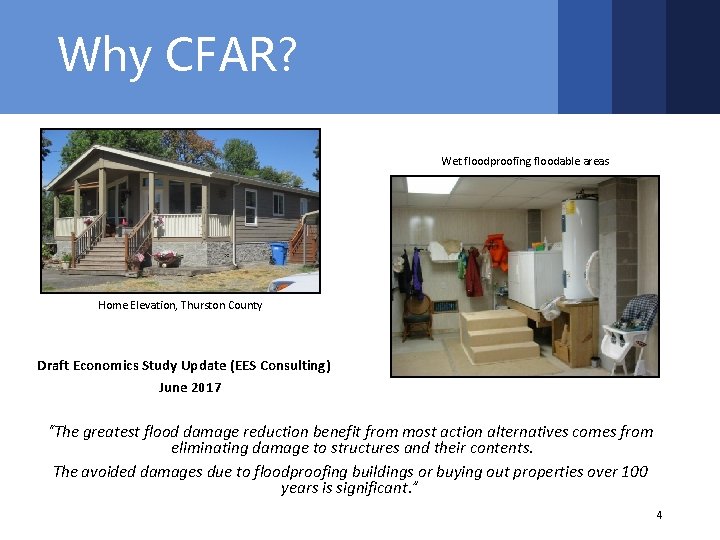
Why CFAR? Wet floodproofing floodable areas Home Elevation, Thurston County Draft Economics Study Update (EES Consulting) June 2017 “The greatest flood damage reduction benefit from most action alternatives comes from eliminating damage to structures and their contents. The avoided damages due to floodproofing buildings or buying out properties over 100 years is significant. ” 4
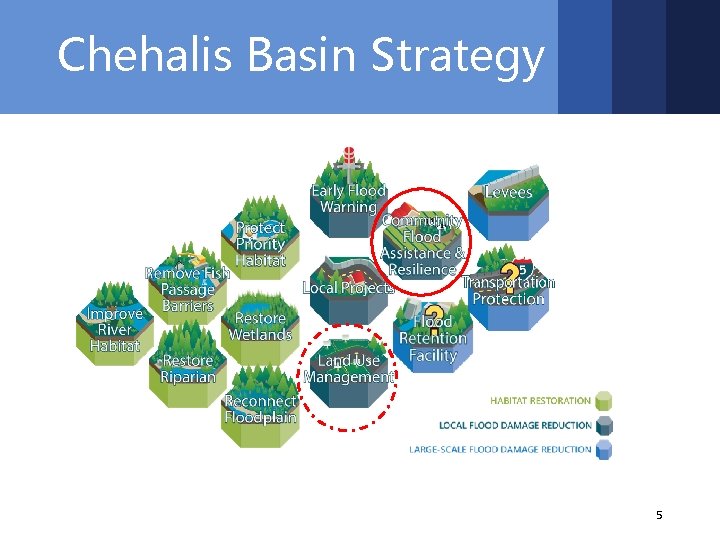
Chehalis Basin Strategy 5
Roles and Responsibilities Office of Chehalis Basin (OCB) o Program administration and management o Project approval o Contracting with project contractors Community o Publicize the program, talk to property owners o Review and comment on project applications o Project permitting, inspections, approval o Monitor owner compliance with non-conversion or reuse agreement 6
Roles and Responsibilities Property Owners o Contribute to the project o Agree to not convert the property to negate the protection provided o Agree to keep flood insurance on the building Flood Authority o Help publicize the program o Review and comment on applications 7
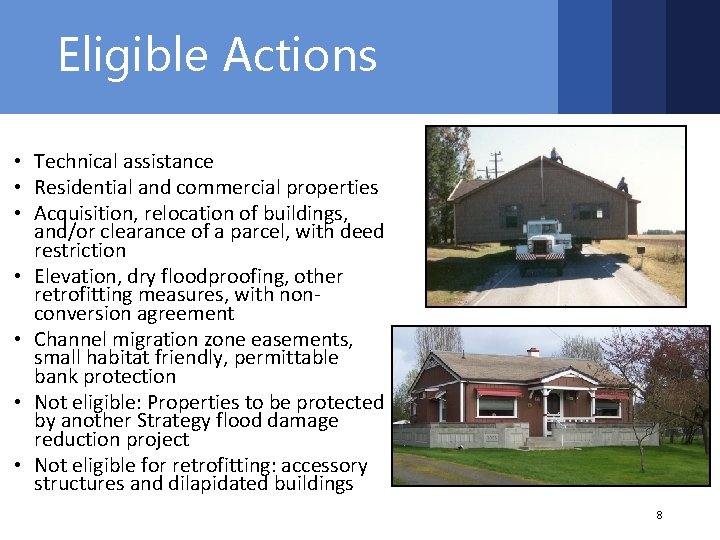
Eligible Actions • Technical assistance • Residential and commercial properties • Acquisition, relocation of buildings, and/or clearance of a parcel, with deed restriction • Elevation, dry floodproofing, other retrofitting measures, with nonconversion agreement • Channel migration zone easements, small habitat friendly, permittable bank protection • Not eligible: Properties to be protected by another Strategy flood damage reduction project • Not eligible for retrofitting: accessory structures and dilapidated buildings 8
Project Priorities • Properties facing the greatest flood or erosion risk • Least costly technique that provides equivalent protection • Projects with cost sharing from other sources • Projects that provide a clear benefit to the Aquatic Species Restoration Plan (ASRP) 9
Relationship to Local Projects “Design and construct local projects that will provide immediate flood damage reduction including the protection of critical infrastructure, wellheads, wastewater treatment plants, roads, homes, and businesses. Concurrent with these projects, develop and implement a long-term strategy for localized flood damage reduction actions. ” 10
Next Steps • Define mechanics for program administration • Continued coordination with local governments to guage community and property owner interest • Draft project solicitation forms and criteria • Fund projects in 2 or 3 communities that are ready to proceed 11
- Slides: 11