
Checking for Understanding Formative Assessment Techniques for Your
- Slides: 40
Checking for Understanding: Formative Assessment Techniques for Your Classroom - Pam Chapin - Lori Harvey - Shane Vondracek - Don Whitson LH
Chapter 1: Why Check for Understanding Shows evidence of learning Provides students with data to monitor their own achievements Can help close achievement gap between poverty, race, and teacher quality LH
What it Means to Check for Understanding. Looking at student background knowledge to: Address misconceptions Inform and modify instructional needs Helps students to monitor their own understanding LH
What it is not. . Final exam or state tests Intended to measure competency A grade End of unit assessment LH
The Framework of Checking for Understanding: Start by planning for where you want students to end up Prioritize information: begin with what is familiar, move to what is important, and end with the lasting understanding Differentiate Instruction LH
Chapter 2: Using Oral Language to Check for Understanding Oral Language Defined: • Speaking – the process of sharing and exchanging information, ideas, and emotions • Listening – the process of receiving, constructing meaning from, and responding to spoken and/or nonverbal messages PC
Using Oral Language to Check for Understanding Oral Language Development focuses on students’ ability to communicate more effectively • involves thinking, knowledge, and skills • five stages of early oral language development • PC
Using Oral Language to Check for Understanding Misuses of Oral Language in the Classroom poverty, language, and perceived skill level • gender differences • Initiate-Respond-Evaluate model • PC
Using Oral Language to Check for Understanding Strategies in Checking for Understanding accountable talk • noticing nonverbal cues • value lineups • retellings • Think-Pair-Share • misconception analysis • whip around • PC
Chapter 3: Using Questions to Check for Understanding Misuses of Questioning in the Classroom questioning rarely goes beyond Initiate-Respond. Evaluate cycle • negative impact on girls • more vocal students dominate classroom discussions • less-assertive students rarely participate • PC
Using Questions to Check for Understanding Effective Questioning Techniques constructing effective questions • providing nonverbal support • developing authentic questions • PC
Using Questions to Check for Understanding Constructing Effective Questions prepare the question • present the question • prompt student responses • process student responses • reflect on questioning practice • PC
Using Questions to Check for Understanding Instructional Practices That Promote Participation • response cards • hand signals • Audience Response Systems (ARS) Re. Quest (reciprocal questioning) • Socratic seminar • PC
Writing to Check for Understanding • Writing IS thinking SV
Writing to Check for Understanding • 3 types of writing: -Narrative -Informative -Persuasive SV
Writing to Check for Understanding • Narrative Writing -write to tell a story SV
Writing to Check for Understanding • Informative Writing -write the inform the reader SV
Writing to Check for Understanding • Persuasive Writing -write the persuade the reader SV
Writing to Check for Understanding • Don't use writing as a punishment for an undesirable behavior SV
Writing to Check for Understanding • Use interactive writing: - sharing the pen with the teacher - changing words from ideas, to spoken words to words in print SV
Writing to Check for Understanding Writing helps learning and clarifies students' thinking. SV
Projects and Performances to Check for Understanding Group Projects Use projects to see what the kids have learned SV
Projects and Performances to Check for Understanding Group Projects -Move away from using group projects as a REWARD for what they have learned SV
Projects and Performances to Check for Understanding Effective Performances - readers theater - multimedia presentations - electronic and paper portfolios - visual displays of information - public performances SV
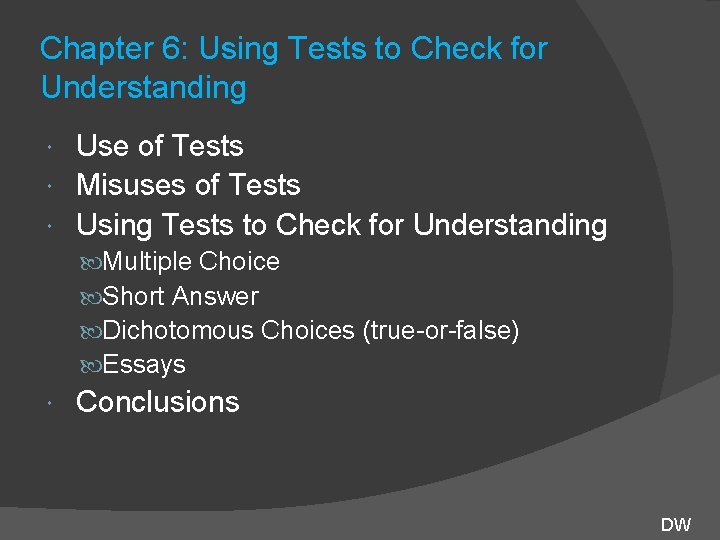
Chapter 6: Using Tests to Check for Understanding Use of Tests Misuses of Tests Using Tests to Check for Understanding Multiple Choice Short Answer Dichotomous Choices (true-or-false) Essays Conclusions DW
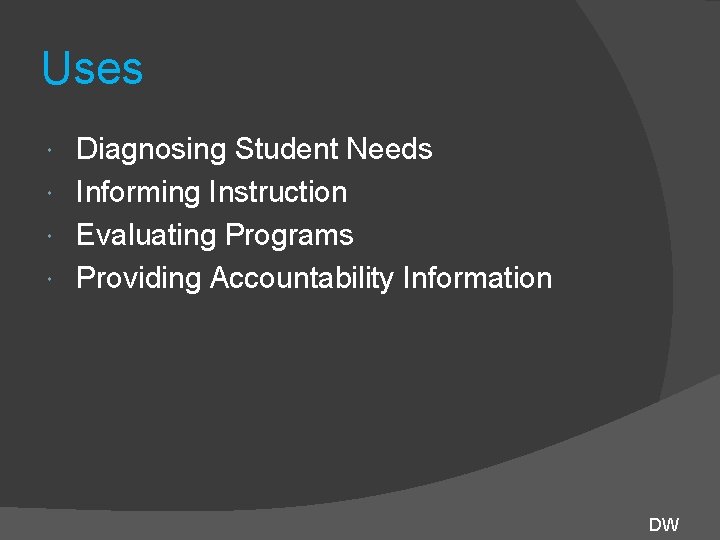
Uses Diagnosing Student Needs Informing Instruction Evaluating Programs Providing Accountability Information DW
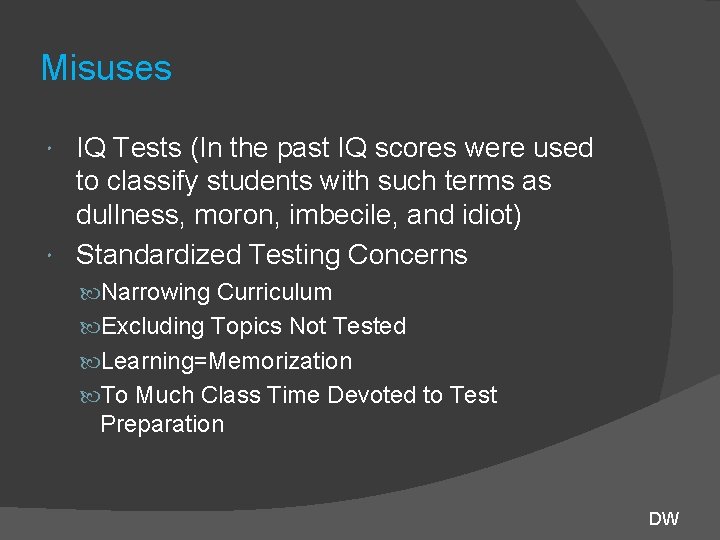
Misuses IQ Tests (In the past IQ scores were used to classify students with such terms as dullness, moron, imbecile, and idiot) Standardized Testing Concerns Narrowing Curriculum Excluding Topics Not Tested Learning=Memorization To Much Class Time Devoted to Test Preparation DW
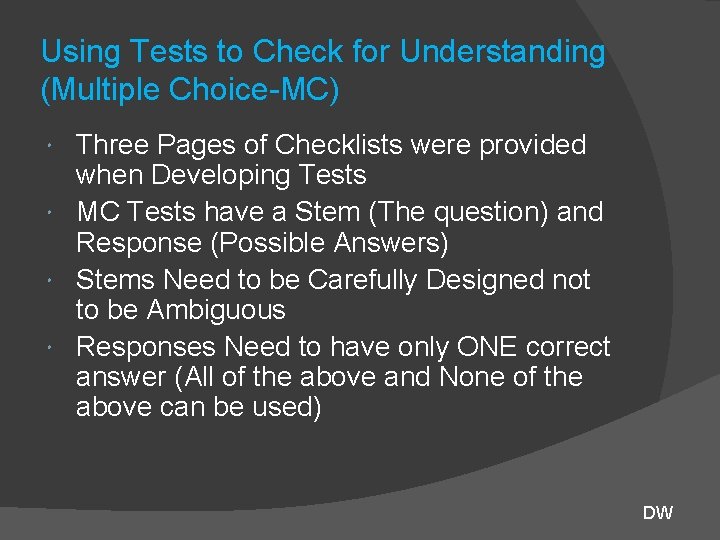
Using Tests to Check for Understanding (Multiple Choice-MC) Three Pages of Checklists were provided when Developing Tests MC Tests have a Stem (The question) and Response (Possible Answers) Stems Need to be Carefully Designed not to be Ambiguous Responses Need to have only ONE correct answer (All of the above and None of the above can be used) DW
Using Tests to Check for Understanding (Multiple Choice-MC)-cont Distractors in MC Tests include Misconceptions Oversimplifications Overgeneralizations DW
Short Answer The Blank Line (Provide Specific Directions with This Approach) Specificity (Make sure there are not a range of answers, only the one the test giver is looking for) Hidden Clues (Make sure plural version, gender, a/an don’t give away the answer) DW
Short Answer Cloze Deleted words from a passage according to a word-count formula Example: Select based on (1) grade level, (2) 100 word passage, (3) leave first and last passage and punctuation intact, (4) Delete every fifth word of remaining sentences, (5) Ask student to read entire passage before filling in the blanks, (6) Correct responses are worth 2 points, (7) Score Assessment : 100 - 57 (independent level), 56 -44 (instructional level), 44 -0 (frustrational level) DW
Dichotomous Choices (true-or-false) Students are asked if a Declarative Statement is True or False Used to Determine if Students Agree with Opinions, Can Define Terms, or Can Understand a Principle Advantages: Quick to Score, Easy to Write, Easily Administered to Large Populations, and Others DW
Dichotomous Choices (true-or-false)-cont Disadvantages: Rote Memorization, Less Discriminating than MC’s, Leads to Trivial Facts or Bits of Information, Difficult to Differentiate Between Effective Difficult Items and Trick Items, and Others. After T/F Assessment; Follow-Up Could Include having Students Correct False Items Lion-Share of Reponses when Students Don’t Know (Guessing) are True Responses. Therefore False Responses Discriminate Between Students That Understand Those Who Do Not DW
Essays (Extended-Response Items) Most Commonly Used Requires Consolidation of Topic Understanding (Synthesizing) Advantages: Novel thinking, Easy to Construct, Encourages Organization of Knowledge, Expression of Ideas, Stimulates Increased Learning, and Others DW
Essays (Extended-Response Items)-cont Disadvantages: More Time-Consuming to Answer and Grade, Grading can be Influenced by Handwriting, Length of Response and Writing Skills, Subjective Scoring is Less Reliable, and Others DW
Conclusions Assessments: Should Drive Instruction, Help Students, and Ultimately Check for Understanding Tests and Assessments are also used for Report Cards, Grading, and Public Accountability DW
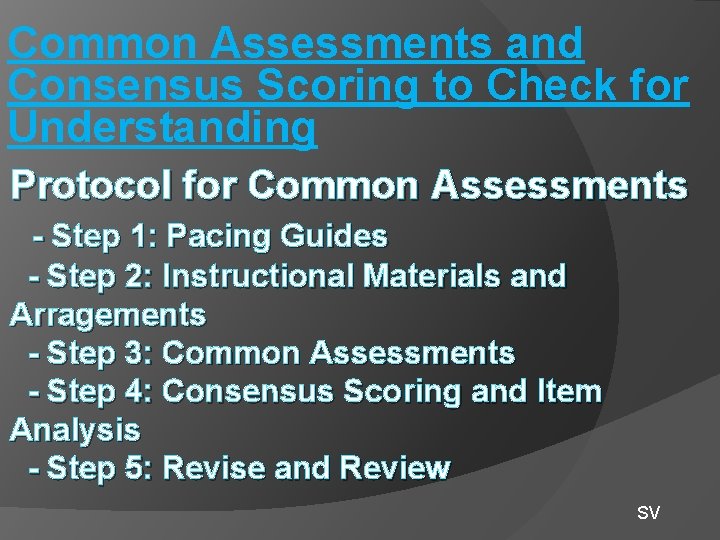
Common Assessments and Consensus Scoring to Check for Understanding Protocol for Common Assessments - Step 1: Pacing Guides - Step 2: Instructional Materials and Arragements - Step 3: Common Assessments - Step 4: Consensus Scoring and Item Analysis - Step 5: Revise and Review SV
Common Assessments and Consensus Scoring to Check for Understanding - Teachers must understand their content standards - Analyze student response and direct instruction toward improvements - When student don’t clearly undersatnd, teacher can intervene. SV
Common Assessments and Consensus Scoring to Check for Understanding Teachers need to. . . - Understand grade-level and contecnt –specific standards - How those standards are assessed - What to do when students don’t understand SV
Reference Fisher, Douglas, & Frey, Nancy (2007) Checking for understanding: Formative assessment techniques for your classroom. ASCD.