
CHECK IT BEFORE YOU SHARE IT Brought to
CHECK IT BEFORE YOU SHARE IT Brought to you by Local Media Association in conjunction with Google, NAMLE, Poynter Institute for Media Studies, and Stanford History Education Group
The problem: At a time when information is plentiful and readily available online, students do not often know who to trust. SHEG research shows that even high achievers and college students and can be deceived by false or misleading information that appears to be credible.
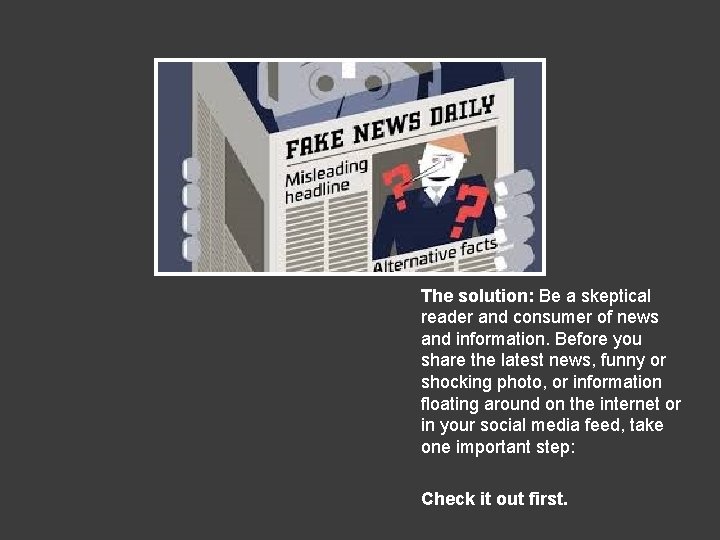
The solution: Be a skeptical reader and consumer of news and information. Before you share the latest news, funny or shocking photo, or information floating around on the internet or in your social media feed, take one important step: Check it out first.
DEVELOPING THE MINDSET OF A PROFESSIONAL FACT-CHECKER The six elements of the Politifact team’s approach to verifying a story.
PICKING THE RIGHT FACT TO CHECK • No one is off limits. You must be willing to fact-check anyone. • Fact-check the most important topics of the day. Don’t be trivial. • Focus on one fact … what seems most controversial or most important. Keep it simple. • Not an opinion or prediction. • Must be something you can verify or debunk. • Do not create an artificial quota of who you fact-check or what you think the verdict needs to be.
POLITIFACT TIPS TO ID FAKE NEWS • Do stories include bylines? – Stories without bylines are less likely to be legitimate. • Do photos included with stories include photo credits? – Do the photo credits appear legitimate? Photos without photo credits are less likely to be legitimate. • Do stories include clear sourcing? – Do stories on the website make clear where they are getting their information? Does the story include hyperlinks to mainstream sources? Stories without clear sourcing are less likely to be legitimate?
POLITIFACT TIPS TO ID FAKE NEWS • Google the headline. – Does the story or a story similar to it appear on more recognizable websites? Stories that do not appear on mainstream websites are less likely to be legitimate. • Does the website have significant misspellings and/or grammatical errors? – Stories with significant misspellings and/or grammatical errors are less likely to be legitimate. • Does the story have a date on it? – Legitimate news organizations conspicuously date their stories, sometimes down to the minute to provide context for when an event occurred. Fake news sites, meanwhile, often omit the date on their stories to obscure when an article was posted.
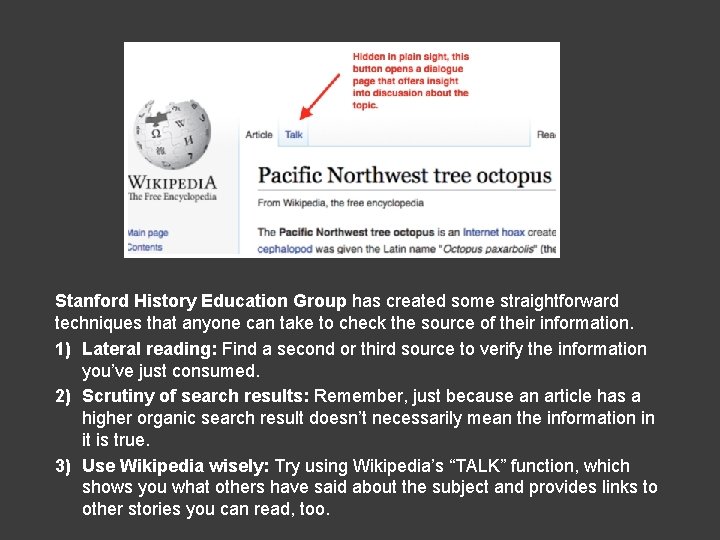
Stanford History Education Group has created some straightforward techniques that anyone can take to check the source of their information. 1) Lateral reading: Find a second or third source to verify the information you’ve just consumed. 2) Scrutiny of search results: Remember, just because an article has a higher organic search result doesn’t necessarily mean the information in it is true. 3) Use Wikipedia wisely: Try using Wikipedia’s “TALK” function, which shows you what others have said about the subject and provides links to other stories you can read, too.
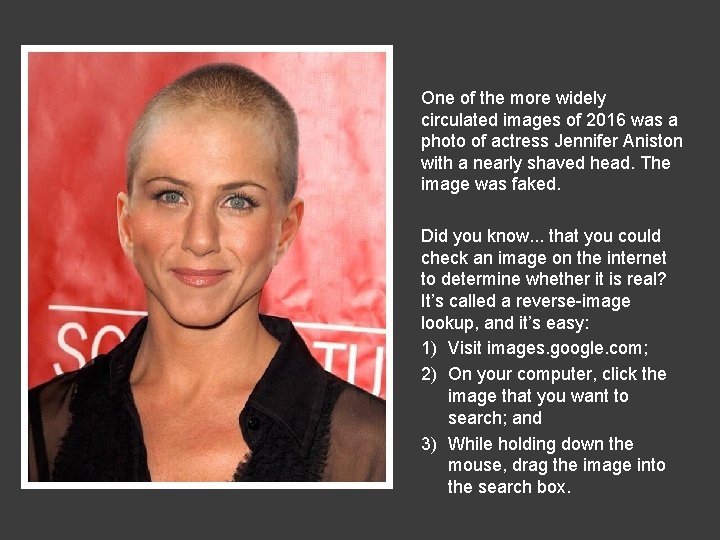
One of the more widely circulated images of 2016 was a photo of actress Jennifer Aniston with a nearly shaved head. The image was faked. Did you know. . . that you could check an image on the internet to determine whether it is real? It’s called a reverse-image lookup, and it’s easy: 1) Visit images. google. com; 2) On your computer, click the image that you want to search; and 3) While holding down the mouse, drag the image into the search box.
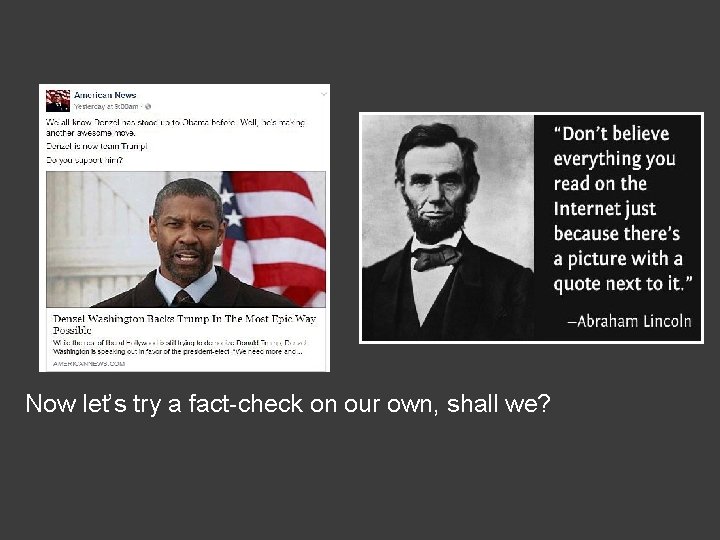
Now let’s try a fact-check on our own, shall we?
FACT CHECK 1
FACT CHECK 2
FACT CHECK 3
THANK YOU! Brought to you by Local Media Association in conjunction with Google, NAMLE, Poynter Institute for Media Studies, and Stanford History Education Group
- Slides: 14