
CHEBYSHEVS THEOREM For any set of data and
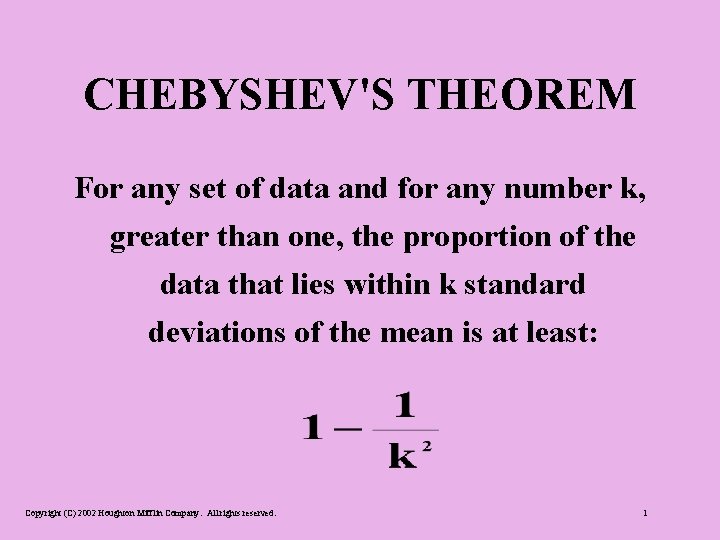
CHEBYSHEV'S THEOREM For any set of data and for any number k, greater than one, the proportion of the data that lies within k standard deviations of the mean is at least: Copyright (C) 2002 Houghton Mifflin Company. All rights reserved. 1
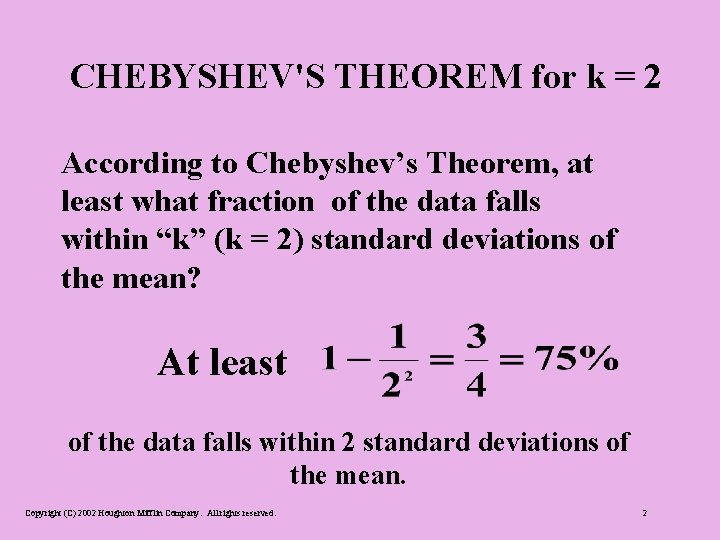
CHEBYSHEV'S THEOREM for k = 2 According to Chebyshev’s Theorem, at least what fraction of the data falls within “k” (k = 2) standard deviations of the mean? At least of the data falls within 2 standard deviations of the mean. Copyright (C) 2002 Houghton Mifflin Company. All rights reserved. 2
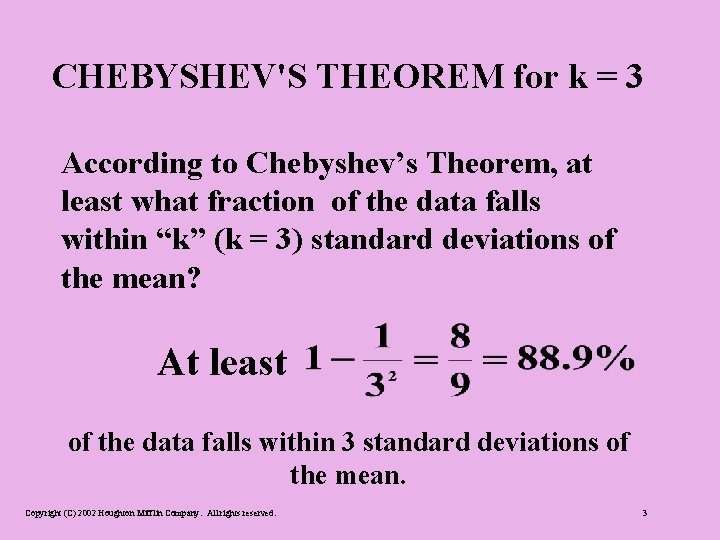
CHEBYSHEV'S THEOREM for k = 3 According to Chebyshev’s Theorem, at least what fraction of the data falls within “k” (k = 3) standard deviations of the mean? At least of the data falls within 3 standard deviations of the mean. Copyright (C) 2002 Houghton Mifflin Company. All rights reserved. 3
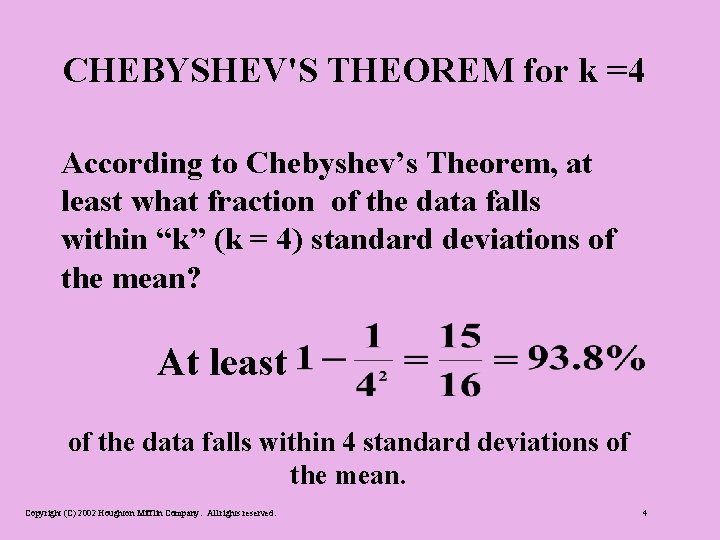
CHEBYSHEV'S THEOREM for k =4 According to Chebyshev’s Theorem, at least what fraction of the data falls within “k” (k = 4) standard deviations of the mean? At least of the data falls within 4 standard deviations of the mean. Copyright (C) 2002 Houghton Mifflin Company. All rights reserved. 4
Using Chebyshev’s Theorem A mathematics class completes an examination and it is found that the class mean is 77 and the standard deviation is 6. According to Chebyshev's Theorem, between what two values would at least 75% of the grades be? Copyright (C) 2002 Houghton Mifflin Company. All rights reserved. 5
Mean = 77 Standard deviation = 6 At least 75% of the grades would be in the interval: 77 – 2(6) to 77 + 2(6) 77 – 12 to 77 + 12 65 to 89 Copyright (C) 2002 Houghton Mifflin Company. All rights reserved. 6
Mean and Standard Deviation of Grouped Data • Make a frequency table • Compute the midpoint (x) for each class. • Count the number of entries in each class (f). • Sum the f values to find n, the total number of entries in the distribution. • Treat each entry of a class as if it falls at the class midpoint. Copyright (C) 2002 Houghton Mifflin Company. All rights reserved. 7
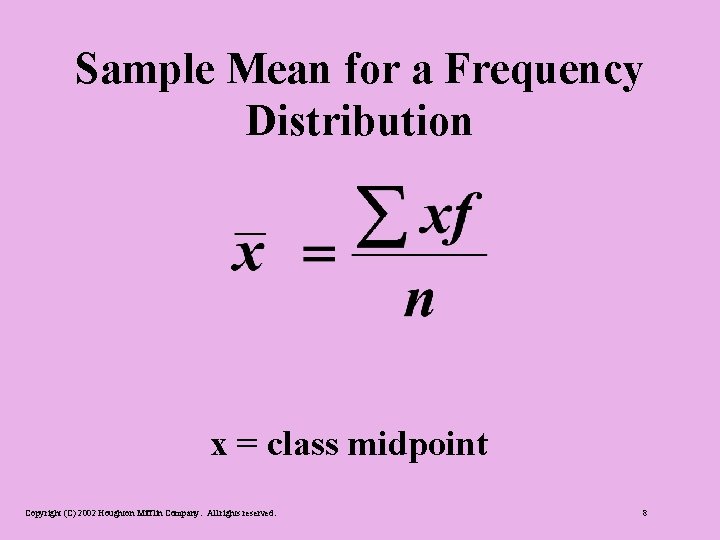
Sample Mean for a Frequency Distribution x = class midpoint Copyright (C) 2002 Houghton Mifflin Company. All rights reserved. 8
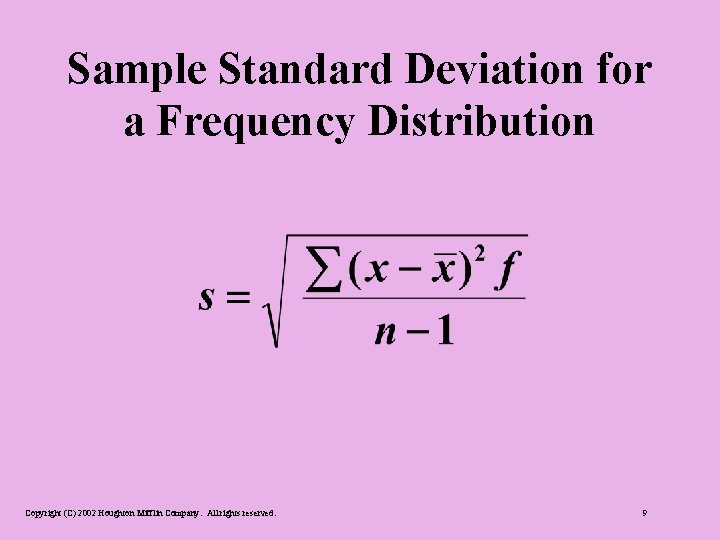
Sample Standard Deviation for a Frequency Distribution Copyright (C) 2002 Houghton Mifflin Company. All rights reserved. 9
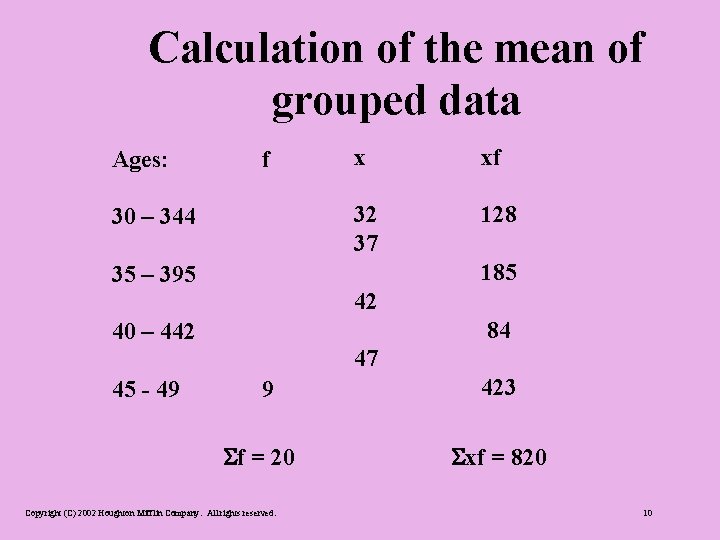
Calculation of the mean of grouped data Ages: f 30 – 344 x xf 32 37 128 185 35 – 395 42 84 40 – 442 47 45 - 49 9 f = 20 Copyright (C) 2002 Houghton Mifflin Company. All rights reserved. 423 xf = 820 10
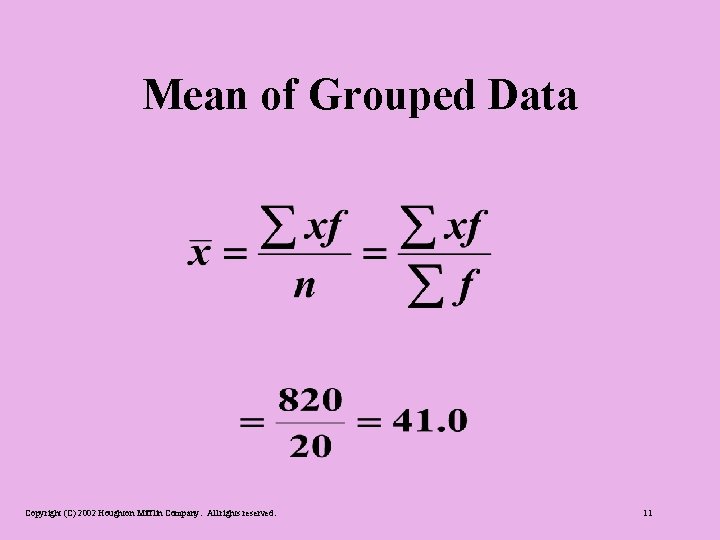
Mean of Grouped Data Copyright (C) 2002 Houghton Mifflin Company. All rights reserved. 11
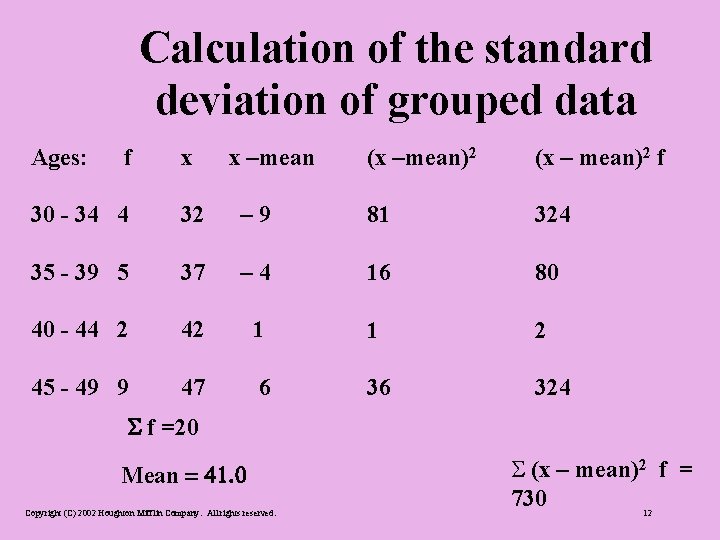
Calculation of the standard deviation of grouped data Ages: f x x –mean (x –mean)2 (x – mean)2 f 30 - 34 4 32 – 9 81 324 35 - 39 5 37 – 4 16 80 40 - 44 2 42 1 1 2 45 - 49 9 47 6 36 324 f =20 Mean Copyright (C) 2002 Houghton Mifflin Company. All rights reserved. (x – mean)2 f = 730 12
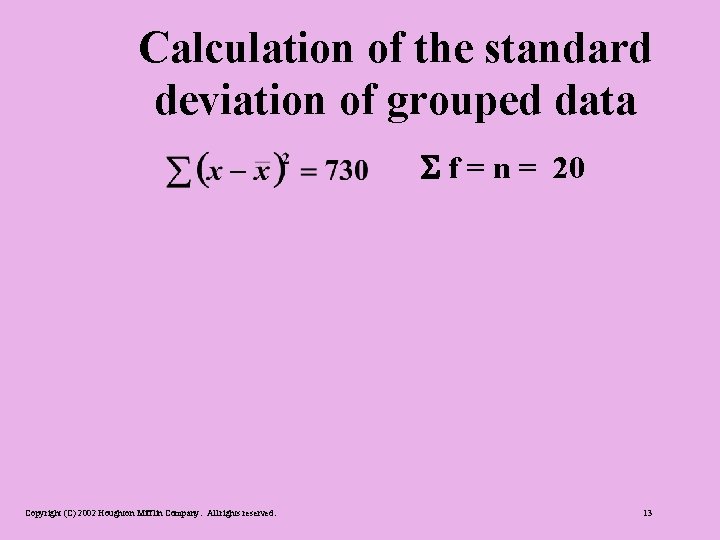
Calculation of the standard deviation of grouped data f = n = 20 Copyright (C) 2002 Houghton Mifflin Company. All rights reserved. 13
Weighted Average calculated where some of the numbers are assigned more importance or weight Copyright (C) 2002 Houghton Mifflin Company. All rights reserved. 14
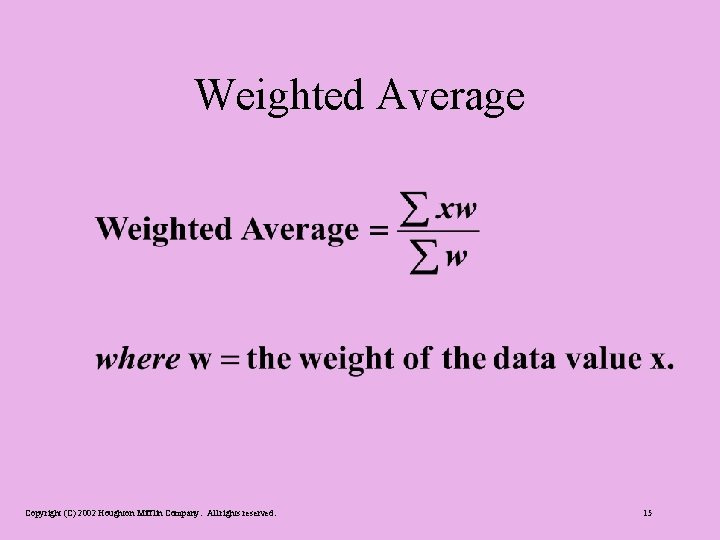
Weighted Average Copyright (C) 2002 Houghton Mifflin Company. All rights reserved. 15
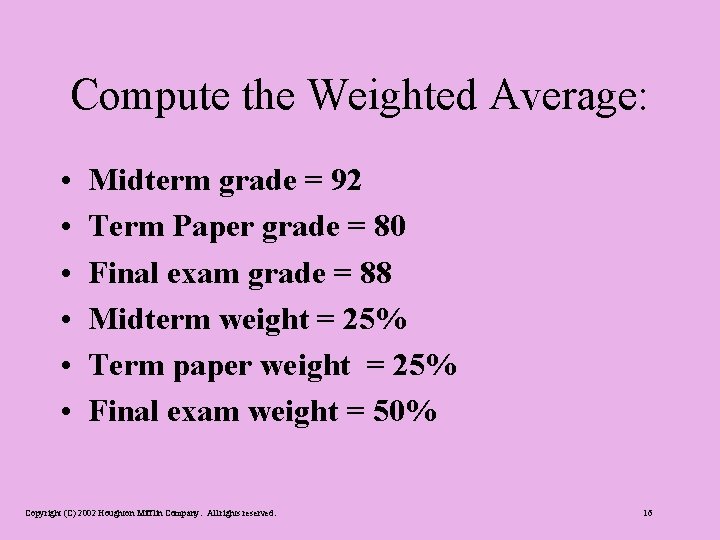
Compute the Weighted Average: • • • Midterm grade = 92 Term Paper grade = 80 Final exam grade = 88 Midterm weight = 25% Term paper weight = 25% Final exam weight = 50% Copyright (C) 2002 Houghton Mifflin Company. All rights reserved. 16
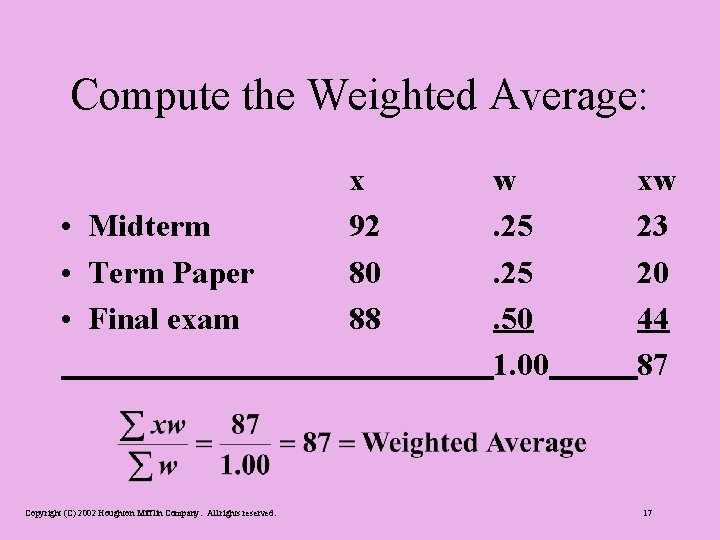
Compute the Weighted Average: • Midterm • Term Paper • Final exam Copyright (C) 2002 Houghton Mifflin Company. All rights reserved. x 92 80 88 w. 25. 50 1. 00 xw 23 20 44 87 17
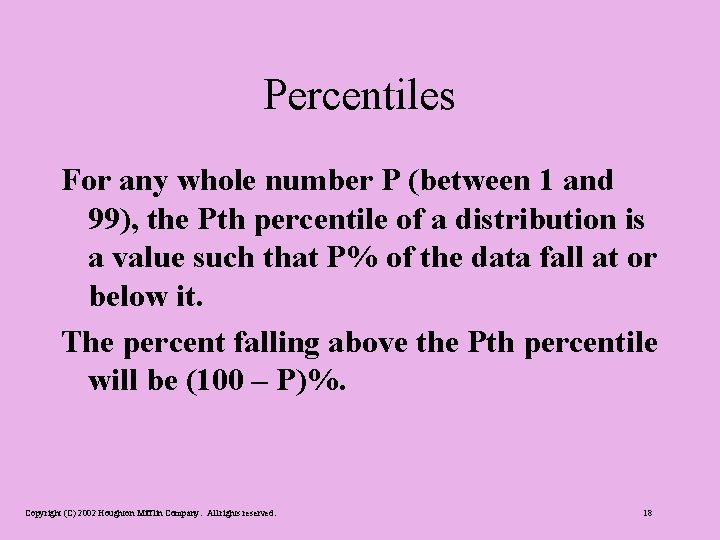
Percentiles For any whole number P (between 1 and 99), the Pth percentile of a distribution is a value such that P% of the data fall at or below it. The percent falling above the Pth percentile will be (100 – P)%. Copyright (C) 2002 Houghton Mifflin Company. All rights reserved. 18
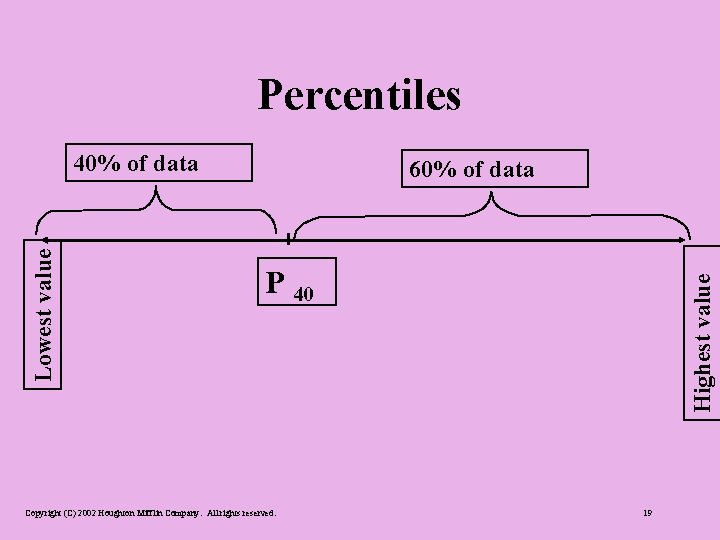
Percentiles 60% of data P 40 Copyright (C) 2002 Houghton Mifflin Company. All rights reserved. Highest value Lowest value 40% of data 19
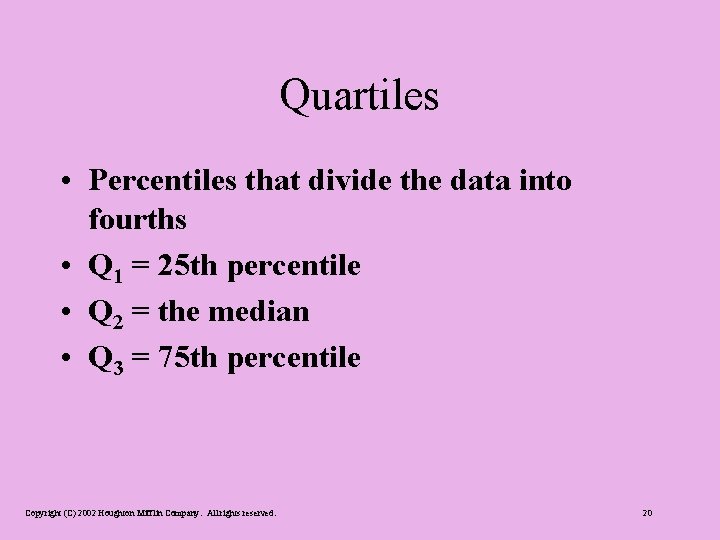
Quartiles • Percentiles that divide the data into fourths • Q 1 = 25 th percentile • Q 2 = the median • Q 3 = 75 th percentile Copyright (C) 2002 Houghton Mifflin Company. All rights reserved. 20
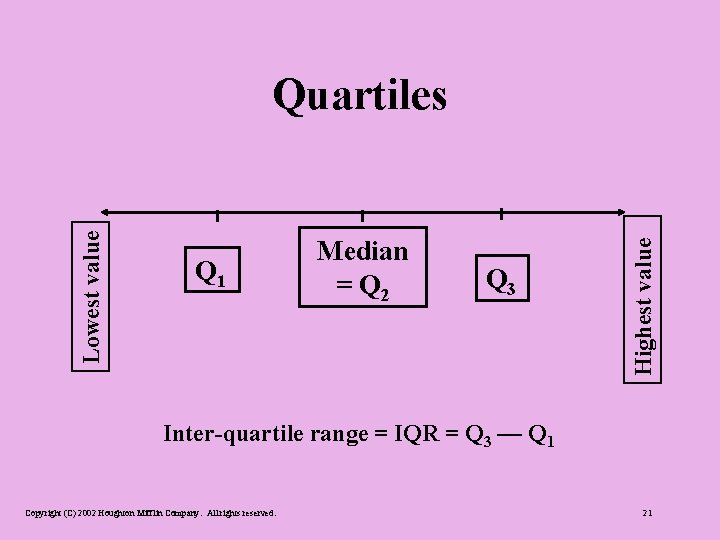
Q 1 Median = Q 2 Q 3 Highest value Lowest value Quartiles Inter-quartile range = IQR = Q 3 — Q 1 Copyright (C) 2002 Houghton Mifflin Company. All rights reserved. 21
Computing Quartiles • Order the data from smallest to largest. • Find the median, the second quartile. • Find the median of the data falling below Q 2. This is the first quartile. • Find the median of the data falling above Q 2. This is the third quartile. Copyright (C) 2002 Houghton Mifflin Company. All rights reserved. 22
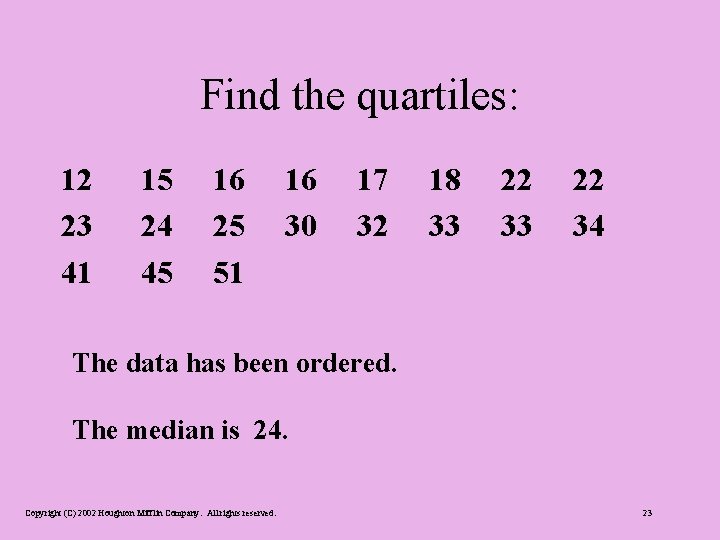
Find the quartiles: 12 23 41 15 24 45 16 25 51 16 30 17 32 18 33 22 34 The data has been ordered. The median is 24. Copyright (C) 2002 Houghton Mifflin Company. All rights reserved. 23
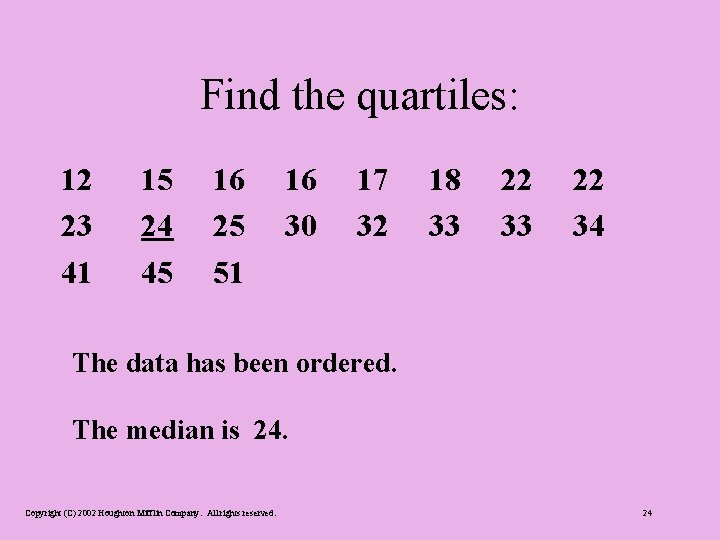
Find the quartiles: 12 23 41 15 24 45 16 25 51 16 30 17 32 18 33 22 34 The data has been ordered. The median is 24. Copyright (C) 2002 Houghton Mifflin Company. All rights reserved. 24
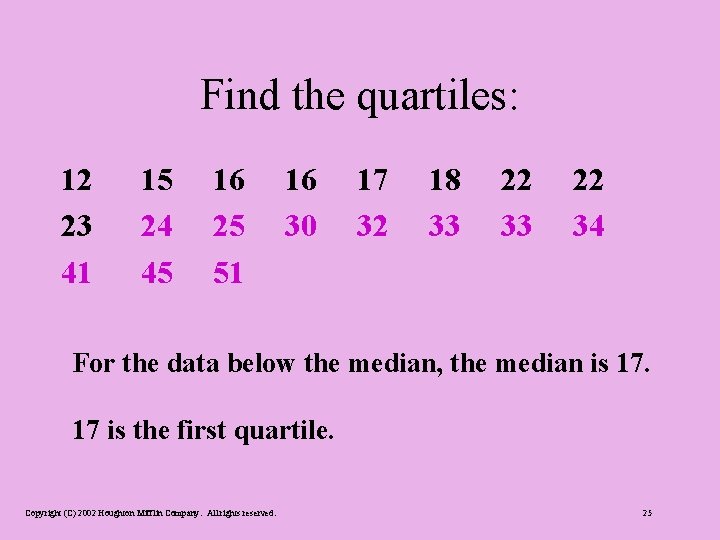
Find the quartiles: 12 23 41 15 24 45 16 25 51 16 30 17 32 18 33 22 34 For the data below the median, the median is 17. 17 is the first quartile. Copyright (C) 2002 Houghton Mifflin Company. All rights reserved. 25
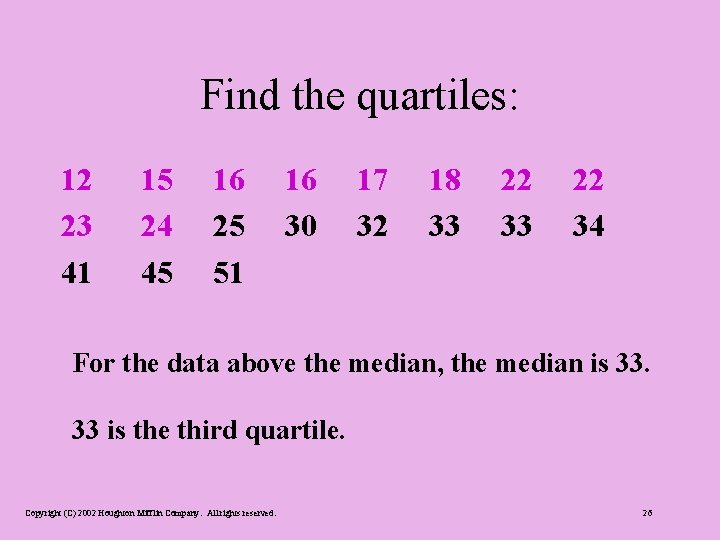
Find the quartiles: 12 23 41 15 24 45 16 25 51 16 30 17 32 18 33 22 34 For the data above the median, the median is 33. 33 is the third quartile. Copyright (C) 2002 Houghton Mifflin Company. All rights reserved. 26
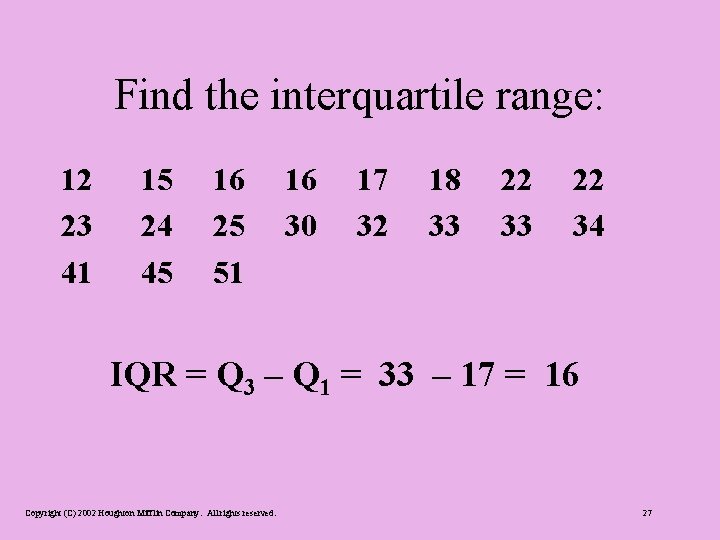
Find the interquartile range: 12 23 41 15 24 45 16 25 51 16 30 17 32 18 33 22 34 IQR = Q 3 – Q 1 = 33 – 17 = 16 Copyright (C) 2002 Houghton Mifflin Company. All rights reserved. 27
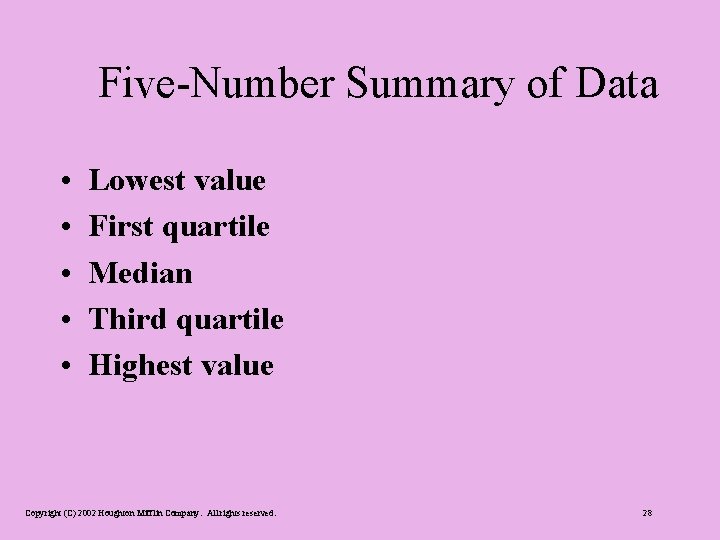
Five-Number Summary of Data • • • Lowest value First quartile Median Third quartile Highest value Copyright (C) 2002 Houghton Mifflin Company. All rights reserved. 28
Box-and-Whisker Plot a graphical presentation of the fivenumber summary of data Copyright (C) 2002 Houghton Mifflin Company. All rights reserved. 29
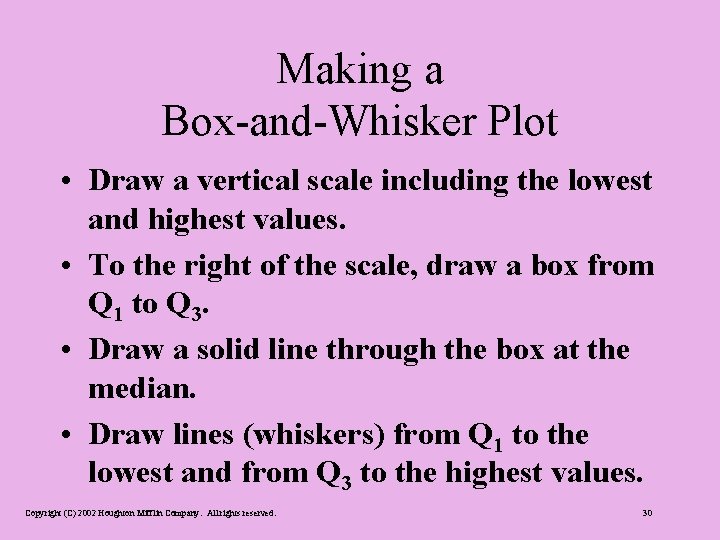
Making a Box-and-Whisker Plot • Draw a vertical scale including the lowest and highest values. • To the right of the scale, draw a box from Q 1 to Q 3. • Draw a solid line through the box at the median. • Draw lines (whiskers) from Q 1 to the lowest and from Q 3 to the highest values. Copyright (C) 2002 Houghton Mifflin Company. All rights reserved. 30
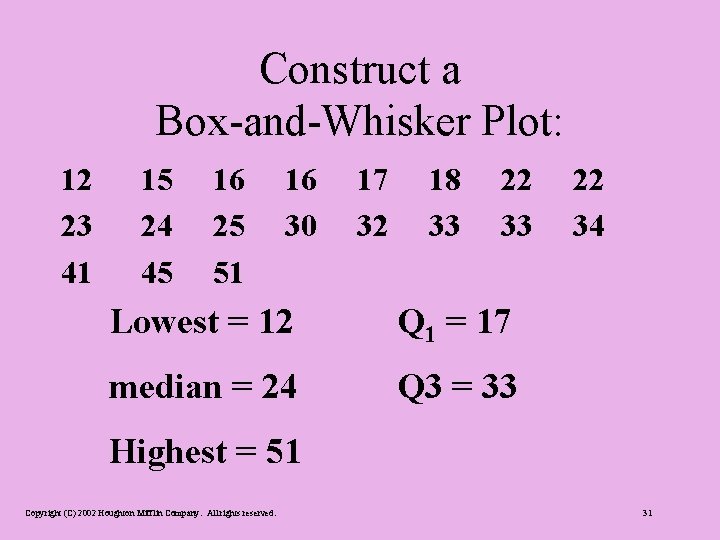
Construct a Box-and-Whisker Plot: 12 23 41 15 24 45 16 25 51 16 30 17 32 18 33 22 33 Lowest = 12 Q 1 = 17 median = 24 Q 3 = 33 22 34 Highest = 51 Copyright (C) 2002 Houghton Mifflin Company. All rights reserved. 31
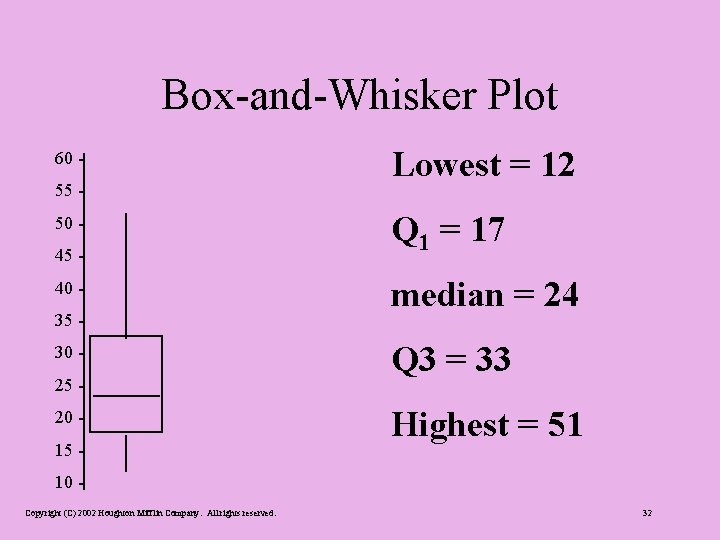
Box-and-Whisker Plot 60 55 50 45 40 35 30 25 20 15 - Lowest = 12 Q 1 = 17 median = 24 Q 3 = 33 Highest = 51 10 Copyright (C) 2002 Houghton Mifflin Company. All rights reserved. 32
- Slides: 32