
Cheap quantumsafe cryptography without breaking anything William Whyte
Cheap quantum-safe cryptography without breaking anything William Whyte, 2015 -07 -22
Problem • Quantum computers make it trivial to break RSA, ECC, DH, … – Current TLS traffic is susceptible to a harvest-then-decrypt attack from a passive attacker – Not clear when quantum computers will come • Would like to thwart this attacker -- – Quantum-safe public key encryption / key exchange algorithms exist! • NTRUEncrypt, Ring-Learning With Errors, Mc. Eliece, … – Good performance, reasonable key/ciphertext size (*except Mc. Eliece), key generation times that support forward secrecy • But migrating public key algorithms is a pain – We’re only just managing to move from RSA to ECDHE
Possible solutions • 1. Define a quantum-safe ciphersuite – Solves the problem! – but… • No community consensus on a quantum-safe encryption algorithm – CFRG hasn’t even discussed it • Not clear there’s appetite to roll out a whole new set of algorithms given that the ECC discussion is still going on • No good quantum-safe signatures • 2. “Quantum-safe” existing ciphersuites
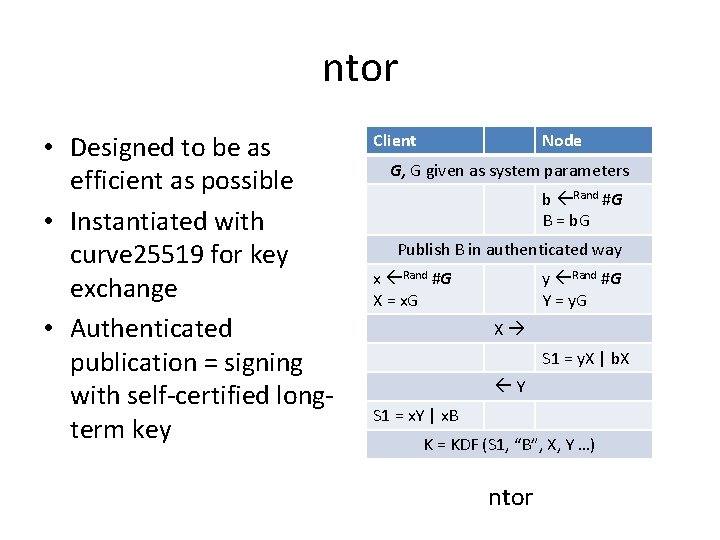
ntor • Designed to be as efficient as possible • Instantiated with curve 25519 for key exchange • Authenticated publication = signing with self-certified longterm key Client Node G, G given as system parameters b Rand #G B = b. G Publish B in authenticated way x Rand #G X = x. G y Rand #G Y = y. G X S 1 = y. X | b. X Y S 1 = x. Y | x. B K = KDF (S 1, “B”, X, Y …) ntor
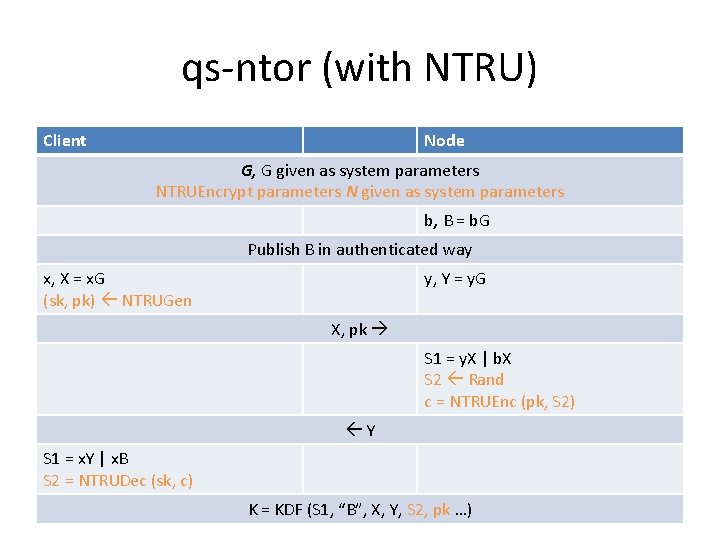
qs-ntor (with NTRU) Client Node G, G given as system parameters NTRUEncrypt parameters N given as system parameters b, B = b. G Publish B in authenticated way x, X = x. G (sk, pk) NTRUGen y, Y = y. G X, pk S 1 = y. X | b. X S 2 Rand c = NTRUEnc (pk, S 2) Y S 1 = x. Y | x. B S 2 = NTRUDec (sk, c) K = KDF (S 1, “B”, X, Y, S 2, pk …) ntor
qs-ntor • A quantum-safe circuit extension handshake for Tor, https: //eprint. iacr. org/2015/287 – Hardwires NTRUEncrypt as quantum-safe key establishment algorithm but can be modified to be modular wrt QSKE • Includes “proof” that it doesn’t make things any worse • Feature Request being prepared for Tor community review – Will include modular approach to QSKE
TLS proposal • draft-whyte-qsh-tls 12, draft-whyte-qsh-tls 13 – variants for TLS 1. 2 and 1. 3 • Create – Quantum-safe hybrid ciphersuite identifier (QSH) – Extensions for quantum-safe public key and ciphertext • Client. Hello includes – QSH identifier – “Classical” ciphersuite identifier(s) – Ephemeral public key for quantum-safe algorithm • Server – Carries out handshake for preferred classical handshake – Encrypts fresh 256 -bit secret with quantum-safe public key • Pre-master secret is concatenation of PMS from classical handshake and quantum-safe secret (+ details) • Working code: https: //www. wolfssl. com/wolf. SSL/Blog/Entries/2015/7/13_Quantum. Safe_wolf. SSL. html
Choice of QSKE algorithm • NTRUEncrypt – Patented, patents owned by my employer, Security Innovation • IPR statement filed with IETF – Patents usable under GPL – Standardized in IEEE 1363. 1 -2008, X 9. 09 -2010 – Security estimates: Choosing Parameters for NTRUEncrypt, https: //eprint. iacr. org/2015/708 • 2015 paper: results are consistent with 2007 analysis • Learning with Errors • Mc. Eliece (but v large keys)
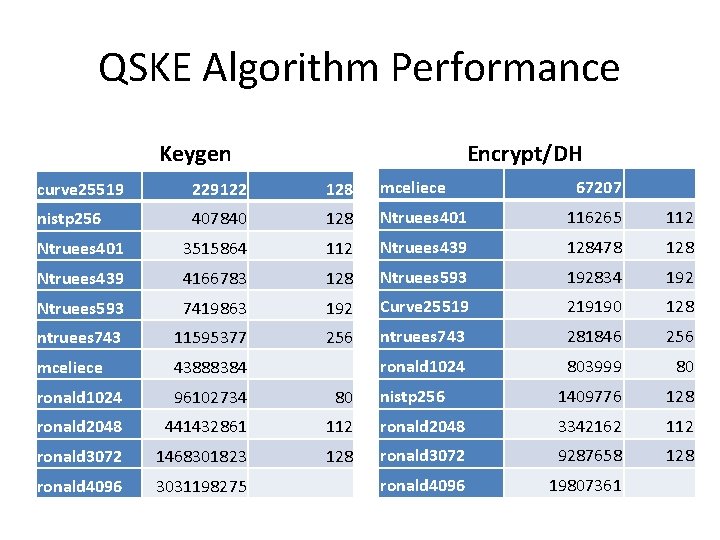
QSKE Algorithm Performance Keygen Encrypt/DH curve 25519 229122 128 mceliece 67207 nistp 256 407840 128 Ntruees 401 116265 112 Ntruees 401 3515864 112 Ntruees 439 128478 128 Ntruees 439 4166783 128 Ntruees 593 192834 192 Ntruees 593 7419863 192 Curve 25519 219190 128 ntruees 743 11595377 256 ntruees 743 281846 256 mceliece 43888384 ronald 1024 803999 80 ronald 1024 96102734 80 nistp 256 1409776 128 ronald 2048 441432861 112 ronald 2048 3342162 112 ronald 3072 1468301823 128 ronald 3072 9287658 128 ronald 4096 3031198275 ronald 4096 19807361
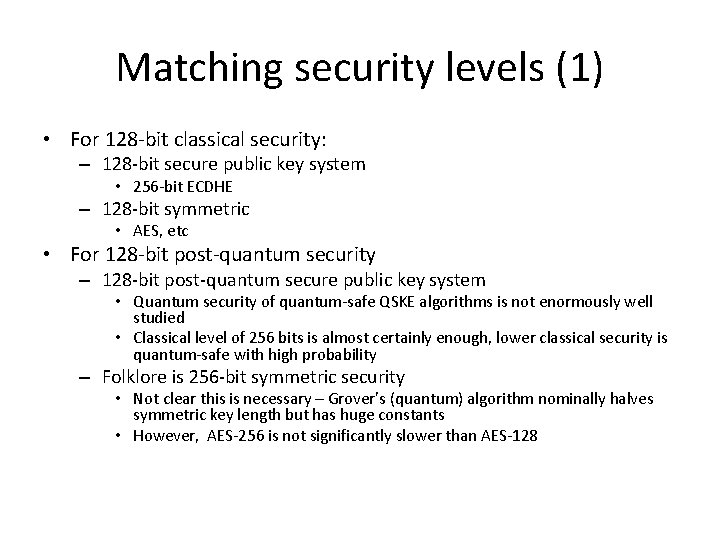
Matching security levels (1) • For 128 -bit classical security: – 128 -bit secure public key system • 256 -bit ECDHE – 128 -bit symmetric • AES, etc • For 128 -bit post-quantum security – 128 -bit post-quantum secure public key system • Quantum security of quantum-safe QSKE algorithms is not enormously well studied • Classical level of 256 bits is almost certainly enough, lower classical security is quantum-safe with high probability – Folklore is 256 -bit symmetric security • Not clear this is necessary – Grover’s (quantum) algorithm nominally halves symmetric key length but has huge constants • However, AES-256 is not significantly slower than AES-128
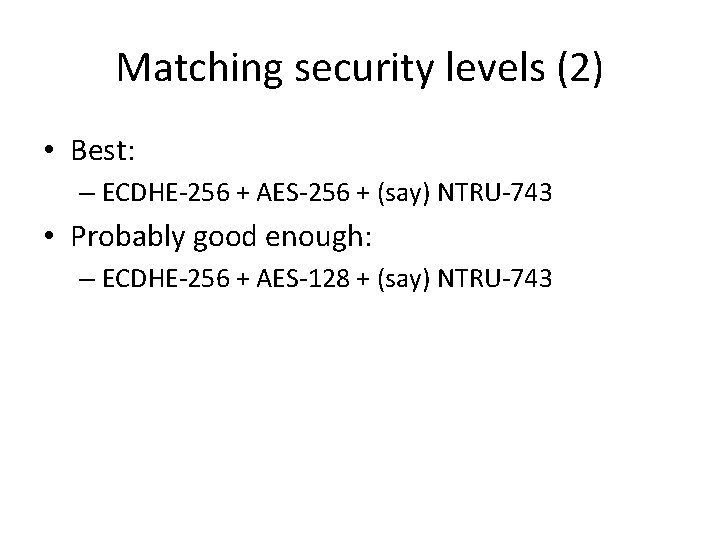
Matching security levels (2) • Best: – ECDHE-256 + AES-256 + (say) NTRU-743 • Probably good enough: – ECDHE-256 + AES-128 + (say) NTRU-743
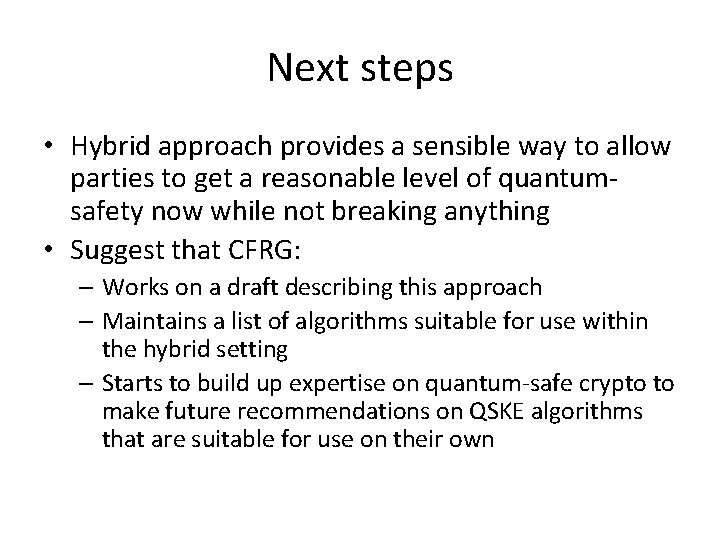
Next steps • Hybrid approach provides a sensible way to allow parties to get a reasonable level of quantumsafety now while not breaking anything • Suggest that CFRG: – Works on a draft describing this approach – Maintains a list of algorithms suitable for use within the hybrid setting – Starts to build up expertise on quantum-safe crypto to make future recommendations on QSKE algorithms that are suitable for use on their own
- Slides: 12